
AI-Ready Data Architecture 2026: The Essential Guide
AI-Ready Data Architecture 2026: The Essential Guide
AI-Ready Data Architecture 2026: The Essential Guide
Enterprise AI is moving beyond chatbots and experimental projects. Businesses now want AI agents that can analyze information, answer complex questions, and complete tasks. But there is a problem: connecting an AI model to enterprise databases does not guarantee accurate answers or safe decisions.
AI-ready data architecture solves this challenge by making enterprise data trustworthy, understandable, accessible, and securely usable by AI systems. It brings together governed data products, semantic layers, identity-based access controls, and monitoring so AI agents can retrieve reliable information and perform only authorized actions.
The need is growing. Stanford’s 2025 AI Index reported that 78% of surveyed organizations used AI in at least one business function in 2024.
Meanwhile, Eurostat found that AI adoption among EU enterprises with at least 10 employees increased from 13.5% in 2024 to 20.0% in 2025.
Yet adopting AI and preparing enterprise data for production AI are different challenges.
For CIOs, CDOs, and enterprise architects, the priority in 2026 is clear: build a data foundation that helps AI understand business context, respect access policies, and produce decisions that people can verify.
What Is AI-Ready Data Architecture in 2026?
AI-ready data architecture is an enterprise framework that prepares business information for reliable use by AI applications, analytics platforms, and autonomous agents.
It combines data quality, consistent business definitions, metadata, security, governed interfaces, and operational oversight.
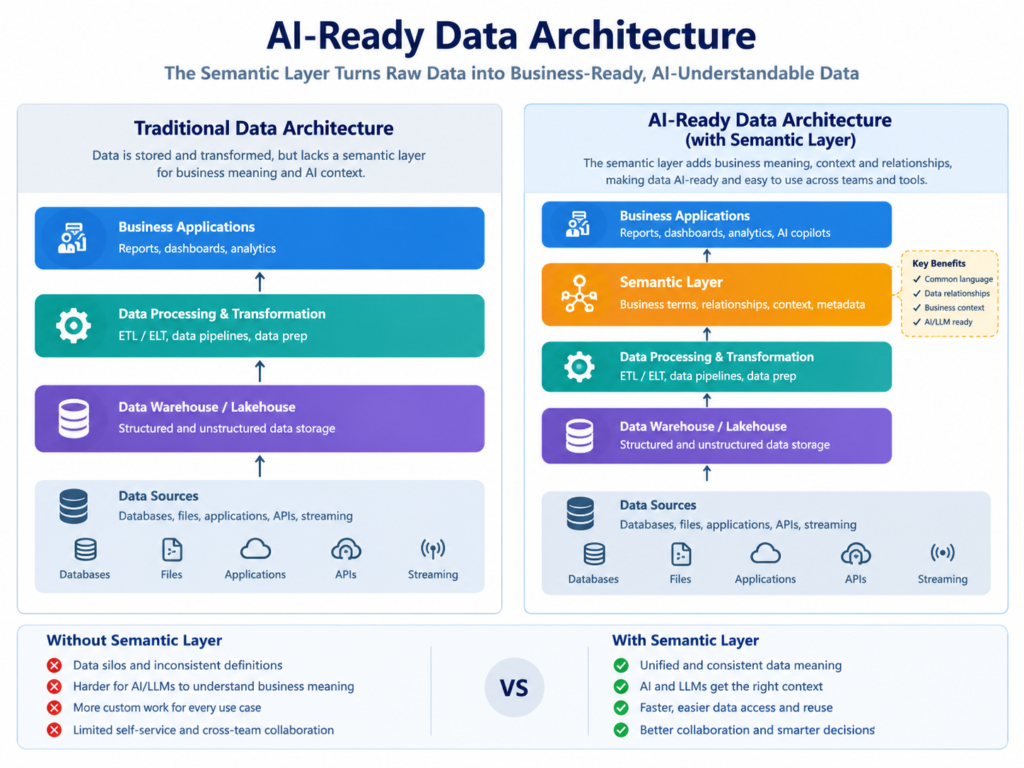
Traditional data systems focus largely on storing, processing, and reporting information. AI-ready environments must also help machines interpret that information and determine what they are allowed to do with it.
Traditional vs. AI-First Data Architecture
A traditional warehouse might show quarterly revenue. An AI-ready system goes further by identifying the approved revenue definition, validating the underlying data, checking access permissions, and limiting what an AI agent can do with the result.
| Capability | Traditional data architecture | AI-ready architecture |
|---|---|---|
| Primary purpose | Reporting and analytics | Analytics and governed AI workflows |
| Data access | Queries and dashboards | Queries, APIs, and agent tools |
| Business meaning | Reports and documentation | Machine-accessible semantic definitions |
| Security | User and application permissions | Context-aware agent authorization |
| Governance | Data quality and ownership | Data, AI, and decision governance |
| Monitoring | Pipeline and query performance | Data lineage, agent traces, and evaluations |
An important distinction: becoming AI-ready does not necessarily require replacing existing warehouses or lakehouses. Many organizations can modernize their current investments.
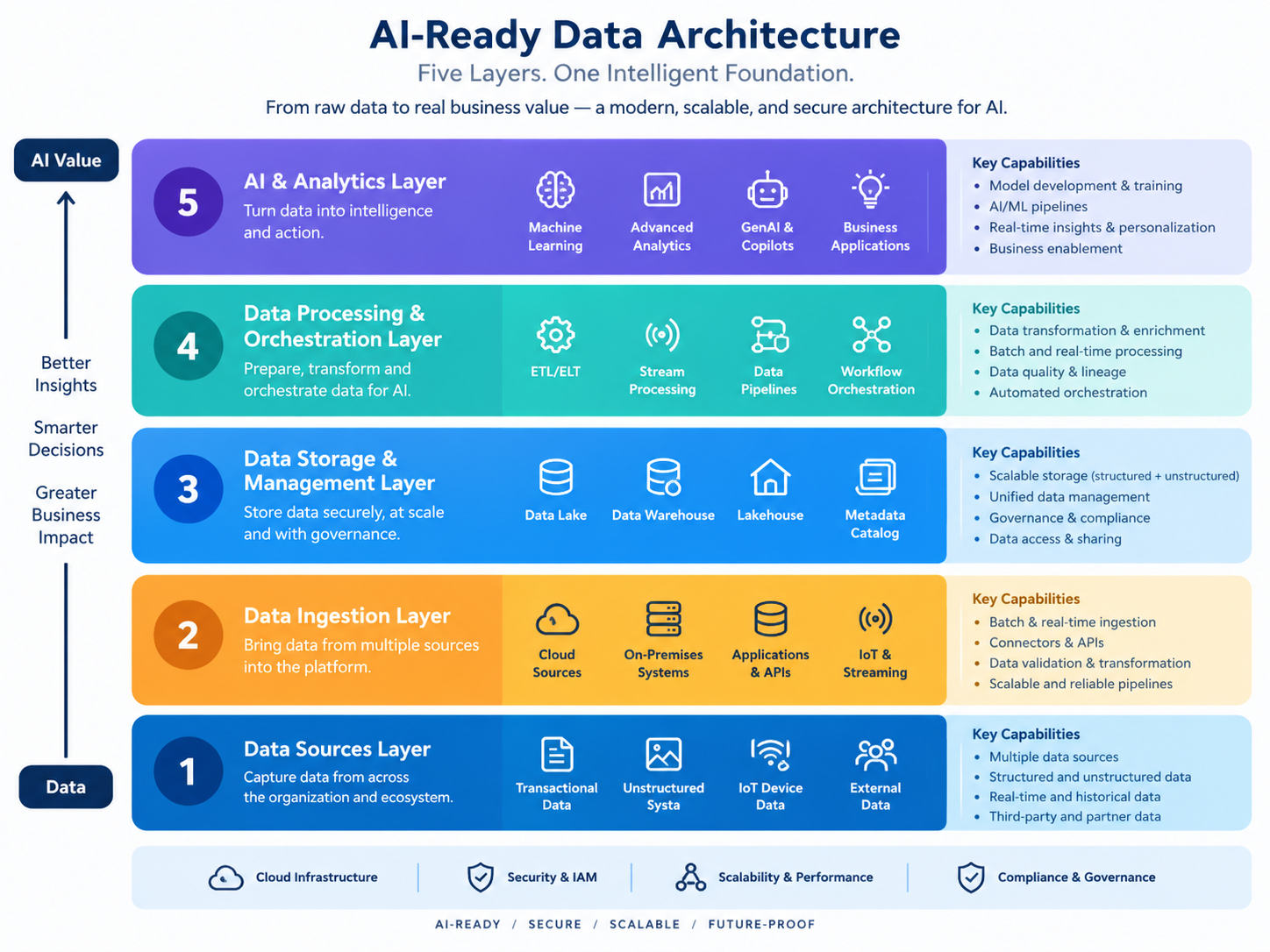
The Five Layers of an Enterprise AI Reference Architecture
A practical enterprise architecture brings together five capabilities.
Trusted data products: Validated, versioned datasets with documented ownership, quality checks, and data contracts.
Semantic context: Certified business metrics, definitions, relationships, and ontologies that explain what information means.
Agent interfaces: Governed APIs, Model Context Protocol (MCP) tools, and retrieval services that connect AI applications to data.
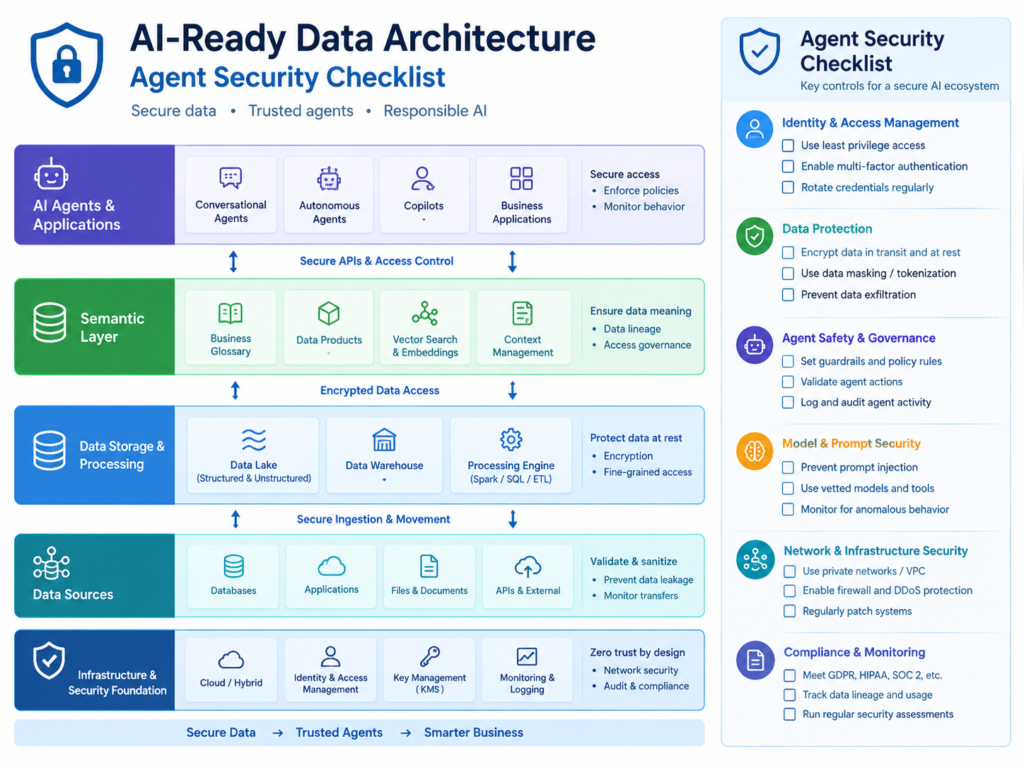
Governance and security: Identity management, access permissions, policy enforcement, and authorization controls.
Observability: Data lineage, execution traces, evaluations, and audit records that support accountability.
These layers represent connected architectural responsibilities, not a rigid deployment sequence.
AI-Ready Data Platforms vs. AI-Native Architecture
Platforms such as Microsoft Fabric, Databricks, AWS services, and Apache Iceberg-based ecosystems can contribute to AI readiness.
However, buying a platform does not automatically create reliable business definitions or secure AI workflows.
Enterprises should assess interoperability, metadata portability, integration capabilities, security, and long-term operating costs before choosing a solution.
Existing business intelligence services can also provide a useful starting point for standardizing data and metrics.
Why Semantic Layers Matter in AI-Ready Data Architecture
An AI agent may understand a database table without understanding the business decisions behind it.
For example, a sales database might contain subscription payments, cancellations, refunds, discounts, and one-time charges. Without clear definitions, an AI agent could calculate monthly recurring revenue incorrectly.
A semantic layer addresses this problem by providing approved metrics, relationships, and business rules that AI systems can consistently reference.
Certified Metrics, Business Ontologies, and Semantic Models
Certified semantic models define how a business measures performance.
They help establish.
Approved formulas for metrics such as revenue, churn, and customer lifetime value.
Relationships between customers, products, locations, and transactions.
Clear ownership and documentation.
Consistent definitions across dashboards, applications, and AI agents.
Traceability from reported values to underlying data.
Tools such as dbt Semantic Layer, Cube, and Power BI semantic models can support these capabilities.
In practice, the goal is not to make every AI answer identical. It is to make sure agents use the same approved definitions when answering equivalent business questions.
Semantic Layer vs. Knowledge Graph vs. RAG
These technologies solve different problems within an enterprise AI environment.
| Technology | Main purpose | Example |
|---|---|---|
| Semantic layer | Defines trusted business metrics | Calculates approved revenue |
| Knowledge graph | Connects entities and relationships | Identifies parent companies and subsidiaries |
| Retrieval-augmented generation (RAG) | Retrieves supporting information | Finds relevant policy documents |
They work best as complementary capabilities.
An AI assistant might use a semantic layer for revenue calculations, a knowledge graph to understand corporate relationships, and RAG to retrieve applicable contract terms.
Connecting Semantic Layers Through MCP
Model Context Protocol (MCP) provides a standardized approach for AI applications to discover and invoke external tools.
An enterprise can use MCP interfaces to expose approved queries and business functions to AI agents.
However, MCP connectivity does not replace authorization or security enforcement.
Production implementations still need tool allowlists, input validation, scoped permissions, logging, and independent access checks.
Strong API security and monetization controls can help protect the underlying services and business workflows.
How to Make Enterprise Data Agent-Ready
Agent-ready data is more than clean data. It must also provide enough context for an AI system to understand the task and operate within defined permissions.
The safest starting point for many organizations is read-only access, followed by carefully controlled automation.
Trusted Data Products and Context Engineering
Every trusted data product should document its owner, schema, refresh frequency, sensitivity classification, quality expectations, and lineage.
Context engineering builds on this foundation by supplying AI agents with the information required to complete particular tasks.
Consider an invoice-processing agent.
Access to invoice records alone may not be enough. The agent also needs approved payment terms, vendor relationships, exception policies, and escalation instructions.
Without this context, it might process accurate data but reach the wrong business conclusion.
Agent Identity, RBAC, ABAC, and Least Privilege
AI agents should have identifiable owners and clearly defined access permissions.
Two useful access-control approaches are.
Role-based access control (RBAC): Grants permissions according to assigned roles.
Attribute-based access control (ABAC): Evaluates attributes such as data sensitivity, region, business purpose, and user or agent context.
OAuth and OpenID Connect can support authentication and delegated-access designs, depending on the implementation.
Each agent should receive only the permissions necessary to complete its authorized tasks.
Applying zero-trust security principles can reduce the risks associated with excessive access and compromised identities.
Governed Agent Tools, Observability, and Evaluations
An AI agent that performs well in a demonstration may still fail in production.
Organizations should evaluate how agents respond to stale data, incorrect inputs, unauthorized requests, system failures, and prompt-injection attempts.
Monitoring should capture tool calls, relevant data versions, policy decisions, exceptions, and approval events.
For sensitive environments, AI data loss prevention controls can help reduce the risk of confidential information being exposed through retrieval, prompts, or generated responses.
The central principle is simple: an agent needs to be observable and controllable, not merely functional.
AI Decision Governance, Risk, and Accountability
Reliable data does not automatically guarantee responsible AI decisions.
A system may retrieve the correct information and still take an action it was never authorized to perform.
Decision governance defines which actions AI can recommend, which it can execute, when human approval is required, and who remains accountable.
Data Governance vs. AI Governance vs. Decision Governance
| Governance area | Primary responsibility |
|---|---|
| Data governance | Data quality, ownership, lineage, and access |
| AI governance | Model risks, testing, performance, and lifecycle management |
| Decision governance | Action permissions, approvals, escalation, and accountability |
These areas overlap, but each needs clear ownership.
Human Oversight and Policy-as-Code
The degree of AI autonomy should reflect the consequences of an action.
An inventory assistant might summarize low-stock products automatically. The same system should not necessarily modify supplier contracts or authorize substantial purchases without approval.
Policy-as-code can help enforce spending limits, permitted actions, approval thresholds, and escalation rules.
This is especially important in financial workflows, where AI agents in procurement may influence purchasing and commercial decisions.
Data Lineage and Audit-Ready Decisions
When an AI-generated recommendation is questioned, the organization should be able to reconstruct how it was produced.
That means retaining appropriate evidence of source data, metric definitions, model or agent outputs, policy checks, and final authorization.
The NIST AI Risk Management Framework offers voluntary guidance for identifying, assessing, and managing AI risks.
A traceable decision is easier to investigate, explain, and improve than one produced by an opaque workflow.
AI-Ready Data Architecture Across the USA, UK, and EU
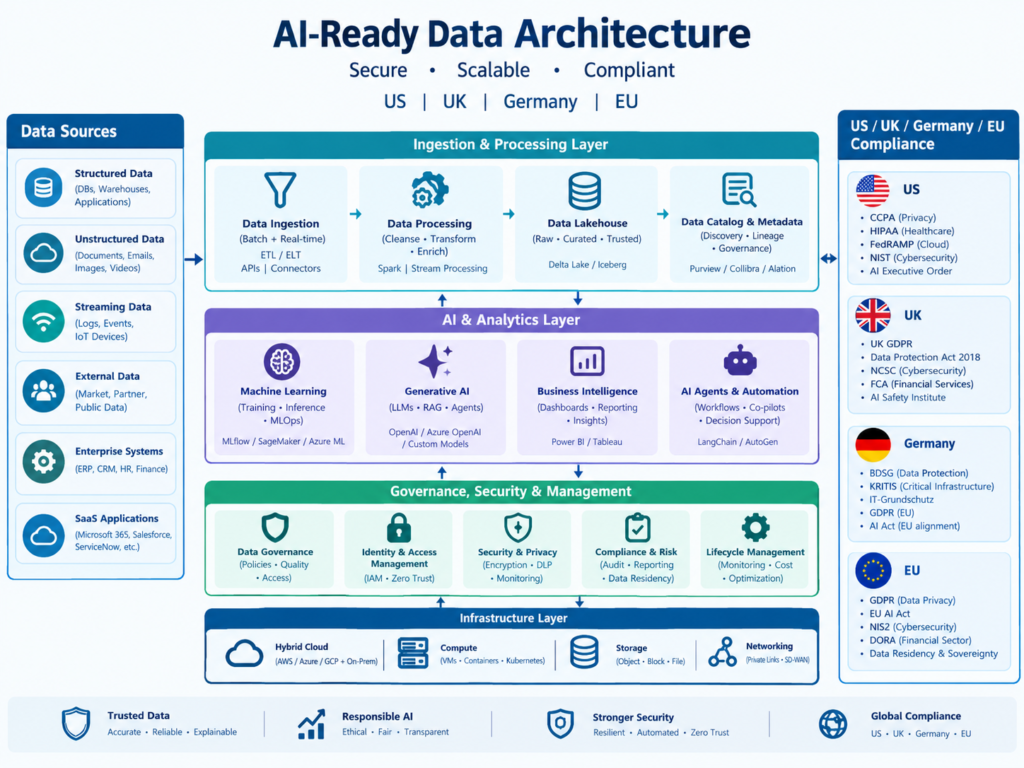
Enterprises operating internationally must account for different privacy, cybersecurity, financial-services, and AI governance obligations.
A shared architecture can support consistent data definitions and security principles, but regional policies still need separate assessment.
USA.
A New York financial institution may need strict permissions for customer financial records and human approval for transaction-related actions.
A Boston healthcare provider handling electronic protected health information must consider applicable HIPAA requirements.
The NIST AI RMF can help organizations assess AI risks, while PCI DSS obligations may apply to environments handling payment-card data.
The appropriate controls depend on the organization, its data, and the relevant regulatory requirements.
UK.
UK organizations must consider privacy and sector-specific obligations when preparing enterprise information for AI.
For example, London financial-services firms may need to evaluate UK GDPR requirements alongside applicable Financial Conduct Authority expectations.
Organizations working with NHS-related information may also face additional healthcare data governance responsibilities.
The Information Commissioner’s Office guidance on AI and data protection provides a useful reference for privacy assessments.
Germany and EU.
German enterprises face a combination of European and national regulatory requirements.
A Frankfurt bank may need to consider the GDPR (DSGVO), applicable BaFin supervisory expectations, and the Digital Operational Resilience Act (DORA).
A Berlin technology company deploying AI systems across Europe should assess its obligations under the EU AI Act.
As of October 2026, the EU AI Act has a phased application schedule. Certain prohibitions, general-purpose AI obligations, and transparency requirements are already applicable. Key high-risk AI requirements for Annex III systems are scheduled to apply from December 2, 2027, while specified product-related high-risk requirements are scheduled for August 2, 2028.
The European Commission’s EU AI Act guidance provides details on the regulatory framework.
Data residency also needs careful consideration. Hosting records in Germany does not automatically establish GDPR compliance, especially when international transfers, processors, and access arrangements are involved.
For multinational enterprises, legal and technical teams should assess the requirements applicable to each deployment and business use case.
Enterprise Implementation Roadmap for AI-Ready Data Architecture
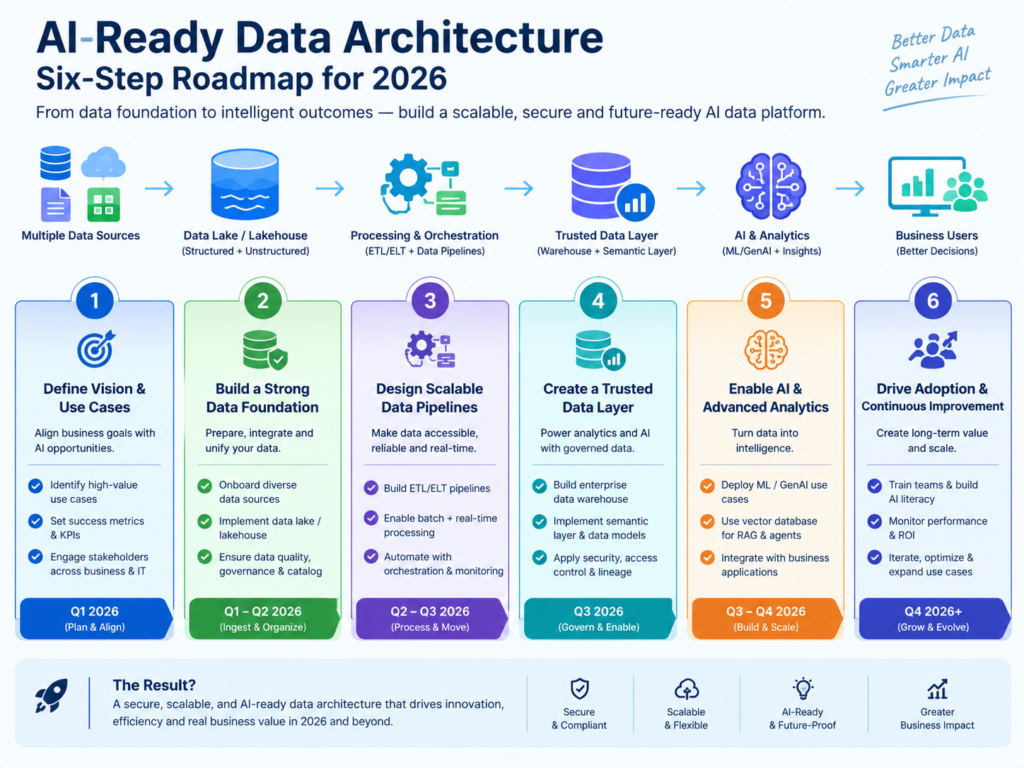
A successful rollout does not need to begin with a major platform replacement.
Organizations can start with a defined business workflow, establish trustworthy data access, and expand only after performance and governance controls have been tested.
Six Steps to Implement AI-Ready Data Architecture
Assess the existing architecture
Inventory data sources, platforms, business ownership, security controls, and integration gaps. Identify outdated pipelines, inconsistent metrics, and sensitive information.
Prioritize a valuable business use case
Select a workflow with measurable business value and manageable risk, such as internal reporting, customer support analytics, or invoice validation.
Establish trusted data products
Define data contracts, ownership, quality checks, freshness expectations, and lineage so agents can access dependable information.
Build semantic context
Create certified business metrics, document relationships, and publish approved definitions that AI applications can use consistently.
Secure AI agent interfaces
Implement governed APIs or MCP tools with identity verification, least-privilege access, policy checks, and appropriate approval workflows.
Pilot, evaluate, and scale
Test answer accuracy, authorization, latency, recovery procedures, and operational outcomes. Expand to additional workflows after the pilot meets defined success criteria.
Measuring AI Readiness and Governance Performance
Enterprises need evidence that their architecture is becoming more reliable.
Useful key performance indicators (KPIs) include.
Metric consistency: Whether equivalent questions produce results based on the same approved definitions.
Grounded-answer accuracy: How often AI responses correctly reflect authoritative sources.
Data freshness: Whether information is updated within required timeframes.
Unauthorized-action prevention: Whether prohibited actions are blocked during testing.
Audit coverage: Whether important agent activities and decisions are traceable.
Human intervention frequency: How often agents require correction, escalation, or approval.
Measure these indicators against a baseline rather than relying only on demonstrations or vendor claims.
Build vs. Buy.
The decision to build or buy depends on existing technology, skills, compliance needs, and the complexity of the intended workflows.
Commercial platforms may simplify deployment and maintenance. Custom development may offer greater flexibility for specialized systems and integrations.
Evaluate total cost of ownership, interoperability, vendor lock-in, regional hosting options, identity integration, and governance capabilities.
Existing Python development services can support specialized integrations without requiring organizations to replace their core data infrastructure.
Final Thoughts
AI-ready data architecture is essential for enterprises looking to move beyond AI experimentation toward secure, reliable, and scalable automation. By combining trusted data products, semantic layers, strong security controls, and effective governance, organizations can help AI agents access accurate information, understand business context, and make accountable decisions. A well-designed architecture also improves data consistency, operational efficiency, and regulatory compliance. ( Click Here’s )
Building this foundation does not require replacing existing systems. Enterprises can modernize gradually, prioritize valuable use cases, and strengthen governance as AI adoption expands. Mak It Solutions helps businesses develop practical strategies for building secure, future-ready AI data ecosystems.
Key Takeaways
AI-ready data architecture adds business context, security, and decision controls to traditional data platforms.
Semantic layers help AI agents use consistent, certified business metrics.
Trusted data products and context engineering improve the reliability of enterprise AI workflows.
Least-privilege access, monitoring, and human approvals help control agent behavior.
International deployments require jurisdiction-specific assessments.
Existing warehouses and lake houses can often support AI readiness without a complete rebuild.
FAQs
Q : Can existing data warehouses support AI agents without a complete rebuild?
A : Yes. Existing warehouses can often support AI applications through incremental improvements such as semantic models, metadata catalogs, governed APIs, and agent-specific permissions.
A complete rebuild may only be necessary when legacy limitations prevent secure integration, adequate performance, or sustainable operations.
Q : How much does AI-ready data architecture cost?
A : Costs depend on data maturity, platform complexity, integration requirements, security needs, and deployment scale.
Expenses may include data engineering, semantic modeling, licensing, infrastructure, monitoring, and ongoing maintenance. A scoped assessment provides a more useful estimate than a universal price range.
Q : Can AI-ready data architecture work in hybrid-cloud environments?
A : Yes. AI-ready architectures can support on-premises systems, private clouds, public clouds, and hybrid deployments.
The main requirement is consistent governance across environments, including identity controls, secure interfaces, monitoring, and applicable data-transfer policies.
Q : Why do enterprise AI agents produce inconsistent business metrics?
A : Common causes include conflicting metric definitions, outdated records, incorrect relationships, and retrieval from non-authoritative sources.
Certified semantic models, documented ownership, data quality tests, and agent evaluations help reduce these inconsistencies.
Q : How can multinational enterprises standardize AI data access?
A : A federated governance approach can establish shared business definitions, data classifications, identity requirements, and evaluation standards.
Regional teams can then apply local privacy rules, retention requirements, and access restrictions without sacrificing enterprise-wide analytical consistency.