
Agentic Arbitrage: How AI Agents Reshape SaaS
Agentic Arbitrage: How AI Agents Reshape SaaS
Agentic Arbitrage: How AI Agents Reshape SaaS
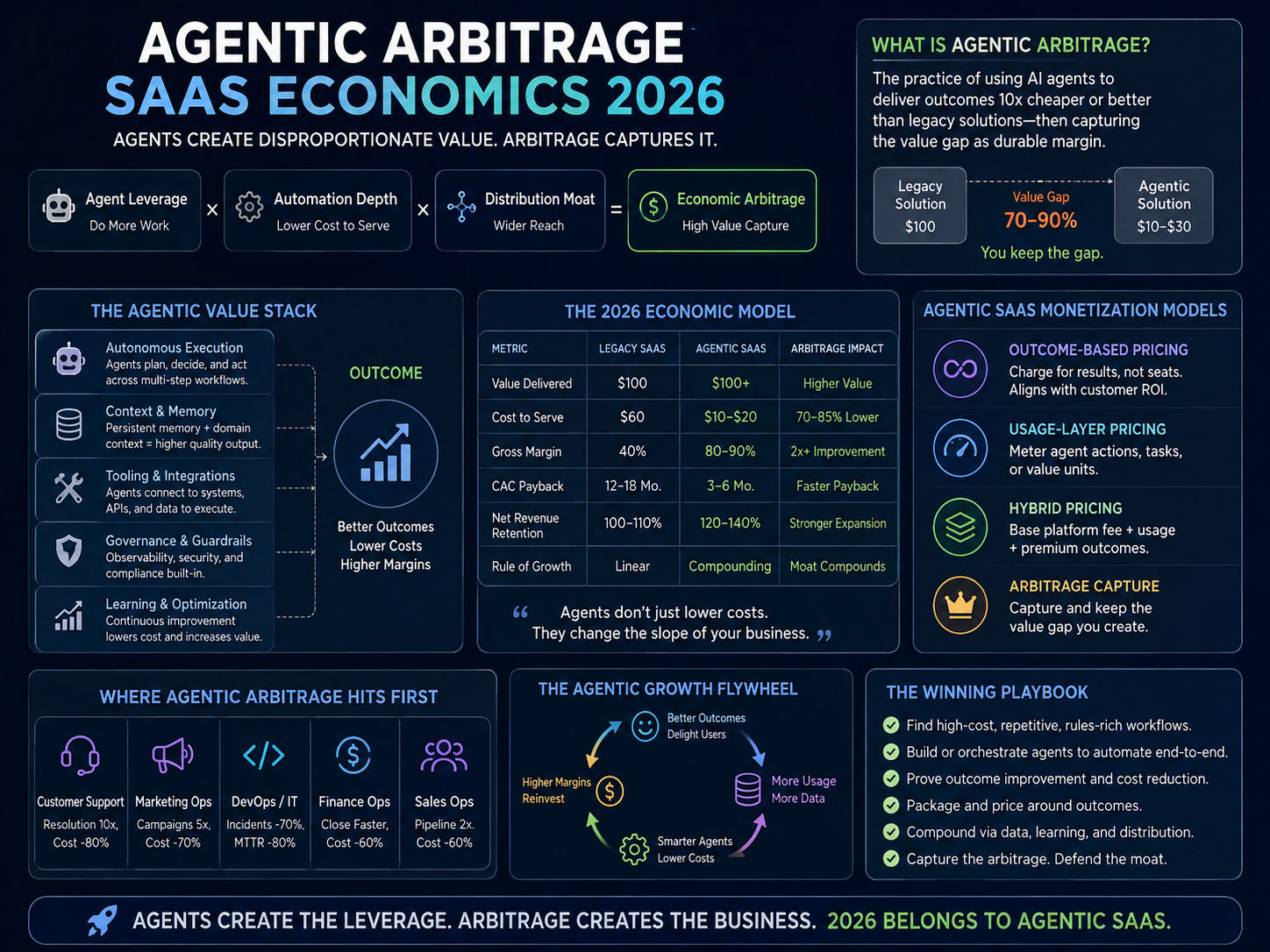
Agentic arbitrage is changing the economics of SaaS by allowing AI agents to complete work across multiple software systems without humans directly using every interface. As that shift accelerates, software vendors may need to rethink per-seat pricing, expose more capabilities through secure APIs and MCP, and build stronger governance for non-human users.
The commercial impact could be significant. Gartner estimates that up to $234 billion in enterprise application spending could be exposed to agentic arbitrage by 2030, equivalent to roughly 20% of enterprise application SaaS spending. Importantly, that figure represents projected exposure not an observed $234 billion loss.
The broader SaaS market is already substantial. Gartner reported that worldwide enterprise application SaaS revenue reached $218.5 billion in 2024, up 16.7% year over year.
The strategic chain is becoming clearer:
AI agents → bypassed interfaces → fewer human seats → pricing pressure → API/MCP readiness → governance → new SaaS economics.
What Is Agentic Arbitrage in SaaS?
Agentic arbitrage happens when AI agents complete valuable work across several software systems while reducing the amount of direct human interaction required with each application.
The SaaS platform may still be essential. What changes is the relationship between software value and the number of people logging into it.
How AI Agents Bypass Traditional SaaS Interfaces
Consider a sales operations workflow.
Instead of an employee opening a CRM, analytics dashboard, communication platform and account-management system separately, an AI agent could interpret an objective such as:
“Identify overdue enterprise accounts and prepare follow-up actions.”
The agent might query customer records, analyze account activity, update relevant fields and prepare communications through approved machine-to-machine connections.
The underlying software still creates value. The human simply spends less time navigating each interface.
Mak It Solutions explores this transition further in its agent-first SaaS guide.
Why Agentic Arbitrage Is Different From Ordinary Automation
Traditional workflow automation generally follows predefined triggers and rules. Copilots assist a human who remains in control of the task.
Autonomous agents can go further: they interpret goals, choose tools, coordinate actions and move work between systems.
That difference matters commercially. If customers continue receiving value from an application while fewer employees actively use its interface, the traditional connection between headcount and SaaS revenue begins to weaken.
Why Agentic Arbitrage Matters Now
AI adoption is already widespread. Stanford HAI reported that 78% of surveyed organizations used AI in 2024, compared with 55% in 2023.
Agentic arbitrage is therefore more than a user-interface trend. It can influence product architecture, customer acquisition, revenue forecasting and even the definition of a billable software user.
Why Agentic Arbitrage Threatens Per-Seat SaaS Pricing
Per-seat pricing works best when software value scales with the number of human users.
AI agents complicate that assumption because one automated workflow may perform tasks that previously required activity from several licensed employees.
The commercial pressure looks something like this:
fewer human interactions → fewer required licenses → slower seat expansion → pressure on ARR assumptions
That does not mean SaaS spending automatically collapses. Machine activity can rise even while human seat counts fall.
For a deeper comparison, see Mak It Solutions’ AI agents versus SaaS pricing analysis.
Usage, Output and Outcome-Based SaaS Pricing
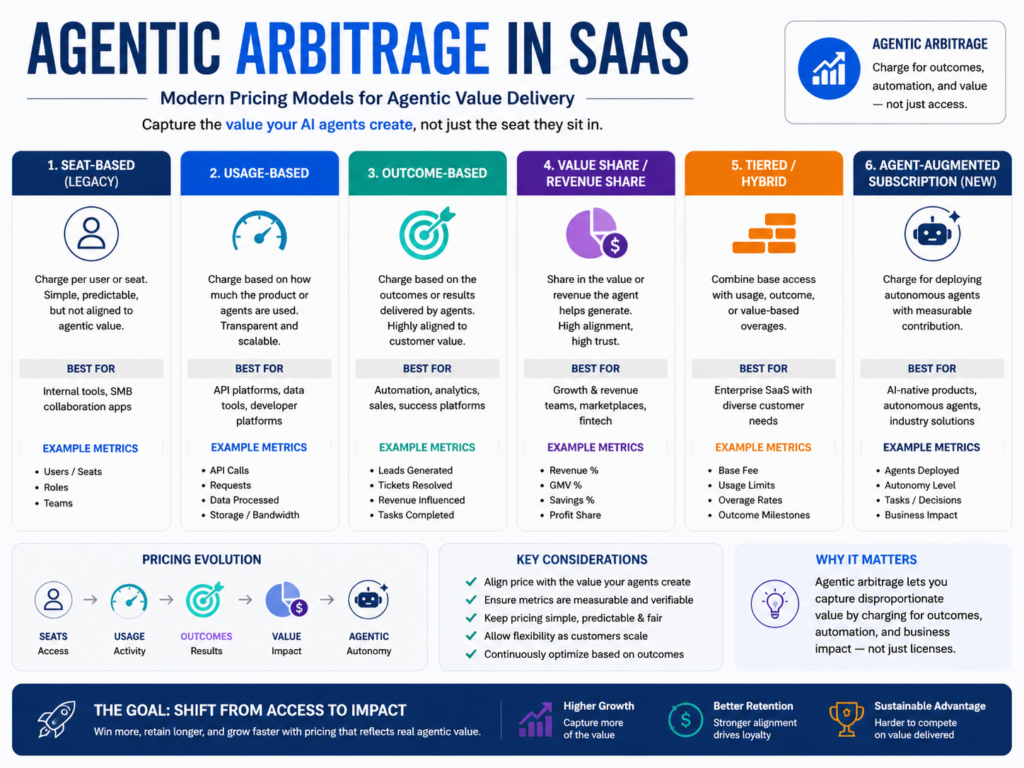
As agent activity grows, vendors can experiment with monetization models that track value differently.
Common approaches include:
Per-agent pricing
Per-action or workflow pricing
Consumption or credit-based pricing
Output-based pricing
Outcome-based pricing
Hybrid platform-plus-consumption contracts
Salesforce, for example, currently offers Agent force options based on consumption, conversations and per-user licensing, showing how established SaaS vendors are already mixing traditional and agent-oriented pricing structures.
Mak It Solutions’ outcome-based SaaS pricing guide examines the commercial trade-offs in more detail.
Choose a Metric Customers Can Understand
The best billing metric is not necessarily the most technically precise one. It needs to make sense to customers.
Product and finance teams should consider predictability, model-inference costs, API calls, margins, failed executions, attribution, procurement complexity and SLA measurement.
For example, a New York enterprise buyer may be more comfortable with a committed platform fee plus defined consumption limits than with a completely variable invoice tied to unlimited agent activity.
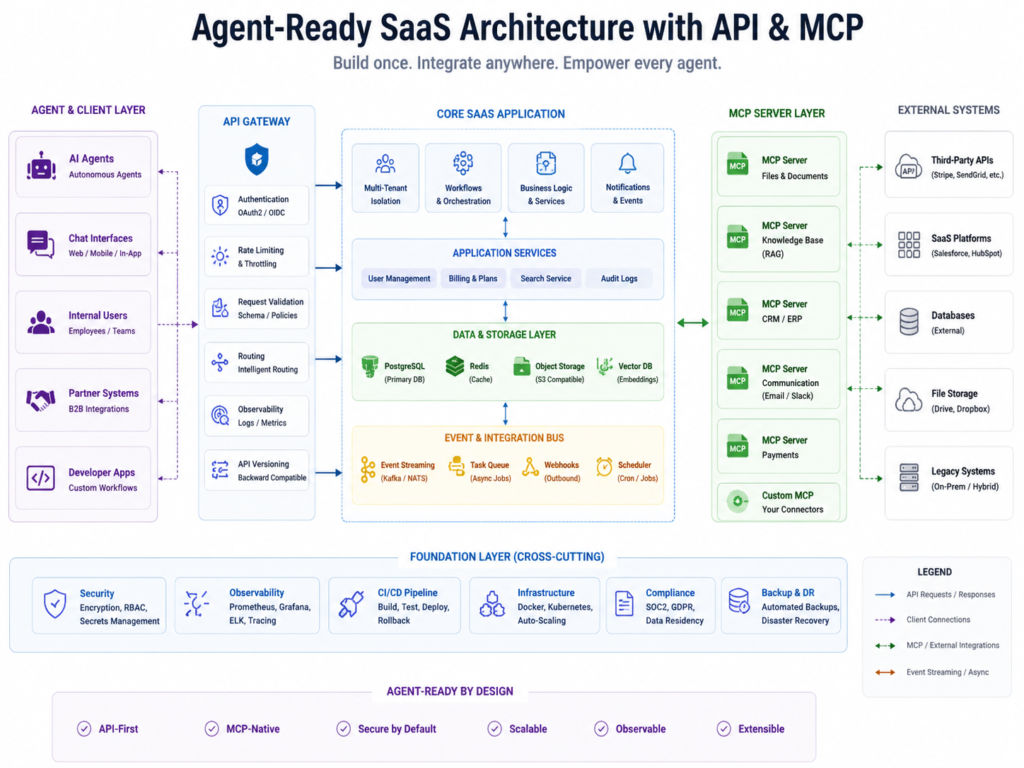
Agent-Ready SaaS: APIs, MCP and Headless Products
Agent-ready SaaS exposes useful product capabilities through secure APIs, tools or protocols such as MCP so authorized AI agents can discover and invoke them.
The human interface does not disappear. It simply stops being the only way value is delivered.
From Human-First UI to Agent-Consumable Capabilities
Headless SaaS separates core product capabilities from the interface used to access them.
A person may use a dashboard while an authorised agent invokes the same workflow through structured APIs.
That turns API quality into a product and revenue issue—not merely an integration concern.
Mak It Solutions’ API-first architecture guide covers the underlying architectural principles.
APIs, MCP and Agent Discovery
An agent-ready product needs more than an API endpoint.
In practice, reliable machine consumption requires.
Clear, documented APIs
Machine-readable schemas
Predictable tool definitions
Strong authentication
Scoped permissions
Discoverability
Observability and logging
Safe failure handling
MCP can help standardize the way agents connect with tools and contextual resources, while AWS, Azure or GCP may provide the infrastructure beneath the execution layer.
The critical question remains the same: what is this agent authorized to do?
Identity and Authorization for Non-Human Users
Every production agent should have a defined identity and narrowly scoped permissions.
That means treating non-human users with the same seriousness as privileged human accounts: least-privilege access, credential rotation, audit trails, revocation and approval gates for consequential actions.
Human review should remain available where mistakes could create financial, legal, privacy or operational consequences.
Mak It Solutions’ API Security Best Practices 2026 guide and backend development services provide additional implementation context.
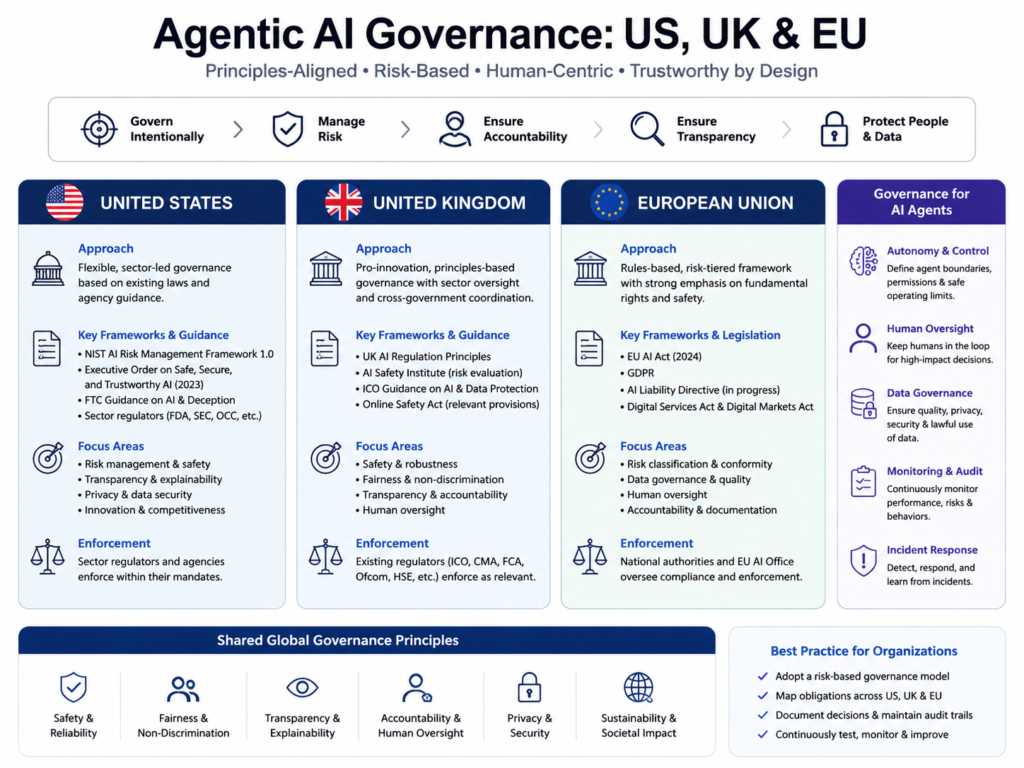
Agentic Arbitrage Governance in the US, UK and EU
Agentic AI governance defines what an agent can access, which actions it may execute, how those actions are recorded and when a human must intervene.
Those controls matter everywhere, but implementation requirements can differ materially between the US, UK and European markets.
US Security and Compliance Considerations
A SaaS company serving customers in San Francisco, New York or other US markets may need to account for SOC 2 controls alongside sector-specific requirements such as HIPAA, PCI DSS and state privacy laws.
Healthcare workflows involving protected health information require appropriate access controls, safeguards and auditing. Payment-related agents should likewise avoid unnecessary access to cardholder environments.
The practical principle is simple: an agent should receive only the data and permissions required for its specific task.
UK GDPR and Regulated-Sector Controls
A London fintech or Manchester SaaS provider should evaluate UK GDPR requirements, data-processing responsibilities and any applicable sector-specific expectations.
ICO guidance requires organizations processing personal data to use appropriate technical and organizational security measures. It also explicitly highlights access control, risk assessment and auditability as important parts of secure processing.
For NHS, financial-services or Open Banking workflows, agent permissions, purpose limitations, logging and escalation rules should be defined before production deployment.
Germany and EU: GDPR, AI Act and DORA
Berlin, Munich and Frankfurt deployments may need GDPR/DSGVO controls alongside the EU AI Act and sector-specific rules.
The EU AI Act entered into force on August 1, 2024, and major provisions became applicable on August 2, 2026, although some requirements follow later application timelines.
For relevant EU financial entities, DORA has applied since January 17, 2025, bringing additional focus to digital operational resilience and ICT risk.
Data residency, cross-border transfers, cloud-region selection, agent identity and auditability should therefore be designed together rather than treated as separate compliance tasks.
How Agentic Arbitrage Changes the SaaS Business Model
Agentic arbitrage shifts the commercial question from.
“How many people have access?”
to:
“How much valuable work does the platform enable?”
The shift is unfolding inside a growing cloud market. Gartner forecast worldwide public-cloud end-user spending of approximately $723.4 billion in 2025, including about $299.1 billion for SaaS.
From Software Seats to Digital-Labour Economics
Digital labour introduces variable costs that conventional seat-based SaaS models often hide.
These can include model inference, API calls, orchestration, infrastructure, retries, monitoring and human review.
Vendors therefore need to understand cost per successful workflow or outcome, not only monthly revenue per human seat.
The New SaaS Moats
Interface familiarity becomes a weaker competitive advantage when an agent can operate several products without learning their navigation.
More durable advantages may come from.
Proprietary or high-quality data
System-of-record status
Deep workflow integration
Reliable APIs and tools
Strong governance and compliance controls
Domain-specific execution
Consistent, measurable outcomes
In an agentic environment, software that can be trusted to execute important work may be harder to replace than software that is simply easy to click.
Where SaaS Vendors Can Still Win
Agentic arbitrage creates opportunity alongside pricing pressure.
Vendors may gain from higher API consumption, embedded capabilities, orchestration partnerships, agent marketplaces and outcome-based monetization.
Fewer human seats can coexist with more transactions and greater machine consumption.
Mak It Solutions’ business intelligence services can support the measurement layer needed to connect execution costs with revenue and customer outcomes.
How SaaS Companies Should Prepare for Agentic Arbitrage
The safest response is not to redesign the entire company around agents overnight.
Start with a workflow that matters commercially and can be measured clearly.
Audit Revenue Exposure to Human Seats
Identify how much revenue depends on named users and which workflows are vulnerable to agent automation.
Pay particular attention to.
Low-utilization licenses
Repetitive administrative workflows
Seat-based expansion assumptions
Products with heavy API usage
Tasks where value already correlates more closely with transactions than logins
Test Agent-Ready Architecture and Pricing Together
Pilot API or MCP-based access alongside alternative billing models such as actions, credits, consumption or outcomes.
Do not test only whether the agent can complete the workflow.
Also measure inference cost, failed executions, human intervention, permissions, approval gates, observability and auditability.
Build Governance Into Expansion Plans
For US-to-Europe expansion, product architecture and compliance should evolve together.
US pilots may priorities enterprise demand and monetization. UK deployments may require additional privacy and regulated-sector controls. Germany and wider EU deployments may require deeper GDPR/DSGVO, AI Act, data-residency and DORA readiness where applicable.
Mak It Solutions’ technology services portfolio can support the architecture, integration and analytics layers behind these pilots.
Concluding Remarks
Agentic arbitrage does not mean SaaS disappears. It means the way customers consume and pay for software can change as AI agents take over more cross-platform work.
For SaaS leaders, the practical response is to identify one meaningful workflow, measure its seat exposure, agent-ready architecture, unit economics and governance requirements, then test how the product behaves when machine activity matters more than human logins.
If agentic arbitrage could affect your pricing model or product roadmap, contact Mak It Solutions to discuss a scoped agent-ready SaaS or AI integration pilot.
Key Takeaways
Agentic arbitrage weakens the traditional link between employee growth, SaaS seats and revenue.
Per-seat subscriptions are likely to coexist with consumption, action, output and outcome-based models.
APIs, MCP, machine identity and least-privilege access are becoming core product capabilities.
Trusted data, workflows, integrations, governance and outcomes can become stronger SaaS moats than interface familiarity.
US, UK and EU deployments require different privacy, security and regulatory decisions.
SaaS teams should measure value and cost per successful workflow not only seats, logins or raw AI usage.
FAQs
Q : Will agentic arbitrage eliminate SaaS subscriptions?
A : No. It is more likely to change how SaaS is accessed and monetized. CRM, ERP, ITSM and other platforms can remain critical systems of record even when AI agents handle more of the interaction.
Q : Which SaaS products are most exposed to agentic arbitrage?
A : Products built heavily around repetitive data entry, information retrieval, routing, basic reporting and administrative tasks may face greater seat-compression risk. Platforms with proprietary data, deep workflows, strong integrations or regulatory importance may be more defensible.
Q : Can hybrid seat-and-usage pricing work for AI agents?
A : Yes. A hybrid model can preserve predictable baseline revenue while charging additionally for agent activity. The key is choosing a metric customers can forecast and connect to business value.
Q : Who pays when one AI agent uses several SaaS platforms?
A : That depends on each vendor’s commercial terms. Different platforms may charge subscriptions, API fees, consumption credits or non-human-user licenses, so procurement teams should review automation and API terms rather than assuming one agent replaces every license.
Q : How should SaaS contracts define AI-generated outcomes?
A : Define the billable outcome precisely, including successful completion, attribution, failed attempts, retries and the system used as evidence. Contracts should also address usage limits, service levels, security responsibilities, auditability, data handling and dispute procedures.
[…] Why SaaS Pricing Strategy Must Change for AI Agents […]