


AI Agents SaaS: How Agent-First Software Wins
AI Agents SaaS: How Agent-First Software Wins
AI Agents SaaS: How Agent-First Software Wins
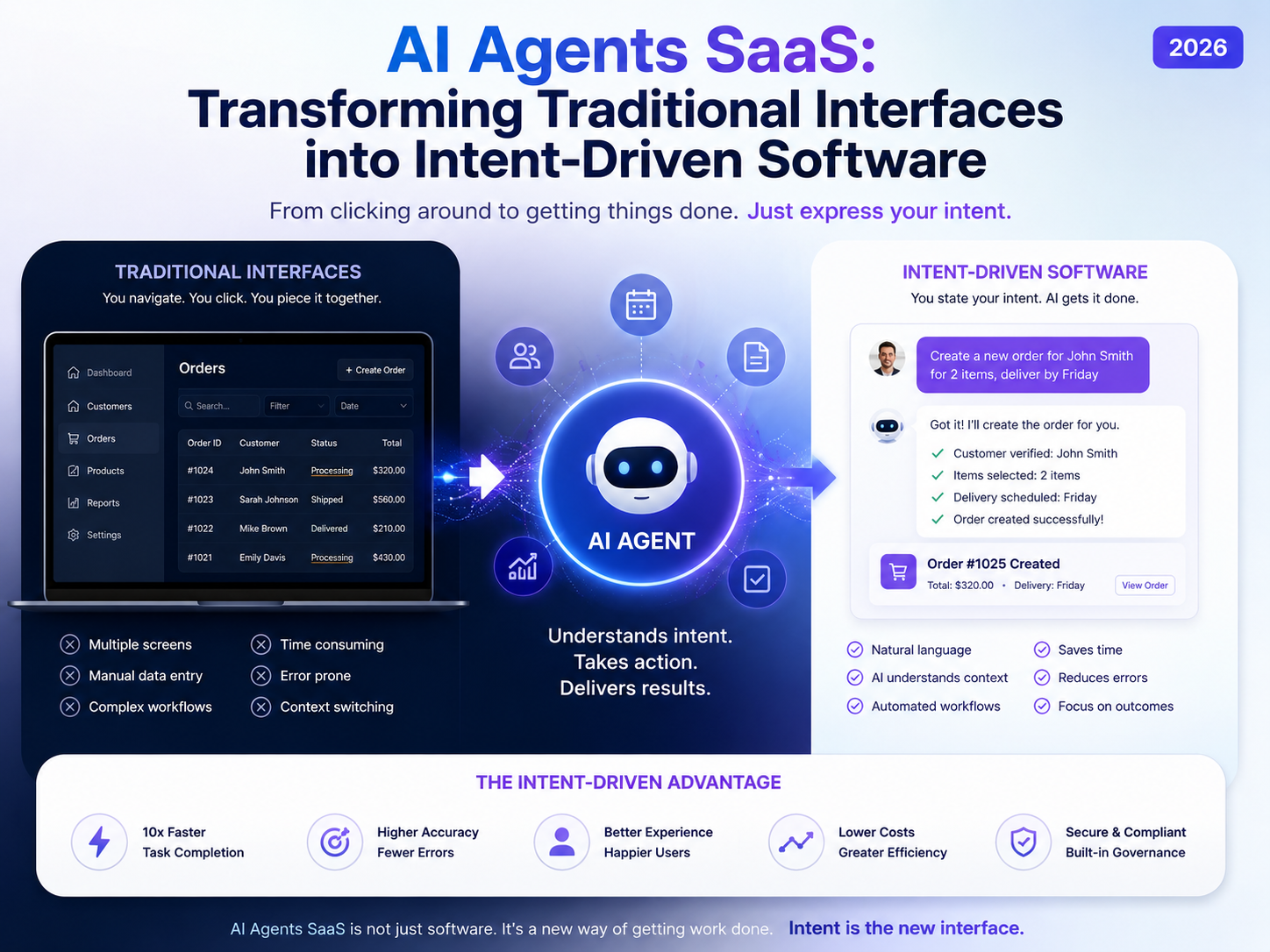
The biggest change in AI agents SaaS is not another chatbot bolted onto an existing dashboard. It is a shift from telling software where to click to telling it what outcome you want.
AI agents are likely to replace much of the click-heavy interaction layer of SaaS, including repetitive navigation, form filling, search and task routing. The underlying platforms are less likely to disappear. CRM, ERP, databases, APIs, permissions and audit records may become even more important as trusted execution layers behind those agents.
Imagine asking: “Find overdue enterprise invoices, prioritize the highest-risk accounts and draft follow-ups.” Instead of opening several screens and applying filters manually, an agent could coordinate finance, CRM and communication tools to complete much of that workflow.
For SaaS leaders across the USA, UK, Germany and wider EU, the emerging model can be viewed through four connected layers: interface, architecture, economics and governance.
Will AI Agents Replace Traditional SaaS Interfaces?
AI agents in SaaS are systems that interpret a goal, select appropriate tools and take actions with varying degrees of autonomy. That makes traditional dashboards, menus and forms less essential for workflows where a user can simply describe the result they want.
The market underneath this transition is substantial. Gartner reported that worldwide enterprise SaaS revenue reached $218.5 billion in 2024, up 16.7% year over year.
What AI Agents in SaaS Actually Replace
Agentic AI primarily challenges the GUI interaction layer, not the underlying SaaS platform.
Search, report creation, data entry, task routing and routine administration can increasingly move behind a conversational or generative interface. Meanwhile, CRM records, ERP transactions, databases, workflow rules and permission systems continue doing the operational work.
That distinction matters in the broader AI agents vs. SaaS discussion.
Why Dashboards, Menus and Forms Could Become Secondary
Traditional SaaS asks users to learn the product’s structure. Agentic software can reverse that relationship: the user describes an objective, and the system determines which capabilities are required.
A generative interface can still surface filters, previews or confirmation controls when useful, but users may no longer need to navigate the complete application for every task.
Gartner expects 33% of enterprise software applications to include agentic AI by 2028, up from less than 1% in 2024.
Why SaaS Applications Will Not Simply Disappear
Companies still need authoritative records of customers, transactions, permissions, workflow states and historical activity.
That leads to a more realistic conclusion:
AI agents are more likely to change how people operate SaaS than eliminate SaaS itself.
Dashboards may increasingly become supervision and exception-management surfaces rather than the place where every routine action starts.
How Agentic SaaS Architecture Works Behind the Interface
Agentic software changes the engineering question from “Which screen should the user open?” to “Which machine-readable action can the agent safely execute?”
From GUI-First to API-First to Agent-Ready Architecture
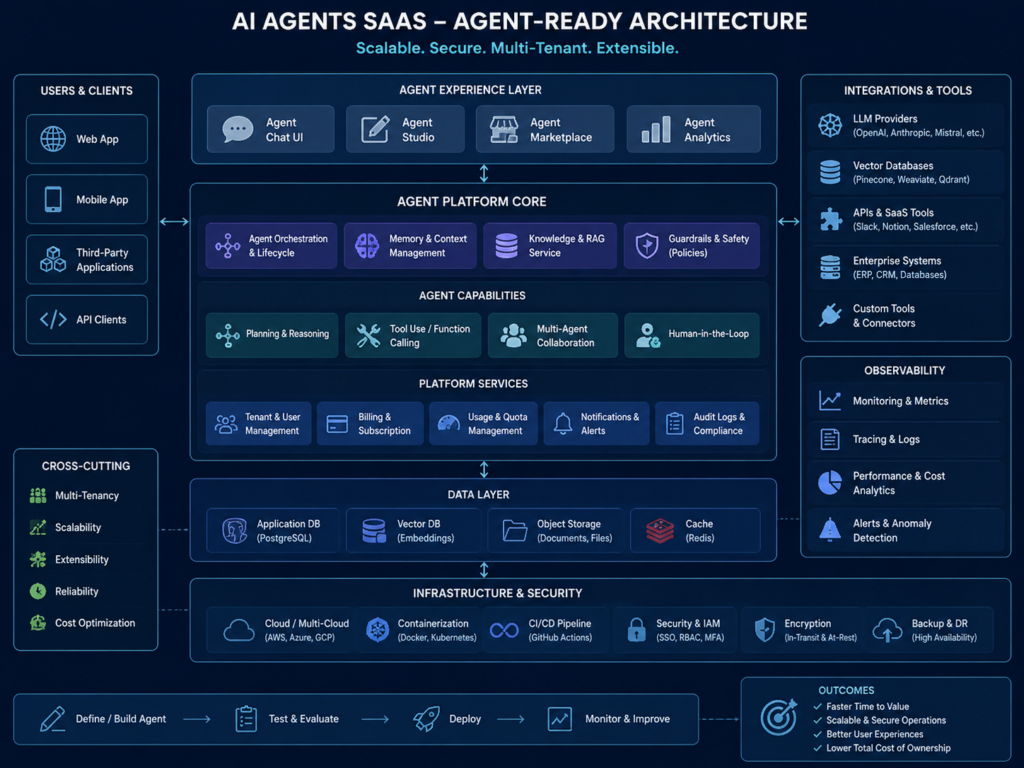
Agent-ready architecture depends on stable APIs, predictable schemas, explicit permissions and well-defined actions.
Headless and API-first SaaS become especially valuable because both human-facing interfaces and machine consumers can rely on the same underlying capabilities.
Mak It Solutions‘ API-first architecture guide covers many of these foundations.
MCP, Tool Calling and AI Agent Orchestration
MCP for SaaS and other tool-calling approaches give agents structured ways to discover capabilities, exchange context and execute workflows.
The Model Context Protocol has also continued to evolve. Its 2026-07-28 specification moved toward a stateless protocol core and added changes aimed at scalability, authorization and enterprise deployment.
The larger point is not that every SaaS company must adopt one protocol. It is that agent orchestration is becoming an application layer of its own, connecting models with APIs, enterprise systems and controlled actions.
What Makes SaaS Truly Agent-Ready?
A production-ready agentic platform needs more than an LLM and a chat window. Core capabilities include.
Reliable, documented APIs
Identity and access management
Role-based access control
Least-privilege permissions
Event and workflow systems
Observability and error monitoring
Audit trails
Graceful recovery from failed actions
Human approval for consequential operations
For German buyers, requirements described as Agent-Ready Architecture Deutschland or KI-Agent API Integration also need to account for data sovereignty and permission-aware execution.
Strong back-end development becomes part of the product’s AI foundation, not merely supporting infrastructure.
How AI Agents SaaS Could Change the Business Model
When agents perform more of the work, the link between human headcount and software value becomes weaker.
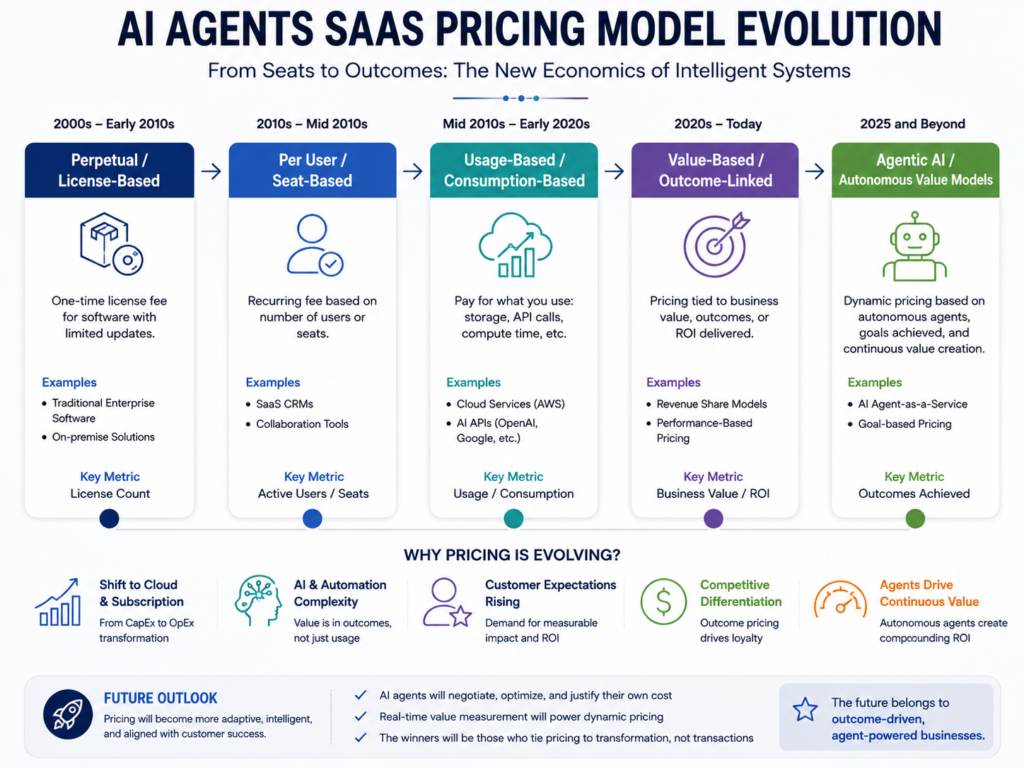
That creates pressure on one of the industry’s most familiar commercial models: per-seat pricing.
Why Per-Seat SaaS Pricing Comes Under Pressure
Traditional SaaS revenue often increases as more employees receive licenses.
An agent can change that equation. One autonomous workflow might complete work that previously required several employees to log in, navigate the software and perform individual tasks.
The software may deliver more value while receiving fewer direct human interactions.
Usage-, Execution- and Outcome-Based SaaS Pricing
That opens the door to models based on.
API consumption
Workflow executions
Tasks completed
Compute or agent usage
Successful business outcomes
Hybrid subscription and usage pricing
Outcome-based pricing can align cost more closely with value, but it also introduces practical questions around attribution, forecasting and procurement.
A hybrid model may therefore be easier for enterprise buyers in markets such as New York, London or Munich. Mak It Solutions’ outcome-based SaaS pricing guide explores that transition in more detail.
Which SaaS Companies Are Most Exposed?
Products whose main differentiation is a convenient interface for otherwise commoditized workflows may face greater pressure.
Companies are better positioned when their moat includes.
Proprietary or difficult-to-replicate data
Systems of record
Deep integrations
Mission-critical workflows
Regulatory or compliance expertise
Embedded customer processes
Trusted infrastructure
Agentic disruption therefore threatens weak interaction-layer differentiation more than durable data, workflow or compliance advantages.
Agent UX, Human Oversight and Trust
Making an interface less visible does not make UX less important. It changes what good UX needs to communicate.
Agent UX Is More Than a Chat Box
A well-designed agent experience should make it clear what the system is doing, what it plans to do next and when the user needs to intervene.
Useful interface elements may include.
Action previews
Status indicators
Approval requests
Confidence or uncertainty signals
Exception handling
Reversible actions
Clear records of completed steps
The goal is not “chat everywhere.” It is the right amount of interface at the right moment.
Human-in-the-Loop Controls and Agent Permissions
Agents working across finance, healthcare, HR or customer systems require deliberate boundaries.
IAM, RBAC, scoped credentials, least-privilege access, approval thresholds and detailed audit trails can reduce the risk that a valid instruction turns into an unauthorized or unintended action.
This becomes especially important when one agent can invoke tools across several enterprise applications.
Why Monitoring Dashboards May Become More Important
The familiar SaaS dashboard may survive, but its job could change.
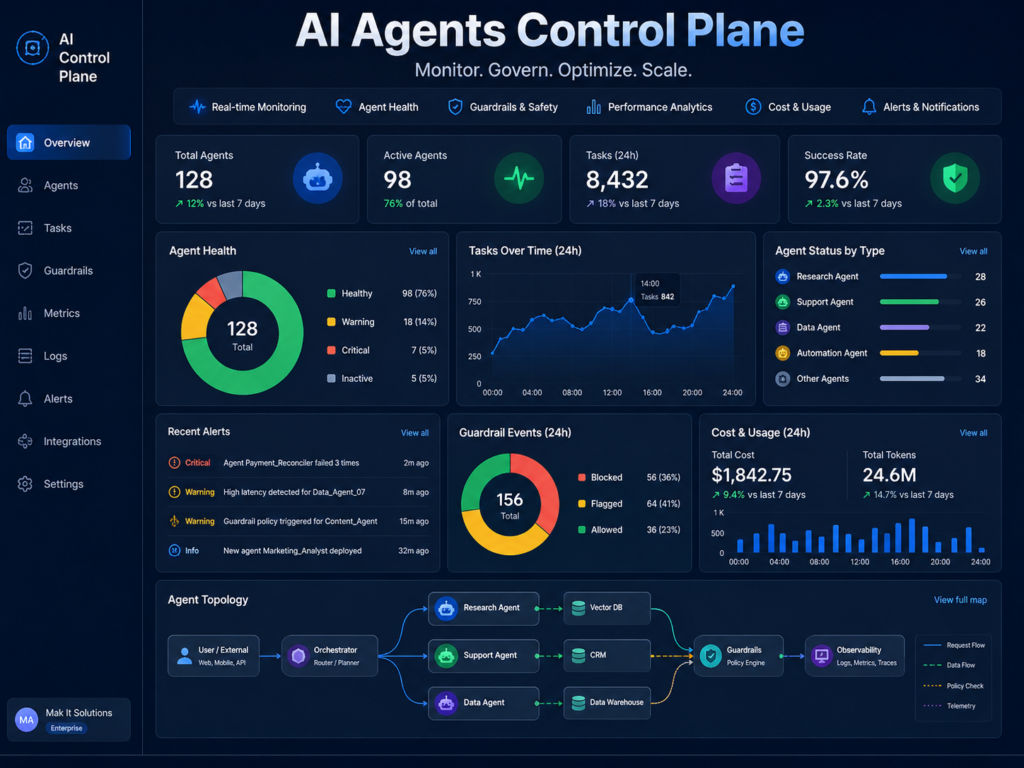
Instead of being the main place where employees perform every action, future dashboards may operate as agent control planes that display.
Workflow health
Failed or paused tasks
Human approvals
Agent activity
Costs
Security alerts
Audit history
Routine execution becomes less visible. Supervision becomes more visible.
SaaS UI does not disappear; it evolves.
AI Agent Governance Across the USA, UK, Germany and EU
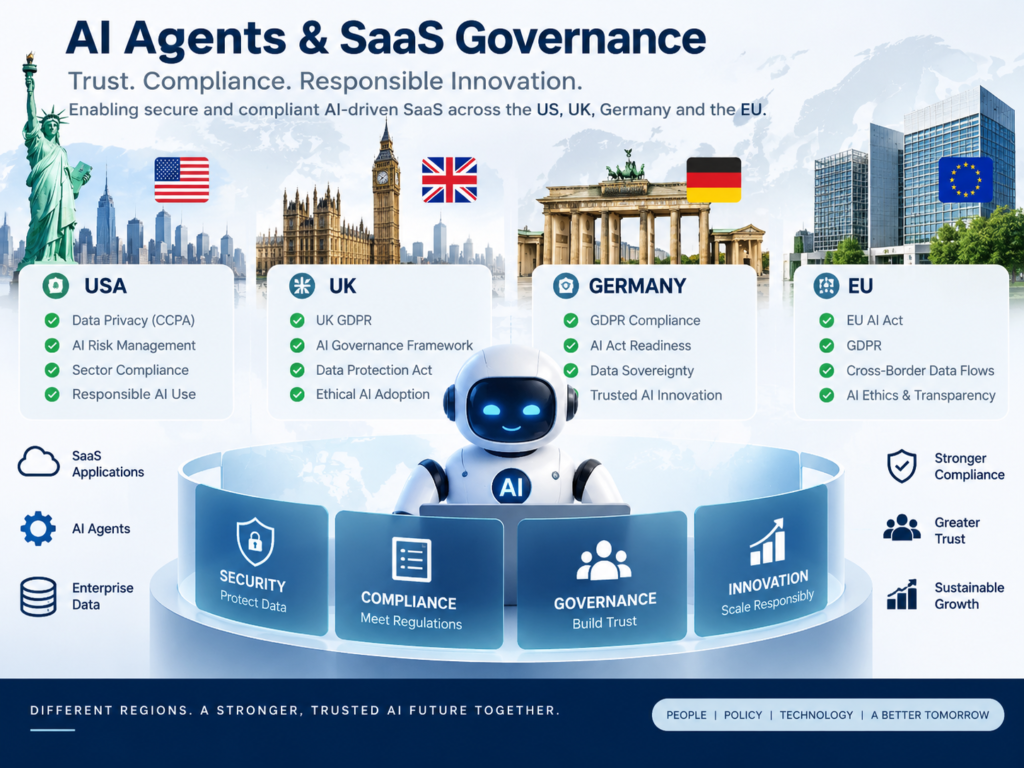
Governance becomes part of product architecture when software can take actions rather than simply generate recommendations.
USA.
A SaaS startup serving general business customers and a healthcare platform can face very different obligations.
Enterprise buyers may expect controls such as SOC 2, IAM and detailed auditability, while particular workflows can also fall within frameworks or laws such as HIPAA, CCPA/CPRA or PCI DSS v4.0.1.
The correct controls depend on the data, industry and actions involved. Autonomous access should therefore be scoped to the actual regulatory and security context rather than treated as a blanket permission model.
UK.
UK SaaS teams should consider UK GDPR, the Data Protection Act 2018 and the Data (Use and Access) Act 2025, alongside relevant sector oversight.
The Data (Use and Access) Act received Royal Assent on 19 June 2025 and introduced changes affecting UK data protection and privacy law, among other areas.
For NHS-related, financial or Open Banking workflows, logging, accountability and clear escalation paths become particularly important.
Germany and EU.
SaaS teams serving Berlin, Munich, Frankfurt and the wider EU should consider GDPR/DSGVO, the EU AI Act, data sovereignty, human oversight and applicable security practices such as ISO 27001.
The EU AI Act’s general application date is 2 August 2026, but current consolidated rules stagger some high-risk obligations. Relevant provisions for certain Annex III high-risk systems are scheduled from 2 December 2027, while provisions covering certain Annex I high-risk systems apply from 2 August 2028.
For enterprise deployments, SAP or ERP integrations and AWS, Azure or GCP region choices should therefore be designed alongside identity, oversight and cross-border data governance not added as an afterthought.
How SaaS Companies Should Prepare for an Agent-First Future
SaaS companies should redesign products around the outcomes customers want completed rather than the screens they currently navigate.
Start with frequent, multi-step workflows where automation has measurable value, then build the APIs, permissions and governance needed to execute them safely.
Redesign Product Strategy Around Intent
Map the jobs customers actually want finished.
Reconcile an invoice
Qualify a lead
Resolve a support request
Retrieve a document
Prepare a forecast
Update a CRM record
Natural language can become one access layer, but deterministic business rules and structured actions still need to sit underneath it.
Build the Foundation Before Increasing Autonomy
Prioritize APIs, identity, permissions, orchestration, events, observability and auditability before giving agents broader autonomy.
A chatbot wrapped around an old GUI is not an agent-ready architecture.
Scalable Node.js development and Python development can support orchestration and execution layers behind agent-driven products.
Rethink the Moat, Metrics and Monetization
Traditional metrics such as logins and active seats may tell only part of the story.
Agentic SaaS teams should also measure completed workflows, autonomous success, human intervention, latency, errors and cost per execution.
Deloitte’s 2026 State of AI in the Enterprise found that 85% of surveyed companies expected to customize agents for their own needs, while only 21% reported a mature governance model for autonomous agents.
That gap is a useful reminder: increasing autonomy without improving governance is not a sustainable product strategy.
Strong business intelligence capabilities will be important for measuring whether agent-driven workflows actually create economic value.
Final Thoughts
The useful question is no longer whether “SaaS is dead.” It is where SaaS creates durable value when AI agents become a primary way of operating software.
For many products, that value will sit beneath the visible interface: trusted data, APIs, permissions, workflows, integrations, governance and reliable execution.
That is the opportunity behind AI agents SaaS. The winners may not be the products with the most impressive chat box, but the platforms agents can safely depend on to get real work done.
If you are planning an agent-ready SaaS product or modernizing an existing platform, contact Mak It Solutions to request a scoped architecture and development estimate.
Key Takeaways
AI agents SaaS is more likely to transform the interaction layer than eliminate underlying SaaS platforms.
APIs, identity, RBAC, observability and audit trails are core parts of agent-ready architecture.
Per-seat pricing may increasingly coexist with usage-, execution- and outcome-based models.
Human oversight remains important for consequential financial, healthcare, HR and customer actions.
USA, UK, Germany and EU deployments can require different privacy, security and regulatory controls.
Durable SaaS moats will increasingly come from trusted data, workflows, integrations and domain expertise not menu design.
FAQs
Q : Do AI agents need direct API access to use SaaS software?
A : Not always. Agents can interact with graphical interfaces through browser automation, but APIs are generally more predictable and easier to secure at scale.
For enterprise AI agents SaaS, API-based execution also makes permissions, authentication, error handling and audit logging easier to manage.
Q : What is the difference between agentic SaaS and AI-powered SaaS?
A : AI-powered SaaS may use AI for isolated functions such as summarization, recommendations or content generation.
Agentic SaaS goes further. An agent can interpret a goal, choose tools, carry out multiple actions and adjust the workflow based on what happens. The defining difference is agency and execution, not simply the presence of an LLM.
Q : Can AI agents securely work across multiple enterprise applications?
A : Yes, when access is deliberately engineered.
Organizations should use IAM, RBAC, scoped credentials, least-privilege permissions, audit trails and human approvals for sensitive actions. An agent should not receive unrestricted access simply because its human operator can use several systems.
Q : Which SaaS workflows are best to automate first?
A : Frequent, repeatable, measurable and reversible workflows usually make better starting points.
Examples include ticket classification, CRM updates, document retrieval, report preparation, basic lead research and internal task routing. Irreversible payments, sensitive healthcare decisions and high-impact employee actions generally require stronger governance and human review.
Q : How should companies measure ROI from agentic SaaS?
A : Focus on business outcomes rather than chatbot activity.
Useful measures include completed workflows, autonomous success rate, intervention rate, time saved, cost per execution, error rates and customer outcomes. Compare those benefits with model, cloud, integration and human-review costs to understand whether the automation is economically sustainable.
[…] Mak It Solutions explores this transition further in its agent-first SaaS guide. […]