


Outcome-Based Pricing SaaS: The AI Pricing Shift
Outcome-Based Pricing SaaS: The AI Pricing Shift
Outcome-Based Pricing SaaS: The AI Pricing Shift
AI is changing the economics of outcome-based pricing SaaS. When an AI agent can complete work that once required several employees, headcount stops being a reliable proxy for the value software creates.
The short answer: per-seat pricing is not dead. It still fits products where access, collaboration, roles and permissions drive value. But in 2026, SaaS companies increasingly need a broader pricing toolkit: seats for predictable access, usage for measurable consumption, outcomes for verified results, and hybrid models that combine recurring revenue with flexible AI monetization.
That shift is happening in a large market. Gartner reports that worldwide enterprise SaaS revenue reached $218.5 billion in 2024, up 16.7% year over year. For companies building new subscription products, monetization therefore needs to be considered alongside architecture, analytics and billing infrastructure not after the product is finished. Mak It Solutions’ SaaS platform development guidance provides useful technical context.
What Is Outcome-Based Pricing SaaS?
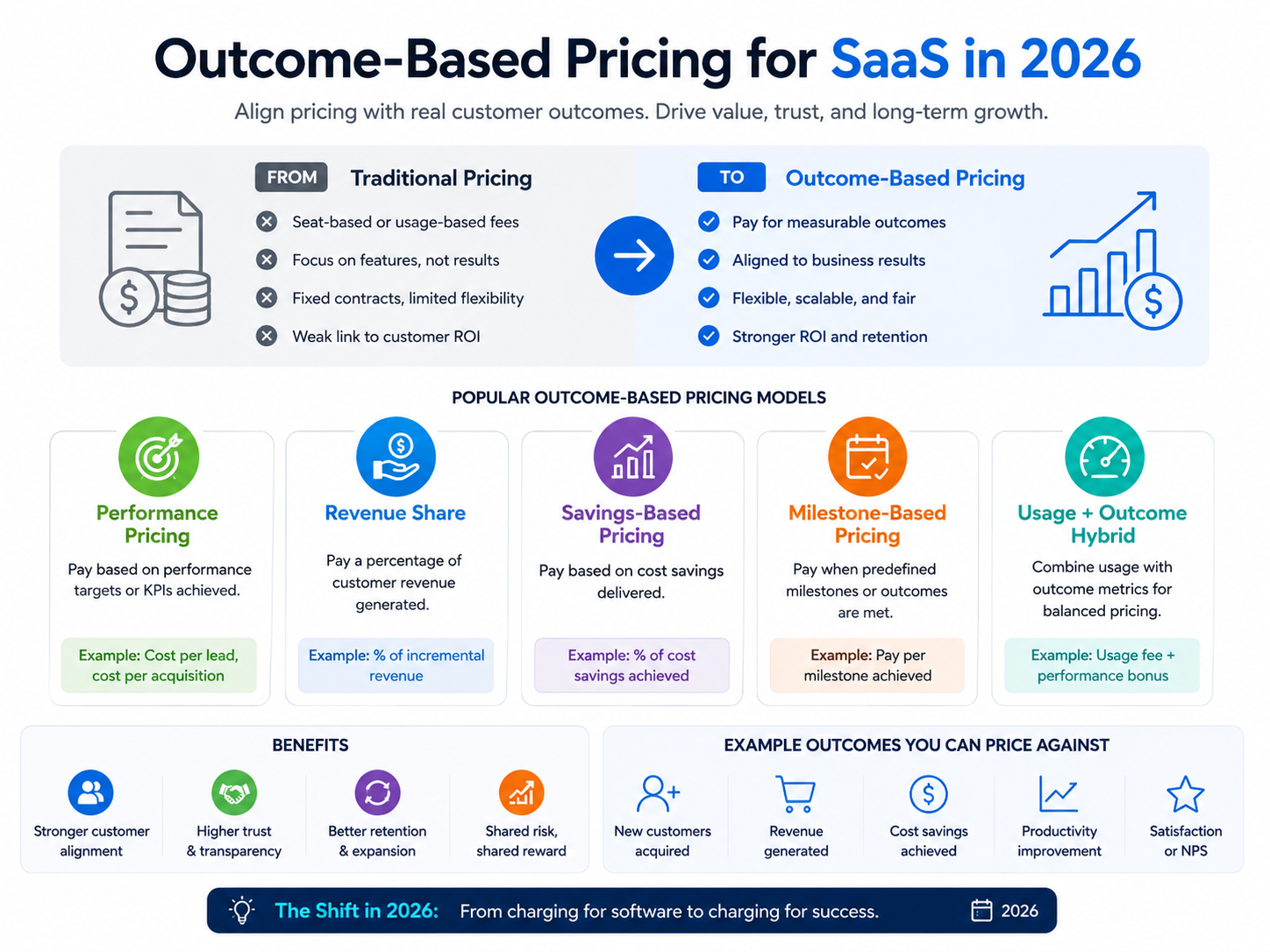
Outcome-based pricing SaaS charges customers for a measurable result delivered by the product rather than simply charging for access or resources consumed.
A successful support resolution, completed workflow, qualified transaction or other verified business event can become the billing metric when it is.
Measurable
Attributable
Auditable
Valuable to the customer
The model works best when both sides can clearly understand why an event was counted and why it appeared on the invoice.
How Outcome-Based SaaS Pricing Works
Traditional software pricing usually starts with access or consumption. Outcome pricing starts with value realization.
The billing chain looks like this:
Product activity → attribution → successful outcome → billable event
For example, instead of charging because an AI agent processed a certain amount of compute or tokens, a vendor might charge when the agent successfully resolves a support request.
That creates a heavier analytics requirement. The vendor needs reliable event tracking, attribution rules and customer-visible evidence. Mak It Solutions’ business intelligence services show the kind of analytics layer that can support this model.
Outcome Pricing vs Value-Based SaaS Pricing
Value-based pricing and outcome pricing overlap, but they are not identical.
Value-based pricing asks what the customer is willing to pay based on the economic value of the product.
Outcome-based pricing makes a defined result itself part of the billing mechanism.
A company may therefore use value research to set the price of an outcome, then meter actual successful outcomes during billing.
What Counts as a Billable SaaS Outcome?
The strongest outcomes are discrete and defensible, such as.
A support issue successfully resolved
A qualified lead or transaction
A completed business workflow
A verified automation event
A successful handoff or task completion
Broad statements such as “productivity improved” are usually harder to bill against because attribution becomes subjective.
Intercom provides a live example through its Fin AI Agent. Its 2026 pricing documentation defines different successful outcomes including resolutions and workflow-related events and charges based on those outcomes rather than simply the number of people using the AI agent.
Per-Seat Pricing vs Outcome-Based Pricing
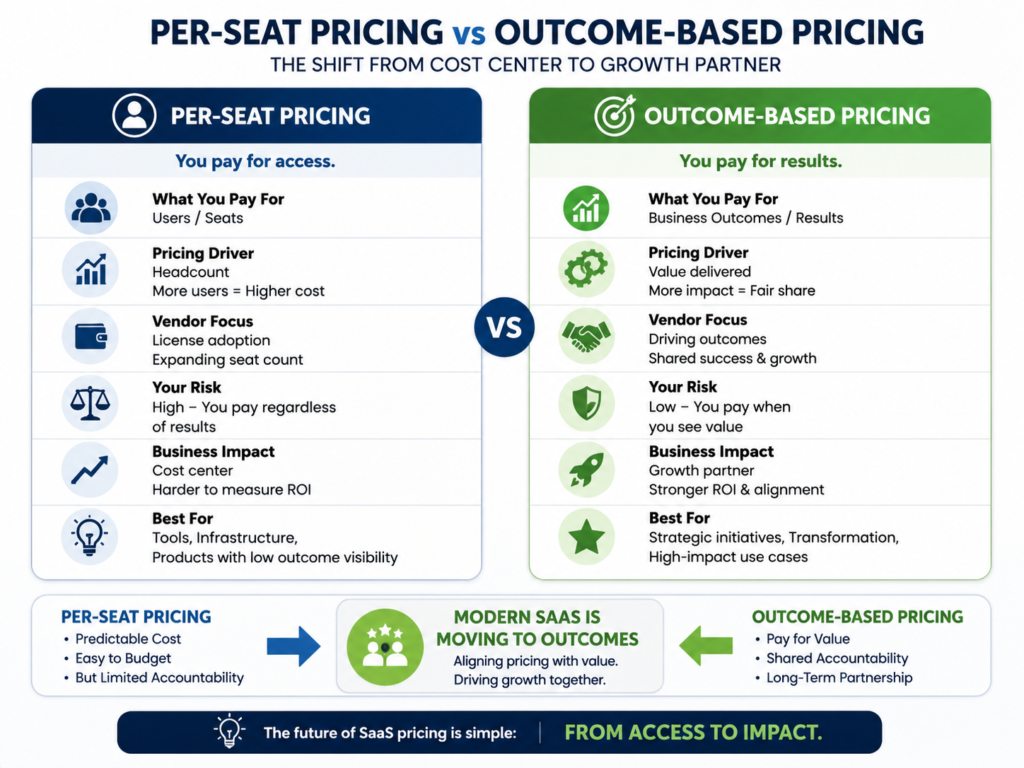
Per-seat pricing charges for licensed users. Outcome-based pricing charges for verified results.
AI makes the distinction more important because output can increase dramatically without the number of human users increasing with it.
Why AI Is Putting Per-Seat Pricing Under Pressure
Seat-based SaaS historically benefited from a simple relationship: as customers hired more employees and added users, software revenue expanded.
AI agents weaken that link. A customer may increase the amount of work completed while reducing the number of employees directly interacting with the platform.
That does not mean outcome pricing has already taken over.
AlixPartners analyzed 65 SaaS and AI companies and found that only 4 had fully moved to outcome-based pricing. At the same time, 72% used some form of hybrid approach incorporating consumption through AI credits or usage metering.
The direction is clear, but the transition is still uneven.
When Per-Seat Pricing Still Makes Sense
Per-seat pricing remains practical when human access is closely tied to product value.
Typical examples include.
Collaboration platforms
Security and administration tools
Approval workflows
Professional productivity software
Systems with detailed role-based permissions
Products where each user receives substantial individual value
Seats also make budgeting simple. Procurement teams know how many licenses they need, finance teams can forecast spend, and vendors gain predictable recurring revenue.
So “per-seat pricing is dead” makes a good headline but not a good pricing strategy.
Seats vs Outcomes: Predictability, Value and Risk
| Factor | Per-Seat Pricing | Outcome-Based Pricing |
|---|---|---|
| Billing metric | Licensed users | Verified results |
| Revenue predictability | High | Medium to variable |
| Customer budget predictability | High | Lower |
| Automation upside | Limited | High |
| Attribution difficulty | Low | High |
| Gross-margin risk | Lower | Potentially higher |
| Implementation complexity | Low to medium | High |
AI SaaS Pricing: Usage, Outcome or Hybrid?
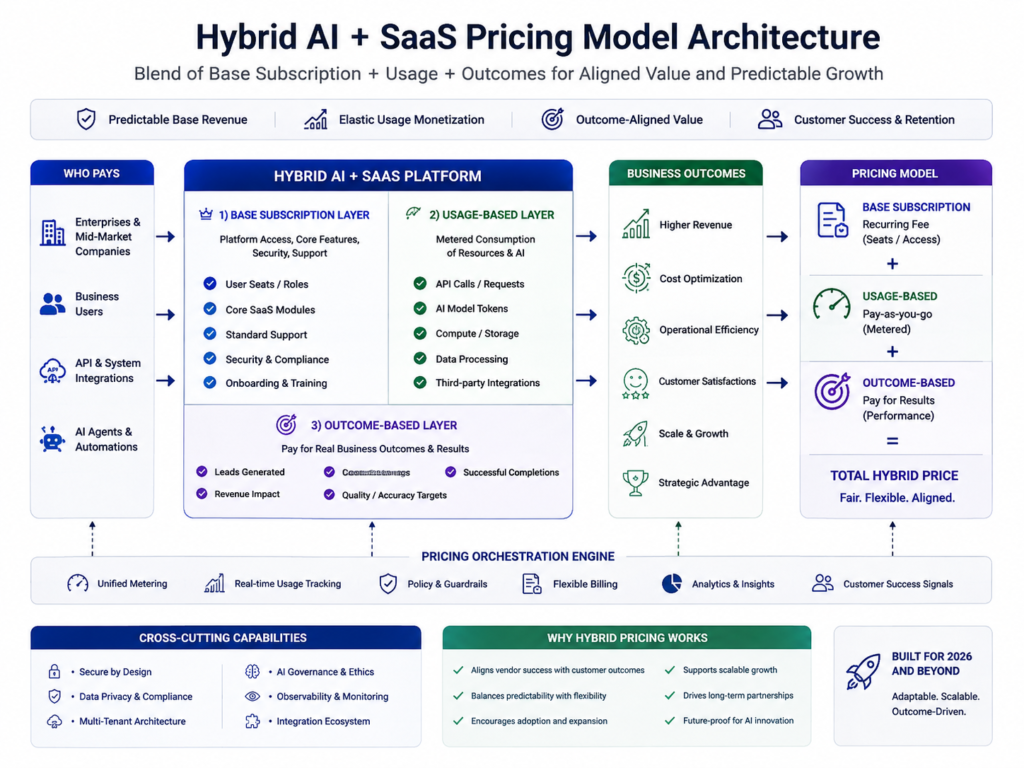
For many companies, hybrid SaaS pricing is the practical bridge between traditional subscriptions and pure outcome-based pricing.
A platform can protect recurring revenue through a base subscription while introducing usage, credits or outcome charges for AI-intensive features.
Outcome-Based vs Usage-Based Pricing for B2B SaaS
Usage-based pricing charges for activity or consumption, such as.
API calls
Tokens
Compute time
Messages
Storage
Credits
Outcome pricing charges when that activity produces a defined result.
The difference matters.
Usage is usually easier to meter and audit. Outcomes can correlate more closely with business value, but they introduce harder questions around attribution, disputes and performance risk.
Mak It Solutions’ API-first architecture and monetization guide explores the event-driven infrastructure behind flexible usage models.
Why Hybrid SaaS Pricing Is the Practical Bridge
Common hybrid structures include:
Base subscription + usage
Base subscription + successful outcomes
Seats + AI credits
Platform fee + metered automation
Minimum commitment + variable outcomes
Modern billing platforms such as Stripe, Zuora, Paddle, Charge bee and Maxie have helped make more flexible billing architectures practical.
Hybrid pricing also gives SaaS companies room to learn. Instead of replacing an established pricing model overnight, they can introduce a variable component, observe customer behavior and refine the value metric.
Protecting ARR, Gross Margin and AI Unit Economics
A customer may love an outcome metric while the vendor loses money delivering it.
AI introduces variable costs including.
Model inference
GPU or cloud compute
Third-party APIs
Data processing
Human escalation
Support and exception handling
Before launching outcome pricing, calculate the cost per successful result, not only revenue per event.
This matters because cloud-based SaaS itself remains a major spending category. Gartner projected $247.2 billion in public-cloud SaaS end-user spending for 2024, representing 20% growth.
Mak It Solutions’ FinOps for AI playbook provides a useful framework for monitoring AI infrastructure economics.
How to Implement Outcome-Based Pricing SaaS
Start with one outcome the product directly influences and can measure consistently.
Do not begin by rewriting the entire price book. Begin by proving that the metric works.
Choose the Right SaaS Value Metric
A strong candidate should pass four tests:
Measurable → Attributable → Auditable → Valuable
If a customer cannot independently understand why an outcome was counted, expect friction once that outcome starts appearing on invoices.
Define Attribution and Successful-Outcome Rules
Document the rules before charging customers.
Clarify.
What triggers a billable outcome
What does not count
Which party controls the result
How retries are handled
How duplicate events are excluded
What happens when a customer disputes a charge
What evidence appears in the audit trail
This makes outcome pricing partly a software-architecture problem.
Reliable APIs, databases and event logs are foundational. Mak It Solutions’ back-end development services cover the underlying capabilities required to build that layer.
Build Outcome Billing Without Margin Surprises
A safer rollout follows four stages.
Measure outcomes first. Track candidate results without changing customer invoices.
Shadow-price the outcomes. Calculate what customers would have paid under the proposed model.
Introduce hybrid billing. Add minimum commitments, tiers, caps or true-ups where appropriate.
Evaluate pure outcome pricing later. Move further only when attribution, customer acceptance and unit economics are stable.
Annual commitments can still protect ARR while variable charges capture incremental value.
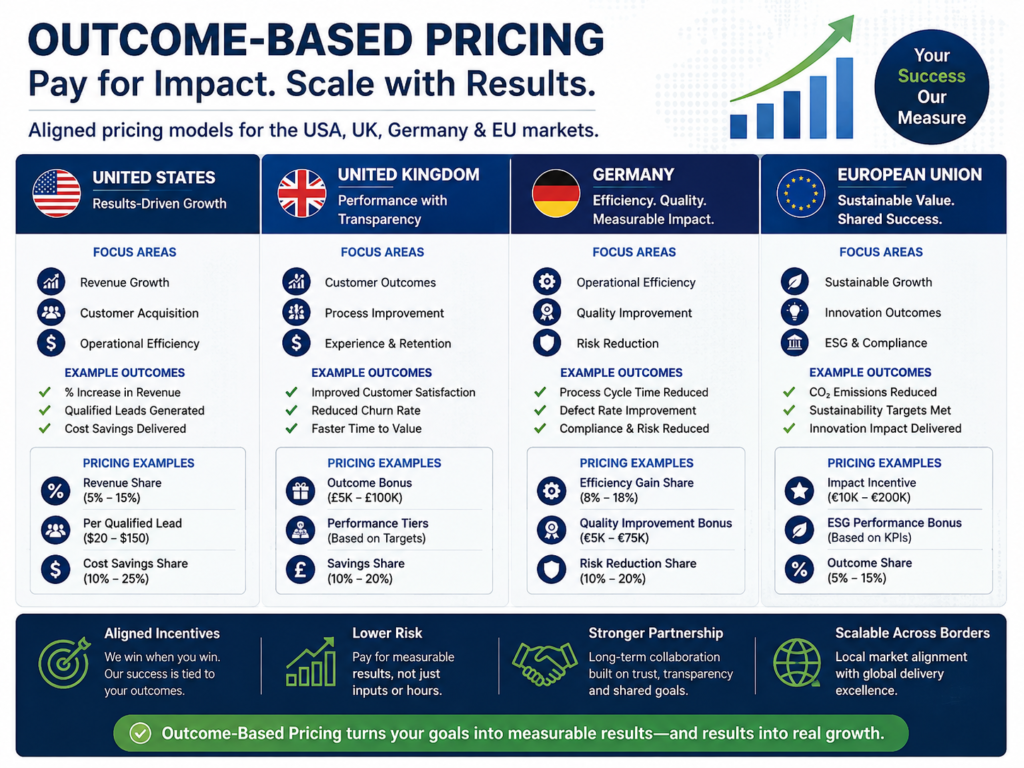
Outcome-Based Pricing in the USA, UK, Germany & EU
Outcome billing creates an important secondary challenge: every billable result may require data proving why the charge occurred.
That makes privacy, security, retention and auditability part of the pricing architecture.
USA.
Enterprise buyers in cities such as New York, Austin, Boston or San Francisco may expect strong security and audit controls.
Healthcare SaaS needs particular care. HIPAA requirements apply to covered entities and to relevant business associates handling protected health information; simply selling software does not automatically make every vendor a business associate.
Products processing or storing payment-card data may also need to consider PCI DSS. As of 2026, the PCI Security Standards Council continues to publish PCI DSS v4.0.1 as the current standard in its document library.
UK.
UK SaaS companies need to design outcome logs around applicable data-protection requirements rather than recording everything simply because it can be measured.
ICO guidance emphasizes that personal information should be adequate, relevant and limited to what is necessary for the stated purpose.
In 2026, UK teams should also account for changes introduced through the Data (Use and Access) Act when assessing their specific obligations. Sector-specific requirements may add another layer for NHS suppliers, financial services providers and Open Banking products.
The practical rule is simple: collect enough evidence to defend the billable event, but avoid turning pricing telemetry into unnecessary data accumulation.
Germany & EU.
For Outcome-Based Pricing Deutschland, ergebnisbasierte Preisgestaltung SaaS or ergebnisorientierte Preisgestaltung, measurable still does not mean “collect everything.”
Vendors serving Berlin, Munich, Hamburg and the wider EU should design outcome logs with GDPR/DSGVO principles, retention policies and cross-border data flows in mind.
The EU AI Act entered into force on 1 August 2024 and became broadly applicable on 2 August 2026, although several requirements follow different transition dates.
For SaaS companies using AI, that makes classification, transparency and evidence increasingly important alongside pricing design.
BaFin expectations may also matter for German financial services, while payment regulation, VAT, invoicing and PCI DSS requirements can affect fintech products across Germany and the wider EU.
Cloud-region choices can influence both residency and cost. Mak It Solutions’ AWS vs Azure vs Google Cloud comparison provides additional infrastructure context.
This section provides general business and technical information, not legal or financial advice. Regulatory obligations should be reviewed for the specific product, market and customer type.
Which SaaS Pricing Model Should You Choose in 2026?
Choose the pricing metric that tracks customer value closely without introducing unacceptable billing complexity, margin volatility or buyer risk.
There is no universal winner.
| Criterion | Seat | Usage | Outcome | Hybrid |
|---|---|---|---|---|
| Value correlation | Medium | Medium–high | High | High |
| Measurability | High | High | Medium | High |
| Attribution ease | High | High | Low–medium | Medium |
| Revenue predictability | High | Medium | Lower | High |
| COGS protection | High | Medium | Variable | High |
| Buyer familiarity | High | Medium | Medium | High |
| Billing complexity | Low | Medium | High | Medium–high |
Early-stage companies should compare any pricing redesign with wider product economics. Mak It Solutions’ build-vs-buy software framework can help teams evaluate total cost and strategic value.
The Future of SaaS Pricing: Hybrid Before Pure Outcomes
Pure outcome pricing is likely to become more relevant where AI agents handle discrete, measurable workflows.
But hybrid pricing offers a more controlled transition.
It lets vendors keep the predictability customers already understand while creating a separate path for monetizing AI consumption and successful results.
AlixPartners’ analysis reinforces that view: fully outcome-based adoption remains limited, while hybrid approaches are already far more common.
Run an Outcome-Pricing Readiness Test
Before redesigning your pricing, audit one valuable workflow.
Can we define the outcome clearly?
Can we measure it reliably?
Can we prove attribution?
Can we protect gross margins?
Will customers accept the billing risk?
If one or more answers are “no,” improve the measurement layer or test hybrid pricing before moving further.
Concluding Remarks
Outcome-based pricing SaaS is not simply replacing per-seat pricing in 2026. It is expanding the set of pricing models SaaS companies can use.
Seats still make sense when people and access drive value. Usage works when consumption is easy to measure. Outcomes become compelling when successful results can be defined, attributed and audited. For many AI products, hybrid pricing connects those models without forcing customers or vendors to absorb unnecessary risk.( Click Here’s )
Before replacing your entire pricing structure, test one workflow where customer value is already measurable.
Mak It Solutions can help connect product architecture, analytics, AI unit economics and billing requirements. Explore its software development services or scope an outcome-pricing pilot around a workflow you can measure today.
Key Takeaways
Per-seat pricing is under pressure, but it is not universally obsolete.
Outcome-based pricing SaaS works best when results are measurable, attributable and auditable.
Usage billing is easier to meter but may correlate less directly with customer value.
Hybrid pricing can protect ARR while monetizing AI usage and successful outcomes.
AI COGS and gross margin should be modeled before pricing changes go live.
USA, UK, Germany and EU deployments require different privacy, security, audit and regulatory considerations.
The pricing model should follow how customers receive value not whichever metric is easiest to invoice.
FAQs
Q : What are the biggest disadvantages of outcome-based SaaS pricing?
A : The main challenges are attribution, variable revenue, billing disputes and margin exposure. Vendors need to prove that the software caused or materially contributed to the result being charged while keeping invoices understandable for customers.
Q : Can outcome-based pricing work for enterprise SaaS contracts?
A : Yes. Enterprise agreements can combine outcome charges with annual commitments, minimum spend levels or platform fees. Contracts should clearly define successful outcomes, attribution rules, audit evidence, dispute procedures and any caps or true-ups.
Q : How do customers dispute an outcome-based SaaS charge?
A : Customers should be able to see an auditable record showing what happened, when it happened and which rule classified the event as billable. The contract should also define how duplicates, retries, exceptions and disputes are handled.
Q : Should AI features be included in an existing subscription or sold separately?
A : It depends on both value and cost. Lightweight AI features may fit inside an existing subscription, while compute-heavy agents or autonomous workflows may justify credits, usage fees or outcome charges. Hybrid pricing often provides the most flexible middle ground.
Q : How often should a SaaS company review its pricing metric?
A : A formal pricing review at least annually is sensible for many SaaS businesses, while AI-heavy products may need closer monitoring as infrastructure costs, customer behavior and value realization change. The goal is not constant repricing; it is catching situations where the billing metric stops reflecting customer value.
[…] AI Agents Replace Traditional SaaS […]