


GCC Data Residency Requirements: AI Guide for Saudi & UAE
GCC Data Residency Requirements: AI Guide for Saudi & UAE
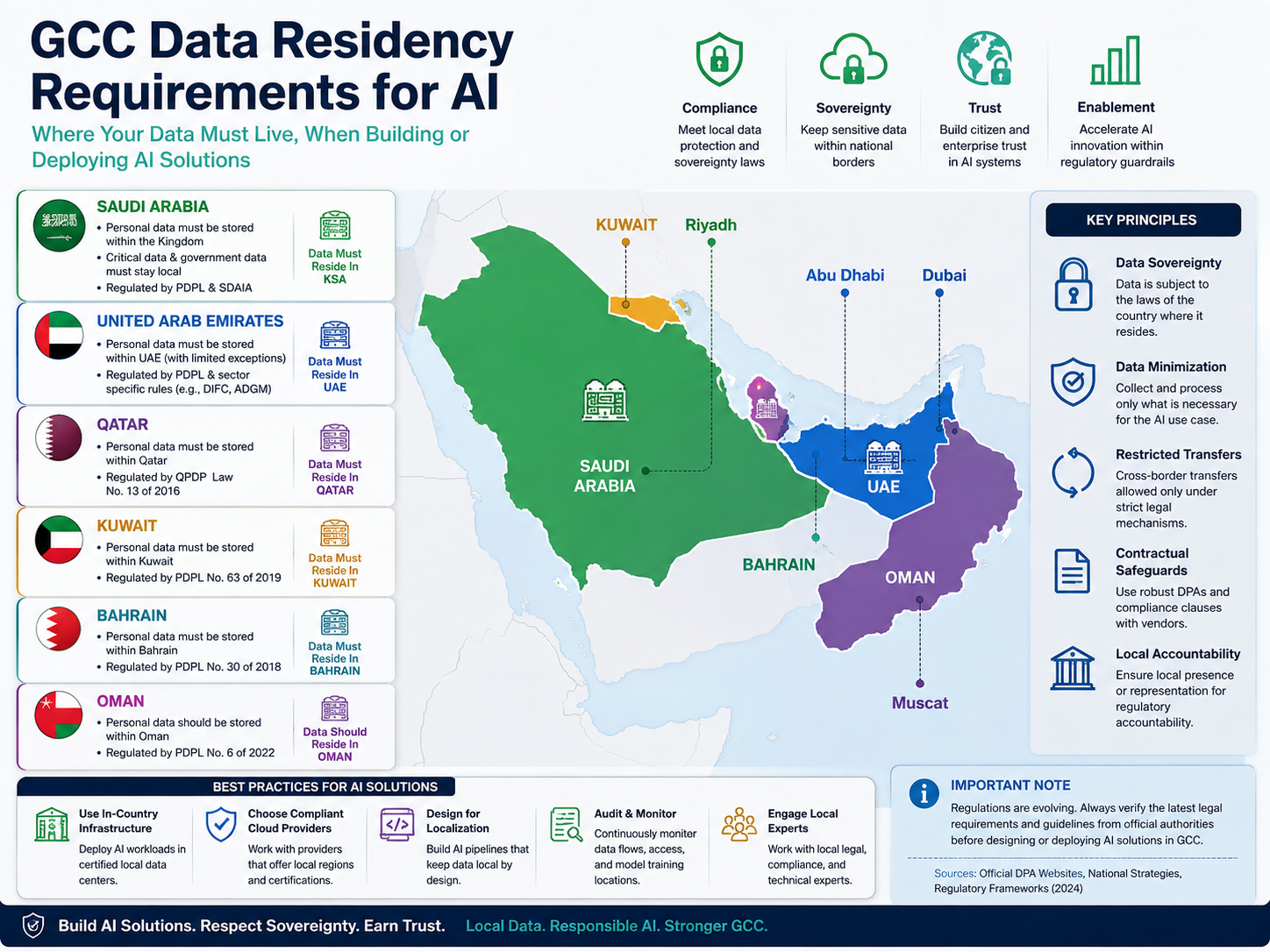
GCC Data Residency Requirements: AI Guide for Saudi & UAE
For AI projects, GCC data residency requirements go far beyond deciding where a database is hosted. Customer information can appear in prompts, RAG documents, embeddings, vector databases, model logs, backups, telemetry and even encryption-key workflows.
The practical answer is straightforward: Saudi Arabia, the UAE and Qatar do not impose one identical, blanket rule that forces every AI dataset to remain in-country. Compliance depends on the jurisdiction, type of data, industry regulator, cross-border transfer mechanism and the way the AI architecture actually processes information.
For CTOs and technology leaders in Riyadh, Dubai, Abu Dhabi and Doha, the safest starting point is to map the complete AI data journey before selecting a cloud region, LLM provider or sovereign-cloud strategy.
Organizations planning a wider transformation can also explore Mak It Solutions’ technology and development services when connecting compliance requirements with implementation.
What Are GCC Data Residency Requirements for AI?
Data Residency vs Data Localization vs Data Sovereignty
These terms are often used interchangeably, but they describe different issues.
Data residency refers to the physical or geographic location where data is stored or processed.
Data localization refers to requirements that certain categories of data remain within a specific jurisdiction.
Data sovereignty concerns the laws and regulatory authorities governing that data.
That distinction matters for AI. A company may be permitted to transfer certain information abroad while still needing to comply with privacy, cybersecurity, outsourcing or sector-specific controls.
So, GCC data residency requirements should never be treated as identical to cross-border data-transfer rules.
Why AI Creates New Data Residency Risks
Traditional infrastructure reviews usually focus on databases, file storage and backups. AI introduces additional places where sensitive information can appear.
An enterprise AI environment may contain.
User prompts and conversation history
RAG source documents
Embeddings and vector databases
Fine-tuning datasets
Model outputs and cached responses
Application and API logs
Monitoring and observability data
Backups and disaster-recovery copies
Encryption keys and secrets
Even when the main application database sits in-country, one of these supporting services may process or retain data elsewhere.
Data-heavy projects should therefore map AI assets alongside existing analytics pipelines. Mak It Solutions’ business intelligence services can support the technical side of that architecture.
Why GCC Rules Must Be Assessed Country by Country
There is no single GCC privacy and AI-hosting framework that can be applied unchanged across every market.
Saudi Arabia combines PDPL transfer requirements with cybersecurity, data-governance and sector controls. The UAE includes federal requirements alongside separate DIFC and ADGM regimes. Qatar combines privacy requirements with cybersecurity and sector-specific obligations.
A regional AI platform can share technical foundations, but its compliance configuration often needs to change by jurisdiction.
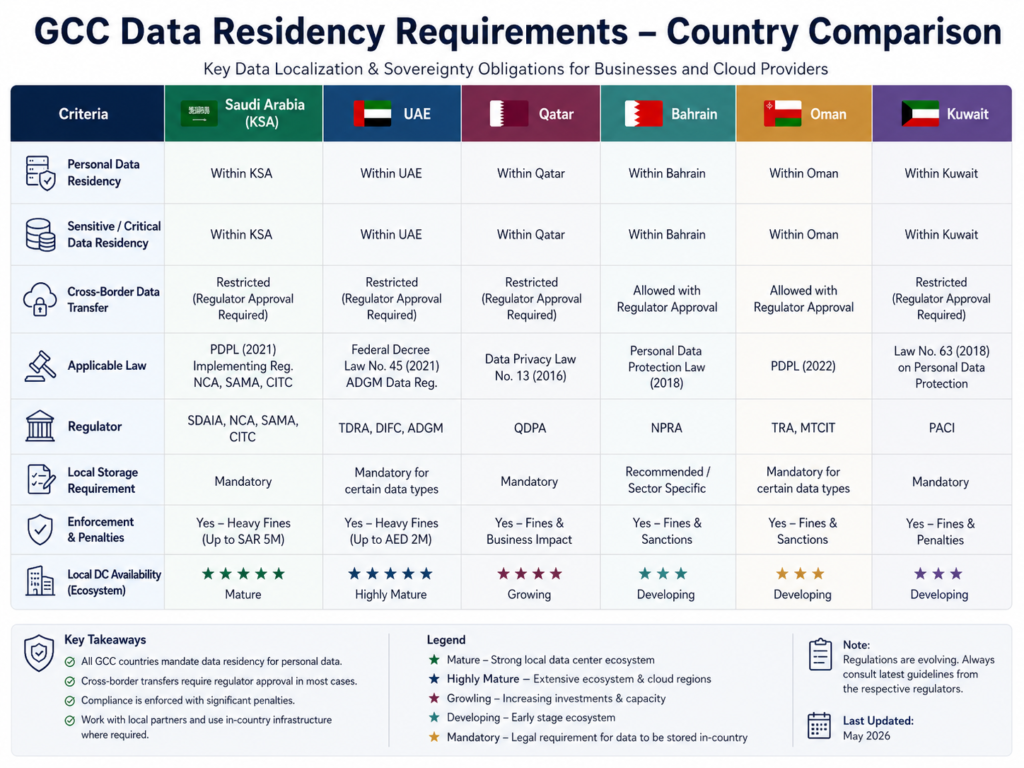
Saudi Arabia vs UAE vs Qatar Data Residency Rules
| Jurisdiction | Key compliance areas | AI architecture implication |
|---|---|---|
| Saudi Arabia | PDPL, SDAIA/NDMO governance, NCA controls, sector rules such as SAMA | Assess transfer conditions, classification and whether sensitive workloads require stronger local controls |
| UAE | Federal privacy framework, DIFC, ADGM and sector requirements | Identify the applicable legal regime before choosing hosting or transfer mechanisms |
| Qatar | PDPPL/NCSA framework and sector requirements such as QCB cloud rules | Review privacy, outsourcing, processing location and cloud governance together |
Saudi Arabia AI Data Residency Requirements
Saudi personal data is not automatically prohibited from leaving the Kingdom in every situation. The PDPL transfer framework permits international transfers when applicable requirements are satisfied, including conditions relating to the purpose, necessity and protection of transferred information.
At the same time, stronger restrictions may arise from cybersecurity controls, data classification, critical-system requirements or sector-specific regulation.
For example, a Riyadh fintech should assess GCC data residency requirements alongside SDAIA/NDMO governance, NCA controls and SAMA obligations rather than relying on the PDPL transfer rules alone.
UAE AI Data Residency Requirements
The UAE requires a similarly jurisdiction-specific approach.
Federal UAE law regulates cross-border transfers of personal data, while DIFC and ADGM operate their own data-protection frameworks. ADGM, for example, provides mechanisms involving adequacy and approved safeguards for international transfers.
The federal institutional landscape is also evolving. In June 2026, the UAE Cabinet approved the establishment of an Artificial Intelligence and Data Authority that consolidates several federal AI, data and digital-government functions.
For an AI project in Dubai or Abu Dhabi, the first question is therefore not simply, “Is the cloud region in the UAE?” It is, “Which legal and regulatory regime governs this workload?”
Qatar AI Data Residency Requirements
Qatar’s privacy environment combines the Personal Data Privacy Protection Law with the NCSA privacy framework and additional sector requirements.
Financial institutions can face another layer through Qatar Central Bank requirements covering cloud arrangements.
A Doha financial-services company should therefore assess privacy, cloud outsourcing, data classification and QCB expectations together rather than treating local hosting as a complete compliance solution.
Where AI Data Actually Travels in a GCC Architecture
A compliant architecture starts with visibility. Teams need to know not only where information is stored, but where it is processed, replicated, observed and supported.
Training Data, RAG and Vector Database Residency
RAG systems deserve particular attention because sensitive corporate information may be copied into several layers.
Map.
Original source documents
Arabic and English knowledge bases
Chunked document content
Embeddings
Vector databases
Cached context
Fine-tuning datasets
Generated outputs
A vector database should not be treated as “just an AI index.” If it represents or enables access to sensitive information, its location and controls can matter just as much as the underlying documents.
Global LLM APIs and Cross-Border Processing
Sending a prompt to an overseas model provider may involve cross-border processing even when the provider does not permanently store the prompt.
Before integrating an external model, review.
Processing location
Retention settings
Provider logging
Subprocessors
Data-processing agreements
Security controls
Private connectivity options
Model-training policies
The same review should apply when AI features are added to custom web applications.
Backups, Telemetry and Disaster Recovery
Some of the easiest residency gaps to miss sit outside the main production environment.
A locally hosted AI application may still send information to.
An overseas monitoring platform
A secondary backup region
A disaster-recovery environment
A global support system
Centralized security tooling
Encryption-key location and administrative access should also be reviewed.
In practice, GCC data residency requirements can be undermined by a forgotten backup or observability service even when the core application is hosted correctly.
GCC Data Residency Requirements: Compliance Checks Before AI Deployment
Saudi Compliance Checks.
For Saudi AI workloads.
Classify personal, sensitive and regulated data.
Verify whether international transfer conditions are satisfied.
Identify applicable NCA cybersecurity controls.
Check whether sector-specific requirements apply.
For financial workloads, review relevant SAMA obligations.
SAMA also sets expectations around confidentiality and security for customer and financial information handled through outsourced arrangements.
SAMA Rulebook — Data Confidentiality and Security
UAE Compliance Checks.
For UAE deployments, first establish which regime applies.
A company operating under the federal framework may face different requirements from an entity established in DIFC or ADGM.
Then evaluate.
Cross-border transfer safeguards
Provider locations
Retention
Sub processors
Security controls
Applicable sector obligations
Sovereign-cloud requirements where relevant
TDRA also has a role in the UAE digital and telecommunications ecosystem, including government sovereign-cloud capabilities.
Qatar Compliance Checks.
For Qatar AI systems.
Identify personal and sensitive information.
Map provider and subprocessor locations.
Check overseas processing paths.
Review security and encryption controls.
Assess applicable QCB requirements for regulated financial workloads.
This is where GCC data residency requirements become engineering decisions rather than statements buried inside a compliance policy.
This article provides implementation guidance and does not constitute legal advice. Organizations should confirm requirements with qualified legal and regulatory specialists before deploying regulated workloads.
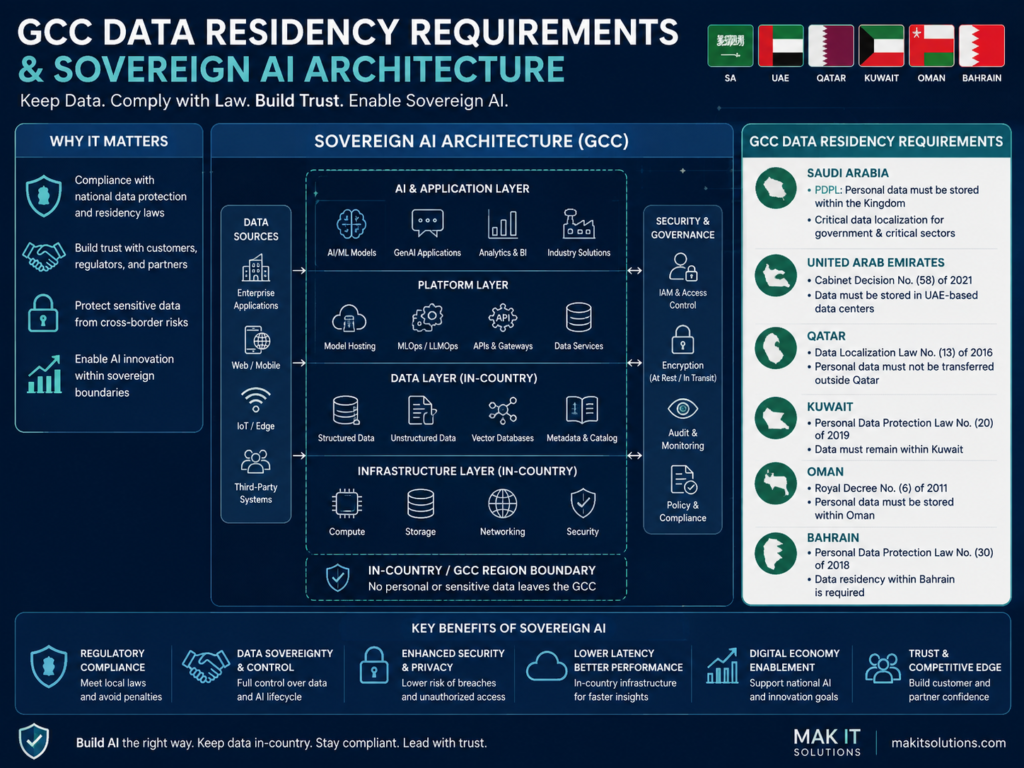
How to Build a GCC-Compliant Sovereign AI Architecture
Classify Data Before Choosing the AI Model
Start with the information, not the vendor.
Separate datasets into categories such as.
Public
Internal
Personal
Sensitive
Confidential
Sector-regulated
Classification helps determine whether a workload can use a global public-cloud AI service or should move toward sovereign cloud, private AI or local inference.
Map Storage, Processing and Cross-Border Data Flows
Document every major component involved in the AI lifecycle:
Source systems
RAG repositories
Vector databases
AI endpoints
API gateways
Application logs
Monitoring systems
Backups
Disaster recovery
Encryption keys
External APIs
Then flag every movement that could affect GCC data residency requirements.
A diagram showing these flows is usually more useful than a simple list of cloud vendors because it reveals where cross-border processing actually occurs.
Choose Local, Sovereign or Hybrid AI Deployment
Once the data is classified and mapped, compare deployment patterns.
Local or sovereign architecture can make sense when sensitive information requires stronger control over infrastructure, keys and administrative access.
Public-cloud AI may be appropriate for lower-risk workloads when the relevant privacy, transfer and security requirements are satisfied.
Hybrid architecture can provide a middle ground. Sensitive data can remain inside a controlled regional environment while sanitized or non-sensitive requests are permitted to reach external AI services.
Regional cloud options referenced in the architecture include AWS Bahrain, Azure UAE Central in Abu Dhabi and Google Cloud’s Doha region.
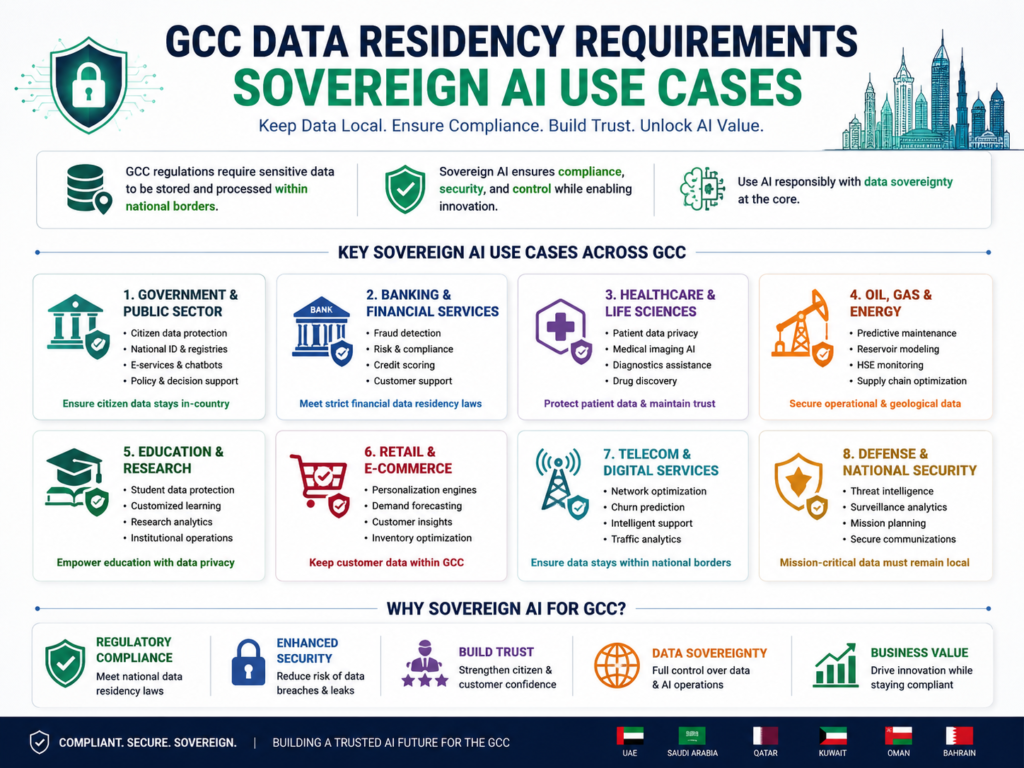
Which GCC Industries Need Sovereign AI Most?
Fintech and Financial Services
Financial institutions deal with high-value customer information and additional regulatory oversight.
A Riyadh fintech building a banking copilot, for example, may keep sensitive RAG content and model processing on approved local infrastructure while applying SAMA and NCA controls.
Qatar banks should likewise assess QCB requirements before selecting their cloud and AI architecture.
Government and Public-Sector AI
Government workloads often require tight control over citizen information, administrative access and encryption keys.
An Abu Dhabi government assistant may therefore use locally controlled RAG, sovereign keys and detailed audit logging rather than sending unrestricted context to a global public AI endpoint.
Arabic-language citizen-service platforms also benefit from treating secure application engineering and data governance as part of the same architecture.
Retail and Logistics
Not every commercial AI workload needs the same level of restriction.
A Dubai e-commerce business could combine compliant customer-data architecture with e-commerce development and mobile app development.
A Doha SME might use GCP Doha for suitable workloads, while a Jeddah logistics company could separate lower-risk forecasting data from personal or regulated customer information.
The same architecture-led approach is increasingly relevant across Bahrain, Kuwait and Oman as organizations develop more mature sovereign-cloud and AI strategies.
Final Takeaway.
Choosing the nearest cloud region does not automatically solve GCC data residency requirements.
A stronger approach starts by classifying information, mapping every storage and processing location, identifying the applicable regulator and then selecting local, sovereign, public-cloud or hybrid AI infrastructure accordingly.
For Saudi Arabia, the UAE and Qatar, the technical foundation may be shared but privacy, transfer, hosting and key-management controls often need jurisdiction-specific configuration.
Explore Mak It Solutions and its delivery experience, or contact the team for a consultation to plan an AI architecture covering data flows, RAG, cloud infrastructure, security and compliance.
FAQs
Q : Does Saudi PDPL require all customer data to remain in Saudi Arabia?
A : No. Saudi PDPL does not create a universal requirement for every customer record to remain inside KSA. Transfers may be possible when applicable PDPL transfer requirements are satisfied, although NCA controls, data classification, critical-system requirements or sector rules can create stronger restrictions.
Q : Do DIFC data-transfer rules differ from UAE federal requirements?
A : Yes. DIFC has its own Data Protection Law, while businesses covered by the UAE federal framework follow a separate regime. ADGM also maintains its own data-protection framework. A company should identify the applicable jurisdiction before selecting a cross-border transfer mechanism.
Q : Can a UAE company use an overseas AI model for customer data?
A : Potentially. The company should assess its applicable data-protection regime, lawful processing basis, cross-border transfer mechanism, retention settings, sub processors and security controls before allowing an overseas AI service to process customer information.
Q : Do Qatar financial institutions need local AI hosting for QCB-regulated data?
A : It depends on the workload and the applicable QCB requirements rather than a single blanket rule for every AI application. Financial institutions should review classification, outsourcing, processing location, provider controls, encryption and business-continuity requirements before choosing an AI hosting model.
Q : Can one AI architecture meet Saudi, UAE and Qatar compliance requirements?
A : A shared technical foundation is possible, but identical configurations across all three jurisdictions can create unnecessary risk. Hosting, transfer controls, encryption, key management and provider choices may need to change by country and sector.
That modular approach also supports the wider digital-transformation ambitions associated with Saudi Vision 2030 while allowing each GCC deployment to follow its own compliance requirements.