
Sovereign AI Saudi Arabia: The New Data Strategy
Sovereign AI Saudi Arabia: The New Data Strategy
Sovereign AI Saudi Arabia: The New Data Strategy
Saudi enterprises are moving beyond the old data-sovereignty question: “Where is our data stored?” With sovereign AI Saudi Arabia, the more important question is now, “Who controls the full AI processing chain?”
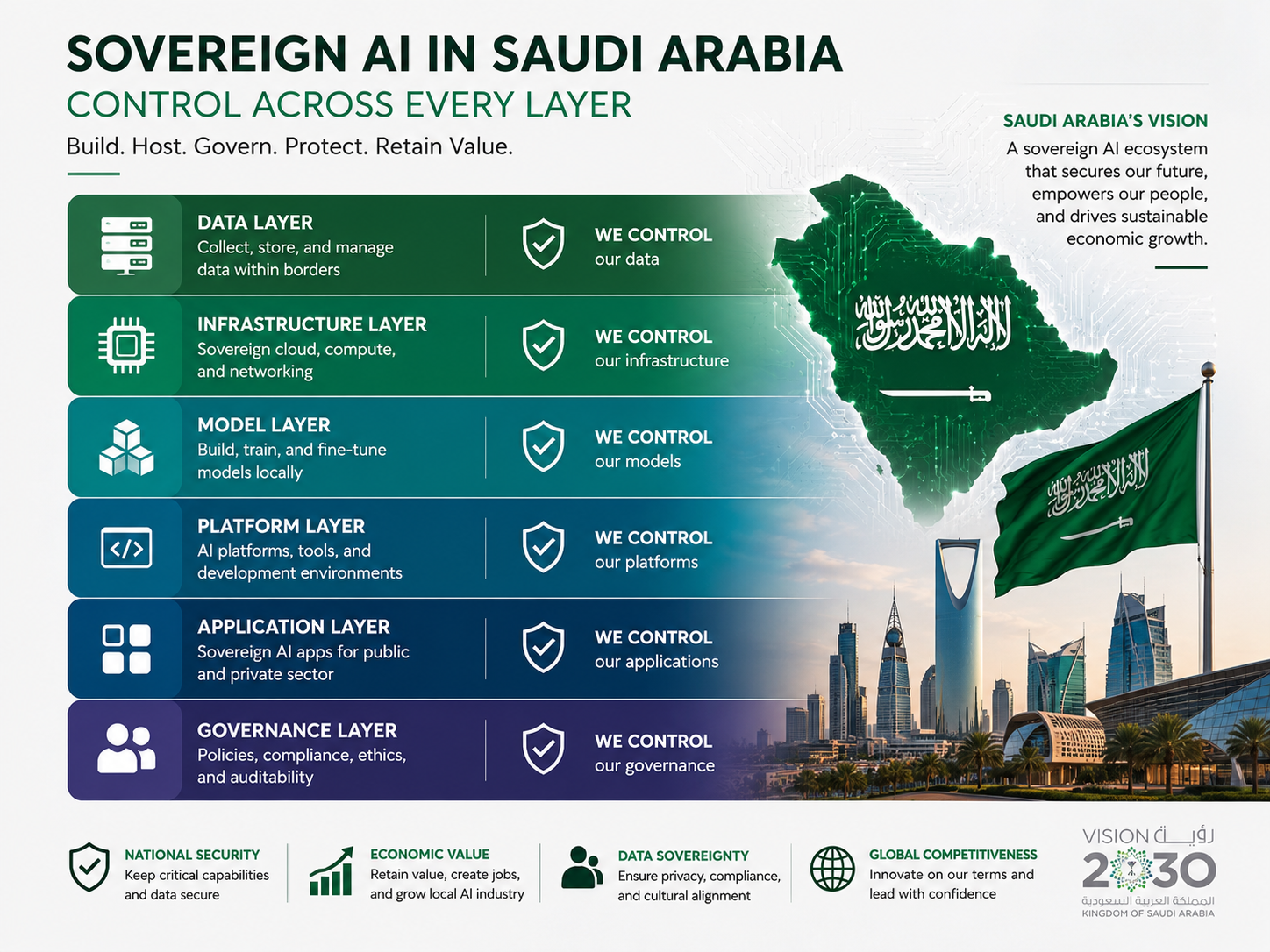
In practical terms, sovereign AI means maintaining appropriate control over the data, models, inference environments, infrastructure, access, compliance, and operations involved in generating an AI response. For CIOs and technology leaders across Riyadh, Jeddah, Dubai, Abu Dhabi, and Doha, that makes AI sovereignty a core enterprise data-strategy issue not simply a cloud-hosting decision.
Mak It Solutions’ AI data leakage prevention guide for GCC businesses explains why controlling what employees and systems send into AI tools is becoming just as important as controlling the databases behind them.
What Sovereign AI Means for Saudi Enterprises
What Is Sovereign AI in Saudi Arabia?
Sovereign AI is the ability of an organization to maintain appropriate control over the systems involved in AI processing. That can include.
Enterprise and personal data
AI models and model access
Training and fine-tuning environments
Inference workloads
Cloud and GPU infrastructure
Identity and permissions
Encryption keys
Logs and monitoring
Operational administrators
Vendor and sub processor access
Applicable jurisdictions
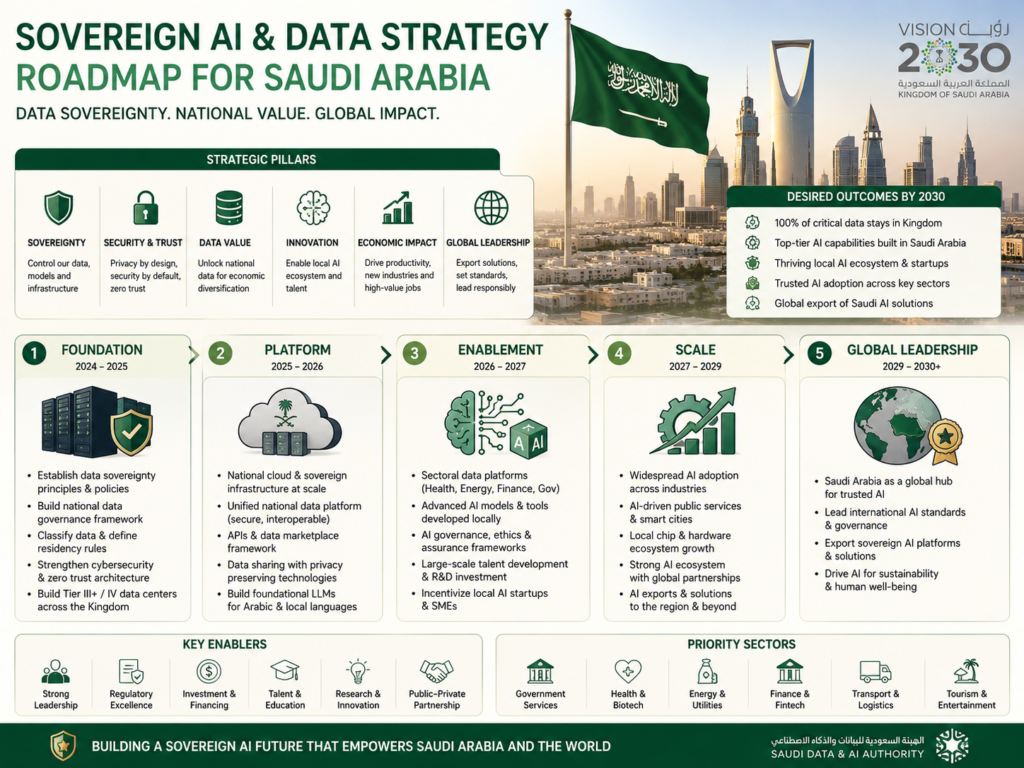
Saudi Arabia’s national data and AI direction places data governance, digital infrastructure, responsible AI adoption, and digital transformation among its strategic priorities.
That matters because an enterprise may know where its primary database is hosted while having far less visibility into where prompts, retrieved documents, vectors, model inference, outputs, or logs are processed.
Sovereign AI vs. Sovereign Cloud
Sovereign cloud and sovereign AI overlap, but they are not the same thing.
A sovereign cloud strategy mainly focuses on areas such as hosting location, infrastructure ownership, operational access, jurisdiction, and data residency.
Sovereign AI goes further. It also asks.
Which model is processing the information?
Where does inference happen?
Can the provider use submitted data for model training?
Where are vector databases and prompt logs stored?
Who controls the GPUs and administrative layer?
Who owns or manages the encryption keys?
Can sensitive information cross borders during processing?
Saudi developments involving center3 and Oracle Alloy illustrate the wider regional interest in locally controlled infrastructure. For enterprises, however, infrastructure is only one part of the sovereignty equation.
Why Sovereign AI Is Rising in Riyadh and the GCC
Several forces are bringing sovereign AI into executive discussions at the same time: generative AI adoption, Vision 2030, growing demand for Arabic AI, regulated-industry use cases, and increased attention to enterprise data governance.
Saudi Arabia has also designated 2026 as its Year of Artificial Intelligence, further strengthening the focus on how AI is deployed, governed, and scaled.
The result is a shift in thinking. AI is no longer treated only as an application layer. It is becoming part of the organization’s data-control architecture.
How Sovereign AI Changes Enterprise Data Strategy
Sovereign AI Saudi Arabia Requires Control Beyond Storage
Traditional data-residency planning often starts with a straightforward question: where does the database live?
That is no longer enough for AI workloads.
An enterprise should understand where each stage of the AI lifecycle takes place:
Data source → retrieval → vector layer → model → inference → output → logs → storage
Each stage may involve a different service, provider, jurisdiction, administrator, or security model.
For organizations modernizing their environments, the GCC cloud migration roadmap offers a useful related framework for approaching infrastructure and compliance decisions systematically.
Models Become Part of the Data-Control Layer
AI models should now be treated as part of enterprise data governance.
A governance team needs to know which models can access sensitive information, which departments can use them, what data can enter prompts, and whether the provider retains or trains on submitted information.
Fine-tuning creates another layer of questions. Where does it happen? Who can modify the model? What training data is used? How are model versions approved and monitored?
For organizations deploying multiple AI systems, model governance can quickly become as important as database governance.
Infrastructure and Vendor Control Become Strategic Decisions
Sovereignty also depends on the infrastructure surrounding the model.
GPUs, identity platforms, control planes, encryption keys, privileged administrators, monitoring services, and subprocessors may all affect how much control an enterprise actually has over its information.
A useful executive question is:
Who controls every layer between our enterprise data and the AI-generated answer?
If that question cannot be answered clearly, the architecture may contain sovereignty or governance gaps that are easy to miss during a conventional cloud review.
Saudi AI Governance, PDPL, and Data Sovereignty
How SDAIA and NDMO Shape Enterprise AI Data Governance
For Saudi enterprises, governance should be designed around classification, accountability, authorized access, auditability, and the handling of sensitive information.
The Saudi Data & AI Authority (SDAIA) and the national data-governance environment make these controls central to sovereign AI Saudi Arabia planning rather than optional technical enhancements.
In practice, an organization should be able to identify what data its AI systems use, who has approved that use, where processing occurs, and how access or model activity can be audited.
What PDPL Means for Cross-Border AI Processing
Saudi data sovereignty should not automatically be interpreted as meaning that every enterprise dataset must remain physically inside the Kingdom.
Saudi personal-data transfer requirements allow qualifying transfers subject to applicable conditions. These can include the purpose of the transfer, the amount of data involved, required safeguards, appropriate protection, and risk considerations.
That means architecture decisions should begin with data classification rather than a blanket assumption that every workload requires the same deployment model.
A public-information chatbot and a financial assistant processing customer records should not automatically receive identical sovereignty controls.
SAMA, NCA, and Sector-Specific AI Risk
Sector context matters.
A Riyadh fintech handling customer or financial records faces a different control threshold from a retailer using publicly available product descriptions.
The SAMA Rulebook emphasizes areas such as safeguards, confidentiality, outsourcing controls, and provider oversight within regulated financial environments.
Organizations operating in regulated or critical sectors should therefore evaluate general privacy requirements alongside industry-specific obligations and cybersecurity controls.
Sovereign AI Across Saudi Arabia, UAE, and Qatar
Saudi Arabia.
Saudi Arabia’s sovereign-AI ecosystem includes organizations and authorities such as SDAIA, NDMO, SAMA, NCA, PIF, SITE, center3, and a growing local technology and infrastructure market.
PIF-backed HUMAIN, launched in 2025, explicitly spans areas including data centers, cloud infrastructure, AI models, and applications.
For Saudi enterprises, this wider ecosystem creates more options—but also makes vendor architecture and control models more important to understand.
Local infrastructure alone does not make an AI workload sovereign. Enterprises still need to examine model access, administrative privileges, data flows, contracts, operational responsibilities, and cross-border dependencies.
UAE.
The UAE brings its own regulatory and infrastructure ecosystem into the regional discussion, including the TDRA, the UAE Data Office, DIFC, ADGM, Core42/G42, e&, and du.
Azure currently lists UAE Central in Abu Dhabi and UAE North in Dubai, giving organizations regional infrastructure choices for selected workloads.
For a Saudi business considering UAE-based infrastructure, however, the existence of a nearby cloud region does not remove the need to assess transfer requirements, provider jurisdiction, administrative access, and sector-specific obligations.
Qatar.
Qatar’s ecosystem includes QCB, MCIT, NCSA, Ooredoo, and MEEZA, alongside regional hyperscale infrastructure.
Google Cloud operates a Doha region, while Qatar’s Digital Agenda 2030 emphasizes secure digital infrastructure, data, and emerging technologies.
For organizations in Doha, sovereign-AI planning should therefore consider both local infrastructure availability and the wider processing chain around prompts, source data, models, outputs, backups, logs, and vendor access.
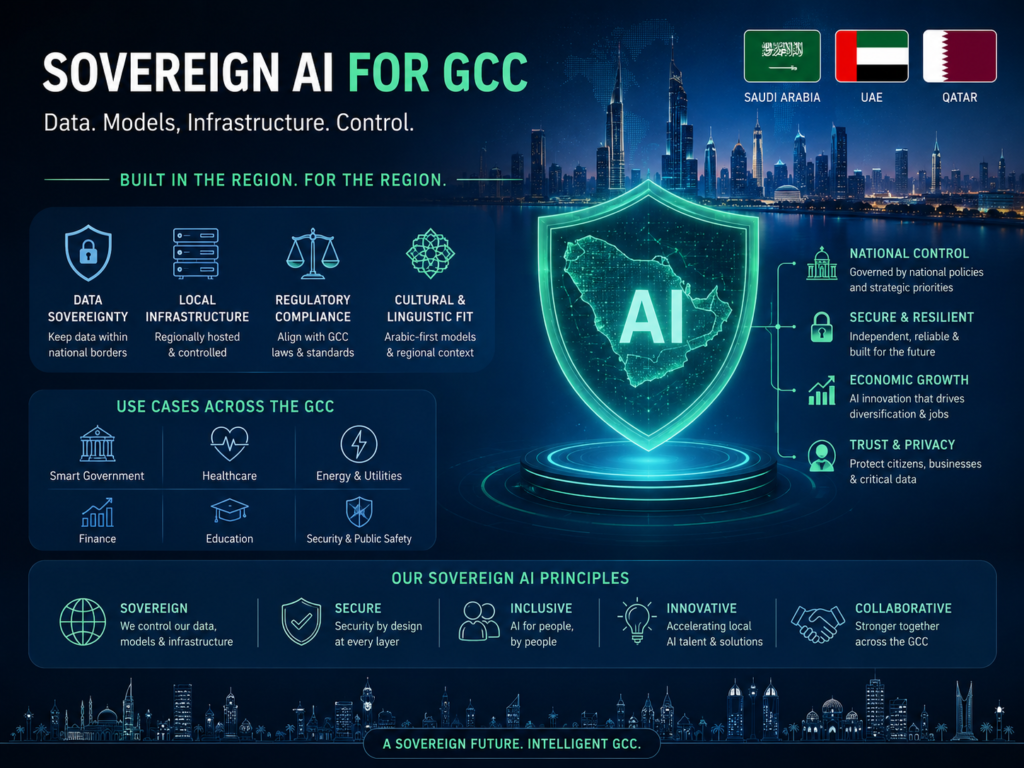
What a Sovereign Enterprise AI Architecture Looks Like
Permission-Aware RAG and Enterprise Knowledge Layers
Retrieval-augmented generation can create major productivity gains, but it can also expose information when permissions are not carried through correctly.
A permission-aware RAG architecture should preserve existing employee access rules across.
Source systems
Document repositories
Vector databases
Knowledge layers
Identity systems
Retrieval filters
AI responses
Audit logs
An employee should not gain access to a confidential document simply because that document has been indexed by an AI system.
Permission inheritance and access filtering should therefore be designed into the architecture from the beginning.
Private, Hybrid, and In-Country AI Deployment Models
Different workloads may require different levels of control.
An organization might use public AI services for low-risk content, private environments for confidential enterprise knowledge, sovereign cloud for workloads requiring stronger jurisdictional control, and on-premise infrastructure for particularly sensitive systems.
The right model depends on risk, not labels.
Mak It Solutions’ multi-cloud strategy for MENA enterprises provides additional context for evaluating infrastructure choices across regional and global providers.
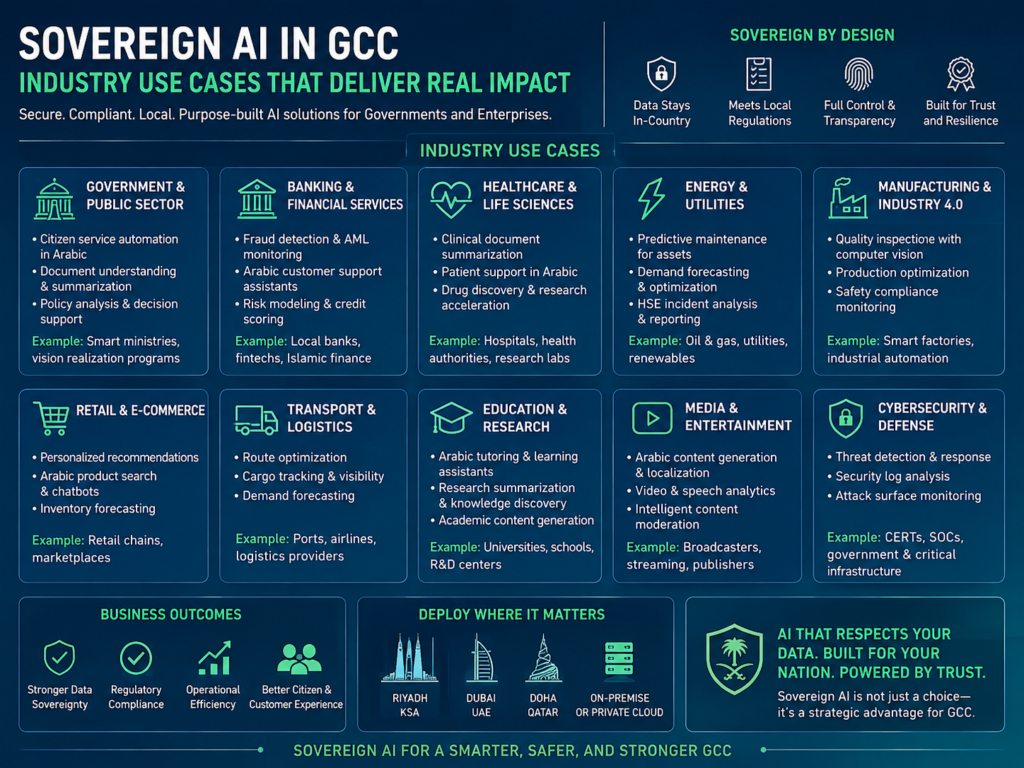
Sovereign AI Use Cases Across GCC Industries
The practical requirements vary considerably by sector.
Riyadh fintech.
A permission-aware financial assistant may need strict identity controls, controlled customer-data retrieval, vendor due diligence, monitoring, and alignment with SAMA requirements.
Dubai retail.
A bilingual personalization platform may focus on useful customer experiences without sending unnecessary customer information into uncontrolled AI services.
Doha SME.
A company may choose local or regional cloud processing for sensitive workloads while keeping lower-risk applications on standard public platforms.
Abu Dhabi government.
An Arabic-first knowledge assistant may require identity-based access, tightly controlled source documents, detailed audit trails, and human review for sensitive outputs.
These examples point to the same principle: sovereignty should be proportional to the sensitivity and business impact of the workload.
How to Build a Sovereign AI Data Strategy in Saudi Arabia
Classify Data and AI Workloads
Start with the information itself.
Classify datasets and AI use cases according to factors such as.
Sensitivity
Personal-data status
Business criticality
Sector requirements
Residency considerations
Permitted AI usage
Cross-border restrictions
Required human oversight
This prevents organizations from applying expensive high-control architecture to every workload while accidentally under-protecting the systems that matter most.
Map the Complete AI Processing Chain
Document the full path from source information to final output.
Data source → retrieval → model → inference → output → logs → storage
For every stage, identify:
Physical or cloud location
Service provider
Applicable jurisdiction
Administrative access
Encryption-key ownership
Sub processors
Retention practices
Cross-border transfers
Exit and deletion procedures
This map often reveals dependencies that are invisible when teams review only the application interface or primary database.
Apply Governance, Arabic UX, and Audit Controls
Once the processing chain is understood, apply controls according to the workload.
These may include.
Approved AI models
Role-based identity controls
Permission-aware retrieval
Audit trails
Arabic-English retrieval testing
RTL interface support
Monitoring and logging
Model and prompt policies
Human approval for higher-risk actions
Mak It Solutions’ Business Intelligence services can support controlled enterprise data layers and decision workflows where AI depends on trusted organizational information.
Costs, Vendor Selection, and Sovereignty Trade-Offs
Where Sovereign AI Can Increase Enterprise Costs
Stronger sovereignty can come with additional cost.
Dedicated GPUs, local capacity, security integrations, governance platforms, monitoring, migration work, specialist operations, and private environments may cost more than a low-control public AI deployment.
That does not mean every organization should pursue maximum sovereignty.
The goal is to spend where the risk justifies it.
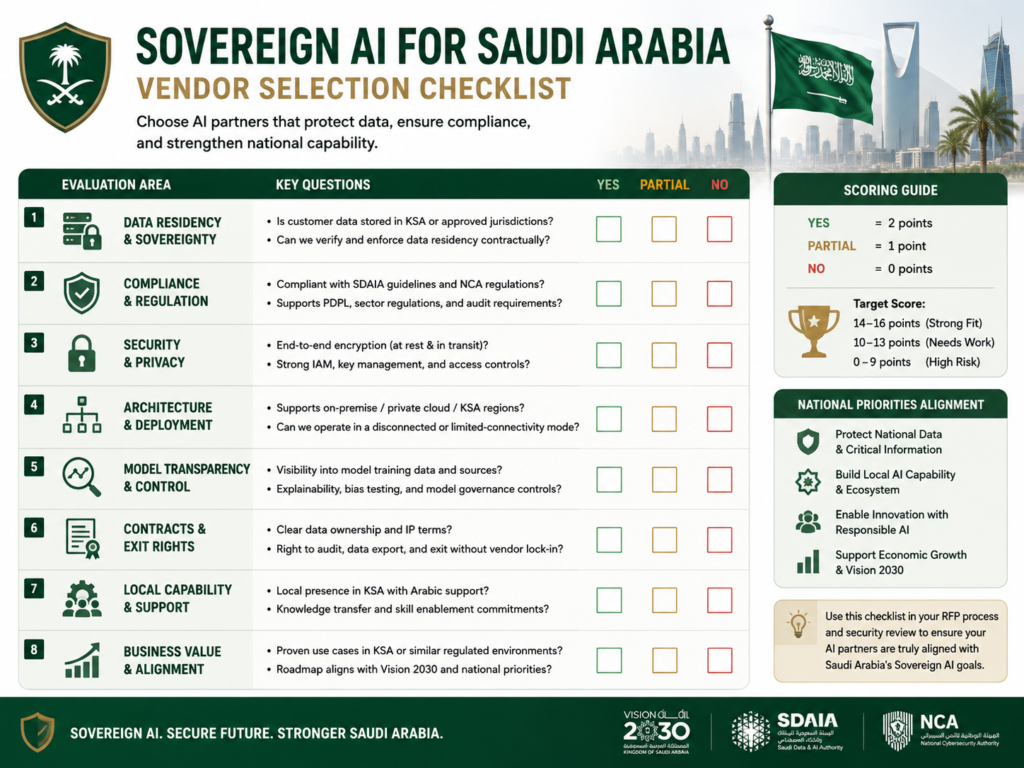
Questions Saudi CIOs Should Ask AI and Cloud Vendors
Before approving an AI platform, Saudi technology leaders should ask.
Where does model inference take place?
Does the provider use customer data to train models?
Where are prompts, vectors, outputs, and logs stored?
Who can access the environment administratively?
Who controls the encryption keys?
Which subprocessors are involved?
Does information cross national borders?
What happens to data when the contract ends?
Can the provider return or securely destroy enterprise information?
How are model changes and security incidents communicated?
Clear answers to these questions are often more useful than a generic “sovereign” product label.
When Full Sovereignty Is and Is Not Necessary
Banking, government, healthcare, critical infrastructure, and other sensitive environments may require stronger controls than systems dealing only with public or low-risk information.
A blanket sovereignty strategy can add complexity without improving every workload. A weak strategy can create serious governance gaps.
The better principle is:
Sovereignty should follow data and workload risk not marketing terminology.
For organizations considering a shift in infrastructure strategy, Mak It Solutions’ cloud repatriation guide for Saudi and UAE firms and GCC Cybersecurity 2026 roadmap provide related guidance.
Last Words
Sovereign AI Saudi Arabia changes enterprise data strategy by extending control across seven connected layers:
Data → Processing → Models → Infrastructure → Access → Compliance → Operations
Saudi and GCC enterprises that map these layers early can make more informed AI decisions before sensitive workloads reach production.
The objective is not to force every AI system into the same architecture. It is to know what information is being processed, who controls each stage, which jurisdictions are involved, and how much sovereignty the workload actually requires.
Ready to assess your enterprise AI architecture? Explore Mak It Solutions’ technology services or contact the team for a consultation to build a Saudi or GCC sovereign-AI strategy around your data, sector, risk profile, and business priorities.
FAQs
Q : Does all enterprise AI data have to stay inside Saudi Arabia?
A : No. Saudi PDPL does not create a universal rule requiring every category of enterprise AI data to remain physically inside Saudi Arabia. Qualifying personal-data transfers may be possible subject to applicable purposes, protection requirements, safeguards, and risk considerations.
Enterprises should classify each dataset and processing activity before choosing an architecture. SAMA-regulated institutions may also need to consider additional outsourcing, confidentiality, and provider requirements.
Q : What should Saudi banks consider before using generative AI with customer data?
A : Saudi banks should identify what customer information enters prompts or retrieval systems, where inference happens, who can access logs, whether submitted information can be used for model training, and what happens to data when a vendor relationship ends.
Model governance, identity controls, encryption, monitoring, approved-use policies, and documented vendor due diligence should be assessed alongside relevant SAMA requirements.
Q : Can a UAE sovereign cloud support Saudi enterprise AI workloads?
A : Potentially. But “sovereign cloud” branding on its own does not determine whether a Saudi workload meets its compliance or governance requirements.
Organizations should examine data classification, processing purpose, transfer paths, safeguards, provider jurisdiction, administrative access, and applicable sector rules before moving sensitive AI processing outside Saudi Arabia.
Q : What data-residency issues should Qatar enterprises check before adopting generative AI?
A : A Doha enterprise should map where its prompts, source documents, vector databases, inference workloads, outputs, backups, and audit logs are processed or stored.
Financial-sector organizations should also consider applicable QCB requirements and relevant cybersecurity controls. The key is to review the entire AI processing chain rather than treating the main cloud region as the only residency decision.
Q : Do Arabic-language AI models create different governance requirements for GCC enterprises?
A : Not necessarily a separate legal regime, but Arabic AI can introduce additional operational risks.
GCC teams should test Arabic retrieval quality, dialect handling, sensitive terminology, hallucination risk, RTL interfaces, permission behavior, and human-review requirements alongside normal privacy, security, and model-governance controls.
[…] What Are GCC Data Residency Requirements for AI? […]