
GPU Cloud Middle East: The New AI Compute Model
GPU Cloud Middle East: The New AI Compute Model
GPU Cloud Middle East: The New AI Compute Model
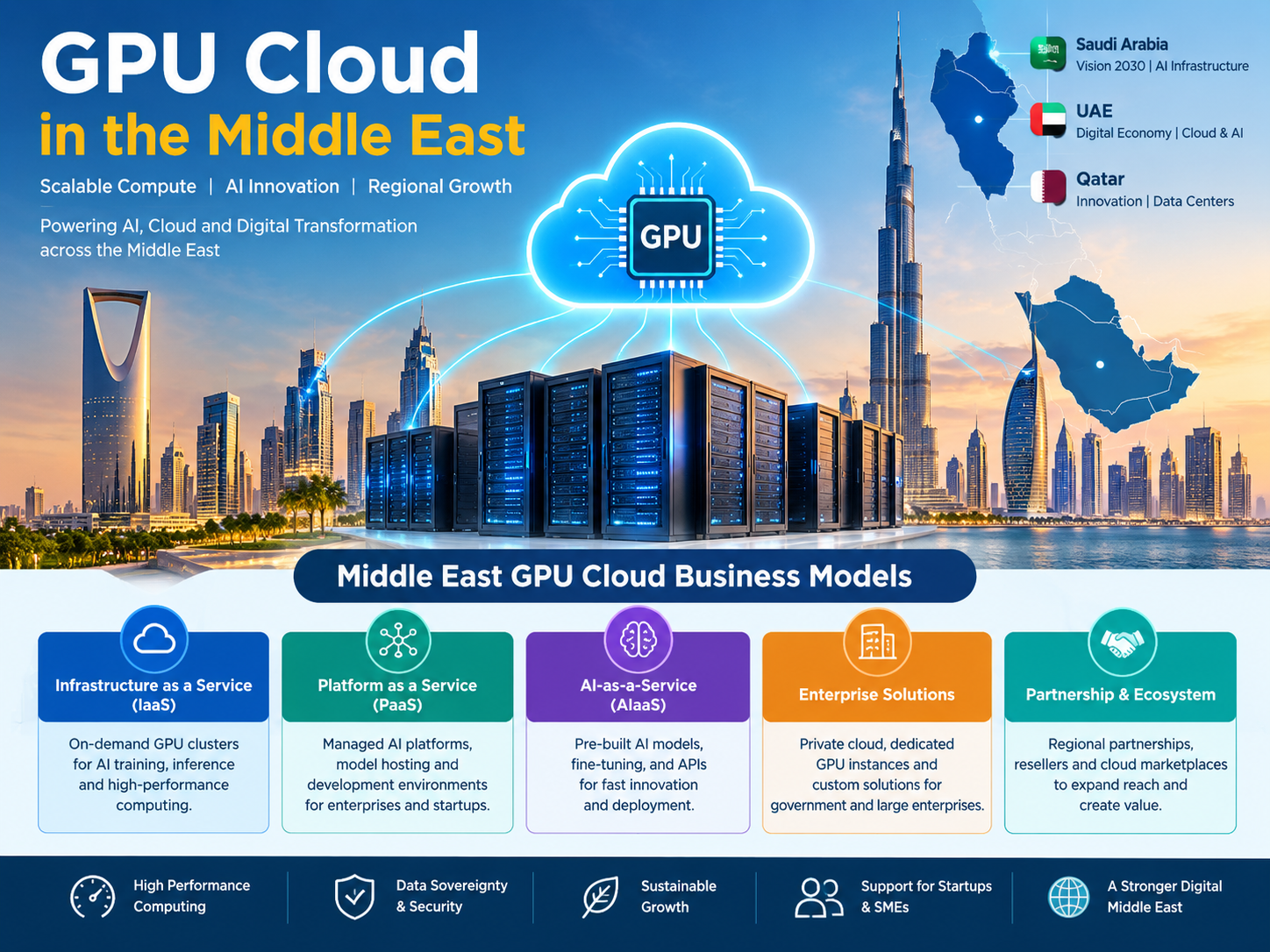
GPU cloud Middle East services are giving GCC organizations a practical alternative to owning and operating expensive AI infrastructure. Instead of building every GPU cluster in-house, companies can rent accelerated compute through GPUaaS, reserved capacity, sovereign cloud, bare-metal infrastructure, and managed inference platforms.
For businesses in Saudi Arabia, the UAE, and Qatar, the decision is no longer simply “cloud or on-premises.” The real question is which compute model offers the right balance of performance, cost, data residency, operational control, and scalability.
That matters for Saudi fintech, UAE enterprises, Qatar government workloads, logistics, healthcare, retail, and Arabic AI projects. For deeper infrastructure context, see Mak It Solutions’ AI supercomputing platforms GCC guide.
What Is GPU Cloud in the Middle East?
AI Compute as a Service gives organizations access to GPUs and AI-optimized infrastructure without requiring them to purchase, install, cool, network, and manage the underlying hardware themselves.
GPU cloud and GPU-as-a-Service, or GPUaaS, are the commercial models buyers usually recognize. AI Compute as a Service is broader: it can include infrastructure, orchestration, model hosting, inference, managed platforms, and supporting AI operations.
AI Compute as a Service vs Traditional Cloud
Traditional cloud infrastructure is designed for a wide range of applications, databases, websites, and enterprise systems.
A GPU cloud Middle East platform is more specialized. It focuses on accelerated computing, high-performance storage, dense GPU clusters, low-latency networking, orchestration, and infrastructure designed for AI training, fine-tuning, and production inference.
Why GPU Infrastructure Is Becoming a Service
Building modern NVIDIA or AMD GPU clusters involves more than buying accelerators. Organizations also need networking, cooling, power capacity, storage, orchestration, security controls, skilled operators, and an upgrade strategy.
That creates both capital and utilization risk. A cluster that is heavily used can make financial sense; one that sits idle quickly becomes an expensive asset.
Renting converts more of that infrastructure commitment into operating expenditure and can shorten deployment time. Mak It Solutions’ FinOps for AI guide covers the related economics of controlling GPU spend.
Why the Model Matters in Riyadh, Dubai, Abu Dhabi, and Doha
The Gulf is not developing as one uniform GPU market.
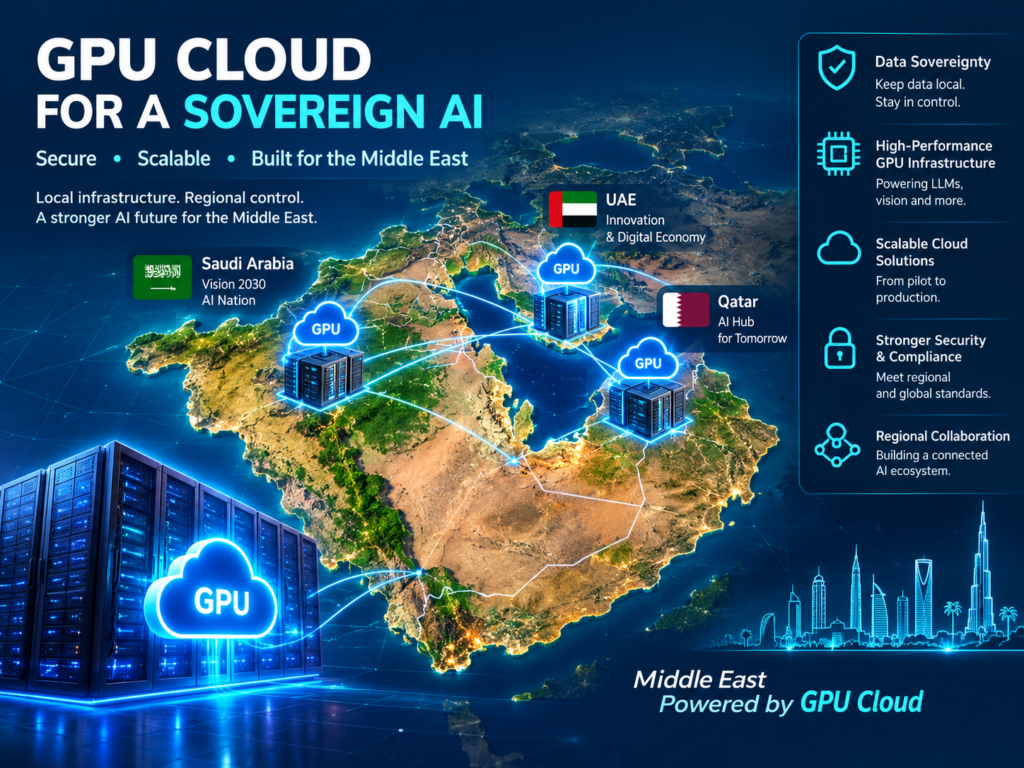
Saudi Arabia is emphasizing large-scale AI infrastructure and national AI capacity. The UAE has an increasingly commercial ecosystem for sovereign AI and GPU services. Qatar is expanding locally hosted AI infrastructure for organizations that value local data control.
Those differences affect procurement, pricing, compliance, architecture, and where workloads should run. Regional data-center economics are explored further in the Middle East data centers guide.
GPU Cloud Middle East Business Models Emerging Across the GCC
Providers are moving beyond simple hourly GPU rental. GCC buyers can now encounter several commercial models, each suited to a different workload profile.
Pay-as-you-go GPUaaS: useful for experimentation, pilots, fine-tuning, and variable workloads.
Reserved GPU capacity: better suited to predictable production workloads that require dependable availability.
Dedicated clusters: provide more consistent performance and isolation for larger customers.
Sovereign cloud and bare metal: designed for workloads that need stronger local control, residency, or infrastructure isolation.
Managed inference: shifts operational responsibility for production model serving toward the provider.
Model and AI platform services: bundle compute with model access, APIs, orchestration, RAG tooling, governance, and deployment services.
The best model depends less on the advertised GPU-hour price and more on utilization, availability, data requirements, operational responsibility, and total workload cost.
Pay-as-You-Go vs Reserved GPU Capacity
On-demand capacity is attractive when teams are still testing models or cannot reliably predict usage.
Reserved capacity becomes more interesting once production demand is stable. It can provide greater certainty around accelerator availability and budgeting, although longer commitments reduce flexibility.
Core42, for example, currently describes consumption options that include on-demand GPUaaS, large-scale clusters, and inference-based pricing.
Sovereign GPU Cloud and Bare-Metal AI
Sovereign AI infrastructure is designed to provide stronger control over where workloads, data, and infrastructure are operated.
That can be especially relevant to government bodies, financial institutions, healthcare organizations, and enterprises handling sensitive information.
In practice, however, “sovereign” should not be treated as a compliance shortcut. Buyers still need to verify jurisdiction, administrator access, subcontractors, encryption, audit rights, business continuity, and data movement.
Inference, Model-as-a-Service, and GPU PaaS
The commercial opportunity is moving up the stack.
Instead of selling only GPU capacity, providers increasingly package inference APIs, model hosting, fine-tuning, RAG services, governance tools, and managed AI operations with the underlying compute.
That model can appeal to organizations that want AI capabilities without building a full infrastructure and MLOps team internally.
Saudi Arabia vs UAE vs Qatar: How the Markets Differ
Saudi Arabia.
Saudi Arabia’s opportunity is strongly linked to large AI data centers, AI factories, high-density clusters, sovereign capacity, and the broader localization of AI infrastructure.
HUMAIN is one of the clearest signals of that direction. PIF launched the company on 12 May 2025, with a mandate spanning next-generation data centers, AI infrastructure, cloud capabilities, AI models, and applications.
For buyers in Riyadh, Jeddah, Dammam, and other major Saudi business centers, this creates a growing range of possibilities around local compute, dedicated capacity, managed platforms, and infrastructure partnerships.
UAE.
Dubai and Abu Dhabi have developed a visible commercial market around GPU cloud, sovereign AI, hyperscale infrastructure, and managed AI services.
Core42’s current Sovereign AI Cloud supports multiple accelerator families and advertises NVIDIA H100, H200, and B200 capacity alongside other architectures. Its platform also includes high-speed networking, Kubernetes and Slurm orchestration, managed inference, and UAE-focused data-sovereignty controls.
That makes the UAE particularly relevant for enterprises that need a mix of infrastructure flexibility, managed AI services, and regional hosting options.
Qatar.
Qatar’s GPU market is developing around locally hosted AI infrastructure, sovereign cloud, AI BareMetal, and managed services.
Ooredoo states that its NVIDIA-based AI offering is locally hosted in Qatar and includes Hopper GPU infrastructure designed for training and inference. The infrastructure is hosted by Ooredoo and operated by Syntys.
For organizations in Doha, local hosting can be especially valuable where data location, latency, or regulatory requirements make overseas infrastructure less attractive.
Sovereignty, Data Residency, and GCC Compliance
Sovereignty is one of the biggest reasons the Gulf AI infrastructure market looks different from a purely global public-cloud market.
A technically powerful GPU cluster is not automatically suitable for every workload. Buyers also need to understand what data is being processed, where it resides, who can access it, and which regulator or contractual framework applies.
Saudi Data Governance and Regulated AI Workloads
Saudi organizations may need to consider requirements from bodies such as SDAIA, NDMO, MCIT, the Digital Government Authority, and sector-specific regulators.
Financial institutions require particular care. SAMA’s cloud controls address areas including risk assessment, provider due diligence, contracts, security, data location, audit rights, business continuity, and exit arrangements. The rulebook also states that SAMA member organizations should, in principle, use cloud services located in Saudi Arabia unless approval is obtained for services outside the Kingdom.
UAE Sovereign Cloud and Financial Free Zones
UAE organizations may need to consider federal requirements as well as rules relevant to their industry or jurisdiction, including frameworks associated with entities such as TDRA, the UAE Cyber Security Council, Digital Dubai, ADGM, or DIFC where applicable.
For regulated workloads, the provider’s marketing label is only the starting point. Buyers should confirm the actual hosting location, operational control model, administrator access, encryption, subcontracting arrangements, disaster recovery, and cross-border data flows.
Qatar Data Residency and Local Cloud Governance
Qatar organizations should map their workloads against the requirements that apply to their sector, including QCB obligations for regulated financial entities.
QCB cloud requirements address issues such as data processing location, provider assessment, cloud security, and regulatory approval. Its Cloud Computing Regulation states that covered entities must ensure PII and financial information is processed within Qatar and must receive QCB approval before entering a cloud arrangement.
For banks, QCB technology-risk guidance also addresses provider contracts, geography and jurisdiction, security monitoring, cloud migration, exit planning, and critical-data protection.
Regulatory requirements vary by organization, workload, and sector. This article provides general infrastructure guidance and should not be treated as legal or regulatory advice.
When Should a GCC Company Rent GPUs Instead of Buying Them?
A GCC company should generally consider renting when demand is uncertain, deployment speed matters, accelerator requirements are changing quickly, or maintaining high hardware utilization would be difficult.
Buying can make more sense when workloads are stable and continuous, the organization has strong infrastructure expertise, and long-term utilization is high enough to justify capital investment.
CapEx, Utilization, and GPU Lifecycle Risk
Ownership gives an organization maximum infrastructure control, but it also transfers hardware lifecycle and utilization risk to the buyer.
GPU cloud provides more flexibility, but flexibility is not automatically cheaper. A workload running continuously for a long period may make reserved capacity, dedicated infrastructure, or owned hardware more attractive.
The right comparison is therefore total cost of ownership, not simply the hourly rental rate. The GCC cloud cost optimization guide covers this wider cost discipline.
Training vs Inference Requirements
Training and inference often have very different consumption patterns.
Model training, experimentation, and fine-tuning may create short periods of intense demand, making on-demand infrastructure attractive. Production inference can be far steadier, particularly for customer-facing copilots, recommendation systems, RAG applications, or enterprise automation.
Once inference becomes predictable, reserved capacity or dedicated infrastructure may produce a better operational and financial fit.
Hybrid designs can also combine cloud infrastructure with on-device AI inference.
Latency, Data Location, and Arabic AI Requirements
GPU selection should not happen in isolation.
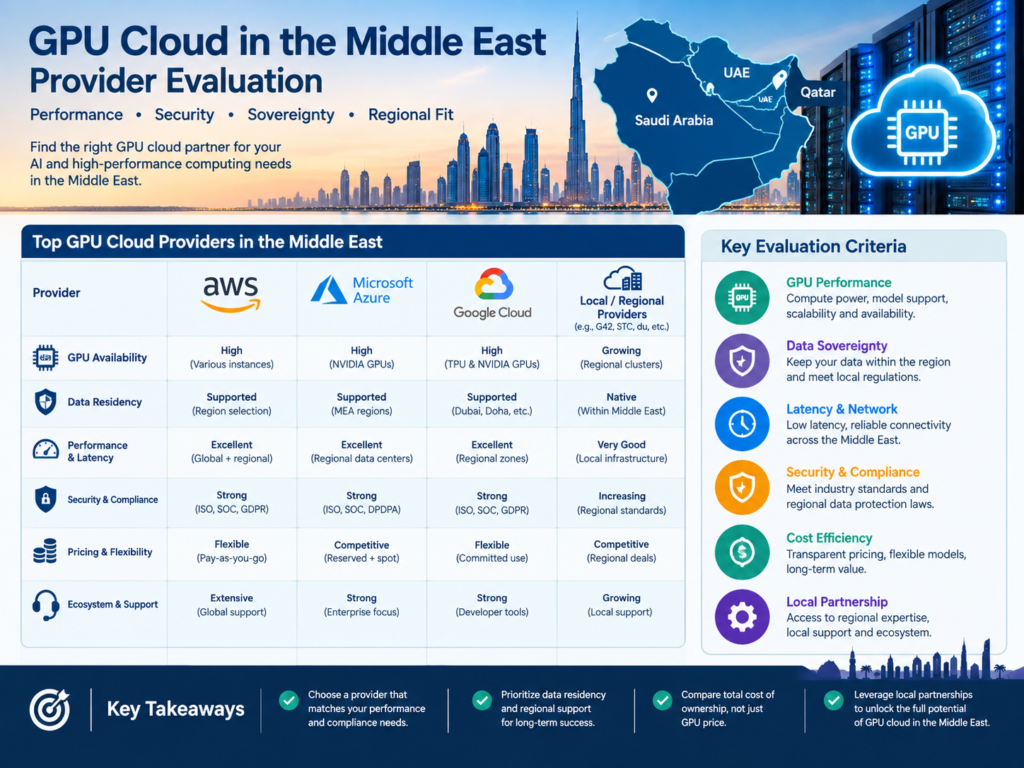
GCC buyers may need to compare regional hyperscaler locations such as AWS Bahrain, Azure UAE Central, and Google Cloud Doha with in-country or sovereign providers.
The architecture may involve NVIDIA or AMD accelerators, InfiniBand or Ethernet networking, Kubernetes, Slurm, high-performance storage, and model-serving infrastructure. Arabic-language model quality, local latency, data location, and operational support can be just as important as raw GPU specifications.
For a broader comparison, see the AWS vs Azure vs Google Cloud guide.
How to Evaluate a GPU Cloud Middle East Provider
A strong procurement process should start with the workload rather than the provider brochure.
Define the Workload
Identify whether the environment will support training, fine-tuning, RAG, batch processing, experimentation, or continuous inference.
Estimate memory needs, expected utilization, scaling patterns, and whether the workload requires multi-GPU or multi-node performance.
Classify Data and Residency Requirements
Determine which datasets are public, internal, confidential, regulated, or subject to specific residency requirements.
Map those classifications to the countries and infrastructure environments where the workload is allowed to run.
Verify Real GPU Capacity
Ask what accelerator generations are actually available—not simply what appears in a product catalog.
Check cluster scale, allocation times, reservation options, networking, storage throughput, redundancy, and whether capacity is suitable for production.
Review Security and Compliance
Confirm encryption, privileged-access controls, tenant isolation, auditability, certifications, incident response, data deletion, business continuity, and subcontractor policies.
For regulated organizations, map those controls directly against the applicable regulator’s requirements.
Calculate Total Cost of Ownership
Compare more than the GPU-hour rate.
Include reservations, storage, networking, data transfer, orchestration, engineering time, support, managed services, unused capacity, and potential migration costs.
Examine Contracts and Exit Terms
Review minimum commitments, service levels, capacity guarantees, termination provisions, data portability, support responsibilities, and what happens if the organization needs to change providers.
These questions become very practical at a local level. A Riyadh fintech may need to map cloud controls to SAMA requirements. A Dubai e-commerce company may reserve inference capacity for recommendation or personalization workloads. A Doha enterprise handling sensitive information may prioritize locally hosted infrastructure.
Analytics teams can monitor usage and business outcomes through business intelligence services.
Where AI Compute as a Service Goes Next in the GCC
From GPU Rental to Full AI Infrastructure Platforms
GPU rental is becoming only one layer of the market.
Providers are increasingly combining accelerated infrastructure with inference, model APIs, fine-tuning, RAG tooling, observability, orchestration, security, and governance.
For buyers, that can reduce operational complexity. It also makes provider comparison harder because two services using the same GPU may offer very different capabilities around the hardware.
Telcos, Sovereign Clouds, and AI Factories Will Converge
The GCC AI ecosystem is increasingly connecting telecom operators, data-center developers, accelerator vendors, hyper scalers, sovereign-cloud providers, and government-backed AI initiatives.
The result is likely to be a market where customers buy combinations of infrastructure, connectivity, models, and managed services rather than isolated GPU instances.
Reliable Local Capacity Will Be the Competitive Advantage
For serious production workloads, the winning provider is not necessarily the one with the most impressive accelerator name.
Reliable capacity matters. So do power, cooling, network performance, storage, data residency, security, regulatory confidence, Arabic AI support, operational expertise, and contract flexibility.

Concluding Remarks
GPU cloud Middle East is becoming far more than hourly GPU rental.
Saudi Arabia is building for infrastructure scale and a broader national AI ecosystem. The UAE offers a commercially active mix of sovereign AI and GPU services, while Qatar is strengthening locally hosted compute for organizations that value residency and control.
For GCC buyers, the strongest architecture will be the one that matches GPU performance with actual business demand, utilization, compliance requirements, data location, and total cost.
Planning a GCC AI workload or comparing sovereign GPU options? Contact Mak It Solutions to assess your architecture, infrastructure economics, data-residency requirements, and deployment strategy across Saudi Arabia, the UAE, or Qatar.
FAQs
Q : Is GPU cloud suitable for Saudi companies with data-residency requirements?
A : Yes, provided the selected architecture and provider meet the organization’s applicable legal, cybersecurity, and sector-specific requirements.
Saudi organizations should classify their data before choosing a GPU location and document cross-border flows. SAMA-regulated organizations need additional attention because cloud requirements include provider due diligence, security, contracts, data location, audit rights, and regulatory approval.
Q : What is the difference between sovereign GPU cloud and regular cloud in the UAE?
A : Regular public cloud is primarily designed around scalable shared infrastructure and broad cloud services.
Sovereign GPU cloud adds stronger controls around jurisdiction, residency, infrastructure governance, and sensitive-data handling. Buyers should still verify encryption, administrator access, subcontractors, audit rights, disaster recovery, and data movement rather than relying on the word “sovereign” alone.
Q : Can Qatar enterprises run NVIDIA GPU workloads inside Qatar?
A : Yes. Ooredoo states that its sovereign AI offering provides locally hosted NVIDIA Hopper GPU infrastructure in Qatar for AI training and inference, with infrastructure hosted by Ooredoo and operated by Syntys.
Organizations should still verify current capacity, pricing, redundancy, security controls, and any sector-specific regulatory requirements before procurement.
Q : Which GPU cloud pricing model works best for GCC AI startups?
A : On-demand infrastructure generally suits early experimentation because usage is still uncertain.
Once production inference becomes predictable, reserved or dedicated capacity may offer greater cost and availability certainty. Startups should compare total cost per useful workload rather than making the decision from the advertised GPU-hour price alone.
Q : How should GCC banks evaluate sovereign AI infrastructure providers?
A : Banks should combine technical benchmarking with regulatory and vendor-risk assessment.
Key areas include data location, privileged access, encryption, segmentation, audit rights, incident reporting, disaster recovery, subcontractors, provider exit procedures, GPU capacity, latency, and total cost. Saudi institutions should map deployments to applicable SAMA requirements, while Qatar-regulated institutions should review relevant QCB rules.