
Private AI Infrastructure: GCC Compliance Guide
Private AI Infrastructure: GCC Compliance Guide
Private AI Infrastructure: GCC Compliance Guide
Private AI infrastructure gives GCC banks and government organizations greater control over where AI models, prompts, embeddings and sensitive institutional data are processed and stored. For organizations in Saudi Arabia, the UAE and Qatar, that control can improve security, data sovereignty, auditability and governance—but private architecture alone does not guarantee regulatory compliance.
As generative AI moves from experimentation into real banking and government workflows, this distinction matters. Financial records, citizen documents, internal policies and Arabic knowledge bases require a very different risk model from ordinary SaaS workloads.
For GCC leaders, private AI infrastructure offers a practical route to private LLM deployment, local AI inference and controlled enterprise AI adoption while reducing unnecessary third-party exposure.
What Is Private AI Infrastructure?
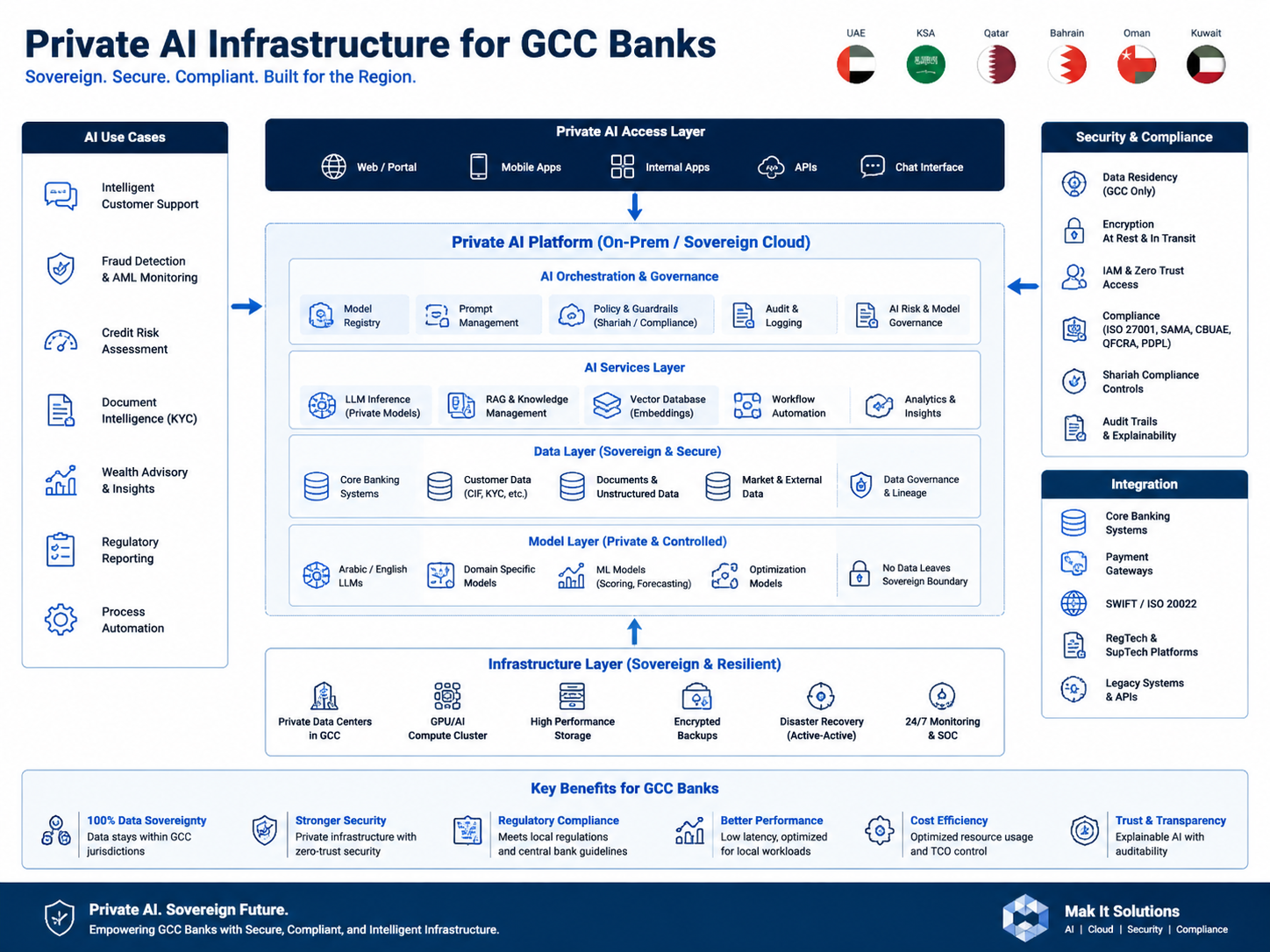
Private AI infrastructure is an AI environment in which the organization maintains significant control over compute, models, data, identities, networks and monitoring.
Depending on the architecture, it can host LLM inference, retrieval-augmented generation (RAG), vector databases and enterprise AI applications while giving security teams tighter control over.
Prompts and model inputs
Sensitive document storage
Encryption keys
User and service permissions
Audit logs
Network connectivity
Model repositories
Processing locations
Data retention
Organizations evaluating larger GPU environments can also review Mak It Solutions’ AI supercomputing platforms GCC guide.
Private AI vs Sovereign AI vs Public-Cloud AI
These terms are related, but they are not interchangeable.
Private AI focuses on organizational control, isolation and restricted access.
Sovereign AI adds questions of jurisdiction, localization, national control and where infrastructure or data is operated.
Public-cloud AI typically uses managed hyperscale infrastructure and services.
In practice, the boundaries can overlap. A private AI environment may run on-premise, in a private cloud, within sovereign infrastructure or as part of a carefully designed hybrid environment.
Why Private AI Infrastructure Matters in the GCC
GCC organizations often need to consider more than raw model performance.
Architecture decisions may also involve.
Data residency and localization
Regulatory oversight
Arabic and bilingual workloads
Restricted or segmented networks
Third-party access
Critical infrastructure requirements
Audit evidence
Operational resilience
Regional cloud availability can also influence deployment choices. Organizations should verify current service and region availability directly with providers; AWS, for example, maintains its official regions and availability documentation.
Why GCC Banks and Government Agencies Need Private AI Infrastructure
Protect Sensitive Financial and Government Data
Generative AI may interact with customer information, legal documents, internal policies, citizen records and confidential institutional knowledge.
Sending that information through uncontrolled AI services can introduce risks that do not exist in traditional application workflows.
A private environment can reduce exposure by keeping selected data flows, retrieval systems and model interactions inside infrastructure governed by the organization.
Mak It Solutions’ AI data leakage prevention guide provides additional context on prompt and data exposure risks.
Control Models, Prompts and Third-Party Exposure
A serious private AI assessment should go beyond asking where the model is hosted.
Buyers should understand.
Where prompts and retrieved documents travel
Who operates the underlying infrastructure
Who can access production environments
Who controls KMS or HSM encryption keys
Which subprocessors may participate
Whether external model APIs are required
How access can be revoked
What audit evidence is available
A strong zero-trust architecture can reinforce these controls by limiting implicit trust between users, services and infrastructure components.
Support Arabic AI and Private RAG
Private RAG is especially relevant for GCC organizations with large Arabic and bilingual knowledge bases.
A Saudi bank, for example, may need an internal assistant to search Arabic compliance policies. A UAE government team may need controlled access to Arabic-English procedures. A Qatar enterprise may want employees to query internal documentation without sending its entire knowledge base to an uncontrolled external service.
Private infrastructure can support these use cases while allowing the organization to decide which documents, models and users are permitted inside the retrieval workflow.
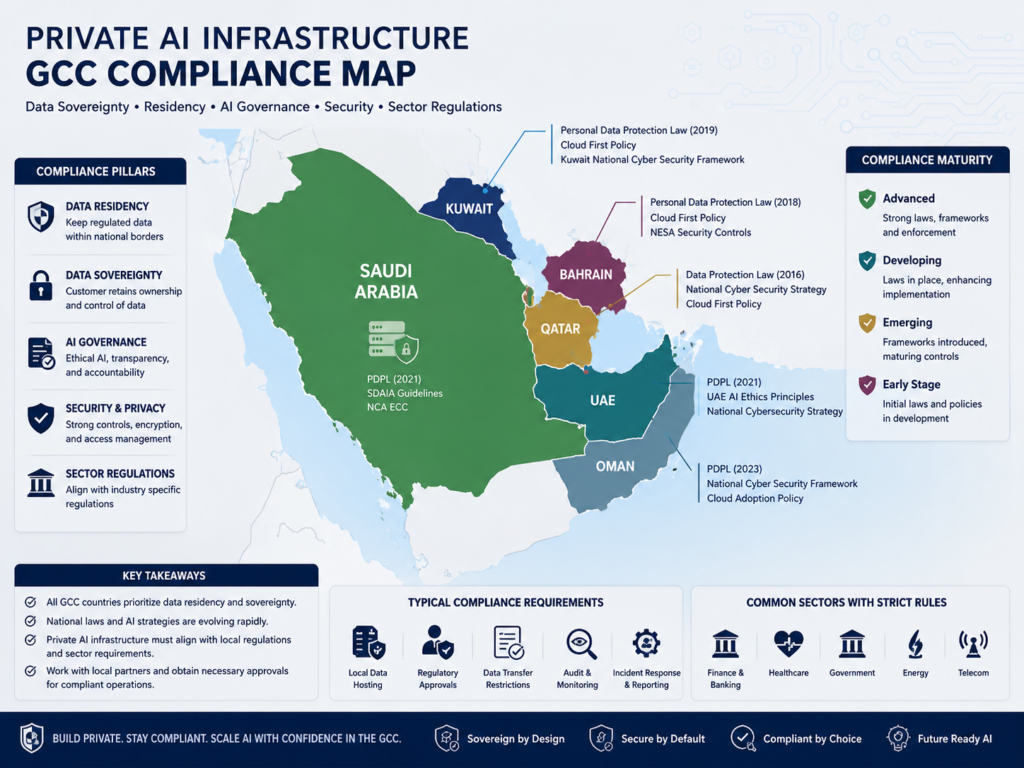
GCC Compliance, Data Residency and AI Governance
Private architecture can support regulatory and governance objectives, but it should not be treated as proof of compliance.
A system does not become SAMA-, CBUAE- or QCB-compliant simply because it runs privately.
Technical architecture still needs to be mapped to applicable legal, regulatory, cybersecurity, outsourcing, privacy and governance requirements.
Saudi Arabia.
Saudi banks should assess how private AI architecture fits relevant SAMA requirements, NDMO/SDAIA data-governance obligations, NCA cybersecurity controls and applicable PDPL requirements.
The SAMA Cyber Security Framework provides a framework for managing cybersecurity risk, while NCA maintains cybersecurity controls relevant to cloud and critical environments.
Architecture teams should therefore connect technical AI controls with documented governance, risk ownership and regulatory evidence.
For implementation context, see Mak It Solutions’ GCC cloud security misconfiguration guide.
UAE.
For UAE banks, private AI decisions may intersect with outsourcing, confidential-data access, subcontractor management, security controls and supervisory expectations.
The CBUAE Outsourcing Regulation for Banks places continuing responsibility on banks for outsourced activities and emphasizes appropriate due diligence and oversight.
That means a third-party AI model is not only a technology choice. It can also become a security, governance, contractual and outsourcing decision.
Organizations operating in DIFC, ADGM or other regulated environments should separately map the architecture to the requirements that apply to their entity and use case.
Qatar.
Qatar financial institutions should evaluate how AI deployment fits relevant technology-risk and governance expectations.
The QCB Artificial Intelligence Guideline emphasizes accountability and governance around AI systems, including the role of boards and senior management.
For a Doha organization, this makes AI governance an operational responsibility rather than a policy document that sits separately from technology.
Model ownership, vendor oversight, security, human review, monitoring and escalation should work together.
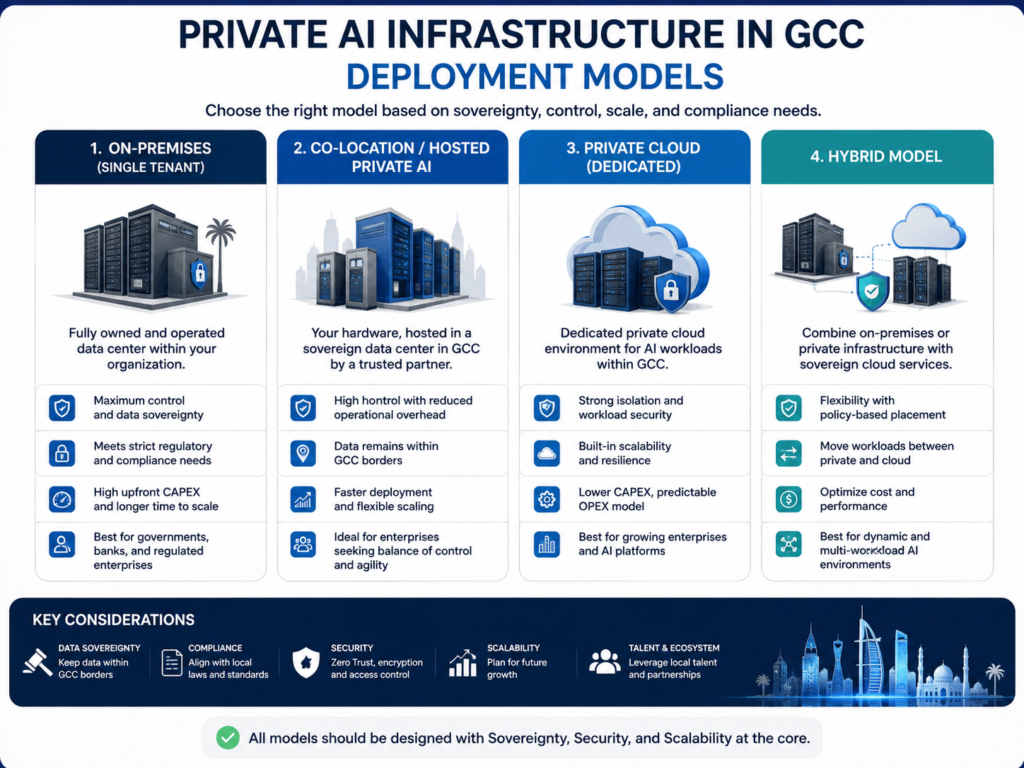
Private AI Deployment Models for GCC Organizations
There is no single deployment model that fits every bank, ministry or enterprise.
The right architecture depends on data sensitivity, connectivity requirements, internal capabilities, regulatory obligations and operational risk.
On-Premise AI
On-premise environments can place GPUs, model servers, vector databases, identity controls and logging inside infrastructure operated directly by the organization.
This model may suit workloads where direct infrastructure control is a priority.
Air-Gapped AI
Air-gapped environments take isolation further by limiting or removing external network connectivity.
They may be appropriate for highly restricted government repositories, critical systems or specialized banking environments where public API access is unacceptable.
The trade-off is operational complexity. Teams still need processes for model updates, vulnerability management, secure data ingestion, monitoring and key management.
Private or Sovereign Cloud AI
Organizations may also evaluate private or sovereign cloud environments where local operational control, jurisdiction or data location is important.
The key is to evaluate the actual control model rather than relying on the word “sovereign” or “private” in a service description.
Ask who operates the environment, who has privileged access, where backups reside, which external dependencies remain and how the platform can be audited.
Hybrid AI Architecture
Hybrid AI can keep higher-risk data and workloads in controlled environments while allowing approved lower-risk functions to use managed services.
Done well, hybrid architecture can provide flexibility without treating every workload as equally sensitive.
Data classification, IAM, APIs, encryption, RAG, monitoring and disaster recovery should be designed together. Mak It Solutions’ GCC cloud disaster recovery guide covers related resilience considerations.
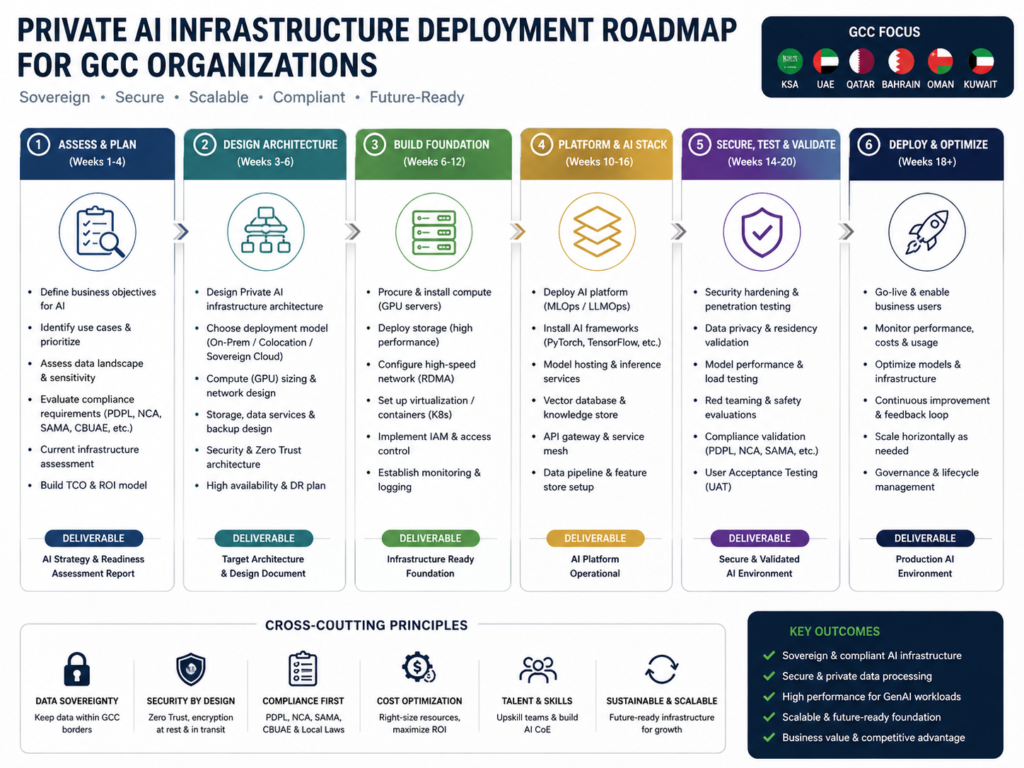
How to Deploy Private AI Infrastructure in the GCC
Classify the AI Use Case and Data
Start with the business process, not the GPU.
Identify what information the AI system will receive, retrieve, generate or store. Separate public, internal, confidential, regulated and highly restricted information according to the organization’s own classification framework.
Define AI Governance
Assign clear responsibility for model ownership, data access, monitoring, audit, legal review, compliance and escalation.
IT, cybersecurity, risk, compliance, legal and business teams should understand where their responsibilities begin and end.
Select the Deployment Model
Choose the architecture that matches the risk profile.
That may be on-premise, air-gapped, private cloud, sovereign infrastructure or hybrid AI.
The most expensive or isolated option is not automatically the best one. The architecture should be proportionate to the workload.
Build the Security Architecture
Design the controls around the data classification and threat model.
Typical areas include.
Network segmentation
IAM and privileged access
Encryption
BYOK
KMS or HSM
Secure model repositories
Private vector databases
Logging and monitoring
API controls
Backup and disaster recovery
Pilot a Controlled Use Case
Start with a narrowly defined workload rather than launching an enterprise-wide assistant immediately.
An Arabic internal policy assistant, for example, can provide a useful test of document ingestion, retrieval quality, access controls, logging and model behavior.
Validate Before Scaling
Before moving into wider production, test security, retrieval quality, output accuracy, performance, governance and operational readiness.
Define measurable criteria so stakeholders can determine whether the deployment is actually improving the target workflow.
Mak It Solutions’ business intelligence services can also support operational reporting and measurement.
Practical GCC Use Cases
Private AI infrastructure can support scenarios such as.
A Riyadh fintech keeping regulated customer knowledge inside a private RAG environment while aligning controls with relevant SAMA requirements.
A Dubai business isolating customer information while using AI to support approved service and operational workflows.
A Doha organization using local infrastructure for selected workloads while documenting data location and governance responsibilities.
An Abu Dhabi government team operating a restricted Arabic document assistant with private identity, logging and controlled model access.
These are architecture patterns, not compliance guarantees. Each deployment still needs its own legal, regulatory and risk assessment.
How to Choose a Private AI Infrastructure Partner
The quality of the architecture often depends as much on operational ownership as it does on the technology stack.
Evaluate Sovereignty, Security and Control
Ask potential partners.
Where will data be processed and stored?
Are external model APIs required?
Who owns and controls encryption keys?
Can the system operate without public internet access?
Who has privileged administrative access?
What information leaves the environment?
Can the platform produce complete audit evidence?
How are model updates and vulnerabilities handled?
Look for GCC Regulatory and Arabic AI Experience
A partner working with regulated GCC organizations should understand that Saudi, UAE and Qatar environments are not interchangeable.
Useful experience may include.
Banking and fintech architecture
Government security requirements
Data residency
Third-party risk
Arabic LLM evaluation
Arabic and bilingual RAG
Secure enterprise search
Audit and governance workflows
Compare Total Cost and Operational Ownership
GPU price alone does not represent the true cost of private AI.
Organizations should also consider storage, networking, power, software licensing, security tooling, MLOps, support, monitoring, governance and the internal skills required to operate the platform.
For sensitive workloads, Mak It Solutions‘ confidential computing guide provides further context on protecting data during processing.
Private AI Infrastructure Is a Governance Decision, Not Just an IT Project
Private AI infrastructure gives GCC banks and government organizations a stronger foundation for controlling data, models, infrastructure, identities and AI operations.
But the real value comes from combining architecture with governance.
Saudi organizations need to align technical controls with applicable local cybersecurity, privacy and banking requirements. UAE organizations need to consider outsourcing, vendor access and regulatory accountability. Qatar institutions need clear AI ownership, oversight and risk management.
The best design is not necessarily the most isolated one. It is the architecture that gives the organization the right level of control for each workload and enough visibility to prove that those controls are working.
Final Thoughts
Private AI infrastructure gives GCC banks and government organizations a practical way to adopt generative AI while maintaining stronger control over sensitive data, models, identities, and operational risk. For organizations in Saudi Arabia, the UAE, and Qatar, the right architecture can support security, sovereignty, auditability, and regulatory governance without assuming that private deployment automatically guarantees compliance.
The strongest approach combines technology with clear governance, data classification, access controls, monitoring, and accountable ownership. By choosing the right mix of on-premise, sovereign, private cloud, or hybrid infrastructure, GCC organizations can scale AI more confidently while protecting critical information and meeting evolving requirements.
Before moving generative AI into production, decide which workloads belong in private, sovereign, hybrid or on-premise environments.
Contact Mak It Solutions to discuss a private AI infrastructure assessment, proof of concept or customized GCC deployment strategy.
FAQs
Q : What should Saudi banks review under SAMA before deploying generative AI?
A : Saudi banks should assess how an AI use case affects information assets, cybersecurity risk, user access, third parties, logging, data classification and operational resilience.
The SAMA Cyber Security Framework provides relevant cybersecurity guidance, while applicable NCA, data-governance and privacy requirements may also need to be considered. Private infrastructure can strengthen technical control, but governance, assessment, approvals and evidence are still required.
Q : Can UAE banks use third-party AI models?
A : Potentially, but the arrangement should be assessed against applicable CBUAE obligations and the bank’s internal risk framework.
Teams should understand where confidential information is processed, which providers or subcontractors can access it, how data is protected and how the service can be audited or exited. The CBUAE outsourcing rules should be considered where relevant.
Q : What AI governance controls should Qatar financial institutions consider?
A : Qatar financial institutions should establish clear accountability, ownership, risk tolerance, monitoring and human oversight around AI systems.
The QCB Artificial Intelligence Guideline provides governance context. In practice, AI governance should connect model management with data classification, vendor oversight, access control, monitoring and escalation.
Q : Can GCC government agencies run private LLMs on air-gapped infrastructure?
A : Yes, private LLMs can technically operate in isolated environments when the required models, GPU infrastructure, vector databases, identity systems and application components are deployed locally.
However, isolation does not remove operational responsibilities. Teams still need secure processes for updates, vulnerability management, logging, encryption keys and data ingestion. Applicable cybersecurity requirements, including relevant NCA controls, should also be assessed.
Q : Can private AI support Arabic RAG in Saudi Arabia, the UAE and Qatar?
A : Yes. Private AI infrastructure can support Arabic and bilingual RAG using controlled LLMs, embedding models, vector databases and approved institutional documents.
Performance will still depend on model quality, document preparation, Arabic embeddings and evaluation. Organizations should test Gulf terminology, retrieval accuracy, citations and relevant language variations before production use.