


Enterprise AI Agents: The Future Beyond the App
Enterprise AI Agents: The Future Beyond the App
Enterprise AI Agents: The Future Beyond the App
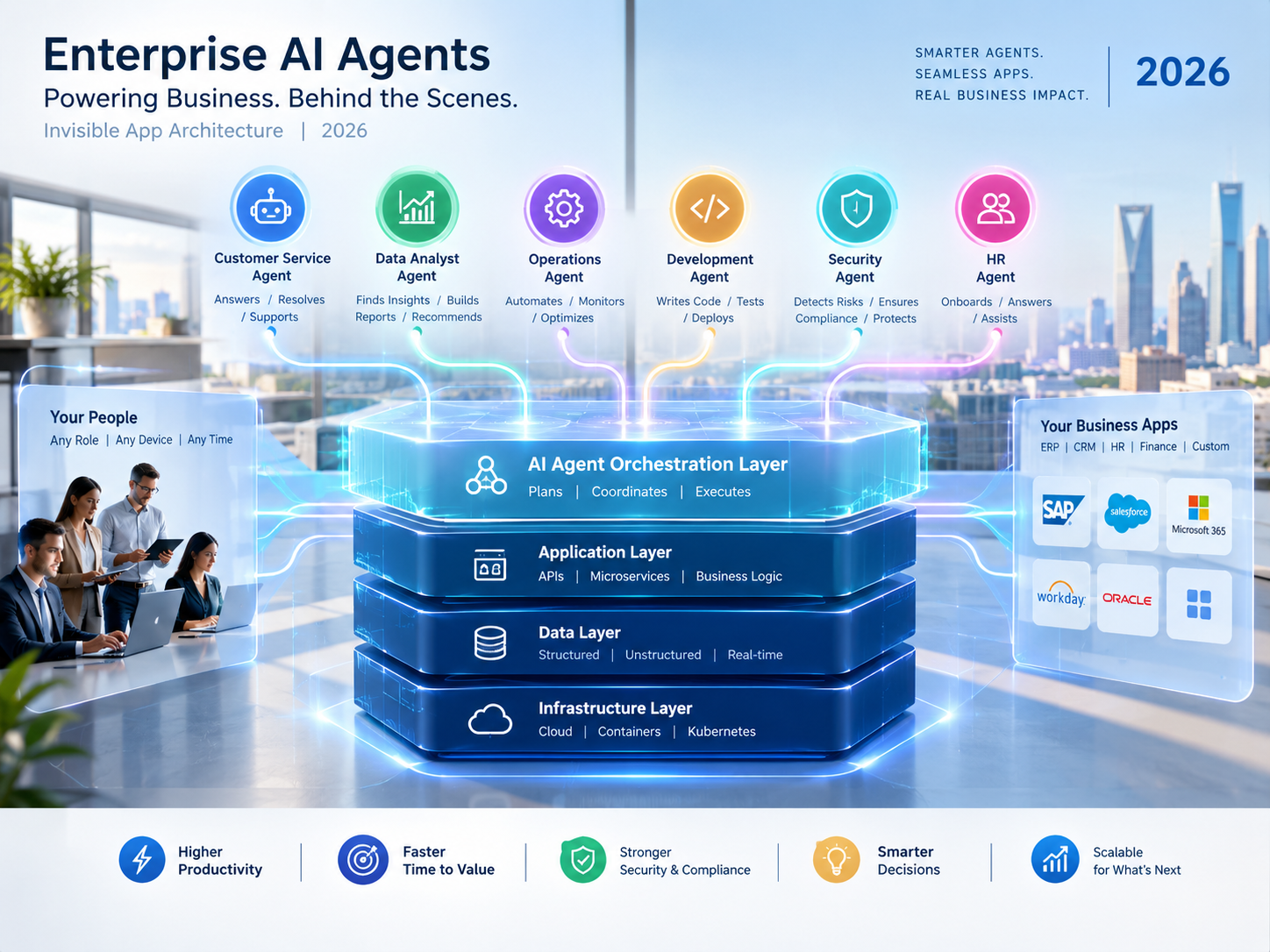
Enterprise AI agents are changing how employees interact with business software. Instead of opening several applications, switching tabs and manually moving information from one system to another, employees can increasingly describe an outcome and let an agent coordinate the approved systems needed to complete it.
That does not mean ERP, CRM, finance, HR or other enterprise platforms are disappearing. The more likely shift is simpler: agents become the interface, while enterprise applications remain the systems of record, business logic and control underneath.
Enterprise AI Agents and the Invisible-App Shift
Enterprise software is likely to become less visible before it becomes obsolete.
The emerging model places an intelligent orchestration layer between employees and the applications holding company data, permissions, workflows and transactions. A user may interact with one agent while several systems quietly participate in the background.
Will Enterprise Applications Actually Disappear?
Probably not.
An employee might ask an agent to investigate an invoice exception, prepare a renewal update or resolve a customer request without manually opening an ERP or CRM screen. The underlying platforms can still remain responsible for validating data, enforcing permissions and recording the final transaction.
That is the essence of the invisible-app shift:
Agents handle intent and coordination. Applications continue to provide execution, context and control.
The economic implications could be significant. Gartner said in July 2026 that up to $234 billion in enterprise application spending could be exposed to what it calls “agentic arbitrage” by 2030—roughly 20% of enterprise application SaaS spending.
Why the Enterprise Software Model Is Changing Now
The conversation around AI has moved beyond model quality. Enterprises are now asking how AI can redesign real workflows.
McKinsey’s 2025 global survey found that 88% of respondents said their organizations were using AI in at least one business function, compared with 78% a year earlier. Most organizations, however, were still experimenting or piloting rather than operating AI at full enterprise scale.
Deloitte has also reported that 26% of surveyed organizations were exploring agentic AI to a large or very large extent.
For organizations moving from experimentation to implementation, Mak It Solutions’ enterprise AI agents practical guide provides a broader deployment perspective.
What Agent-First Enterprise Software Actually Means
Agent-first enterprise software puts an intelligent layer between employees and many traditional application interfaces.
The ERP, CRM or service-management platform still matters. It provides the trusted data, transaction logic, permissions, APIs and governance that an agent should not invent for itself.
From SaaS Screens to Agent-Led Workflows
Traditional SaaS requires users to translate a business goal into application-specific actions: open a module, find a record, change a field, submit an approval and repeat the process in another system.
Agent-led workflows reverse that relationship.
The employee describes the desired outcome. AI agent orchestration then determines which approved applications, tools and processes need to participate.
The experience moves from screen-driven computing toward outcome-driven computing.
Why ERP and CRM Remain Critical Systems of Record
Platforms from Salesforce, SAP, Microsoft, Oracle, Workday, ServiceNow and other enterprise vendors often contain the authoritative state of the business: customers, employees, orders, approvals, contracts, entitlements and financial transactions.
An agent can make these systems easier to use, but it still needs a trusted source for questions such as.
Is this customer entitled to a refund?
Has this purchase been approved?
Which employee has authority to release the payment?
What is the current contract status?
Which policy applies to this transaction?
Removing a screen is very different from removing the underlying application.
Headless Enterprise Applications and Business Context
This points toward increasingly headless enterprise applications.
A growing share of software value may be exposed through APIs, events and machine-readable workflows instead of conventional graphical interfaces.
Business context becomes more valuable in that environment. Agents need to understand relationships between customers, contracts, products, employees, policies and transactions—not simply retrieve isolated documents.
Mak It Solutions’ multi-agent AI architecture guide explores these orchestration patterns in more detail.
Will Enterprise AI Agents Replace SaaS Applications?
Enterprise AI agents are more likely to replace parts of the SaaS interaction layer than entire enterprise platforms.
That distinction matters.
Applications remain difficult to replace when they contain authoritative data, complex business rules, compliance controls and deeply embedded transaction infrastructure. Deloitte similarly expects the transformation of SaaS to be gradual because established platforms support complex workflows that are difficult to displace quickly.
Which SaaS Interfaces Can Agents Bypass?
The strongest early candidates are repetitive tasks in which employees spend time moving between screens rather than applying unique judgment.
Examples include.
Knowledge retrieval and summarization
CRM record updates
Service-ticket triage
Routine reporting
Scheduling and coordination
Procurement research
Repetitive finance administration
Customer service is an obvious example. An approved agent can inspect a case, retrieve account context, consult a knowledge source and recommend or execute the next permitted action without requiring an employee to manually navigate every application involved.
Why Complex Enterprise Applications Are Harder to Replace
Mission-critical enterprise platforms often represent years of process configuration, permissions, integrations and organizational knowledge.
Re-creating their user interface may be relatively straightforward. Re-creating all the business rules underneath it is not.
That is why agent-first transformation is more likely to begin by operating existing systems differently rather than replacing every system underneath.
How Agentic AI Could Change SaaS Pricing
Agentic workflows also challenge traditional per-seat pricing.
When a digital worker interacts with software on behalf of employees, counting human logins becomes a weaker measure of software value. Vendors may increasingly experiment with pricing tied to usage, transactions, successful workflows or business outcomes.
Deloitte expects traditional subscriptions and seat-based models to evolve toward hybrid approaches that include usage- and outcome-based pricing.
Mak It Solutions’ usage-based versus per-user pricing guide provides a useful framework for evaluating that shift.
How Enterprise AI Agent Architecture Works
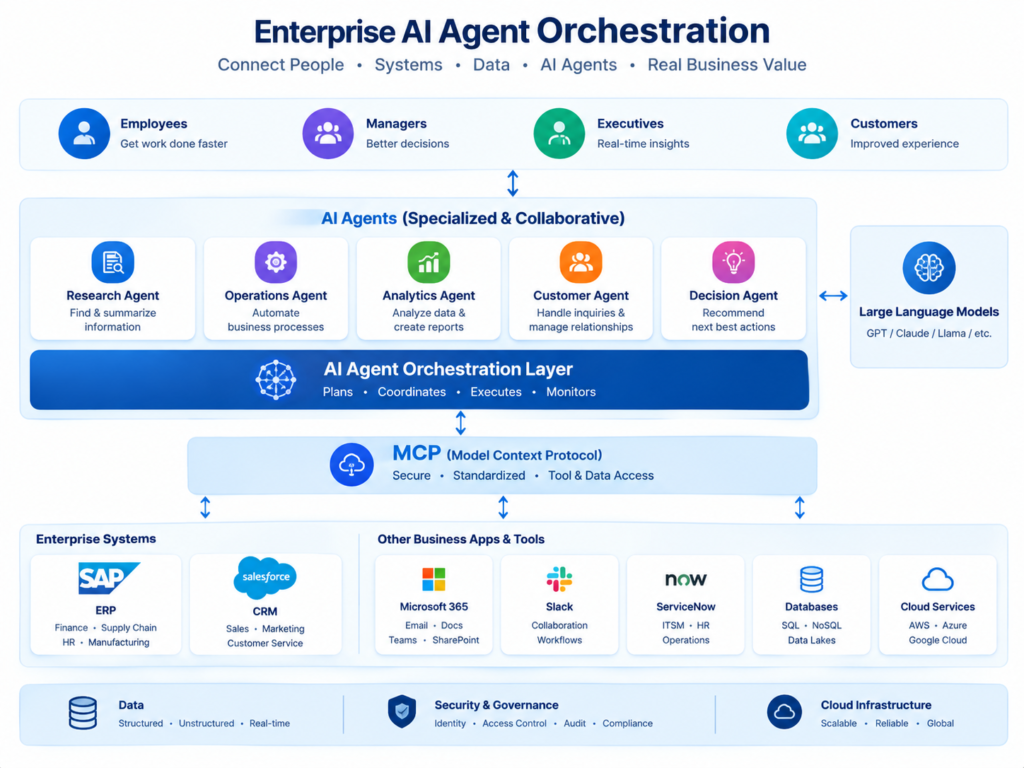
A practical enterprise architecture can be summarized as:
User → AI agent → orchestration and integration layer → enterprise applications → systems of record
The agent interprets intent. The orchestration layer determines which approved tools can be used, manages workflow state, validates outputs and handles failures or escalation.
APIs, MCP and Agent-to-Agent Communication
APIs remain one of the main bridges between agents and platforms such as ERP, CRM, HR, finance and service-management systems.
MCP can provide a standardized way for AI applications to interact with tools and data, but enterprises do not need MCP for every integration. Conventional REST APIs, event systems, vendor connectors and established integration platforms remain valid options.
The protocol matters less than the controls around it.
Production integrations still require authentication, authorization, input validation, logging, observability and lifecycle management. The Mak It Solutions API security guide covers these foundations in more depth.
Identity, Permissions and Human Approval
An autonomous enterprise agent should be treated as a privileged digital actor rather than a generic chatbot.
In practice, each production agent should have.
A clearly defined owner
Its own identity where appropriate
Least-privilege permissions
Approved tools and data sources
Revocable credentials
Transaction or action limits
Complete audit trails
Human approval for high-impact actions
The AI agent identity management guide and zero trust strategy for AI-era security provide complementary approaches to identity and access control.
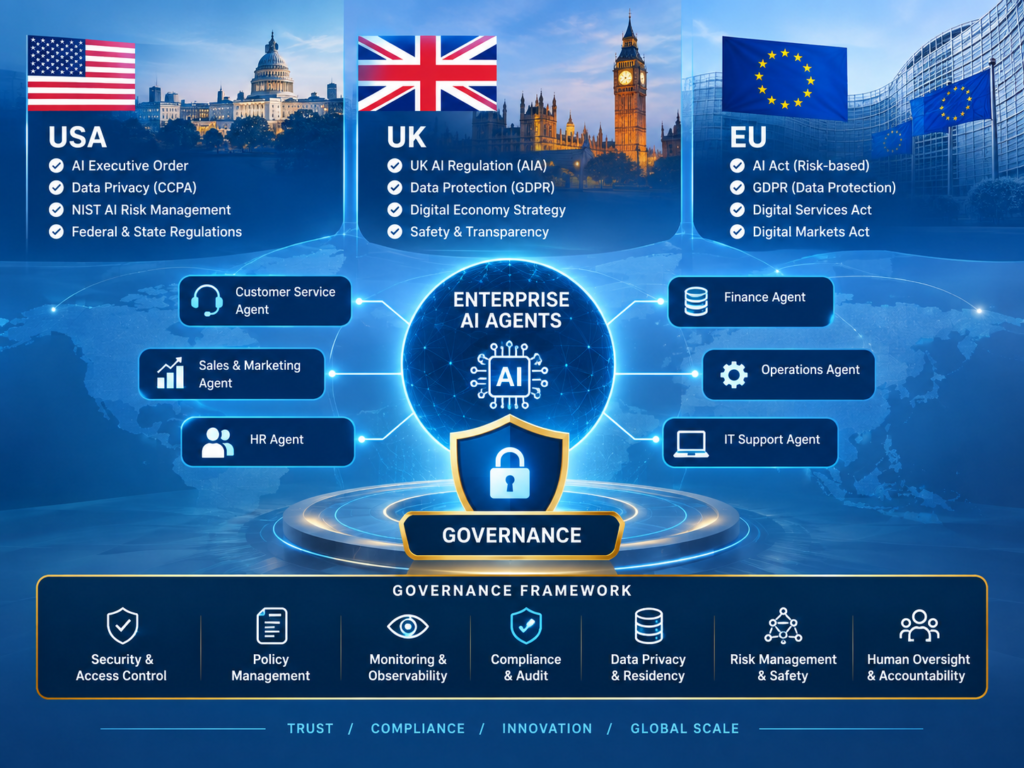
Governing Enterprise AI Agents in the US, UK, Germany and EU
Enterprise AI agents should be governed like privileged digital workers.
Identity, least privilege, auditability, human oversight, data-location requirements and clear accountability become more important as an agent gains authority to execute actions.
US.
For US deployments, the required controls depend heavily on industry and data type.
A healthcare workflow handling electronic protected health information may fall within HIPAA requirements. The HHS Security Rule requires appropriate administrative, physical and technical safeguards for ePHI, including access controls and mechanisms to record and examine system activity.
Other enterprises may need to consider frameworks or obligations associated with SOC 2, ISO 27001, PCI DSS or sector-specific requirements.
The financial risk is also material. IBM reported an average global data-breach cost of approximately $4.44 million in 2025.
UK.
A London fintech or Manchester healthcare workflow should clearly define what personal data an agent can access, which decisions it can influence and when a human must intervene.
The ICO emphasizes meaningful human involvement when automated systems affect decisions with legal or similarly significant consequences. A human reviewer must be able to actively evaluate and challenge an automated recommendation rather than simply rubber-stamping it.
For financial services, the FCA continues to apply its existing principles-based regulatory framework to AI rather than creating a separate AI rulebook, with accountability, governance and consumer outcomes remaining central.
Germany and EU.
Organizations operating in Berlin, Munich, Frankfurt or elsewhere in the EU need to consider GDPR requirements alongside the EU AI Act and relevant sector regulation.
The EU AI Act entered into force on August 1, 2024 and became broadly applicable on August 2, 2026, although several requirements follow staggered or extended timelines. Current European Commission guidance places certain high-risk AI requirements on later dates, including December 2, 2027 and August 2, 2028, depending on the category.
For enterprise architectures, practical questions include where data is processed, which cloud region is involved, who owns the agent, which system authorized an action and whether that action can be traced or reversed.
Regulatory requirements vary by use case and jurisdiction. This article is general information, not legal advice.
What Agent-First Software Means for Buyers and SaaS Vendors
The enterprise buying question is changing from:
“Does this product include AI?”
To.
“Can this platform safely participate in agent-led workflows?”
What CIOs Should Evaluate Beyond the Demo
A polished agent demo is not enough.
Enterprise buyers should examine.
Workflow coverage
API and integration quality
Access to trusted data
Identity and permission controls
Orchestration capabilities
Observability and auditability
Human escalation
Deployment and data-location options
Cost per completed business outcome
An impressive conversational interface has limited value if the agent cannot safely operate against production systems or explain which authority permitted an action.
How SaaS Vendors Stay Valuable When the UI Becomes Invisible
SaaS vendors can remain valuable by making their platforms easy for trusted agents to operate.
That means exposing reliable APIs, making workflows machine-readable, protecting proprietary business context and providing dependable transaction infrastructure.
The strongest enterprise platforms may eventually be distinguished less by how many screens they offer and more by how safely and reliably agents can use them.
From Seat-Based Software to Outcome-Based Economics
Enterprise buyers should also rethink how value is measured.
Instead of evaluating only license counts, measure cost per completed workflow, resolution, transaction or other meaningful business result.
Mak It Solutions’ business intelligence services can help connect agent activity with operational outcomes.
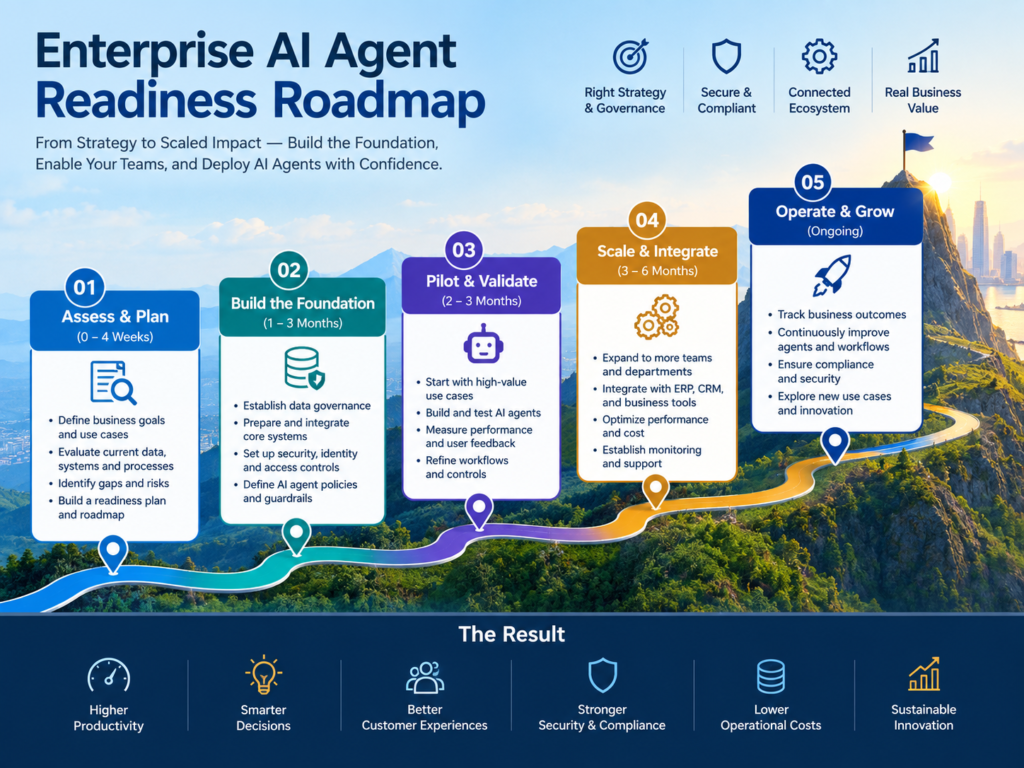
A Practical Enterprise AI Agent Readiness Roadmap
Companies do not need to automate everything at once. A controlled rollout usually starts with bounded workflows, dependable data and clear escalation paths.
Audit High-Value Workflows
Inventory repetitive processes that cross multiple applications.
Prioritize workflows with clear inputs, measurable outcomes and manageable consequences when something goes wrong. Reversible or approval-based actions are usually safer starting points than highly consequential autonomous decisions.
Build the Identity, Data and Orchestration Foundation
Define the agent’s identity, permissions, approved tools, trusted data sources, logs and escalation path before expanding its authority.
Connect systems through governed interfaces rather than granting broad database or network access simply because it is technically possible.
The enterprise AI adoption roadmap offers a broader framework for moving from pilots into controlled production.
Decide What to Build, Buy or Integrate
Compare native SaaS agents, specialist platforms and custom development against integration requirements, security boundaries, regulatory obligations and long-term economics.
The first question should not be.
“How autonomous can we make the agent?”
It should be.
“Which workflow is ready for agent-led execution without weakening control?”
Final Words
The important question is no longer whether enterprise AI agents will influence enterprise software. They already are.
The more useful question is which systems must remain authoritative, which interfaces can become invisible and which workflows are mature enough for controlled agent-led execution.
Organizations that answer those questions early can modernize without throwing away the trusted systems their operations still depend on.
Mak It Solutions can help map systems of record, integration points, agent permissions and high-value workflows. Contact Mak It Solutions to request a scoped enterprise AI agent readiness assessment.
Key Takeaways
Enterprise AI agents are likely to make application interfaces less visible rather than eliminate core ERP, CRM and SaaS platforms.
Systems of record remain essential for trusted data, business rules, permissions and transactions.
APIs, orchestration, identity and protocols such as MCP connect agents with enterprise systems.
Human approval remains important for sensitive, consequential or difficult-to-reverse actions.
US, UK, German and EU deployments require different privacy, security and regulatory considerations.
SaaS economics may gradually shift from human seats toward usage, transactions and outcomes.
The safest starting point is a bounded workflow with measurable value and clear governance.
FAQs
Q : How are enterprise AI agents different from copilots?
A : Copilots generally help a person complete a task through drafting, searching, summarizing or recommendations. Enterprise AI agents can go further by planning steps, calling approved tools and executing permitted actions across applications.
Q : Which workflows should companies automate with enterprise AI agents first?
A : Start with repetitive workflows that use reliable data, follow understandable rules and have measurable outcomes. Ticket triage, knowledge retrieval, routine CRM updates, reporting and selected finance or procurement tasks can be practical starting points.
Q : Do enterprise AI agents need MCP?
A : No. MCP can standardize connections between AI systems, tools and data, but enterprises can also use APIs, events, vendor connectors and integration platforms. Secure permissions, validation, logging and governance matter more than choosing one specific protocol.
Q : How should companies measure ROI from AI agents?
A : Measure the complete workflow rather than agent activity alone. Useful measures include processing time, cost per completed workflow, error rate, human-review requirements and total technology cost associated with the outcome.
Q : Can enterprise AI agents work with legacy or on-premises systems?
A : Yes. Legacy platforms can remain systems of record while agents interact through controlled APIs, middleware, automation services or carefully scoped connectors. Direct unrestricted access to networks or databases should generally be avoided in favor of least privilege, logging and revocable access.
[…] Mak It Solutions explores this broader shift in its guide to enterprise AI agents and the future beyond traditional app interfaces. […]