Drone Inspection for Oil & Gas: GCC Guide 2026
Drone Inspection for Oil & Gas: GCC Guide 2026
Drone Inspection for Oil & Gas: GCC Guide 2026
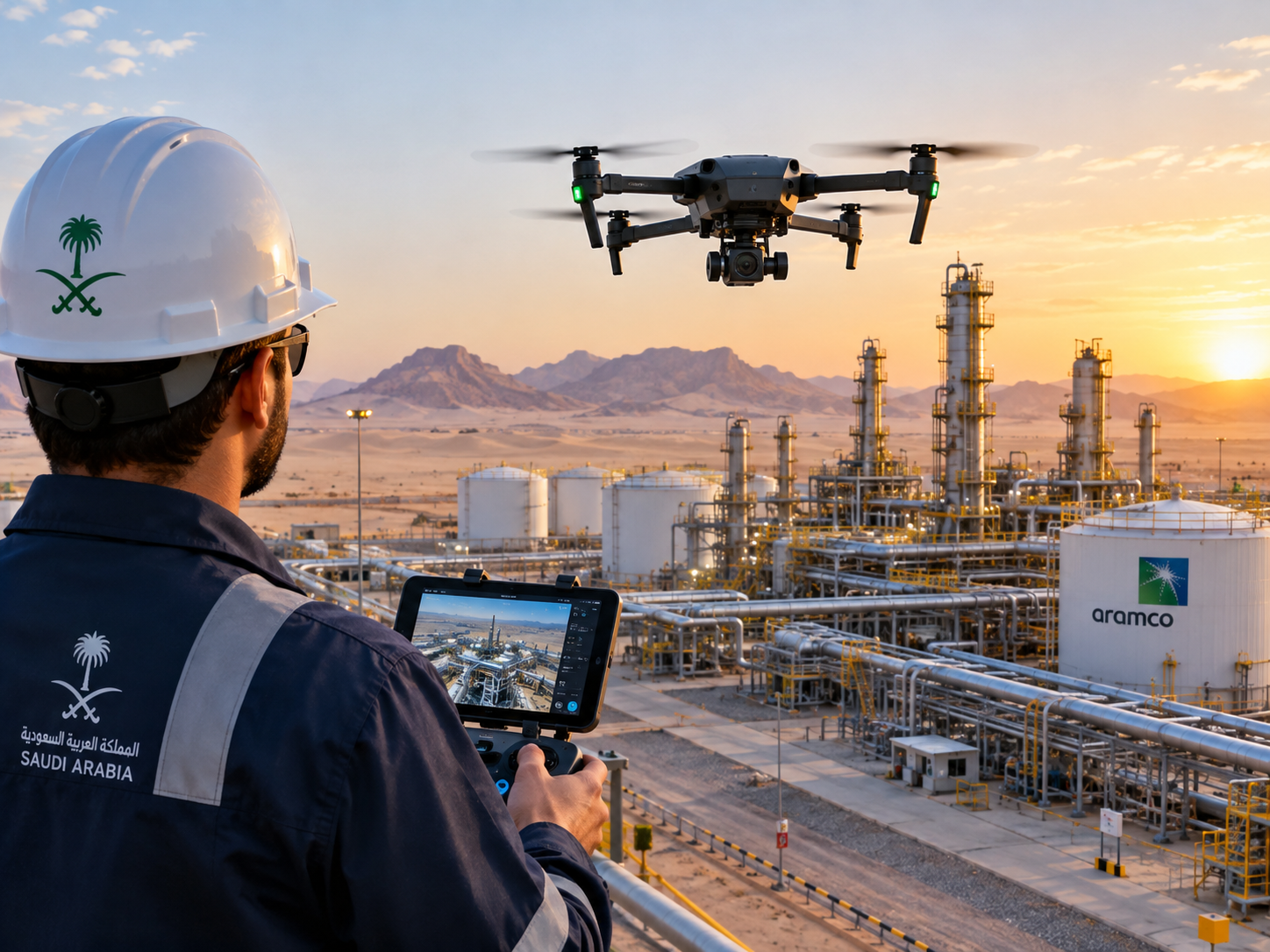
Traditional inspection in oil and gas can mean scaffolding, rope access, confined-space entry, production disruption and significant preparation. Drone inspection for oil and gas gives operators another option: capture visual, thermal, gas and dimensional data remotely while reducing the need to place people close to hazardous assets.
Across Saudi Arabia, the UAE and Qatar, the technology is already relevant to tanks, flare stacks, pipelines, refineries and offshore facilities. The practical value, however, goes beyond the aircraft itself. A successful program also depends on aviation approvals, HSE controls, suitable sensors, cybersecurity and clear rules for handling sensitive industrial data.
Drone inspection for oil and gas uses UAVs equipped with cameras, thermal sensors, LiDAR, gas-detection equipment and, in some applications, specialized NDT payloads to assess industrial assets remotely. In the GCC, operators must combine those capabilities with local aviation authorization, facility procedures and data-governance requirements.
Aramco is one clear regional example. The company says it deploys more than 100 drones across major facilities for work that includes storage tanks, pipelines and offshore assets.
What Is Drone Inspection for Oil and Gas?
How UAV Inspection Works in Industrial Facilities
A typical UAV inspection starts with mission planning and risk assessment. The drone then captures the required sensor data before the results are reviewed, classified and converted into an engineering or maintenance report.
That information can also feed asset-management platforms, inspection dashboards and business intelligence services, helping teams compare findings across assets and inspection cycles.
The drone is therefore only one part of the workflow. The real value comes from turning captured data into information that maintenance, integrity and HSE teams can use.
Autonomous vs. Pilot-Controlled Inspection Drones
Pilot-controlled drones rely on a remote pilot for direct flight inputs. Semi-autonomous systems can follow predefined routes while still allowing intervention. Fully autonomous operations go further by managing the flight without pilot intervention.
Saudi GACAR Part 107 explicitly defines automatic operations, autonomous operations and Beyond Visual Line of Sight, or BVLOS, operations. It also separates Open and Specific operating categories, with Specific-category missions requiring GACA authorization based on the applicable operational risk assessment.
For oil and gas operators, this distinction matters. A technically autonomous drone does not automatically have permission to fly autonomously at an industrial site.
Which Oil and Gas Assets Can Drones Inspect?
Storage Tanks and Confined Industrial Assets
Storage tanks are a natural fit for remote inspection because conventional access may involve scaffolding, working at height or confined-space controls.
For storage tank drone inspection in Saudi Arabia, UAVs can capture roof and shell imagery, thermal patterns and visible signs of deterioration. Aramco specifically notes that drone-based tank inspection can remove the need to erect and dismantle scaffolding for suitable inspection tasks.
Depending on the platform and inspection objective, drones may support.
External visual inspection
Roof and shell condition assessment
Thermal anomaly detection
Corrosion screening
Internal visual inspection using collision-tolerant systems
Specialized ultrasonic measurements where approved equipment and procedures are available
The resulting data should still be interpreted within the facility’s established asset-integrity and NDT program.
Flare Stacks, Refineries and Petrochemical Facilities
Flare stacks are another strong use case because they are elevated, hot and operationally sensitive.
For flare stack drone inspection in KSA or the UAE, thermal and high-resolution visual cameras can help teams identify visible deformation, cracking, corrosion and unusual temperature patterns without sending personnel onto the structure.
Aramco reports using drones to inspect flare stacks while they remain operational, avoiding the conventional shutdown that would otherwise be required for certain access-based inspections.
That does not mean every live-asset inspection can proceed without interruption. Site rules, hazardous-area controls, flight permissions, weather and sensor limitations still determine what is practical.
Pipelines, Offshore Platforms and Remote Infrastructure
Pipelines, long corridors and offshore structures create a different inspection challenge: scale.
Drones can support visual surveys, thermal inspection, mapping, vegetation or right-of-way monitoring, gas sensing and repeatable image capture across large areas. Offshore assets may also benefit where conventional access exposes personnel to difficult working conditions.
Qatar Energy has publicly referenced drone inspection for onshore and offshore engineering inspection together with advanced 3D modelling, showing that the technology has practical relevance within Qatar’s energy sector.
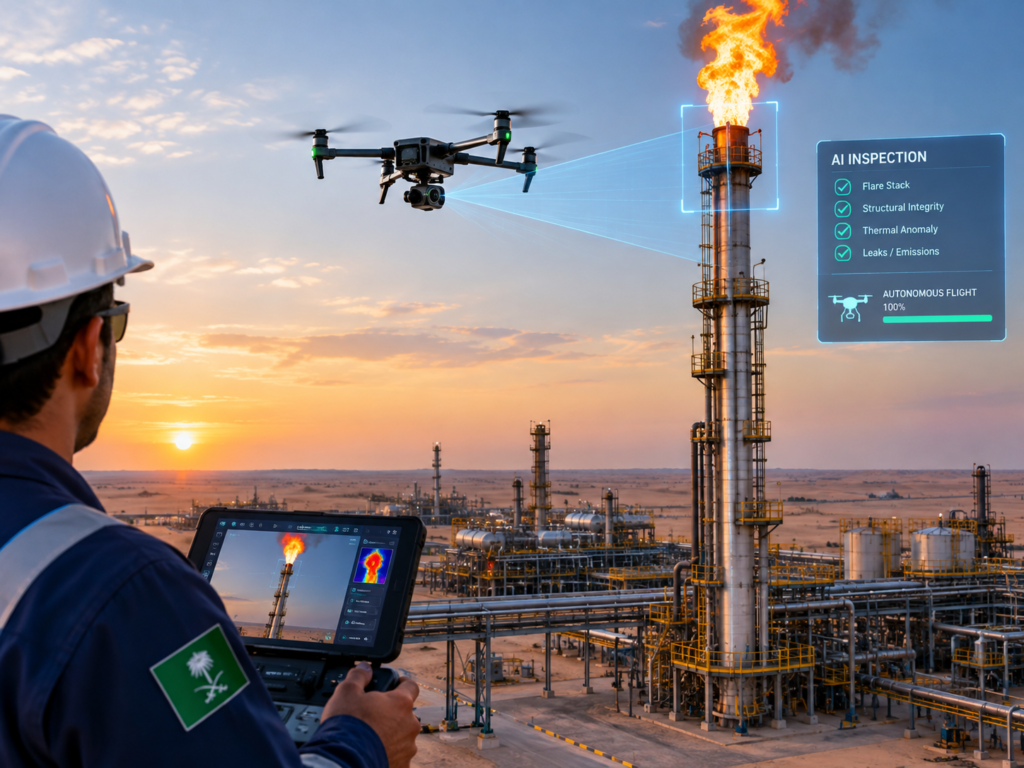
How AI and Autonomous Drones Improve Oil and Gas Inspection
AI-Assisted Defect, Corrosion and Thermal-Anomaly Detection
Capturing thousands of images is useful only if teams can review them efficiently.
AI drone inspection for oil and gas can help classify images, flag visible defects, compare repeat missions and highlight potential thermal anomalies for human review. It can also help inspection teams prioritize assets that may require closer engineering assessment.
AI should support not replace qualified interpretation. False positives, poor image quality and changing environmental conditions can all affect automated detection.
Organizations building their own inspection analytics can also connect this workflow with Python development services for AI-driven solutions.
Methane Detection, OGI, LiDAR and Photogrammetry
No single sensor fits every inspection objective.
RGB cameras are useful for high-resolution visual evidence. Thermal cameras reveal temperature differences. LiDAR and photogrammetry can create dimensional or 3D representations of infrastructure. Optical gas imaging and dedicated gas sensors can support leak-detection workflows.
ADNOC’s 2024 Sustainability Report states that its methane-monitoring program uses technologies including aerial surveillance, drone-mounted sensors and optical gas imaging.
For methane or hydrocarbon-leak work, sensor selection should be based on the target gas, required detection or quantification capability, operating distance, environmental conditions and facility procedures.
Digital Twins and Predictive Maintenance
The value of drone inspection increases when data is collected consistently over time.
Repeat inspections can create a history of an asset’s condition, helping teams compare corrosion, deformation, thermal behavior or other visible changes. That history can feed digital twins, maintenance systems and predictive-maintenance models.
Integration matters here. Secure back-end development and API integration can connect drone platforms with inspection databases, work-order systems and enterprise dashboards instead of leaving imagery isolated in separate folders.
How Drone Inspection Can Reduce Shutdowns and HSE Exposure
Less Personnel Exposure in High-Risk Areas
Drones can reduce but not eliminate the need to expose personnel to heights, hot equipment, confined locations and difficult offshore structures.
People remain essential for flight authorization, mission supervision, engineering analysis and any hands-on inspection or repair that follows.
That makes the safety case more realistic: drones change where human exposure is necessary rather than removing people from the inspection process completely.
Less Scaffolding, Rope Access and Preparation
Scaffolding and rope access remain necessary for many maintenance and inspection tasks, but they may not be required for every initial visual or thermal assessment.
Remote capture can therefore reduce preparation for suitable inspections, particularly across large tank farms and refinery facilities where physical access itself can consume significant resources.
Inspection Without a Full Production Shutdown
Some visual and thermal inspection tasks can be performed while equipment remains operational.
Whether that approach is appropriate depends on the asset, inspection procedure, hazardous-area restrictions, drone platform, sensor, site HSE requirements and aviation authorization.
The goal should not be “never shut down.” The goal is to avoid unnecessary shutdowns when remote inspection can provide the required evidence safely and compliantly.
Drone Inspection Regulations in Saudi Arabia, UAE and Qatar
Industrial drone projects in the GCC should treat regulatory planning as part of project design, not as paperwork to handle immediately before mobilization.
Saudi Arabia.
Saudi GACAR Part 107 governs UAS operations in the Open and Specific categories.
Specific-category operations require GACA authorization and consider the mitigation measures identified through an Operational Risk Assessment. GACA guidance also identifies advanced operations that may be authorized, including BVLOS missions, night operations and operations near aerodromes or heliports.
That framework is particularly relevant to large industrial sites where repeat missions, complex airspace or long inspection corridors may fall outside straightforward operating scenarios.
Industrial imagery and inspection data should also be assessed against the project’s cybersecurity and data-governance requirements. Mak It Solutions’ GCC data-localization guidance provides additional architecture context.
UAE.
The UAE has an established professional UAS framework that lists inspection and petroleum among special-operation use cases. Its current registration guidance also describes operator authorization, operational permission and security-clearance requirements for flights involving cameras or other capturing devices.
There is, however, a critical 2026 restriction to consider.
GCAA Safety Decision 2026-03 Issue 03, issued on April 27, 2026, temporarily suspends UAS authorizations and operations within UAE airspace. It states that a covered operation may proceed only when specifically exempted by GCAA through written authorization.
Regulatory note: The professional UAS framework should not be read as overriding a later temporary safety decision. Any drone inspection planned for Abu Dhabi, Ruwais, Dubai or elsewhere in the UAE should therefore confirm the current operating position directly with GCAA before mobilisation, tender commitment or flight scheduling.
Qatar.
Qatar’s Law No. 10 of 2026 gives the Qatar Civil Aviation Authority responsibility for regulating unmanned-aircraft operations.
The law covers areas including permitted aircraft categories, licensing, operational permits, approved operating areas, maximum altitudes and authorized flight routes. QCAA continued public-awareness activity around the new framework in August 2026, including an introductory session on August 19.
For oil and gas operators, that means flight planning around Doha, Ras Laffan, Misaimed or offshore facilities must be aligned with both QCAA requirements and facility-level controls.
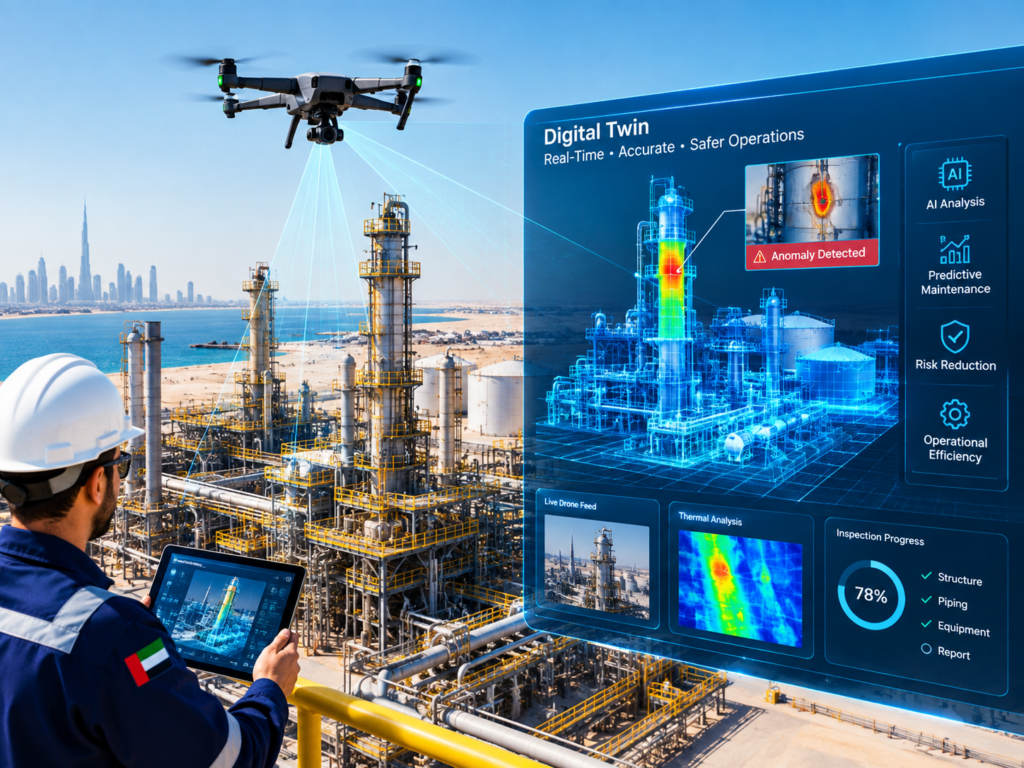
How Saudi, UAE and Qatar Drone Inspection Projects Differ
Saudi Arabia.
Saudi Arabia’s Eastern Province combines extensive tank farms, refineries, pipelines, processing facilities and offshore assets.
Aramco’s documented use of more than 100 drones across major facilities provides a strong regional example of UAV technology moving beyond pilots and trials into recurring industrial workflows.
For projects around Dammam and Al Khobar, scalability matters. Inspection programs need repeatable mission planning, consistent reporting and a practical way to manage large volumes of sensor data.
UAE.
Abu Dhabi and Ruwais offer obvious technical use cases for drone-enabled inspection, emissions monitoring and robotics.
ADNOC’s use of drone-mounted sensors in methane monitoring demonstrates that the underlying industrial case is well established.
The immediate question in 2026 is therefore not simply whether the technology works. Operators must first establish whether a planned flight can proceed under the current GCAA safety position or through a specific written exemption.
Qatar.
Ras Laffan and Messaged contain the type of large energy infrastructure where repeat aerial inspection, engineering surveys and 3D modelling can provide operational value.
At the same time, Qatar’s 2026 drone law puts licensing, permits and approved operating areas firmly within QCAA’s regulatory framework.
Providers entering the market therefore need both industrial inspection capability and a clear process for regulatory compliance.
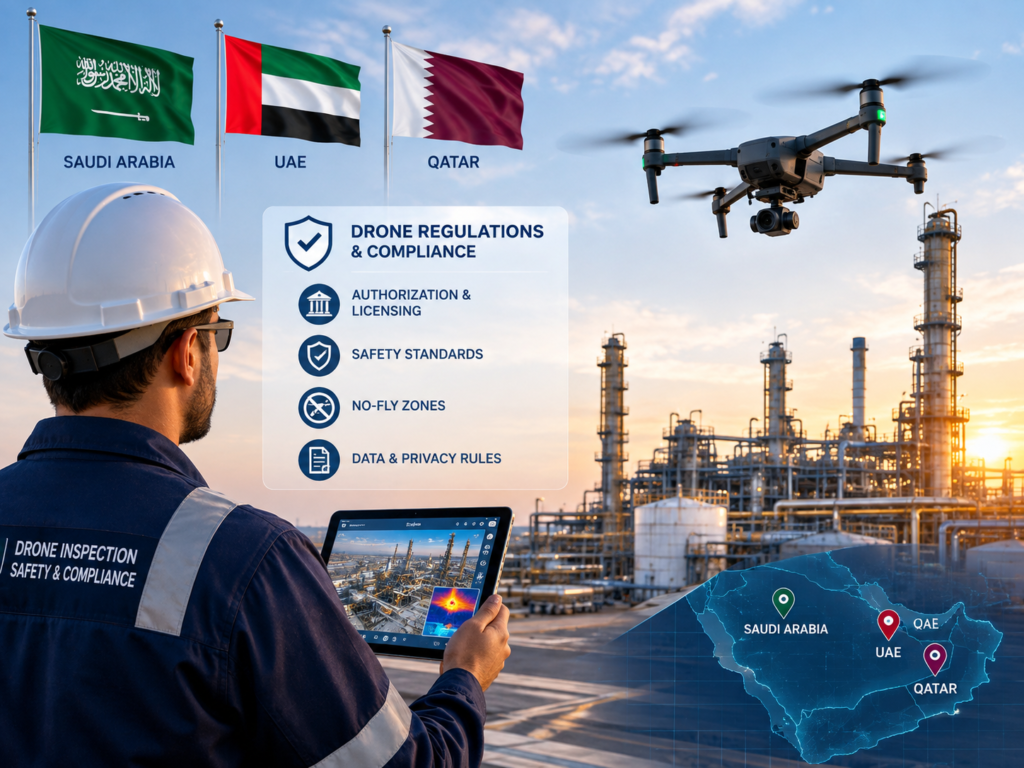
How to Choose a Drone Inspection Provider in the GCC
A good provider should be evaluated as an inspection and data partner—not simply as a company that owns drones.
Check Aviation, HSE and Industrial-Site Capability
Ask how the provider manages.
Current aviation approvals and operational permissions
Oil and gas site experience
Mission-specific risk assessment
Hazardous-area planning
Emergency procedures
BVLOS capability where legally permitted
Coordination with facility HSE and asset-integrity teams
For organizations building a wider automation program, a structured AI adoption roadmap for GCC teams can help connect inspection technology with broader operational priorities.
Match Sensors to the Inspection Objective
Avoid selecting a drone first and trying to fit every inspection around it.
Start with the engineering question. Do you need visible corrosion evidence, temperature data, methane detection, dimensional modelling or thickness measurements?
Only then should the team choose between RGB, thermal, LiDAR, photogrammetry, OGI, methane or specialized ultrasonic systems.
Drone data can complement API 653 and API 580/581 workflows, but a UAV should not be presented as automatically replacing certified NDT or engineering verification.
Evaluate Reporting and Data Integration
A flight that produces attractive footage but no structured inspection record has limited long-term value.
Look for reporting that can connect observations to asset IDs, locations, severity levels, previous findings and maintenance actions. Where possible, results should integrate with existing asset-management or inspection platforms.
That makes repeat inspections much more useful than isolated one-off missions.
Ask About Data Residency and Cybersecurity
Oil and gas imagery can reveal sensitive facility layouts, infrastructure details and operating conditions.
Before deployment, ask.
Where raw imagery and video are stored
Where AI processing takes place
Where backups and 3D models reside
Who can access or export the data
How long inspection records are retained
Whether customer data is used to train external AI systems
What cybersecurity controls protect field-to-cloud transmission
Whether reports can be delivered in Arabic and English
Cloud regions in the GCC may provide useful deployment options, but architecture should be matched to the customer’s contractual, regulatory and security requirements rather than selected purely for convenience.
Mak It Solutions’ GCC sovereign-cloud and data-residency guide and zero-trust security guidance cover these considerations in more detail.
Where Drone Inspection Delivers the Most Value
Drone inspection usually creates the strongest business case when three conditions come together: the asset is difficult or risky to access, inspection is repeated regularly, and the captured data can influence maintenance decisions.
That can make UAVs particularly useful for.
Large tank farms
Elevated flare systems
Long pipeline corridors
Offshore structures
Thermal surveys
Emissions-monitoring programs
Repeated visual condition assessments
3D modelling and digital-twin updates
The strongest projects do not begin with “Where can we fly a drone?” They begin with “Which inspection problem are we trying to solve?”
That distinction keeps the technology focused on measurable operational value.
Final Takeaway
Drone inspection for oil and gas is becoming a practical asset-integrity tool across the GCC because it can improve access to tanks, flare stacks, pipelines, refineries and offshore structures while reducing unnecessary exposure and inspection preparation.
The technology alone is not enough. Saudi, UAE and Qatar projects need the right combination of aviation approval, HSE planning, sensor selection, engineering interpretation, cybersecurity and reliable data integration.
For operators that get those pieces right, drones can become part of a repeatable inspection system rather than a one-off technology demonstration.
Planning drone inspection for oil and gas assets in Saudi Arabia, the UAE or Qatar? Contact Mak It Solutions to discuss a GCC-focused feasibility, analytics and digital-integration strategy for tanks, flare stacks, pipelines, refineries or offshore assets.
Regulatory information can change. Confirm current aviation, site and sector-specific requirements with the relevant authority and facility owner before deployment.
FAQs
Q : Can drones inspect live flare stacks at Saudi oil and gas facilities?
A : Yes, where site procedures, operating conditions and GACA requirements allow it. Aramco documents using drones to collect high-resolution thermal imagery while flare stacks remain operational, helping assess deformation, cracking, corrosion and deterioration without a conventional shutdown.
The final inspection scope still depends on facility HSE rules, weather, sensor capability and the authorization required for the mission.
Q : Can autonomous drones perform tank inspections for Aramco projects?
A : Potentially, but autonomy does not remove aviation or facility requirements.
Saudi GACAR Part 107 recognizes autonomous operations and distinguishes them from automatic missions in which a remote pilot can intervene.
A real deployment would still require a suitable aircraft, competent personnel, site approval, HSE planning and any required GACA authorization.
Q : Can oil and gas companies currently operate inspection drones in the UAE?
A : They should not assume that normal commercial operations are available.
GCAA Safety Decision 2026-03 Issue 03, dated April 27, 2026, temporarily suspends UAS operations and says covered flights may proceed only when specifically exempted by GCAA through written authorization.
The GCAA’s standing UAS framework still lists inspection and petroleum as professional use cases, but project teams should verify the current safety decision and authorization route directly before deployment.
Q : What sensors are useful for methane and gas-leak inspection at Qatar LNG facilities?
A : It depends on the target gas, required detection threshold, measurement objective and operating environment.
OGI cameras can visualize certain hydrocarbon releases, while dedicated methane sensors can support detection or quantification. RGB, thermal and LiDAR systems provide complementary asset information but do not replace gas-specific instrumentation.
Any mission around Ras Laffan or Messaged should also be planned around QCAA authorization and facility HSE requirements.
Q : Can drone inspections replace NDT at GCC refineries?
A : Not automatically.
Drones are inspection platforms. They may carry visual, thermal, dimensional, gas-sensing or specialized ultrasonic equipment, but the resulting method still has to meet the applicable engineering code, inspection procedure and qualified-person requirements.
For API 653 or API 580/581 programs, drone evidence may strengthen inspection planning and condition assessment while conventional NDT or engineering verification remains necessary where specified.