

Port Automation GCC: Saudi & UAE AI Transformation
Port Automation GCC: Saudi & UAE AI Transformation
Port Automation GCC: Saudi & UAE AI Transformation
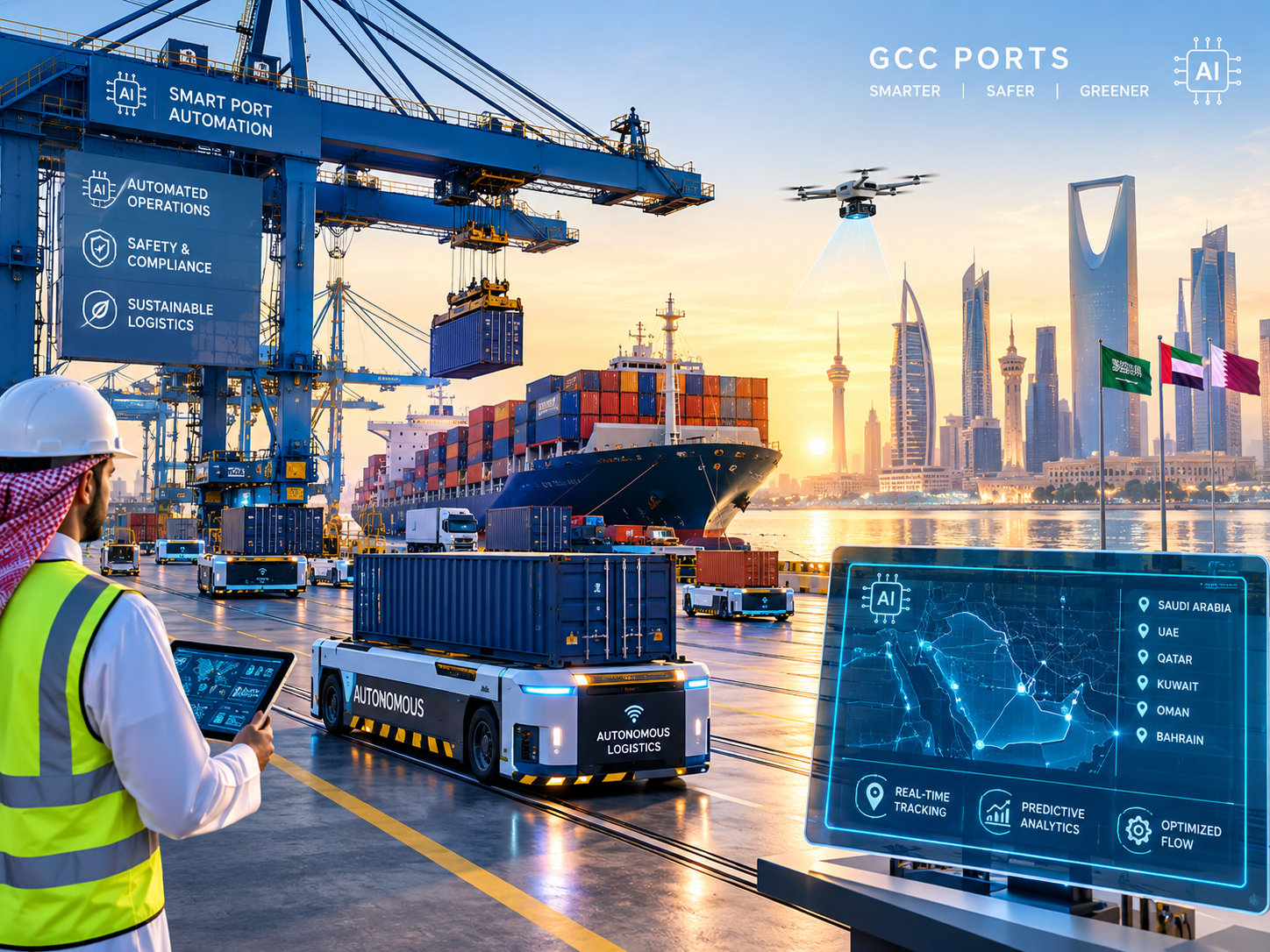
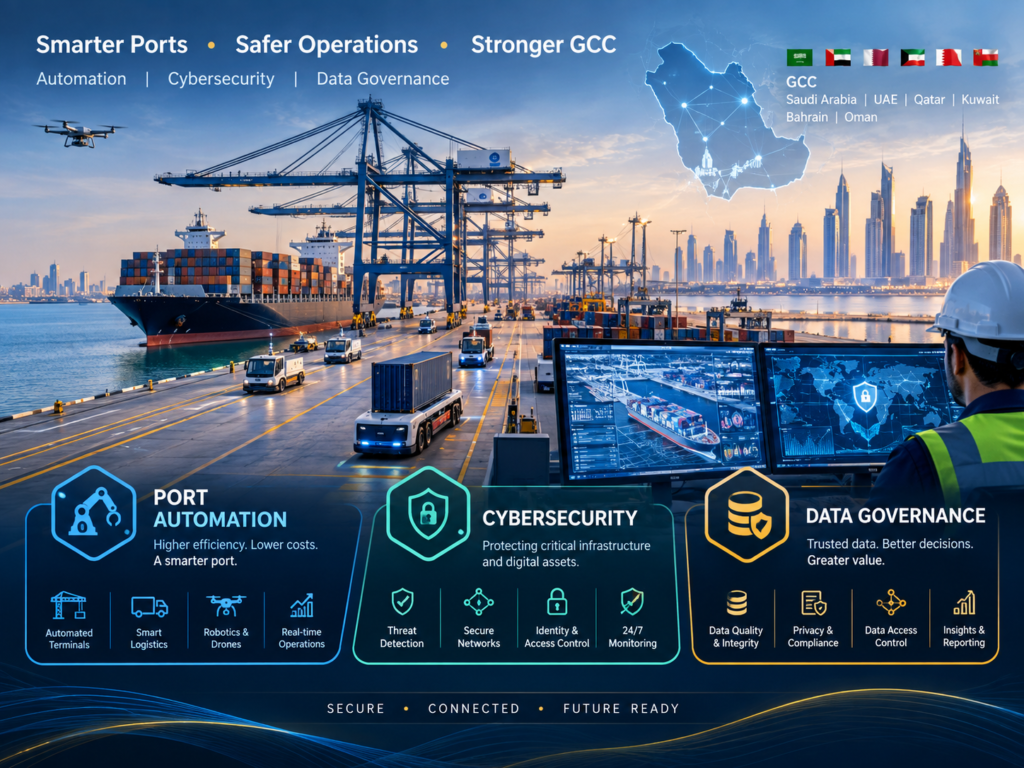
Port automation is rapidly changing how cargo moves through Saudi Arabia, the UAE, Qatar, and the wider GCC. By combining AI, robotics, autonomous vehicles, smart cranes, IoT, and terminal operating systems, ports can improve cargo visibility, reduce operational delays, strengthen safety, and make better use of expensive infrastructure.
For GCC operators, however, successful port automation is not simply about adding more robots. The strongest projects connect physical automation with cybersecurity, edge computing, workforce training, local compliance, and measurable operational KPIs.
Why Port Automation Matters in the GCC
GCC ports are moving beyond isolated digital tools toward connected automation ecosystems. Across Jeddah, Dubai, Abu Dhabi, and Doha, operators are increasingly combining AI, autonomous cargo handling, computer vision, IoT, edge systems, and terminal operating systems to improve throughput and operational resilience.
For Saudi Arabia, this shift is closely linked to logistics transformation under Vision 2030. The UAE provides mature regional examples of automated port operations, while Qatar represents a natural expansion market for smart logistics and automated container-terminal technologies.
The business case is straightforward: move cargo more efficiently, improve asset utilization, reduce avoidable downtime, strengthen worker safety, and support reliable 24/7 operations.
What Is Port Automation and How Does It Work?
Port automation uses software, connected equipment, sensors, and intelligent machines to automate or optimise vessel, cargo, gate, yard, inspection, and maintenance workflows.
A fully automated port is not always the goal. In practice, many terminals benefit more from automating specific bottlenecks first and expanding only after the operational value is proven.
From Smart Ports to Automated Container Terminals
A modern smart port can connect cranes, sensors, gates, terminal operating systems, Port Community Systems, digital twins, and analytics platforms.
The objective is not simply to replace manual work. It is to create continuous operational visibility from vessel arrival and container handling through to gate processing and inland logistics.
Where AI and Robotics Fit into Port Operations
Computer vision can help identify containers, monitor restricted areas, detect safety events, and support automated cargo tallying.
Physical automation may include.
Automated guided vehicles (AGVs)
Autonomous mobile robots (AMRs)
Autonomous or electric terminal tractors
Automated and remotely operated cranes
Inspection drones
AI-enabled camera systems
Robotic inspection equipment
Predictive AI can also support equipment maintenance, berth planning, scheduling, and resource allocation, creating a more responsive AI-powered supply chain.
The Business Case for GCC Port Automation
The commercial value usually comes from solving specific operational problems rather than deploying automation for its own sake.
Common targets include.
Faster vessel and truck turnaround
Higher crane and equipment utilization
Lower unplanned downtime
Improved worker safety
More consistent cargo visibility
Better maintenance planning
More reliable round-the-clock operations
Teams evaluating wider digital transformation can align pilots with a structured GCC AI adoption roadmap before committing to terminal-wide deployment.
Port Automation in Saudi Arabia and Vision 2030
Port automation supports Saudi Arabia’s Vision 2030 logistics ambitions by improving productivity, trade connectivity, technology adoption, and the sophistication of transport infrastructure.
For Saudi port operators, the challenge is not only acquiring advanced equipment. Automation must also connect with data platforms, cybersecurity controls, workforce capabilities, and clearly defined business outcomes.
Jeddah Islamic Port as a Saudi Automation Use Case
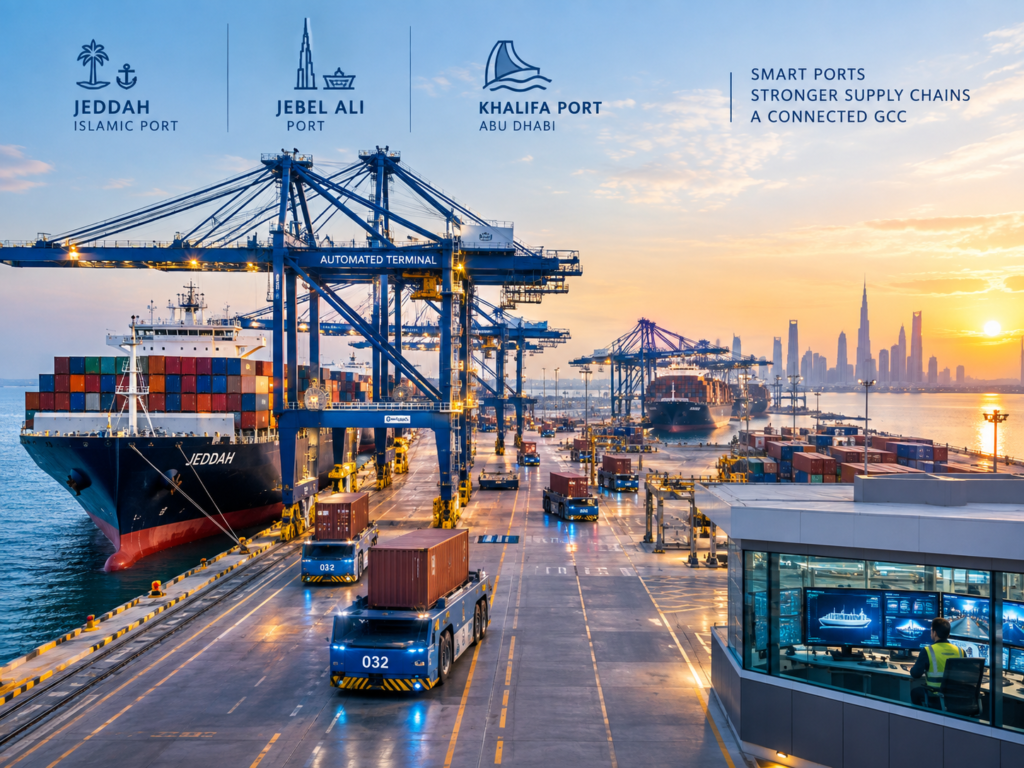
DP World and Mawani’s Jeddah terminal provides a practical Saudi example of connected port technology, combining IoT-enabled cargo tracking, AI-supported cargo tallying, and automated or electrified yard equipment.
In July 2026, DP World also deployed 35 electric terminal tractors, adding another layer to the terminal’s efficiency and lower-carbon operating model.
For other Saudi logistics operators, the lesson is useful: equipment automation delivers more value when tracking, planning, analytics, and terminal systems are connected around it.
Dammam and NEOM.
King Abdulaziz Port in Dammam remains strategically important to Saudi Arabia’s eastern logistics network.
At the Port of NEOM/Oxagon, the automation direction is even more explicit. Saudi Arabia’s first fully automated, remote-controlled ship-to-shore and eRTG cranes arrived in 2025, with Terminal 1 planned for launch in 2026.
These projects show how Saudi port automation is moving from individual digital tools toward integrated equipment, data, remote operation, and intelligent terminal control.
Private 5G, Edge AI and Saudi Smart-Port Infrastructure
Private 5G, edge AI, and local processing can be particularly valuable for low-latency cameras, remote controls, safety systems, and industrial IoT.
Instead of sending every operational signal to distant infrastructure, critical workloads can be processed closer to the terminal.
That matters in GCC environments, where port technology must also deal with heat, dust, connectivity resilience, and outdoor hardware reliability. Operators planning similar environments can review Mak It Solutions’ guide to edge computing in desert environments.
How UAE Port Automation Uses AI, Robotics and Autonomous Vehicles
The UAE offers some of the region’s strongest reference points for port automation, particularly around Dubai and Abu Dhabi.
Rather than treating AI, robotics, and digital platforms as separate projects, leading terminals increasingly connect them through terminal operating systems, logistics platforms, and real-time data.
Jebel Ali Port Automation and Autonomous Terminal Vehicles
At Jebel Ali, DP World has introduced autonomous internal terminal vehicles and implemented its ZODIAC terminal operating system at Container Terminal 3.
The platform brings together areas such as crane operations, fleet management, tracking, gates, and IoT-enabled processes.
For operators evaluating port automation in Saudi Arabia or elsewhere in the GCC, Jebel Ali demonstrates why the software layer matters just as much as the physical equipment.
Khalifa Port and Abu Dhabi Autonomous Logistics
Khalifa Port offers another regional benchmark, with AD Ports Group deploying technologies such as autonomous trucks, remote crane operations, and aerial drones.
The surrounding Abu Dhabi logistics ecosystem also makes it a useful example of how automation can extend beyond quay-side equipment into broader industrial and logistics operations.
The UAE Digital Port Technology Stack
Physical automation delivers more value when trade and logistics information can move with the cargo.
Abu Dhabi’s Maqta Port Community System and ATLP support information exchange between port, customs, logistics, and trade stakeholders. Jebel Ali similarly demonstrates how terminal operating systems can link physical equipment with operational planning.
The result is a more connected operating model rather than a collection of disconnected machines.
Which AI and Robotics Technologies Deliver the Most Value?
There is no single “best” automation technology for every terminal.
The right investment depends on the bottleneck being solved, existing infrastructure, cargo mix, integration requirements, safety risks, and expected return on investment.
AGVs, AMRs and Autonomous Terminal Tractors
AGVs are well suited to predictable and repeatable routes. AMRs offer greater navigation flexibility, while autonomous terminal tractors can support high-frequency yard movements.
The key is integration.
A Dubai e-commerce or logistics operator, for example, gains more from automated cargo movement when the terminal connects effectively with warehousing, inventory, fulfilment, and inland transport systems.
Automated Cranes, Computer Vision and Inspection Robotics
Remote STS and eRTG cranes, AI-based container recognition, drones, and robotic inspection systems can reduce manual exposure to hazardous environments while improving consistency.
Computer vision can also support container identification, safety monitoring, cargo tallying, and inspection workflows.
Because many of these applications require rapid local decisions, they are natural candidates for GCC edge-AI architectures.
Predictive AI, Digital Twins and Smart Terminal Systems
Not every high-value automation project needs a robot.
Predictive maintenance can help teams identify equipment problems earlier. Digital twins can model operational scenarios. AI-supported berth and yard planning can improve asset allocation.
A strong analytics layer is important as well. Business intelligence services can help operators turn raw terminal data into dashboards covering utilization, downtime, maintenance, safety, and throughput.
GCC Port Automation Compliance, Cybersecurity and Operating Challenges
Automation introduces new efficiencies, but it also expands the operational technology attack surface and creates new data-governance responsibilities.
Cybersecurity and compliance should therefore be designed into automation projects from the pilot stage.
Saudi PDPL, NDMO and Data Governance for Port AI
Saudi PDPL considerations may become relevant when port automation involves CCTV footage, driver information, employee records, biometrics, or identifiable video feeds.
Operational telemetry is not automatically personal data. Operators should first classify the data they collect and then apply controls based on its actual sensitivity and regulatory status.
The important point is to build governance around the real data flows rather than treating every AI workload as identical.
UAE Data, Telecom and OT Cybersecurity Considerations
UAE deployments should maintain clear separation between IT and operational technology environments, control third-party access, and plan resilient edge and cloud connectivity.
Regional cloud options may include AWS Middle East in Bahrain, Azure UAE Central, or Google Cloud Doha depending on workload, architecture, and residency requirements. Choosing a regional cloud region alone, however, does not automatically establish regulatory compliance.
For industrial automation, vendor access, identity controls, network segmentation, recovery planning, and system availability can be just as important as the AI model itself.
Qatar and GCC-Specific Operational Constraints
Hamad Port already operates with modern terminal infrastructure, advanced equipment, automated gates, and terminal systems, making Qatar a credible market for scalable GCC automation architectures.
At the same time, GCC deployments have environmental and operational realities that global technology designs cannot ignore.
Extreme heat
Dust and sand exposure
Outdoor equipment reliability
Network resilience
Arabic-English workforce requirements
Industrial cybersecurity
Local integration and hosting requirements
Financial-sector regulators such as SAMA, QCB, ADGM, or DIFC generally become relevant when a platform adds regulated payment, financing, or trade-finance functionality not merely because AI is being used in cargo operations.
How to Implement Port Automation in the GCC
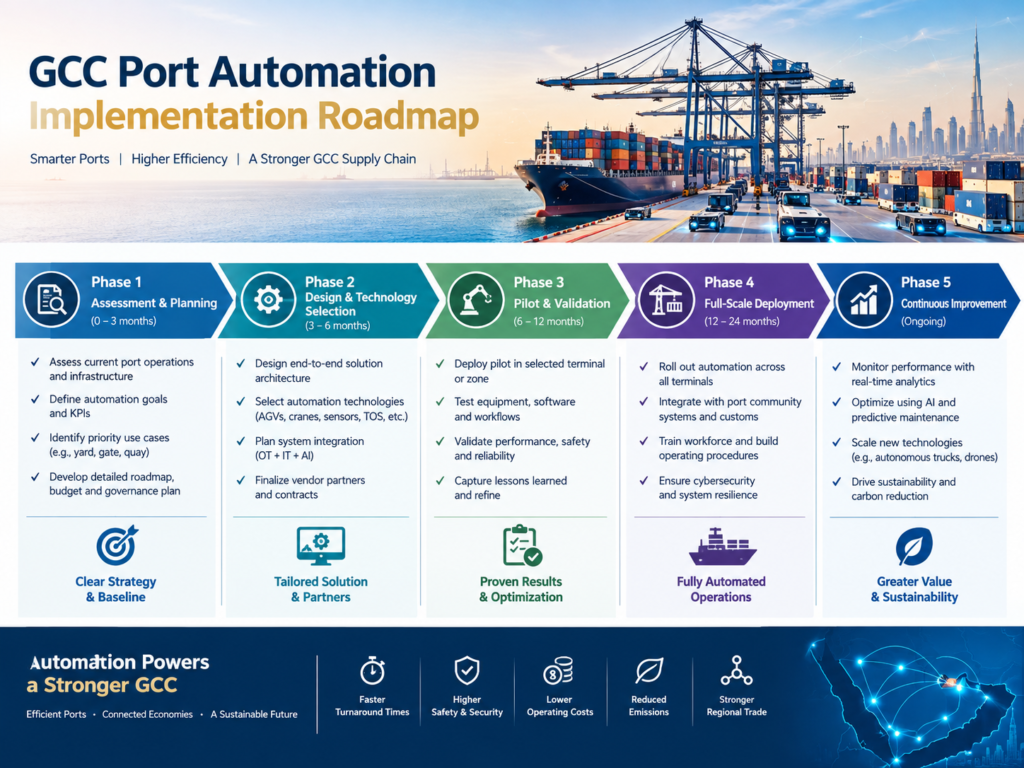
A practical GCC port automation strategy starts with one measurable operational problem and expands only after the technology proves its value.
Rather than attempting a full autonomous-terminal transformation from day one, operators can use a staged approach that lowers implementation risk and makes ROI easier to measure.
Select the Highest-ROI Port Automation Use Case
Start by establishing a baseline.
Useful KPIs can include.
Vessel turnaround time
Truck turnaround time
Container moves per hour
Crane productivity
Asset utilisation
Equipment downtime
Maintenance costs
Safety incidents
Labour intensity
Then choose one bounded use case, such as computer vision, predictive maintenance, automated gate processing, or autonomous yard transport.
Assign a clear commercial or operational owner so the project is measured against business results rather than technology activity.
Pilot and Integrate with TOS, OT and Port Systems
A pilot should connect safely with the existing terminal environment.
That may involve APIs, terminal operating systems, Port Community Systems, operational technology controls, customs systems, analytics tools, and identity platforms.
Where legacy platforms require new APIs or integration layers, Mak It Solutions’ back-end development services can support scalable server-side architecture and system connectivity.
Cybersecurity, worker safety, data governance, and recovery procedures should be part of the pilot not additions after it succeeds.
Scale Across Saudi Arabia, the UAE and Qatar
Scale only after the pilot demonstrates measurable improvement in areas such as throughput, safety, reliability, utilization, or maintenance.
A modular architecture can make regional expansion easier. A system first deployed in Jeddah or Jebel Ali, for example, may later be adapted for Doha or another GCC logistics site while adjusting hosting, governance, language, integrations, and operating procedures.
Critical workloads should also include a tested GCC cloud disaster-recovery strategy.
Port Automation KPIs GCC Operators Should Track
Technology investment becomes easier to justify when operators can compare performance before and after deployment.
The most useful KPIs depend on the project, but port teams commonly need visibility into.
Vessel and truck turnaround
Container moves per hour
Crane productivity
Equipment utilization
Planned and unplanned downtime
Maintenance expenditure
Safety incidents
Labour intensity
System availability
Integration reliability
A computer-vision pilot should not be judged using the same metrics as an autonomous vehicle programme. Each automation initiative needs KPIs that connect directly to the operational problem it is supposed to solve.
Final Thoughts
Successful port automation programmes do not simply buy more robots.
They combine AI, robotics, terminal operating systems, OT integration, edge connectivity, cybersecurity, workforce design, and measurable KPIs into one operating model.
Saudi Arabia offers significant automation growth potential alongside Vision 2030, while the UAE provides proven regional benchmarks and Qatar offers a logical market for modular GCC deployments.
For organizations planning more compute-intensive AI strategies, AI infrastructure and supercomputing planning can also become part of the longer-term technology roadmap.
Ready to identify where port automation could deliver measurable value in your GCC logistics operation? Contact Mak It Solutions to explore a tailored automation strategy for Saudi Arabia, the UAE, Qatar, and the wider Gulf region.
FAQs
Q : Which Saudi ports are adopting smart-port automation technologies?
A : Jeddah Islamic Port is a strong current example, using technologies such as AI-supported cargo tallying, IoT tracking, automated yard equipment, and electric terminal tractors. Port of NEOM is another major reference, while King Abdulaziz Port in Dammam remains strategically important to the Kingdom’s logistics network.
Q : What port automation technologies are most suitable for Jeddah and Dammam?
A : Good starting points include computer vision, automated gate processing, predictive maintenance, remote crane operations, and autonomous or electric yard transport. The best option should be selected based on measurable local bottlenecks rather than copying another terminal’s technology stack.
Q : Do UAE port automation systems need Arabic and English interfaces?
A : Not every machine requires a bilingual interface, but Arabic-English dashboards, alerts, training materials, and management workflows can improve workforce usability. This is particularly relevant in GCC terminals with multinational technical teams and Arabic-speaking managers or government stakeholders.
Q : Can Qatar logistics operators use automation platforms deployed in Saudi Arabia and the UAE?
A : Often, yes. Modular platforms can usually be adapted for Qatar if local integrations, cybersecurity, hosting, operational requirements, and governance are revalidated before deployment.
Q : What KPIs should GCC ports track before investing in robotics?
A : Start with vessel and truck turnaround, container moves per hour, crane productivity, equipment utilization, maintenance costs, downtime, safety incidents, and labour intensity. Establishing the baseline before the pilot makes it easier to determine whether the automation project created measurable value.
[…] Computer Vision Matters for GCC Construction […]