


Computer Vision in Construction: GCC Safety & AI Uses
Computer Vision in Construction: GCC Safety & AI Uses
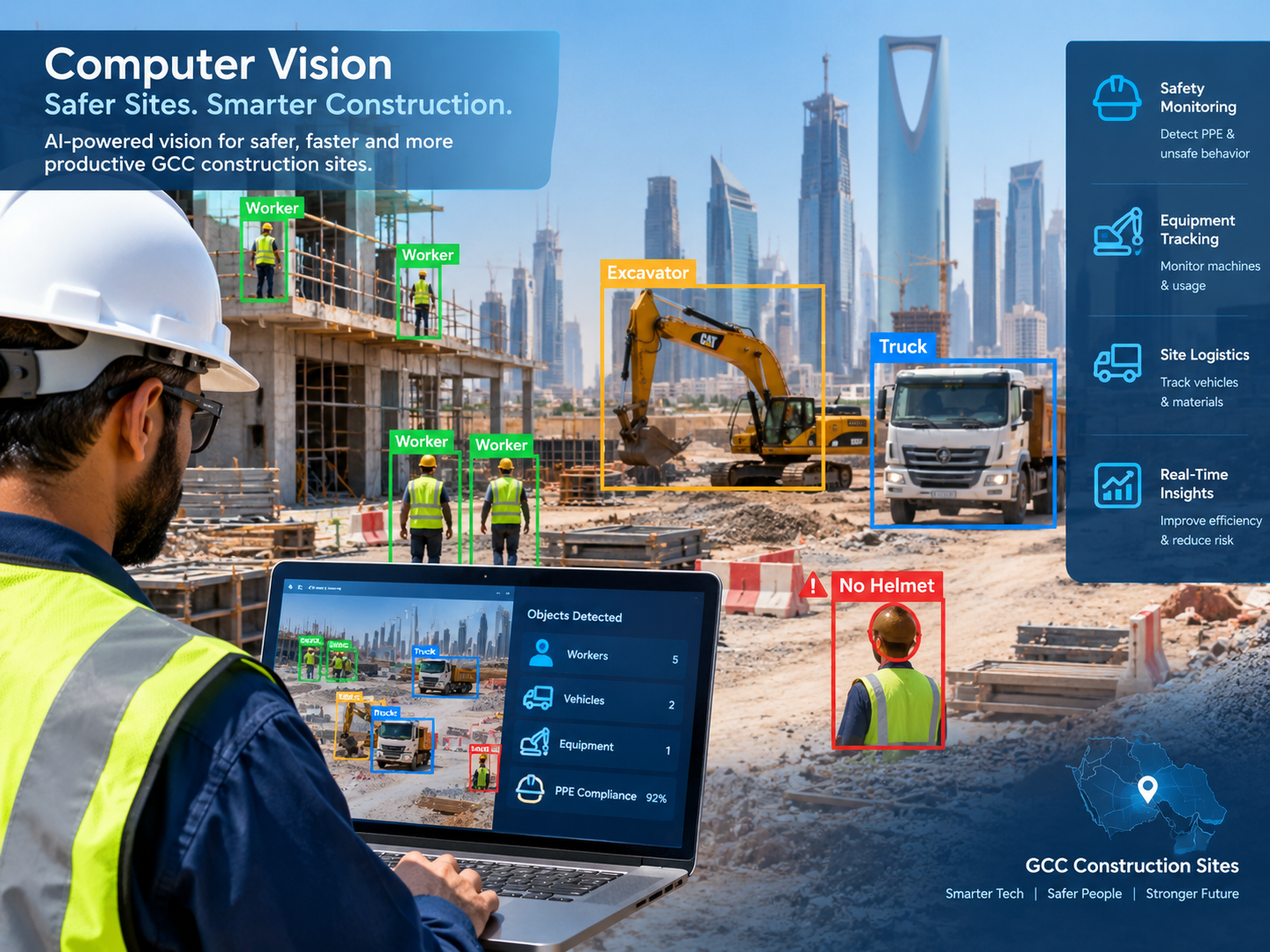
Computer Vision in Construction: GCC Safety & AI Uses
Large GCC construction projects generate enormous amounts of visual data every day, from CCTV feeds and fixed site cameras to drone footage and mobile inspections. Yet much of that information still depends on manual review, which can make safety incidents, progress changes and operational risks harder to spot quickly.
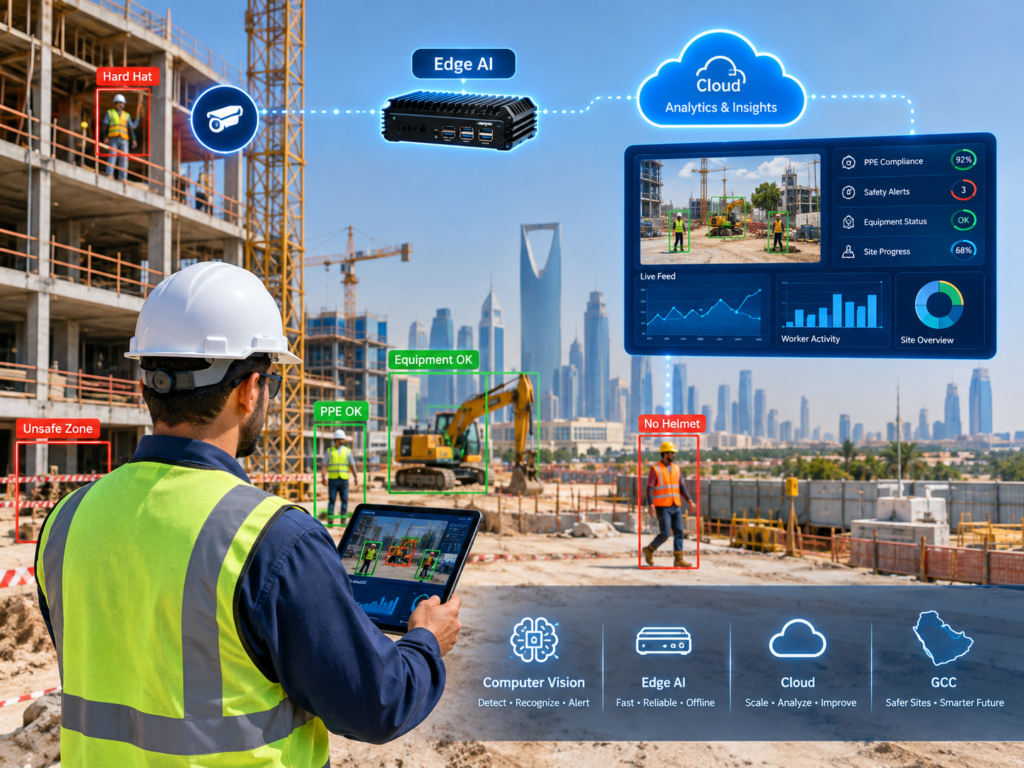
Computer vision in construction uses AI to analyze site images and video automatically. It can identify workers, PPE, equipment, restricted-area activity and visible construction progress, helping HSE and project teams turn existing camera footage into useful operational information.
For contractors and developers in Saudi Arabia, the UAE and Qatar, that can mean faster reporting, better safety visibility and more consistent monitoring across complex sites.
What Is Computer Vision in Construction?
Computer vision is a branch of AI that allows software to interpret images and video. On a construction site, it can transform cameras from passive recording devices into active sources of structured data.
Instead of requiring someone to watch hours of footage, construction video analytics can identify predefined events and send the results to dashboards, alerting systems or project-management workflows.
How AI Cameras Analyze Construction Site Activity
Computer-vision models can process footage from CCTV, fixed cameras, drones or mobile devices to identify visually recognizable objects and activities, such as.
Workers
Hard hats and reflective vests
Construction vehicles and machinery
Restricted zones
Materials and site assets
Visible progress changes
These detections can then feed operational dashboards, including systems supported through Mak It Solutions’ Business Intelligence Services.
Computer Vision vs Traditional Construction Monitoring
Manual inspection remains essential because site supervisors and HSE professionals provide context that an AI model may not understand.
The difference is coverage.
A manual inspection captures what a person sees at a particular place and time. AI-powered monitoring can continuously review selected camera zones and create visual records of events that teams can later verify.
The strongest approach combines both: automated detection for visibility and human review for judgment.
Why Computer Vision Matters for GCC Construction Projects
Construction environments across the GCC can be especially demanding. Large workforces, multiple subcontractors, heavy machinery, night shifts, dust, heat and wide project areas can make consistent monitoring difficult.
On major Saudi developments, as well as large projects in Dubai, Abu Dhabi and Doha, computer vision can help organize visual information that would otherwise be difficult to review manually.
How Computer Vision in Construction Improves Site Safety
Safety is one of the clearest applications of computer vision because many high-priority events can be visually detected.
PPE Detection for Helmets, Vests and Harnesses
PPE compliance detection can identify equipment that is visible to a camera, such as hard hats, reflective clothing and some harness configurations.
For example, a contractor in Riyadh could monitor controlled access points and send suspected PPE violations to an HSE dashboard for human verification.
The goal is not to replace supervisors. It is to help them focus attention where it may be needed most.
Unsafe-Zone, Fall-Risk and Hazard Detection
Configured systems can monitor predefined site zones and flag events such as.
Workers entering restricted areas
People appearing within hazardous equipment zones
Work-at-height activity requiring review
Unsafe proximity to selected site hazards
These alerts should support existing HSE procedures rather than act as a substitute for proper training, supervision or site controls.
Vehicle and Worker Interaction Monitoring
Construction sites with frequent movement of excavators, loaders, trucks and other heavy equipment create additional monitoring challenges.
Computer vision can detect when pedestrians enter defined equipment zones or repeatedly move close to operating machinery. Teams can then review those events to identify recurring patterns and improve site controls.
This can be particularly useful on logistics-heavy projects in Riyadh, Dubai, Abu Dhabi and Doha.
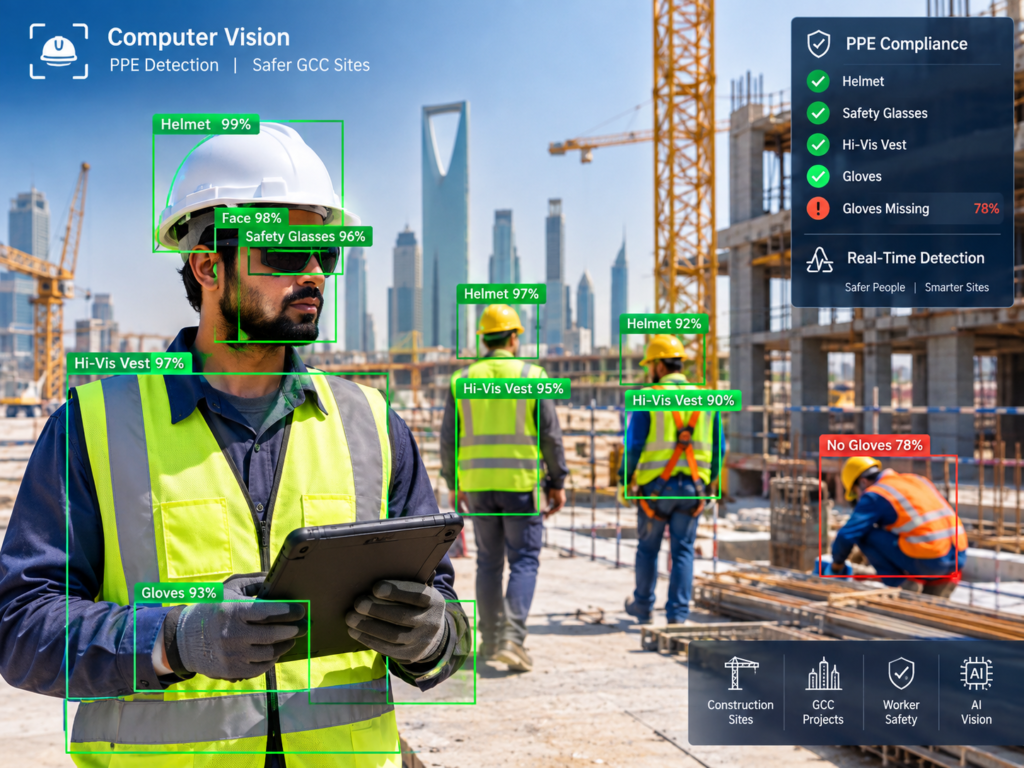
10 High-Value Computer Vision Use Cases for GCC Construction Sites
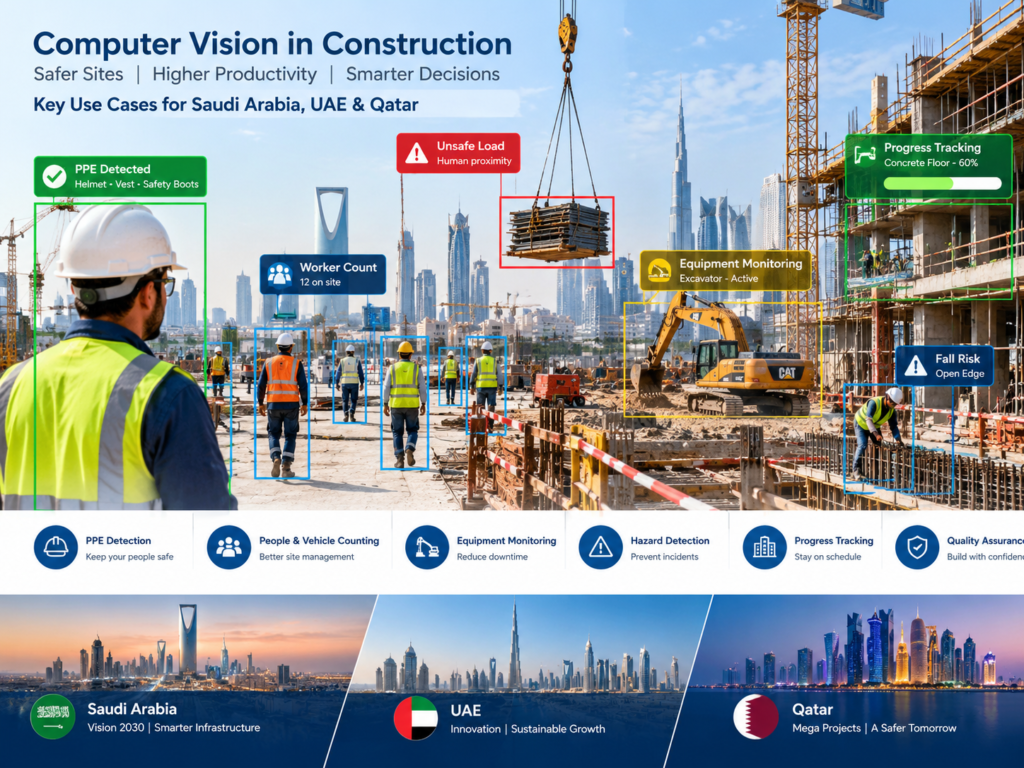
Computer vision is not limited to PPE detection. A well-designed system can support safety, productivity, progress reporting and quality management.
PPE Compliance Detection
AI cameras can flag missing or visually undetected helmets, reflective vests and other configured safety equipment.
Worker-Presence Monitoring
Teams can monitor whether workers are present within predefined work areas without relying entirely on manual observation.
Restricted-Zone Detection
Computer vision can detect people entering areas that have been defined as restricted or controlled.
Vehicle-Worker Proximity Monitoring
Systems can identify situations where pedestrians and moving equipment appear within configured safety boundaries.
Automated Construction Progress Tracking
Recurring camera or drone imagery can help project teams compare visible work over time and identify areas that may require further review.
Equipment Monitoring
Computer vision can help track the visible presence, movement or utilization of selected machinery and vehicles.
Activity Recognition
Depending on the model and camera setup, teams may classify selected construction activities to support operational analysis.
Site-Utilization Analysis
Visual data can help teams understand how different areas of a construction site are being used throughout the project.
Visual Quality and Defect Inspection
Computer vision can support selected inspection workflows where defects or inconsistencies are visually identifiable.
Automated Visual Documentation
Site imagery can be organized automatically to support reporting, evidence capture and project records.
Custom interfaces for these workflows can be developed through web development services, front-end development or broader Mak It Solutions services.
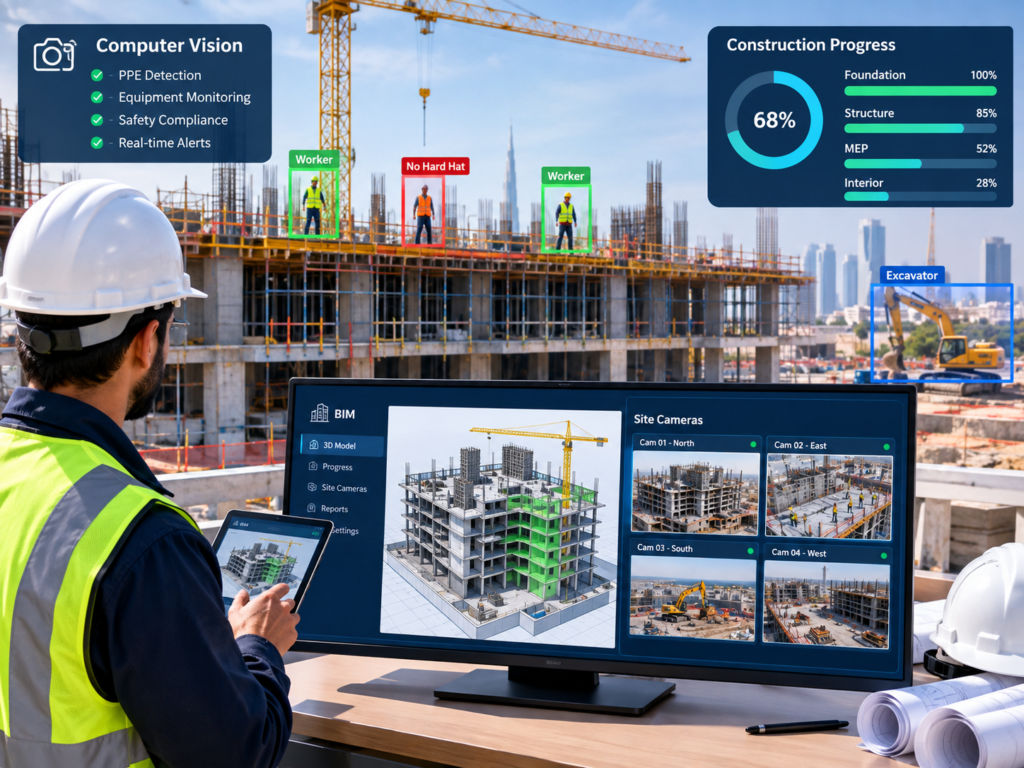
Computer Vision for Construction Progress Monitoring and BIM
Safety is only one part of the opportunity. Computer vision can also help project controls teams understand how visible site conditions compare with planned progress.
Automated Progress Tracking from Cameras and Drones
Recurring photographs, fixed-camera feeds or drone imagery can create a visual record of construction over time.
Instead of manually sorting large image libraries, teams can use computer vision to organize footage, compare visible changes and highlight areas that may require investigation.
This can reduce the effort involved in routine photo reporting while giving managers a more consistent view of progress.
Connecting Computer Vision with BIM and Digital Twins
A practical way to understand the relationship is simple.
BIM represents the planned digital state. Computer vision provides evidence of the observed physical state.
Comparing the two can help project controls teams investigate whether visible work aligns with expected progress.
Computer vision does not automatically prove that work is complete or compliant, but it can make discrepancies easier to identify and review.
Dashboards, Alerts and Automated Construction Reporting
Validated computer-vision events can be connected to.
HSE dashboards
Project-management systems
BIM platforms
Digital twins
Reporting tools
Mobile approval workflows
Field notifications and approvals may also be supported through Mak It Solutions’ mobile app development services.
Computer Vision in Saudi Arabia, the UAE and Qatar
The underlying technology is similar across GCC markets, but deployment decisions should reflect local project conditions, infrastructure and data-governance requirements.
Saudi Arabia.
Construction projects in Riyadh, Jeddah, Dammam and major developments associated with NEOM or Diriyah can involve large sites, multiple contractors and complex reporting requirements.
Computer vision can support safety monitoring, progress visibility and contractor coordination as Saudi Vision 2030 continues to encourage digital transformation.
Where camera footage captures identifiable people, Saudi Arabia’s Personal Data Protection Law is relevant because its definition of personal data includes photographs and videos. Construction organizations should therefore consider access, processing, retention and governance requirements when designing monitoring systems.
UAE.
A developer in Dubai could combine CCTV, drones and BIM to monitor construction progress across several contractors. In Abu Dhabi, some projects may use edge processing when rapid alerts or reduced data transfer are operational priorities.
Deployments involving identifiable people should also account for the UAE’s federal Personal Data Protection Law and its requirements around personal-data processing and governance.
Qatar.
A Doha EPC contractor might start with PPE detection at controlled access points and process selected workloads locally or through suitable regional cloud infrastructure.
Qatar has its own personal-data privacy framework, so construction companies should evaluate local requirements when camera footage contains identifiable individuals.
GCC Data, Privacy and Deployment Considerations
Computer vision can create operational value, but cameras, AI models and dashboards must be deployed with appropriate governance.
Camera Privacy and Construction-Site Data Governance
Before processing construction-site video, companies should define.
Why the footage is being analyzed
Which cameras and areas are included
Who can access alerts and recordings
How long footage is retained
When information should be anonymized or deleted
How employees and contractors are informed where required
There is no single GCC-wide privacy rule. Governance should be aligned with the applicable requirements of the country in which the project operates.
Edge AI vs Cloud Processing for GCC Construction Sites
Both edge and cloud architectures have practical advantages.
Edge AI processes footage closer to the camera or site. It can reduce latency, limit bandwidth use and minimize the need to transmit continuous video.
Cloud processing can make centralized analytics, storage and multi-site management easier.
For larger construction programs, a hybrid model may be the most practical option: process time-sensitive detections locally while sending selected events or aggregated data to centralized platforms.
Regional infrastructure options referenced in the source material include AWS Middle East regions and Microsoft Azure infrastructure across several GCC markets.
References: AWS regional infrastructure and Microsoft Azure global infrastructure.
Accuracy Challenges in Heat, Dust and Complex Worksites
A model that performs well in a controlled environment may behave differently on a real construction site.
Potential challenges include.
Dust obscuring workers or equipment
Strong sunlight and glare
Deep shadows
Crowded scenes
Partial visual obstruction
Different PPE styles and colors
Poor camera positioning
Night work and low-light conditions
Limited network connectivity
For GCC projects, site-specific testing is essential. Camera placement, maintenance and lighting can be just as important as the AI model itself.
How to Deploy Computer Vision on a GCC Construction Site
A successful deployment does not need to begin with every possible use case. In practice, starting with one measurable problem makes validation easier.
Choose the Highest-Value Monitoring Use Case
Select a problem with a clear operational purpose, such as.
PPE compliance
Vehicle-worker safety
Progress monitoring
Equipment visibility
Define what success should look like before expanding the system.
Connect Existing CCTV, Cameras or Drones
Existing visual infrastructure may be reusable if it provides suitable.
Resolution
Camera angles
Lighting
Frame rate
Network access
Coverage of the required monitoring zone
Testing existing cameras first can help identify where upgrades are genuinely necessary.
Integrate Alerts, BIM and Project Systems
Once detections have been validated, connect them to the workflows people already use.
That may include dashboards, HSE systems, BIM platforms, project-management tools or digital twins.
Mak It Solutions can also support surrounding applications through web application development and WordPress development services where reporting portals or customer-facing interfaces are required.
Start with a controlled deployment, measure accuracy and operational usefulness, then expand only after the workflow proves its value.
Last Words
Computer vision in construction can turn CCTV, drone imagery and site cameras into a more useful source of safety, progress and operational information.
For GCC construction teams, the strongest use cases are usually the ones tied to a specific business problem: PPE compliance, restricted-zone monitoring, vehicle-worker safety, progress tracking or automated reporting.
The technology works best when AI detection is paired with good camera placement, human verification, clear workflows and appropriate data governance.
If your project in Saudi Arabia, the UAE or Qatar needs a custom monitoring dashboard, system integration or supporting application, explore Mak It Solutions’ services to discuss a tailored computer-vision deployment.
FAQs
Q : Can existing CCTV cameras be used for AI construction monitoring in Saudi Arabia?
A : Often, yes. Existing CCTV may support computer vision when resolution, lighting, viewing angle, frame rate and network access are suitable for the intended use case.
A Saudi contractor could begin with cameras covering entrances or defined PPE zones before upgrading other areas. Where identifiable employee footage is processed, privacy, access and retention requirements should also be reviewed under the applicable Saudi framework.
Q : What PPE can computer vision detect on UAE construction sites?
A : Depending on training data, camera position and visibility, computer vision can detect visually distinguishable PPE such as hard hats, reflective vests and some harness configurations.
Performance should be validated on the actual Dubai or Abu Dhabi site because lighting, uniforms, camera angles and partial obstruction can affect detection quality.
Q : Can AI construction cameras work in GCC heat, dust and low visibility?
A : Yes, but difficult environmental conditions can reduce reliability.
Dust may obscure PPE, strong sunlight can create glare and shadows, and night work may require suitable low-light cameras. Teams should test the system under real daytime, nighttime and dusty conditions rather than relying only on controlled-model performance.
Q : Is edge AI better than cloud AI for construction sites in Qatar?
A : Neither architecture is universally better.
Edge AI can suit Doha projects that require rapid alerts, have limited bandwidth or want to reduce continuous video transfer. Cloud systems can make centralized analytics and multi-site reporting easier. Many deployments can benefit from a hybrid approach.
Q : How accurate is computer vision for monitoring large GCC construction projects?
A : There is no meaningful single accuracy percentage that applies to every site.
Performance depends on the AI model, camera resolution, viewing distance, lighting, occlusion, worker density, PPE design and the definition of each detection. Large Saudi, UAE or Qatar projects should evaluate precision, recall and false-alert rates using representative site footage before scaling.