


Autonomous Delivery Robots: Gulf Cities Guide
Autonomous Delivery Robots: Gulf Cities Guide
Autonomous Delivery Robots: Gulf Cities Guide
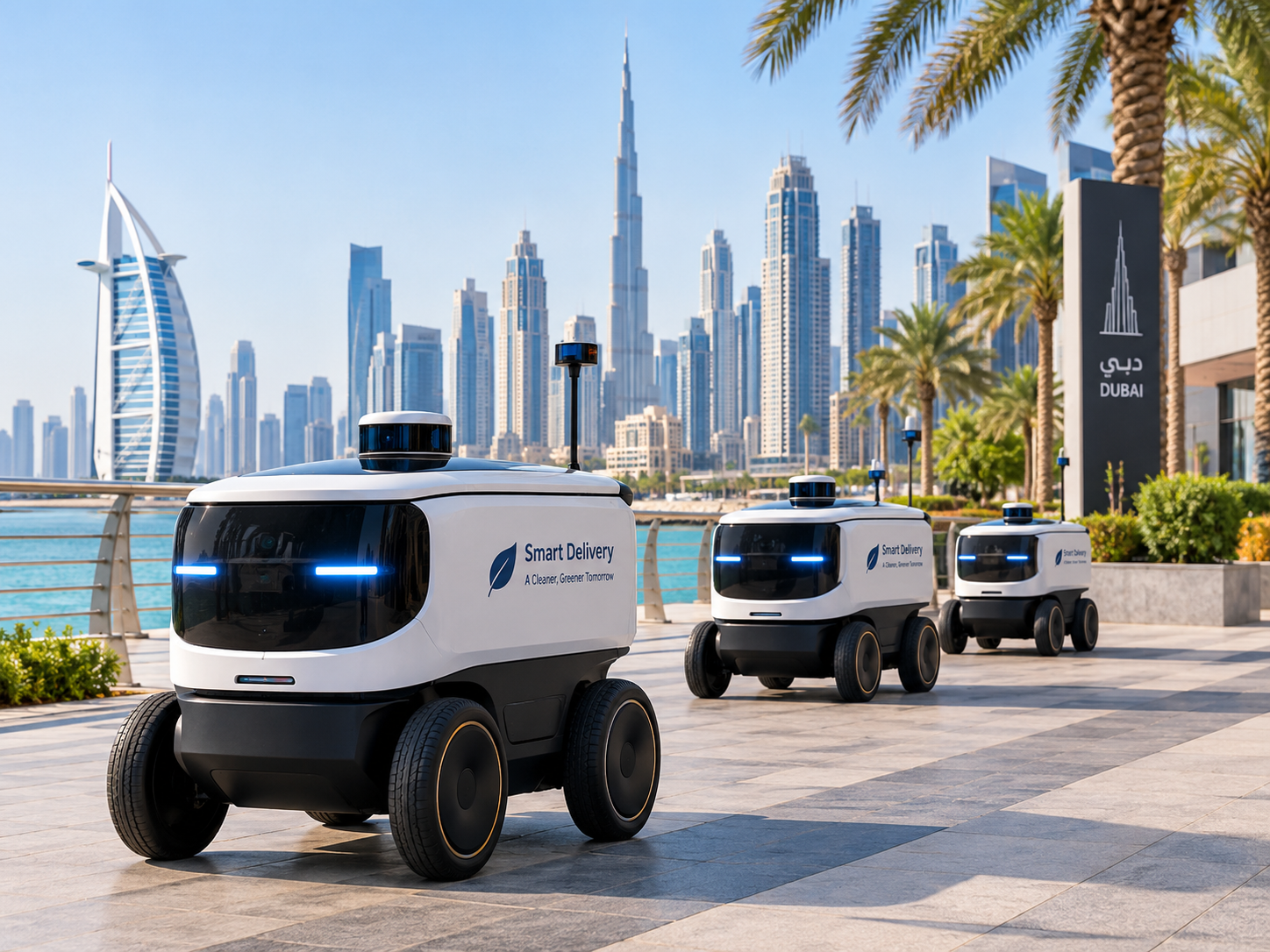
Autonomous delivery robots are moving from controlled technology demonstrations into practical last-mile logistics across the Gulf. In Saudi Arabia, the UAE and Qatar, these compact electric machines are being explored for food, grocery and parcel delivery as cities invest in smarter mobility and more automated urban services.
For GCC businesses, the opportunity is significant—but successful deployment involves more than buying robots. Heat, dust, pedestrian safety, building access, cybersecurity, privacy rules and regulatory approvals all affect whether a project can scale.
Autonomous delivery robots can reduce repetitive last-mile journeys, support lower-emission logistics and automate deliveries in campuses, communities and mixed-use districts. In the GCC, the strongest deployments are likely to be those designed specifically for regional climate conditions, local regulations and integration with buildings, apps and digital platforms.
What Are Autonomous Delivery Robots?
Autonomous delivery robots are small self-driving machines designed to transport food, groceries, parcels or other lightweight goods over relatively short distances without a human driver physically operating the vehicle.
They typically combine cameras, LiDAR, computer vision, GNSS/GPS, connectivity, geofencing and fleet-management software. Remote supervision may also be used when a robot encounters an obstacle or situation it cannot safely resolve on its own.
Customer-facing deployments need more than robotics. Reliable mobile app development can support live tracking, delivery notifications, authentication and proof of delivery.
Delivery Robots vs Autonomous Delivery Vehicles
The terms are sometimes used interchangeably, but they can describe different types of systems.
Sidewalk delivery robots are compact autonomous mobile robots designed for pedestrian areas, campuses, communities and short-distance routes.
Autonomous delivery vehicles are generally larger, road-oriented platforms that can carry heavier loads and travel farther.
For Gulf cities, smaller robots are especially suitable for controlled pilot environments where routes and operating conditions can be carefully managed.
Where Are Autonomous Delivery Robots Used in the GCC?
Saudi Arabia, the UAE and Qatar are approaching autonomous delivery through slightly different smart-city and mobility initiatives. The common theme is controlled deployment before wider expansion.
Autonomous Delivery Robots in Saudi Arabia
Saudi Arabia is exploring autonomous delivery as part of its wider smart-logistics ambitions.
Jahez reported in its 2024 annual report that it was working with Saudi Arabia’s Transport General Authority on self-driving delivery vehicles in ROSHN SEDRA. The project connects autonomous delivery with smart-community logistics and the Kingdom’s broader Vision 2030 focus on technology-enabled services. Saudi Exchange
These controlled environments are useful because operators can test routing, customer interaction, safety procedures and remote intervention without immediately tackling unrestricted citywide deployment.
Delivery Robots in Dubai and the UAE
Dubai has become one of the region’s most visible testing grounds for autonomous mobility.
Dubai’s Roads and Transport Authority, Dubai Integrated Economic Zones Authority and Talab at have previously launched autonomous food-delivery robot trials in Dubai Silicon Oasis. These pilots fit within Dubai’s wider effort to test automated transport and smart-city technologies.
For retailers and delivery businesses, the robot itself is only one part of the system. Orders, inventory, payment, dispatch and customer communication also need to work together, which makes scalable e-commerce solutions an important part of deployment.
Autonomous Ground Delivery in Qatar
Qatar’s TASMU Smart Qatar uses the term autonomous ground delivery for small electric vehicles that transport goods through streets and sidewalks.
Its framework considers technologies and operational elements such as remote monitoring, proof of delivery and vehicle-to-infrastructure communication.
For Doha and other planned urban environments, this approach places delivery robots within a broader smart-logistics ecosystem rather than treating them as standalone devices.
What Opportunities Do Autonomous Delivery Robots Create for Gulf Cities?
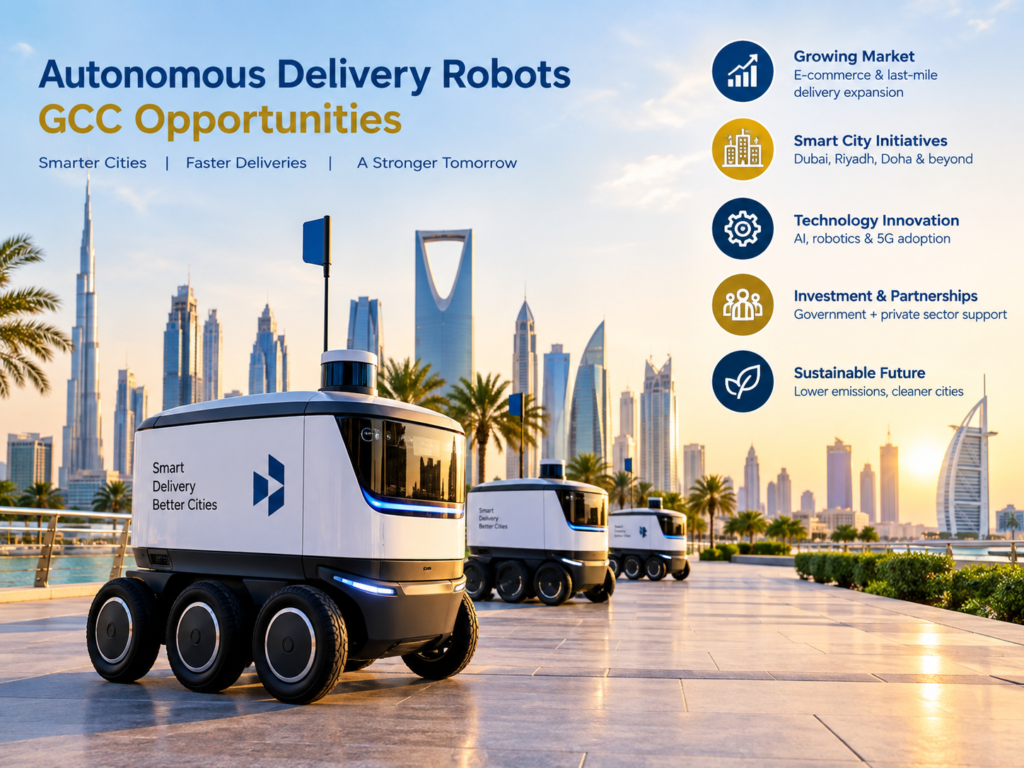
The strongest business case for delivery robots is usually not replacing every conventional delivery. It is automating repetitive, predictable journeys where smaller electric vehicles can operate efficiently.
Lower Last-Mile Delivery Costs
Last-mile delivery can involve short trips, waiting time and repeated movement between nearby locations.
Inside a campus, residential community, business district or mixed-use development, robots may reduce the need for conventional vehicles on routine journeys. They can also help businesses automate predictable delivery routes.
The actual savings depend on utilization, maintenance, remote supervision, infrastructure and integration costs.
Lower-Emission Urban Logistics
Electric autonomous delivery robots produce no tailpipe emissions at the point of use.
That makes them potentially useful within wider urban logistics strategies focused on reducing unnecessary vehicle movements in dense or pedestrian-oriented districts.
Their overall environmental impact still depends on factors such as electricity sources, manufacturing, battery life and how effectively the robots replace conventional delivery trips.
New Use Cases for Retail, Food and Smart Communities
Potential GCC use cases include.
Restaurant and food delivery
Grocery delivery
E-commerce parcels
Hospital and healthcare logistics
University and corporate campuses
Hotels and hospitality
Gated residential communities
Mixed-use developments
Government-backed smart districts
These services also require reliable digital connections between merchants, robots, buildings and customer platforms. Scalable back-end systems and API integrations can help connect those components.
What Are the Main Risks of Autonomous Delivery Robots?
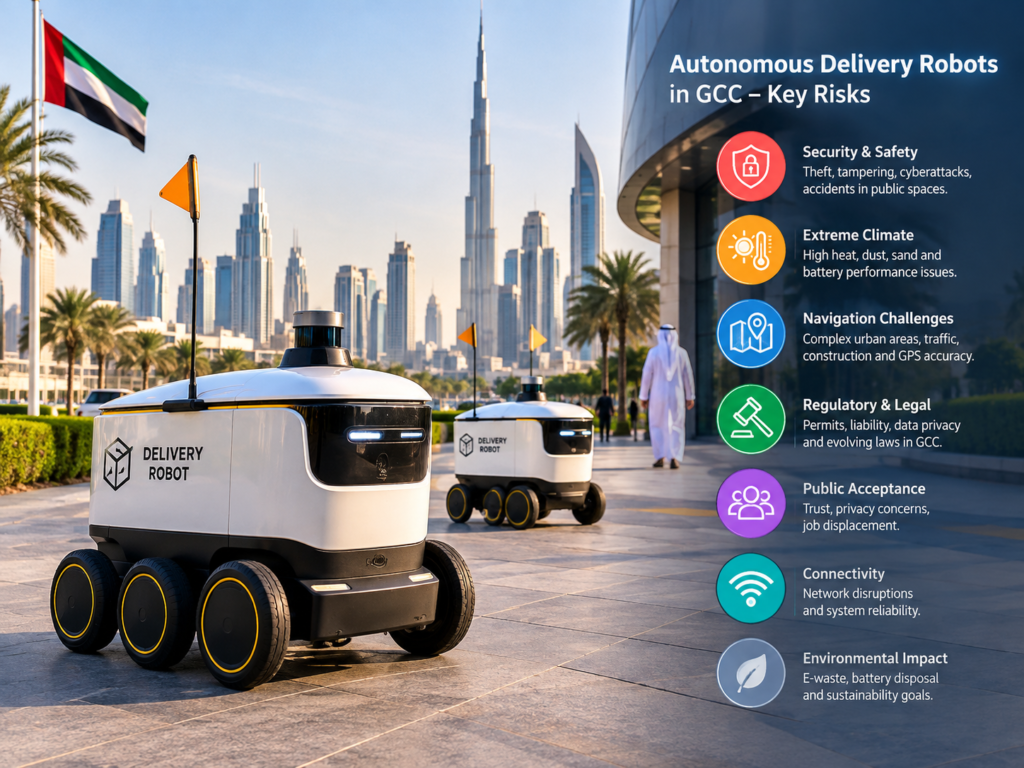
Quick answer: The main GCC challenges include pedestrian safety, extreme heat, sand and dust, inconsistent sidewalk access, cybersecurity, privacy and reliable remote operations. These issues need to be addressed during pilot design rather than after deployment.
Pedestrian Safety and Urban Accessibility
Delivery robots share space with people, so pedestrian safety is one of the most important design requirements.
A robot may need to respond safely to.
Children moving unpredictably
Wheelchair users
Crowded pathways
Road crossings
Temporary construction
Parked objects
Curbs and uneven surfaces
People approaching the robot from different directions
The robot must not simply reach its destination. It must do so without creating new obstacles for pedestrians or people with limited mobility.
Gulf Heat, Dust and Infrastructure Challenges
A robot that performs well in a mild climate may behave very differently during a Gulf summer.
Sustained heat can affect batteries, processors, motors and other electronic components. Sand and dust may interfere with cameras, LiDAR and mechanical systems.
Operators therefore need to test cooling, battery performance, charging intervals, sensor reliability and fail-safe behaviour under actual GCC conditions.
Infrastructure matters too. Missing sidewalks, steep curbs or unsuitable pedestrian routes can quickly turn a technically capable robot into an impractical delivery system.
Cybersecurity, Privacy and Remote Operations
Autonomous delivery robots continuously generate and exchange data.
Depending on the system, that may include.
Camera footage
Location information
Customer details
Building-access credentials
Fleet telemetry
Remote-control commands
Delivery verification data
This creates both cybersecurity and privacy considerations.
Saudi Arabia’s Personal Data Protection Law, for example, treats identifiable photographs and videos as personal data. Businesses therefore need to consider how robot-generated imagery is collected, processed, stored and protected. Data Governance Platform
How Are Autonomous Delivery Robots Regulated in Saudi Arabia, UAE and Qatar?
Quick answer: There is no single GCC-wide law covering autonomous delivery robots. Requirements vary by jurisdiction and may involve transport authorities, data-protection rules, telecom regulations, insurance, cybersecurity and permission to operate in public spaces.
Businesses planning a deployment should involve relevant authorities early rather than assuming a successful pilot in one Gulf market can automatically be replicated in another.
Saudi Arabia.
Saudi deployments may need to consider Transport General Authority requirements alongside applicable data-governance and privacy obligations.
This becomes especially important when robots use cameras, mapping systems, location information or identifiable customer data.
A technically successful robot still needs an operational model that fits local transport, safety and data requirements.
Dubai and UAE Autonomous Mobility Rules
Dubai’s RTA plays a central role in autonomous-mobility initiatives and approvals.
Connected robot fleets may also intersect with UAE telecommunications and IoT requirements. The Telecommunications and Digital Government Regulatory Authority provides an approval process for companies offering IoT services.
For operators, regulatory planning should therefore happen alongside engineering and software development.
Qatar’s Smart Mobility and Autonomous Ground Delivery Framework
TASMU Smart Qatar identifies several practical considerations for autonomous ground delivery, including public-road policy, vehicle security, insurance and pedestrian safety. TASMU Smart Qatar
This framework is particularly useful for businesses evaluating how robot delivery could fit into Doha’s broader smart-city infrastructure.
Are Autonomous Delivery Robots Worth the Investment in the GCC?
The answer depends less on the novelty of the technology and more on the operating environment.
A robot can look impressive in a demonstration while still being commercially inefficient if routes are unpredictable, utilization is low or frequent human intervention is required.
Main Cost Drivers for Delivery Robot Projects
A realistic deployment budget may need to account for.
Robot hardware
Mapping and route configuration
Connectivity
Charging infrastructure
Maintenance and replacement parts
Fleet-management software
Remote operators
Customer applications
Building integrations
Cybersecurity
Insurance and compliance
Operational monitoring
Businesses also need meaningful performance data. Business intelligence services can help teams monitor delivery performance, operating costs and return on investment.
Where Robots Can Deliver the Strongest ROI
Controlled environments often provide the best starting point.
Examples include gated communities, university campuses, business districts, hospitals and large mixed-use developments where routes are predictable and infrastructure can be adapted.
These environments make it easier to answer the questions that matter: How often does the robot need human help? How many successful deliveries can it complete? What happens in extreme heat? Does automation actually reduce delivery costs?
Saudi Arabia vs UAE vs Qatar Deployment Considerations
Each market offers a different operating context.
Saudi Arabia combines large-scale development projects with growing interest in smart logistics and technology-enabled urban services.
The UAE, particularly Dubai, has visible autonomous-mobility pilots and dense mixed-use environments where delivery automation can be tested alongside smart-building systems.
Qatar has a clearly articulated autonomous-ground-delivery concept through TASMU, providing a useful framework for operators exploring smart logistics in Doha.
Cloud infrastructure may also be part of the technical architecture. Depending on business, resilience and data requirements, organizations can evaluate regional services such as AWS Bahrain, Azure UAE Central and Google Cloud Doha. AWS Documentation
How Should GCC Companies Prepare for Autonomous Delivery Robots?
Successful implementation starts with a narrow operational problem, not a citywide rollout.
Start With a Controlled Pilot Zone
Choose a location where routes and operating conditions can be clearly defined.
A residential development in Riyadh, a mixed-use district in Dubai or a campus in Doha can provide a practical environment for testing geofencing, delivery times, obstacle handling and remote support.
Set clear operating hours, routes and service expectations before expanding.
Design for Arabic-English Users and Smart Buildings
Localization matters.
Customer interfaces should support Arabic and English where appropriate, while delivery workflows may need secure compartment codes, identity verification and digital proof of delivery.
Building access is another major factor. Robots operating in high-rise Gulf developments may need to communicate securely with elevator systems, access controls and property-management platforms.
Teams can combine robotics with front-end development and Flutter application development to create localized customer experiences across devices.
Measure Safety, Cost and Delivery Performance
A pilot should be evaluated using operational evidence rather than novelty.
Useful KPIs include.
Cost per delivery
Delivery time
Robot uptime
Battery performance
Human intervention rate
Failed deliveries
Safety incidents
Customer completion rates
These metrics should feed into dashboards so decision-makers can see whether performance improves as the pilot matures.
A practical implementation sequence is straightforward: select a controlled zone, integrate the robot with customer and building systems, measure safety and operational performance, and only then consider wider expansion.
Final Thoughts
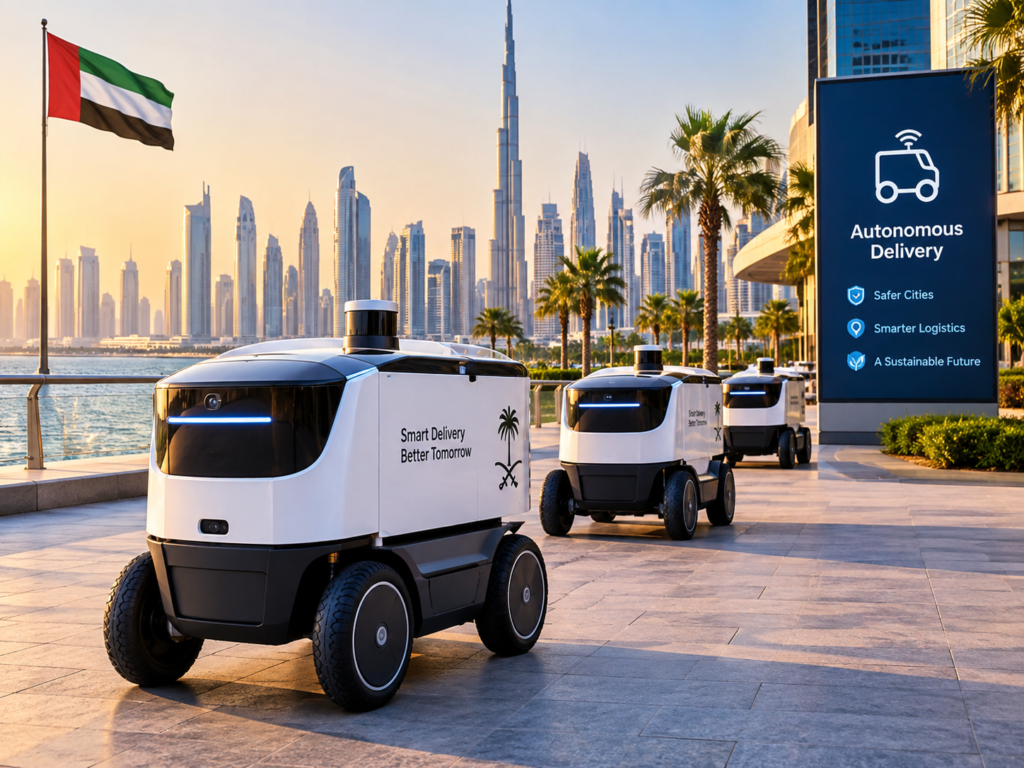
Autonomous delivery robots have credible applications across Saudi Arabia, the UAE and Qatar, particularly in controlled communities, campuses and smart developments.
Their long-term value will depend on much more than autonomous navigation. Gulf operators need hardware that can withstand regional weather, software that integrates with existing platforms, strong cybersecurity, accessible pedestrian design and a clear understanding of local regulatory requirements. ( Click Here’s )
For businesses evaluating autonomous delivery robots, the strongest starting point is a measurable pilot built around a real logistics problem.
Mak It Solutions can help businesses plan mobile experiences, integrations, dashboards and scalable platforms through its technology development services. Contact the team to discuss a GCC-focused deployment strategy.
FAQs
Q : Are autonomous delivery robots already operating in Saudi Arabia?
A : Saudi Arabia has moved beyond purely theoretical discussion. Jahez reported autonomous-delivery testing involving the Transport General Authority and ROSHN SEDRA.
That does not mean autonomous delivery robots can operate freely on every Saudi sidewalk. Businesses should still coordinate with relevant transport authorities and assess applicable data requirements when robots use cameras, mapping, location information or customer data.
Q : Can delivery robots operate safely in Dubai’s extreme summer heat?
A : They can be engineered for hot climates, but Gulf operation requires careful thermal design and real-world testing.
Batteries, processors, motors, cameras and LiDAR need to remain reliable under sustained heat, while dust and sand can affect sensors and moving components. Operators should test cooling, battery degradation, charging intervals and fail-safe behavior under realistic UAE conditions.
Q : Can autonomous delivery robots use elevators in UAE high-rise buildings?
A : Yes, provided the robot and building systems are properly integrated.
A delivery robot can potentially communicate with elevator controls, access-management systems and building IoT platforms. The main challenges are authorization, cybersecurity and interoperability between different property-management technologies.
Q : What does autonomous ground delivery mean in Qatar?
A : TASMU Smart Qatar describes autonomous ground delivery as the use of small autonomous electric vehicles to move goods through urban streets and sidewalks to designated delivery or collection points.
The concept may include remote monitoring, recipient applications, proof of delivery and vehicle-to-infrastructure communication.
Q : Which GCC industries could benefit from autonomous delivery robots?
A : Retail, food delivery, e-commerce, logistics, healthcare, hospitality, property development and smart communities are practical use cases.
The best opportunities are generally environments where journeys are short, demand is predictable and infrastructure can support safe autonomous operation.