

Harvest Now, Decrypt Later: GCC Quantum Risk Guide
Harvest Now, Decrypt Later: GCC Quantum Risk Guide
Harvest Now, Decrypt Later: GCC Quantum Risk Guide
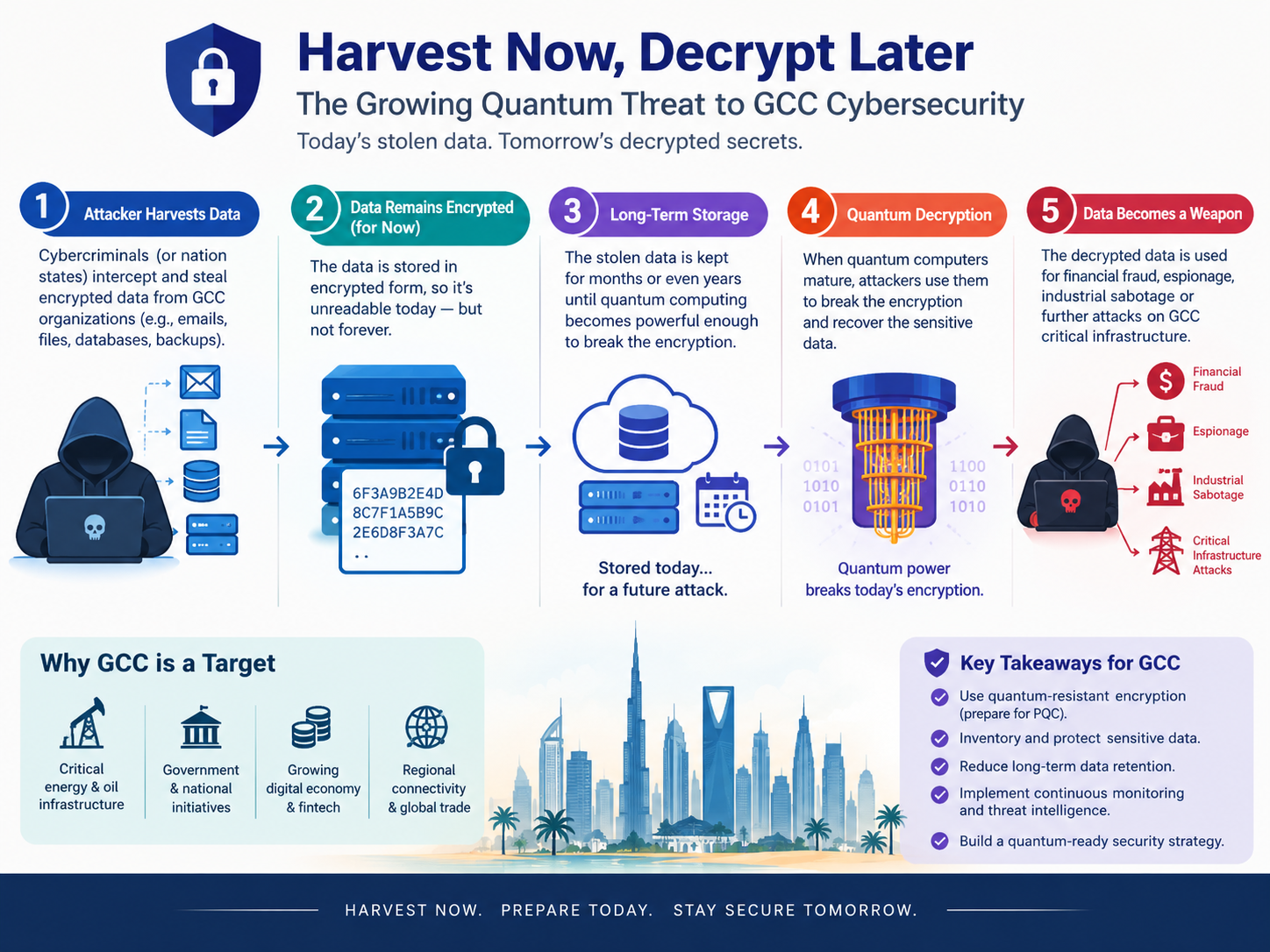
A cybercriminal does not need a quantum computer today to create a security problem for tomorrow. With Harvest Now, Decrypt Later, attackers can capture encrypted information now, store it, and potentially decrypt it years later when sufficiently capable quantum computing becomes available.
For organizations in Saudi Arabia, the UAE and Qatar, the practical response is not panic or an immediate replacement of every encryption system. It is to identify long-lived sensitive data, understand where vulnerable public-key cryptography is used, improve crypto-agility and begin a structured post-quantum cryptography roadmap.
What Is Harvest Now, Decrypt Later?
Harvest Now, Decrypt Later is a cyber strategy in which an attacker collects encrypted data today with the intention of decrypting it in the future.
The attacker does not need immediate access to the plaintext. If the information remains valuable for years, simply storing the encrypted data may be enough to create a future security risk.
A simplified attack flow looks like this.
Encrypted data → interception → storage → future quantum capability → attempted decryption
That is what makes HNDL different from many conventional cyberattacks. Time becomes part of the attacker’s strategy.
Government documents, KYC records, healthcare information, intellectual property, engineering files and strategic contracts can all retain value long after they are created. If their confidentiality lifetime extends beyond the expected security lifetime of today’s cryptography, they deserve closer attention.
Organizations reviewing this exposure can incorporate it into broader quantum-computing readiness planning.
How Could Quantum Computing Threaten Today’s Encryption?
Modern enterprises rely heavily on public-key cryptography.
RSA and elliptic-curve cryptography, or ECC, support technologies such as.
TLS connections
Public key infrastructure
Digital certificates
VPN authentication
Digital signatures
Enterprise identity systems
Secure APIs and applications
A sufficiently capable cryptographically relevant quantum computer could threaten important forms of today’s public-key cryptography.
This does not mean current encryption suddenly becomes useless today. The concern is that information intercepted today may still be sensitive by the time future quantum systems become capable of attacking the algorithms protecting it.
What does “Q-Day” mean?
“Q-Day” is an informal term for the point at which quantum computers become powerful and reliable enough to threaten widely deployed public-key cryptography.
No organization needs to predict an exact Q-Day before taking sensible precautions. Migration across large enterprises, legacy applications, certificate systems, suppliers and hardware can take considerable planning.
That is why preparation matters before the technology reaches that point.
Why post-quantum cryptography matters now
Post-quantum cryptography, or PQC, uses algorithms designed to resist attacks from both conventional and quantum computers.
NIST finalized its first major post-quantum cryptography standards in 2024, including ML-KEM, ML-DSA and SLH-DSA. The practical implication for GCC organizations is straightforward: standardized migration options now exist, so cryptographic discovery and testing can begin before quantum-capable attacks become an operational reality.
PQC planning can also be incorporated into a wider technology services roadmap.
Why Harvest Now, Decrypt Later Matters in the GCC
Saudi, UAE and Qatar organizations should pay attention to Harvest Now, Decrypt Later because data intercepted today may remain commercially, legally or strategically valuable for many years.
The highest priority is not necessarily the largest database. It is information whose confidentiality must survive long enough for future decryption risk to matter.
Saudi Arabia.
Saudi organizations already operate in an environment where cryptographic governance, data protection and cybersecurity controls are important regulatory considerations.
The Saudi National Cybersecurity Authority’s cryptographic standards address areas including post-quantum cryptography, PKI and key lifecycle management. Financial institutions supervised by SAMA must also maintain governed cryptographic controls under applicable cybersecurity requirements.
For a Riyadh fintech, bank, government contractor or digital-services provider, PQC readiness therefore fits naturally alongside existing security, architecture and data-governance work.
The practical starting point is to determine.
Which information must remain confidential for years
Where RSA or ECC is currently used
Which certificates and keys depend on those algorithms
Which applications cannot be upgraded easily
Which suppliers control critical cryptographic components
UAE.
Organizations in Dubai and Abu Dhabi should approach PQC as part of broader information-assurance, trust-services, key-management and sector-specific security programs.
Rather than creating a separate “quantum project” with no connection to existing infrastructure, security teams can map PQC readiness against current PKI, cloud, identity, certificate and encryption environments.
For firms operating in regulated environments such as ADGM or DIFC, legal and compliance teams should remain involved as cryptographic requirements and vendor capabilities evolve.
Qatar.
Qatar’s banking, energy, government, healthcare and critical-infrastructure sectors may have substantial quantities of data with long confidentiality lifetimes.
For a Doha bank, energy operator or government supplier, the most useful question is not simply.
When will quantum computers break encryption?
A better question is.
Which information would still damage us if someone decrypted it years from now?
That shift makes HNDL planning much more practical.
Which GCC Business Data Faces the Greatest HNDL Risk?
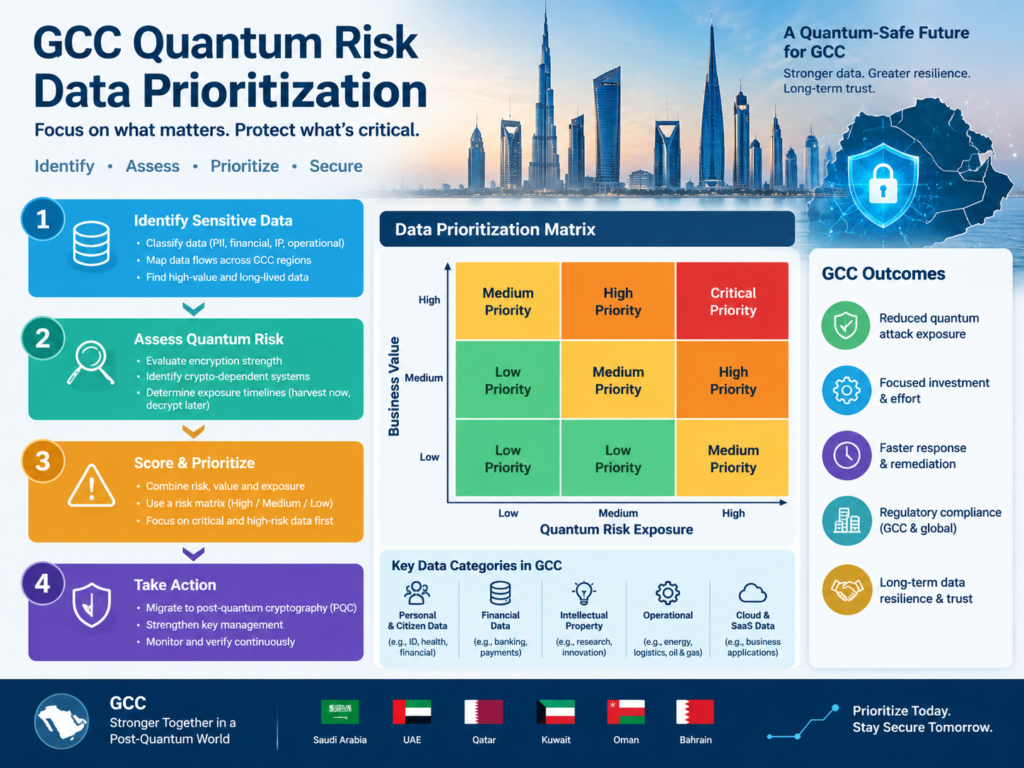
Not every piece of encrypted information requires the same level of urgency.
Organizations should start with data that combines a long confidentiality lifetime with high business, regulatory or strategic impact.
Financial, identity and customer information
High-priority categories may include.
KYC and identity records
Sensitive banking information
Payment-related records
Private customer communications
Authentication material
Regulated financial documentation
These datasets can remain useful to attackers long after collection.
Government, healthcare and critical infrastructure data
Long-lived government and infrastructure information deserves similar attention.
Examples include.
Citizen information
Health and patient records
Infrastructure designs
Operational documentation
Security architecture
Government contracts
Critical-system configurations
Exposure may remain harmful even years after the original data was generated.
Intellectual property and strategic business information
Commercially sensitive information can also have a long useful life.
Source code, engineering designs, acquisition documents, product plans, logistics strategies and confidential contracts may continue to reveal competitive information well into the future.
Organizations using analytics platforms can incorporate confidentiality-lifetime classification into existing business intelligence workflows.
How Should GCC Companies Prepare for Harvest Now, Decrypt Later?
A practical PQC program does not begin by replacing every algorithm.
It begins with visibility.
Build a cryptographic inventory
Identify where cryptography exists across the organization.
The inventory should include.
Algorithms
Certificates
Encryption keys
PKI
TLS
VPN systems
APIs
Cryptographic libraries
Cloud services
Embedded systems
Hardware appliances
Third-party and supplier dependencies
Discovery should extend beyond the security team. Cryptographic dependencies may be buried inside applications, integrations and backend systems.
Prioritize by confidentiality lifetime and impact
Once the inventory exists, classify systems according to risk.
A useful planning model is:
Confidentiality lifetime + migration difficulty + exposure + business impact = PQC priority
For example, a Riyadh fintech’s long-term KYC archive will typically deserve more attention than public marketing content whose value disappears quickly.
The same logic applies to government records in Abu Dhabi or infrastructure information held by a Doha energy company.
Improve crypto-agility
Crypto-agility is the ability to replace cryptographic algorithms, certificates and key mechanisms without rebuilding entire systems.
This matters because PQC migration will not happen everywhere at once.
Standards, vendor support, protocols and implementation guidance will continue to evolve. Systems designed around a single hard-coded algorithm can make future migration much harder than necessary.
Crypto-agile architecture gives organizations room to adapt.
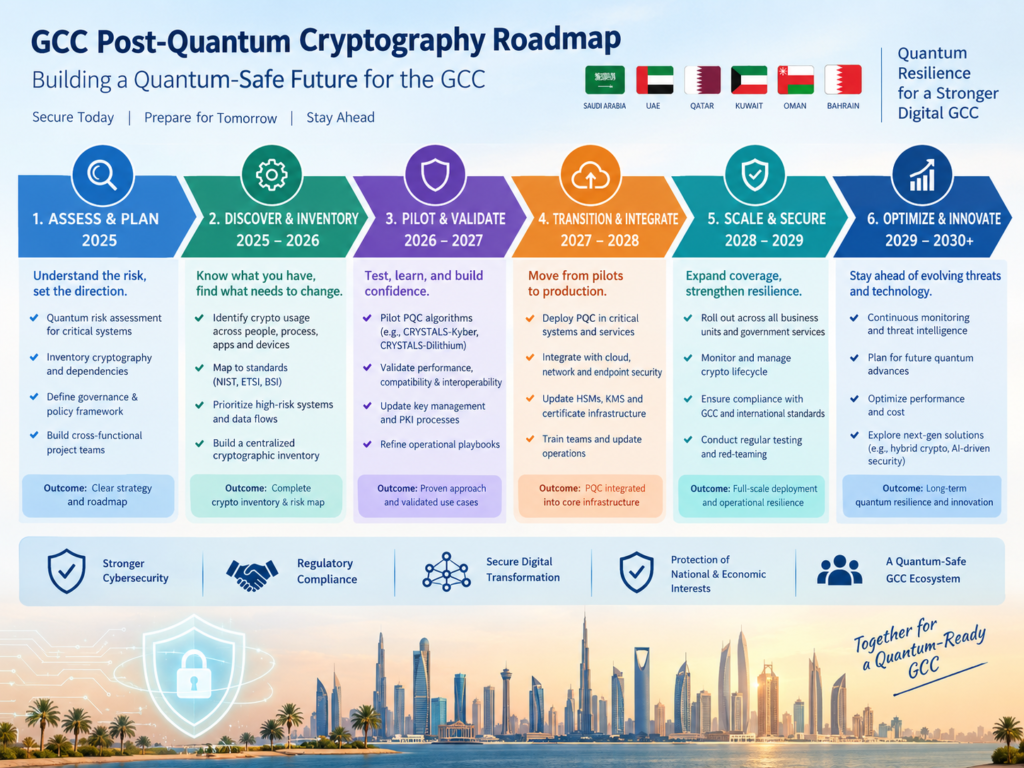
What Should a GCC Post-Quantum Migration Roadmap Include?
A credible roadmap should connect security engineering with governance, regulation, procurement and business priorities.
Assess regulatory and sovereign requirements
Map the obligations that apply to your organization.
Depending on the country and sector, this may involve frameworks or requirements associated with:
NCA, NDMO and SAMA in Saudi Arabia
TDRA, ADGM and DIFC considerations in the UAE
NCSA and QCB requirements in Qatar
Data residency, procurement rules, cross-border architecture and supplier obligations should also be considered.
PQC should not be treated as a replacement for these requirements. It becomes another layer within the organization’s broader cryptographic governance.
Test PQC across real infrastructure
Testing should extend beyond laboratory demonstrations.
Review how post-quantum and transitional approaches behave across.
TLS
VPNs
PKI
Certificates
APIs
Cloud environments
Identity platforms
Legacy systems
Network appliances
Regional cloud infrastructure can support data-residency strategies, but hosting information inside the GCC does not automatically make its encryption quantum-resistant.
Existing applications may also require upgrades through secure web development services.
Define owners and migration milestones
PQC cannot remain solely a CISO-team issue.
Ownership should involve.
Security
Enterprise architecture
Application teams
Infrastructure
Cloud teams
Compliance
Procurement
Legal teams
Relevant business owners
Future procurement requirements should also ask suppliers to document their cryptographic dependencies, supported algorithms and upgrade roadmaps.
That prevents future migration plans from being blocked by opaque vendor technology.
What GCC Leaders Should Do Before Q-Day
The first objective is discovery, not wholesale replacement.
Start by identifying long-lived information and the cryptography protecting it. Then determine which systems are difficult to migrate, which suppliers create dependencies and where crypto-agility is missing.
Existing security programs, including endpoint detection and response implementation, may also help reveal ownership, asset and dependency gaps that affect future migration.
A useful operating sequence is:
Assess → Inventory → Prioritize → Test → Migrate → Govern
This can sit alongside a broader GCC technology adoption roadmap.
The key is to focus first on information that must stay confidential for years. A strategic government contract or sensitive identity archive deserves more urgency than information whose value disappears quickly.
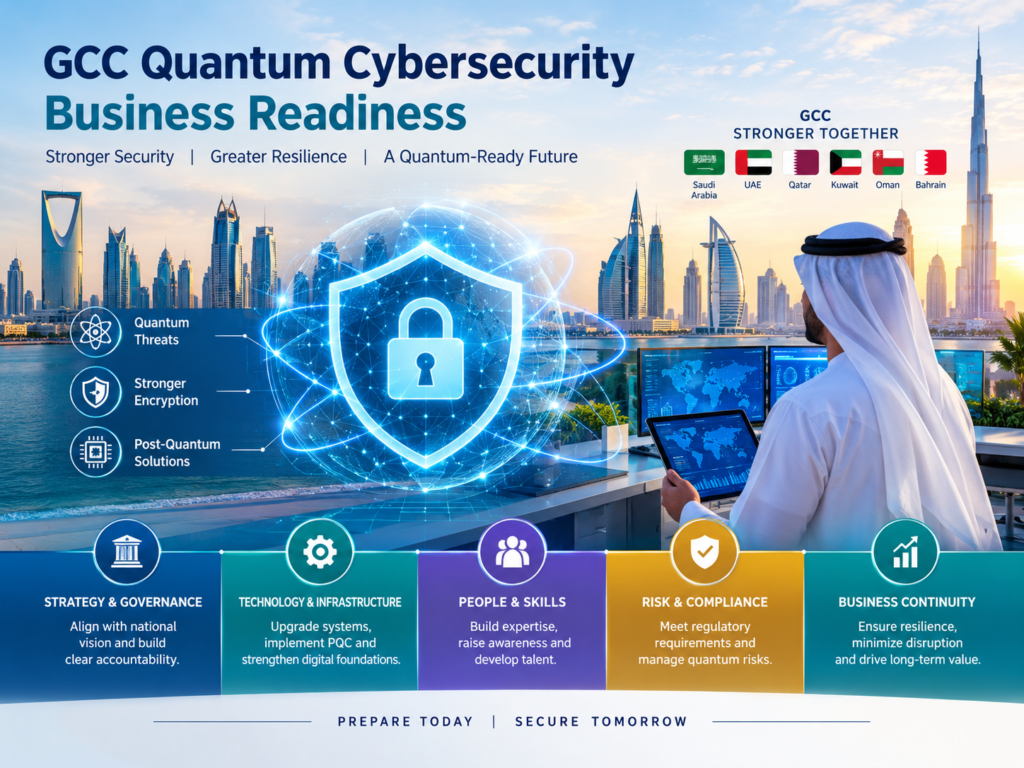
Concluding Remarks
Harvest Now, Decrypt Later changes the way organizations should think about encrypted information. A file can be secure against today’s attacker while still creating a future confidentiality problem if it remains valuable for years.
For Saudi, UAE and Qatar organizations, the sensible path is structured preparation: identify sensitive long-lived data, inventory cryptographic dependencies, improve crypto-agility, test standardized PQC technologies and establish clear ownership for migration. Mak It Sol
Quantum risk does not require panic. It requires visibility and a plan.
Contact Mak It Solutions to discuss a GCC-focused quantum-readiness assessment, cryptographic inventory or post-quantum migration strategy for Saudi Arabia, the UAE, Qatar and the wider Gulf.
FAQs
Q : Are Saudi companies required to prepare for post-quantum cryptography?
A : There is no single blanket requirement forcing every Saudi company to complete a PQC migration immediately. However, Saudi NCA cryptographic standards address post-quantum cryptography, while regulated organizations may face additional sector-specific requirements.
For many organizations, cryptographic discovery and long-lived data classification are sensible first steps even before a full migration is required.
Q : Does the UAE National Encryption Policy affect enterprise PQC planning?
A : UAE businesses should consider PQC within the country’s wider information-assurance, trust-services, encryption and sector-specific regulatory environment.
The practical approach is to assess existing cryptographic dependencies, key-management practices, applicable obligations and vendor migration plans together rather than treating PQC as an isolated technology project.
Q : Which Qatar industries face the greatest long-term quantum risk?
A : Banking, fintech, government, energy, healthcare and critical infrastructure are among the sectors likely to hold significant quantities of long-lived sensitive information.
The highest-priority systems are those where confidentiality lifetime, technical migration difficulty and business or regulatory impact are all high.
Q : Can GCC businesses continue using existing TLS and VPN systems during migration?
A : In most environments, migration will be phased rather than an immediate replacement of every TLS or VPN implementation.
Organizations should identify quantum-vulnerable dependencies, test supported post-quantum or transitional approaches, and validate interoperability, performance, compliance and vendor support before production deployment.
Q : How long does a post-quantum readiness assessment take?
A : There is no universal timeframe. The scope depends on organizational size, application complexity, supplier dependencies, regulatory requirements and the maturity of the existing cryptographic inventory.
The more useful goal is not completing an assessment as quickly as possible. It is building a defensible inventory and a prioritized roadmap that security, architecture, compliance and management teams can actually execute.