


Post-Quantum TLS: Essential GCC Website Guide
Post-Quantum TLS: Essential GCC Website Guide
Post-Quantum TLS: Essential GCC Website Guide
Your website has HTTPS enabled. Customers can log in, make payments, and share sensitive information through encrypted connections. But what happens if cybercriminals record that traffic today and gain the technology to decrypt it years later?
That’s the security challenge post-quantum TLS is designed to address.
Post-quantum TLS strengthens HTTPS by introducing quantum-resistant key establishment. For businesses in Saudi Arabia, the UAE, and Qatar, hybrid TLS 1.3 offers a practical way to begin protecting long-lived confidential information against future quantum threats without replacing their entire website infrastructure.
The transition doesn’t have to happen overnight. What matters is knowing which connections need protection, what your providers support, and where to start.
What Is Post-Quantum TLS and Why Does It Matter for GCC Websites?
Post-quantum TLS uses cryptographic mechanisms designed to withstand attacks from conventional computers and future quantum computers.
Unlike standard HTTPS configurations that rely on classical public-key cryptography, post-quantum TLS can use quantum-resistant algorithms to establish secure session keys.
This matters for GCC businesses handling financial transactions, medical records, customer accounts, and confidential enterprise data.
How Post-Quantum Cryptography Protects HTTPS Connections
When a browser connects to a secure website, TLS helps establish the encryption keys used to protect data in transit.
Post-quantum cryptography strengthens this process through mathematical problems believed to remain difficult even for powerful quantum computers.
It primarily addresses the public-key mechanisms used during secure connection establishment. Protecting authentication and other cryptographic components requires separate consideration.
Why Traditional TLS May Face Future Quantum Threats
Today’s quantum computers cannot practically break properly implemented modern TLS at scale. However, sufficiently powerful future quantum computers could threaten widely used classical public-key algorithms.
This creates a risk known as harvest-now-decrypt-later.
An attacker might capture encrypted communications now, store them, and attempt to decrypt them when stronger quantum technology becomes available.
For ordinary short-lived data, that risk may be limited. For healthcare records, financial information, and confidential agreements that must remain private for years, it’s worth planning for.
Why Saudi, UAE and Qatar Website Owners Should Prepare
Consider how different GCC organizations handle sensitive information.
A Jeddah e-commerce retailer protects customer accounts and checkout sessions.
An Abu Dhabi SaaS provider transfers confidential business information through APIs.
A Doha financial platform handles sensitive transactions and customer records.
Their infrastructure and risks differ, but each can benefit from understanding its cryptographic dependencies.
Adding quantum-readiness assessments to existing web development and maintenance practices helps make security planning more proactive.
How Does Post-Quantum TLS Work with TLS 1.3?
TLS 1.3 is a modern protocol for protecting internet communications. However, using TLS 1.3 alone does not guarantee quantum-resistant security.
The key difference lies in which cryptographic algorithms are negotiated during the handshake.
Hybrid Key Exchange.
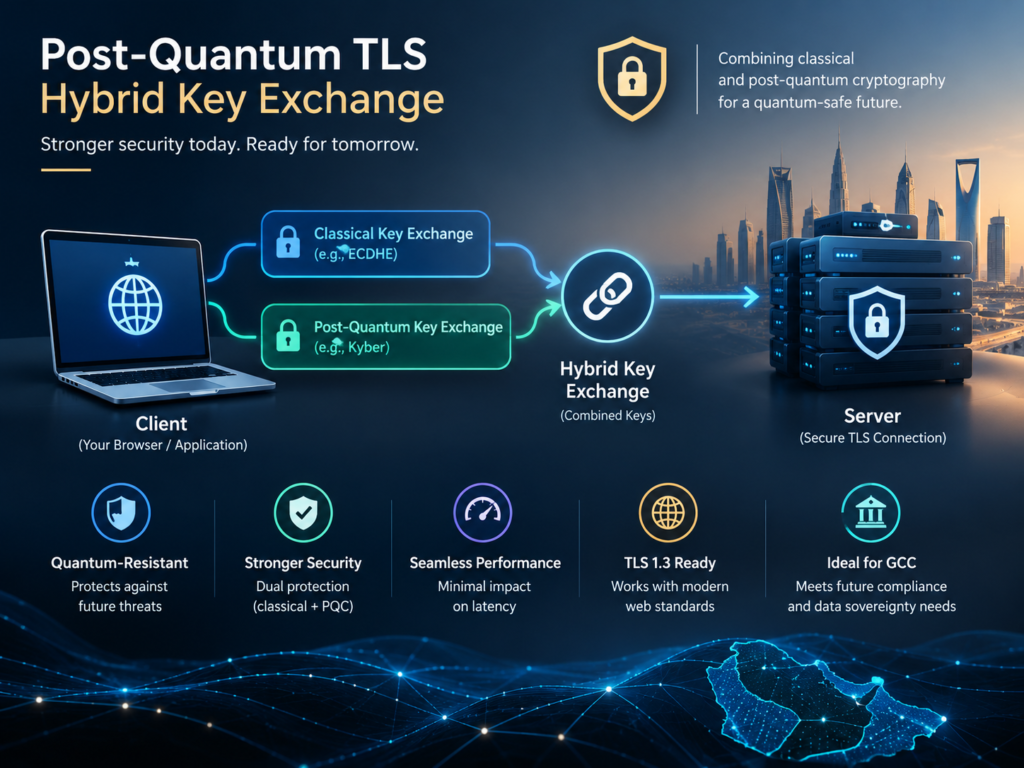
A hybrid key exchange combines a traditional cryptographic mechanism with a post-quantum one.
A prominent example is X25519MLKEM768, which combines.
X25519: A widely deployed classical elliptic-curve key agreement mechanism.
ML-KEM: A quantum-resistant key encapsulation mechanism standardized by NIST in FIPS 203.
The combination is specified in IETF RFC 10024, published in August 2026. Its purpose is to preserve key-establishment security if at least one component remains secure under the relevant protocol assumptions.
For businesses, this approach provides a practical transition path while conventional and post-quantum cryptography coexist.
Is TLS 1.3 Already Quantum-Safe?
No. TLS 1.3 does not automatically provide quantum resistance.
A connection must successfully negotiate a suitable hybrid or post-quantum key establishment mechanism.
Simply checking the TLS version or seeing an HTTPS padlock won’t tell you whether that protection is active.
Your hosting provider, CDN, web server, and connecting clients must support compatible configurations.
Post-Quantum Key Exchange vs Quantum-Safe SSL Certificates
Key establishment and authentication perform different security functions.
Key establishment helps create the secrets used to encrypt a session. Digital certificates and their signatures help authenticate the server.
NIST FIPS 204 defines ML-DSA, a post-quantum digital signature standard. However, enabling hybrid key establishment does not automatically replace classical certificate signatures.
|
TLS configuration |
Key establishment |
Authentication |
|---|---|---|
| Classical TLS 1.3 | Classical | Usually classical |
| Hybrid TLS 1.3 | Classical + ML-KEM | Usually classical |
| Broader post-quantum deployment | Hybrid or post-quantum | PQ signatures where supported |
A successful hybrid TLS handshake strengthens session-key establishment, but it does not establish that every cryptographic component is quantum-resistant.
Post-Quantum TLS Compliance in Saudi Arabia, UAE and Qatar
Regulatory expectations are an important part of cybersecurity planning across the GCC.
Still, businesses should distinguish national cryptographic guidance from binding requirements applicable to their own sector and organization.
Saudi Arabia.
Saudi Arabia’s National Cybersecurity Authority (NCA) publishes National Cryptographic Standards that address cryptographic protection for national systems and data.
The standards also discuss post-quantum cryptography and associated risks.
For Saudi organizations, sensible preparation includes reviewing applicable controls, understanding sensitive-data requirements, and identifying cryptographic systems that may need upgrading.
Financial institutions should additionally examine relevant Saudi Central Bank (SAMA) cybersecurity requirements.
These references should not be interpreted as a universal mandate requiring every Saudi commercial website to deploy hybrid TLS immediately.
UAE.
The UAE’s National Encryption Policy addresses encryption, key management, post-quantum cryptography, and implementation monitoring.
Businesses should determine which requirements apply to their operations rather than assuming that all private websites have identical obligations.
Organizations operating under sector-specific rules, including relevant TDRA frameworks or ADGM and DIFC financial supervision, may need additional assessments.
For a Dubai financial technology company, cryptographic readiness should form part of a broader security and regulatory compliance strategy.
Qatar.
Qatar’s National Cyber Security Agency provides cybersecurity direction, while the Qatar Central Bank supervises relevant financial institutions.
For a Doha organization managing sensitive financial information, preparation starts with identifying encrypted communications and understanding how long that information must remain confidential.
Cryptographic inventories, provider assessments, and documented migration decisions can support broader cybersecurity governance.
Organizations should verify their specific regulatory obligations before treating any post-quantum deployment approach as mandatory.
How GCC Website Owners Can Prepare for Post-Quantum TLS
Adopting post-quantum TLS is easier when approached as a controlled infrastructure upgrade.
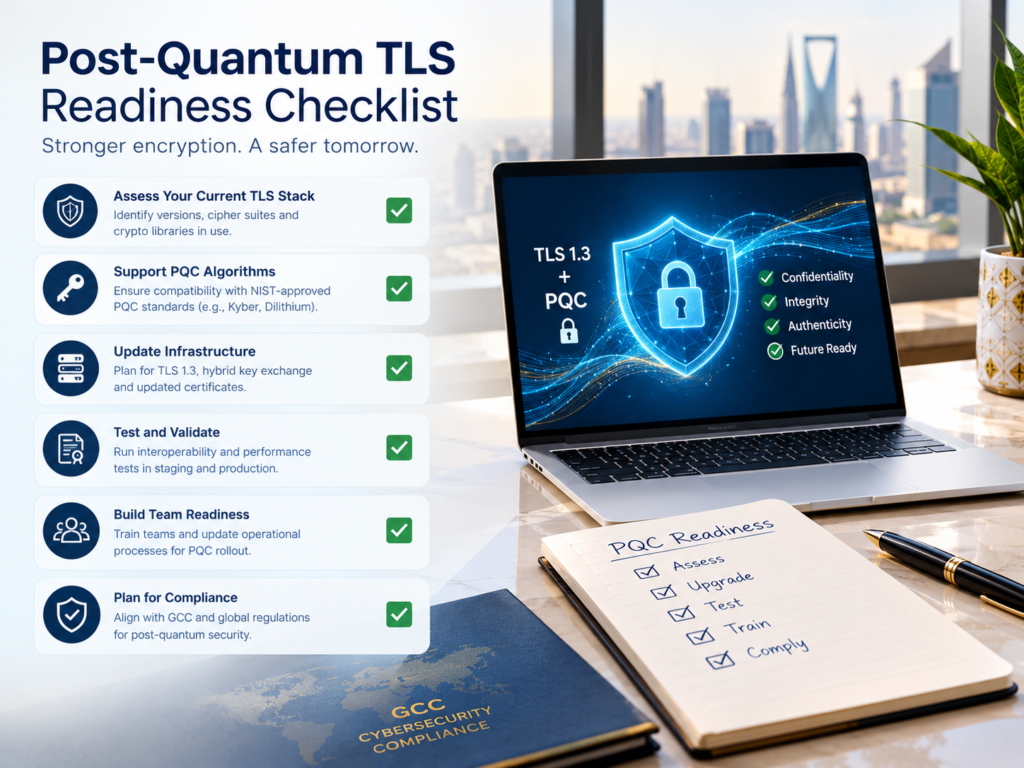
Businesses can begin with an audit, confirm provider capabilities, and test compatibility before changing production configurations.
Audit HTTPS, TLS 1.3 and Cryptographic Dependencies
Start by identifying every component involved in your website’s encrypted communications.
Your inventory should include.
Public websites, domains, and subdomains.
TLS certificates and authentication algorithms.
Hosting environments, CDNs, and load balancers.
Origin servers, application servers, and APIs.
External integrations and legacy applications.
Negotiated TLS versions and key exchange groups.
Don’t overlook traffic between internal services. A secure browser connection does not guarantee that every downstream connection has equivalent protection.
This audit establishes where cryptographic changes may be needed.
Evaluate Hosting, CDN and Hybrid ML-KEM Support
Next, ask your hosting and CDN providers whether they support standardized hybrid key exchange, particularly X25519MLKEM768.
Cloudflare, for example, documents post-quantum key agreement for supported connections between its edge network and origin servers, along with post-quantum authentication options for certain origin configurations.
However, actual protection depends on successful negotiation between the relevant endpoints.
A business reviewing its web application infrastructure should evaluate browser-to-CDN, CDN-to-origin, and application-to-application connections separately.
Test Compatibility, Monitor Handshakes and Plan Rollout
Before enabling changes across production systems, test them in a controlled environment.
Focus on.
Confirming that hybrid key exchange is actually negotiated.
Checking older browsers, mobile applications, and API clients.
Monitoring TLS handshake failures and connection performance.
Testing payment, authentication, and checkout workflows.
Establishing a rollback procedure if compatibility problems appear.
Hybrid handshakes can involve larger messages than classical handshakes, which may expose problems in older network equipment or software.
Gradual deployment helps teams identify these issues before they affect customers.
Post-Quantum TLS Use Cases and Costs Across GCC Markets
There is no single migration plan suitable for every GCC website.
Implementation effort depends on application complexity, existing security infrastructure, and the sensitivity of the information being protected.
Saudi E-Commerce, UAE Fintech and Qatar Digital Services
Here are some realistic planning scenarios.
Riyadh fintech: Assess customer information retention, TLS endpoints, and relevant SAMA cybersecurity controls.
Dubai e-commerce: Test hybrid TLS across checkout journeys, authentication flows, and connected mobile applications.
Doha digital services: Evaluate confidential API communications and cloud infrastructure dependencies.
Abu Dhabi healthcare: Prioritize data flows carrying medical records that require long-term confidentiality.
The priority should reflect business risk, not simply the number of servers or website visitors.
What Affects Post-Quantum TLS Migration Costs?
Migration costs vary based on infrastructure and available technical capabilities.
A modern website using a managed CDN may require less engineering effort than a custom financial application with multiple integrations.
Common cost factors include infrastructure assessments, vendor support, application upgrades, testing, monitoring, and internal engineering resources.
Businesses should request a scoped technical evaluation before committing to a budget.
How Long Could a GCC Website Security Upgrade Take?
The following comparison indicates relative complexity rather than guaranteed delivery timelines.
|
Website environment |
Relative effort |
|---|---|
| Modern CDN-managed website |
Lower |
| Multi-region SaaS platform |
Medium |
| Legacy financial infrastructure |
Higher |
Existing hybrid TLS support can simplify deployment. Legacy clients, custom cryptographic implementations, or complex authentication requirements may require additional work.
The most reliable timeline comes after reviewing the architecture and completing initial compatibility testing.
Best Practices for Quantum-Safe Website Security in the GCC
Post-quantum TLS should form part of a wider website security strategy.
Updating one cryptographic mechanism does not resolve vulnerabilities in application code, infrastructure access, authentication, or operational processes.
Build Crypto-Agility and Continuous TLS Monitoring
Crypto-agility means being able to replace or update cryptographic algorithms without rebuilding an entire application.
To support it, maintain current cryptographic inventories, patch dependencies, monitor TLS configurations, and review certificate lifecycles.
Also pay attention to software security. Strong enterprise application security practices remain essential even when encryption is correctly configured.
Address Data Residency, Arabic UX and Cloud Infrastructure
GCC organizations may also need to consider hosting location, data residency, and local customer expectations.
Regional cloud infrastructure options include AWS Bahrain, Microsoft Azure UAE Central, and Google Cloud Doha.
However, regional hosting does not automatically provide post-quantum protection.
Similarly, an Arabic-language website’s cryptographic requirements are fundamentally the same as those of an English-language website.
Businesses should evaluate data residency obligations separately while ensuring that encryption upgrades preserve Arabic shopping journeys, payment functionality, and mobile performance.
Choose a Post-Quantum TLS Assessment or Managed Security Partner
Before selecting an implementation partner, ask for evidence of technical capabilities rather than relying on broad claims about quantum-safe hosting.
Look for experience with modern TLS configurations, documented compatibility testing, infrastructure visibility, and realistic migration planning.
Review the provider’s technical services and company background to understand whether its offering matches your requirements.
A useful assessment should leave your team with clear priorities, identified risks, and a practical deployment roadmap.
Wrap It Up
Your HTTPS padlock remains an important part of website security. But it does not tell you whether the connection can withstand future quantum attacks.
For businesses across Saudi Arabia, the UAE, and Qatar, post-quantum TLS offers an increasingly practical way to strengthen long-term confidentiality.
The most sensible approach is to audit existing cryptographic dependencies, check hybrid TLS 1.3 support, test critical connections, and review relevant regulatory requirements.
You don’t need to replace every system immediately. You do need a clear understanding of which systems protect sensitive information and how their security can evolve.
Protecting customer information begins with understanding the infrastructure you already have.
Explore Mak It Solutions and its website development services, or contact the team to discuss a tailored GCC website security-readiness assessment.
Ask about HTTPS configuration reviews, hybrid TLS compatibility, and migration priorities aligned with your business requirements.
FAQs
Q : Does Saudi Arabia require every business website to use post-quantum TLS?
A : No universal immediate requirement for every Saudi commercial website has been established by the cited NCA standards.
Saudi businesses should review the cryptographic controls that apply to their operations. Organizations in regulated sectors, especially finance, should also examine relevant SAMA requirements.
Q : Can UAE e-commerce websites use Cloudflare for post-quantum TLS?
A : Yes. Cloudflare supports hybrid post-quantum key exchange for compatible TLS 1.3 connections.
However, a Dubai e-commerce business should verify both browser-facing and origin-server protection. Payment systems, mobile apps, and third-party integrations should also undergo compatibility testing.
Q : Do Qatar financial websites need new SSL certificates for post-quantum TLS?
A : Not necessarily.
Hybrid post-quantum key establishment can work alongside conventional TLS certificates because key establishment and authentication are different functions.
However, conventional certificate authentication may remain vulnerable to future quantum attacks. Financial organizations should evaluate both mechanisms as part of their broader security governance.
Q : Does post-quantum TLS affect Arabic-language shopping websites?
A : Yes. An Arabic-language shopping website can benefit from the same quantum-resistant key establishment used by other HTTPS websites.
Its language does not change the underlying cryptographic requirements. The main implementation concerns are compatibility, performance, payment integration, and preserving a smooth customer experience.
This applies to Arabic e-commerce businesses in Saudi Arabia, Kuwait, Bahrain, Oman, and the wider GCC.
Q : What should GCC businesses check before choosing quantum-safe hosting?
A : Start by asking whether the provider supports standardized hybrid TLS key establishment such as X25519MLKEM768.
Then verify origin-server protection, certificate management, monitoring, supported client environments, and migration procedures.
A hosting provider’s regional data-center location or quantum-safe marketing claims are not sufficient evidence of actual quantum-resistant TLS protection.