

Post-Quantum Cryptography Migration Roadmap: GCC Guide
Post-Quantum Cryptography Migration Roadmap: GCC Guide
Post-Quantum Cryptography Migration Roadmap: GCC Guide
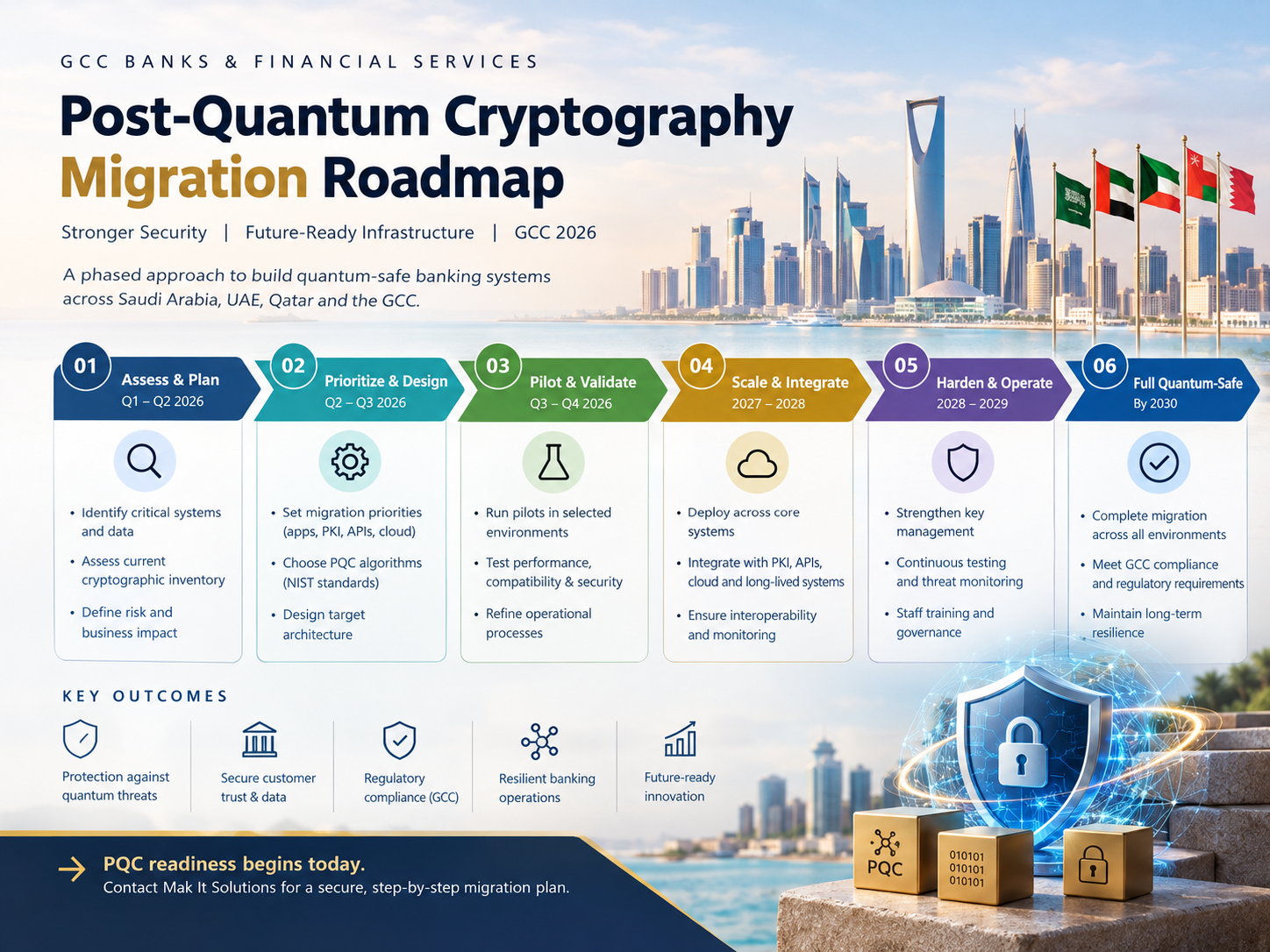
Government data encrypted today may not remain secure forever. As quantum computing advances, sensitive information stolen now could potentially be decrypted years later. For government agencies in Saudi Arabia, the UAE and Qatar, protecting long-lived information means preparing before that threat becomes operational.
A Post-Quantum Cryptography Migration Roadmap helps GCC government organizations identify vulnerable cryptographic systems, assess quantum-related risks and transition toward quantum-resistant security without disrupting essential public services.
The most practical approach combines NIST post-quantum standards, national cybersecurity requirements, cryptographic asset discovery, controlled pilots and phased deployment. The objective isn’t simply to replace encryption algorithms. It’s to build government IT infrastructure that can adapt as security standards and threats evolve.
Why GCC Government IT Needs a Post-Quantum Cryptography Migration Roadmap
What Is a Post-Quantum Cryptography Migration Roadmap?
A post-quantum cryptography (PQC) migration roadmap is a structured plan for identifying cryptographic dependencies, prioritizing vulnerable systems and adopting algorithms designed to withstand attacks from classical and quantum computers.
Unlike quantum key distribution (QKD), which may require specialized communication infrastructure, PQC can be implemented through conventional computing systems and supported software.
For government IT departments, a roadmap connects cryptographic modernization with risk management, procurement planning, regulatory obligations and service continuity.
Harvest Now, Decrypt Later Risks for Public Data
One concern is harvest now, decrypt later (HNDL), a threat model in which attackers collect encrypted information today, anticipating that future quantum computers may help decrypt it.
This matters particularly for government information that must remain confidential for decades.
Examples include.
Citizen identity records and sensitive personal information.
Medical histories and long-term healthcare archives.
Confidential communications between government agencies.
Critical infrastructure configuration and security information.
Sensitive legal, financial and administrative records.
Not every encrypted system faces the same level of quantum exposure. Agencies should distinguish quantum-vulnerable public-key cryptography from symmetric encryption and hashing, which have different security considerations.
Why Riyadh, Dubai and Doha Must Plan Early
Government IT environments often combine legacy applications, public key infrastructure (PKI), identity platforms, vendor-managed systems and cloud services.
RSA and elliptic-curve cryptography (ECC) remain widely used for key establishment and digital signatures, but sufficiently capable quantum computers could undermine their underlying mathematical security assumptions.
Replacing these dependencies is rarely a simple software update.
For agencies operating across Riyadh, Abu Dhabi, Dubai and Doha, early assessments can reveal where cryptography is embedded in applications, certificates, authentication workflows and supplier integrations.
These findings can support ongoing web application development and modernization programs instead of forcing a rushed infrastructure overhaul later.
NIST PQC Standards and GCC Compliance Requirements
Understanding NIST FIPS 203, 204 and 205
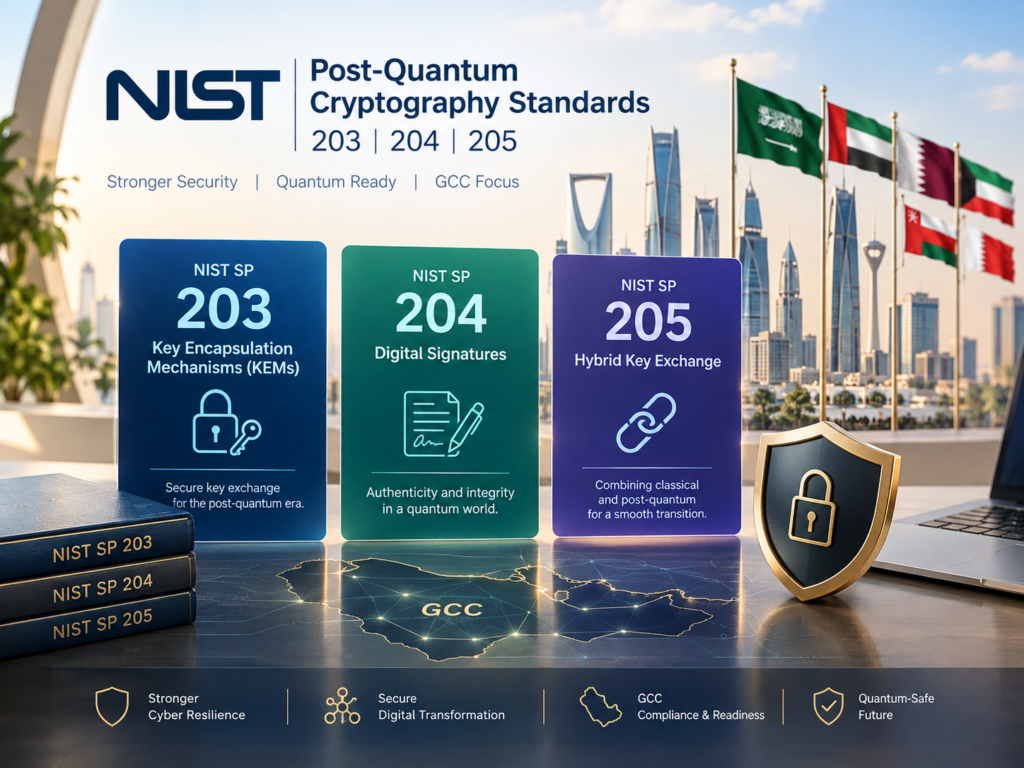
In August 2024, the US National Institute of Standards and Technology (NIST) finalized foundational standards for post-quantum cryptography.
They establish standardized algorithms for quantum-resistant key establishment and digital signatures.
| Standard | Algorithm | Primary purpose |
|---|---|---|
| FIPS 203 | ML-KEM | Key establishment |
| FIPS 204 | ML-DSA | Digital signatures |
| FIPS 205 | SLH-DSA | Digital signatures |
FIPS 203 defines ML-KEM, a key-encapsulation mechanism designed to establish shared cryptographic secrets.
FIPS 204 specifies ML-DSA, which supports digital signatures for authentication and integrity verification.
FIPS 205 specifies SLH-DSA, a stateless hash-based digital signature algorithm offering an alternative cryptographic construction.
These standards provide a technical foundation, but adopting a NIST-standardized algorithm does not automatically satisfy every GCC regulatory requirement.
Government agencies must separately evaluate implementation requirements, approved cryptographic profiles, procurement conditions and national cybersecurity policies.
Saudi NCA and UAE Encryption Policy Considerations
Saudi Arabia’s National Cybersecurity Authority (NCA) publishes National Cryptographic Standards covering cryptographic strength, accepted mechanisms, PKI and key lifecycle management.
The standards also address post-quantum cryptography as a relevant security consideration. Saudi organizations must select applicable protection levels based on information sensitivity and regulatory requirements.
In the UAE, the National Encryption Policy creates a more explicit policy framework for cryptographic modernization.
Approved in November 2025, the policy and its executive regulation call for government entities to establish officially approved plans for transitioning from traditional cryptography toward post-quantum cryptography.
For government IT leaders, the distinction matters: a technical migration recommendation and a mandatory regulatory obligation are not necessarily the same thing.
Official references: Saudi NCA National Cryptographic Standards and UAE National Encryption Policy.
Qatar NCSA, QCB and Sector-Specific Governance
Qatar’s National Cyber Security Agency (NCSA) oversees national cybersecurity priorities, regulatory development and cyber-resilience initiatives.
Its National Cyber Security Strategy 2.0 emphasizes stronger cybersecurity capabilities and protection of critical national infrastructure.
For government systems connected to regulated financial services, Qatar Central Bank (QCB) requirements may introduce additional security and governance considerations.
Public-sector organizations should therefore assess PQC adoption against applicable NCSA guidance, sector-specific requirements and existing data protection obligations.
Importantly, data governance compliance and cryptographic algorithm approval should be evaluated separately.
Discover and Prioritize Quantum Risks
Build a Government Cryptographic Asset Inventory
Before replacing cryptographic algorithms, agencies need to know where those algorithms are used.
A cryptographic asset inventory should document.
RSA and ECC implementations.
TLS connections and VPN infrastructure.
Certificate authorities and PKI dependencies.
Hardware security modules (HSMs).
API authentication and signing mechanisms.
Cloud-based cryptographic services.
Third-party software libraries and managed services.
Application-level encryption and key management.
A cryptographic bill of materials (CBOM) helps identify algorithms, libraries, certificates and dependencies that might otherwise remain hidden.
This is especially useful in legacy applications and interconnected backend systems, where cryptographic operations may be spread across multiple services.
Without reliable discovery, agencies risk upgrading visible infrastructure while overlooking vulnerable dependencies.

Score Quantum Exposure Across Critical Systems
Not every government system needs to migrate at the same time.
A practical risk assessment should consider data sensitivity, confidentiality lifetime, exposure to interception, operational criticality and supplier readiness.
| Government system | Illustrative priority | Main consideration |
|---|---|---|
| Citizen identity infrastructure | Critical | Authentication and sensitive identity data |
| Long-term medical archives | High | Extended confidentiality requirements |
| Internal administrative portals | Medium | Exposure and operational dependencies |
These priorities are examples, not universal classifications. An individual agency’s risk assessment may produce different results.
Government teams should also consider whether compromised public-key cryptography could expose previously intercepted information or undermine future authentication.
Identify High-Risk Services in Saudi Arabia, UAE and Qatar
National digital identity platforms illustrate how cryptographic dependencies can span applications, authentication systems and external services.
Relevant environments to assess include Saudi Nafath, UAE Pass and Qatar Digital ID.
These examples do not imply that the platforms have known cryptographic vulnerabilities.
Rather, they highlight the importance of evaluating cryptographic dependencies in widely connected government identity ecosystems.
A meaningful assessment should review certificate chains, key establishment, signing processes, supplier integrations and opportunities for cryptographic upgrades.
Design and Pilot PQC Architecture
Build Crypto-Agile Government IT Architecture
Crypto agility is the ability to replace or modify cryptographic algorithms without rebuilding an entire application or service.
It is particularly valuable when standards evolve, vulnerabilities emerge or regulatory requirements change.
Government architecture teams should focus on modular cryptographic components, upgradeable libraries, manageable key lifecycles and clearly defined algorithm policies.
Where practical, cryptographic implementations should be separated from core business logic.
This allows future algorithm changes to be implemented more consistently across software and backend architectures.
Crypto agility doesn’t eliminate migration work, but it can reduce the operational impact of future changes.
Evaluate Hybrid PQC for TLS, VPNs and PKI
Hybrid cryptographic approaches combine traditional and post-quantum mechanisms in supported implementations.
They can help organizations manage the transition while evaluating newer algorithms, but compatibility cannot be assumed.
Before deploying hybrid cryptography, technical teams should test.
TLS implementation and endpoint compatibility.
Handshake sizes and network performance.
VPN protocol and appliance support.
Digital certificate formats and processing.
HSM capabilities and firmware compatibility.
Authentication and fallback behavior.
Interoperability with legacy applications.
Different parts of the cryptographic environment may require different migration strategies.
For example, post-quantum key establishment and post-quantum digital signatures address related but distinct security functions.
Pilot Quantum-Safe Systems in GCC Data Centers
Controlled pilots allow agencies to evaluate PQC without immediately exposing critical production services to implementation risks.
Suitable pilot environments might include non-production APIs, internal services, test PKI environments or representative government workloads.
Cloud and hosting environments may include Saudi-hosted infrastructure, Azure UAE Central, AWS Bahrain and Google Cloud’s Doha region.
However, cloud geography alone does not demonstrate data-residency compliance, local regulatory approval or post-quantum readiness.
Each pilot should include a defined scope, baseline performance measurements, interoperability checks, failure testing and rollback procedures.
Results should be documented before expanding deployment.
Deploy, Validate and Monitor Migration
Roll Out Quantum-Resistant Cryptography by Risk Tier
Once pilot results meet the agency’s security and operational requirements, deployment can proceed according to risk.
A sensible sequence begins with highly sensitive, long-lived information and high-exposure communications.
Subsequent work may cover identity services, certificate infrastructure, PKI-dependent applications and external integrations.
Deployment should remain coordinated across security, infrastructure, application development, procurement and operations teams.
Existing custom development services can help modernize application components, provided specialist cryptographic expertise is used where required.
Validate Security, Performance and Arabic UX
A successful migration must preserve more than cryptographic confidentiality.
Government services still need reliable authentication, acceptable performance, accessibility and operational continuity.
Validation should include implementation correctness, certificate processing, application response times, key management, recovery procedures and system interoperability.
For GCC citizen-facing applications, Arabic and English user journeys should also be tested.
Through appropriate front-end development and quality assurance, organizations can check that authentication, error handling and service interactions remain usable after cryptographic changes.
Arabic-language usability is an important public-service requirement, although it is not itself a PQC algorithm requirement.
Track Government PQC Migration KPIs
Progress should be measured through operational evidence rather than the number of systems scheduled for upgrades.
Useful indicators include cryptographic inventory completeness, high-risk systems remediated, pilot success, vendor readiness, unresolved exceptions and rollback effectiveness.
Crypto-agility coverage is another useful measure because it indicates how easily systems can accommodate future cryptographic changes.
Regular reporting helps leadership identify bottlenecks and make procurement or risk-management decisions before they affect major deployment milestones.
Saudi Arabia vs UAE vs Qatar.
Saudi Government Roadmap and NCA Alignment
Saudi government agencies should evaluate PQC migration alongside NCA National Cryptographic Standards, Digital Government Authority (DGA) requirements and relevant National Data Management Office (NDMO) governance.
Saudi Central Bank (SAMA) requirements may also apply where government infrastructure connects with regulated financial systems.
For organizations supporting Vision 2030 digital transformation initiatives, the practical challenge is balancing long-term cryptographic resilience with dependable service delivery.
PKI inventories, certificate management and confidential citizen-data systems are useful starting points for assessment.
UAE PQC Policy and Government Modernization
The UAE’s National Encryption Policy provides an important framework for planning cryptographic transition.
Government entities should evaluate their officially approved migration planning obligations, implementation controls, supplier readiness and relevant Cyber Security Council requirements.
Organizations operating in Abu Dhabi or Dubai may also need to consider infrastructure dependencies involving TDRA-regulated services and financial environments associated with ADGM or DIFC, where applicable.
Technical readiness should be assessed alongside sectoral and jurisdiction-specific obligations.
Qatar NCSA Strategy and Critical Infrastructure Readiness
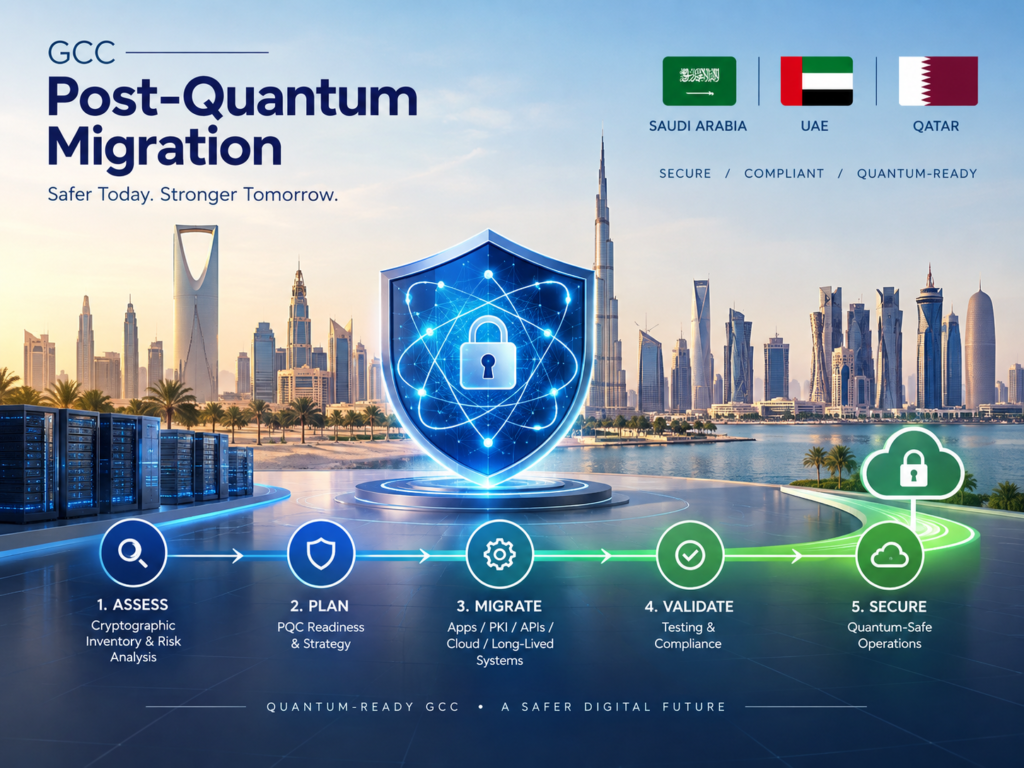
For Qatar’s public sector, PQC planning should align with NCSA cybersecurity direction, operational resilience and the protection of critical national infrastructure.
Doha-based organizations should examine confidentiality lifetimes, key management, application dependencies and third-party support.
QCB requirements may also be relevant to connected financial services.
Although quantum key distribution has potential specialized applications, it should not be treated as interchangeable with software-based PQC migration.
| Market | Relevant authorities | Suggested starting point |
|---|---|---|
| Saudi Arabia | NCA, DGA | PKI and sensitive citizen-data systems |
| UAE | Cyber Security Council | National Encryption Policy alignment |
| Qatar | NCSA, QCB where applicable | Critical infrastructure and cryptographic dependencies |
This comparison is a planning guide, not an exhaustive list of applicable regulations.
PQC Migration Timeline, Costs and Readiness Checklist
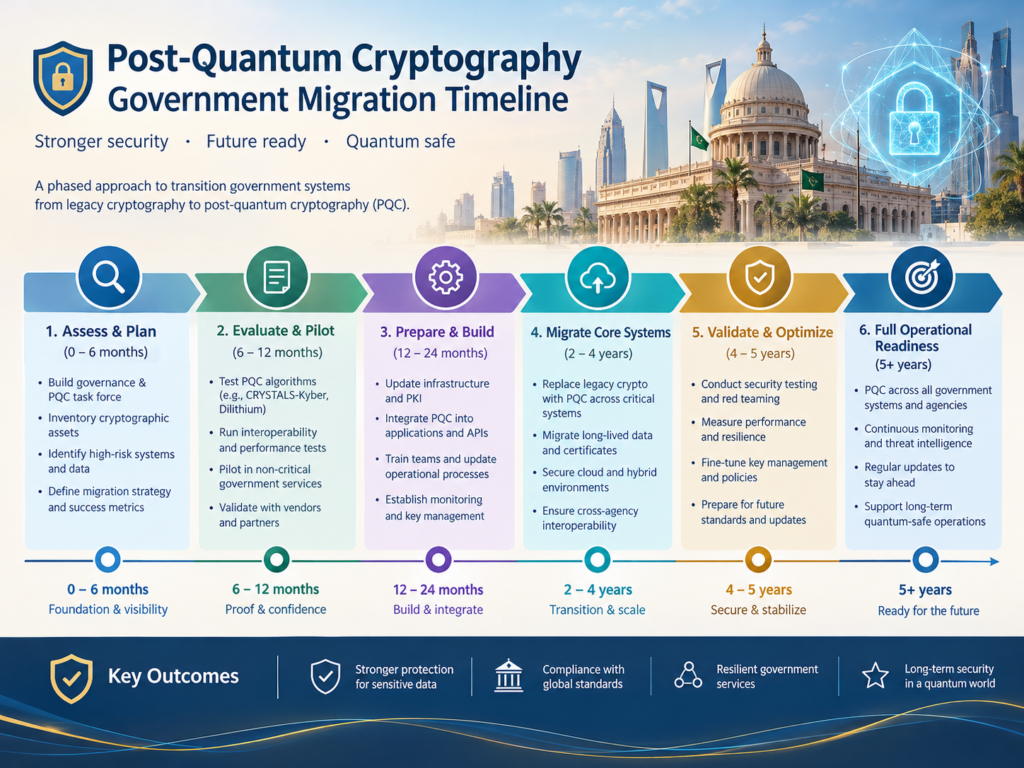
A Practical 36-Month Government Migration Plan
A post-quantum cryptography migration may extend across several years, particularly in complex public-sector environments.
The schedule below illustrates how agencies could organize discovery, assessment, architecture development and deployment.
Illustrative government migration schedule
Planning example only not an official GCC deadline
Discovery
Months 0–3
Risk assessment
Months 3–6
Architecture and pilots
Months 6–12
Deployment and assurance
Months 12–36+
The exact duration will depend on legacy dependencies, procurement processes, available expertise, vendor capabilities and regulatory directions.
Agencies should treat the timeline as a planning framework rather than a guaranteed completion schedule.
What Drives PQC Migration Cost in the GCC?
Post-quantum migration costs vary considerably between organizations.
Major expenditure categories can include cryptographic asset discovery, HSM replacements, PKI modernization, licensing, vendor assessments, staff training and testing.
Additional costs may arise from legacy integration, specialized security expertise, procurement approvals and maintaining parallel cryptographic environments during transition.
A useful budget should distinguish mandatory infrastructure changes from optional improvements and account for ongoing maintenance.
Cost estimates should be based on documented system inventories and supplier proposals, not general assumptions about PQC adoption.
Government PQC Readiness Checklist and Next Steps
Use this checklist to evaluate whether the essential foundations for a government migration program are in place.
PQC migration readiness
0/6 completed
Completing these activities does not automatically mean an agency is compliant or quantum-safe. It establishes a practical basis for more detailed technical and regulatory assessments.
To Sum Up
A successful Post-Quantum Cryptography Migration Roadmap starts with understanding existing cryptographic dependencies and prioritizing the information most exposed to future quantum threats.
For GCC government agencies, NIST standards provide a technical foundation, while Saudi, UAE and Qatar cybersecurity frameworks shape the local implementation and governance requirements.
The strongest migration programs combine accurate inventories, risk-based prioritization, crypto-agile architecture, carefully tested pilots and continuous assurance.
Government organizations do not need to replace every cryptographic component simultaneously. They do need a defensible plan that protects sensitive information while keeping essential digital services reliable.
Preparing your government or enterprise infrastructure for post-quantum security?
Explore Mak It Solutions‘ technology services and contact the team to discuss application modernization, system integration and technical readiness.
A tailored GCC migration strategy should incorporate qualified cryptographic specialists, vendor assessments and verification of applicable regulatory obligations.
FAQs
Q : Does Saudi Arabia’s NCA require government agencies to replace RSA and ECC immediately?
A : Saudi NCA standards establish cryptographic security requirements, but they should not be interpreted as imposing a universal immediate replacement deadline for RSA and ECC across all government systems.
Agencies should verify applicable regulations, assess data sensitivity and review official directions before establishing migration deadlines.
Q : Can UAE government organizations use hybrid PQC with existing TLS systems?
A : Yes. Hybrid post-quantum key establishment is technically possible in compatible TLS implementations.
However, UAE government organizations must verify interoperability, vendor support, performance and applicable National Encryption Policy requirements before production deployment.
Q : Is quantum key distribution the same as PQC for Qatar’s government networks?
A : No. Quantum key distribution uses quantum communication techniques and may require specialized infrastructure.
Post-quantum cryptography relies on mathematical algorithms that can operate on conventional computing systems. Qatar government agencies should evaluate each approach independently under applicable NCSA and sector requirements.
Q : What should Saudi government agencies ask PKI and HSM vendors before migration?
A : Agencies should request evidence of supported PQC algorithms, relevant certification status, firmware upgrade paths, certificate compatibility, key lifecycle management and rollback capabilities.
They should also clarify whether future upgrades require hardware replacements, additional licenses or major integration changes.
Q : How can UAE and Qatar public-sector teams assess quantum risks in sovereign cloud platforms?
A : Start by identifying where cryptographic keys, certificates, signing operations and encrypted data are managed.
Review cloud-provider algorithm support, key ownership, shared responsibilities, contractual obligations and the relevant cybersecurity requirements.
Regional cloud hosting alone does not guarantee post-quantum security or regulatory compliance.