

Quantum-Safe VPN: Essential Guide for Saudi Enterprises
Quantum-Safe VPN: Essential Guide for Saudi Enterprises
Quantum-Safe VPN: Essential Guide for Saudi Enterprises
What happens if attackers steal your company’s encrypted communications today and gain the technology to decrypt them years later?
For enterprises in Saudi Arabia, the UAE, and Qatar, this is becoming an important cybersecurity planning question.
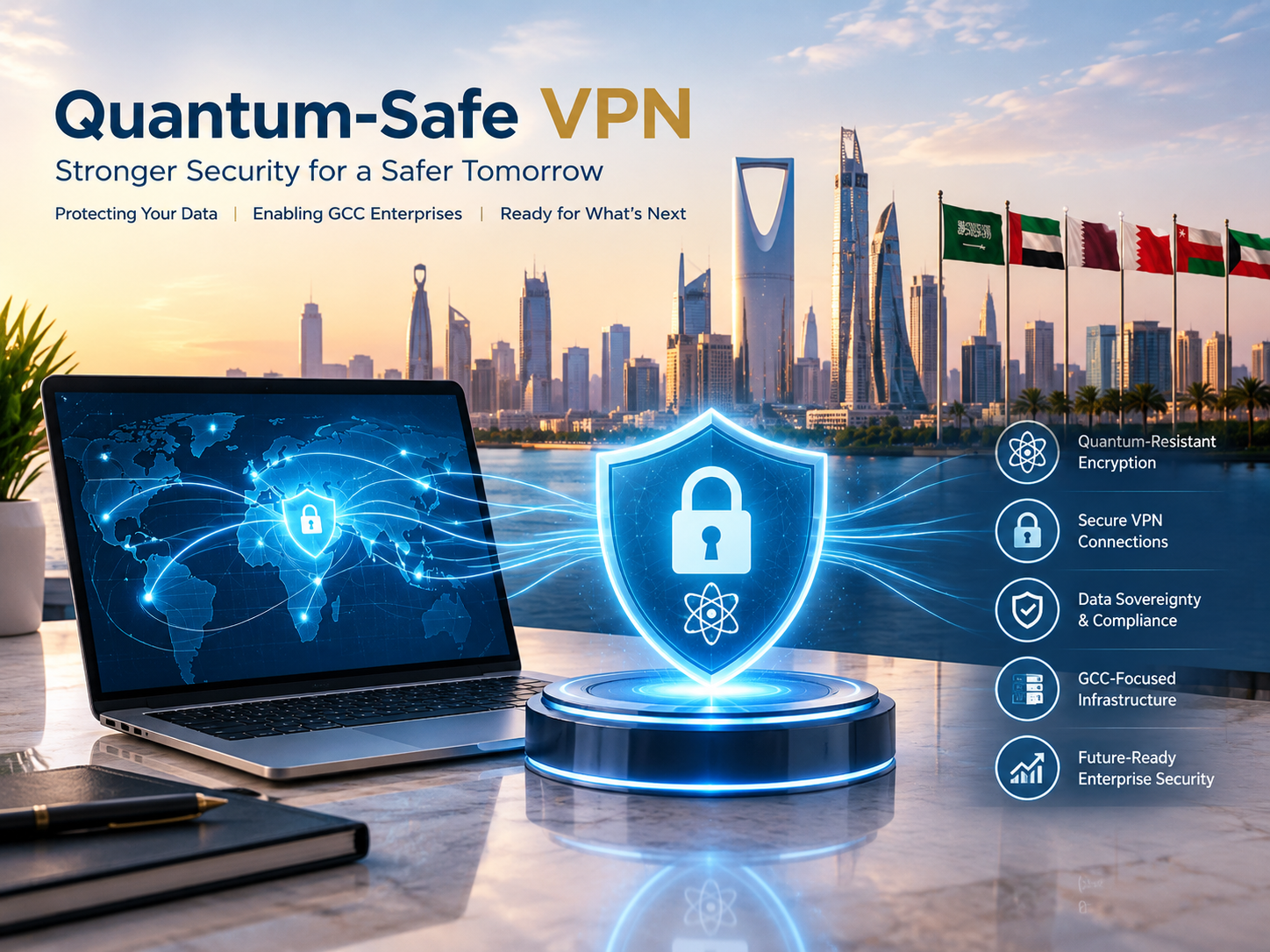
A Quantum-Safe VPN is a virtual private network designed to protect communications against future quantum-computing threats by incorporating post-quantum cryptography (PQC). It may combine quantum-resistant key establishment with traditional encryption to maintain compatibility while reducing exposure to future attacks.
For organizations handling financial records, government information, customer data, or critical infrastructure communications, understanding this technology is increasingly important.
What Is a Quantum-Safe VPN?
A Quantum-Safe VPN is an enterprise VPN that uses cryptographic mechanisms designed to resist attacks from both conventional computers and sufficiently powerful quantum computers.
Its primary purpose is to protect sensitive communications against weaknesses in traditional public-key cryptography.
Quantum-Safe VPN vs Traditional VPN Security
Traditional enterprise VPNs establish encrypted connections between users, offices, and corporate networks.
Many VPN architectures rely on RSA or elliptic-curve cryptography for authentication or key establishment. These mechanisms could become vulnerable to future quantum attacks.
Quantum-safe VPN implementations address this risk by introducing post-quantum cryptographic algorithms.
The main differences are.
| Feature | Traditional VPN | Quantum-Safe VPN |
|---|---|---|
| Key establishment | Commonly classical cryptography | Post-quantum or hybrid mechanisms |
| Quantum threat resistance | Vulnerable public-key mechanisms may be exposed | Designed to reduce future quantum-related risks |
| Authentication | Traditional authentication mechanisms | May require quantum-resistant authentication upgrades |
| Compatibility | Widely supported | Depends on vendors, clients, and gateways |
| Deployment | Established enterprise infrastructure | Often requires testing and migration planning |
A VPN should not be considered completely quantum-safe simply because its vendor advertises PQC support.
How Post-Quantum Cryptography Protects VPN Connections
Post-quantum cryptography uses mathematical algorithms believed to resist attacks from powerful quantum computers.
The US National Institute of Standards and Technology (NIST) has standardized ML-KEM under FIPS 203 for establishing shared cryptographic secrets.
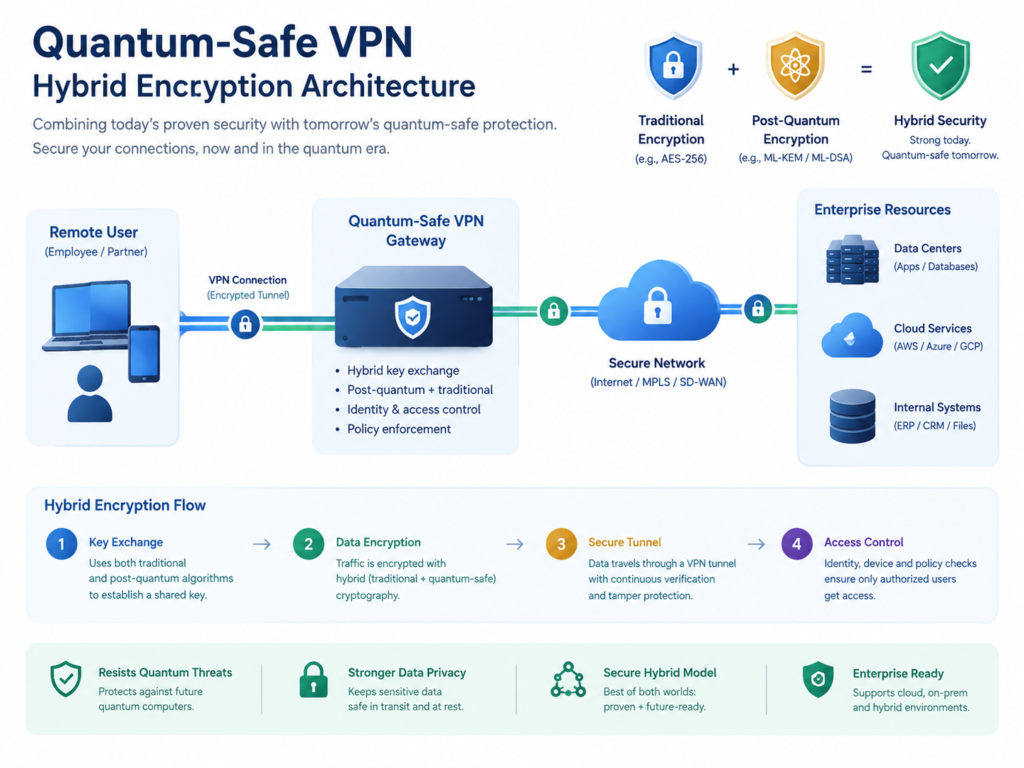
Hybrid key exchange can combine classical and post-quantum mechanisms within a supported protocol.
This approach can help organizations introduce quantum-resistant protection while maintaining selected existing infrastructure.
However, key establishment and authentication must be evaluated separately.
Why Quantum-Safe VPN Matters for GCC Enterprises
GCC businesses increasingly rely on secure connections between regional offices, remote employees, data centers, and cloud environments.
Consider these examples.
Saudi Arabia: A Riyadh financial institution transferring confidential banking information between branches.
UAE: A Dubai e-commerce company connecting employees, suppliers, and international operations.
Qatar: A Doha energy operator exchanging sensitive technical and operational records.
These organizations have different security priorities, but each may hold information that must remain confidential for many years.
That makes quantum-readiness assessments relevant well before large-scale quantum attacks become practical.
Why GCC Enterprises Need Quantum-Ready VPN Security
Quantum computing does not mean existing VPN encryption has suddenly stopped working.
The concern is that some cryptographic techniques protecting today’s communications may not provide the same security against future quantum computers.
Harvest Now, Decrypt Later Attacks on Enterprise Traffic
One significant concern is the Harvest Now, Decrypt Later (HNDL) attack.
An attacker collects encrypted communications today, stores them, and attempts to decrypt them later when more powerful technology becomes available.
The risk is particularly relevant for information with long confidentiality requirements, including financial agreements, medical information, intellectual property, and government records.
Organizations can begin identifying exposed systems through a structured post-quantum cryptography migration roadmap.
Sensitive Data in Saudi Banking, UAE Retail and Qatar Energy
Different GCC industries face different cryptographic challenges.
Saudi financial institutions may prioritize regulated banking information, payment systems, and confidential customer records.
UAE retailers and e-commerce businesses may need to protect supplier agreements, customer information, and connections between distributed platforms.
Qatar’s energy and infrastructure sectors may be especially concerned about the long-term confidentiality of technical documentation and operational communications.
For banking-specific considerations, see our post-quantum cryptography guide for financial services.
What Quantum-Safe VPNs Can and Cannot Protect
Quantum-resistant VPN connections can reduce exposure associated with vulnerable cryptographic mechanisms.
They do not automatically protect organizations against.
Phishing and stolen employee credentials
Malware and compromised endpoints
Misconfigured network access
Insider threats
Unauthorized data transfers
Weak identity and access management
A well-designed endpoint security strategy remains essential alongside VPN encryption.
How Quantum-Safe VPN Encryption Works
A quantum-safe VPN uses cryptographic components that must work together to establish secure connections, authenticate participants, and protect transmitted information.
ML-KEM, Hybrid Key Exchange and NIST Standards
NIST’s principal finalized post-quantum standards include.
| Standard | Algorithm | Primary purpose |
|---|---|---|
| FIPS 203 | ML-KEM | Key establishment |
| FIPS 204 | ML-DSA | Digital signatures |
| FIPS 205 | SLH-DSA | Hash-based digital signatures |
These standards address different security requirements.
For example, ML-KEM establishes shared secrets but does not independently provide every authentication function needed by an enterprise VPN.
Organizations should confirm which algorithms their products actually support and how they are implemented.
The official NIST Post-Quantum Cryptography project provides additional technical guidance.
Post-Quantum IPsec, IKEv2 and TLS VPN Architectures
Enterprise VPN environments commonly use IPsec/IKEv2 or TLS-based architectures.
Quantum-resistant capabilities depend on the relevant protocol implementations, gateway firmware, VPN clients, and supported cryptographic negotiations.
For example, upgrading a central VPN gateway may not provide quantum-resistant protection if remote clients cannot negotiate the required mechanisms.
Before purchasing or upgrading equipment, enterprises should request implementation details and interoperability evidence from vendors.
Performance, Authentication and Downgrade Resistance
Security teams should evaluate more than algorithm availability.
Important testing areas include connection establishment times, certificate handling, network throughput, supported client versions, and system reliability.
Downgrade resistance also matters.
If an attacker can silently force a connection to negotiate weaker cryptography, the expected quantum-resistant protection may not be achieved.
Saudi, UAE and Qatar VPN Compliance Considerations
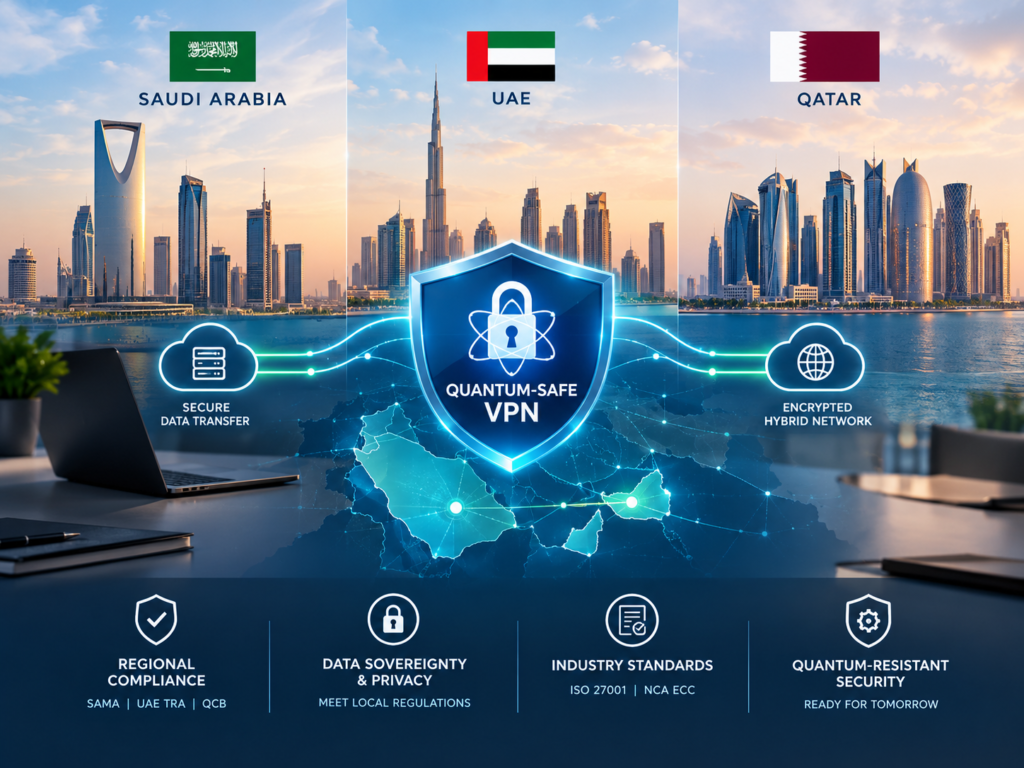
GCC organizations should assess quantum-safe VPN adoption within their existing cybersecurity, privacy, and sector-specific regulatory obligations.
Importantly, cryptographic capability does not automatically establish regulatory compliance.
Saudi NCA Standards, SAMA and NDMO Considerations
Saudi Arabia’s National Cybersecurity Authority (NCA) publishes National Cryptographic Standards covering cryptographic mechanisms, key management, and related security considerations, including post-quantum cryptography.
Organizations should review the NCA National Cryptographic Standards and determine which requirements apply to their environments.
Saudi financial institutions should also examine relevant Saudi Central Bank (SAMA) cybersecurity expectations.
Applicable NDMO governance requirements may affect information classification and handling.
A quantum-safe VPN should therefore be assessed as part of the organization’s wider security and compliance program, not as a standalone compliance solution.
UAE Encryption Policy, TDRA, ADGM and DIFC
The UAE announced its National Encryption Policy and executive regulation on November 27, 2025.
The announcement specifically calls for government entities to establish approved migration plans from traditional encryption to post-quantum cryptography.
This should not be interpreted as an automatic requirement for every UAE private business to replace its current VPN.
Organizations must assess obligations relevant to their activities.
TDRA responsibilities, financial-sector rules, and regulatory frameworks applicable within ADGM and DIFC serve different purposes.
For enterprises operating in Dubai or Abu Dhabi, regulatory reviews should accompany technical migration planning.
Qatar NCSA Standards and QCB Security Expectations
Qatar businesses should examine relevant requirements and guidance from the National Cyber Security Agency (NCSA).
Organizations supervised by Qatar Central Bank (QCB) should also consider applicable financial-sector cybersecurity expectations.
Before selecting a quantum-safe VPN, enterprises should determine how cryptographic changes interact with existing security controls, audit requirements, and data-handling obligations.
No VPN product should be described as automatically approved by a regulator merely because it supports post-quantum algorithms.
Comparing Enterprise Quantum-Safe VPN Solutions
Selecting a suitable solution requires more than comparing marketing claims.
For GCC enterprises, compatibility, operational reliability, local requirements, and long-term vendor support are particularly important.
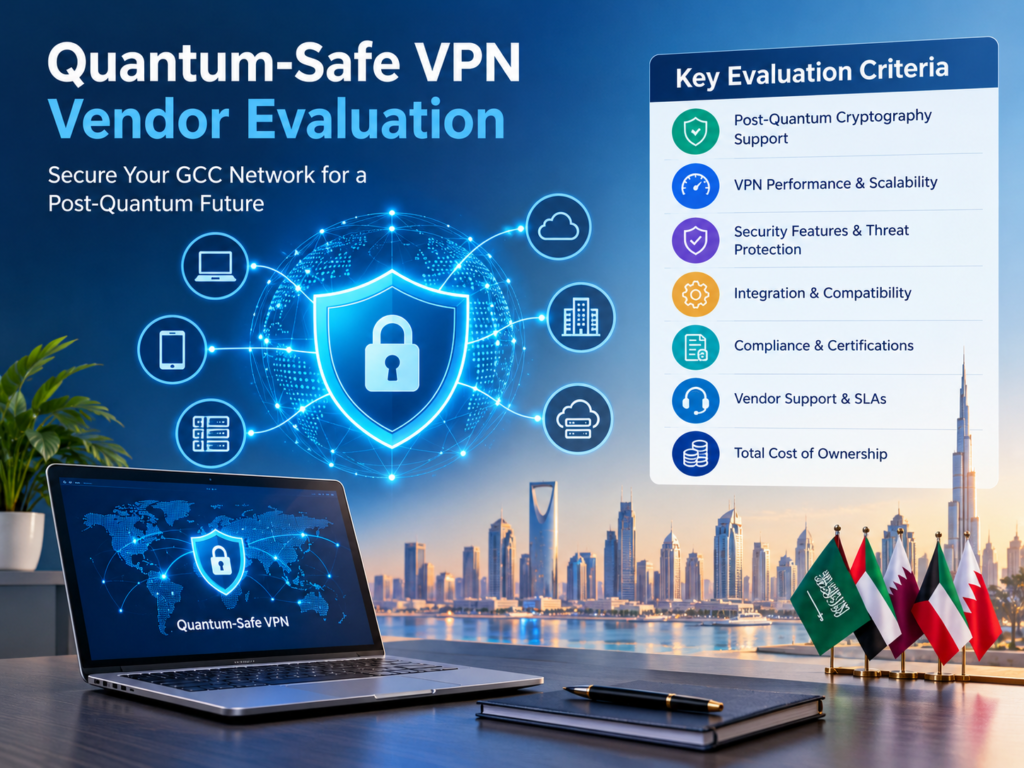
Vendor Evaluation Criteria for GCC Enterprises
Security and procurement teams should investigate.
Documented PQC algorithms and supported configurations
Hybrid key-establishment capabilities
Authentication and certificate requirements
Compatibility with existing VPN clients and gateways
Independent security testing and interoperability evidence
Downgrade protection and monitoring capabilities
Vendor commitments to future cryptographic updates
Organizations should also evaluate their broader monitoring architecture.
Our MDR vs SOC vs XDR guide explains related enterprise security considerations.
Cloud, On-Premises and Hybrid VPN Deployments
Quantum-safe VPN requirements can vary across deployment models.
On-premises organizations may need gateway firmware updates or hardware replacements.
Cloud-based environments require evaluation of supported VPN services, managed gateways, and network security integrations.
GCC businesses may also consider regional infrastructure options such as AWS Bahrain, Azure UAE Central, and Google Cloud Doha.
However, using regional cloud infrastructure does not automatically satisfy data-residency or regulatory requirements.
Arabic UX, Data Residency and Enterprise Integrations
Regional operational requirements should influence procurement decisions.
Enterprises may benefit from Arabic-English documentation, identity-provider integration, local technical support, and clearly documented data flows.
Businesses protecting highly sensitive cloud workloads can also review our GCC confidential computing guide.
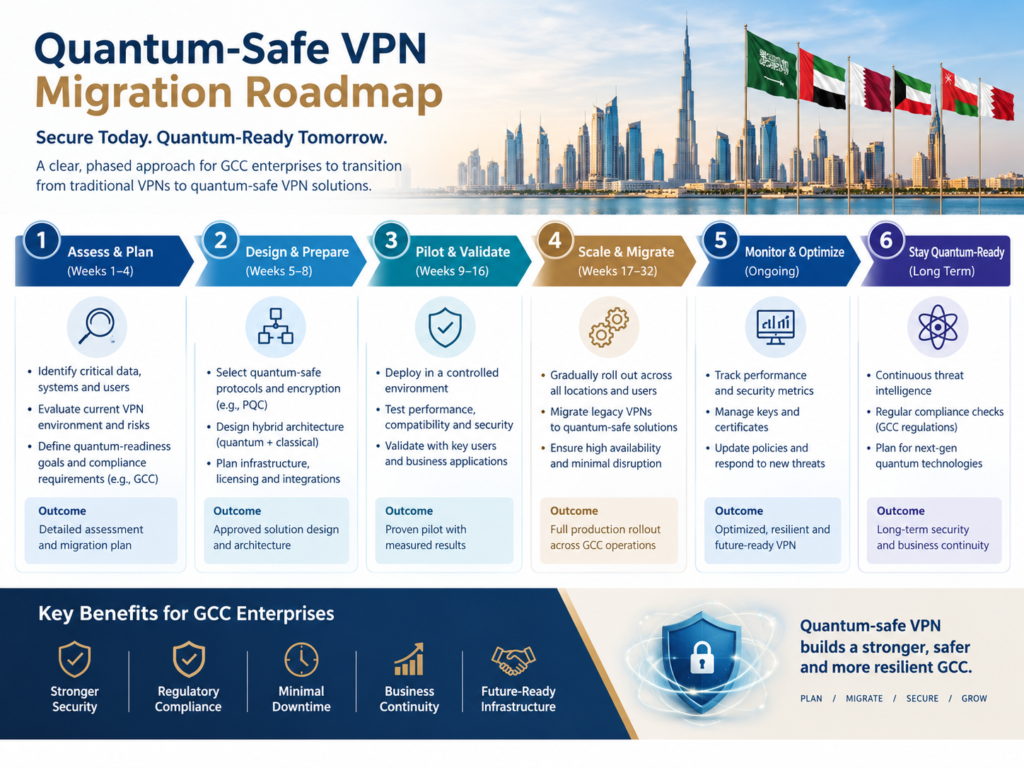
How to Plan a Quantum-Safe VPN Migration
Moving toward quantum-resistant communications does not necessarily require replacing an entire VPN environment immediately.
A phased approach allows enterprises to identify vulnerabilities, test compatibility, and limit operational disruption.
Audit VPN Infrastructure and Sensitive Data
Begin by reviewing your existing VPN environment.
Identify gateways, software versions, cryptographic algorithms, certificates, authentication mechanisms, and interconnected systems.
Next, classify the information travelling through these connections according to sensitivity and required confidentiality lifetime.
A documented cryptographic asset inventory can make prioritization easier.
Pilot Hybrid Post-Quantum VPN Configurations
Choose a limited deployment environment before introducing changes across the enterprise.
A Saudi bank, for example, might initially test compatible site-to-site connections between controlled locations.
The pilot should examine cryptographic negotiation, client compatibility, latency, authentication, logging, and recovery procedures.
Record the results before approving wider deployment.
Roll Out, Monitor and Improve Cryptographic Agility
Expand gradually after validating the pilot.
Assign responsible teams, document configuration decisions, establish monitoring, and maintain rollback procedures.
Cryptographic agility is especially important: organizations should be able to update algorithms and configurations as standards, implementation guidance, and security threats evolve.
Costs, Timelines and Best Practices for GCC Adoption
The cost of quantum-safe VPN adoption depends heavily on existing infrastructure and implementation scope.
There is no reliable universal price for every enterprise deployment.
What Drives Quantum-Safe VPN Implementation Costs?
Common cost factors include software licensing, hardware compatibility, gateway replacement, systems integration, security testing, training, and ongoing monitoring.
Legacy environments may require more extensive changes than modern centrally managed deployments.
Businesses should request vendor quotations based on their actual network architecture and security requirements.
Realistic Migration Phases for Riyadh, Dubai and Doha
A Riyadh financial institution may begin with high-sensitivity connections between regulated systems.
A Dubai e-commerce business might first assess employee remote access and links to cloud infrastructure.
A Doha SME may prioritize connections to important regional services before upgrading older endpoints.
Although these examples involve different environments, the underlying approach remains consistent: discovery, controlled testing, deployment, and ongoing governance.
Migration timelines should reflect technical dependencies rather than arbitrary deadlines.
Best Practices for Sustainable Quantum Readiness
Long-term readiness requires regular cryptographic reviews, reliable asset inventories, vendor assessments, trained security teams, and clear ownership of migration decisions.
Organizations should also review changes in applicable national standards and cross-border data requirements.
For related infrastructure and cybersecurity projects, explore Mak It Solutions’ technology services.
Wrapping It Up
A Quantum-Safe VPN can become an important component of long-term enterprise cybersecurity, particularly for organizations handling information that must remain confidential for years.
However, quantum readiness involves more than installing a new VPN product. Mak It Sol
Enterprises across Saudi Arabia, the UAE, Qatar, Bahrain, Kuwait, and Oman should evaluate cryptographic weaknesses, authentication mechanisms, regulatory obligations, and infrastructure compatibility before making deployment decisions.
A sensible starting point is a documented risk assessment followed by a controlled technical pilot.
Ready to assess your enterprise VPN infrastructure?
Contact Mak It Solutions to discuss quantum-safe VPN readiness, evaluate existing security architecture, and explore a GCC-focused migration strategy aligned with your operational and regulatory requirements.
FAQs
Q : Can Saudi banks use hybrid post-quantum VPN encryption with existing IPsec gateways?
A : Yes, if their existing gateways and clients support compatible hybrid cryptographic mechanisms.
Saudi financial institutions should test firmware compatibility, key establishment, authentication, and monitoring before deployment.
They must also review applicable SAMA and NCA requirements. Supporting PQC does not automatically establish regulatory compliance.
Q : Does the UAE National Encryption Policy require every business to replace its current VPN?
A : No. The UAE National Encryption Policy announcement of November 27, 2025, specifically addressed post-quantum transition planning for government entities.
Private organizations should evaluate their own regulatory obligations, contractual requirements, and information sensitivity.
Businesses operating within ADGM or DIFC may have additional compliance considerations.
Q : Can Qatar enterprises protect legacy remote-access systems without replacing every VPN client?
A : Sometimes. Organizations may use compatible gateway upgrades, network segmentation, or phased migration strategies.
However, legacy connections that continue using vulnerable classical key establishment should not be assumed to provide quantum-resistant protection.
The appropriate approach depends on supported software, authentication mechanisms, and risk requirements.
Q : What affects quantum-safe VPN deployment costs in Dubai and Abu Dhabi?
A : Costs vary according to hardware requirements, software licensing, integration complexity, authentication systems, testing, and support.
Organizations may also need to budget for security assessments, employee training, and regulatory documentation.
A detailed infrastructure assessment and vendor quotation provide a more useful estimate than a generic subscription price.
Q : How can businesses operating across Kuwait, Bahrain and Oman assess cross-border VPN data handling?
A : Start by documenting where information originates, travels, is processed, and is stored.
Include VPN gateway locations, cloud environments, security logs, and third-party administrative access.
Organizations should then review relevant privacy, cybersecurity, and sector-specific requirements in each jurisdiction.
Quantum-resistant encryption protects communications against certain cryptographic threats, but it does not independently establish compliance with cross-border data rules.
[…] GCC Government IT Needs a Post-Quantum Cryptography Migration […]