


Endpoint Security Setup Guide for GCC Teams
Endpoint Security Setup Guide for GCC Teams

Endpoint Security Setup Guide for GCC Teams
An endpoint security setup helps GCC small teams protect laptops, servers, mobile users, POS devices, and cloud-connected systems from ransomware, phishing, stolen credentials, and unauthorized access.
For SMBs in Saudi Arabia, the UAE, and Qatar, the strongest setup usually combines device inventory, EDR, patching, access control, incident response workflows, compliance awareness, and local managed support when internal security capacity is limited.
Why GCC Small Teams Need Endpoint Security Now
GCC SMBs are moving fast across Riyadh, Jeddah, Dubai, Abu Dhabi, and Doha. New laptops, SaaS logins, mobile apps, remote workers, and POS terminals make daily operations easier, but they also widen the attack surface.
That is why a practical endpoint security setup is no longer only for banks or large enterprises. It now matters for fintech startups, logistics firms, retailers, clinics, e-commerce brands, and professional services teams.
For small teams without a full SOC, endpoint protection should be simple, monitored, and aligned with local expectations from regulators and sector authorities. In Saudi Arabia, SAMA’s Cyber Security Framework is used to assess cyber security maturity and control effectiveness for member organizations. In the UAE, the Information Assurance Regulation applies to government entities and critical entities, while also recommending adoption more broadly. In Qatar, QCB has issued information and cyber security requirements for payment service providers.
Mak It Solutions’ broader business technology services can support companies that need secure digital systems, cloud-connected apps, and scalable operations.
What Is Endpoint Security Setup?
Endpoint security setup means protecting every business device that connects to your company systems. This includes.
Laptops and desktops
Servers
Mobile devices
POS machines
Developer systems
Remote employee devices
Some cloud workloads
A strong setup includes device inventory, policies, EDR tools, alerts, patching, access control, encryption, and incident response.
Why EDR Matters More Than Basic Antivirus
Traditional antivirus mainly blocks known malware. EDR, or endpoint detection and response, goes further.
It watches device behavior, detects suspicious activity, records security events, and helps teams respond faster. For a Riyadh fintech company or Dubai e-commerce brand, this matters because attackers often use phishing links, stolen credentials, malicious scripts, and fileless techniques that basic antivirus may miss.
Common GCC Endpoint Risks
Many GCC SMBs work in flexible, fast-moving ways. Teams may use personal devices, WhatsApp-based coordination, remote sales staff, cloud apps, and shared office machines.
That flexibility is useful, but it also creates risk.
Common endpoint threats include.
Ransomware on employee laptops
Phishing through email or messaging apps
Unmanaged BYOD devices
Weak local admin controls
Outdated operating systems
Lost or stolen laptops
Compromised developer machines
Unauthorized access to cloud dashboards
If your team handles customer data, payments, medical records, financial files, or government supplier documents, endpoint visibility becomes even more important.
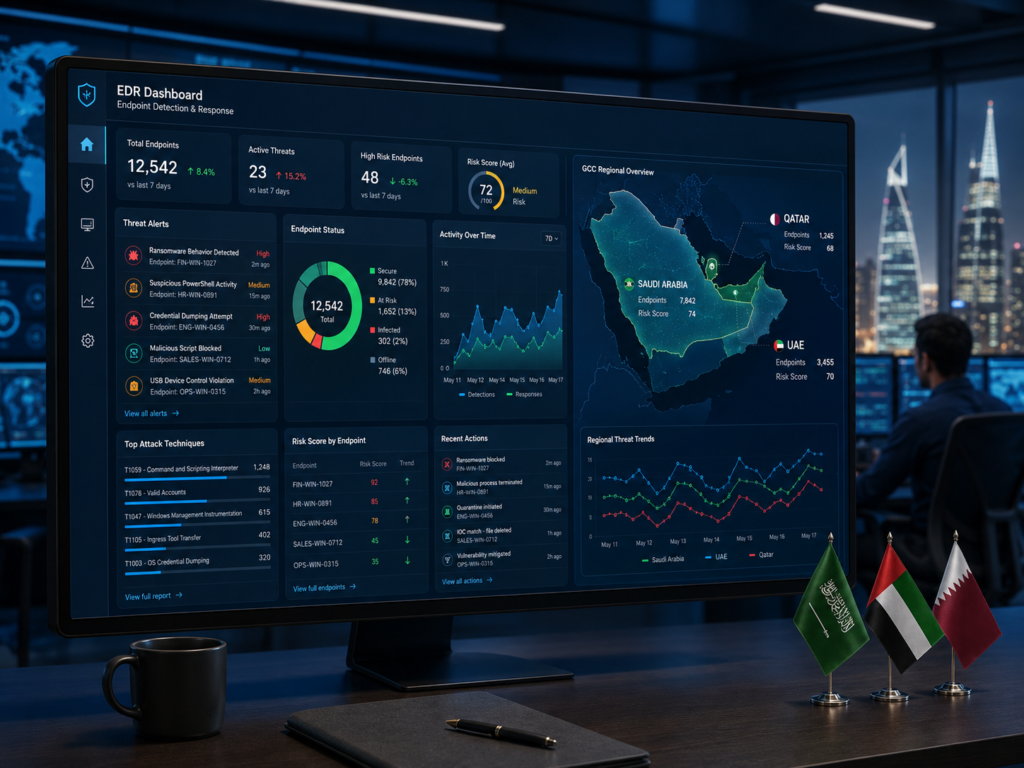
How to Build an Endpoint Security Setup for Small Teams
Create a Device and User Inventory
Start with visibility. You cannot protect devices you do not know exist.
List every laptop, server, admin account, remote employee, shared device, and critical system. Include.
Device owner
Operating system
Location
Access level
Business function
Installed security tools
Last patch status
A Doha SME using cloud apps and local laptops should know exactly which devices can access finance, HR, customer records, and admin dashboards.
Deploy EDR on Critical Endpoints First
Roll out EDR in phases. Start with the highest-risk devices.
Finance laptops
Executive devices
Developer machines
Servers
POS systems
Admin workstations
Customer support devices
Then expand coverage across the whole company.
Businesses building custom portals or apps through web development services should pay special attention to developer endpoints. One compromised developer machine can expose code, credentials, API keys, and production systems.
Configure Alerts and Response Rules
Small teams need clear rules before an incident happens.
Decide.
Who receives security alerts
What counts as a critical alert
When a device should be isolated
Who approves emergency actions
When to contact managed support
How incidents are documented
For example, if ransomware-like behavior appears on a Jeddah sales laptop, the EDR policy should isolate the device, alert IT, and start a response workflow immediately.
Add Patching, Access Control, and Encryption
EDR is important, but it is not the full setup.
A GCC-ready endpoint security setup should also include.
Automatic operating system updates
Application patching
Multi-factor authentication
Disk encryption
Strong password policies
Local admin restrictions
Secure remote access
Device lock and wipe options
In practice, many breaches happen because one old laptop, weak password, or unpatched app gives attackers the opening they need.
EDR vs Antivirus vs MDR vs XDR
Antivirus: Basic Protection
Antivirus can still help block known malware, but it is not enough for modern GCC businesses using SaaS tools, cloud storage, mobile apps, and remote access.
A UAE company selling online through e-commerce solutions should treat endpoint security as part of customer trust, not just IT maintenance.
EDR: Better Detection and Response
EDR gives more visibility into what is happening on devices. It can detect suspicious behavior, track attack paths, and support faster investigation.
For many SMBs, EDR is the practical next step after antivirus.
MDR: Managed Security Support
Managed detection and response is useful when a company has no internal SOC.
A Dubai startup with 25 employees may not need a large security department, but it still needs alert review, investigation, response guidance, and after-hours coverage. Mak It Solutions’ IT and solution consulting can help teams decide what should be handled internally and what should be managed.
XDR: Broader Security Visibility
XDR connects endpoint, email, identity, network, and cloud signals. It makes sense for larger, regulated, or higher-risk organizations that need wider threat detection across multiple systems.
Fintech, healthcare, and government supplier environments may benefit from this broader visibility.
GCC Compliance Considerations for Endpoint Security
Endpoint security is not only about stopping malware. It also supports audit readiness, evidence collection, access control, and incident response.
Saudi Arabia.
Saudi organizations should align endpoint controls with governance, access control, logging, and incident response expectations.
For financial-sector firms, SAMA’s Cyber Security Framework is especially important because it supports periodic assessment of cybersecurity maturity and control effectiveness for member organizations.
For non-financial SMBs, endpoint security still supports better data handling, business continuity, and readiness when working with larger clients or regulated partners.
UAE.
In the UAE, endpoint security supports security governance, risk management, and stronger operational controls.
The UAE Information Assurance Regulation obligates government entities and critical entities to implement its requirements, while recommending adoption more broadly where applicable.
For companies in Dubai, Abu Dhabi, ADGM, or DIFC environments, endpoint logs, admin controls, and response records can become important during audits, vendor checks, or incident reviews.
Qatar.
Qatar SMBs serving banks, payment firms, or public-sector buyers should treat endpoint logs, access records, and response evidence seriously.
QCB’s regulation for payment service providers focuses on security requirements and mechanisms to protect PSPs from cyberattacks and security risks.
For Doha-based teams, local response support can make a real difference when security alerts involve customer data, payment systems, or government-related documents.

Local Endpoint Security Use Cases Across GCC Industries
Fintech Teams in Riyadh, Dubai, Abu Dhabi, and Doha
Fintech teams need strong protection for admin laptops, developer endpoints, finance machines, and customer support devices.
A Riyadh fintech following SAMA expectations should keep clean logs and access records. In Dubai and Abu Dhabi, firms working around financial free zones may need stronger audit trails. In Doha, suppliers connected to QCB-regulated entities should be ready to show how endpoints are protected and monitored.
Retail and Logistics Teams
Retail and logistics teams often operate across warehouses, delivery routes, POS systems, and mobile apps.
A Dubai e-commerce brand scaling mobile operations may combine endpoint security with mobile app development services to protect staff devices, courier apps, warehouse laptops, and customer-facing systems.
Clinics and Professional Services Firms
Clinics, consultants, accountants, and legal teams often store sensitive files on laptops and shared drives.
A consultancy in Riyadh or Doha should make sure client documents are not stored on unmanaged laptops. A clinic in Abu Dhabi should treat device encryption, access control, and patching as basic operational safeguards.
Government Suppliers
Government suppliers need clean audit trails, controlled access, and fast incident response.
Even a small supplier may handle sensitive proposals, IDs, invoices, technical files, or project documents. Endpoint security helps reduce the chance that one compromised laptop becomes a wider business problem.
Endpoint Security Setup Costs, Timeline, and Vendor Support
What Affects Cost?
Endpoint security cost depends on several factors.
| Cost Factor | Why It Matters |
|---|---|
| Number of users | More users usually means more licenses and support needs |
| Number of devices | Servers, laptops, and POS devices may require different coverage |
| EDR features | Advanced detection, rollback, and response tools can affect pricing |
| Log retention | Longer retention may cost more |
| Managed monitoring | MDR or managed EDR adds service cost but reduces internal workload |
| Compliance needs | Regulated firms may need more reporting and controls |
A 15-user SME usually needs a lighter setup than a regulated fintech with servers, privileged users, and compliance reporting.
Typical Rollout Timeline
Most small teams can plan endpoint security in phases.
Inventory devices and users
Pilot EDR on critical endpoints
Roll out protection company-wide
Tune alerts and exclusions
Train staff on response steps
Review coverage quarterly
Companies already modernizing systems with custom software support should include endpoint protection during planning, not after launch.
Why Local GCC Support Matters
Local support matters because communication, time zones, weekend coverage, and regulator awareness affect response quality.
Arabic and English escalation workflows can reduce confusion during urgent incidents. For teams in Saudi Arabia, the UAE, and Qatar, this is especially useful when business leaders, IT staff, and external vendors need to coordinate quickly.
Best Practices for a GCC-Ready Endpoint Security Setup
Use Arabic-Friendly Dashboards and Bilingual Alerts
Arabic-speaking operations teams respond faster when alerts are easy to understand.
Even if the technical console is in English, incident summaries should be clear enough for management. A short bilingual escalation note can help decision-makers act quickly.
Align Endpoint Logs With Cloud and Data Residency Needs
Cloud region choices matter for GCC companies planning logging, backups, and data storage.
AWS lists Middle East cloud regions including Bahrain and the UAE, with the UAE region launched as its second Middle East region. Google Cloud announced the opening of its Doha region on May 22, 2023. Microsoft lists Qatar, United Arab Emirates, and Saudi Arabia among Azure geographies, with regions such as Qatar Central, UAE North, UAE Central, and Saudi Arabia East available or coming soon.
These options can help GCC teams design logging and data-residency strategies more carefully.
Review Policies Quarterly
Endpoint policies should not be set once and forgotten.
Review them quarterly to check.
Unmanaged devices
Inactive users
Old laptops
Missing patches
Noisy alerts
Weak exclusions
Response workflow gaps
Devices without encryption
Pair endpoint reviews with business intelligence dashboards so leaders can track device coverage, patch status, and incident trends.
Test Incident Response Before a Real Attack
Small tabletop tests can reveal big gaps.
Ask simple questions.
Can IT isolate a device quickly?
Who contacts the business owner?
Where are incident notes stored?
Who talks to customers if data is involved?
Which systems must be checked first?
Testing these steps before a real incident saves time when pressure is high.
To Sum Up
A strong endpoint security setup protects more than devices. For GCC SMBs, it supports business continuity, compliance readiness, customer trust, and daily operations.
The right mix of EDR, patching, access control, monitoring, response workflows, and local support can help small teams act early before a minor alert turns into a major incident.
Need a GCC-ready endpoint security setup for your Saudi, UAE, or Qatar team? Contact Mak It Solutions to assess your devices, identify risk gaps, and request a custom endpoint protection strategy for your business.( Click Here’s )
FAQs
Q : Do Saudi small businesses need EDR for endpoint security setup?
A : Yes, many Saudi small businesses need EDR when they handle customer data, payment information, cloud systems, or regulated-sector work. EDR gives better visibility than basic antivirus because it records suspicious behavior and supports faster response.
Q : Is managed EDR better for UAE startups with no internal SOC?
A : Managed EDR is often better for UAE startups that do not have a dedicated security team. A startup in Dubai or Abu Dhabi may have developers, sales staff, and cloud tools, but no one consistently reviewing endpoint alerts after hours.
Q : What should Qatar SMBs include in an endpoint protection checklist?
A : A Qatar SMB endpoint checklist should include device inventory, EDR coverage, patching, access control, encryption, phishing protection, alert rules, incident response contacts, and log retention.
Q : How often should GCC companies review endpoint security policies?
A : GCC companies should review endpoint security policies at least quarterly and after major changes such as new offices, cloud migrations, new compliance needs, or major staffing changes.
Q : Can endpoint security protect remote employees in Riyadh, Dubai, and Doha?
A : Yes. Endpoint security is especially useful for remote employees because it protects devices outside the office network. EDR, encryption, access rules, and device monitoring reduce the risk of stolen credentials, malware, and data loss.