
Quantum Computing for Businesses: GCC SME Guide
Quantum Computing for Businesses: GCC SME Guide

Quantum Computing for Businesses: GCC SME Guide
Running a fintech startup in Riyadh, an e-commerce store in Dubai, or a healthcare business in Doha? Quantum computing for businesses may sound like a distant technology, but its cybersecurity implications are worth understanding today.
The good news is that most GCC small and medium-sized enterprises (SMEs) do not need to invest in quantum computers right now. However, businesses that store sensitive customer information, financial records, or confidential documents for long periods should begin evaluating their encryption systems and preparing for post-quantum cybersecurity.
The goal isn’t to spend money on futuristic technology before you need it. It’s to understand where your business could be exposed and make practical decisions before security requirements change.
What Is Quantum Computing for Businesses in the GCC?
Quantum computing uses principles of quantum physics to perform certain specialized calculations differently from traditional computers.
For businesses, potential applications include complex optimization, scientific simulation, financial modelling, and advanced research.
But there’s an important distinction: quantum computing isn’t a replacement for the computers, cloud platforms, and business applications you use every day.
Quantum Computing vs. Traditional Computing
Traditional computers handle routine activities such as invoicing, customer management, website hosting, and payment processing.
Quantum computers use quantum bits, known as qubits, to process information in ways that can provide advantages for particular types of problems.
Here’s how they compare.
|
Traditional computing |
Quantum computing |
|---|---|
| Uses classical bits | Uses qubits |
| Supports everyday business software | Targets specialized computational problems |
| Mature and widely available | Still developing commercially |
| Suitable for routine SME operations | Primarily relevant to research and selected advanced applications |
| Uses established IT infrastructure | Often requires specialized hardware and expertise |
For a typical GCC SME, improving its current infrastructure will deliver more immediate value than investing directly in quantum hardware.
Why Saudi Arabia, UAE, and Qatar SMEs Should Pay Attention
Quantum technology is gaining attention across the Gulf.
Saudi Vision 2030 supports technological innovation and economic diversification. In the UAE, Abu Dhabi’s Technology Innovation Institute (TII) conducts advanced research, including quantum-related work.
Qatar is also developing regional expertise through Hamad Bin Khalifa University’s Qatar Center for Quantum Computing.
These developments create potential opportunities for businesses, researchers, and technology providers.
They don’t mean every SME must adopt quantum technology immediately. What matters is understanding how advances could eventually affect existing systems, particularly cybersecurity.
Business Opportunities vs. Cybersecurity Risks
Quantum computing could eventually help businesses solve difficult optimization and modelling problems.
A logistics company, for example, might benefit from advances in route planning or warehouse scheduling. Financial institutions could explore specialized risk-modelling applications.
The more immediate planning concern, however, involves encryption.
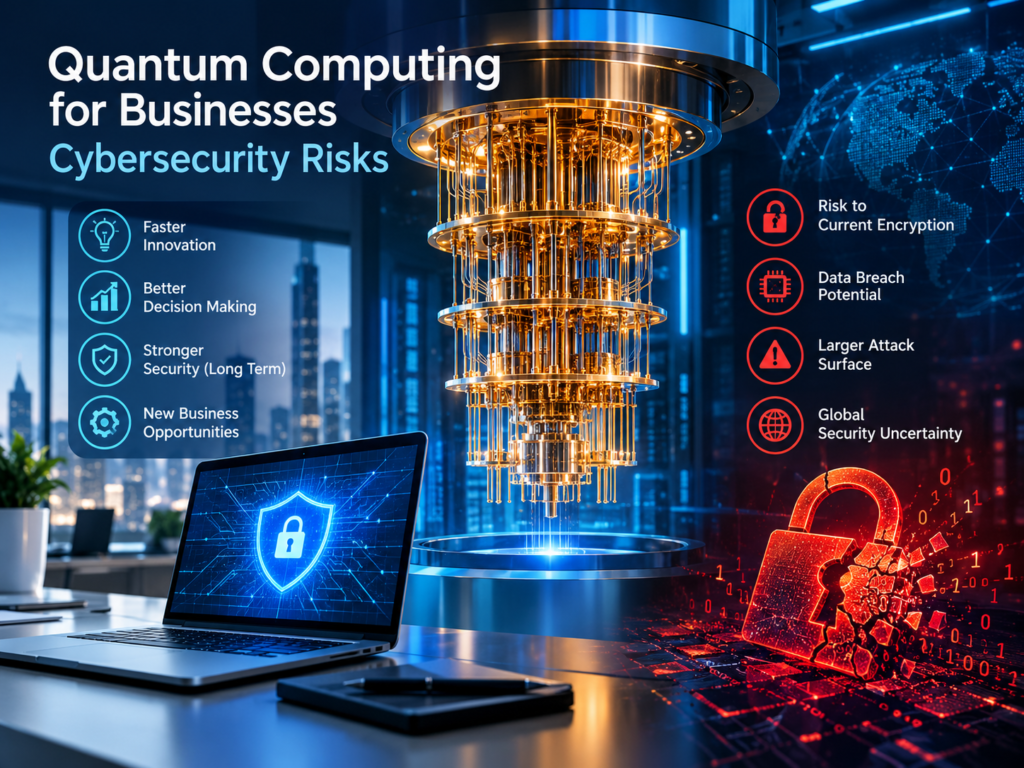
Future quantum computers may be able to undermine some widely used public-key cryptographic methods.
Businesses developing websites, applications, and customer platforms should therefore consider long-term security from the outset.
This is especially relevant when investing in secure web development services that handle confidential business information.
Should GCC SMEs Worry About Quantum Security Risks Now?
For most GCC SMEs, quantum cybersecurity is a preparation issue rather than an immediate operational emergency.
Today’s main priorities should still include secure configurations, software updates, access controls, backups, and protection against existing cyber threats.
However, businesses that need to keep information confidential for many years should also understand how quantum computing could affect their encryption.
How Quantum Computers Could Affect RSA and ECC Encryption
RSA and elliptic-curve cryptography (ECC) are widely used public-key cryptographic technologies.
They support digital signatures, authentication, and secure communication protocols.
A sufficiently powerful, fault-tolerant quantum computer could potentially break the mathematical protections behind these systems.
That doesn’t mean current quantum computers can suddenly access every encrypted business database.
There is no publicly established demonstration of existing quantum computers breaking properly implemented mainstream RSA or ECC at a commercially threatening scale.
The concern is about future capabilities, making early planning important for information that must remain confidential over long periods.
Harvest Now, Decrypt Later: Why Data Lifespan Matters
One of the most important concepts for business owners is harvest now, decrypt later.
The idea is straightforward: attackers may collect encrypted communications today, store them, and attempt to decrypt them when more capable quantum technology becomes available.
Consider confidential information such as.
Patient records and healthcare-related documents.
Financial communications and sensitive transaction information.
Government contracts and intellectual property.
Long-term business agreements and confidential customer records.
A business might have strong encryption today, yet still face future exposure if sensitive communications are captured and retained by an attacker.
The US National Institute of Standards and Technology (NIST) explains the importance of preparing for these threats in its post-quantum cryptography guidance.
Not every type of encryption is affected in the same way. Organizations should focus on identifying vulnerable public-key cryptography rather than assuming that all encrypted data requires replacement.
Which GCC Businesses Face Greater Exposure?
The level of risk depends on the information a business handles, how long it must remain protected, and the technology used to secure it.
Examples of different exposure levels.
|
Business |
Main consideration |
Practical priority |
|---|---|---|
| Riyadh fintech startup | Financial communications and long-retained customer records | Review encryption and regulatory requirements |
| Dubai e-commerce company | Payment integrations, customer information, and certificates | Assess vendors and maintain secure infrastructure |
| Doha healthcare supplier | Confidential records with extended retention periods | Classify sensitive data and examine long-term encryption risks |
These are illustrative scenarios, not assessments of particular companies.
For many organizations, the right starting point is better data governance.
Reviewing existing information leakage prevention practices can help identify sensitive information before introducing specialized quantum-security products.
Quantum Cybersecurity Regulations in Saudi Arabia, UAE, and Qatar
Cybersecurity obligations vary across GCC countries, industries, and business activities.
There is no single GCC-wide requirement forcing every SME to implement post-quantum encryption immediately.
However, organizations working in regulated sectors should review applicable national standards, supervisory requirements, and contractual obligations.
Saudi Arabia.
Saudi Arabia’s National Cybersecurity Authority (NCA) publishes cybersecurity requirements and cryptographic standards.
Businesses can review its National Cryptographic Standards to understand the applicable framework.
The Saudi Central Bank (SAMA) oversees relevant financial-sector institutions, while the National Data Management Office (NDMO) provides data-management and governance frameworks within its scope.
For example, a government contractor in Jeddah may need to consider contractual cybersecurity obligations before changing encryption technologies.
A Riyadh fintech operating under SAMA supervision may have additional compliance responsibilities.
The sensible approach is to identify which requirements apply to your organization before committing to a security migration.
UAE.
The UAE has taken visible steps toward post-quantum cybersecurity.
On May 11, 2026, the UAE’s Advanced Technology Research Council announced a partnership with the UAE Cyber Security Council to advance a coordinated national post-quantum security transition.
The initiative includes cryptographic discovery and quantum-security technologies intended to support national preparedness.
This announcement is significant, but it doesn’t automatically create identical compliance obligations for every business in Dubai or Abu Dhabi.
UAE SMEs should review requirements relevant to their activities, including guidance from the Telecommunications and Digital Government Regulatory Authority (TDRA), where applicable.
Financial businesses operating within the Abu Dhabi Global Market (ADGM) or Dubai International Financial Centre (DIFC) must also consider the requirements of their relevant regulators.
Qatar.
Qatar’s National Cyber Security Agency (NCSA) plays a central role in the country’s cybersecurity environment.
The Qatar Central Bank (QCB) is also relevant to regulated financial-sector organizations.
For SMEs, practical considerations include protecting customer information, identifying sensitive records, reviewing encryption methods, and understanding cloud-provider responsibilities.
Regional infrastructure options such as AWS Bahrain, Azure UAE Central, and Google Cloud Doha may help support certain operational or data-residency needs.
However, choosing a regional cloud location does not automatically guarantee compliance with local data protection requirements.
Businesses should evaluate their contracts, processing activities, cross-border transfers, and industry-specific obligations.
For everyday security fundamentals, see our GCC endpoint security setup guide.
Quantum Computing Opportunities for GCC Small Businesses
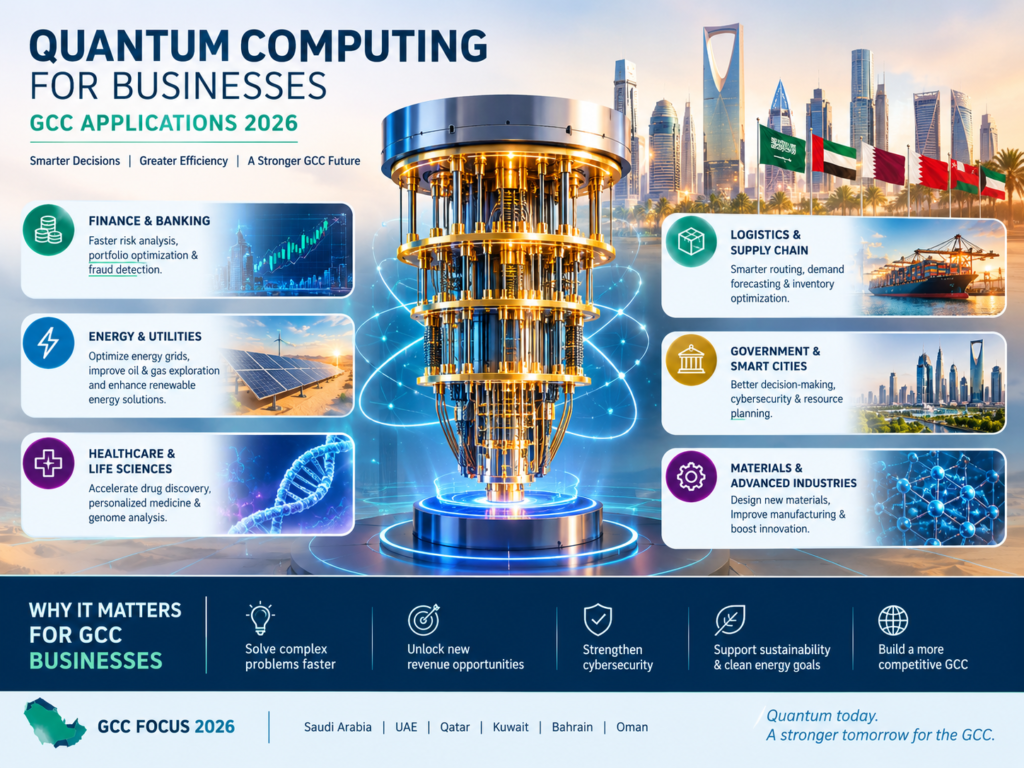
Cybersecurity receives much of the attention, but quantum computing may also create commercial opportunities.
The important question is whether a technology solves a real business problem at a reasonable cost.
Fintech and Financial Services in Riyadh and Dubai
Financial institutions are exploring how quantum computing might contribute to specialized modelling, optimization, and risk analysis.
Potential research applications include complex portfolio optimization and financial simulation.
These benefits remain dependent on technical progress, suitable algorithms, and evidence that quantum approaches outperform conventional alternatives for specific tasks.
For most GCC fintech startups, reliable databases, secure payment systems, cloud infrastructure, and conventional analytics remain more practical priorities.
Investing in dependable back-end development services is likely to be more relevant than purchasing access to experimental computing resources without a clear use case.
Retail and Logistics Applications Across the GCC
Retailers and logistics companies deal with problems involving inventory allocation, delivery schedules, and operational efficiency.
Quantum-assisted optimization may eventually contribute to solving some of these challenges.
For example, a Dubai retailer managing multiple warehouses could explore future optimization tools to improve inventory distribution.
However, businesses should first evaluate their existing systems.
Better forecasting, cleaner operational data, and conventional optimization software can address many common challenges without experimental technology.
Regional Innovation and Quantum-as-a-Service
Access to quantum research infrastructure is expanding in the Gulf.
On May 18, 2026, Aramco and Pasqal announced the launch of a quantum computer in Dhahran alongside a commercial Quantum Computing as a Service (QCaaS) platform.
The initiative aims to support development in sectors including energy, materials, and industrial applications.
This development provides evidence of growing regional interest and infrastructure.
It does not guarantee that quantum computing will immediately become economical or beneficial for every SME.
For smaller companies, the opportunity may initially lie in partnerships, technical learning, and experimentation rather than direct investment.
How Much Does Quantum Readiness Cost GCC SMEs?
There is no universal price for becoming quantum-ready.
The cost depends on your organization’s existing systems, security maturity, information sensitivity, supplier arrangements, and regulatory responsibilities.
A small online retailer and a regulated financial institution are unlikely to need the same level of assessment or investment.
What Should a Quantum Readiness Assessment Include?
Before purchasing any new security products, a business should understand its current environment.
A useful assessment should identify sensitive information, existing encryption technologies, system dependencies, digital certificates, and third-party providers.
It should also determine how easily existing cryptographic algorithms could be replaced.
This capability is called cryptographic agility.
A cryptographically agile system can adopt new approved algorithms without requiring an extensive rebuild of its architecture.
Businesses can begin with an evaluation of their existing technology services and infrastructure.
Budget Factors for Saudi, UAE, and Qatar Businesses
The table below illustrates how assessment needs may differ.
|
Business type |
Likely assessment scope |
Budget consideration |
|---|---|---|
| Small Dubai online retailer | Vendor review, certificates, data classification | Often manageable through existing IT resources |
| Riyadh fintech | Encryption inventory, regulatory review, migration planning | May require specialist expertise |
| Doha healthcare supplier | Sensitive records, storage security, supplier contracts | Depends on confidentiality and retention requirements |
| Abu Dhabi technology startup | Application architecture, cloud services, security dependencies | Depends on system complexity |
These are qualitative examples rather than cost estimates.
Actual expenditure should be based on an assessment of business risks and technical requirements.
Should SMEs Buy Quantum-Safe Tools Immediately?
Not necessarily.
For most businesses, an expensive product purchase should not be the first step.
Start by strengthening existing cybersecurity controls and understanding where vulnerable cryptographic methods are used.
When considering new tools, ask vendors whether their solutions follow recognized standards, support future upgrades, and integrate with existing systems.
Avoid replacing effective security systems solely because a product is advertised as quantum-safe.
If cloud spending is already a concern, our guide to cloud cost optimization in the GCC can help frame security investments alongside broader infrastructure costs.
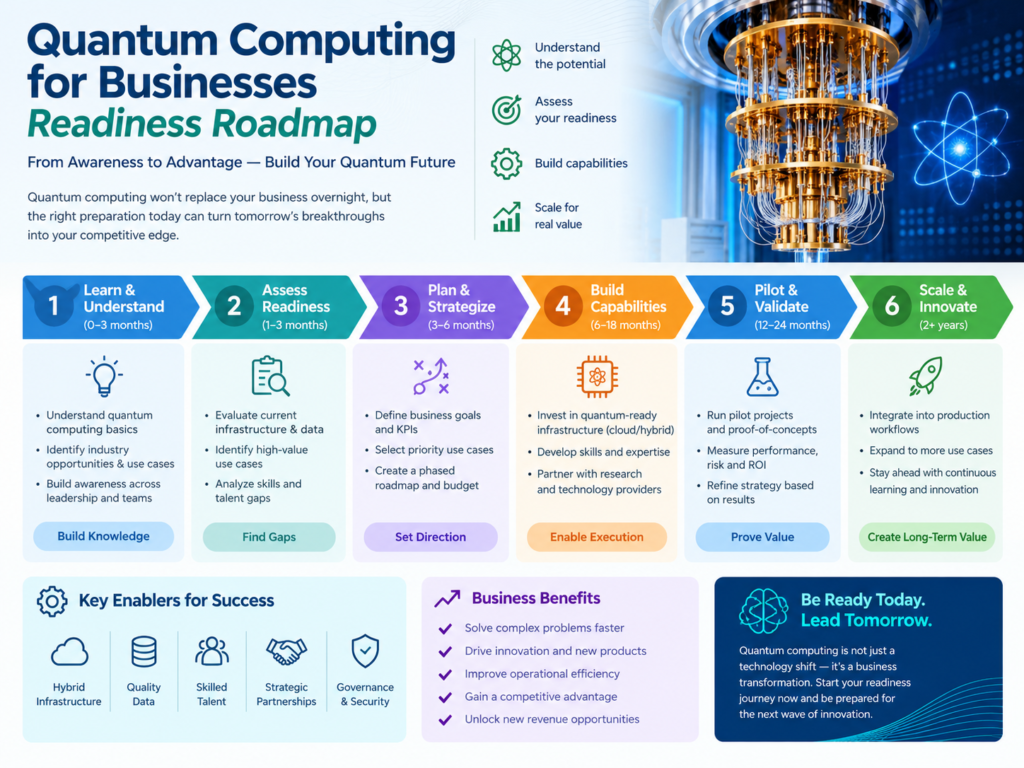
How Can GCC SMEs Prepare for Quantum Threats? A Six-Step Roadmap
You don’t need a dedicated quantum research department to start preparing.
For most GCC SMEs, a practical roadmap focuses on understanding sensitive data, reviewing existing encryption, and coordinating with technology providers.
Identify Sensitive Business Data
Classify financial records, customer information, confidential contracts, healthcare documents, and other long-lived sensitive data. Prioritize information that must remain confidential for years.
Map Existing Encryption
Identify where your applications use RSA, ECC, digital certificates, digital signatures, and related cryptographic components. Include websites, APIs, cloud infrastructure, and third-party integrations.
Review Technology Vendors
Ask cloud, payment, cybersecurity, and software providers about post-quantum support, migration schedules, and compatibility. Request written documentation rather than relying exclusively on marketing claims.
Create a Prioritized Migration Roadmap
Rank systems according to confidentiality, data-retention periods, regulatory exposure, business importance, and replacement difficulty. For GCC organizations, include regional hosting arrangements and Arabic- and English-language supplier documentation where relevant.
Test Appropriate Quantum-Safe Upgrades
Where suitable, evaluate cryptographic solutions aligned with NIST’s post-quantum standards.
FIPS 203 — ML-KEM, for key establishment.
FIPS 204 — ML-DSA, for digital signatures.
FIPS 205 — SLH-DSA, for digital signatures.
These standards were approved in August 2024.
Conduct testing in controlled environments and retain appropriate existing protections during migration.
Assign Ownership and Review Progress
Designate responsibility for the roadmap, document findings, monitor standards and vendor updates, and review progress periodically. Update priorities when systems, regulations, or business risks change.
The purpose of this roadmap is to prepare systematically without interrupting normal operations.
For SMEs in Saudi Arabia, the UAE, Qatar, and the wider GCC, quantum readiness should become part of routine IT planning rather than an expensive emergency project.
Final Thoughts
Quantum computing for businesses presents both potential opportunities and future cybersecurity challenges.
Most GCC SMEs don’t need quantum hardware today. Their priorities should remain secure systems, reliable infrastructure, strong data governance, and cost-conscious technology investments.
However, businesses that handle long-term confidential information should begin reviewing encryption dependencies and asking suppliers about post-quantum migration plans.
The advantage of preparing early isn’t that you can predict exactly when quantum computing will transform cybersecurity.
It’s that you can make informed decisions, avoid rushed purchases, and give your business a clearer path toward future security requirements.
At Mak It Solutions, we understand that technology decisions must balance security, operational needs, and budget.
Whether you’re operating in Riyadh, Dubai, Abu Dhabi, or Doha, reviewing your current infrastructure is a sensible starting point.
Contact Mak It Solutions to discuss your technology requirements, request a consultation, or explore a tailored GCC technology and quantum-readiness strategy.
FAQs
Q : Can Saudi SMEs use cloud providers for post-quantum security upgrades?
A : Yes. Saudi SMEs can use cloud providers that support modern encryption and offer documented post-quantum migration plans. However, cloud adoption does not automatically satisfy applicable Saudi cybersecurity regulations.
Businesses should review provider responsibilities, data location, encryption controls, and relevant NCA or SAMA requirements before making major changes.
Q : Which Dubai fintech systems should be reviewed for quantum vulnerabilities?
A : Dubai fintech companies should prioritize systems that handle confidential communications, digital signatures, payment integrations, authentication, and long-term financial information.
Relevant components include TLS connections, RSA and ECC certificates, APIs, and document storage. Businesses should also consider applicable UAE, DIFC, or ADGM regulatory requirements.
Q : How can Qatar SMEs check whether their IT vendors offer quantum-safe encryption?
A : Ask vendors for written documentation describing supported encryption algorithms, post-quantum migration plans, testing requirements, and implementation responsibilities.
Businesses in Doha should also review data location, subcontractor access, and applicable Qatar data protection requirements. Companies subject to QCB oversight may have additional obligations.
Q : Do Abu Dhabi startups need specialized quantum cybersecurity consultants?
A : Not every startup needs a specialist immediately.
Businesses with straightforward systems can begin with an internal IT review, data classification, and supplier questionnaires.
However, organizations handling regulated financial information, healthcare records, government contracts, or complex cryptographic infrastructure may benefit from independent technical expertise.
Q : Can Kuwait, Bahrain, and Oman SMEs follow the same quantum-readiness checklist?
A : Yes. SMEs in Kuwait, Bahrain, and Oman can follow the same six-step approach: classify data, map encryption, review vendors, prioritize risks, test appropriate upgrades, and monitor progress.
However, cybersecurity regulations and sector-specific obligations differ between countries. Businesses should adapt their roadmap to local requirements, customer contracts, and operational risks.