

AI Data Leakage Prevention in the GCC
AI data leakage prevention is now a real business priority for GCC SMEs using Chat GPT, Copilot, Gemini, and AI-enabled SaaS tools. The risk is simple: employees may paste contracts, customer records, source code, invoices, credentials, or internal documents into AI tools without realizing where that data may go.
For Saudi, UAE, and Qatar businesses, prevention means more than banning AI. It means setting clear usage rules, classifying sensitive data, monitoring prompts, checking vendors, and aligning AI workflows with local data protection and cybersecurity expectations.
For practical implementation, GCC teams can start with Mak It Solutions’ secure digital delivery services and connect AI usage with data loss prevention, AI governance, and sensitive data exposure controls.
Why AI Data Leakage Is a New GCC Business Risk
AI adoption is moving faster than internal controls. In Riyadh, Dubai, Abu Dhabi, Doha, and Jeddah, teams may use AI to draft emails, summarize documents, write code, translate Arabic-English content, or speed up customer support.
That sounds harmless until sensitive data enters the prompt.
A staff member may paste an Arabic contract into an AI tool for summarization. A developer may ask AI to debug source code that includes API keys. A support agent may upload customer complaints with names, IDs, or payment details.
The damage is not only technical. AI data leakage can affect customer trust, procurement eligibility, banking relationships, legal exposure, and regulatory confidence.
What Is AI Data Leakage Prevention?
AI data leakage prevention means stopping confidential business data from being entered into, stored by, or exposed through AI tools.
It includes.
Clear AI usage policies
Data classification rules
DLP and endpoint controls
Prompt monitoring
Vendor and cloud checks
Employee training
Approval workflows for sensitive use cases
The goal is not to stop employees from using AI. The goal is to help them use it safely.
How AI Tools Can Expose Sensitive Data
AI prompts often contain more than a simple question. They may include customer names, salary details, payment disputes, legal clauses, unpublished product plans, or private source code.
Once that information is entered into the wrong tool, it may leave the company’s controlled environment. That creates risk around storage, model training, access logs, vendor review, and future retrieval.
Why Chat GPT, Copilot, Gemini, and SaaS AI Need Rules
Employees need simple guidance before they use AI at work.
A good AI policy should answer four basic questions.
Which AI tools are approved?
What data is never allowed in prompts?
Which use cases need manager or security approval?
What should employees do if they accidentally share sensitive data?
Mak It Solutions’ agentic AI security guide is especially useful when AI agents connect to APIs, identity systems, business workflows, or customer platforms.
What Data Should GCC Employees Never Enter Into AI Tools?
A safe rule is this: never enter data into an AI tool if exposure would damage a customer, employee, partner, or regulator relationship.
Customer, Contract, HR, and Financial Data
Employees should not paste customer IDs, banking records, signed contracts, payroll files, medical details, complaints, invoices, or payment disputes into public AI tools.
For example, a Dubai retailer can use AI to write product descriptions or campaign ideas. But it should not upload identifiable CRM exports just to generate customer segments.
Passwords, API Keys, Source Code, and Internal Documents
Passwords, API tokens, secrets, production logs, private repositories, and internal strategy decks should stay out of AI prompts.
For software teams, AI governance should connect directly with secure engineering practices. Mak It Solutions’ back-end development support can help teams build safer architecture, access controls, and application workflows.
Arabic and Bilingual Content Risks
Arabic-English workflows add another layer of risk.
Names, IDs, commercial clauses, legal terms, and confidential notes may appear inside copied bilingual text. That means training should include Arabic prompt examples, not only English policy documents.
A Saudi HR team, for example, may not think a bilingual employee letter is sensitive. But if it includes salary, passport, iqama, or performance details, it should not be pasted into an unapproved AI tool.

AI Data Leakage Prevention Controls for SMEs
Strong AI data leakage prevention does not require a huge enterprise budget. It starts with practical layers.
Data Classification Before AI Usage
Classify business data before employees use AI.
A simple model can work well.
| Data Type | Example | AI Usage Rule |
|---|---|---|
| Public | Website copy, published FAQs | Usually allowed |
| Internal | Internal process notes | Use approved tools only |
| Confidential | Contracts, pricing, strategy | Mask or avoid |
| Restricted | Credentials, source code, HR files | Never use in public AI |
| Regulated | Financial, health, personal data | Needs formal approval |
This gives employees a clear decision path instead of leaving them to guess.
DLP, CASB, Endpoint, and Email Controls
SMEs can use DLP, CASB, endpoint protection, browser controls, and email security to detect risky uploads or prompt activity.
These controls can flag
National IDs
IBANs
API keys
Source code
Customer names
Contract clauses
Confidential Arabic keywords
HR and payroll documents
For reporting and leadership visibility, Mak It Solutions’ business intelligence services can help teams track risk trends and policy gaps.
Prompt Monitoring and Sensitive Data Detection
Prompt monitoring helps identify sensitive information before it is sent to an AI tool.
In practice, this means scanning prompts and uploads for customer records, credentials, legal documents, internal files, and regulated data. The system can then block the prompt, warn the employee, or route the case for approval.
This is especially useful for SMEs in fintech, logistics, health, e-commerce, SaaS, and government supplier ecosystems.
GCC Compliance Considerations for AI Data Protection
AI data leakage prevention should match the local business environment. Saudi Arabia, the UAE, and Qatar all place strong emphasis on digital trust, privacy, cloud security, and cybersecurity maturity.
Saudi Arabia.
Saudi SMEs should align AI usage with PDPL expectations, SDAIA privacy objectives, NDMO-style data governance, SAMA controls for financial institutions, and NCA cybersecurity controls.
SDAIA says the Personal Data Protection Law protects individuals’ personal data, guarantees their rights, and defines controller obligations. SAMA’s Cyber Security Framework also requires regulated financial institutions to assess cybersecurity maturity and identify control gaps.
For Saudi businesses, this means AI tools should not become an informal shortcut around privacy, governance, or access-control rules.
UAE.
UAE teams should consider federal privacy duties, UAE Data Office direction, TDRA digital government and cloud security initiatives, and free-zone requirements such as DIFC and ADGM where applicable.
TDRA describes its digital government role as part of the UAE’s national digital transformation ecosystem, including shared digital enablers and secure infrastructure.
For Dubai and Abu Dhabi businesses, a written AI usage policy is becoming a practical trust requirement, especially when customer data, cloud platforms, or outsourced vendors are involved.
Qatar.
Qatar SMEs should review PDPPL obligations, NCSA guidance, QCB expectations for regulated entities, and QFC rules where relevant.
QCB’s cloud computing regulation focuses on governance, security controls, encryption, authentication, access controls, and cloud lifecycle management for regulated entities.
For AI adoption, this matters because many AI systems depend on cloud processing, vendor storage, logs, and third-party integrations.

Local AI Data Security Examples Across the GCC
Riyadh Fintech SME Using AI for Customer Support
A Riyadh fintech can use AI to draft support replies, summarize non-sensitive FAQs, or improve internal knowledge-base content.
But customer KYC, account numbers, dispute evidence, and transaction records should be masked or kept out of public AI tools. SAMA-aware approval, logging, and access control are essential.
Dubai Retail Company Using AI for Marketing and CRM
A Dubai e-commerce brand can safely use AI for product descriptions, Arabic ad copy, category pages, and campaign ideas.
The risky part is uploading identifiable CRM files, WhatsApp conversations, refund disputes, or payment records. For safer customer journeys, Mak It Solutions’ e-commerce solutions can support better platform design and data handling.
Doha Logistics Firm Using AI for Operations
A Doha logistics SME can use AI to summarize delivery issues, write internal SOPs, or draft customer updates.
The safer approach is to anonymize shipment data, remove customer names, and review cloud or vendor storage before using AI with operational documents.
How GCC SMEs Can Build an AI Usage Policy
A practical AI usage policy does not need to be long. It needs to be clear enough for busy employees to follow.
Define Approved AI Tools and Prohibited Data
List approved tools, blocked tools, allowed use cases, prohibited data, and exception rules.
For example.
Approved: marketing drafts, public FAQs, generic summaries
Restricted: internal documents, customer conversations, contracts
Prohibited: passwords, API keys, national IDs, payroll files, source code secrets
Keep the policy short, visible, and easy to understand.
Add Arabic-English Training for Staff
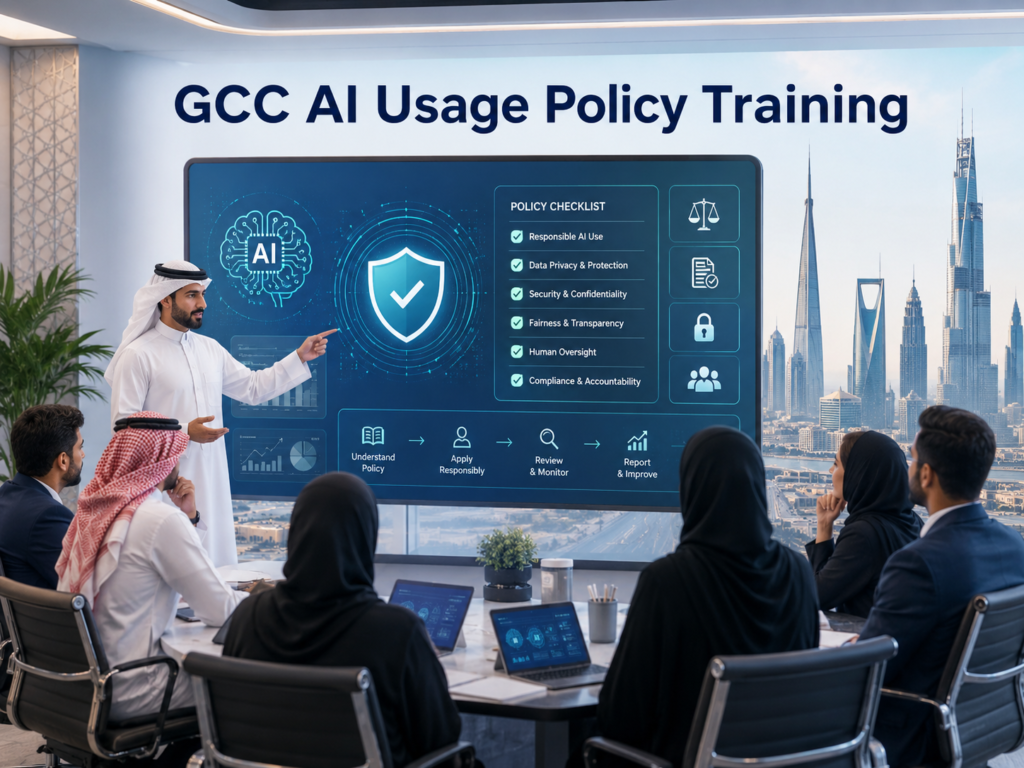
Training should reflect how GCC teams actually work.
Use examples from Arabic contracts, bilingual emails, WhatsApp-style customer messages, invoices, HR letters, and sales proposals. Employees are more likely to follow rules when they recognize the scenarios.
For customer-facing platforms, Mak It Solutions’ mobile app development services can support safer UX, access flows, and data minimization.

Review Vendors, Cloud Regions, and Data Residency
Before approving an AI tool, check.
Where prompts are stored
Whether files are used for training
Who can access logs and outputs
Whether data can be deleted
Which cloud region is used
Whether encryption and access controls are available
What the contract says about confidentiality and breach response
Mak It Solutions’ Middle East cloud providers guide can help teams compare regional cloud and data-residency decisions.
Cost, Timeline, and Best Practices for AI DLP Adoption
AI security does not have to start with a large transformation project. SMEs can begin with low-cost controls and mature over time.
Low-Cost Controls for Small Teams
Start with.
Approved AI tool lists
Prompt rules
Browser warnings
MFA
Role-based access
Monthly policy refreshers
Basic sensitive-data checklists
These steps reduce careless leakage while the business builds stronger technical controls.
When to Invest in Managed DLP or SOC Services
Managed DLP or SOC support becomes more important when the business handles regulated data, customer PII, payments, health records, source code, or government documents.
This is especially relevant for fintech, health, logistics, SaaS, and e-commerce companies that are scaling across Saudi Arabia, the UAE, and Qatar.
Best Practices for Ongoing AI Governance
AI governance should be continuous, not one-time.
Review tools quarterly, test prompts, update vendor registers, document exceptions, and keep human approval for high-risk decisions. A Jeddah healthcare provider, Abu Dhabi government supplier, and Doha financial SME may use different systems, but all need the same discipline: know what data goes into AI, where it goes, and who is accountable.
Concluding Remarks
GCC SMEs do not need to fear AI or ban it completely. They need AI data leakage prevention that protects customer trust while allowing teams to work faster.
With clear rules, Arabic-English training, data classification, DLP controls, vendor checks, and local compliance awareness, AI becomes safer, more useful, and easier to scale.
Ready to make AI safer for your Saudi, UAE, or Qatar business? Book a consultation with Mak It Solutions through the contact page and request a custom GCC AI data leakage risk assessment.
FAQs
Q : Is Chat GPT safe for Saudi SMEs handling customer data?
A : Chat GPT can be useful for drafting, brainstorming, and summarizing non-sensitive content. Saudi SMEs should avoid entering customer records, financial details, contracts, national IDs, or regulated business data into public AI tools. A safer approach is to classify data first, mask sensitive fields, approve tools centrally, and keep audit records.
Q : Do UAE companies need a formal AI usage policy?
A : Yes. UAE companies should have a written AI usage policy, even if they are small. The policy should explain approved tools, prohibited data, acceptable prompts, review steps, and employee responsibilities.
Q : What should Qatar SMEs check before using AI tools with business data?
A : Qatar SMEs should check what data the AI tool receives, where it is stored, whether prompts are logged, who can access outputs, and whether the vendor supports deletion, encryption, and contractual controls. Regulated businesses should also review cloud, data protection, and cybersecurity expectations before using AI with sensitive workflows.
Q : Can Dubai businesses use AI tools for customer support?
A : Yes, but they should avoid exposing identifiable customer data unless the tool, contract, hosting model, and access controls are properly reviewed. A good pattern is to let AI draft general replies while human staff handle complaints, refunds, identity verification, and sensitive cases.
Q : How often should GCC SMEs update their AI data security policy?
A : GCC SMEs should review their AI data security policy at least quarterly. They should also update it whenever they add a new AI tool, vendor, cloud region, sensitive workflow, or regulated use case.
[…] It Solutions’ AI data leakage prevention guide for GCC businesses explains why controlling what employees and systems send into AI tools is becoming just as […]