


GCC Cloud Resilience Strategy: A Critical Guide
GCC Cloud Resilience Strategy: A Critical Guide
GCC Cloud Resilience Strategy: A Critical Guide
Imagine a Riyadh-based fintech platform suddenly losing regional connectivity. Its cloud servers remain operational, yet customers cannot complete transactions. Worse, the backup environment depends on the same authentication infrastructure that has become unreachable.
This hypothetical situation exposes a weakness that traditional cloud availability measures can overlook.
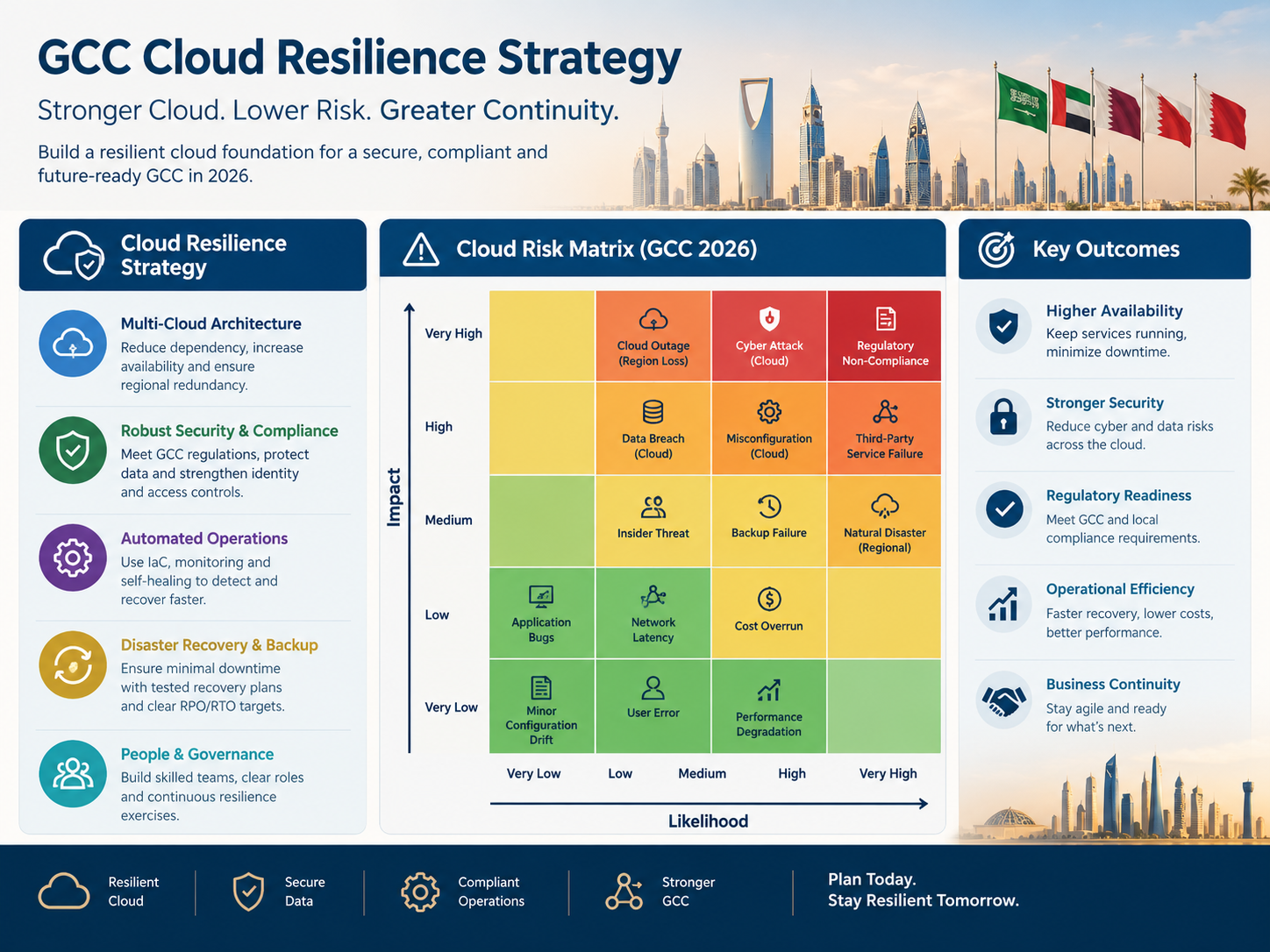
A GCC cloud resilience strategy helps organizations maintain and restore critical digital services during geopolitical disruptions, infrastructure outages, and supplier failures. It combines independent recovery environments, diversified connectivity, secure backups, and regulatory-compliant disaster recovery to protect business continuity across Saudi Arabia, the UAE, and Qatar.
For enterprises operating in Riyadh, Dubai, Abu Dhabi, Jeddah, and Doha, resilience is no longer just an IT performance metric. It is a business risk that requires executive attention.
The question is not simply whether cloud infrastructure can remain online. It is whether the organization can recover when several technology dependencies fail at the same time.
Why Geopolitical Risk Changes GCC Cloud Resilience Strategy
Geopolitical threats to cloud infrastructure in Saudi Arabia, UAE and Qatar
Geopolitical events can disrupt cloud operations without directly damaging a data center.
Telecommunications interruptions, energy supply problems, infrastructure incidents, and restrictions involving technology suppliers may all affect service availability.
For example, a Saudi bank could experience payment-network disruption even when its core cloud workloads are functioning normally. Similarly, a Dubai logistics company might lose access to regional delivery partners because of connectivity failures.
These scenarios illustrate the importance of identifying dependencies beyond the cloud provider itself.
A resilient cloud architecture must account for failures involving networks, identity platforms, third-party services, and operational access.
Why multi-availability-zone deployments may not be enough
Many enterprises rely on multiple availability zones (AZs) to improve application uptime.
Although availability zones offer infrastructure separation, they do not necessarily provide independence from every regional service or dependency.
Potential shared risks include.
Regional networking and internet connectivity
Centralized identity and authentication services
Cloud management and control-plane components
Encryption-key management dependencies
Third-party APIs and payment platforms
Shared operational processes and privileged access
An application may continue running across multiple availability zones while users remain unable to access it.
That distinction matters. Infrastructure redundancy is not the same as operational resilience.
How to assess cloud concentration and correlated disruption risk
A practical risk assessment should identify services that could fail together and determine whether recovery remains possible.
|
Risk scenario |
Potential business impact |
Recommended resilience control |
|---|---|---|
| Regional connectivity failure | Applications become unreachable | Independent telecom routes |
| Cloud-region disruption | Critical application downtime | Separate recovery environment |
| Identity-system failure | Recovery administrators lose access | Independently managed emergency credentials |
| Supplier restrictions | Essential services become unavailable | Application portability and exit planning |
| Backup dependency failure | Data restoration becomes difficult | Isolated, immutable backups |
Organizations can use business intelligence dashboards to monitor infrastructure dependencies, recovery performance, and executive risk indicators.
The goal is to understand not only what might fail, but also which other services would fail with it.
Multi-Region Cloud Architecture and Disaster Recovery in the GCC
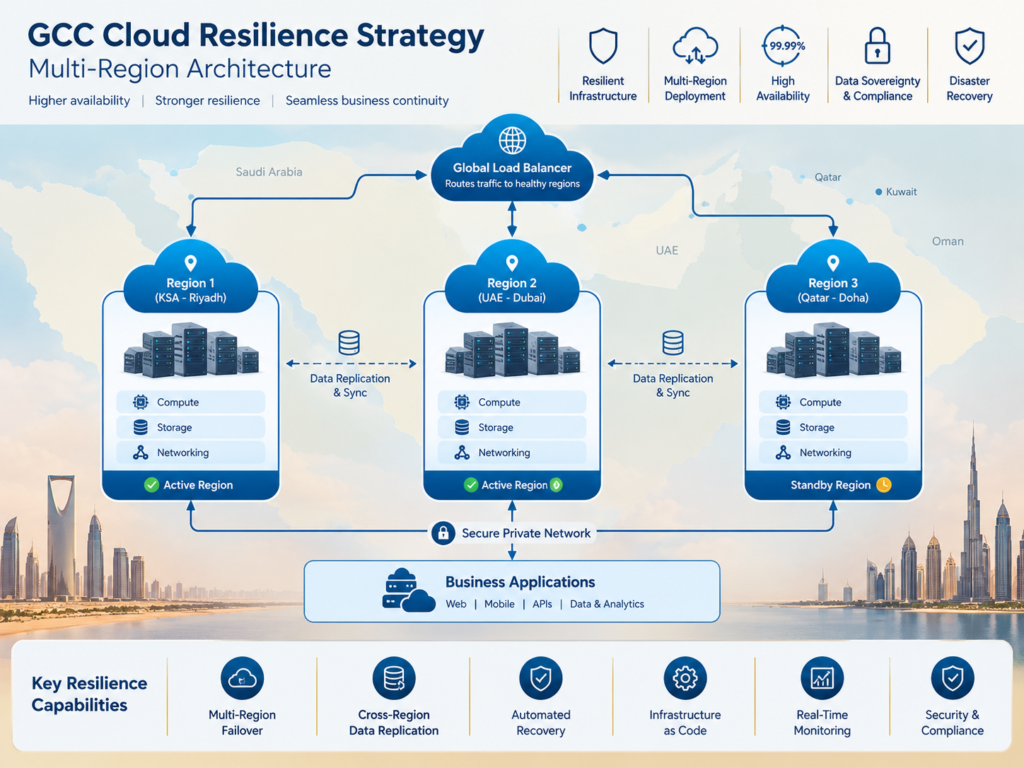
Single-region vs multi-region vs multi-cloud resilience
Choosing a cloud architecture involves balancing availability, operational complexity, regulatory requirements, and cost.
|
Architecture |
Resilience characteristics | Operational complexity |
|---|---|---|
| Single-region, multi-AZ | Protects against certain localized failures but retains regional dependencies |
Low |
| Independent multi-region | Improves geographic separation when shared dependencies are controlled |
Medium |
| Multi-cloud | Can reduce provider concentration but adds integration challenges |
High |
| Sovereign-hybrid | Supports local control and flexible recovery design, depending on implementation |
High |
A multi-cloud strategy may appear more resilient, but introducing additional providers does not automatically eliminate failure risks.
For example, separate cloud environments may still depend on the same DNS provider, identity platform, or network carrier.
For GCC enterprises, the most appropriate architecture depends on the services being protected and the organization’s ability to operate the recovery environment effectively.
How to design independent disaster recovery and failover
An effective disaster recovery architecture starts with clearly defined recovery objectives.
Recovery Time Objective (RTO) measures the maximum targeted time for restoring a service after disruption.
Recovery Point Objective (RPO) defines the maximum acceptable amount of data loss, measured in time.
Once these objectives are established, architecture teams can select the right recovery approach.
Key controls include.
Immutable backups: Protect recovery copies from unauthorized modification or deletion.
Independent identity access: Ensure recovery personnel can authenticate during primary identity-system failures.
Encryption-key management: Design key access and recovery without unnecessary shared dependencies.
Network failover: Prepare and test appropriate DNS or Border Gateway Protocol (BGP) recovery arrangements.
Data replication: Maintain recoverable application data while meeting residency and security requirements.
Recovery testing: Verify that applications and their dependencies can be restored within approved objectives.
Organizations must also choose between active-active, warm standby, and cold recovery approaches.
Active-active designs can support high availability but require more coordination and investment. Warm standby offers a compromise between readiness and operating cost. Cold recovery generally reduces ongoing infrastructure expenditure but requires more time to restore services.
Sovereign cloud vs hyperscalers vs multi-cloud for GCC enterprises
Sovereign cloud and multi-cloud solve different problems.
Sovereign cloud arrangements emphasize jurisdictional control, data governance, and operational requirements. Multi-cloud focuses on distributing workloads or dependencies across different infrastructure providers.
Neither approach guarantees business continuity by itself.
Regional services offered by AWS in Bahrain, Microsoft Azure in the UAE, and Google Cloud in Doha demonstrate the range of cloud infrastructure available to GCC organizations.
However, enterprises must verify current service availability, geographic restrictions, applicable compliance requirements, and recovery-site independence before selecting a deployment.
Oracle Cloud Infrastructure and qualified local providers may also be relevant, depending on workload needs.
Applications built using scalable back-end development practices can reduce unnecessary platform-specific dependencies and make future recovery or migration planning more manageable.
GCC Cloud Compliance, Data Residency and Digital Sovereignty
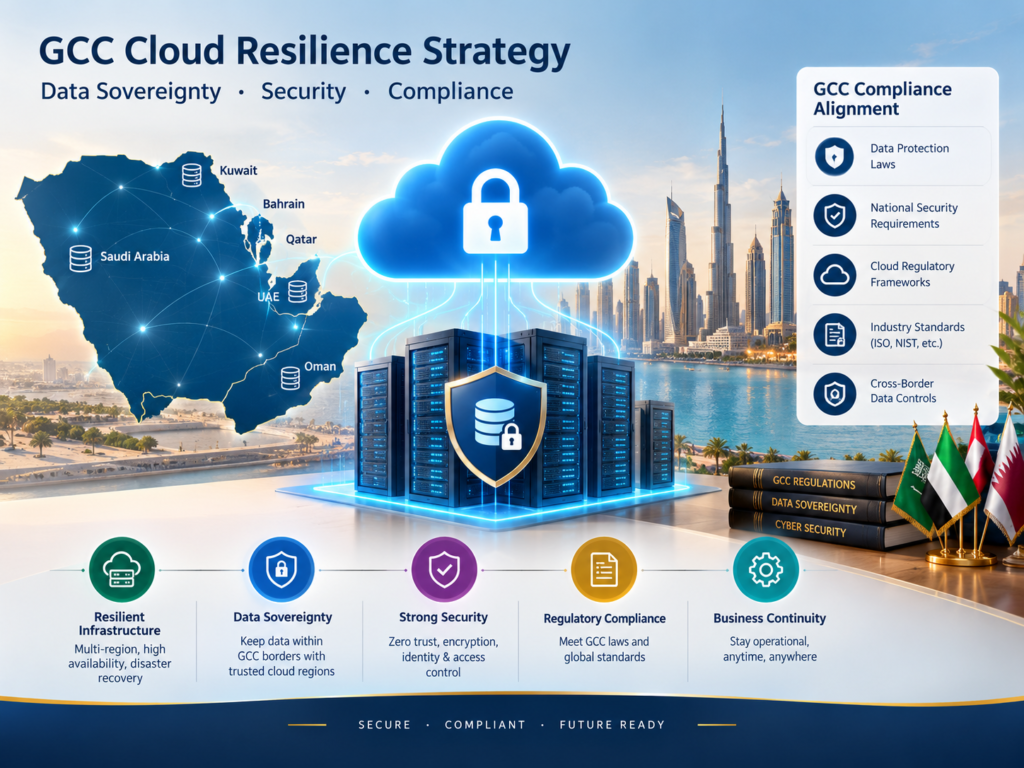
Geopolitical resilience cannot be separated from regulatory compliance.
A technically functional recovery environment may still be unsuitable if it violates data handling, localization, outsourcing, or sector-specific obligations.
Saudi cloud compliance.
Organizations operating in Saudi Arabia should evaluate the requirements relevant to their industry and data classifications.
Important regulatory and governance bodies include.
National Cybersecurity Authority (NCA): Establishes applicable national cybersecurity controls.
National Data Management Office (NDMO): Provides data governance and management requirements within its remit.
Communications, Space and Technology Commission (CST): Regulates relevant communications and technology activities.
Saudi Central Bank (SAMA): Oversees financial institutions and applicable technology, outsourcing, and operational-risk obligations.
The NCA Cloud Cybersecurity Controls (CCC–2:2024) are an important reference for assessing cloud cybersecurity responsibilities.
For example, a Riyadh financial institution considering an overseas disaster recovery environment should assess whether the arrangement is permitted for its workload and data classification.
Encryption alone does not establish regulatory compliance. Organizations must also consider access permissions, data transfers, provider contracts, and applicable approvals.
UAE cloud sovereignty.
Cloud governance in the UAE depends on the organization’s activities, location, and regulatory status.
The Telecommunications and Digital Government Regulatory Authority (TDRA) plays a role in national digital infrastructure governance.
Organizations may also need to comply with federal data protection requirements and specialized frameworks, including those applicable within:
Abu Dhabi Global Market (ADGM)
Dubai International Financial Centre (DIFC)
Other regulated sectors and government environments
A Dubai enterprise may consider disaster recovery infrastructure in Abu Dhabi, provided suitable services are available and the arrangement meets its legal and operational obligations.
However, hosting data in separate UAE cities does not automatically remove shared networking or cloud management dependencies.
The architecture still needs independent recovery controls and documented validation.
Qatar cloud governance.
Qatar’s Communications Regulatory Authority (CRA) has published a Cloud Policy Framework covering important aspects of the country’s cloud ecosystem, including governance and security considerations.
Financial institutions must additionally evaluate applicable Qatar Central Bank (QCB) requirements.
For enterprises in Doha, disaster recovery decisions should consider data protection, outsourcing, continuity obligations, and the suitability of proposed recovery destinations.
The main regulatory considerations can be summarized as follows.
|
Country |
Key regulatory bodies |
Important recovery considerations |
|---|---|---|
| Saudi Arabia | NCA, NDMO, CST, SAMA | Data classification, cybersecurity, and sector obligations |
| UAE | TDRA, ADGM, DIFC and relevant authorities | Jurisdiction, data transfers, and operational controls |
| Qatar | CRA, QCB and relevant authorities | Privacy, outsourcing, and business continuity |
This comparison provides a planning overview rather than a complete legal compliance checklist. Applicable regulatory instruments should be confirmed for each workload before implementation.
GCC Cloud Resilience Use Cases Across Critical Industries
Saudi fintech and banking: Protecting payment continuity
Payment infrastructure has limited tolerance for prolonged outages or inconsistent transaction records.
Consider a hypothetical Riyadh payment provider that operates a primary cloud environment alongside a separately secured recovery system.
Its disaster recovery preparation includes isolated backups, independent administrative access, and transaction reconciliation procedures.
During a recovery exercise, the organization validates whether payment processing can resume within approved RTO and RPO limits.
For financial institutions, the process must also address applicable SAMA requirements and internal risk governance.
The objective is not simply restarting an application. It is restoring trustworthy financial operations.
UAE retail and logistics: Maintaining service during regional disruptions
Retailers and logistics providers often depend on interconnected systems covering payments, inventory, mobile applications, warehouse operations, and delivery networks.
Imagine a Dubai-based retailer serving customers across the GCC.
A connectivity disruption could affect order processing even when its storefront remains available.
A practical recovery strategy might prioritize.
Customer order processing
Payment gateway availability
Inventory data synchronization
Alternative network connectivity
Delivery and fulfillment integrations
Well-planned web application development and front-end development can also support clear customer communication and usable application experiences during partial service recovery.
Qatar government and enterprise cloud: Sovereign resilience
Government and enterprise platforms in Qatar may handle sensitive information and essential digital services.
A hypothetical Doha government platform could maintain separated recovery storage, documented emergency access, and approved recovery environments.
Its continuity exercises should test not only infrastructure restoration but also access to the services citizens and administrators need.
For platforms supporting both Arabic and English interfaces, user-facing functionality in both languages should be included in recovery testing.
Successful recovery means that essential services function as intended, not merely that the servers have restarted.
GCC Cloud Disaster Recovery Cost, Timelines and Trade-Offs
What drives cloud resilience costs in Saudi Arabia, UAE and Qatar?
Disaster recovery spending varies significantly with architecture and business requirements.
Major cost factors include infrastructure capacity, backup storage, data transfer, licensing, network connectivity, security controls, specialist staffing, and periodic testing.
A cold standby environment may have lower recurring costs than an active-active design. However, slower recovery could create greater business losses during a major outage.
Organizations should therefore assess both direct infrastructure expenses and the financial consequences of interruption.
How long does a GCC cloud resilience upgrade take?
There is no universal implementation timeline.
A relatively straightforward recovery improvement may require less effort than redesigning a complex banking platform with multiple integrations and regulatory obligations.
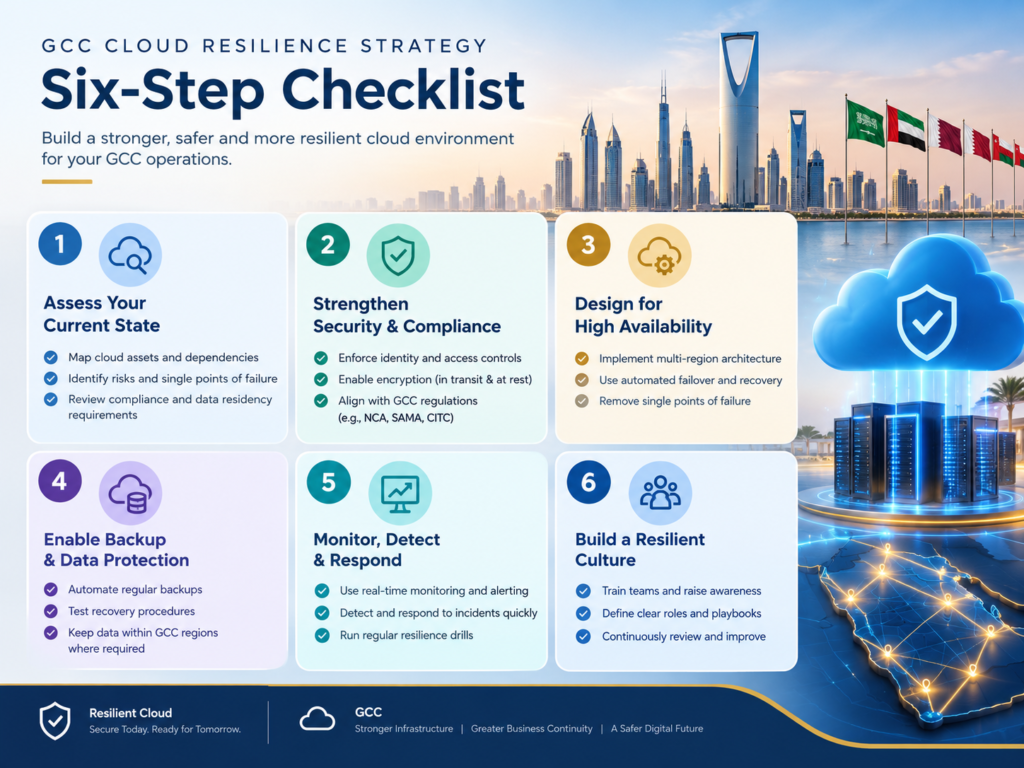
Most resilience programs follow a similar sequence.
Discover critical workloads and dependencies.
Assess technical, geopolitical, and regulatory risks.
Design an appropriate recovery architecture.
Review compliance and operational requirements.
Implement and validate recovery controls.
Test, document, and improve recovery performance.
Project duration depends on existing architecture, data migration complexity, staffing, vendor coordination, and required approvals.
Measuring ROI through RTO, RPO and avoided disruption
Resilience investments should be evaluated against measurable business outcomes.
Consider the following hypothetical calculation.
Illustrative disruption-cost scenario
Cost per hour of downtime
$20,000
Recovery time reduction
8h → 2h
Estimated disruption cost avoided per event
$120,000
Illustrative only. Assumes constant hourly impact and excludes recovery investment costs and other variable losses.
This example demonstrates why recovery performance matters financially, although actual savings depend on the incident, business activity, and recovery costs.
Useful performance indicators include achieved RTO and RPO, successful restoration tests, critical workload coverage, and unresolved recovery dependencies.
Executive teams can monitor these measures through business intelligence reporting.
How to Build a GCC Cloud Resilience Strategy
A practical GCC cloud resilience strategy should combine technical independence with regulatory awareness and measurable recovery outcomes.
The following framework provides a starting point.
Classify critical workloads
Identify essential services, sensitive data, recovery priorities, business impact, and applicable regulatory requirements.
Map infrastructure dependencies
Document cloud regions, connectivity providers, identity services, APIs, suppliers, and operational access paths. Identify dependencies that could fail together.
Select compliant recovery locations
Choose legally suitable recovery destinations and design independent backups, encryption-key access, and recovery credentials.
Reduce provider concentration
Limit avoidable platform dependencies, improve application portability, and prepare realistic supplier exit plans.
Step 5: Test failover under realistic conditions
Simulate regional isolation, authentication outages, lost connectivity, infrastructure failures, and restoration from isolated backups.
Establish governance and continuous improvement
Assign executive ownership, document test results, address weaknesses, and regularly reassess risks and recovery capabilities.
A recovery design is only dependable when teams can demonstrate that it works under realistic conditions.
Documentation, technical controls, and operational readiness must support one another.
Wrap It Up
Cloud availability remains important, but it is not enough to guarantee business continuity during geopolitical disruption.
Enterprises must assess how their applications, networks, identity services, data platforms, and suppliers depend on one another.
For organizations operating in Saudi Arabia, the UAE, and Qatar, an effective GCC cloud resilience strategy combines independent recovery capabilities, compliant infrastructure choices, and regular disaster recovery testing.
The real measure of resilience is the ability to restore essential business services when normal operating conditions break down.
Building a resilient digital environment requires dependable application architecture, clear infrastructure dependencies, and recovery planning aligned with business priorities.
Explore Mak It Solutions’ development and technology services to support your organization’s digital infrastructure planning.
You can also contact our team to discuss application architecture, infrastructure dependencies, recovery priorities, and opportunities to strengthen your GCC cloud resilience strategy.
FAQs
Q : Can Saudi companies use an overseas cloud region for disaster recovery?
A : Potentially, yes. However, permission depends on workload classification, data protection requirements, and applicable regulatory obligations.
Saudi organizations should assess relevant NCA, NDMO, personal data protection, and sector-specific requirements before implementing cross-border recovery. Financial institutions may also need to satisfy applicable SAMA obligations.
Q : Is a multi-cloud strategy necessary for UAE businesses?
A : No. Multi-cloud is not essential for every UAE enterprise.
A carefully designed multi-region architecture with appropriately independent networking, authentication, and recovery controls may provide adequate protection for some workloads.
Provider diversification becomes more relevant when cloud concentration creates unacceptable business risk.
Q : What cloud disaster recovery controls should Qatar banks evaluate under QCB supervision?
A : Qatar banks should evaluate applicable QCB requirements concerning outsourcing, information security, technology risk, and business continuity.
Important technical controls include isolated backups, protected encryption keys, recovery testing, supplier due diligence, and documented recovery procedures.
Recovery locations must also meet applicable regulatory and data governance obligations.
Q : Can a Dubai-based business fail over to an Abu Dhabi cloud region?
A : Yes, if suitable infrastructure is available and the recovery arrangement meets applicable legal and operational requirements.
However, using different cities does not automatically establish independence.
Organizations should verify connectivity, identity dependencies, encryption-key access, data synchronization, and actual failover performance.
Q : How often should Saudi financial institutions test cloud disaster recovery?
A : Testing schedules should reflect workload criticality, approved internal policies, and applicable SAMA and NCA requirements.
Critical financial services generally require stronger recovery assurance than lower-priority applications.
Institutions should document test results, actual recovery times, unresolved issues, and corrective actions rather than assuming one testing interval applies universally.