


Digital Resilience in GCC: 2026 Survival Guide
Digital Resilience in GCC: 2026 Survival Guide
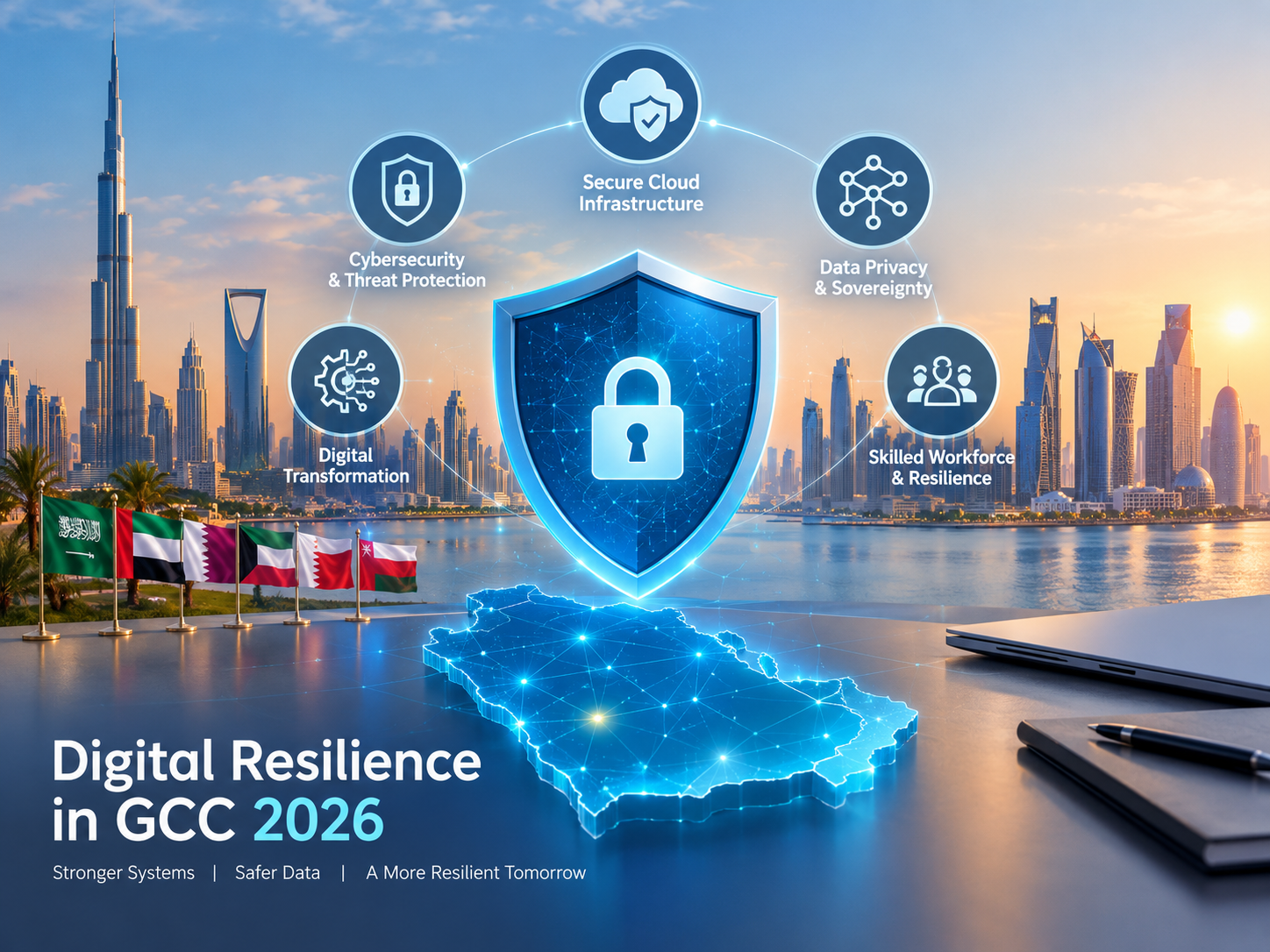
Digital Resilience in GCC: 2026 Survival Guide
A cloud outage in Riyadh, a network disruption in Dubai, or a supplier failure affecting a business in Doha can bring critical digital operations to a halt. For GCC companies, the challenge is no longer simply preventing disruption. It’s making sure essential services can continue when something goes wrong.
Digital Resilience in GCC means protecting critical business operations against cloud failures, cyberattacks, telecommunications outages, supply chain interruptions, and geopolitical uncertainty. In 2026, businesses across Saudi Arabia, the UAE, Qatar, Bahrain, Kuwait, and Oman need reliable recovery systems, independent connectivity, dependable technology suppliers, and continuity plans that meet applicable local regulations.
Building that resilience requires a coordinated strategy, not just another backup server.
What Is Digital Resilience in the GCC?
Digital resilience is an organization’s ability to withstand unexpected disruptions, maintain essential services, and restore affected systems within acceptable business limits.
For GCC enterprises, this includes protecting cloud applications, payment platforms, customer databases, telecommunications infrastructure, and the technology suppliers supporting daily operations.
Digital Resilience vs. Cybersecurity and Business Continuity
Although closely related, these concepts serve different purposes.
Cybersecurity: Protects systems, networks, and information against digital threats.
Business Continuity Planning (BCP): Establishes procedures for keeping essential business activities running during disruption.
Disaster Recovery (DR): Focuses on restoring technology infrastructure, applications, and data after an incident.
Digital Resilience: Connects these capabilities to maintain service availability and support business recovery.
A company can have strong cybersecurity controls and still experience downtime because of a cloud outage or telecommunications failure.
Digital resilience prepares businesses for situations where prevention alone is not enough.
The Four Pillars of Digital Resilience in GCC
Cloud infrastructure
Resilient hosting, independent backups, workload recovery, and tested failover environments.
Connectivity
Diverse telecommunications providers, network routes, submarine cables, and alternative connections.
Technology supply chains
Reliable hardware, software vendors, replacement equipment, licensing, and procurement arrangements.
Geopolitical readiness
Planning for cross-border dependencies, regional trade interruptions, regulatory restrictions, and changing operating conditions.
These pillars are interconnected. A company’s cloud platform may remain operational while a telecommunications failure prevents customers from accessing it.
That is why business resilience must address the entire service delivery chain.
Why Riyadh, Dubai, and Doha Face Different Challenges
Digital infrastructure needs vary across GCC markets.
In Saudi Arabia, businesses operating in Riyadh and Jeddah must consider applicable cybersecurity requirements, data governance obligations, and sector-specific continuity rules.
Dubai and Abu Dhabi enterprises often depend on international applications, payment integrations, logistics platforms, and cross-border business systems.
Meanwhile, businesses in Doha may prioritize telecommunications redundancy, locally available cloud services, and dependable recovery for critical applications.
The right resilience strategy depends on the organization’s location, sector, regulatory exposure, and technology dependencies.
Cloud, Connectivity, and Supply Chain Risks in GCC
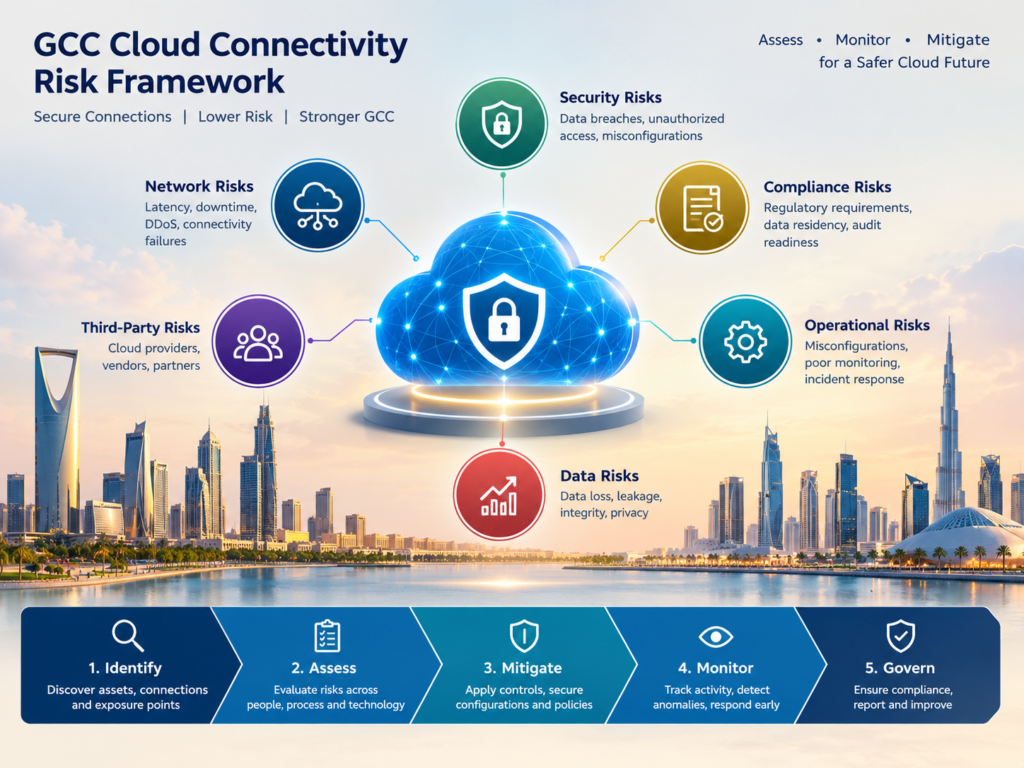
Businesses across the Gulf are increasingly dependent on interconnected digital infrastructure. A disruption affecting one service provider can create operational problems across multiple applications and business functions.
Understanding where these dependencies exist is essential before designing recovery systems.
Cloud Outages, Data Residency, and Provider Concentration
Cloud platforms offer scalability and access to regional infrastructure, but they do not eliminate operational risk.
Regional hosting options include Amazon Web Services (AWS)’ Bahrain Region, Microsoft Azure’s UAE Central region, and Google Cloud’s Doha region.
These services can support regional deployment strategies. However, choosing a local cloud region does not automatically satisfy every data residency or regulatory requirement.
Businesses should evaluate.
Whether production and recovery environments share critical infrastructure.
How backups are isolated from the primary environment.
Whether applications can operate on alternative infrastructure.
Where sensitive data is stored, accessed, and recovered.
Whether recovery procedures meet approved downtime and data-loss limits.
Multi-cloud architecture can reduce certain concentration risks, but only when failover is practical, independently supported, and regularly tested.
A second cloud provider has limited value if applications cannot actually be restored there.
For technical teams, reliable back-end development and integrations can help reduce unnecessary dependencies and improve application recovery capabilities.
Submarine Cables, Telecom Redundancy, and Network Failures
International connectivity remains a critical consideration for businesses in the Gulf.
Submarine cables, terrestrial networks, international gateways, and domestic telecommunications infrastructure all contribute to service availability.
Disruptions along important geographic corridors, including the Red Sea and Strait of Hormuz, can affect network traffic depending on the routes and capacity available.
However, not every cable disruption causes a complete internet outage. Providers may reroute traffic, although congestion and increased latency can still occur.
One overlooked risk is the assumption that having two internet providers guarantees genuine redundancy.
Separate commercial contracts may still depend on shared physical infrastructure.
Businesses should confirm whether alternative telecommunications services use independent network routes, entry points, and supporting facilities.
Geopolitical Disruption and Technology Supply Chain Risks
Digital operations also depend on access to replacement hardware, software licenses, cloud services, specialist vendors, and international logistics.
Procurement restrictions, transport delays, regional instability, or supplier financial problems can slow recovery after an incident.
The following table illustrates common risks and practical mitigation measures.
| Risk |
|
Recommended mitigation |
|---|---|---|
| Cloud service outage | Application or payment downtime | Tested workload failover |
| Network or cable disruption | Slow or unavailable connectivity | Diverse carriers and routes |
| Technology supplier failure | Delayed repairs or restoration | Qualified alternative vendors |
| Geopolitical disruption | Equipment or procurement delays | Inventory and sourcing plans |
A resilient business should understand not only its direct technology suppliers but also the critical dependencies those suppliers rely upon.
GCC Digital Resilience Regulations: Saudi Arabia, UAE, and Qatar
Regulatory expectations across GCC countries are not identical.
Requirements depend on the organization’s industry, operational activities, data classification, and the authorities responsible for its oversight.
Businesses should establish which laws, cybersecurity controls, and continuity requirements apply before choosing infrastructure or disaster recovery locations.
Saudi Arabia.
Saudi Arabia maintains cybersecurity and data governance frameworks relevant to enterprise technology operations.
The National Cybersecurity Authority (NCA) publishes Cloud Cybersecurity Controls covering applicable cloud security responsibilities and requirements.
The Saudi Central Bank (SAMA) oversees regulated financial institutions, including relevant cybersecurity and business continuity expectations.
The National Data Management Office (NDMO) also contributes to Saudi data governance requirements.
Companies should review the applicable requirements rather than assuming that every organization is subject to the same controls.
Official references include the NCA Cloud Cybersecurity Controls and SAMA Business Continuity Management Framework.
UAE.
The UAE has several authorities and regulatory environments relevant to cybersecurity, telecommunications, and business continuity.
The Telecommunications and Digital Government Regulatory Authority (TDRA) oversees telecommunications and digital-government matters.
The UAE Cyber Security Council supports national cybersecurity initiatives and strategy.
Organizations operating in Dubai International Financial Centre (DIFC) or Abu Dhabi Global Market (ADGM) should assess their respective regulatory requirements separately.
A government entity, financial institution, and commercial retailer may face substantially different obligations.
Businesses can consult the official TDRA website as a starting point for relevant telecommunications and digital-government information.

Qatar.
Qatar’s National Cyber Security Agency (NCSA) plays an important role in the country’s cybersecurity framework.
Its National Cyber Security Strategy 2024–2030 identifies resilience as part of Qatar’s broader cybersecurity direction.
Organizations regulated by Qatar Central Bank (QCB) must also consider applicable financial-sector technology and business continuity requirements.
For enterprises using cloud infrastructure in Doha, recovery architecture should be evaluated alongside regulatory obligations and service-provider capabilities.
GCC Regulatory Comparison
| Country | Key authorities |
Main resilience considerations |
|---|---|---|
| Saudi Arabia | NCA, SAMA, NDMO | Cloud security, financial continuity, data governance |
| UAE | TDRA, Cyber Security Council, DIFC, ADGM | Telecommunications, cybersecurity, sector-specific oversight |
| Qatar | NCSA, QCB | Cyber resilience and financial-service continuity |
This comparison is intended as general guidance. Regulatory applicability and current requirements should be confirmed with the relevant authority or qualified adviser before implementation.
How to Build a GCC Digital Resilience Framework
An effective framework begins with understanding which services matter most to the business.
The goal is not to make every system equally redundant. It is to prioritize critical operations, eliminate avoidable points of failure, and verify that recovery arrangements work.
Map Critical Services and Technology Dependencies
Start by identifying the applications and infrastructure that support essential business activities.
Document cloud workloads, data locations, connectivity providers, payment systems, technology vendors, and external integrations.
Establish two important recovery measures.
Recovery Time Objective (RTO): The maximum targeted time for restoring a service after disruption.
Recovery Point Objective (RPO): The maximum acceptable amount of data loss measured in time.
For example, an online transaction platform may require more demanding recovery targets than an internal reporting application.
Dependency mapping helps technology teams understand which failures could affect multiple services simultaneously.
Design Multi-Cloud Recovery and Connectivity Redundancy
Once critical dependencies are understood, create recovery arrangements appropriate to business risk.
Possible measures include geographically separated recovery environments, independent network connections, secure backups, and alternative service providers.
Where multi-cloud recovery is selected, technical teams should confirm that the required applications, databases, configurations, and security controls can be restored successfully.
Cross-border recovery plans must also be reviewed against applicable data transfer, residency, and contractual requirements.
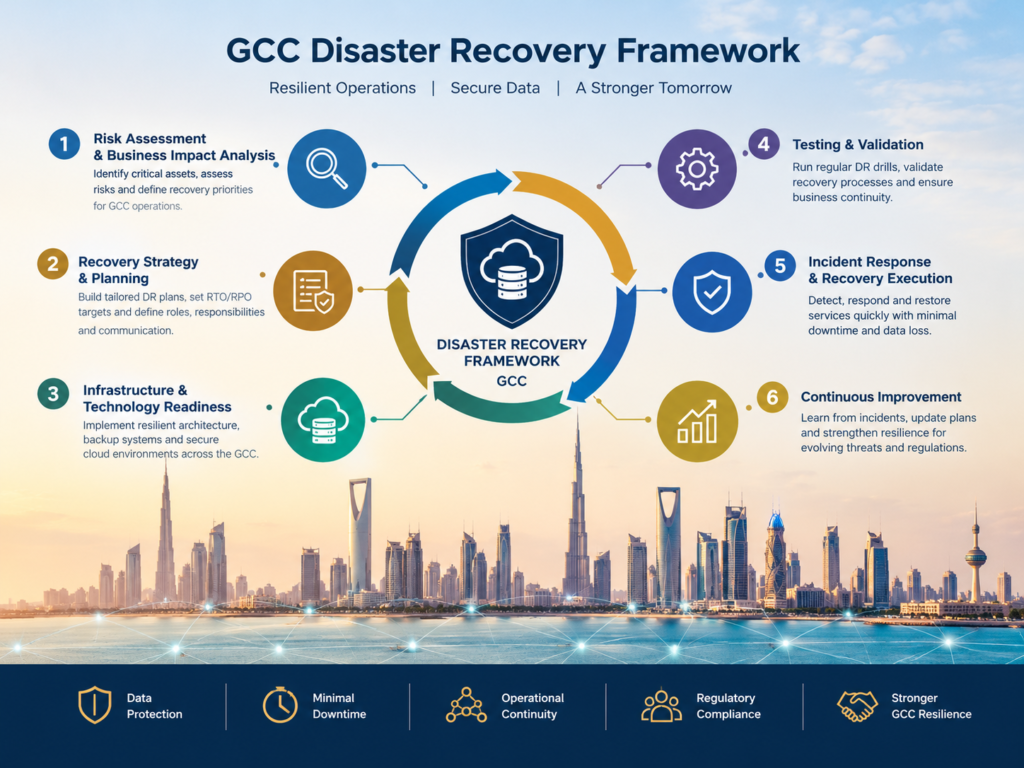
Test Failover, Supplier Responses, and Crisis Communications
A recovery plan is only useful when it can be executed.
Organizations should run practical restoration exercises and simulated disruption scenarios covering technical recovery, supplier coordination, and business communications.
Exercises should identify.
Whether essential applications can be restored.
Whether actual RTO and RPO results meet approved targets.
Whether vendors respond according to their obligations.
Whether employees understand their recovery responsibilities.
Whether customers and stakeholders receive timely communication.
Record problems, assign corrective actions, and repeat tests after improvements.
GCC Digital Resilience Implementation Checklist
|
Stage |
Responsible team |
Main deliverable |
|---|---|---|
| Map | CIO / Risk Management | Critical dependency register |
| Design | Cloud / Network Teams | Approved recovery architecture |
| Test | IT / Security Teams | Verified recovery exercise report |
The process should be reviewed whenever important systems, suppliers, infrastructure, or business requirements change.
Digital Resilience Use Cases for GCC Industries
Digital resilience strategies become easier to understand when applied to realistic operational situations.
The following scenarios are illustrative examples, not accounts of actual company incidents.
Saudi Fintech and Banking Resilience in Riyadh
Consider a Riyadh-based fintech platform that suddenly loses access to its primary payment processor.
Even if its main application remains operational, customers may be unable to complete transactions.
A resilience plan could include alternative payment workflows, transaction reconciliation procedures, incident communication, and documented responsibilities aligned with applicable SAMA requirements.
Secure web application development can also support better error handling and more resilient customer-facing systems.
UAE Retail, Logistics, and Government Digital Services
Imagine a Dubai e-commerce platform experiencing checkout failures during a major promotional campaign.
Without reliable recovery arrangements, customers may abandon transactions and support teams may face a sudden increase in complaints.
Alternative payment integrations, capacity planning, and scalable e-commerce architecture can reduce the impact of certain disruptions.
For Abu Dhabi government digital services, resilience planning may place additional emphasis on identity systems, essential service delivery, secure infrastructure, and recovery testing.
Qatar Telecommunications and Enterprise Cloud Recovery
A Doha-based business may depend on a cloud-hosted application for customer management, internal communication, or operational reporting.
If its primary network connection fails, staff may lose access even though the cloud service itself remains available.
Independent connectivity, alternative access arrangements, and tested recovery procedures can help maintain operations.
Depending on the application, mobile app development with controlled offline capabilities may also help employees continue selected activities during temporary interruptions.
GCC Digital Resilience Costs, Timelines, and Best Practices
Digital resilience investment should reflect business impact rather than a fixed technology spending target.
A small enterprise and a regulated financial institution may require very different recovery arrangements.
What Determines Digital Resilience Investment Costs?
Several factors influence the overall budget.
Criticality and complexity of business applications.
Recovery time and data-loss requirements.
Backup storage and replication frequency.
Geographic infrastructure redundancy.
Telecommunications diversity and bandwidth.
Software licenses and service-provider contracts.
Staffing, training, and operational testing.
Industry-specific compliance obligations.
Cloud replication and additional connectivity can increase recurring operating costs.
However, cost comparisons should also account for potential downtime, recovery expenses, contractual penalties, and customer-service disruption.
An appropriate strategy balances protection with the organization’s actual risk exposure.
A Phased 30–60–90 Day Resilience Roadmap
Businesses can use a phased roadmap to organize initial improvements.
Days 1–30
Assess dependencies
Identify critical services, document vulnerabilities, and develop a risk register.
Days 31–60
Design recovery
Establish recovery priorities, evaluate infrastructure alternatives, and approve the proposed architecture.
Days 61–90
Test and improve
Conduct recovery exercises, document weaknesses, and prepare an executive readiness report.
This roadmap is a planning example, not a guaranteed implementation timeline.
Complex infrastructure, regulated workloads, and supplier constraints may require more extensive preparation.
KPIs for Measuring Digital Resilience
Recovery performance should be measurable, not based solely on documented policies.
|
KPI |
What to measure |
|---|---|
| Recovery success rate | Successful recovery drills divided by total drills |
| RTO compliance | Recovery tests completed within approved time targets |
| RPO compliance | Tests meeting approved data-loss limits |
| Backup reliability | Successful restoration and integrity checks |
| Supplier coverage | Critical vendors assessed for continuity readiness |
Management teams can use business intelligence dashboards to monitor recovery performance, outstanding risks, and remediation progress.
Regular reporting also helps decision-makers identify where further investment is justified.
Common Digital Resilience Mistakes GCC Businesses Should Avoid
Even organizations with established cybersecurity programs can overlook operational weaknesses.
Common mistakes include relying on untested backups, assuming separate cloud regions provide complete independence, or treating different telecommunications contracts as proof of physically separate connections.
Other problems arise when recovery plans ignore third-party suppliers or when technology teams design cross-border failover without assessing applicable data requirements.
Another frequent weakness is measuring readiness through policy completion rather than actual restoration results.
A stronger approach combines technical architecture, business ownership, supplier accountability, and repeated operational testing.
Outlook
Digital Resilience in GCC is about ensuring businesses remain operational when technology, connectivity, suppliers, or external conditions fail.
For organizations in Saudi Arabia, the UAE, Qatar, and the wider Gulf, resilience depends on more than cloud availability or cybersecurity investment.
It requires clear visibility into critical dependencies, independent recovery options, regulatory awareness, and tested continuity procedures. Mak It Sol
The strongest resilience strategy is one that works under realistic conditions, not just on paper.
Protect your critical digital services before an unexpected disruption exposes hidden infrastructure weaknesses.
Explore Mak It Solutions’ technology services to discover solutions for cloud-connected applications, enterprise systems, integrations, and digital operations.
You can also contact our team to discuss your business requirements, request a consultation, and explore a technology strategy that supports your organization’s resilience goals.
FAQs
Q : Can Saudi companies use overseas cloud backups for disaster recovery?
A : Overseas backups may be possible, but they are not automatically permitted for every Saudi organization or category of data.
Businesses should assess applicable data protection requirements, cross-border transfer conditions, NCA controls, and any sector-specific obligations, including SAMA requirements where relevant.
A regulatory assessment should be completed before implementing offshore recovery arrangements.
Q : Is sovereign cloud necessary for every UAE business?
A : No. Sovereign cloud infrastructure is not universally mandatory for every UAE business.
Requirements depend on the organization’s industry, data sensitivity, applicable regulations, and contractual commitments. A Dubai retailer may have different hosting obligations from a government entity or an ADGM-regulated financial institution.
Businesses should classify their data and evaluate their compliance requirements before selecting an infrastructure model.
Q : What should Qatar enterprises check before choosing a disaster recovery provider?
A : Qatar businesses should examine the provider’s recovery capabilities, geographic infrastructure, network connectivity, backup security, contractual responsibilities, and previous restoration-test evidence.
Organizations should also assess relevant NCSA guidance and applicable QCB obligations where financial services are involved.
Regional cloud availability alone does not guarantee that a disaster recovery solution meets business requirements.
Q : How often should Dubai businesses test cloud disaster recovery plans?
A : Testing frequency should depend on business criticality, regulatory obligations, and infrastructure changes.
Quarterly recovery exercises may be a useful voluntary target for critical commercial applications, but they are not a universal UAE legal requirement.
Every exercise should evaluate application recovery, backup integrity, supplier participation, and actual restoration performance.
Q : What is the difference between local and cross-border failover for GCC businesses?
A : Local failover restores operations using infrastructure within the same country. Cross-border failover uses recovery resources located in another jurisdiction.
Local recovery may simplify certain latency and data residency considerations, while cross-border recovery may provide additional geographic separation.
Both approaches require technical testing and assessment of relevant legal, security, and regulatory obligations.