


Warehouse Robotics ROI: The Smarter Investment Guide
Warehouse Robotics ROI: The Smarter Investment Guide
Warehouse Robotics ROI: The Smarter Investment Guide
Can warehouse robots deliver a positive financial return without reducing employee headcount? Yes—but the answer depends on what automation improves and how those improvements translate into actual financial value.
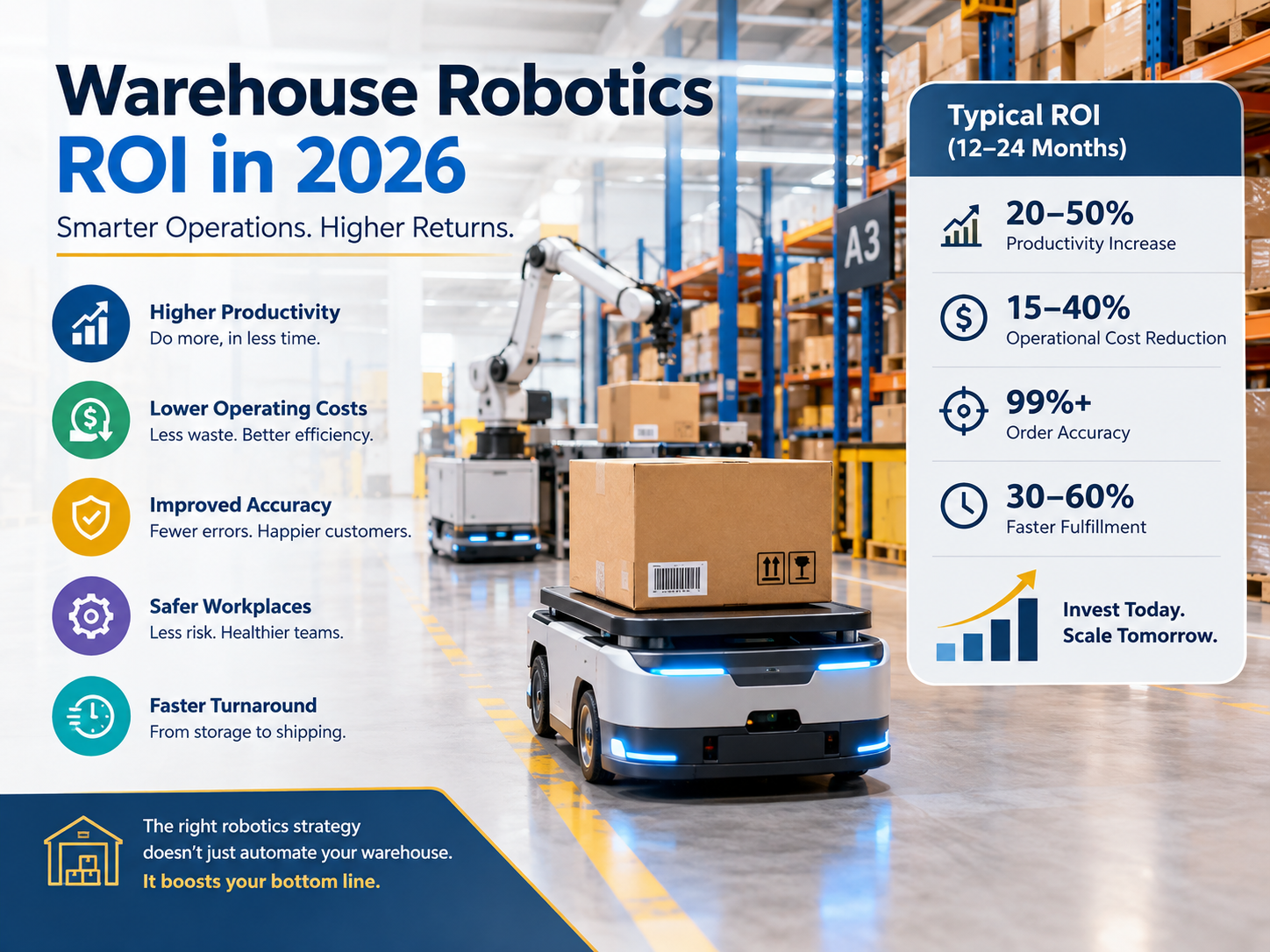
Warehouse robotics ROI measures the financial return generated by warehouse automation compared with its total investment and operating costs. Beyond labor savings, robots can create value through faster order fulfillment, improved inventory accuracy, fewer picking errors, better space utilization, and increased operational capacity.
For warehouse managers, third-party logistics (3PL) operators, and CFOs, the challenge is separating measurable financial benefits from productivity claims that look impressive but may not improve profitability.
According to the International Federation of Robotics (IFR), more than 205,000 professional service robots were registered as sold worldwide in 2023. This demonstrates the broader adoption of service robotics, although it does not establish the profitability of individual warehouse deployments.
So, how can businesses calculate warehouse automation returns with confidence? The answer starts with understanding what creates value, calculating full lifecycle costs, and testing assumptions against actual warehouse performance.
What Is Warehouse Robotics ROI in 2026?
Warehouse robotics ROI is the net financial benefit an organization earns from robotic automation relative to its investment over a specified period.
It considers both direct savings and indirect operational improvements that can be converted into measurable financial outcomes.
How Robotics ROI Differs From Labor-Cost Savings
Traditional warehouse automation business cases often focus on reducing manual labor costs.
That approach overlooks other sources of value.
Autonomous mobile robots (AMRs), for example, can transport inventory between warehouse locations, reducing the time employees spend walking between picking stations.
Employees can then spend more time processing orders, resolving exceptions, and completing higher-value tasks.
The resulting benefits may include reduced overtime, avoided temporary staffing expenses, and increased order-handling capacity.
However, higher productivity does not automatically mean higher profit. Additional throughput creates financial value only when customer demand, margins, and other operating processes support it.
ROI, Payback Period, and Total Cost of Ownership
A reliable financial assessment uses several complementary metrics.
| Financial metric | What it measures | Why it matters |
|---|---|---|
| Return on investment (ROI) | Net return relative to invested capital | Evaluates overall profitability |
| Payback period | Time required to recover the initial investment | Measures capital recovery |
| Total cost of ownership (TCO) | Equipment, integration, maintenance, and ongoing expenses | Reveals lifecycle costs |
| Net present value (NPV) | Present value of future net cash flows minus investment | Accounts for the time value of money |
ROI shows potential profitability, while payback indicates how quickly the investment may recover its cost.
NPV provides a stronger basis for comparing projects with different cash-flow patterns.
CapEx vs Robotics-as-a-Service (RaaS)
Warehouse automation is commonly financed through equipment ownership or recurring service arrangements.
With capital expenditure (CapEx), businesses purchase robotic equipment and assume responsibility for ownership-related costs.
Robotics-as-a-Service (RaaS) generally provides access to robotic equipment or operational capacity through recurring payments.
RaaS can reduce upfront spending and provide flexibility, but ongoing fees and contractual commitments may affect long-term profitability.
The better option depends on utilization, available capital, service agreements, and expected operating requirements.
For a more detailed comparison, read our Robotics-as-a-Service guide.
5 Warehouse Robotics Benefits Beyond Labor Savings
Warehouse robots can improve financial performance in several ways without necessarily reducing employee headcount.
The most important benefits are those that increase contribution margin, eliminate avoidable costs, or prevent measurable losses.
Faster Throughput and Order Fulfillment
AI-enabled warehouse robots can help reduce unnecessary travel, optimize material movement, and improve workflow coordination.
A warehouse should measure improvements using indicators such as picks per hour, orders completed per shift, processing time, and fulfillment capacity.
Consider a Chicago fulfillment center experiencing seasonal order increases.
An AMR fleet could help existing workers process additional orders without proportionally increasing temporary staffing.
The financial return would come from avoided staffing expenses or additional profitable orders—not simply from the number of extra picks completed.
Improved Inventory Accuracy
Warehouse robots equipped with computer vision, RFID integration, or inventory-scanning capabilities can help businesses maintain better stock visibility.
Accurate inventory records can reduce misplaced products, prevent unnecessary replenishment, and improve order availability.
However, actual benefits depend on system accuracy, integration quality, and warehouse processes.
Organizations can use business intelligence services to monitor inventory discrepancies and identify recurring operational problems.
Fewer Picking Errors and Returns
Picking mistakes can create costs through rework, customer complaints, reshipping, and returns.
Automated picking systems and goods-to-person solutions may reduce certain errors when appropriately designed and integrated.
Financial teams should calculate the benefit using actual baseline error rates and documented costs per error.
An assumed accuracy improvement without operational evidence should not be treated as a confirmed saving.
Better Storage Density and Space Utilization
Certain automated storage and retrieval systems can increase usable storage capacity within an existing warehouse.
This may reduce the need for additional external storage or delay facility expansion.
The benefit is particularly relevant where suitable industrial property is expensive or expansion options are limited.
Nevertheless, additional storage capacity should only be assigned a financial value when it avoids a realistic future cost.
Greater Scalability and Operational Reliability
Robotics can help warehouses manage changing order volumes and maintain more consistent material flows.
For 3PL providers, this flexibility may support new customer contracts or additional fulfillment capacity.
Reliability also matters. Reducing preventable downtime may protect service levels and avoid missed fulfillment commitments.
A useful pilot KPI scorecard includes:
| KPI | Baseline measurement | Financial relevance |
|---|---|---|
| Throughput | Orders per hour | Revenue capacity |
| Picking errors | Errors per 1,000 orders | Rework and return costs |
| Inventory accuracy | Recorded vs actual stock | Inventory losses |
| Space utilization | Storage capacity per m² | Expansion avoidance |
| Downtime | Unavailable operating hours | Lost productivity |
These indicators require actual before-and-after measurements. No improvement should be assumed before testing.
How to Calculate Warehouse Robotics ROI and Payback
Calculating warehouse robotics ROI requires a clear understanding of investment costs, recurring expenses, and measurable annual benefits.
The most useful financial model connects operational improvements directly to cash flows.
Identify Investment and Operating Costs
Before estimating returns, account for the full cost of deployment.
Common expenses include robot hardware, fleet management software, warehouse management system (WMS) integration, commissioning, staff training, networking, cybersecurity, electricity, maintenance, and equipment replacement.
Integration costs deserve particular attention when facilities operate older ERP or warehouse software.
Custom Python development services and backend integration solutions can support operational data exchange, reporting, and financial modeling where custom development is required.
Warehouse Robotics ROI Calculation: A Five-Year Example
Consider a hypothetical warehouse evaluating a robotic automation investment.
The following figures are illustrative assumptions, not verified industry benchmarks.
| Financial component | Illustrative amount |
|---|---|
| Initial investment | $500,000 |
| Annual gross financial benefits | $220,000 |
| Annual operating costs | $40,000 |
| Annual net cash benefit | $180,000 |
| Simple payback period | 2.78 years |
| Five-year undiscounted ROI | 80% |
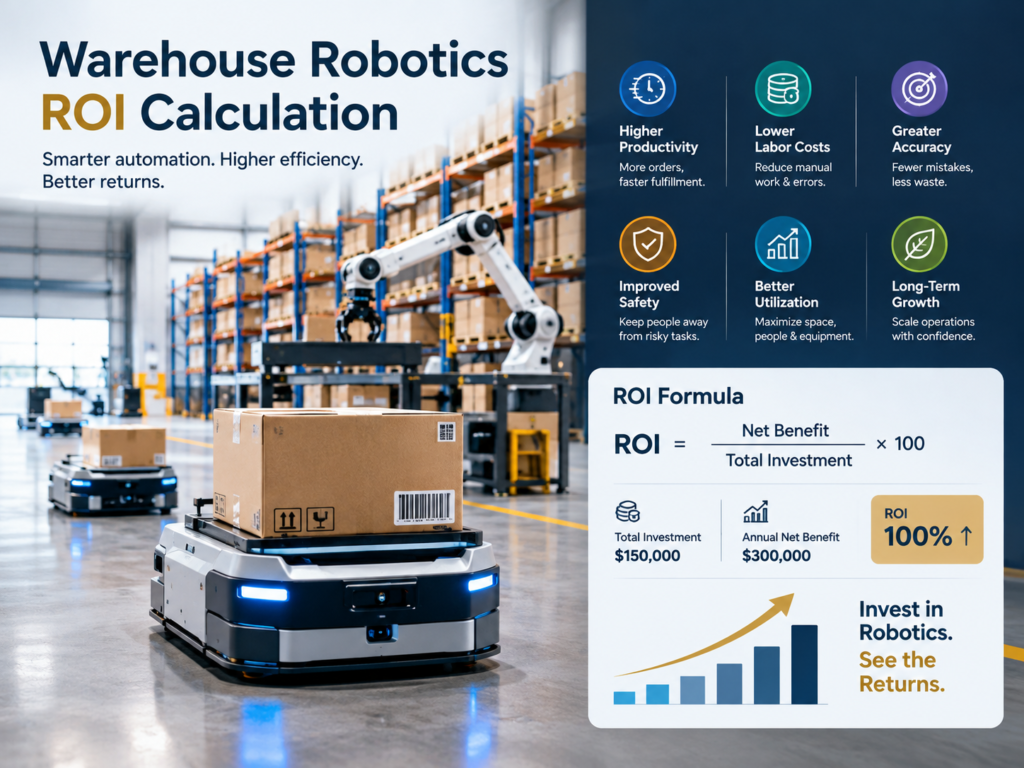
The basic ROI formula is:
ROI = [(Total Benefits − Total Costs) ÷ Total Costs] × 100
For this example, annual net cash benefit is:
$220,000 − $40,000 = $180,000
Over five years:
$180,000 × 5 = $900,000
The resulting return is:
ROI = [($900,000 − $500,000) ÷ $500,000] × 100
Five-year ROI = 80%
To calculate simple payback:
Payback = $500,000 ÷ $180,000
Simple payback = approximately 2.78 years
This suggests that the hypothetical investment could recover its initial cost before the end of the third operating year.
However, the example assumes constant annual benefits and operating costs. It excludes taxes, discounting, residual value, financing effects, and replacement capital.
Actual warehouse performance may differ significantly.
Validate NPV, Risk, and Sensitivity Assumptions
A positive simple ROI does not guarantee that an investment is the best use of available capital.
A stronger model evaluates NPV, financing costs, implementation delays, utilization, maintenance risks, and fluctuations in customer demand.
Finance teams should test conservative, base-case, and optimistic scenarios.
Avoid double-counting financial benefits. For example, if faster picking reduces labor expenses, that same productivity improvement should not also be counted as incremental profit unless additional sales and contribution margin can be demonstrated.
For businesses considering automation, a scoped ROI modeling discussion can help identify the software integration and operational data requirements behind a credible financial model.
Which AI Warehouse Robots Deliver the Best ROI?
There is no universally best warehouse robot for ROI.
The right technology depends on movement patterns, inventory characteristics, facility layout, order volumes, and integration requirements.
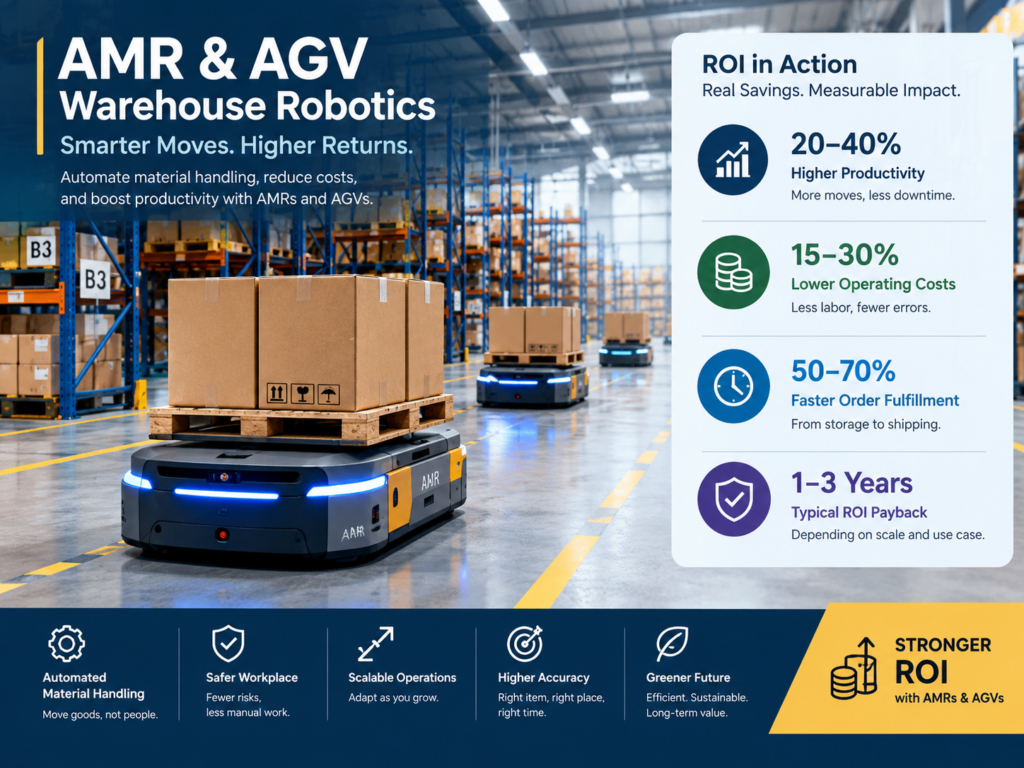
Autonomous Mobile Robots (AMRs) vs AGVs
AMRs typically use sensors and mapping technology to navigate changing environments.
They are often suited to warehouses requiring flexible material transport.
Automated guided vehicles (AGVs), by comparison, generally follow predefined or more constrained routes.
They can be effective where material movements are predictable and repetitive.
AMRs may offer greater operational flexibility, while AGVs may provide a practical solution for stable transportation workflows.
The financial decision should reflect actual infrastructure requirements, utilization, and maintenance costs.
AI Robotic Picking vs Goods-to-Person Systems
AI robotic picking uses robotic arms, vision technology, and suitable gripping equipment to handle compatible inventory items.
Goods-to-person systems bring stored inventory to an operator or picking station.
Inventory-scanning robots focus on stock verification rather than physical order handling.
| Technology | Primary benefit | Main cost consideration | Suitable workload |
|---|---|---|---|
| AMRs | Flexible material transport | Fleet software and equipment | Variable movement |
| AGVs | Repeatable transport | Routing infrastructure | Fixed routes |
| AI robotic picking | Automated item handling | Grippers and machine vision | Compatible SKUs |
| Goods-to-person systems | Consolidated picking and storage | Storage and system infrastructure | High-volume fulfillment |
Technology selection should begin with the warehouse’s operational bottleneck rather than a vendor’s advertised performance.
For a broader technical comparison, see our Physical AI vs Traditional Robotics guide.
WMS Integration and Pilot Deployment Economics
Robots rarely operate as isolated systems.
Effective deployments require communication between warehouse management systems, warehouse execution systems (WES), warehouse control systems (WCS), ERP platforms, and robot fleet software.
Poor integration can create delays, inaccurate instructions, and additional operating costs.
Before committing to a full deployment, evaluate interoperability, vendor APIs, system reliability, workforce training, and implementation effort.
Warehouse Robotics ROI in the USA, UK, Germany, and EU
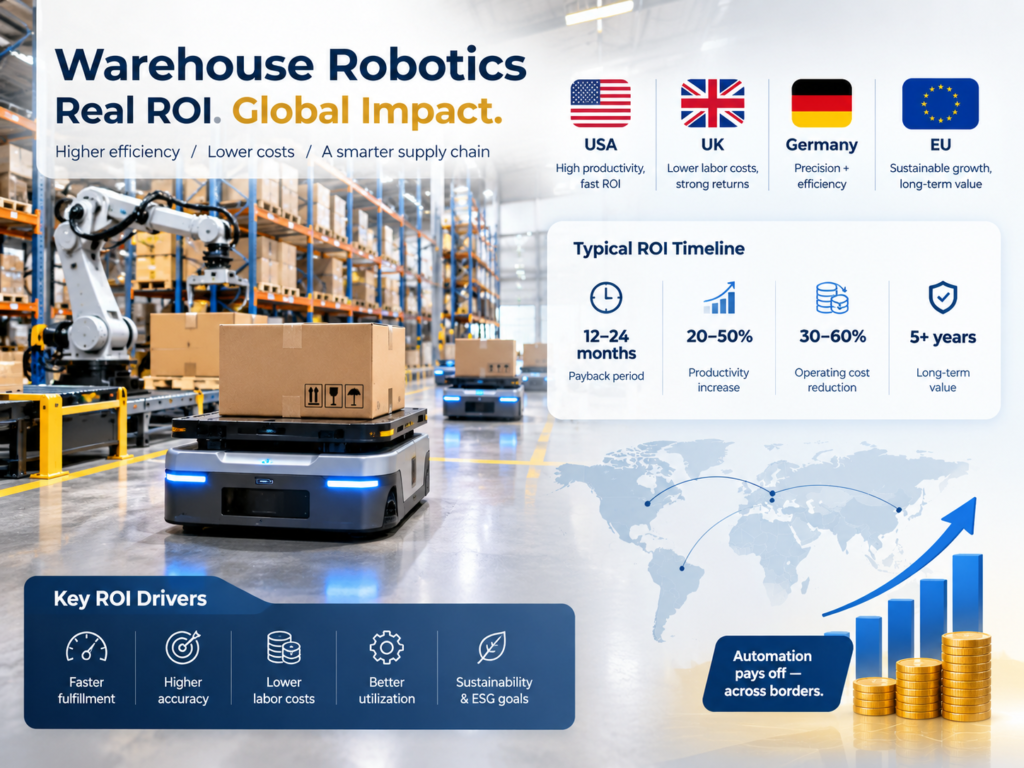
Warehouse automation economics vary considerably across countries.
Labor costs, industrial property expenses, financing conditions, energy prices, and safety requirements can all influence returns.
A credible financial assessment should use local operating assumptions rather than applying a generic global ROI figure.
USA.
Warehouses serving major logistics markets such as Chicago, Dallas–Fort Worth, and Atlanta may prioritize throughput, seasonal scalability, and fulfillment efficiency.
According to the International Federation of Robotics, the United States recorded approximately 34,200 industrial robot installations in 2024.
This reflects broader industrial automation activity, not a warehouse-specific ROI benchmark.
American warehouse operators should consider applicable OSHA robotics safety guidance and relevant equipment standards when planning deployments.
UK.
UK warehouse operators around Birmingham, Manchester, and the Midlands may evaluate robotics against labour availability, operating costs, and warehouse space constraints.
Automation can be particularly relevant when additional capacity is needed within existing facilities.
Financial models should use GBP and reflect actual local staffing, energy, service, and maintenance expenses.
Safety assessments should also consider the UK Health and Safety Executive’s Provision and Use of Work Equipment Regulations (PUWER).
Germany and EU.
For German Mittelstand businesses, Lagerroboter Wirtschaftlichkeit focuses on whether warehouse robotics creates measurable economic value.
Investment evaluations may include Lagerautomatisierung ROI, Amortisationszeit, and intralogistics interoperability.
In logistics locations such as Hamburg and Duisburg, integration with existing material-handling infrastructure can influence the economics of automation.
Relevant technical and regulatory considerations may include ISO 3691-4, VDA 5050 interoperability, GDPR where personal data is processed, and applicable European machinery requirements.
The EU Machinery Regulation 2023/1230 generally becomes mandatory on January 20, 2027, although certain provisions apply earlier.
Distribution networks serving Rotterdam and Antwerp may also need to consider cross-site compatibility when evaluating multi-facility investments.
Compliance requirements should always be assessed against the specific robotic system, its intended use, and the jurisdiction.
Risks That Can Reduce Warehouse Automation ROI
Robotics investments can fail to meet financial expectations even when the technology performs its intended function.
Integration delays, limited utilization, maintenance problems, and inaccurate financial assumptions can all reduce returns.
Integration, Maintenance, and Unexpected Downtime
Deployment costs may rise when existing warehouse software is incompatible with robotic fleet systems.
Unexpected commissioning delays can postpone expected benefits.
Similarly, spare-parts shortages or slow maintenance response times can reduce equipment availability.
Vendor contracts should clearly define service obligations, maintenance coverage, response times, and recovery procedures.
Safety, Cybersecurity, and Regulatory Requirements
Robotic warehouse operations require suitable risk assessments, safety controls, employee training, and secure software interfaces.
Human–robot interaction deserves particular attention where workers and mobile equipment share operating areas.
Cybersecurity planning should address system access, software updates, network connectivity, and relevant operational data.
The applicable legal requirements differ between the US, UK, Germany, and other EU jurisdictions.
Regulatory compliance is not simply a documentation expense. Failure to plan for it can delay deployment and create operational or financial exposure.
Pilot KPIs and a Realistic Rollout Roadmap
A controlled pilot helps businesses identify problems before committing to a larger investment.
A practical rollout follows five stages:
Document baseline performance. Record throughput, errors, utilization, operating expenses, and service levels.
Select a defined use case. Choose a workflow where automation could address a measurable constraint.
Integrate the robotic system. Connect the pilot to relevant warehouse software and operational processes.
Measure actual results. Compare post-deployment performance with baseline KPIs, including financial outcomes.
Validate the scaling decision. Expand only when measured results support the business case.
Robot activity alone is not evidence of financial success.
A successful pilot demonstrates meaningful operational improvement and explains how that improvement affects costs, cash flow, or contribution margin.
To Sum Up
Warehouse robotics ROI is ultimately about financial performance, not the number of robots operating inside a facility.
Labor efficiency matters, but throughput, inventory accuracy, storage utilization, fulfillment reliability, and scalability can also contribute to meaningful returns.
The strongest investment cases connect these improvements to measurable financial benefits while accounting for integration, maintenance, safety, utilization, and operational risk.
For warehouse operators in the USA, UK, Germany, and the wider EU, the best approach is to build a facility-specific financial model, validate assumptions through a pilot, and scale only when the results justify further investment.
At Mak It Solutions, we help businesses explore the software integration, analytics, and operational data needed to support informed automation decisions.
Request a scoped warehouse robotics ROI assessment to discuss the data and integration requirements behind your investment case.
FAQs
Q : What warehouse size justifies an investment in autonomous mobile robots?
A : There is no universal minimum warehouse size for AMR investment.
Order volume, travel distance, operating hours, and robot utilization are generally more important than floor area alone.
Compare expected annual financial benefits against equipment, integration, and operating costs before making a decision.
Q : Can warehouse robotics ROI improve without reducing employee headcount?
A : Yes. Robots can improve financial returns by increasing order capacity, reducing picking errors, lowering overtime, or avoiding additional temporary staffing.
The important distinction is between higher operational productivity and realized financial value.
Q : Should a 3PL choose robotics leasing or upfront ownership?
A : The decision depends on capital availability, contract duration, customer demand, and expected robot utilization.
Ownership offers greater equipment control but requires upfront investment and ongoing maintenance.
RaaS or leasing may offer more cash-flow flexibility, although recurring charges and contract terms can increase long-term costs.
Compare discounted lifecycle cash flows before deciding.
Q : Which warehouse KPIs should be tracked during an AMR pilot?
A : Track throughput, cost per order, robot utilization, travel time, picking accuracy, downtime, and service-level performance.
Establish baseline measurements before deployment and assess results under representative workloads.
Include maintenance, integration issues, and employee safety observations in the evaluation.
Q : How should seasonal demand affect a warehouse robotics ROI forecast?
A : Seasonal demand should be evaluated using separate peak and off-peak operating assumptions.
Higher utilization during busy periods may improve financial returns, while extended periods of underutilization can delay payback. Compare conservative, expected, and high-demand scenarios, including the flexibility and minimum commitments of any RaaS agreement.