


Robotics as a Service: Where It Wins and Fails
Robotics as a Service: Where It Wins and Fails
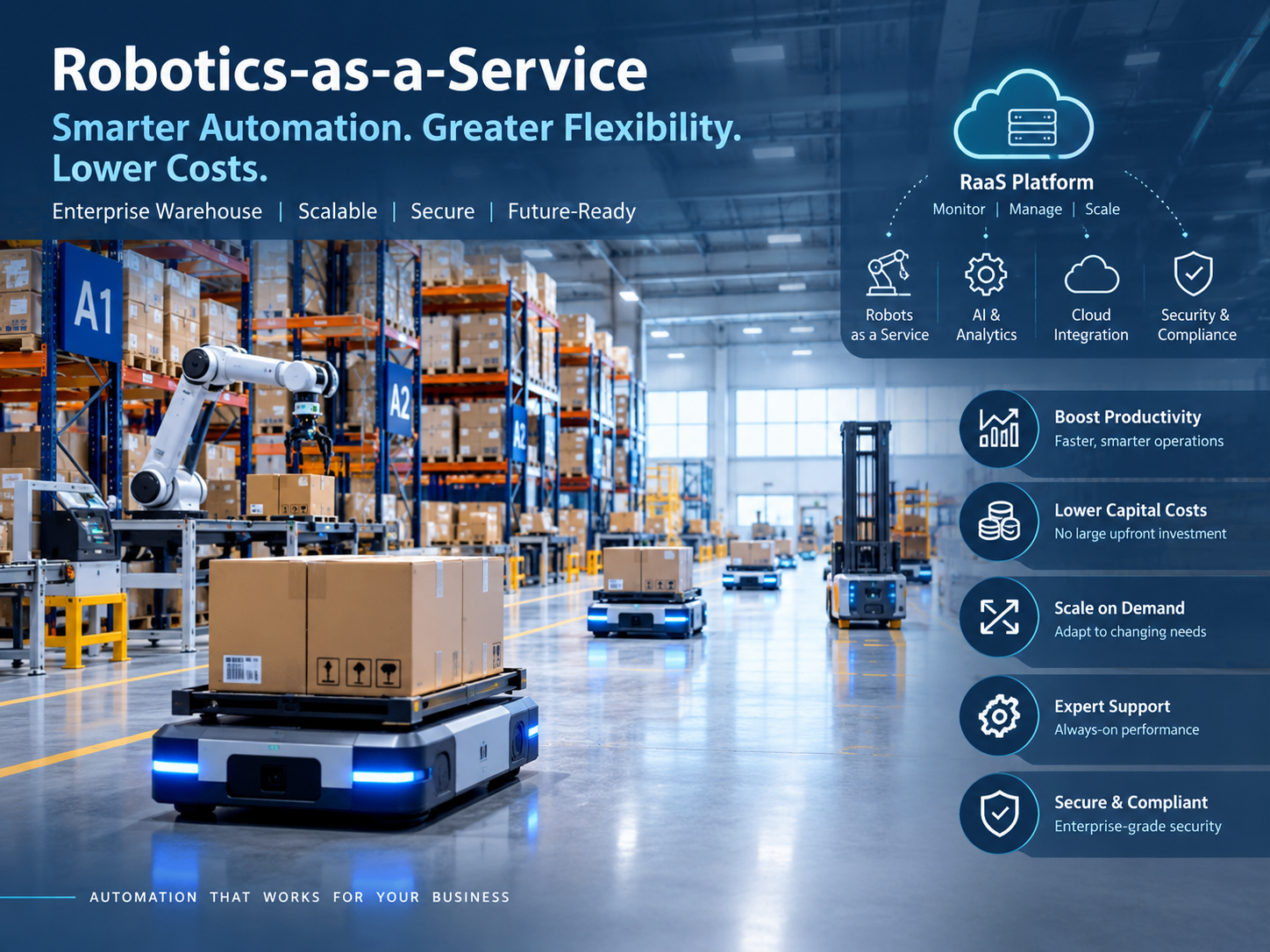
Robotics as a Service: Where It Wins and Fails
Enterprise automation is no longer just about buying robots and putting them to work. For companies dealing with labor shortages, unpredictable demand and pressure to improve productivity, the bigger challenge is choosing an automation model that makes financial sense.
Robotics as a Service (RaaS) allows businesses to deploy robotic systems through recurring service agreements rather than purchasing equipment outright. The model works best when flexible capacity, managed maintenance and lower initial investment offer greater value than long-term ownership.
For CEOs, CFOs and operations leaders, the decision comes down to a practical question: will the robots deliver enough measurable operational value to justify their total cost?
The International Federation of Robotics (IFR) reported approximately 542,000 industrial robot installations worldwide in 2024, reflecting continued investment in industrial automation.
Yet growing adoption doesn’t mean every enterprise should subscribe to robots. Utilization, integration costs, service agreements and equipment lifespan can all change the financial equation.
What Is Enterprise Robotics as a Service?
Enterprise Robotics as a Service is a business model that gives companies access to robotic equipment and related services through recurring payments rather than direct ownership.
Depending on the provider and contract, the service may include hardware, software, maintenance, fleet monitoring, technical support and performance commitments.
This approach allows businesses to focus on what automation accomplishes rather than managing every aspect of robot ownership.
How the Robotics as a Service Business Model Works
A typical RaaS agreement may include.
Robotic equipment and deployment support
Fleet management and monitoring software
Preventive maintenance and remote diagnostics
Technical assistance and equipment servicing
Performance reporting and service-level commitments
Providers may charge fixed monthly subscriptions, usage-based fees or payments tied to measurable outputs.
Unlike conventional equipment rental, RaaS often includes ongoing operational support. However, the exact responsibilities vary considerably between providers.
For companies exploring physical AI and enterprise automation, this model shifts the discussion from purchasing technology to achieving measurable business results.
RaaS vs Buying or Leasing Industrial Robots
|
Factor |
RaaS |
Buying |
Leasing |
|---|---|---|---|
| Upfront investment | Usually lower | Usually highest | Moderate |
| Ownership | Typically provider | Enterprise | Depends on terms |
| Maintenance | Often included | Usually enterprise-managed | Contract-dependent |
| Flexibility | Depends on agreement | Greater asset control | Contract-dependent |
| Long-term cost | Recurring fees | Potentially lower | Depends on financing |
RaaS prioritizes access, flexibility and managed services. Buying gives enterprises greater control over the equipment and may offer better economics when robots operate consistently over many years.
Leasing sits somewhere between the two, although its benefits depend on the financing and maintenance arrangements.
When Does Robotics as a Service Make Financial Sense?
Robotics as a Service makes financial sense when its productivity benefits, flexibility and avoided ownership expenses justify the recurring fees and deployment costs.
The strongest business case usually appears when demand changes frequently, capital budgets are constrained or maintaining robotic equipment internally would be expensive.
Robotics as a Service Pricing: OpEx vs CapEx
RaaS pricing can involve several components, including subscription fees, installation charges, software access, minimum usage commitments and additional support services.
Lower initial expenditure is attractive, particularly for enterprises looking to preserve cash for other investments.
However, CFOs should avoid assuming that every RaaS subscription automatically qualifies as an operating expense.
Some contracts may contain leases that require recognition of assets and liabilities under applicable accounting standards.
Before signing, finance teams should assess the actual contractual structure, accounting treatment, tax implications and financing alternatives.
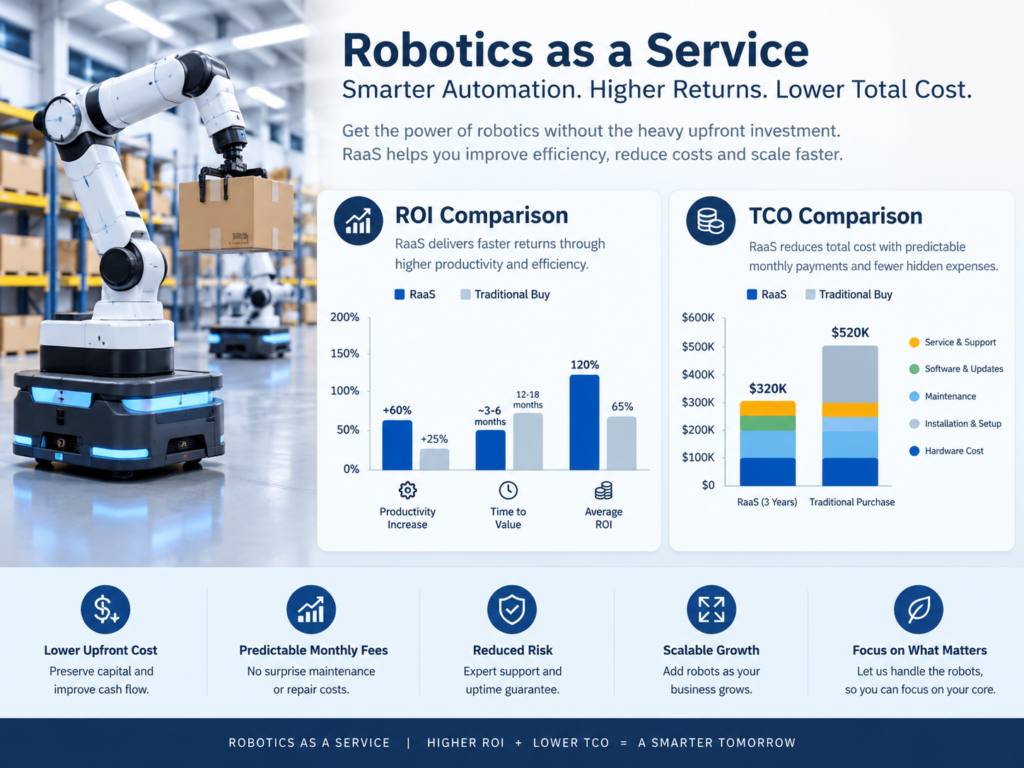
Calculating Robotics as a Service ROI and TCO
A reliable financial comparison starts with total cost of ownership (TCO) over the same period.
RaaS TCO = Subscription fees + deployment costs + integration expenses + additional operating and exit costs
Ownership TCO = Equipment purchase + integration + maintenance + operating costs − residual asset value
Return on investment (ROI) should then account for the measurable benefits generated by automation.
For clarity, net financial benefits should represent the quantified operating benefits before deducting the costs included in the denominator.
Hypothetical Three-Year Cost Comparison
Consider an enterprise comparing subscription-based robotics with purchasing its own equipment.
|
Cost component |
RaaS | Ownership |
|---|---|---|
| Equipment purchase |
$0 |
$420,000 |
| Onboarding and integration |
$30,000 |
$50,000 |
| Annual service or maintenance |
$180,000 |
$45,000 |
| Three-year total |
$570,000 |
$605,000 |
ILLUSTRATIVE THREE-YEAR COST DIFFERENCE
$35,000
Approximately 5.8% lower modeled costs with RaaS.
Hypothetical figures, not actual vendor quotations.
Illustrative figures only. Excludes residual asset value, financing, taxes, productivity differences, energy consumption and downtime.
The example highlights potential cost savings, not guaranteed ROI. A different utilization rate, contract structure or equipment lifespan could reverse the result.
Enterprises can use business intelligence and operational analytics to compare actual operating costs, productivity gains and service expenses.
Break-Even Points and Utilization Thresholds
Utilization often determines which commercial model performs better.
RaaS can be attractive when robots are needed intermittently, demand fluctuates seasonally or expansion requires flexible capacity.
Purchasing becomes more compelling when equipment performs predictable, high-volume work across multiple shifts over an extended period.
Instead of comparing monthly fees alone, calculate the cost per completed task at different utilization levels.
Include subscription minimums, overtime charges, maintenance, downtime and realistic production volumes.
Best Enterprise Robotics as a Service Use Cases
The most suitable RaaS applications usually involve repetitive activities, measurable outputs and manageable integration requirements.
Warehousing, manufacturing, cleaning and internal material transport are particularly relevant.
According to IFR’s World Robotics 2024 Service Robots report, more than 205,000 professional service robots were sold worldwide in 2023.
Warehouse Robotics as a Service for 3PL and Fulfilment
Warehouse robotics can automate or support picking assistance, goods movement and inventory transportation.
Autonomous mobile robots (AMRs) are particularly useful for moving materials between warehouse locations without requiring extensive fixed conveyor infrastructure.
For example, a distribution center in Dallas–Fort Worth may need additional robotic capacity during holiday demand without purchasing equipment sized for its busiest weeks.
A Manchester fulfilment operator could face similar requirements, although the actual flexibility depends on vendor inventory, deployment timelines and contract terms.
IFR reported nearly 113,000 transportation and logistics service robots sold globally in 2023.
The important commercial benefit is not simply adding robots. It is matching automation capacity to operating demand.
Industrial Robotics as a Service in Manufacturing
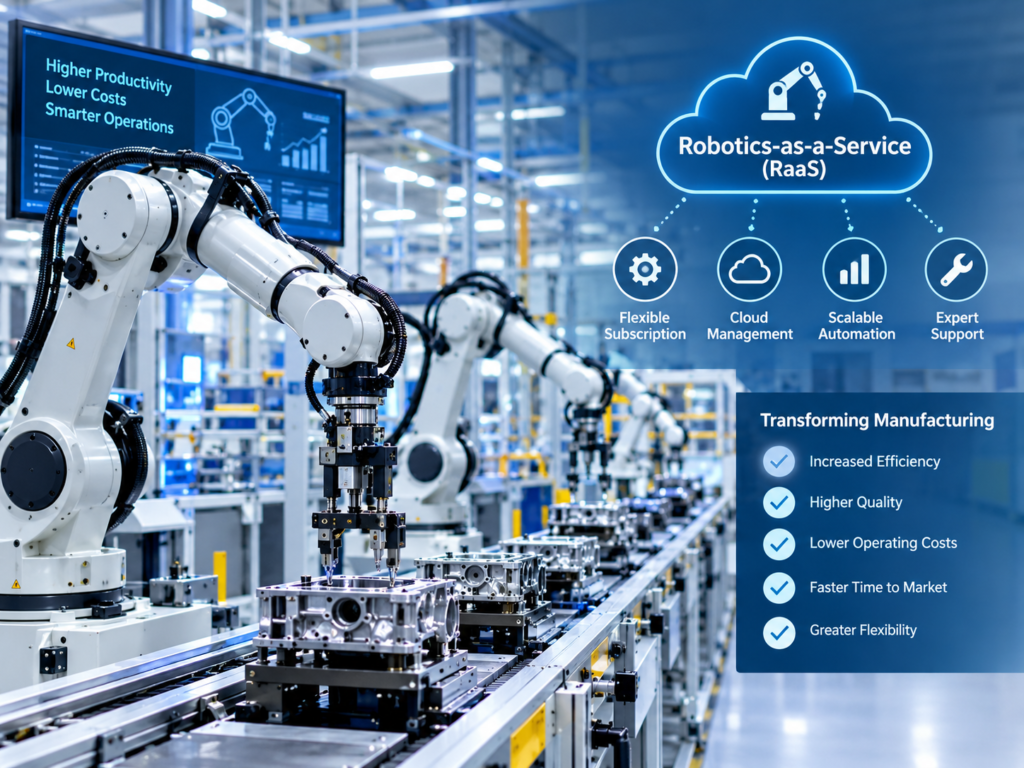
Manufacturing businesses can apply RaaS to palletizing, machine tending and repetitive assembly tasks.
Factories in Detroit or Stuttgart may consider subscription-based industrial automation when production requirements are relatively predictable but future order volumes remain uncertain.
Robotics deployment still requires careful integration with sensors, manufacturing execution systems and production controls.
Where custom integrations are necessary, software development services can support the data-processing and application layers surrounding robotic operations.
Cleaning, Material Handling and Multi-Site Robotics
Commercial cleaning robots and internal transport systems are suitable candidates because their work can often be standardized and measured.
Multi-site operators may benefit from centralized monitoring, consistent performance reporting and shared fleet management practices.
However, service coverage is critical.
A provider offering attractive subscription pricing may deliver poor operational value if replacement parts or qualified technicians are unavailable near the deployment site.
When Robotics as a Service Is the Wrong Choice
RaaS is not necessarily the most economical option for every business.
High equipment utilization, extensive customization and expensive exit provisions can make ownership more attractive.
High Utilization and Long-Term Ownership Advantages
Consider a factory expecting its robots to operate continuously for eight years.
If the equipment remains reliable and productive, the business may recover its original investment well before the end of the robots’ useful life.
Once that investment has been recovered, continuing subscription payments could become more expensive than maintaining owned equipment.
The conclusion depends on actual maintenance costs, remaining useful life, operating performance and the risk of technological obsolescence.
Customization, Vendor Lock-In and Hidden Costs
Some RaaS arrangements create dependencies that become expensive to reverse.
Common concerns include proprietary fleet software, restricted integration interfaces, early termination penalties and minimum fleet commitments.
Highly customized systems can increase switching costs because replacement equipment may require new software integration and operational testing.
Before committing, enterprises should negotiate clear provisions covering data access, migration assistance and contract termination.
These concerns also connect with broader technology vendor concentration risks.
Enterprise RaaS Deployment, Security and Compliance
Successful robotics deployment involves more than equipment delivery.
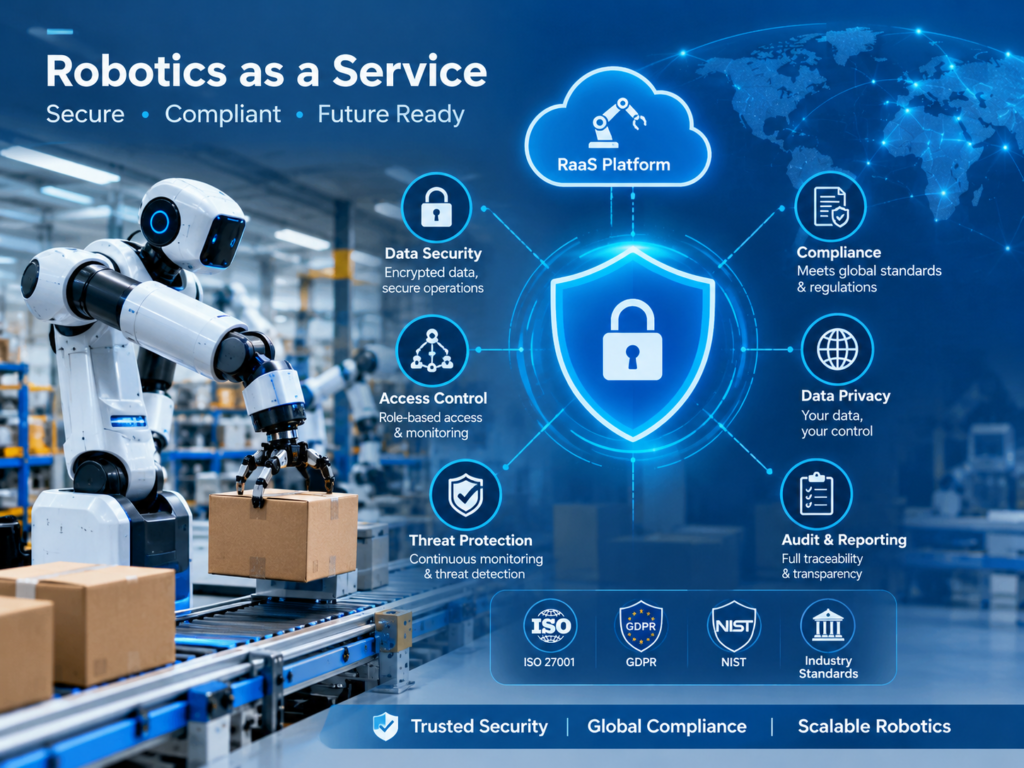
Enterprise-system compatibility, workplace safety, cybersecurity and clearly assigned responsibilities all affect the long-term viability of a RaaS agreement.
WMS, ERP and Robot Fleet Integration
Enterprise robots rarely operate independently of existing technology infrastructure.
Relevant systems may include warehouse management systems (WMS), enterprise resource planning (ERP) software, SAP EWM, manufacturing execution systems (MES) and programmable logic controllers (PLCs).
Integration planning should address authenticated interfaces, network segmentation, monitoring, data exchange and operational recovery procedures.
Related capabilities such as enterprise application development and unified data architecture can support connectivity and reporting across these environments.
RaaS Safety and Data Compliance Across the USA, UK and EU
Regulatory responsibilities differ by jurisdiction and application.
United States
Enterprises should review relevant OSHA requirements, including machine guarding and lockout/tagout obligations.
OSHA confirms that no OSHA standards are dedicated exclusively to the robotics industry. Nevertheless, broader workplace safety requirements remain applicable.
Relevant technical references may include ANSI/A3 R15.06 and ISO 10218, depending on the robotic application and applicable editions.
Organizations should evaluate Health and Safety Executive (HSE) guidance, applicable machinery safety obligations, UK GDPR and the Data Protection Act 2018 when personal information is processed.
Germany and European Union
Enterprises should consider GDPR, Germany’s Federal Data Protection Act (BDSG) where relevant, CE conformity and applicable machinery requirements.
The EU AI Act may also apply to systems that fall within its scope.
The EU Machinery Regulation (EU) 2023/1230 generally becomes applicable on 20 January 2027, with certain provisions applying earlier. Machinery placed on the EU market before that date generally remains subject to Directive 2006/42/EC.
Depending on the deployment, companies may also need to assess ISO 3691-4 for driverless industrial trucks and IEC 62443 for industrial cybersecurity.
These references provide a starting point, not a substitute for application-specific legal and safety assessments.
Uptime Guarantees, Maintenance and Service-Level Agreements
A service-level agreement (SLA) should define more than a promised uptime percentage.
Procurement teams need clear answers about how availability is measured, which outages are excluded and what happens when equipment stops operating.
The agreement should specify maintenance response times, spare-parts availability, recovery procedures and escalation responsibilities.
It should also address safety incidents, equipment damage, data breaches, service credits and termination rights.
Without enforceable remedies, an uptime guarantee may offer limited practical protection.
How to Choose Enterprise Robotics as a Service Providers
A suitable RaaS provider should demonstrate operational compatibility, transparent pricing, reliable maintenance coverage and measurable performance.
Potential providers to investigate include Locus Robotics, Formic, Element Logic and specialized German robotics suppliers.
These are research starting points, not a ranking or endorsement.
When comparing vendors, assess deployment experience, financial stability, geographical coverage, integration capabilities and contract transparency.
German procurement teams may also encounter terminology such as Roboter mieten, Mietmodell, Industrieroboter and Wirtschaftlichkeit.
RaaS Pilot Programs and the Enterprise Decision Checklist
Before entering a long-term agreement, run a controlled pilot using realistic operating conditions.
Establish a baseline. Record existing throughput, labor requirements and operating costs.
Define success metrics. Agree on target utilization, uptime and cost per completed task.
Test system integration. Validate communication with WMS, ERP and robot fleet management platforms.
Evaluate operational readiness. Review safety, cybersecurity, maintenance responsiveness and support quality.
Apply decision criteria. Compare measured results against predetermined go/no-go thresholds.
A pilot should reveal whether automation performs reliably under normal workloads rather than ideal demonstrations.
Operational performance dashboards can help teams monitor these indicators and support investment decisions with consistent evidence.
Concluding Remarks
Robotics as a Service can be an effective automation strategy when flexibility, managed maintenance and reduced initial investment are worth more than the potential cost advantages of ownership. Mak It Sol
For enterprises with stable, high-volume workloads, purchasing robots may deliver better long-term economics.
The right decision depends on measurable performance, realistic cost assumptions and contractual terms that support business objectives.
Mak It Solutions can help enterprises evaluate the software integration, data architecture and analytics requirements surrounding automation investments.
Contact Mak It Solutions to discuss your enterprise automation evaluation requirements.
Key Takeaways
RaaS can reduce upfront capital requirements, but it does not guarantee lower lifetime costs.
A three- to five-year TCO comparison should include productivity, utilization, downtime and integration expenses.
Warehousing, repetitive manufacturing and commercial cleaning are promising applications.
Enterprise integration, cybersecurity and regulatory compliance remain essential.
Vendor lock-in, maintenance responsibilities and contractual exit costs deserve careful scrutiny.
A measurable pilot provides stronger decision evidence than vendor projections alone.
FAQs
Q : What is the typical minimum contract length for enterprise RaaS?
A : Contract duration varies by provider, equipment and implementation complexity.
Some arrangements span multiple years, especially when substantial hardware or deployment investment is involved. Shorter pilot agreements may also be available.
Enterprises should negotiate renewal provisions, early termination rights and capacity adjustments before committing.
Q : Can enterprises scale robot subscriptions during seasonal demand?
A : Yes. Some providers allow businesses to increase or reduce robotic capacity as demand changes.
However, flexibility depends on equipment availability, deployment lead times, minimum commitments and contract conditions.
Seasonal businesses should confirm adjustment windows and related charges in advance.
Q : Who owns the operational data generated by RaaS robots?
A : Data ownership and usage rights depend on contractual terms.
Agreements should distinguish productivity records, equipment telemetry, employee-related information and proprietary software data.
Businesses should define access, retention, portability and deletion responsibilities. GDPR or UK GDPR obligations may apply where personal data is processed.
Q : What happens if a RaaS provider fails to meet uptime guarantees?
A : The available remedies depend on the service-level agreement.
Options may include maintenance escalation, service credits, replacement equipment or termination rights after repeated failures.
Enterprises should verify how uptime is calculated and whether liability limitations affect compensation for operational losses.
Q : Can Robotics as a Service be deployed across multiple European countries?
A : Yes, provided the vendor has suitable deployment capabilities and local support coverage.
Multinational implementations may require country-specific assessments covering workplace safety, employment consultation, taxation, insurance and data protection.
In Germany, works council involvement may also require consideration. Enterprises should confirm consistent service commitments and spare-parts coverage across all sites.