


Can Robots Be Hacked? Essential Security Guide
Can Robots Be Hacked? Essential Security Guide
Can Robots Be Hacked? Essential Security Guide
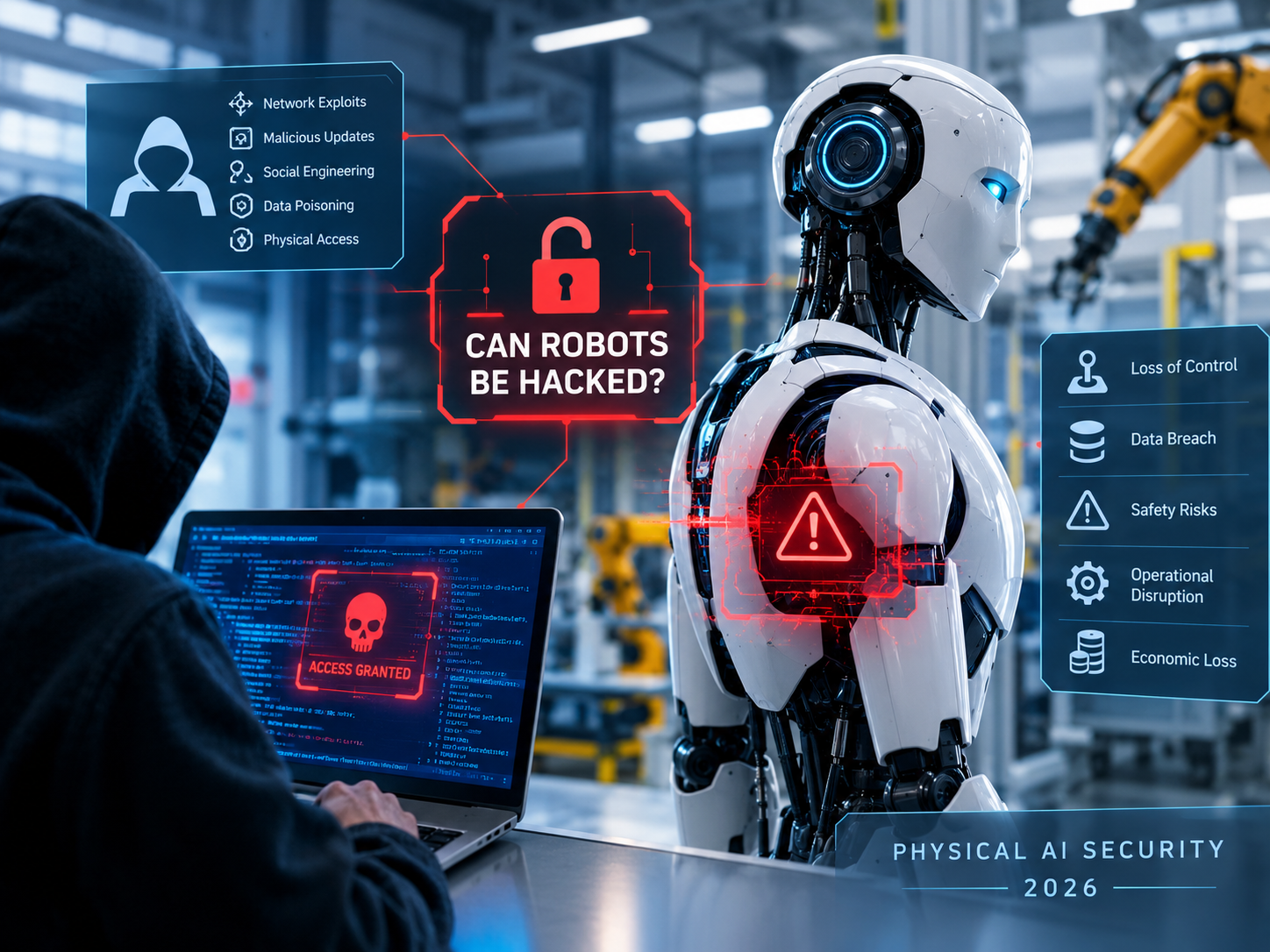
Can robots be hacked? Yes. Modern robots rely on software, connected networks, sensors, firmware, and increasingly sophisticated AI systems. Vulnerabilities in these components can allow attackers to access sensitive information, interrupt operations, or manipulate robotic behavior.
Unlike traditional cybersecurity incidents, a compromised robot may create risks beyond stolen data. An industrial robotic arm could behave unpredictably, an autonomous warehouse robot might lose navigation reliability, or a connected humanoid robot could expose confidential camera feeds.
The scale of adoption makes these concerns increasingly relevant. According to the International Federation of Robotics, approximately 542,000 industrial robots were installed worldwide in 2024.
For businesses in the USA, UK, Germany, and wider European Union, physical AI security is becoming an important part of operational resilience.
The key is understanding which threats are technically possible, which vulnerabilities researchers have demonstrated, and which risks require immediate business attention.
What Is Physical AI Security, and Can Robots Be Hacked?
Physical AI security focuses on protecting intelligent machines that interact with the real world.
These systems combine digital decision-making with physical movement. That connection creates security challenges that conventional IT protections alone may not fully address.
How Physical AI Connects Software, Sensors, and Movement
Physical AI, also known as embodied AI in certain applications, allows machines to interpret their surroundings and act on that information.
A typical AI-powered robot may include cameras, LiDAR sensors, onboard processors, wireless communication, control software, and mechanical actuators.
The AI interprets incoming information, while control systems convert decisions into actions.
These technologies support industrial robotic arms, autonomous mobile robots (AMRs), warehouse automation, and humanoid machines.
For a closer look at how visual intelligence supports industrial systems, explore our guide to computer vision for industrial quality control.
Can Hackers Remotely Control AI-Powered Robots?
Some connected robots can be remotely compromised, but not every robot is accessible over the internet.
An attacker generally needs a reachable communication pathway, a security weakness, and sufficient privileges to issue unauthorized commands.
Potential entry points include exposed management interfaces, compromised fleet-management software, and poorly secured remote-access services.
Strong authentication, encrypted communications, network segmentation, and independent safety controls can substantially reduce these risks.
How Do Hackers Attack Robots? Common Security Vulnerabilities
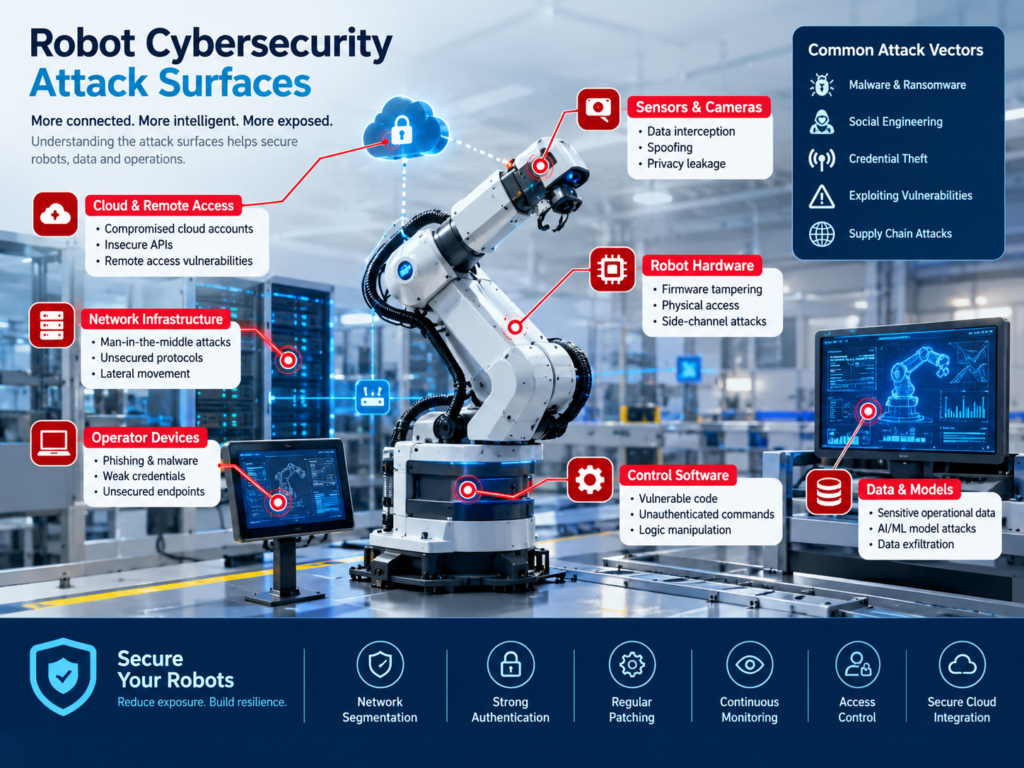
Robot hacking rarely depends on a single weakness. Attackers may exploit problems in software configuration, communication protocols, firmware, or external systems connected to robotic equipment.
Understanding these attack surfaces helps manufacturers identify where protection is most important.
ROS 2, Network, Firmware, and Supply Chain Vulnerabilities
Robot Operating System 2 (ROS 2) provides software infrastructure for many robotics applications.
Although ROS 2 supports security mechanisms, including DDS Security, protection depends on proper configuration and deployment.
Common areas of concern include.
Insecure ROS 2 and DDS configurations: Insufficient authentication or access controls may expose robot communications.
Exposed APIs: Poorly protected management interfaces can provide unauthorized access.
Weak credentials: Default passwords and excessive administrator privileges increase exposure.
Insecure firmware: Unsigned or inadequately verified updates may introduce malicious code.
Third-party dependencies: Vulnerable software libraries can create supply-chain risks.
Organizations integrating robotics with Python development and backend systems should build security into software development, testing, and ongoing maintenance.
Sensor Spoofing, AI Prompt Injection, and Model Manipulation
AI-powered robots make decisions using information collected from their surroundings.
If that information is manipulated, the robot may interpret its environment incorrectly.
For example, sensor spoofing can interfere with distance measurements or positioning information. Manipulated visual inputs may affect object recognition.
Robots using Vision-Language-Action (VLA) models may face additional risks when untrusted text or images influence their planning systems.
Prompt injection is a particular concern where an AI model processes potentially malicious instructions from external content.
However, these attacks depend on the model, operating environment, system permissions, and safeguards. They do not establish that every AI-powered robot can be manipulated.
What Happens When a Robot Is Hacked?
The consequences depend on the vulnerability and the level of access an attacker gains.
Possible outcomes include unauthorized access to camera feeds or operational data, service interruptions, altered configuration settings, and unexpected robotic behavior.
In more serious circumstances, compromised movement commands could create physical hazards.
This is why robot cybersecurity must work alongside safety engineering rather than replacing it.
Real Robot Hacking Examples and Emerging Threats
Documented vulnerabilities show that robotic systems can contain exploitable security weaknesses.
However, there is an important distinction between a published vulnerability, a controlled research demonstration, and a confirmed malicious attack against operational equipment.
Ghost Robotics Vision 60.
In October 2025, researchers disclosed CVE-2025-41110, an improper-authentication vulnerability affecting Ghost Robotics Vision 60 version 0.27.2.
The disclosure identified encrypted Wi-Fi and SSH credentials inside an Android application package.
According to the official advisory, these weaknesses could allow unauthorized access to robot data and potentially enable control of the affected system under the stated attack conditions.
The vulnerability received a CVSS 4.0 score of 7.0 (High)
This is a documented security issue, but the advisory itself does not establish widespread malicious exploitation.
Unitree Humanoid Robot Hacking Research
In September 2025, researchers disclosed a Bluetooth Low Energy (BLE) provisioning vulnerability affecting several Unitree robotic platforms.
The affected models included the G1 and H1 humanoids and certain quadruped robots.
Researchers demonstrated how weaknesses in wireless configuration and authentication could enable privileged access under relevant conditions.
The research also raised concerns about compromise spreading between vulnerable robots within wireless range.
These findings highlight the importance of securing provisioning interfaces, particularly in environments where multiple robots operate together.
For manufacturers evaluating automated systems, warehouse robotics ROI planning should account for security, software maintenance, and operational downtime alongside productivity gains.
Why Robot Cybersecurity Matters for Safety and Business
A security incident involving a robot can affect more than the machine itself.
Production availability, intellectual property, employee safety, and business continuity may all be at risk.
Physical AI Safety vs. Cybersecurity
Cybersecurity and physical safety are closely connected, but they address different problems.
|
Cybersecurity |
Physical safety |
|---|---|
| Prevents unauthorized access | Reduces hazardous physical behavior |
| Protects data and communications | Protects people and equipment |
| Detects malicious activity | Detects or limits unsafe operating conditions |
| Uses authentication, encryption, and monitoring | Uses emergency stops, protective devices, and safety controls |
For example, an independently designed emergency-stop system may help limit physical harm even when application software is compromised.
However, that emergency stop will not prevent an attacker from stealing sensitive information.
Businesses need both forms of protection.
Manufacturing, Healthcare, and Humanoid Robot Risks
Different industries face different levels and types of exposure.
In Detroit, cybersecurity weaknesses affecting automotive production robots could interrupt assembly operations.
In London, connected healthcare robotics may require additional attention to patient information, access controls, and clinical safety.
Manufacturers in Stuttgart and Munich must consider cybersecurity across interconnected Industrie 4.0 systems, including industrial controllers and robotic equipment.
The financial consequences of industrial cyber incidents can be significant.
According to IBM’s 2024 Cost of a Data Breach research, the average industrial-sector data breach cost was approximately $5.56 million.
This is an industry-wide figure, not an estimate specifically for robot hacking incidents.
How to Secure AI Robots Against Cyberattacks
Protecting robots requires a layered security strategy covering access, communications, firmware, connected software, monitoring, and physical safety.
No single security feature eliminates every threat.
Zero Trust, Authentication, and Network Segmentation
Organizations should avoid assuming that devices or users are trustworthy simply because they operate inside an internal network.
A zero-trust approach verifies access based on identity, permissions, and context.
Practical measures include multifactor authentication where supported, least-privilege access, encrypted communications, and restricted remote connections.
Operational technology (OT) networks should be appropriately segmented from general business networks.
ROS 2 and DDS communications also require secure configuration.
These protections should extend to connected mobile application platforms used for robot management and monitoring.
Secure Firmware, Penetration Testing, and Continuous Monitoring
Secure boot and cryptographically signed firmware help protect against unauthorized software modifications.
Manufacturers should also evaluate supplier update procedures and request software bills of materials (SBOMs) to understand third-party dependencies.
Authorized robot penetration testing can identify weaknesses in connected services, communication interfaces, and application software.
However, testing should be conducted within defined safety boundaries to avoid damaging equipment or endangering workers.
Continuous monitoring can help detect unusual network activity, unexpected commands, or unauthorized configuration changes.
Business reporting may also benefit from business intelligence capabilities, although robotics-specific threat detection requires dedicated security tools and expertise.
Practical Robot Cybersecurity Checklist for Manufacturers
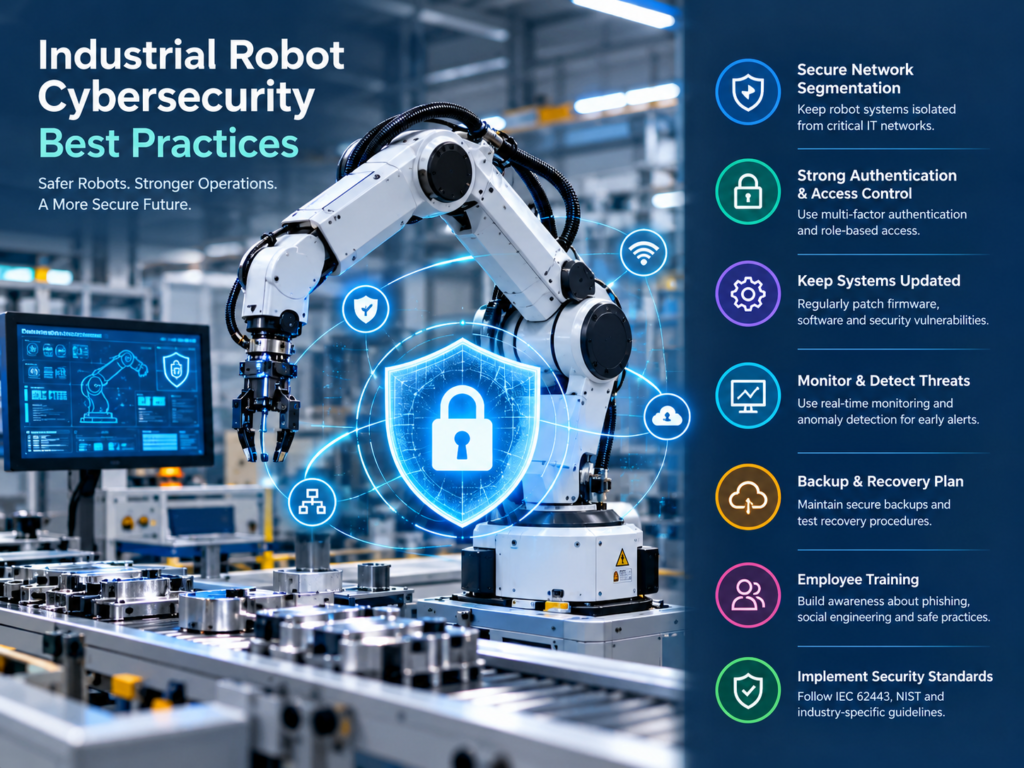
Before deployment and following major system changes, review the following controls:
Security responsibilities should be documented, with unresolved risks assigned to accountable owners.
Robot Cybersecurity Regulations in the USA, UK, and EU
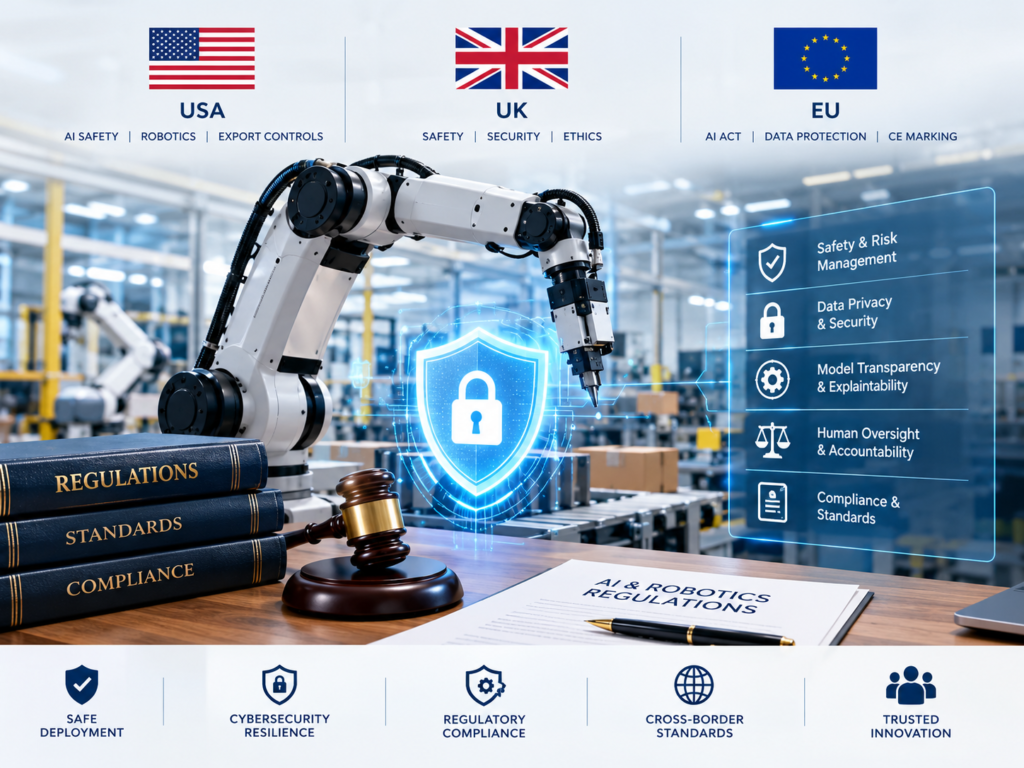
Robot cybersecurity obligations differ depending on the country, industry, product classification, and intended use.
A security framework may provide useful guidance without being legally mandatory for every deployment.
USA.
The NIST Cybersecurity Framework 2.0 helps organizations organize cybersecurity risk management.
Its core functions cover Govern, Identify, Protect, Detect, Respond, and Recover.
The NIST AI Risk Management Framework provides complementary guidance for AI-related risks.
CISA resources, applicable OSHA requirements, and IEC 62443 standards may also support industrial cybersecurity and workplace safety programs.
Organizations should evaluate which requirements apply to their operations rather than treating every framework as mandatory.
UK.
UK organizations can use National Cyber Security Centre (NCSC) guidance when securing connected devices and industrial systems.
Businesses processing personal information must also consider applicable UK GDPR obligations.
The Health and Safety Executive provides relevant workplace safety requirements, while healthcare robotics may require additional clinical, privacy, and procurement assessments.
Germany and EU.
German manufacturers should consider guidance from the Federal Office for Information Security (BSI), applicable NIS2 requirements, GDPR (DSGVO), and relevant machinery legislation.
The EU Cyber Resilience Act (CRA) introduces cybersecurity obligations for covered products with digital elements.
Its reporting obligations began on September 11, 2026, while its main product requirements are scheduled to apply from December 11, 2027.
The amended EU AI Act follows a phased implementation schedule.
Specified high-risk AI requirements apply from December 2, 2027, for certain systems classified under Annex III, and August 2, 2028, for certain systems associated with products covered by Annex I.
Not every robot qualifies automatically as a high-risk AI system.
Manufacturers and operators should assess the relevant product category, intended purpose, deployment environment, and legal responsibilities.
Regulatory information is provided for general awareness and should not replace deployment-specific legal or compliance advice.
How Should Organizations Assess Physical AI Security?
A meaningful physical AI security assessment considers technical vulnerabilities, supplier reliability, operational dependencies, and physical safety together.
Evaluate Attack Surfaces, Vendors, and Safety Controls
Begin by identifying the robots, software components, communication pathways, and external services involved in the deployment.
Examine privileged interfaces, firmware update mechanisms, supplier patch commitments, and third-party dependencies.
Threat modeling should address both conventional data compromise and situations where digital manipulation could affect physical movement.
Safety controls need separate validation rather than relying entirely on software-based cybersecurity testing.
When Is a Professional Robot Security Assessment Needed?
Specialist assessment is particularly valuable before connecting robots to production networks, enabling remote administration, or deploying safety-critical applications.
Significant firmware updates, new integrations, disclosed supplier vulnerabilities, and unexplained behavior may also justify reassessment.
Qualified robotics and OT security professionals should define safe testing conditions and provide a prioritized remediation plan.
To Sum Up
Understanding whether robots can be hacked is only the starting point. The larger challenge is building connected systems that remain secure as technologies, suppliers, and operating requirements change. Mak It Sol
Explore Mak It Solutions’ technology services for software development and integration support.
To discuss your connected technology requirements, contact Mak It Solutions and request a scoped consultation.
Where specialized robot penetration testing or safety certification is required, involve appropriately qualified robotics and OT security professionals.
Key Takeaways
Yes, robots can be hacked when attackers exploit weaknesses in connected software, communication interfaces, firmware, or other components.
But successful compromise is not inevitable, and not every robot has the same exposure.
The most important lessons are straightforward:
Security risks extend beyond data loss to operational disruption and potential physical hazards.
Documented Ghost Robotics and Unitree vulnerabilities demonstrate realistic attack surfaces.
Network segmentation, strong authentication, signed updates, and monitoring reduce risk.
Cybersecurity protections must be supported by independent safety engineering.
Applicable US, UK, and EU compliance obligations depend on the specific product and deployment.
For organizations investing in robotics, cybersecurity should be part of procurement, development, integration, and long-term maintenance not something added after deployment.
FAQs
Q : Can a robot be hacked without an internet connection?
A : Yes. Robots without internet access may still be vulnerable through local wireless connections, physical maintenance ports, removable storage, or infected engineering laptops.
Operating offline reduces some attack paths but does not eliminate cybersecurity risks.
Q : Are offline industrial robots safer than cloud-connected robots?
A : Offline robots generally have fewer externally accessible attack paths.
However, maintenance equipment, removable media, and vulnerable software can still create security weaknesses. Cloud-connected robots require additional protections for remote access, APIs, communications, and monitoring.
Q : Do all robots using ROS 2 have security vulnerabilities?
A : No. ROS 2 supports security mechanisms, including authentication, encryption, and access controls through DDS Security.
The security of an individual robot depends on configuration, software dependencies, firmware, credentials, and network architecture.
Q : Should manufacturers require an SBOM from robot suppliers?
A : Requesting a software bill of materials is a useful supplier security practice.
An SBOM helps organizations identify software components and investigate known vulnerabilities. It should complement secure update procedures, vendor assessments, and vulnerability disclosure policies.
Q : How often should industrial robots receive cybersecurity assessments?
A : Industrial robots should be assessed before deployment, following significant changes, and periodically according to operational risk.
Additional reviews may be necessary after major firmware updates, supplier vulnerability disclosures, suspicious activity, or changes to network connectivity.
There is no universal assessment interval suitable for every robotic system.