


IT/OT Convergence for Physical AI: Essential Guide
IT/OT Convergence for Physical AI: Essential Guide
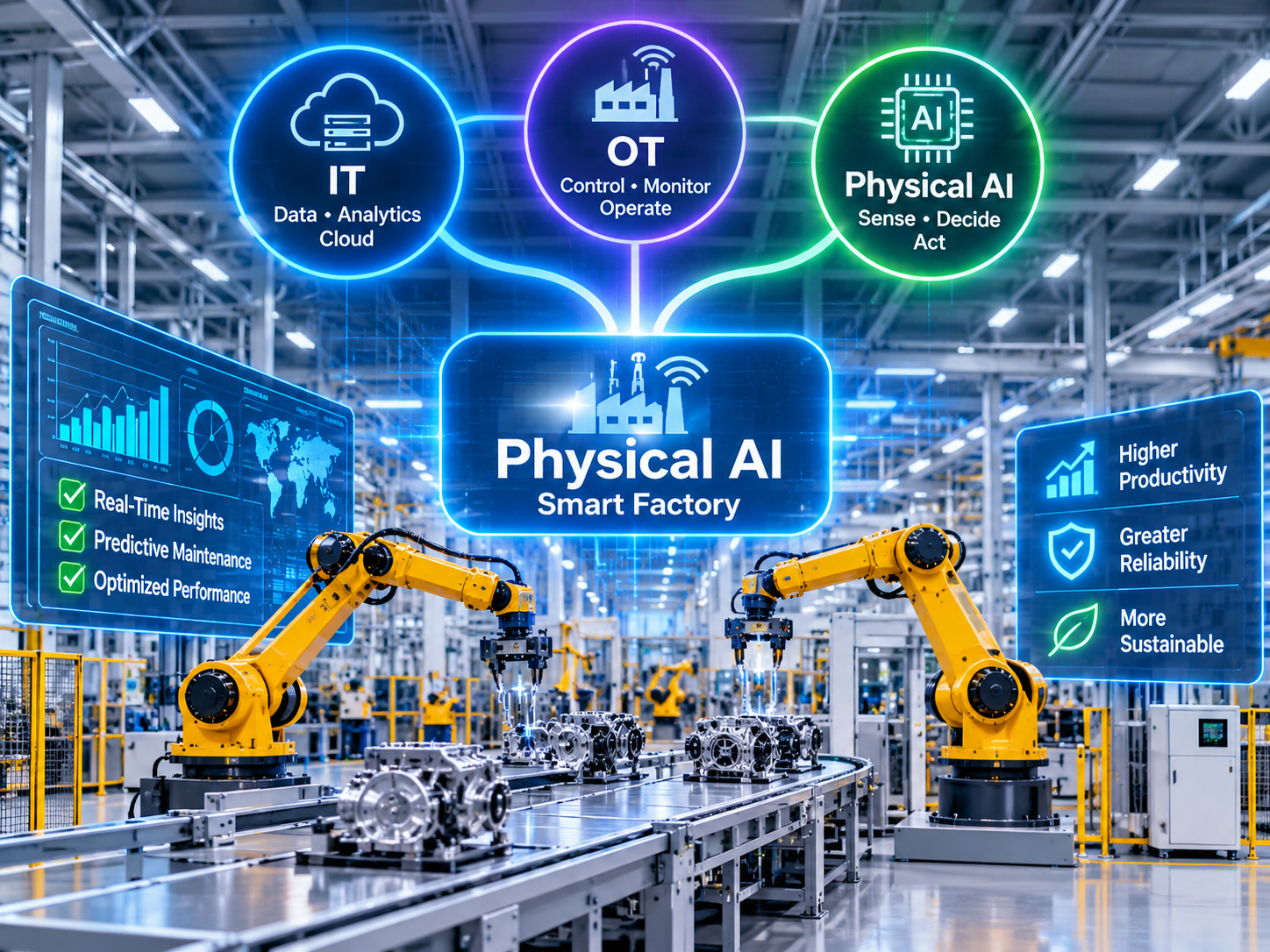
IT/OT Convergence for Physical AI: Essential Guide
Factories are becoming more intelligent, but connecting robots, sensors, enterprise software, and AI systems is not as straightforward as installing new technology.
IT/OT convergence bridges the gap between information technology (IT) and operational technology (OT), enabling industrial equipment and enterprise systems to exchange data securely. In the Physical AI era, this integration gives intelligent machines the operational context they need to support real-world decisions while respecting established safety controls.
For manufacturers in the USA, UK, Germany, and across Europe, the priority is not simply connecting more equipment. It is building reliable industrial infrastructure that supports automation, protects production environments, and delivers measurable business value.
What Is IT/OT Convergence in the Physical AI Era?
IT/OT convergence integrates enterprise information systems with technologies that monitor and control industrial equipment.
Traditionally, these environments operated separately. IT teams managed business applications and information security, while OT teams focused on machinery, production continuity, and physical safety.
Physical AI makes closer coordination increasingly valuable. Intelligent applications need access to accurate operational data, but they must interact with industrial processes through approved interfaces and safeguards.
IT vs. OT.
Although IT and OT share some technologies, their operational priorities differ.
|
IT systems |
OT systems |
|---|---|
| ERP, databases, cloud platforms | PLCs, SCADA, sensors, machinery |
| Manage business data and workflows | Monitor and control physical processes |
| Prioritize data security and business continuity | Prioritize safety, availability, and reliability |
| Often support flexible updates | Usually require controlled maintenance windows |
Manufacturing execution systems (MES) often connect production activities with enterprise planning.
For example, equipment status collected from a production line can feed maintenance dashboards, production schedules, and business analytics.
The objective is coordinated information sharing, not unrestricted communication between industrial and enterprise networks.
How IT/OT Integration Connects Industrial Workflows
Imagine a manufacturing facility where a machine begins showing signs of unusual vibration.
Sensors capture the change, an industrial gateway transfers the relevant information, and an analytics application identifies a potential maintenance issue.
The maintenance team receives an alert before the condition develops into a more serious failure.
With suitable controls, that information can also inform production scheduling and spare-parts planning.
This is where IT/OT integration becomes commercially useful: operational information reaches the people and applications that can act on it.
Why Physical AI Makes IT/OT Convergence Essential
Physical AI extends industrial automation beyond predefined instructions.
It enables intelligent systems to interpret physical conditions, evaluate available responses, and, where authorized, initiate actions.
These capabilities depend on reliable data, appropriate computing infrastructure, and predictable industrial controls.
From Connected Factories to Intelligent Industrial Systems
Traditional smart factories focus on monitoring equipment, collecting data, and generating operational alerts.
Physical AI adds capabilities such as environmental perception, adaptive robotics, machine vision, and AI-assisted decision-making.
Consider an automated inspection system that detects recurring defects.
Instead of merely recording the issue, an AI application could identify possible causes and recommend changes to the production process.
However, any equipment adjustment must remain subject to validated control logic, safety limits, and appropriate authorization.
Industrial robotics adoption provides useful context.
According to the International Federation of Robotics (IFR), manufacturers installed 541,302 industrial robots worldwide in 2023, followed by approximately 542,000 in 2024. These figures reflect broader industrial automation activity rather than Physical AI deployment specifically.
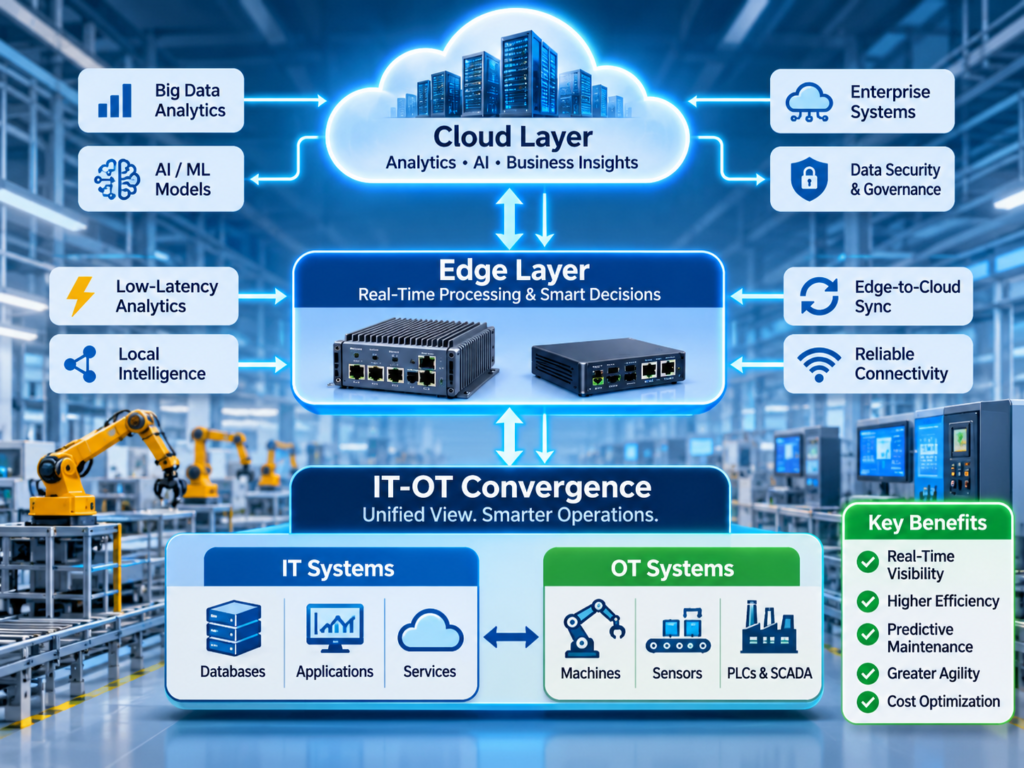
Physical AI Applications: Robotics, Digital Twins, and Edge AI
Several technologies benefit from reliable IT/OT integration.
Autonomous mobile robots (AMRs): Navigate facilities and transport materials using environmental information.
Machine vision: Detect defects, inspect products, and support quality-control decisions.
Predictive maintenance: Analyze operating conditions to identify potential equipment problems.
Industrial digital twins: Model equipment behavior and test operational scenarios.
Edge AI: Processes selected information close to machinery, reducing dependence on remote computing.
A digital twin for robotics can help engineering teams simulate operating conditions before making changes to physical equipment.
None of these technologies automatically delivers better performance. Their effectiveness depends on data quality, integration reliability, and suitable operating procedures.
IT/OT Convergence Architecture for Smart Factories
A reliable architecture connects industrial equipment, secure communication services, edge computing, enterprise applications, and AI systems.
The architecture should make operational data accessible without exposing critical controllers to unnecessary risks.
Edge-to-Cloud Integration, OPC UA, and MQTT
A practical IT/OT convergence architecture can be organized into five layers.
|
Layer |
Main components | Purpose |
|---|---|---|
| Industrial assets |
PLCs, sensors, SCADA, machinery |
Monitor and control physical operations |
| Secure connectivity |
OPC UA, MQTT, industrial gateways |
Exchange operational data through controlled channels |
| Edge intelligence |
Edge gateways, local analytics, AI inference |
Process data close to equipment |
| Enterprise and cloud |
ERP, MES, databases, cloud platforms |
Support planning, reporting, and analytics |
| AI applications |
Robotics, machine vision, digital twins |
Generate insights and support authorized decisions |
Cybersecurity, data governance, and functional safety must be considered across every layer.
OPC UA supports structured industrial communication and interoperability. MQTT provides lightweight publish-subscribe messaging for suitable data-exchange applications.
These technologies serve different purposes and should be selected according to operational requirements.
For US manufacturers managing multiple production facilities, edge-to-cloud integration can support centralized analytics while keeping time-sensitive processing within the factory.
Custom back-end integration services can help connect enterprise applications and build governed data pipelines.
Keeping AI Decisions Separate From Safety-Critical Controls
AI systems should not bypass established industrial safety mechanisms.
A reliable design distinguishes between AI recommendations, supervisory decisions, and deterministic machine control.
For example, an AI application might recommend changing a production parameter. The request should pass through approved interfaces, permission checks, and validated equipment controls before implementation.
Safety interlocks, emergency-stop systems, and other protective measures must remain effective regardless of AI behavior.
Manufacturers exploring local inference can also review the practical considerations of edge AI for industrial robots.
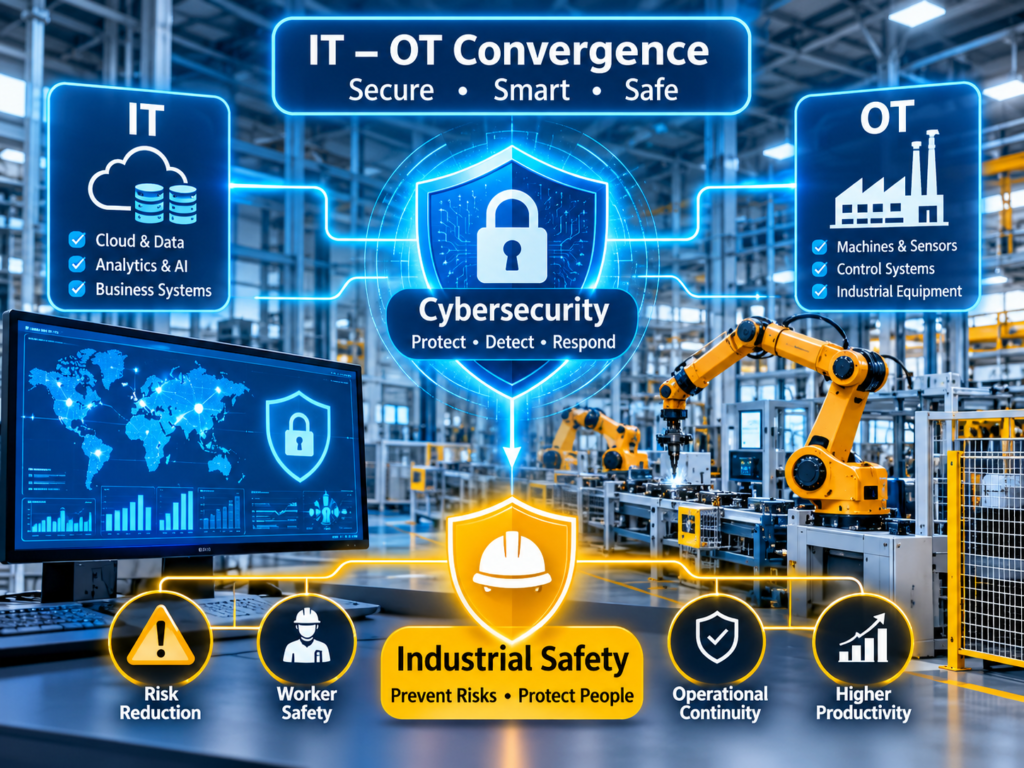
IT/OT Convergence Cybersecurity and Functional Safety
Connecting enterprise applications with industrial machinery increases the importance of cybersecurity.
A compromised business application must not become an easy route into production controls.
For Physical AI systems, the consequences can extend beyond data loss to equipment disruption, unsafe operating conditions, and interrupted production.
OT Network Segmentation, Zero Trust, and IEC 62443
A secure integration strategy begins with visibility into industrial assets, network connections, and access permissions.
Important safeguards include.
Network segmentation: Separate industrial control environments from general enterprise traffic.
Industrial demilitarized zones: Control information exchange between IT and OT networks.
Identity and access management: Restrict access according to operational responsibilities.
Asset inventories: Maintain accurate records of controllers, gateways, software, and connected equipment.
Continuous monitoring: Identify unusual communication patterns and unauthorized activity.
Controlled remote access: Protect maintenance connections and third-party support channels.
Zero Trust principles can strengthen access control, but implementation must account for legacy controllers and operational availability.
The ISA/IEC 62443 standards provide a framework for industrial cybersecurity.
Similarly, NIST SP 800-82 Revision 3, published in September 2023, addresses OT cybersecurity while considering reliability, performance, and safety requirements.
Cybersecurity and Functional Safety Are Not the Same
Cybersecurity protects systems against threats such as unauthorized access, malicious manipulation, and disruption.
Functional safety focuses on preventing unacceptable hazards arising from equipment or control-system failures.
A secure AI-enabled factory needs both.
Appropriate safeguards may include independent safety controls, documented risk assessments, model monitoring, change-management procedures, and equipment validation.
Importantly, compliance with IEC 62443 does not automatically establish that an AI-controlled machine is functionally safe.
Cybersecurity and functional-safety assessments require complementary but distinct engineering processes.
IT/OT Convergence in the USA, UK, Germany, and EU
The technical foundations of convergence are broadly similar across manufacturing regions. Regulatory obligations, however, depend on jurisdiction, industry, and the technologies being deployed.
US and UK Manufacturing.
In Detroit, an automotive manufacturer might use shared analytics to monitor equipment reliability across several factories.
The engineering challenge is ensuring that enterprise connectivity does not interfere with plant-level controls.
US organizations can reference NIST guidance alongside industry-specific cybersecurity requirements.
In Birmingham, a UK manufacturer may face a different challenge: integrating legacy PLCs and SCADA platforms without interrupting production.
The UK National Cyber Security Centre provides OT security guidance relevant to asset visibility, connectivity, and operational risk.
Organizations should also determine whether applicable UK Network and Information Systems requirements affect their operations.
German Industry 4.0 and European Regulations
Germany’s Industry 4.0 approach emphasizes interconnected manufacturing, industrial interoperability, and digital production processes.
A Stuttgart automotive plant, for example, could integrate robotic production equipment with quality analytics and enterprise planning through a governed data architecture.
German and wider EU manufacturers should assess applicable requirements under GDPR, NIS2, the EU AI Act, and the Cyber Resilience Act.
As of November 2026, the EU AI Act has phased implementation dates. Relevant transparency obligations began applying in August 2026, while certain high-risk AI requirements have later application dates.
Under the Cyber Resilience Act, reporting obligations for specified vulnerabilities and severe incidents began on 11 September 2026, while the main product requirements are scheduled to apply from 11 December 2027.
Regulatory applicability depends on the product, operator, sector, and legal classification of the system.
Manufacturers should confirm their obligations with appropriately qualified legal and technical specialists before deployment.
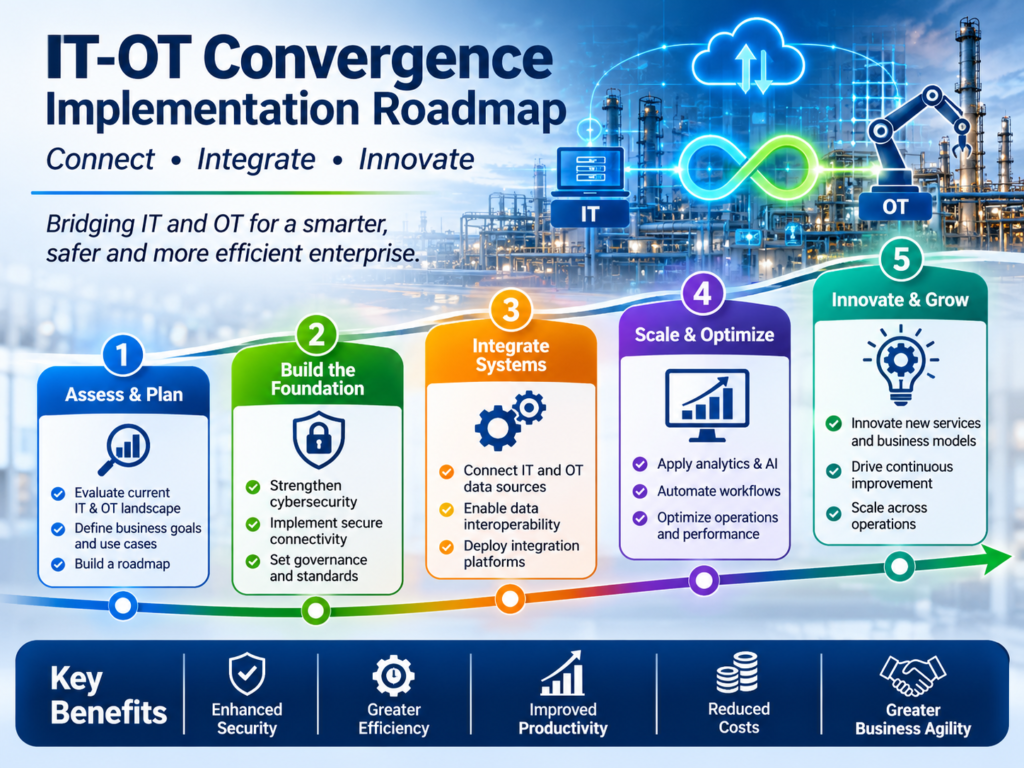
How to Implement an IT/OT Convergence Roadmap
Successful integration starts with understanding the factory’s existing environment.
Connecting equipment before documenting operational dependencies can create unnecessary complexity and introduce risks that become expensive to correct.
A phased IT/OT convergence roadmap makes those risks easier to identify and manage.
Assess IT/OT Maturity and Operational Readiness
Start by documenting existing machinery, software platforms, network connections, and operational priorities.
Identify systems that cannot tolerate interruptions, equipment that depends on older protocols, and areas where data quality is inconsistent.
The assessment should also clarify responsibility across IT, cybersecurity, engineering, and plant operations.
A business intelligence platform can help consolidate operational information and establish baseline performance measures.
Five Steps to Secure Industrial Integration
Discover assets and assess risks. Inventory industrial machinery, network connections, legacy dependencies, and safety-critical systems.
Define the integration architecture. Choose suitable communication protocols, gateways, data models, and access-control policies.
Implement cybersecurity safeguards. Establish network segmentation, identity controls, monitoring, and independent safety boundaries where required.
Validate a focused pilot. Test a specific application, such as predictive maintenance or machine vision, against agreed operational and safety criteria.
Review results before scaling. Expand only after confirming reliability, cybersecurity performance, operational acceptance, and measurable business value.
A pilot should answer practical questions.
Does the integration deliver sufficiently accurate data? Can it operate reliably during network interruptions? Are maintenance teams comfortable supporting it?
Most importantly, does it solve a meaningful production problem?
These answers provide a stronger basis for investment than an ambitious deployment plan without validated outcomes.
IT/OT Convergence Benefits, ROI, and Vendor Selection
IT/OT convergence creates business value when connected information leads to measurable operational improvements.
Better visibility alone is not enough. Manufacturers need evidence that integration improves reliability, productivity, quality, or decision-making.
Measuring Industrial ROI and Operational Performance
Common performance indicators include.
Overall equipment effectiveness (OEE)
Unplanned downtime
Mean time to repair (MTTR)
Production throughput
Scrap and defect rates
Maintenance expenditure
Operational availability
According to IFR’s World Robotics 2025 reporting, approximately 4.66 million industrial robots were operating worldwide in 2024.
This installed base highlights the scale of industrial automation, but it does not establish the financial return from a specific convergence project.
For meaningful results, manufacturers should compare performance against a documented baseline.
Investment costs should account for integration, infrastructure, cybersecurity, training, operational disruption, maintenance, and ongoing support.
Choosing an IT/OT Integration Partner
A suitable integration partner should understand both enterprise technology and the constraints of industrial environments.
Evaluate potential providers based on.
Compatibility with existing industrial protocols and equipment
Experience integrating MES, ERP, and enterprise applications
Industrial cybersecurity knowledge
Ability to support legacy infrastructure
Long-term maintenance and technical support
Understanding of relevant regional regulations
Avoid unnecessary dependence on proprietary technologies when interoperable alternatives meet operational requirements.
For application modernization, Mak It Solutions offers custom development services and business intelligence solutions.
Safety-critical industrial control work should involve appropriately qualified OT engineers and functional-safety specialists.
The strongest implementation strategy combines practical integration experience, clear technical ownership, and independently validated outcomes.
Concluding Remarks
IT/OT convergence is becoming an important foundation for intelligent manufacturing.
Robotics, machine vision, digital twins, and edge AI can help industrial teams make better decisions, but they need reliable information and secure connections to existing operations.
The most effective strategy is not to automate everything at once.
Start with operational visibility, establish cybersecurity and safety boundaries, validate a practical use case, and expand when results justify further investment.
Ready to assess your IT/OT convergence strategy?
Mak It Solutions can support enterprise integration, data pipelines, Python-based AI applications, and analytics requirements as part of a broader industrial modernization initiative.
Working alongside qualified OT and safety specialists, manufacturers can identify technical priorities before making major deployment decisions.
Contact Mak It Solutions to discuss a scoped consultation.
Key Takeaways
IT/OT convergence connects enterprise information systems and industrial operations through controlled data exchange.
Physical AI benefits from accurate operational data, edge intelligence, and authorized equipment interactions.
Industrial cybersecurity and functional safety must be addressed separately but coordinated effectively.
Regulatory requirements differ across the USA, UK, Germany, and the wider EU.
Asset discovery and focused pilots reduce uncertainty before wider deployment.
Financial returns should be measured against validated performance improvements and lifecycle costs.
FAQs
Q : Can legacy PLC and SCADA systems support Physical AI?
A : Yes. Many legacy PLC and SCADA systems can exchange information with modern AI applications through compatible gateways, protocol adapters, and secure interfaces.
Actual compatibility depends on equipment capabilities, available communication protocols, and data quality. Read-only integration is often a sensible starting point.
Q : Does industrial edge AI eliminate the need for cloud computing?
A : No. Edge AI supports local processing for time-sensitive operations, while cloud platforms can handle centralized analytics, model training, and enterprise reporting.
A hybrid architecture allows manufacturers to keep critical processing close to equipment while using cloud resources where appropriate.
Q : How much does an IT/OT convergence assessment cost?
A : There is no universal assessment price.
Costs depend on facility size, equipment complexity, cybersecurity requirements, existing documentation, and the scope of technical evaluation.
Manufacturers should request itemized proposals that clearly identify deliverables, assumptions, specialist activities, and recommendations.
Q : Who should own IT/OT convergence?
A : IT/OT convergence requires shared accountability.
The CIO typically oversees enterprise integration, the CISO leads cybersecurity governance, and plant operations and engineering teams manage production reliability and equipment safety.
A cross-functional governance group can coordinate priorities while preserving clear decision-making authority.
Q : What should manufacturers prepare before engaging an integration consultant?
A : Manufacturers should gather equipment inventories, network diagrams, PLC and SCADA information, enterprise application details, cybersecurity policies, and baseline performance indicators.
Clearly defined operational problems are equally valuable.
These materials help consultants establish a realistic scope, identify integration risks, and recommend a pilot with measurable acceptance criteria.