
AI Audit Trail Guide for GCC Businesses in 2026
AI Audit Trail Guide for GCC Businesses in 2026
AI Audit Trail Guide for GCC Businesses in 2026
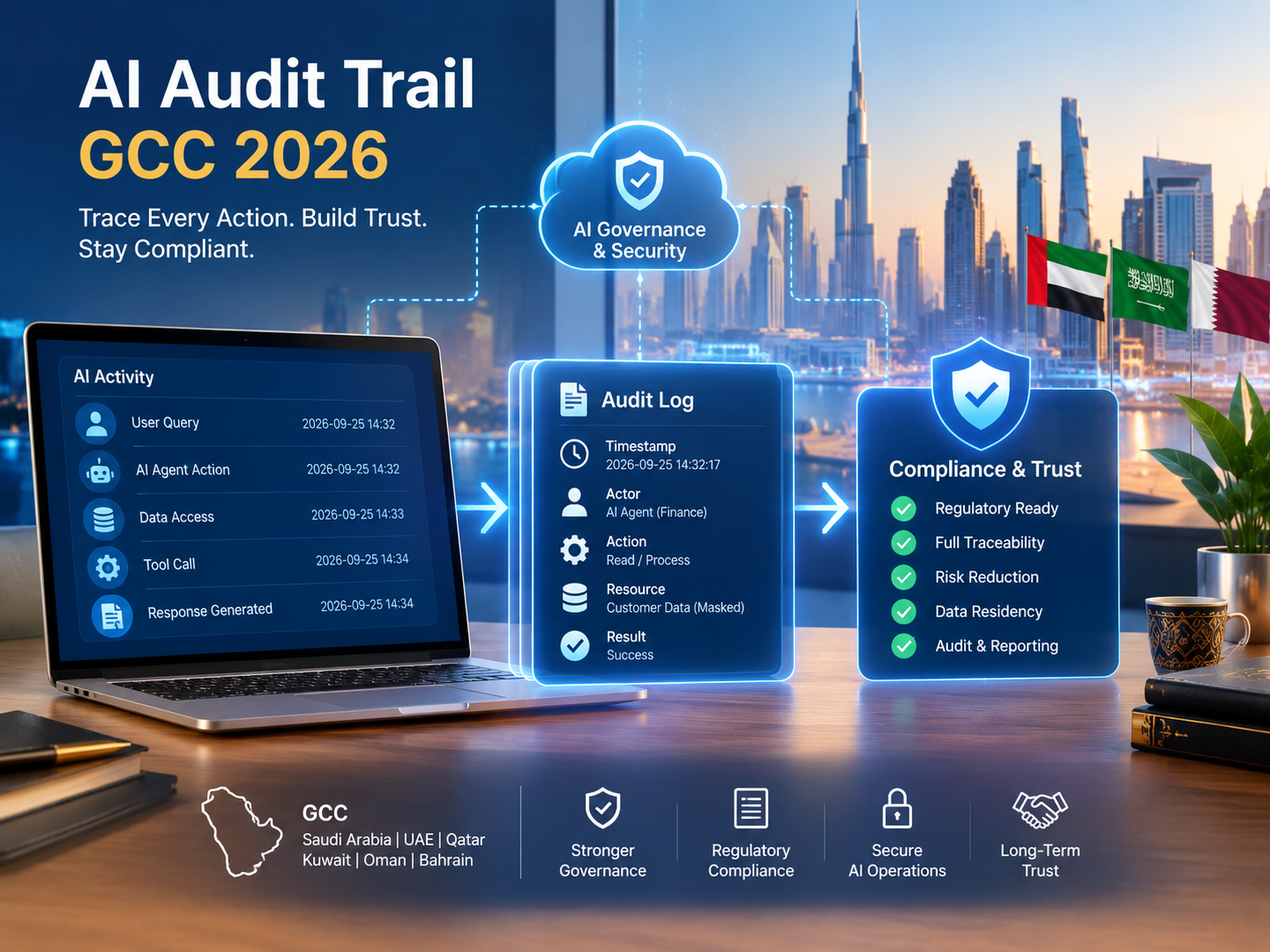
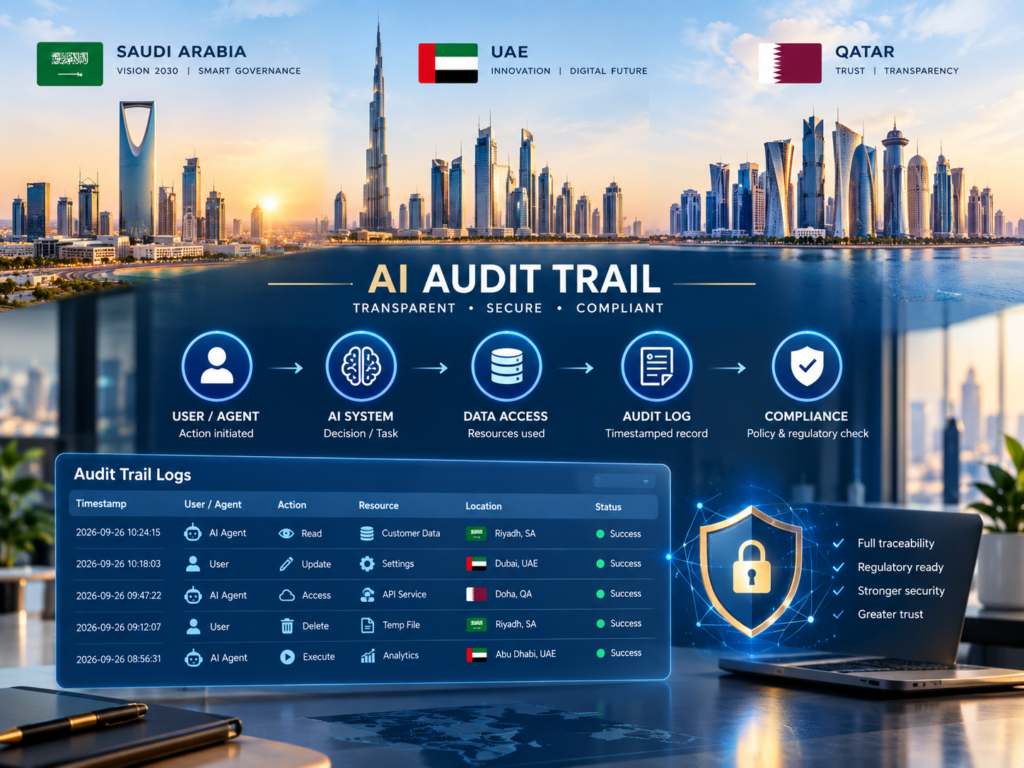
An AI audit trail records who initiated an AI action, which model ran, what data it accessed, what it produced or executed, which controls applied, and whether a human approved the result. For businesses in Saudi Arabia, the UAE, and Qatar, that traceability can support AI accountability, incident investigation, security reviews, and regulatory evidence.
As enterprise AI moves beyond chat and starts interacting with customer records, APIs, CRMs, and business workflows, ordinary application logs are no longer enough. GCC organizations need records that can reconstruct the full chain of an AI-assisted action.
Why AI Audit Trails Matter in the GCC in 2026
AI systems are increasingly capable of doing more than generating text. An enterprise AI application may retrieve customer information, query internal documents, call an API, update a CRM, or trigger a downstream workflow.
When that happens, organizations need to answer a basic question: What exactly did the AI system do?
For businesses operating in Riyadh, Dubai, Abu Dhabi, Doha, and other GCC markets, an AI audit trail provides evidence of what happened before, during, and after an AI-assisted event.
This is particularly relevant as organizations scale AI adoption while regional governance frameworks place greater emphasis on accountability, privacy, risk management, monitoring, and human oversight.
Saudi Arabia, for example, published its National AI Risk Management Framework in January 2026, covering AI risk identification, assessment, treatment, and monitoring.
What Is an AI Audit Trail?
An AI audit trail is a structured history of an AI system’s activities, inputs, identities, decisions, data access, actions, and outcomes.
It goes beyond conventional system logging. A useful audit trail should allow security, compliance, technical, and business teams to reconstruct an AI-assisted event without piecing together unrelated records from multiple systems.
AI Audit Trails vs. Standard Application Logs
Traditional application logs may record a login, system error, API response, or database event.
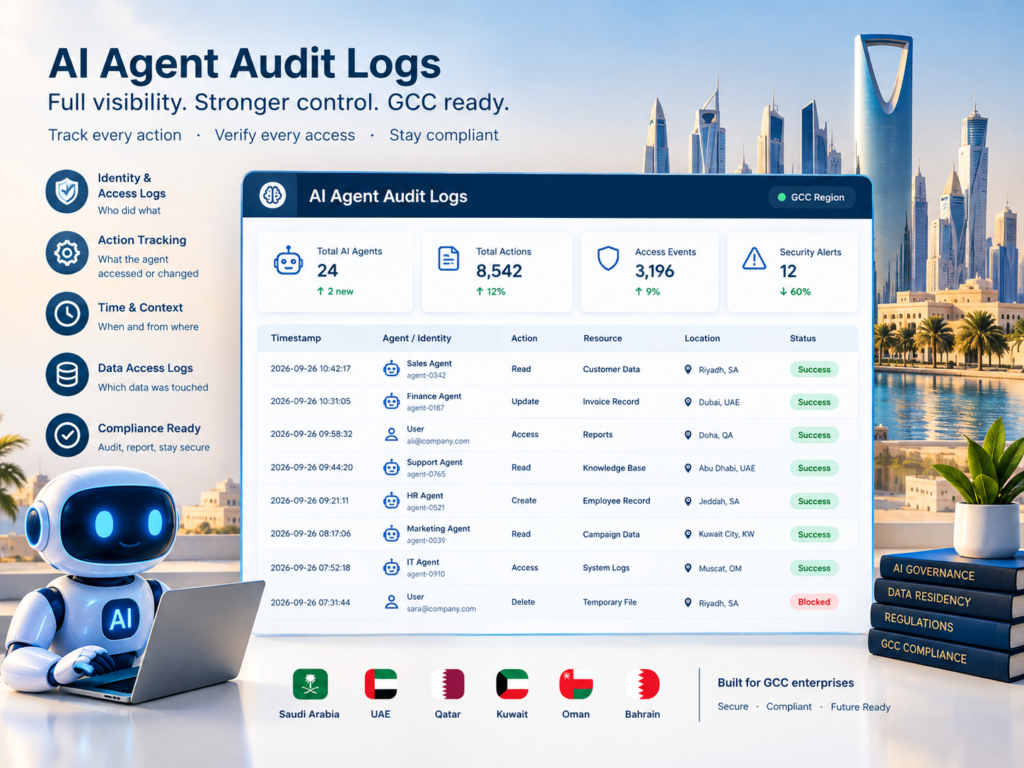
AI audit logs require additional context, such as.
User or system identity
Prompt or instruction
AI model and version
Retrieved information
Authorization state
Tool and API calls
Generated output
Human intervention
Final business outcome
The goal is not simply to prove that “AI was used.” The record should show what actually happened.
Teams designing these workflows can connect AI logging with broader API security best practices and Zero Trust controls for AI-era systems.
Why AI Traceability Matters for GCC Businesses
AI traceability helps organizations investigate incidents, demonstrate internal controls, and understand how an automated workflow reached a particular outcome.
Saudi AI guidance emphasizes lifecycle risk management and continuous oversight. Qatar’s AI guidance similarly includes accountability, human oversight, monitoring, and auditability among important responsible-AI principles.
In practice, good traceability means an organization can move from “the AI did something” to a documented sequence showing who initiated the event, what the AI accessed, what it decided or generated, and what happened next.
Which Businesses Need AI Audit Trails Most?
The need becomes stronger when AI systems can access sensitive information or execute meaningful business actions.
This is particularly relevant to organizations operating in.
Banking and fintech
Government and public services
Healthcare
Retail and e-commerce
Logistics and supply chains
Enterprise SaaS
Customer-service operations
A Riyadh fintech, for example, may need evidence showing how an AI workflow accessed customer information. A Dubai e-commerce company using AI agents may need to trace automated order or account actions.
Organizations in Doha deploying Arabic-language AI may also need to preserve multilingual context so investigators can understand the original instruction rather than relying entirely on a translated version.
10 Things Businesses Should Log in an AI Audit Trail
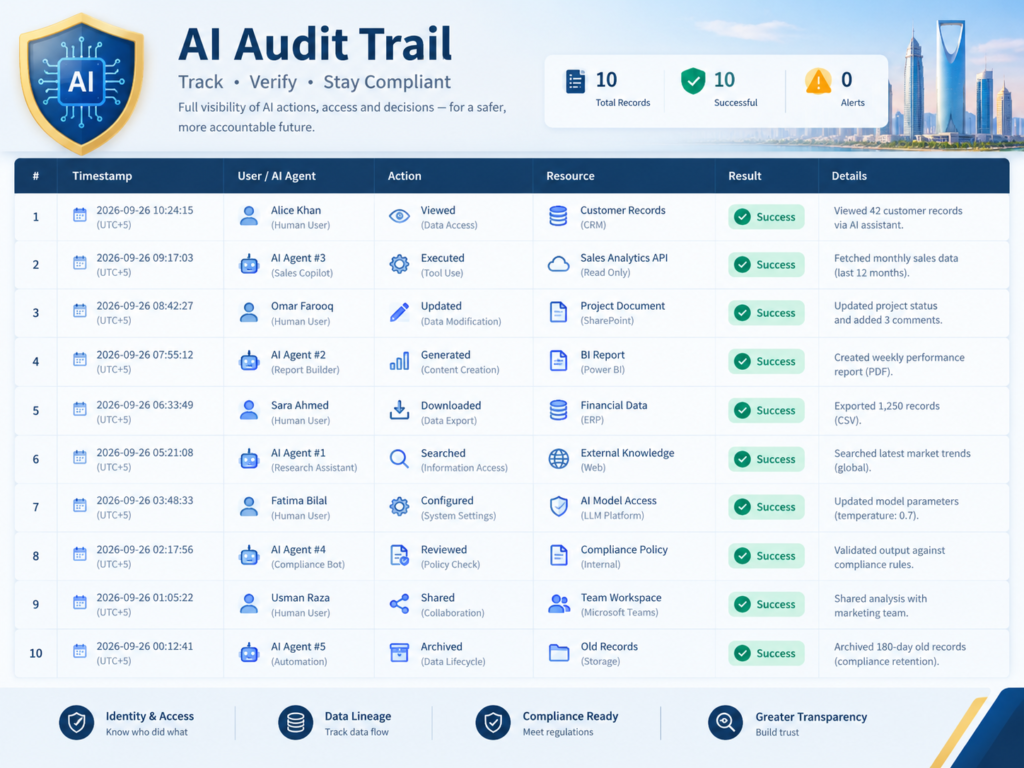
A practical AI audit trail should capture enough information to reconstruct an AI-assisted transaction from beginning to end.
The following records provide a useful foundation.
Timestamp and Event ID
Every AI event should have a reliable timestamp and unique event or transaction identifier.
This makes it possible to correlate AI activity with application, security, database, API, and infrastructure logs.
User or System Identity
Record who initiated the action.
That could be an authenticated employee, customer, service account, automated workflow, or another AI agent. Identity records should make it possible to distinguish human-initiated activity from machine-to-machine actions.
AI Model Identity and Version
Record which AI model actually processed the request, including the relevant model or deployment version where available.
Model versioning matters because AI behavior can change following model, configuration, or system updates. A useful audit record should identify what ran rather than simply state that “AI” handled the request.
Prompt, Instruction, or Relevant Input
Capture enough of the original instruction and context to understand what the AI was asked to do.
This does not necessarily mean storing every prompt in full. Sensitive information may require masking, redaction, tokenization, or another data-minimization approach.
Data Sources Accessed
Record which relevant databases, documents, CRM records, knowledge bases, or other sources the AI accessed.
Where practical, include identifiers that allow investigators to trace the information back to its source without unnecessarily duplicating sensitive data inside the audit log.
AI Output or Recommendation
Preserve the relevant output, recommendation, classification, decision support, or response produced by the model.
For high-impact workflows, it may also be useful to distinguish between raw model output and the version ultimately shown to a user or passed to another system.
API and Tool Calls
If the AI can use tools, record which API, application, plugin, function, or business system it invoked.
An AI agent might read a CRM record, retrieve an internal document, call an external service, and update a workflow during a single task. The audit trail should connect those events into one understandable chain.
Authorization and Control State
Record the relevant permissions and authorization checks applied before an action was allowed.
This helps investigators determine not only what an AI system attempted to do, but also why it was permitted or blocked.
Human Approval, Rejection, or Override
Where human review is required, preserve evidence showing who reviewed the AI recommendation and whether it was approved, rejected, edited, or overridden.
Human oversight logs help answer an important governance question: did the AI recommend an action, or did it execute the action itself?
Final Action and Outcome
Finally, record what actually happened.
Did the transaction complete? Was an account updated? Did an API call fail? Was the AI recommendation rejected? Was the workflow escalated for manual review?
The final outcome closes the audit chain.
For architecture planning, Mak It Solutions’ web development services and business intelligence services illustrate relevant development and reporting capabilities.
Why Normal Logs Are Not Enough for AI Agents
From AI Conversations to Autonomous Actions
A conventional chatbot interaction may end with generated text.
An AI agent can potentially retrieve information, select tools, invoke APIs, evaluate results, and change business systems. That creates a very different audit requirement.
AI compliance logging therefore needs to capture the action chain, not just the conversation.
Logging Tool Calls, Permissions, and Authorization
For each meaningful AI action, organizations should be able to identify.
Which tool or API was called
Which identity initiated the request
What permissions were available
Which authorization check occurred
What data was accessed
Whether the action succeeded or failed
Whether human approval was required
This information can also strengthen incident response. Mak It Solutions’ cyber incident response checklist discusses the importance of preserving logs and decision evidence when investigating security events.
Arabic and English AI Workflows in the GCC
GCC organizations frequently operate across Arabic and English.
An employee may submit a request in Arabic, an AI system may retrieve an English document, and a human reviewer may respond in either language.
Where the original language affects meaning or context, audit records should preserve the relevant original input rather than assuming a translated version is identical.
How Should AI Audit Logs Be Stored and Protected?
Creating logs is only part of the problem. The logs themselves can contain sensitive operational or personal information, so they need appropriate security controls.
Tamper Resistance, Access Controls, and Data Lineage
Organizations should restrict who can read, alter, export, or delete AI audit records.
Depending on risk and architecture, useful controls may include strong identity management, integrity protection, centralized monitoring, segregation of duties, and reliable data lineage.
Data lineage is particularly valuable because it allows investigators to connect model activity with the source information used during an AI-assisted action.
Related cloud controls are covered in Mak It Solutions‘ cloud misconfiguration security guide.
Retention Periods and Data Minimization
There is no single GCC-wide AI audit-log retention period that applies to every organization and every AI system.
Retention should reflect factors such as.
Jurisdiction
Industry and regulatory obligations
Type of information in the log
Contractual requirements
Cybersecurity and incident-response needs
Privacy requirements
Business purpose
More logging is not automatically better.
Copying sensitive prompts, personal records, or confidential documents into a permanent audit repository can create another security and privacy risk. Logs should contain enough context for accountability without unnecessarily duplicating sensitive information.
GCC Data Residency and Cross-Border Processing
Saudi, UAE, and Qatar organizations should also evaluate where their logs and underlying data are processed, which vendors can access them, and what requirements apply to cross-border transfers.
This makes cloud architecture part of AI governance rather than a separate technical concern.
GCC organizations can review cloud disaster recovery planning for Saudi, UAE and Qatar environments and GCC AI infrastructure considerations when assessing the wider architecture.
AI Audit Trail Requirements Across Saudi Arabia, UAE, and Qatar
GCC businesses should avoid treating the region as one uniform regulatory environment. AI governance, privacy, cybersecurity, and sector requirements vary by country, regulator, free zone, and business activity.
| Market | Key entities/signals | Practical audit-trail focus |
|---|---|---|
| Saudi Arabia | SDAIA, NDMO, PDPL context | Risk monitoring, accountability, data governance |
| UAE | DIFC, DFSA, ADGM/FSRA, CBUAE | Governance, oversight, documentation |
| Qatar | QCB, MCIT, NCSA | Accountability, auditability, human oversight |
Saudi Arabia.
Saudi organizations should map AI logging to the PDPL, data-governance requirements, cybersecurity controls, sector rules, and AI guidance that apply to their specific activities.
SDAIA’s 2026 AI risk framework promotes structured identification, assessment, treatment, and monitoring of AI risks.
For a Riyadh fintech, that can translate operationally into preserving evidence around model identity, customer-data access, authorization, AI actions, and human review.
UAE.
AI governance requirements in the UAE depend heavily on jurisdiction and sector.
Within DIFC, the DFSA’s 2025 survey reported that 52% of responding authorized firms were using AI, while governance and accountability mechanisms remained an area of continuing development.
DIFC also proposed Data Protection Regulation amendments in June 2026 addressing AI-native personal-data processing and accountability.
For organizations operating under DIFC/DFSA, ADGM/FSRA, CBUAE, or other UAE frameworks, the practical lesson is straightforward: logging controls should be mapped to the rules that actually apply to the business rather than copied from a generic GCC checklist.
Qatar.
Qatar’s AI guidance connects trustworthy AI with principles including accountability, privacy, human oversight, monitoring, and auditability.
A Doha enterprise should therefore design its AI documentation and logging controls around applicable QCB, MCIT, NCSA, privacy, cybersecurity, and sector obligations rather than importing another country’s framework unchanged.
How to Build an Audit-Ready AI Logging Framework
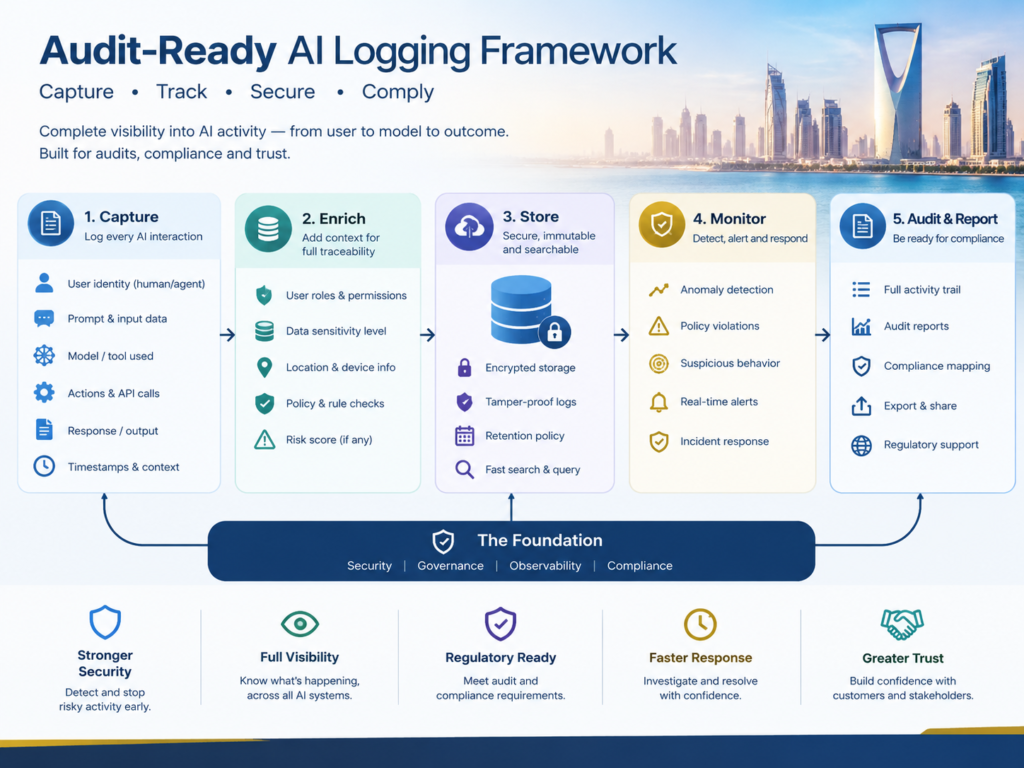
Technology alone does not make an audit trail useful. Organizations also need ownership, policies, review processes, and a way to test whether records can actually reconstruct an event.
Map AI Systems, Models, and Data Access
Start by inventorying.
AI applications
Models and model providers
Vendors
APIs and connected tools
Data sources
User identities
High-impact workflows
Identify where personal, financial, confidential, or otherwise sensitive information enters the AI chain.
Define Logging, Ownership, and Review Controls
Decide which events must be logged and who owns those records.
Define required fields, access permissions, review responsibilities, human approval points, escalation processes, and retention policies according to the risk of each AI workflow.
A customer-service assistant that only drafts responses may require different controls from an agent capable of modifying financial or customer records.
Test Whether AI Actions Can Be Reconstructed
Do not assume that collecting logs makes a system audit-ready.
Select a sample AI-assisted event and try to answer:
Who initiated it? Which model ran? What data did it access? What did it generate or execute? Which controls applied? Who approved the outcome? What ultimately happened?
If those questions cannot be answered reliably, the AI audit trail still has gaps.
Last Words
The most useful AI audit trail is not necessarily the one that collects the most data. It is the one that creates reliable evidence without introducing unnecessary privacy, security, or operational risk.
For GCC businesses, that means connecting AI activity with identity, model versions, data access, authorization, tool calls, human oversight, and final outcomes then aligning those records with the applicable rules in Saudi Arabia, the UAE, Qatar, and the relevant industry.
Building AI systems across the region? Explore Mak It Solutions services or contact Mak It Solutions to discuss an AI audit-trail assessment, secure application architecture, or a custom GCC AI governance strategy.
FAQs
Q : Do Saudi companies need AI audit logs under SDAIA governance frameworks?
A : Saudi organizations should assess AI logging against the requirements that apply to their sector, processing activities, and systems. SDAIA’s National AI Risk Management Framework promotes structured AI risk identification, assessment, treatment, and monitoring. An AI audit trail can provide practical evidence for those activities, but businesses should not treat the framework as one universal logging checklist for every Saudi organization.
Q : What should UAE fintech companies record when using AI?
A : UAE fintechs should consider recording model identity, timestamps, relevant inputs, data access, authorization, outputs, tool calls, human approvals, and final outcomes. The exact requirements depend on whether the organization operates under DIFC/DFSA, ADGM/FSRA, CBUAE, or another applicable framework.
Q : How long should GCC businesses retain AI audit logs?
A : There is no universal GCC retention period for every AI audit log. A Saudi bank, Dubai retailer, and Doha government supplier may face different legal, contractual, cybersecurity, privacy, and sector requirements. Organizations should classify logs according to their contents and purpose and then set an appropriate retention policy.
Q : What does QCB guidance mean for AI auditability in Qatar?
A : Qatar organizations should first determine which QCB requirements apply to their regulated activities and then consider the country’s wider AI, privacy, and cybersecurity environment. In practice, auditability can include reliable records of model activity, data access, permissions, human approvals, and final outcomes.
Q : Should GCC companies log prompts containing personal or sensitive data?
A : Only when justified and appropriately protected. An AI audit trail needs enough information to reconstruct important events, but duplicating every sensitive prompt or customer record into another repository can increase exposure. Data minimization, masking, redaction, restricted access, and appropriate retention should be considered according to applicable requirements.
[…] GCC Companies Need an AI Risk […]