
AI CI/CD Automation for Safer Releases
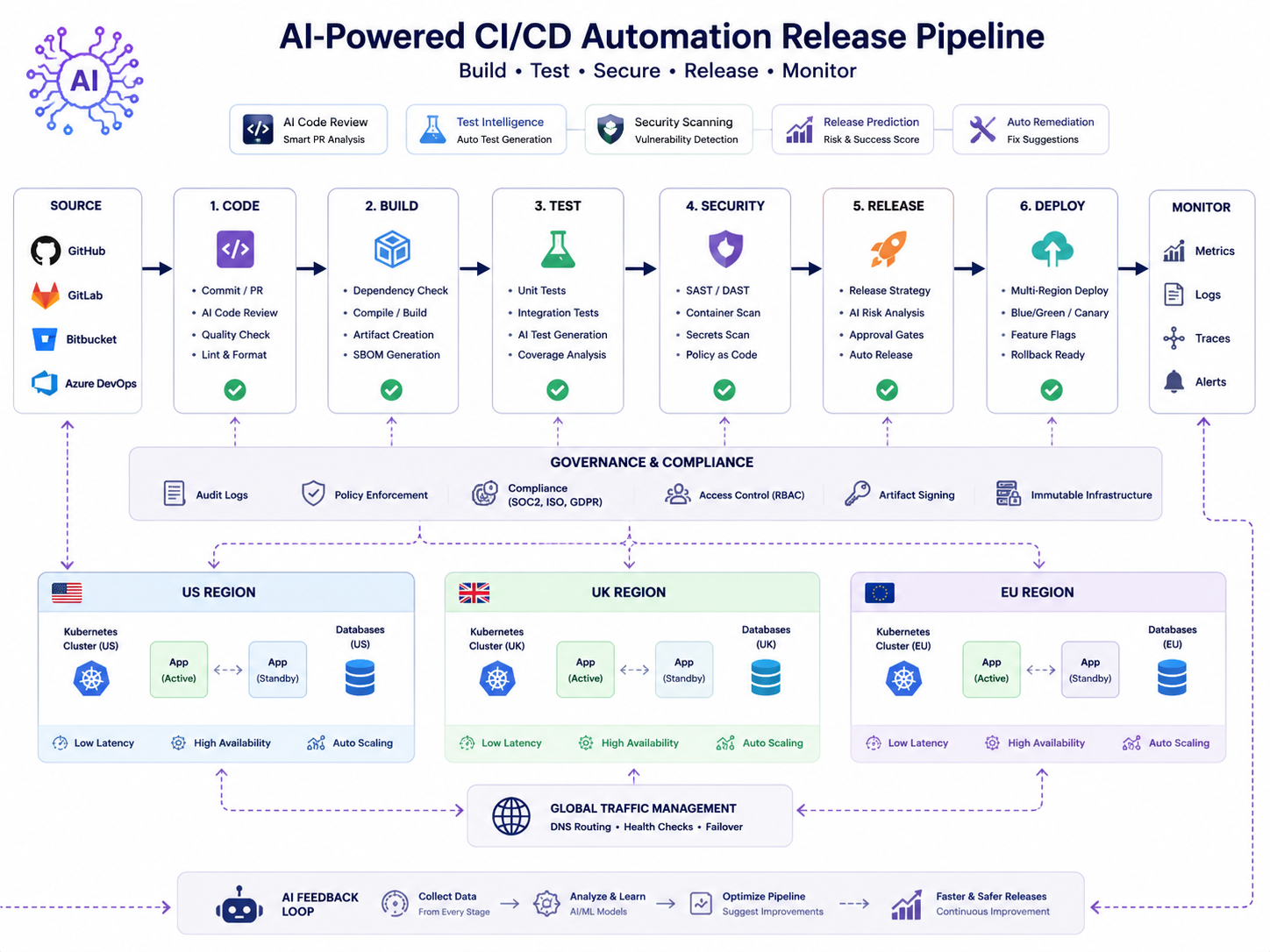
AI CI/CD automation uses artificial intelligence to improve how software teams build, test, release, document, and govern software changes. It helps DevOps, platform, QA, and release teams reduce manual work while making releases easier to review, audit, and roll back when needed.
For SaaS, fintech, healthcare, public-sector, and enterprise teams, the real value is not “AI replacing engineers.” It is AI helping teams spot risk earlier, summarize changes faster, and create cleaner release evidence before production.
Why AI CI/CD Automation Matters Now
Software teams are shipping faster than traditional release processes can comfortably support. Manual release notes, spreadsheet approvals, scattered Jira tickets, and rushed risk reviews slow teams down at the exact moment they need reliable delivery.
AI-assisted delivery changes that workflow. It can summarize release scope, detect risky patterns, suggest extra checks, and produce evidence that compliance and security teams can actually review.
For teams in the USA, UK, Germany, and the wider EU, this is also a governance issue. Frameworks and regulations such as SOC 2, HIPAA, PCI DSS, UK-GDPR, GDPR/DSGVO, DORA, NIS2, FCA expectations, NHS governance, and BaFin oversight all push software teams toward stronger control over change. DORA has applied in the EU financial sector since January 17, 2025, and NIS2 creates a cybersecurity framework across 18 critical sectors in the EU.
The pressure is practical, not theoretical. Google Cloud’s 2024 DORA report found that more than one-third of respondents reported moderate to extreme productivity gains from AI, while Per force’s 2026 State of DevOps report says only 39% of organizations maintain fully automated audit trails.
What Is AI CI/CD Automation?
AI CI/CD automation is the use of artificial intelligence inside continuous integration and continuous delivery workflows to improve how software is built, tested, deployed, monitored, and governed.
In plain English, AI helps teams answer questions like.
What changed in this release?
Which changes are risky?
Which tests failed, and why?
Are approvals complete?
Is rollback possible?
Can we prove what happened later?
AI in CI/CD Pipelines.
AI in CI/CD pipelines can analyze build logs, test failures, code ownership, dependency updates, deployment frequency, incident history, and observability signals.
Instead of treating every release the same, AI helps teams understand what changed and what could break.
For example, a San Francisco SaaS company using GitHub Actions and Kubernetes might use AI risk scoring to flag a release that touches billing logic, authentication, and database migrations at the same time.
That kind of release should not move through the same path as a small front-end copy update.
Where Generative AI Fits in DevOps Automation
Generative AI works best where teams need summarization, classification, explanation, and structured documentation.
It can help with.
Drafting release notes
Creating customer-friendly changelogs
Summarizing failed test clusters
Explaining why a release needs extra review
Turning technical commits into readable summaries
But it should not replace quality gates, security scanning, human judgment, or production accountability.
The strongest model is simple: AI supports the process, policy-as-code enforces the rules, and humans approve high-risk production changes.
How AI Software Delivery Automation Supports Platform Teams
Platform teams use AI software delivery automation to reduce repetitive coordination work. Release managers use it to see readiness, missing approvals, rollback coverage, and change impact in one place.
Core Use Cases for AI in CI/CD Pipelines
AI in CI/CD pipelines helps teams optimize delivery flow, test smarter, and prevent avoidable production issues.
The biggest gains usually come from release automation, changelog generation, deployment governance, risk scoring, and DevOps workflow automation.
AI DevOps Automation for Workflow Routing
AI DevOps automation can help decide which releases need fast approval, which need security review, and which should wait for stronger test coverage.
A small UI text change does not need the same approval route as a payment API update.
In practice, a New York fintech team could route database, encryption, or PCI DSS-related changes to senior reviewers while allowing low-risk UI updates to move faster. PCI DSS v4.0.1 is a clarification update and does not add or remove requirements.
Automated Test Analysis and Flaky Test Detection
AI can group similar test failures, identify flaky tests, and highlight areas where regression risk is rising.
This is useful for teams with large test suites across GitHub, GitLab, Bitbucket, Jira, and Atlassian workflows.
A Manchester health-tech team working with NHS-related integrations, for example, may use AI to prioritize failures affecting appointment booking, identity verification, or patient-facing journeys before release approval.
AI-Assisted Rollback Recommendations
Rollback planning is often ignored until production is already unstable.
AI can inspect deployment metadata, feature flags, database migrations, and observability readiness to recommend whether a release is safe to roll back.
For Kubernetes workloads on AWS, Azure, or GCP, that might include checking whether dashboards, alerts, logs, and runbooks exist before deployment.
Automated Release Notes and Changelog Generation
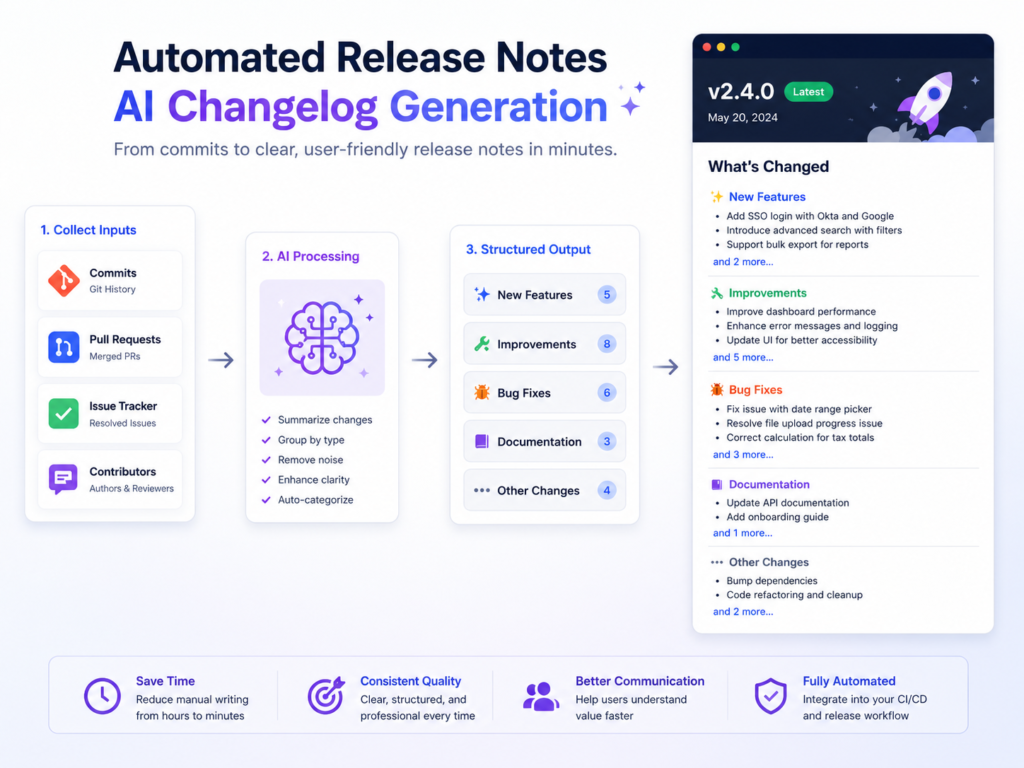
Automated release notes turn commits, pull requests, tickets, and CI/CD metadata into readable summaries for engineering, product, support, and customers.
This is one of the easiest wins for AI CI/CD automation because manual release documentation is slow, inconsistent, and often rushed.
Generate Release Notes From Pull Requests, Commits, and Tickets
An AI release notes generator can read merged pull requests, commit messages, Jira tickets, issue labels, reviewers, and deployment metadata.
Then it can create different summaries for different audiences.
| Audience | What They Need |
|---|---|
| Engineering | Technical changes, dependencies, risks |
| Product | Feature impact and release scope |
| Support | Known issues and customer-facing changes |
| Customers | Clear benefits without internal jargon |
| Compliance | Approvals, checks, evidence, timestamps |
The key is review. AI can draft the notes, but teams should still check accuracy before publishing customer-facing changelogs.
AI Release Notes Generator Workflows
A practical workflow connects GitHub or GitLab activity with Jira or Bitbucket tickets. Rules then classify changes as features, fixes, security updates, breaking changes, or internal improvements.
For example, an Austin SaaS company could generate weekly customer changelogs from GitHub Actions and Jira while still requiring manual review for security-sensitive wording.
Changelog Automation for SaaS and Enterprise Teams
Changelog automation reduces the gap between what engineering shipped and what customers, sales, and support understand.
That gap matters. If support teams do not know what changed, customers feel it. If product teams cannot explain releases, adoption suffers. If compliance teams cannot trace approvals, audits become painful.
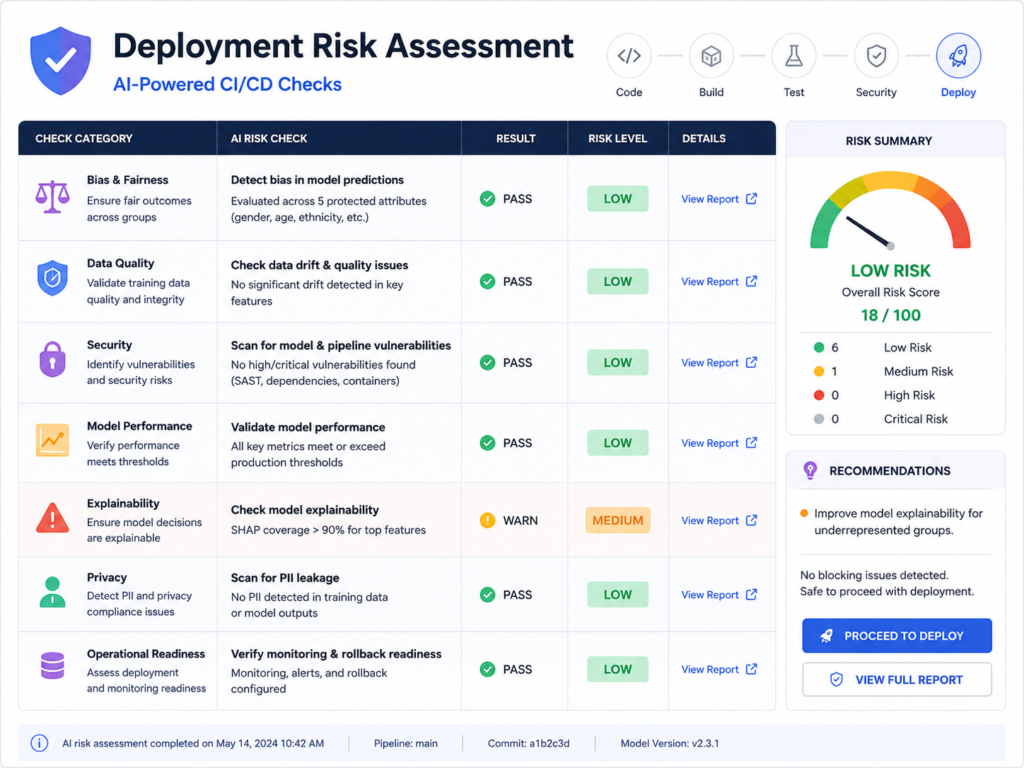
Deployment Risk Assessment and CI/CD Risk Checks
Deployment risk assessment uses AI and rules to identify releases that need more testing, stronger approval, or rollback planning.
AI can flag high-risk releases by analyzing failed tests, sensitive code changes, missing approvals, dependency updates, incident history, and weak rollback coverage.
What Deployment Risks AI Can Detect
AI can detect signals such as.
Large or unusual change size
Sensitive file paths
Authentication changes
Payment logic updates
Infrastructure drift
Missing test coverage
New dependencies
Recent incidents in the same service
No clear code owner
A Berlin banking platform, for example, may flag releases touching identity, payment reconciliation, or third-party API routing because those areas carry higher operational and regulatory risk.
Release Risk Scoring That Teams Can Explain
AI risk scoring becomes more useful when it combines several signals.
A release with many changed files, failed tests, new dependencies, and no clear owner should receive a higher score than a small, well-tested bug fix.
The goal is not to block every release. The goal is to match review effort to actual risk.
For regulated industries, explain ability matters. A black-box risk score is hard to defend during an internal review or external audit.
Automated Deployment Checks Before Production
CI/CD risk checks should verify.
Rollback readiness
Monitoring coverage
Alerting status
Secrets scanning
Dependency health
Security gates
Required approvals
Change ownership
Incident links
Teams using AWS, Azure, Kubernetes, ServiceNow, Harness, Cloud smith, or Copado can connect these checks into deployment workflows.
For regulated teams, these checks also become evidence. They show what was reviewed, who approved it, which controls ran, and why the release moved forward.
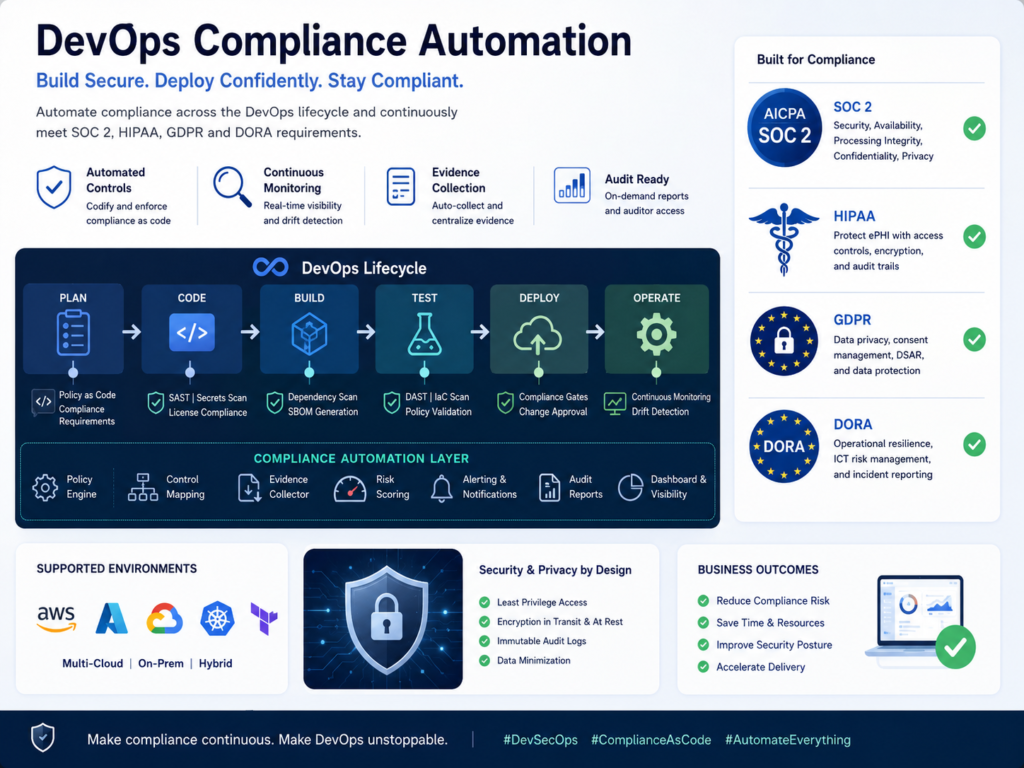
Enterprise Release Governance and DevOps Compliance Automation
DevOps compliance automation helps regulated teams prove who changed what, when it was approved, what checks ran, and whether deployment risk was controlled.
AI can improve compliance-ready software releases by turning scattered CI/CD activity into structured evidence for audits, reviews, and incident learning.
CI/CD Audit Trails for SOC 2, ISO 27001, HIPAA, PCI DSS, and FedRAMP
SOC 2, ISO 27001, HIPAA, PCI DSS, and FedRAMP programs all depend on reliable evidence.
CI/CD audit trails can capture.
Pull request approvals
Test results
Security scan results
Deployment records
Rollback decisions
Incident links
Reviewer activity
For healthcare software in Boston, Seattle, or other US markets, HIPAA Security Rule expectations around administrative, physical, and technical safeguards make change control and access discipline especially important.
UK-GDPR, FCA, PRA, and NHS Delivery Expectations
In the UK, London fintech, Manchester SaaS, Cambridge AI, and NHS-adjacent teams need governance that supports accountability.
AI CI/CD automation can help by creating cleaner change records, approval trails, incident links, and release summaries for internal governance teams.
The benefit is not just audit readiness. It also helps engineering leaders understand where release friction is coming from.
DSGVO, BaFin, DORA, NIS2, and EU Operational Resilience
In Germany and the wider EU, GDPR/DSGVO, BaFin expectations, DORA, and NIS2 increase pressure on operational resilience and supplier risk management.
Munich, Frankfurt, Hamburg, Amsterdam, Dublin, Paris, and Stockholm teams often need stronger data residency controls, clearer audit evidence, and more conservative approval models.
For EU financial entities, DORA harmonizes digital operational resilience rules across financial organizations and ICT third-party providers.
Regional Strategy: USA, UK, Germany, and EU Adoption Patterns
AI CI/CD automation adoption varies by region because buyer risk, regulation, and engineering culture differ.
The USA often prioritizes speed and audit readiness. The UK balances innovation with accountability. Germany and EU teams usually place heavier emphasis on governance, data residency, and operational resilience.
USA.
In the USA, SaaS teams in San Francisco, New York, Austin, Seattle, and Boston often adopt AI CI/CD automation to move faster while preparing for SOC 2, HIPAA, PCI DSS, or FedRAMP reviews.
The practical focus is evidence: release notes, approval records, test results, security checks, and customer-impact summaries.
UK.
UK teams in London, Manchester, Edinburgh, and Cambridge often focus on audit-ready change control.
Fintech, Open Banking, FCA/PRA-regulated environments, and NHS-related platforms need reliable records of software change.
AI helps by reducing documentation gaps and making release decisions easier to review after the fact.
Germany and EU.
Germany and the wider EU often require stronger proof of control.
Berlin startups may move quickly, but Munich, Frankfurt, and Hamburg enterprises often need German-language release documentation, clear data residency policies, and stricter approval workflows.
This is where AI CI/CD automation can support both delivery speed and governance discipline.
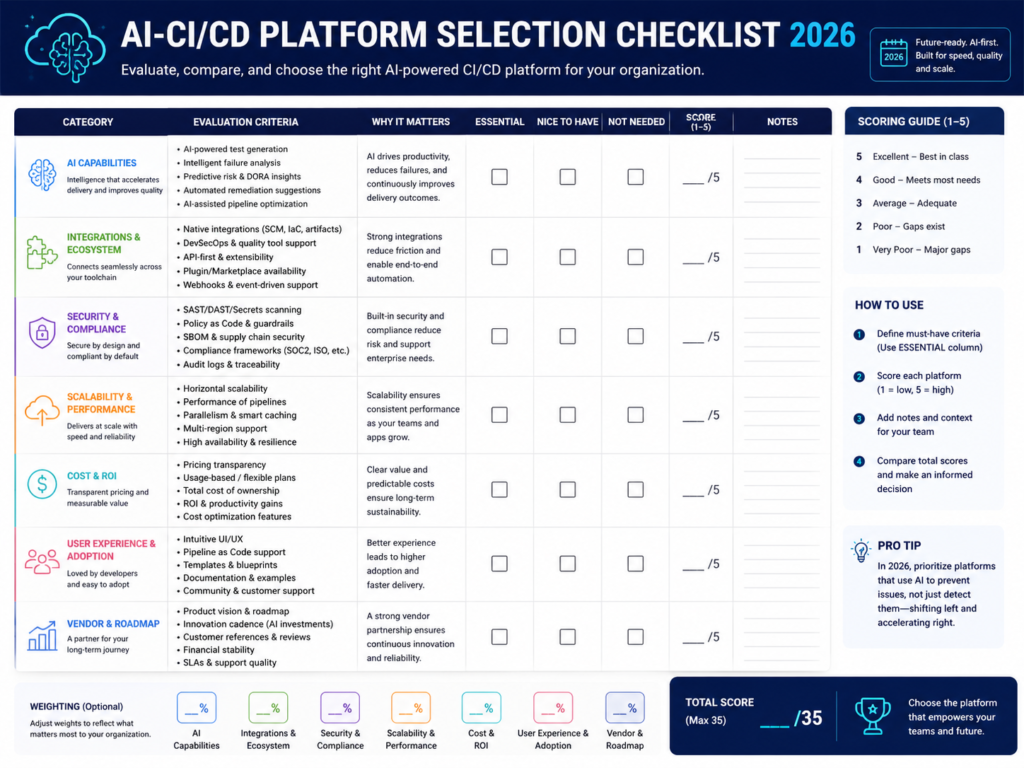
How to Choose an AI CI/CD Automation Platform
Choose an AI CI/CD automation platform by comparing release documentation, risk scoring, compliance gates, audit trails, integrations, and data controls.
The best platform should improve developer flow without weakening governance or exposing sensitive code and operational data.
Platform Selection Checklist
Use this checklist before buying or building.
| Area | What to Check |
|---|---|
| Release notes | Can it generate accurate internal and external summaries? |
| Risk scoring | Does it explain why a release is high risk? |
| Compliance gates | Can it enforce required checks before production? |
| Audit trails | Can it export evidence for reviews and audits? |
| Integrations | Does it support your Git, CI/CD, cloud, ticketing, and ITSM tools? |
| Data controls | Can you manage retention, access, logging, and regional hosting? |
| Human review | Can teams require approval for high-risk changes? |
Integration Checklist
Your platform should integrate with the tools your teams already use, such as.
GitHub
GitLab
Jira
Bitbucket
AWS
Azure
Kubernetes
ServiceNow
Harness
Cloud smith
Copado
Also check role-based access control, regional hosting, data retention, model logging, and whether sensitive source code is used for model training.
Start With a Pipeline Risk Assessment
Before adding another tool, review your current release process.
Look for places where.
Release notes are still manual
Approvals happen outside the pipeline
Rollback checks are inconsistent
Compliance teams chase screenshots
Security gates are bypassed under pressure
Incident learnings do not feed back into release checks.
To sum Up
AI CI/CD automation gives DevOps teams a practical way to release faster, document better, and reduce production risk.
It works best when teams use AI for summarization, risk signals, workflow routing, changelog generation, and audit evidence while keeping humans responsible for high-impact release decisions.
Planning to add AI CI/CD automation without creating new governance risk? Mak It Solutions can help assess your current pipeline, map release evidence gaps, and design automation that fits your engineering stack, compliance needs, and delivery goals.( Click Here’s )
FAQs
Q : Can AI CI/CD automation replace release managers?
A : No. AI CI/CD automation should support release managers, not replace them. It can summarize changes, flag risk, draft release notes, and collect audit evidence, but humans should still own final release decisions for high-risk production changes.
Q : What data does an AI release notes generator need?
A : An AI release notes generator usually needs pull requests, commit messages, issue titles, Jira tickets, labels, deployment metadata, and sometimes customer-impact notes from product teams. Teams should avoid sending secrets, credentials, or unnecessary customer data into the tool.
Q : How do CI/CD risk checks support SOC 2 audits?
A : CI/CD risk checks support SOC 2 audits by creating evidence that software changes followed defined controls. They can show who approved a pull request, which tests passed, what scans ran, whether rollback was reviewed, and when deployment occurred.
Q : Is AI DevOps automation safe for regulated industries?
A : AI DevOps automation can be safe for regulated industries when it is governed carefully. Teams should use role-based access, strong logging, approved model providers, human review for high-risk releases, and clear policies on what data AI can process.
Q : Which teams benefit most from deployment risk assessment?
A : Deployment risk assessment is most useful for SaaS, fintech, healthcare, e-commerce, public-sector, and enterprise platform teams that ship frequently. It is especially helpful when failed releases affect revenue, patient data, payments, compliance, or customer trust.