
AI Content Authenticity in GCC: Proven Trust
AI Content Authenticity in GCC: Proven Trust
AI Content Authenticity in GCC: Proven Trust
AI content authenticity helps GCC organizations prove whether digital media is original, AI-assisted, edited, or approved before it reaches customers, regulators, or the public. For Saudi, UAE, and Qatar teams, it brings together provenance, watermarking, bilingual disclosure, approval workflows, and audit evidence.
In simple terms, it answers one business-critical question: can we prove where this content came from and whether it was changed after approval? That matters for government announcements, fintech communication, executive videos, investor decks, retail campaigns, and Arabic-English customer content across Riyadh, Dubai, Abu Dhabi, Doha, and Jeddah.
This guide is general information, not legal or regulatory advice. GCC organizations should review sector-specific obligations with their compliance, legal, and cybersecurity teams.
What Is AI Content Authenticity?
AI content authenticity means proving the origin, creation process, AI involvement, edits, approvals, and trust status of digital content.
It is not the same as guessing whether something “looks AI-generated.” Authenticity focuses on evidence: source files, edit history, signer identity, approval logs, and tamper-evident credentials.
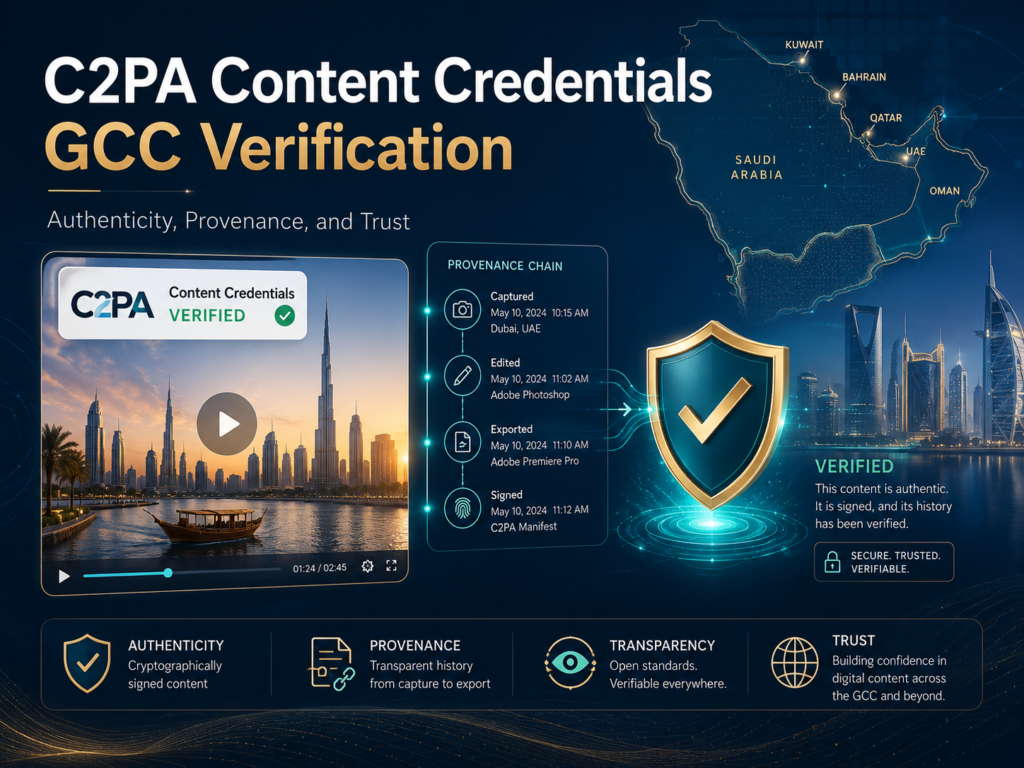
C2PA describes an open technical standard for establishing the origin and edits of digital content, while Content Credentials act like a visible “nutrition label” that can show useful history signals about a file.
Why AI Content Authenticity Matters in Saudi, UAE, and Qatar
Deepfakes, synthetic media, fake executive statements, and brand misuse can move fast. In the GCC, where government communication, banking trust, and corporate reputation carry serious weight, one misleading image, video, or voice note can create real damage.
AI content authenticity helps teams.
Verify approved content before publishing
Reduce fake media and impersonation risk
Support internal review and compliance evidence
Explain AI-assisted content clearly in Arabic and English
Protect customer trust across regulated and public-facing channels
AI Detection vs Content Authenticity
AI detection is a probability signal. It suggests that content may have been generated or edited by AI.
Content authenticity is stronger because it focuses on proof. It can show who created the asset, what changed, which tools were involved, who approved it, and whether the file still matches its trusted record.
For ministries, banks, fintech apps, insurers, media teams, and enterprise communication departments, that difference matters. A detection score may raise a concern, but provenance and approval evidence help teams make a defensible decision.
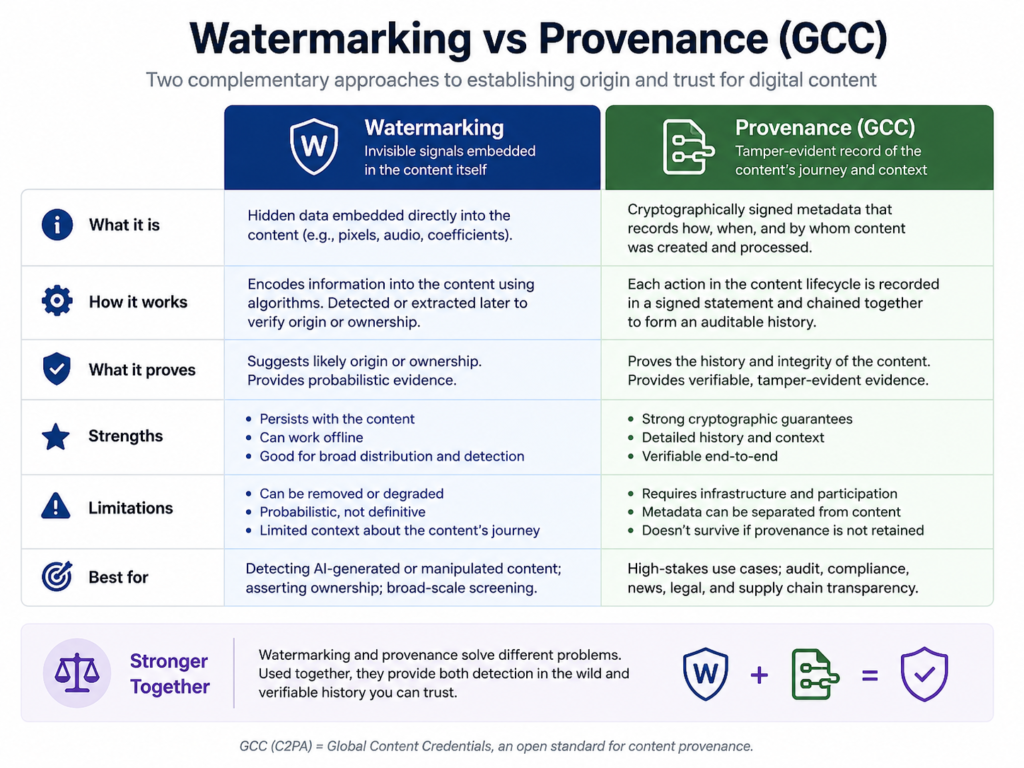
Watermarking vs Provenance.
Watermarking and provenance are often discussed together, but they solve different problems.
| Trust Layer | What It Does Best | Main Limitation |
|---|---|---|
| Watermarking | Flags AI-generated or synthetic media | Can be affected by editing, cropping, compression, or platform handling |
| Provenance | Shows source, edits, signer, and approval history | Metadata can be removed or separated from the asset |
| Human Review | Checks context, meaning, legal risk, and brand fit | Depends on training and workflow discipline |
| Audit Logs | Stores proof for later review | Only useful if logs are complete and secure |
What AI Watermarking Does Well
Watermarking is useful for quick identification. It can help platforms, internal teams, and content tools flag synthetic media before it spreads.
It works best for public-facing creative assets, marketing visuals, AI-generated media disclosure, and early synthetic media checks.
What Content Provenance Does Better
Content provenance gives deeper context. It can show origin, edit history, verification status, signer identity, and tamper-evident metadata.
The C2PA specification describes claims as digitally signed and tamper-evident structures connected to assertions about an asset.
Why GCC Teams Should Use Both
A Saudi government entity, UAE bank, or Qatar media team should not rely on a single signal. Watermarking can help identify AI-generated content, while provenance can help prove source, approval, and chain of custody.
In practice, the safest approach is layered: watermarking, C2PA-style credentials, human review, bilingual disclosure, access control, and secure evidence storage.
How C2PA and Content Credentials Support Digital Trust
C2PA-style infrastructure gives organizations a practical way to attach trust signals to images, videos, documents, and other media.
Content Credentials can show who produced a piece of content, when it was produced, and which tools or editing processes were used.
For GCC organizations, this is useful when content moves between internal teams, agencies, designers, legal reviewers, compliance teams, and publishing platforms.
Where Provenance Helps Most
Provenance is especially valuable for.
Government announcements and public campaigns
Financial education content
Insurance and banking explainers
Investor presentations
Legal or procurement documents
Executive images, videos, and voice content
Media verification workflows
Arabic-English customer communication
A Riyadh fintech, for example, can connect provenance records with Business intelligence services to monitor approvals, content risks, and compliance dashboards.
Limits of Metadata-Based Provenance
C2PA is useful, but it is not magic. The C2PA specification itself notes that an asset can become separated from its manifest if metadata is removed or corrupted.
That is why AI content authenticity should also include policy, access control, staff training, role-based approvals, and human review.
GCC Compliance Signals for AI Content Authenticity
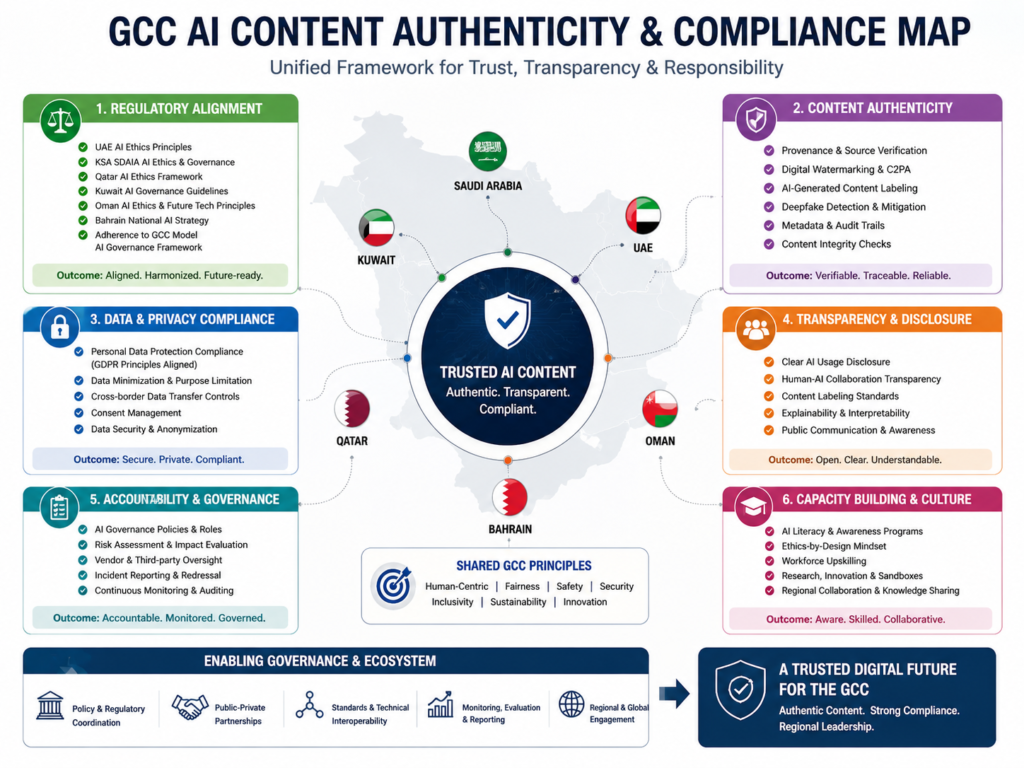
GCC compliance is not only about avoiding penalties. It is about proving that sensitive content was handled responsibly.
Saudi Arabia.
Saudi organizations should consider personal data protection, data governance, digital government expectations, and regulated-finance cybersecurity requirements.
SDAIA states that Saudi Arabia’s Personal Data Protection Law protects personal data, guarantees individual rights, and defines controller obligations.
For financial institutions, SAMA’s cloud computing rulebook says member organizations should define, implement, monitor, measure, and evaluate cybersecurity controls for hybrid and public cloud services.
UAE.
In the UAE, authenticity connects with digital identity, cybercrime risk, financial communication, regulated-sector governance, and customer trust.
UAE PASS is described as the UAE’s first secure national digital identity for citizens, residents, and visitors, enabling access to online services.
For Dubai and Abu Dhabi teams, this means AI-generated or AI-assisted content should be reviewed carefully before it touches onboarding, financial education, product claims, or official customer communication.
Qatar.
In Qatar, provenance supports financial services, public communication, media verification, and national digital transformation.
Qatar Central Bank lists fintech resources including fintech strategy, payment services regulation, DLT guidance, and insurance technology regulation.
For Doha-based teams, authenticity workflows can help preserve source files, approval notes, bilingual captions, and evidence for later review.
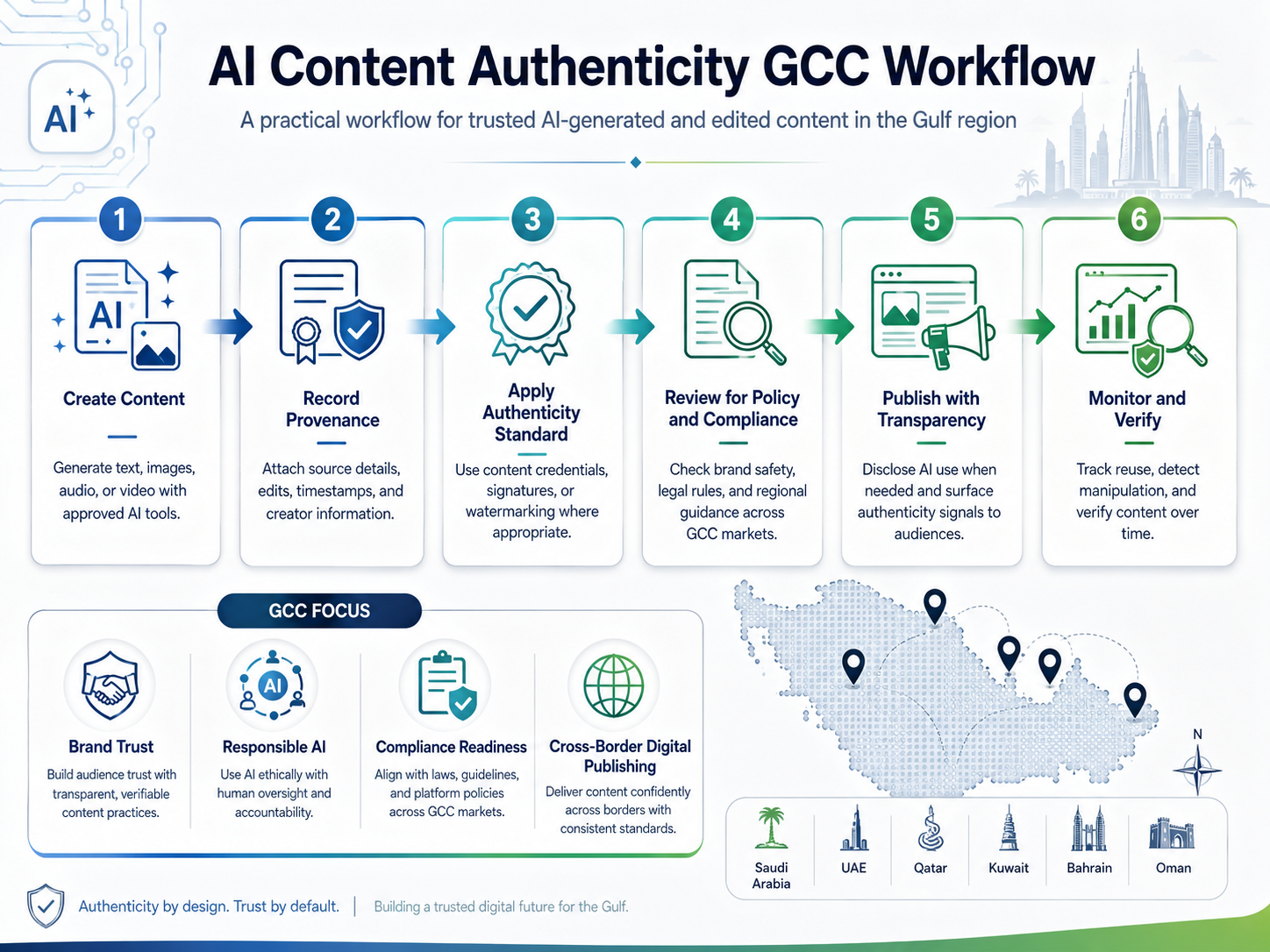
How to Build an AI Content Authenticity Workflow
A strong workflow makes authenticity repeatable. It should not depend on one careful employee checking files manually at the last minute.
Classify High-Risk AI Content
Start by identifying content that could create legal, financial, reputational, or public-trust risk.
High-risk content may include:
Executive statements
Financial documents
Public-sector visuals
Legal evidence
Paid advertising
Customer-facing Arabic copy
Voice or video assets
Product claims
Investor communication
Low-risk internal drafts can follow a lighter process, but public and regulated content needs stricter controls.
Add Watermarking, Provenance, and Review Gates
Use watermarking for AI-generated media signals. Use provenance to record source, edits, and approvals. Add human review for tone, accuracy, compliance, and Arabic-English clarity.
For Dubai e-commerce brands, this can connect with Graphic designing services and WooCommerce development services so AI-assisted product visuals are reviewed before publishing.
Store Evidence for Audit and Data Residency Needs
Keep source files, prompts where relevant, signer records, approval logs, reviewer notes, final exports, and verification reports.
Cloud planning matters too. AWS launched its Middle East Bahrain Region on July 29, 2019, with three Availability Zones; Microsoft lists UAE North and UAE Central among Azure geographies; and Google Cloud announced its Doha region for Qatar customers in 2023.
Local Use Cases Across Riyadh, Dubai, Abu Dhabi, and Doha
Government and Public Communication
A Saudi ministry can verify campaign visuals before publishing them in Riyadh or Jeddah. A UAE public entity can attach approved credentials to bilingual announcements. A Doha agency can preserve official media history for future review.
Fintech, Banking, and Insurance
A Riyadh fintech can store approved explainers, onboarding screens, and investor documents. A UAE insurer can verify AI-assisted customer videos. A Qatar bank can retain provenance for financial education content.
Retail, Logistics, and Corporate Brands
Retailers can verify product imagery, influencer assets, Arabic ad labels, and campaign approvals. Logistics teams can preserve shipment proofs and supplier documents. Corporate brands can protect executive communication from impersonation and misuse.
For customer-facing verification inside apps, teams can use Mobile app development services.
Best Practices for GCC AI Content Authenticity
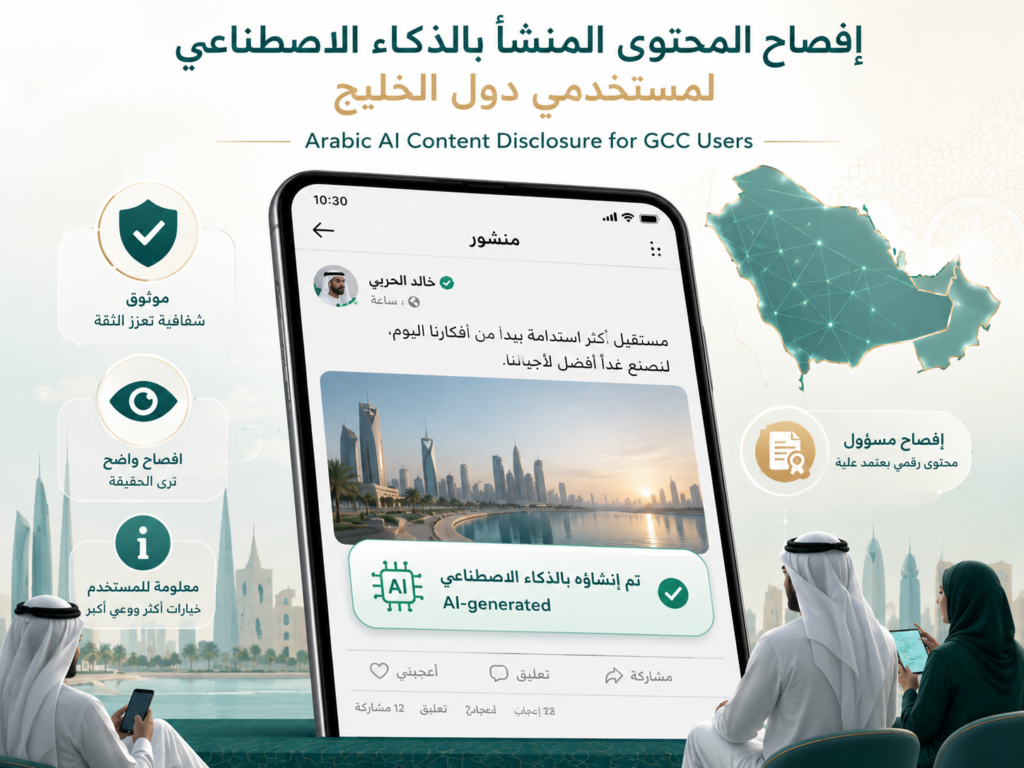
Create a Bilingual Disclosure Policy
Use clear Arabic and English labels for AI-assisted content, synthetic edits, approval status, and sensitive media.
Avoid vague labels like “digitally enhanced” when the audience needs clearer context. Use practical labels such as:
AI-assisted image
Synthetic voice
Edited with AI
Reviewed and approved by our team
Original source verified
Choose Tools That Support Audit Trails
Prioritize tools that support C2PA-style credentials, watermarking, signer identity, role-based access, API integration, and exportable logs.
Train Teams Before a Deepfake Crisis
Marketing, compliance, legal, IT, media, and executive offices should know what to do before a fake video or document appears.
Training should cover.
How to verify source files
When to disclose AI assistance
Who approves sensitive content
How to escalate suspicious media
How to preserve evidence
How to avoid publishing unverified assets.
Concluding Remarks
AI content authenticity is becoming a core trust layer for GCC organizations. Watermarking helps identify AI-generated media, but provenance, approval logs, bilingual disclosure, and secure audit trails make the evidence stronger.
For Saudi, UAE, and Qatar teams, the goal is simple: publish faster without losing control of trust. Mak It Solutions can help design practical workflows for provenance, verification APIs, cloud planning, audit evidence, and bilingual digital trust.( Click Here’s )
FAQs
Q : What is AI content authenticity?
A : AI content authenticity is the process of proving where digital content came from, whether AI was used, how it was edited, and whether it was approved. It combines provenance, watermarking, review workflows, and audit evidence.
Q : Do GCC companies need both watermarking and Content Credentials?
A : Yes, most GCC companies should use both. Watermarking helps identify AI-generated media, while Content Credentials and provenance help show origin, edits, signer identity, and approval history.
Q : Is AI-generated content disclosure required in Saudi, UAE, or Qatar?
A : Requirements depend on sector, content type, and use case. Even where a specific disclosure rule is not clear, GCC organizations should treat clear Arabic-English labeling as a responsible trust and governance practice.
Q : Can UAE fintech teams use AI-generated content in customer communication?
A : Yes, but they should review it carefully. AI-assisted financial education, onboarding, and product content should be accurate, approved by compliance, clearly written, and not misleading.
Q : What should Qatar media teams check before publishing AI-generated visuals?
A : They should check source, edit history, usage rights, AI involvement, approval status, captions, and bilingual disclosure. They should also store original files and reviewer notes for future verification.