


AI Procurement Checklist: Saudi & UAE Risk Guide
AI Procurement Checklist: Saudi & UAE Risk Guide
AI Procurement Checklist: Saudi & UAE Risk Guide
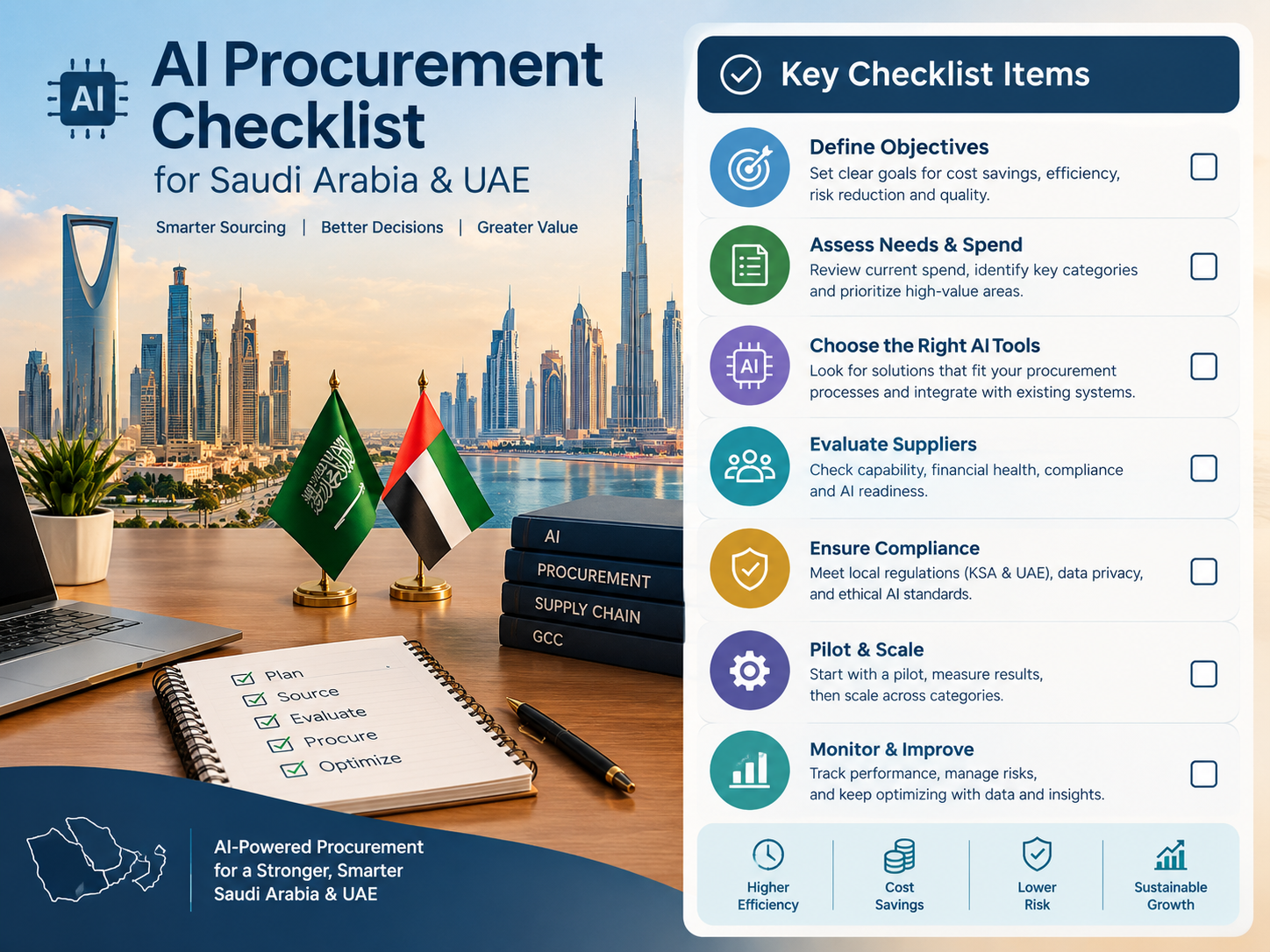
An AI procurement checklist helps enterprises assess an AI vendor before purchase across use-case risk, governance, privacy, cybersecurity, model performance, human oversight, and contractual controls.
For organizations in Saudi Arabia, the UAE, and Qatar, that assessment should also reflect applicable local data-protection rules, sector requirements, and AI-governance frameworks. The goal is simple: identify material risks before an AI system reaches production, customer data, or high-impact business processes.
Buying an AI platform is no longer just an IT decision. In Riyadh, Dubai, Abu Dhabi, or Doha, procurement can involve privacy teams, cybersecurity leaders, legal counsel, data-governance specialists, business owners, and technology teams.
A practical AI procurement checklist gives those stakeholders one framework for reviewing evidence, assigning responsibilities, and making unresolved risks visible before deployment.
What Should Enterprises Check Before Buying AI?
A strong assessment should cover six areas: use-case risk, vendor governance, data and privacy, cybersecurity, model performance and human oversight, and contractual and lifecycle controls.
Define the AI Use Case and Business Risk
Start by documenting what the system does, who it affects, how much it automates, and what happens if it fails.
An AI assistant used to draft marketing copy, for example, creates a very different risk profile from technology that influences lending, healthcare, employment, or government decisions.
Classify the AI System Before Vendor Approval
Controls should be proportionate to potential impact. Higher-impact systems generally need stronger testing, documentation, oversight, escalation procedures, and monitoring.
Saudi SDAIA’s AI Ethics Principles also use risk-based concepts and address areas including privacy, fairness, transparency, accountability, and safety.
Create a Cross-Functional AI Approval Team
Bring procurement, legal, cybersecurity, privacy or data governance, AI governance, and the business owner into the process early.
Technical teams can also evaluate application architecture through Mak It Solutions’ backend development services and Python development services.
What Evidence Should You Request From an AI Vendor?
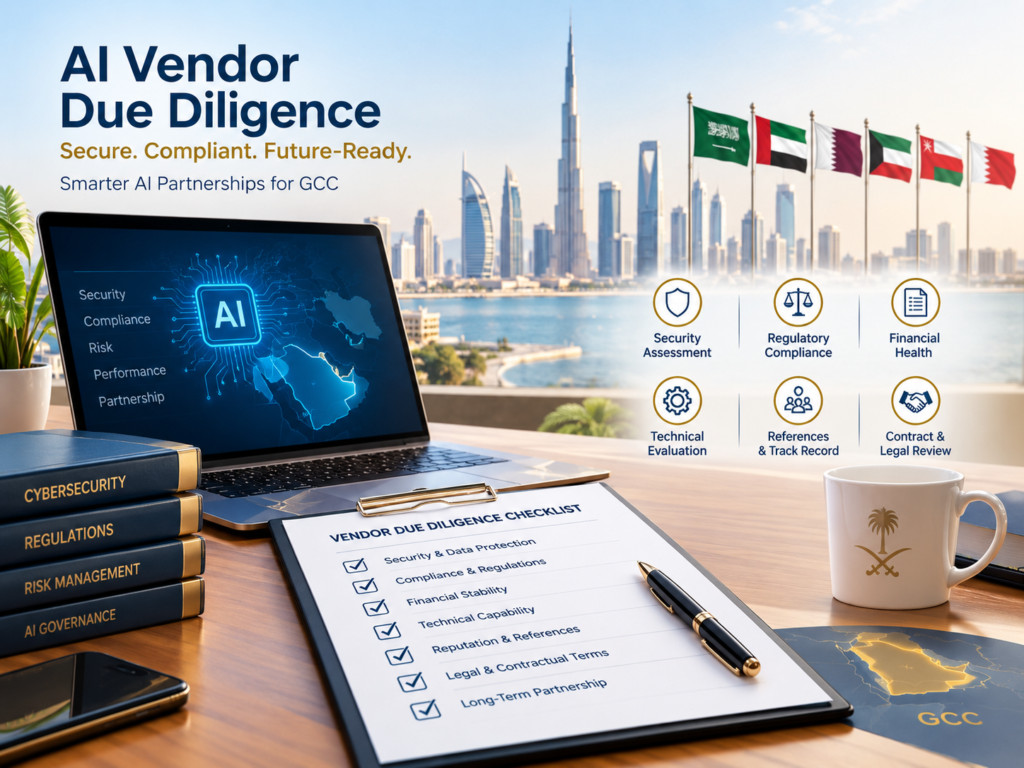
AI vendor due diligence should verify claims rather than rely on a polished sales presentation. Ask for evidence that reflects your actual deployment, data, users, and risk level.
Governance, Testing, and Model Documentation
Request documentation covering.
Intended system purpose and known limitations
Evaluation and testing results
Governance responsibilities
Monitoring processes
Human-oversight controls
Material model-change procedures
ISO/IEC 42001 certification or alignment with the NIST AI Risk Management Framework may provide useful supporting evidence, but neither replaces a use-case-specific assessment.
Data Flows, Retention, and Sub processors
Ask exactly what data enters the AI system, where it is processed, how long it is retained, how deletion works, and which sub processors receive access.
Procurement teams should also establish whether prompts, files, customer information, or other inputs can be reused to train or improve vendor models.
Security and Incident-Response Evidence
Review access controls, vulnerability management, API security, independent assurance, incident-response procedures, and business-continuity arrangements.
Mak It Solutions‘ Node.js development services can also support secure API-led application architectures.
How Do Saudi and UAE AI Procurement Requirements Differ?
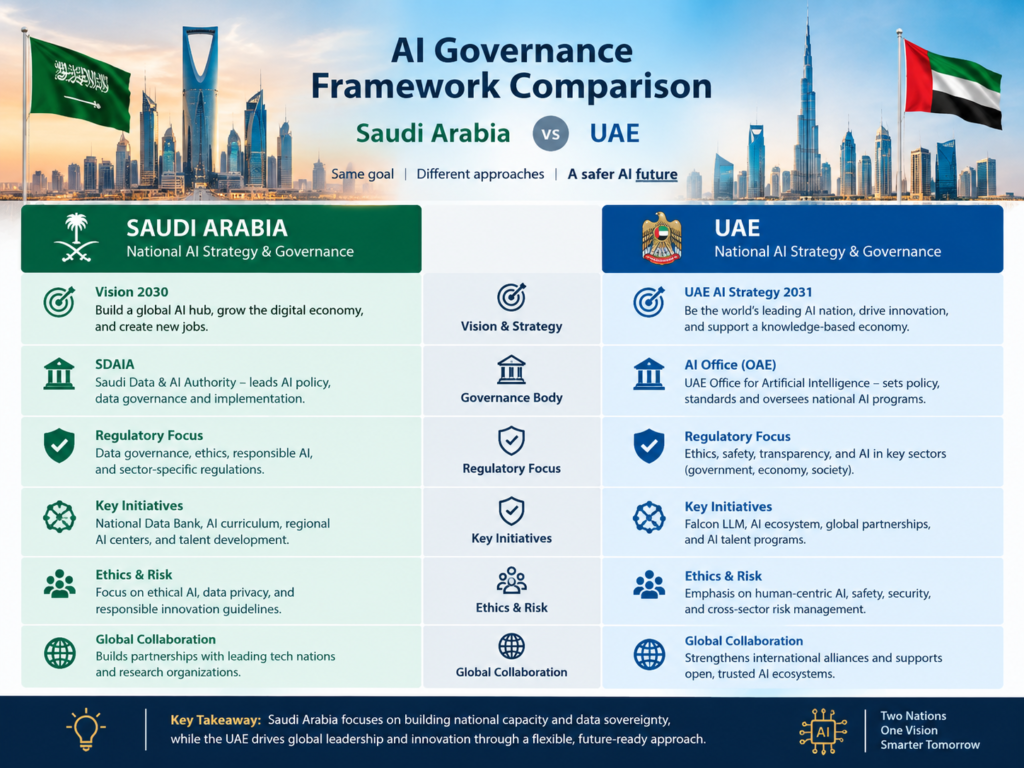
Saudi Arabia and the UAE have distinct regulatory environments. Responsible AI procurement should therefore be localized rather than built around a single generic assumption of “GCC compliance.”
Saudi Arabia.
Saudi organizations should consider applicable SDAIA and NDMO requirements, the Saudi Personal Data Protection Law (PDPL), AI Ethics Principles, AI Ethics Assessment, AI Service Provider Accreditation, and, where relevant, the National AI Risk Management Framework.
SDAIA describes the risk-management framework as addressing AI risk identification, assessment, treatment, and monitoring.
Importantly, the Saudi PDPL should not be simplified into “all data must stay in Saudi Arabia.” Saudi regulations provide mechanisms and safeguards for qualifying international transfers of personal data.
UAE.
UAE procurement teams should assess applicable privacy obligations alongside cybersecurity and AI-governance requirements.
The UAE’s National Cyber Security Policy for Artificial Intelligence addresses areas including governance, supply-chain risk, algorithm security, human oversight, monitoring, and incident response.
Depending on where an organization operates, DIFC or ADGM requirements may also apply.
Qatar and Wider GCC Considerations
A financial-services company in Doha may also need to consider Qatar Central Bank requirements and relevant Qatar MCIT frameworks.
Likewise, organizations operating in Kuwait, Bahrain, or Oman should conduct jurisdiction-specific analysis rather than automatically reusing Saudi or UAE controls.
How Should Enterprises Assess AI Data and Security Risk?
Map Personal, Confidential, and Training Data
Create a clear data map showing.
Personal and confidential information
Prompts and AI outputs
Application and system logs
Model-training or improvement use
Third parties and sub processors receiving data
This gives privacy, legal, and security teams a practical view of where sensitive information actually travels.
Assess Data Residency and Cross-Border Transfers
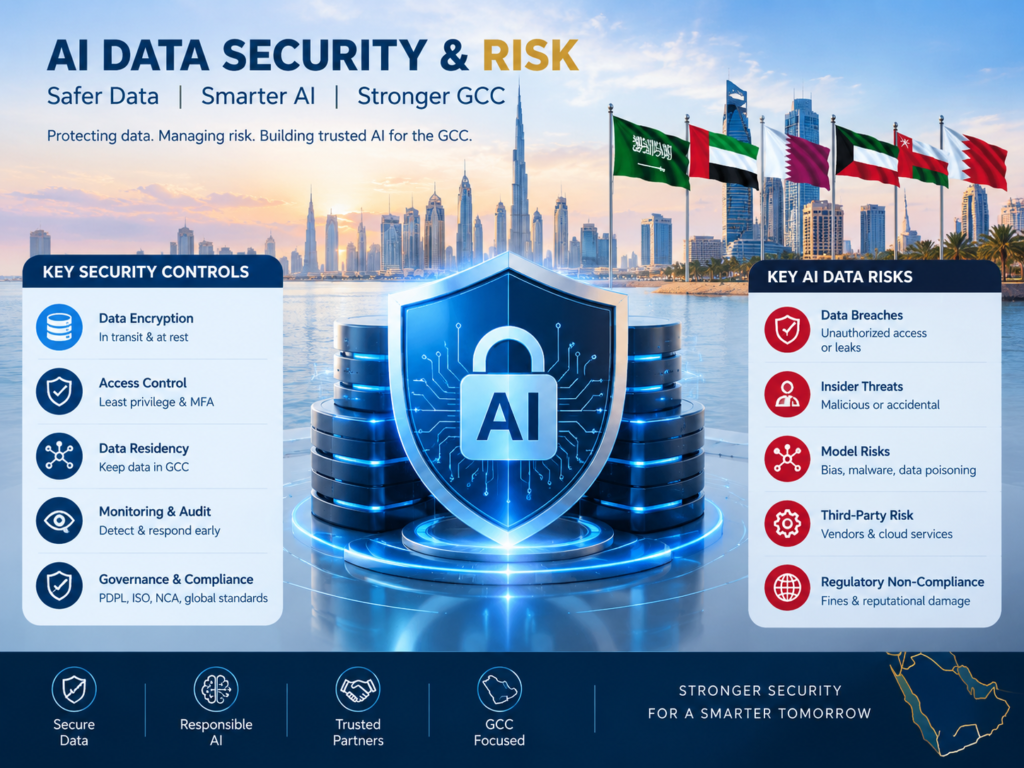
Document primary hosting locations, backups, disaster-recovery infrastructure, and sub processor locations.
Regional infrastructure such as AWS Bahrain, Azure UAE regions, or Google Cloud Doha may support architecture and residency decisions. However, selecting a nearby cloud region does not, by itself, establish regulatory compliance.
Test AI Cybersecurity and Third-Party Risk Controls
Review identity and access controls, API security, prompt and data-leakage risks, third-party dependencies, and incident procedures.
Existing applications and integrations can also be assessed alongside Mak It Solutions web development services.
How Should You Evaluate Model Risk and Human Oversight?
Test Accuracy, Bias, and Model Limitations
Test the system against your own users, languages, workflows, and realistic scenarios.
A Riyadh fintech handling Arabic-language customer interactions, for example, should not rely solely on global model benchmarks. Performance needs to be evaluated against the environment in which the AI will actually operate.
Define Human-in-the-Loop Controls
Specify which AI outputs require human review, who has authority to override the system, and how consequential decisions are escalated.
Human oversight should be a defined operational control not simply a statement in a policy document.
Require Monitoring, Auditability, and Change Control
Require appropriate logs, ongoing monitoring, post-update evaluations, and notification of material model changes.
Business intelligence services can support broader enterprise monitoring and analytics requirements.
What AI Contract Controls Should Procurement Teams Require?
Put Data and AI Responsibilities Into the Contract
Contracts should clearly define permitted data use, confidentiality obligations, security responsibilities, sub processors, retention, deletion, and appropriate evidence or audit rights.
Define AI Incidents, Changes, and Vendor Notifications
Specify when the vendor must notify your organization about security incidents, new sub processors, material model changes, or significant changes in system performance.
These requirements can prevent important technical changes from remaining hidden inside routine vendor updates.
Plan for Exit, Migration, and Data Deletion
Procurement should consider the end of the relationship before signing the agreement.
Address data exportability, termination assistance, deletion evidence, migration requirements, and replacement-vendor planning to reduce operational lock-in.
How to Use the AI Procurement Checklist Before Approval
Screen the Use Case and Vendor
Classify the potential business impact and identify which teams need to participate in due diligence.
A Dubai e-commerce business deploying AI-powered recommendations, for example, may need input from privacy, cybersecurity, technology, and digital-commerce stakeholders.
Collect Evidence and Complete Risk Reviews
Organize vendor evidence under six categories.
Governance
Privacy and data
Cybersecurity
Model risk
Human oversight
Contracts and lifecycle controls
A Doha SME using regional cloud infrastructure should document the actual processing, backup, and sub processor locations rather than relying on the cloud provider’s brand or regional presence alone.
Approve, Remediate, or Escalate
Document unresolved risks, required remediation, accountable owners, approval decisions, and post-deployment monitoring requirements.
Most importantly, treat the AI procurement checklist as a lifecycle control. It should not become a questionnaire that disappears once the contract is signed.
For Saudi Arabia, teams should map applicable SDAIA and PDPL requirements. UAE organizations should identify relevant federal, DIFC, or ADGM obligations. In both markets, procurement should obtain clear data flows, security evidence, model evaluations, sub processor information, human-oversight controls, and contractual commitments.
Final Takeaway
Effective AI procurement brings governance, security, privacy, technology, and business accountability into the same decision.
A well-designed AI procurement checklist helps Saudi and UAE enterprises move beyond vendor claims and evaluate how an AI system will actually handle data, perform in production, respond to change, and operate under local requirements.
Explore Mak It Solutions services or contact Mak It Solutions to discuss a custom GCC technology and AI-risk strategy for your organization.
Regulatory requirements can change and may differ by industry and jurisdiction. This content is general information and should not be treated as legal or regulatory advice.
FAQs
Q : Does Saudi PDPL affect the procurement of AI vendors?
A : Yes. When an AI vendor processes personal data within the PDPL’s scope, procurement should examine processing purposes, vendor responsibilities, security, retention, and applicable transfer requirements. Teams should verify the actual data flow rather than assume every dataset must remain locally hosted.
Q : What should a Dubai enterprise ask an AI vendor about data processing?
A : Ask about the categories of data collected, processing purposes, hosting locations, retention periods, deletion procedures, sub processors, model-training practices, and cross-border data flows. The exact legal requirements depend on the organization’s jurisdiction and activities.
Q : Do Saudi companies need an AI vendor’s data-flow documentation?
A : Data-flow documentation is highly useful because it shows what information enters the AI system, where it travels, who receives it, and whether international transfers occur. For organizations handling sensitive or regulated information, this can become an important part of privacy and third-party risk assessment.
Q : What AI contract clauses should UAE enterprises consider?
A : Relevant clauses may cover permitted data use, confidentiality, security responsibilities, sub processors, retention, deletion, incident notifications, material system changes, evidence or audit rights, and exit support. These provisions should be adapted to the organization’s jurisdiction, sector, and AI use case.
Q : Can the same AI vendor checklist be used in Saudi Arabia, UAE, and Qatar?
A : The same core framework can provide a useful starting point, but jurisdiction-specific and sector-specific controls should be added. Saudi, UAE, and Qatar organizations should therefore use a modular checklist rather than treating the GCC as a single regulatory regime.