
Arabic AI Hallucination Reduction for GCC
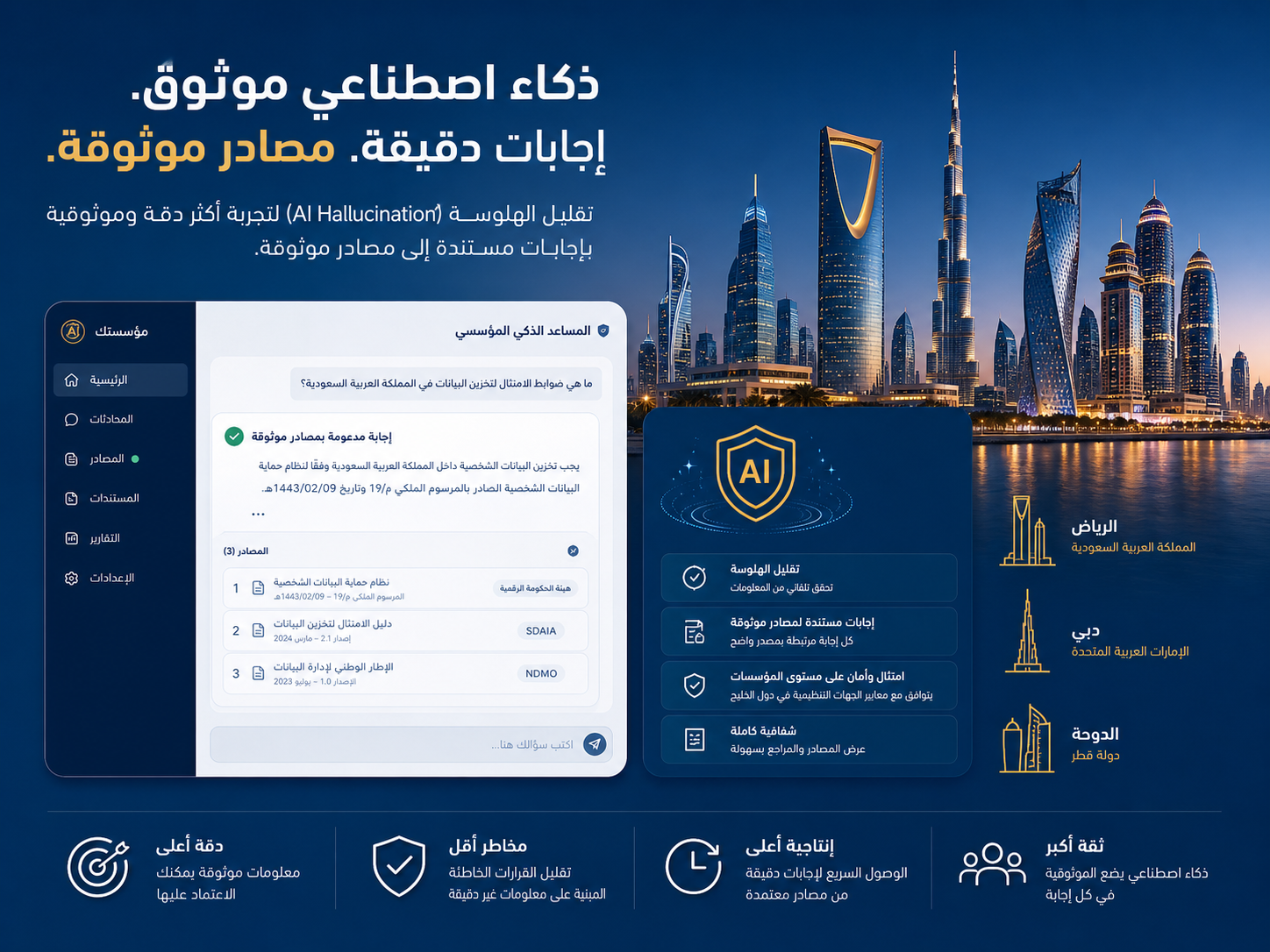
Arabic AI hallucination reduction helps GCC enterprises stop AI systems from giving false, outdated, or unsupported answers in Arabic. For teams in Saudi Arabia, the UAE, and Qatar, the safest approach is to combine Arabic RAG, source verification, compliance guardrails, and human review.
This matters because Arabic AI is no longer a “nice-to-have” experiment. It is already being used in customer support, government services, fintech, logistics, retail, and internal enterprise workflows across Riyadh, Dubai, Abu Dhabi, and Doha.
A single confident but wrong answer can hurt trust fast.
Why Arabic AI Hallucination Reduction Matters in the GCC
GCC companies are adopting Arabic AI quickly, but the region has a unique challenge: many systems must understand Arabic, English, Modern Standard Arabic, Gulf dialects, legal terminology, internal policies, and customer intent at the same time.
That makes Arabic AI hallucination reduction more than a technical task. It becomes a business risk control.
A banking chatbot should not invent eligibility rules. A public-service assistant should not guess document requirements. A logistics bot should not promise a delivery policy that does not exist. And an e-commerce assistant should not confuse return rules across countries.
In practice, safer Arabic AI depends on one simple principle: the answer should come from trusted sources, not from the model’s memory alone.
What Is Arabic AI Hallucination Reduction?
Arabic AI hallucination reduction is the process of reducing false, invented, outdated, or unsupported responses generated by Arabic large language models.
It usually combines.
Retrieval augmented generation
Source attribution
Factual consistency checks
AI guardrails
Human review for sensitive cases
Ongoing monitoring and improvement
The goal is not to make the AI silent or overly cautious. The goal is to make it useful, grounded, and auditable.
How Hallucinations Appear in Arabic AI Outputs
Arabic AI hallucinations can show up in subtle ways.
The model may create fake citations, mistranslate policy terms, misread a bilingual document, or give a confident answer without a reliable source. In GCC customer support, this can affect payments, refunds, eligibility, appointment steps, product warranties, or official procedures.
The risk becomes higher when users ask in Arabic while the knowledge base is written in English, or when the AI has to understand local phrases used in Saudi Arabia, the UAE, or Qatar.
Why Arabic, Dialects, and GCC Context Increase Risk
Arabic AI systems often switch between Modern Standard Arabic, Gulf Arabic, and English. A Saudi customer may ask a question using local wording, while the company’s policy document may be stored in English.
That gap can create retrieval errors, translation drift, and unclear answers.
For example, a customer may ask about “رسوم” while the English document uses “service charges,” “processing fees,” or “admin fees.” If the retrieval system does not connect those terms correctly, the AI may guess.
Why GCC Teams Need Higher Factual Accuracy
Saudi, UAE, and Qatar organizations operate in fast-moving digital markets where users expect quick answers. At the same time, regulators and enterprise buyers expect clear controls.
Saudi fintech teams, Dubai e-commerce brands, Abu Dhabi enterprises, and Doha public-sector suppliers need Arabic AI systems that can explain where an answer came from.
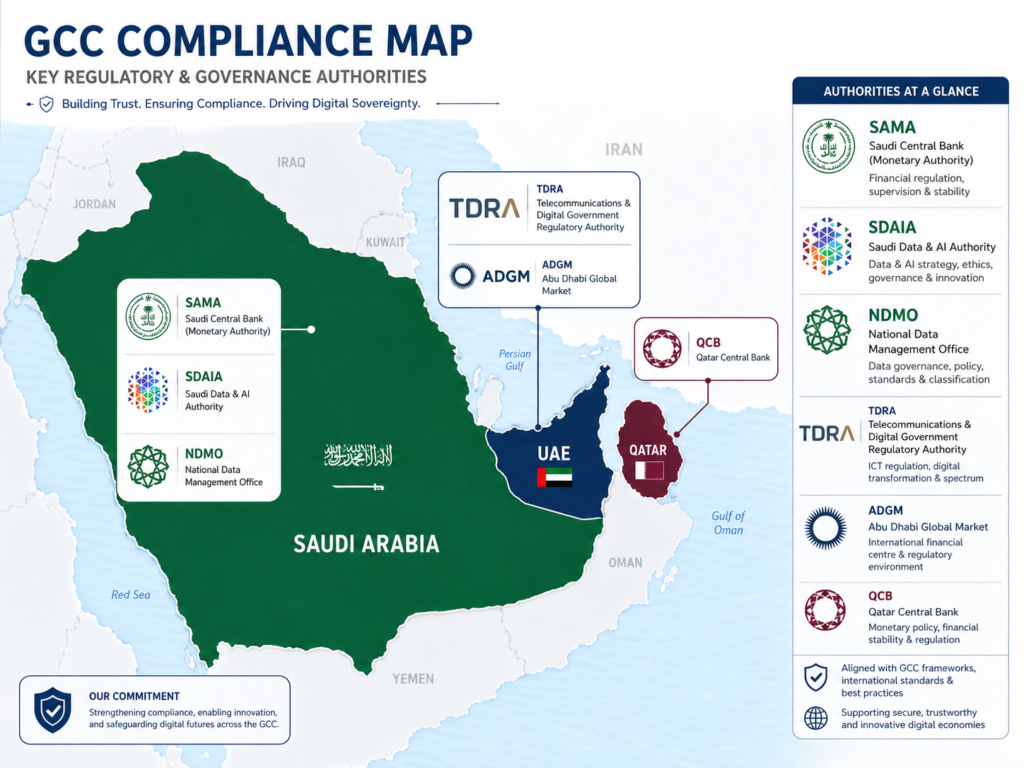
SDAIA describes itself as Saudi Arabia’s authority concerned with data and AI, while NDMO is part of its data governance ecosystem. That makes governance an important design factor for AI systems used in Saudi Arabia. (SDAIA)
Why Arabic LLMs Hallucinate in GCC Use Cases
Arabic LLMs usually hallucinate when they do not have strong grounding, fresh local content, or clear policy boundaries.
Weak Grounding in Local Rules and Internal Policies
A model may not know your latest internal policy, customer flow, product update, refund rule, or compliance requirement.
This becomes more serious in regulated environments. A financial assistant, for example, should not guess around SAMA-sensitive banking workflows, QCB fintech expectations, ADGM obligations, DIFC processes, or TDRA digital government requirements.
SAMA’s Cyber Security Framework requires banks in Saudi Arabia to comply with its framework, which makes unsupported AI responses especially risky in financial contexts.
Arabic-English Document Mismatch
Many GCC enterprises store contracts, FAQs, product documents, customer policies, and compliance material in both Arabic and English.
If the AI retrieves only English documents but answers in Arabic, it may simplify too much or choose the wrong translation. If it retrieves Arabic content but the terminology differs from internal English systems, the answer may still become inaccurate.
The fix is not only better prompting. Teams need better content structure, bilingual search, Arabic embeddings, and answer verification.
Outdated or Missing GCC-Specific Data
Regional models such as Saudi ALLaM, UAE Jais, and Qatar Fanar show strong momentum for Arabic AI. But enterprise AI systems still need company-specific grounding.
Public models rarely know your latest pricing, product rules, onboarding process, customer journey, internal escalation policy, or country-specific compliance setup.
That is why Arabic AI hallucination reduction must happen at the system level, not only at the model level.
How a Verification Layer Reduces Arabic AI Hallucinations
A verification layer checks AI answers before users see them.
It compares the generated response against approved sources, scores confidence, detects risky claims, and routes uncertain cases to a human reviewer. For GCC enterprises, this is especially useful when AI handles Arabic customer support, regulated information, or public-facing services.
Arabic RAG for Source-Backed Answers
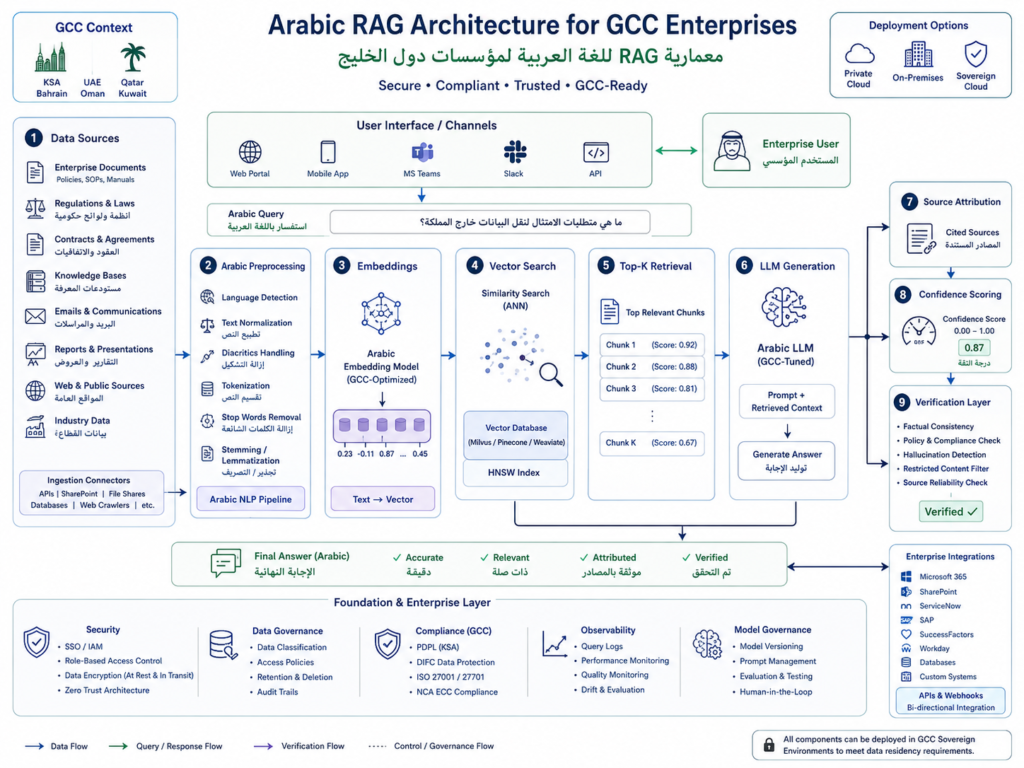
Arabic RAG connects the AI system to trusted knowledge bases, such as.
Policy manuals
Product FAQs
Service pages
CRM notes
Government documents
Compliance references
Internal support playbooks
Instead of answering from memory, the AI retrieves relevant information first and then generates an Arabic response based on those sources.
For example, a GCC enterprise can pair RAG with secure back-end development services to keep Arabic answers tied to approved company data.
Factual Consistency Checks Before Publishing
A factual consistency check asks a simple question: does the final answer match the retrieved source?
If the answer does not match, the system can rewrite it, refuse to answer, ask for clarification, or escalate the case to a human.
This is valuable for finance, healthcare, government, legal-adjacent workflows, and any service where a wrong answer can cause real-world friction.
Guardrails for Compliance, Safety, and Arabic UX
AI guardrails define what the system can and cannot say.
For Arabic AI systems in the GCC, guardrails should cover.
Sensitive financial or legal claims
Personal data handling
Escalation triggers
Arabic tone and cultural suitability
Country-specific terminology
Unsupported answer refusal
Source citation requirements
Good guardrails do not make the chatbot feel robotic. They make it safer, clearer, and more trustworthy.
GCC Compliance Factors for Arabic AI Systems
GCC compliance is not one universal checklist. It depends on the country, sector, data type, deployment model, and customer journey.
Saudi Arabia.
In Saudi Arabia, teams should review SDAIA, NDMO, SAMA, and data-residency expectations before launching Arabic AI systems.
A Riyadh fintech startup, for example, should make sure banking-related responses are source-backed, auditable, and routed to a human when the AI is unsure.
Mak It Solutions’ guide to Middle East cloud providers can support early hosting and infrastructure discussions for Saudi, UAE, and Qatar teams.
UAE.
In the UAE, AI is becoming more visible in public digital services. TDRA has supported generative AI on government portals through the “U Ask” platform and wider digital government initiatives. (TDRA)
For a Dubai e-commerce brand, Arabic AI can help with orders, returns, product discovery, and support. But sensitive journeys involving payment, identity, disputes, or regulated services need verification and escalation.
Qatar.
In Qatar, QCB supervises licensed fintech companies and publishes fintech-related guidance, including AI guidelines listed on its financial technology page.
A Doha SME can use Arabic AI to improve customer support, but fintech, onboarding, payment, and identity workflows should be checked carefully before going live.
For local performance and compliance planning, teams may also consider cloud architecture choices such as GCP Doha where appropriate.
Best Use Cases for Arabic AI Hallucination Reduction
Fintech and Banking Chatbots
Fintech and banking assistants need strict hallucination controls because they often answer questions about eligibility, fees, onboarding, payments, card issues, and account processes.
A Saudi fintech chatbot should not invent approval criteria. A UAE banking assistant should respect ADGM or DIFC-sensitive workflows. A Qatar payments bot should align with QCB expectations when handling regulated information.
For these systems, Arabic AI hallucination reduction should include source citations, refusal logic, audit logs, and human escalation.
Government Service Assistants
Arabic service assistants can help users understand document requirements, appointment steps, application status, and service eligibility.
But public-sector AI needs extra care. If the assistant gives wrong guidance, users may submit incorrect documents or miss important steps.
For government and public-facing systems, source attribution and human escalation are not optional features. They are trust features.
Retail, Logistics, and Customer Support
Retail and logistics teams can use Arabic AI to answer questions about delivery, refunds, stock availability, order status, and service terms.
A Dubai e-commerce company using Shopify development services or WooCommerce development services can connect product data, shipping policies, and return rules into verified Arabic support flows.
This helps customers get fast answers without forcing the AI to guess.
Arabic RAG vs Arabic AI Verification Layer
Arabic RAG and verification layers are related, but they are not the same thing.
| Feature | Arabic RAG | Verification Layer |
|---|---|---|
| Main role | Retrieves trusted content | Checks if the answer is safe and supported |
| Best for | Grounding responses | Reducing unsupported claims |
| Output | Source-backed draft answer | Approved, rewritten, refused, or escalated answer |
| Risk control | Medium | Higher |
| Best use case | Knowledge-based support | Regulated or high-risk workflows |
What Arabic RAG Does Well
Arabic RAG retrieves documents, grounds responses, and can add source attribution.
It works best when documents are clean, current, bilingual, and well structured. If the source content is messy or outdated, RAG may still retrieve weak information.
What a Verification Layer Adds
A verification layer adds confidence scoring, contradiction detection, compliance checks, and escalation logic.
It does not replace RAG. It strengthens RAG.
For example, the AI may retrieve the right source but still generate an answer that overstates a policy. A verification layer can catch that before the user sees it.
When GCC Companies Need Both
Regulated or high-risk teams usually need both RAG and verification.
A public-sector assistant, bank chatbot, healthcare support tool, or fintech onboarding assistant should combine retrieval, validation, guardrails, and human-in-the-loop review.
For teams planning this workflow, Mak It Solutions’ article on human-in-the-loop AI workflows is a helpful next read.
Implementation Roadmap for GCC AI Teams
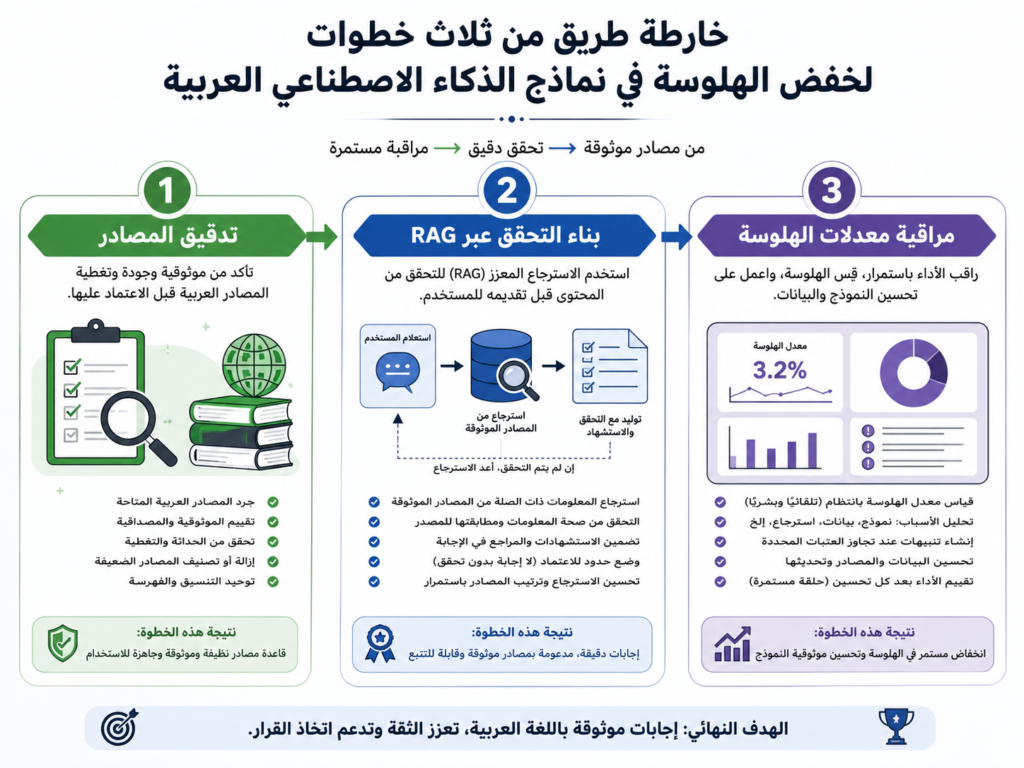
Audit Arabic Content, Sources, and Compliance Risks
Start by listing all Arabic and English sources the AI may use.
Remove outdated pages, duplicate FAQs, and conflicting policy documents. Then classify content by risk level. A delivery FAQ is usually lower risk than a banking eligibility rule or a government application requirement.
Your audit should identify.
Approved sources
Outdated documents
Missing Arabic content
Bilingual terminology gaps
Regulated answer categories
Escalation scenarios
Build a GCC-Aware RAG and Verification Workflow
Next, build the retrieval and verification pipeline.
Use vector search, Arabic embeddings, citation checks, answer validation, confidence scoring, and human review for sensitive responses.
Teams modernizing their portals can connect this with front-end development services and custom service development to create a smoother Arabic user experience.
Monitor Hallucination Rates and Improve Over Time
Arabic AI hallucination reduction is not a one-time setup.
Track failed answers, unsupported claims, escalation rates, dialect issues, source gaps, and customer feedback. Over time, improve the knowledge base, retrieval logic, prompts, guardrails, and review process.
A strong monitoring loop helps your AI system become safer and more useful with every release.
Practical Checklist for Safer Arabic AI Answers
Before launching an Arabic AI assistant in the GCC, check whether your system can.
Answer from approved sources
Show or store source references
Refuse unsupported questions
Escalate sensitive cases
Handle Arabic-English terminology
Understand Gulf Arabic variations
Avoid legal, financial, or compliance overclaims
Log responses for audit and improvement
Support human review for high-risk journeys
This is the foundation of reliable Arabic AI hallucination reduction.
Final Take
Arabic AI can improve customer support, public services, fintech workflows, retail operations, and internal productivity across the GCC. But speed alone is not enough.
For Saudi Arabia, the UAE, and Qatar, Arabic AI hallucination reduction should be built into the architecture from day one. That means using Arabic RAG, verification layers, guardrails, compliance workflows, and human review where needed.
Contact Mak It Solutions to build a custom GCC AI strategy, or explore our Arabic GenAI systems guide to plan your next step.( Click Here’s )
FAQs
Q : Is Arabic AI hallucination reduction important for Saudi government services?
A : Yes. Saudi government services often involve eligibility rules, official forms, appointment steps, and personal data. If an Arabic AI assistant invents a requirement or gives outdated guidance, users may submit the wrong documents or lose trust.
Can UAE companies use Arabic RAG to improve chatbot accuracy?
Yes. UAE companies can use Arabic RAG to connect chatbots with approved FAQs, policy pages, product data, and service documents. For sensitive workflows, they should also add verification, escalation, and Arabic UX guardrails.
Q : How can Qatar enterprises verify Arabic AI answers before publishing them?
A : Qatar enterprises can verify Arabic AI answers by comparing each response with trusted source documents, checking confidence scores, and routing uncertain answers to a human reviewer. This is especially important for fintech, payments, onboarding, and public-facing services.
Q : What industries in the GCC need Arabic AI verification most?
A : Fintech, government, healthcare, logistics, telecom, and e-commerce need Arabic AI verification most because they handle high-volume customer questions and sensitive decisions. These sectors benefit from source attribution, factual checks, compliance guardrails, and human escalation.
Q : Does data residency stop Arabic AI hallucinations?
A : No. Data residency does not automatically stop hallucinations. However, it affects where knowledge bases, logs, prompts, and user data are stored or processed, which can support safer RAG pipelines and stronger audit trails.