



B2B SEO Case Study Framework That Wins
A strong B2B SEO case study framework does more than show ranking wins. It explains how organic search attracts the right buyers, supports long sales cycles, creates qualified leads, and connects SEO activity to pipeline and revenue.
In simple terms, a B2B SEO case study framework is a repeatable proof model. It connects search intent, content execution, ranking movement, qualified organic leads, sales opportunities, and measurable business outcomes in one clear story.
That matters because B2B buyers are doing more research before they ever speak to sales. Gartner reported in 2025 that 61% of surveyed B2B buyers preferred a rep-free buying experience, while 73% actively avoided suppliers that sent irrelevant outreach.
What Is a B2B SEO Case Study Framework?
A B2B SEO case study framework is a structured way to show how search visibility creates business value. Instead of stopping at “traffic increased,” it answers the question leadership actually cares about: did SEO help attract better-fit buyers and move them closer to a sales conversation?
For a B2B marketing team, the framework is part story and part evidence. It explains.
The starting problem
The target market
The SEO strategy
The content and technical execution
The results across rankings, leads, pipeline, and revenue
The lessons that can be repeated
For example, a SaaS company targeting buyers in New York, London, Berlin, and Amsterdam should not only show keyword gains. It should show whether the right accounts found the content, engaged with it, and moved toward a demo, consultation, or procurement discussion.
Why B2B SEO Case Studies Must Go Beyond Traffic
Traffic is useful, but it is not the full story. A page can bring thousands of visitors and still fail commercially if those visitors are students, job seekers, low-fit companies, or people with no buying intent.
A proper B2B SEO case study separates three layers.
| Metric Type | What It Shows | Why It Matters |
|---|---|---|
| Traffic | Search visibility and attention | Useful for early growth signals |
| Qualified organic leads | Buyer fit and conversion quality | Shows whether SEO attracts the right audience |
| Pipeline and revenue | Sales opportunity and commercial impact | Proves SEO is tied to business growth |
This matters even more because B2B deals are rarely simple. Forrester reported in late 2024 that 86% of B2B purchases stall during the buying process.
That means your SEO case study should not feel like a lucky ranking win. It should show a repeatable system that helps buyers move through awareness, consideration, and decision stages with less friction.
The 6-Step B2B SEO Case Study Framework
A practical B2B SEO case study framework starts with search intent, builds content around commercial opportunities, tracks business outcomes, and turns the result into a proof asset for marketing and sales.
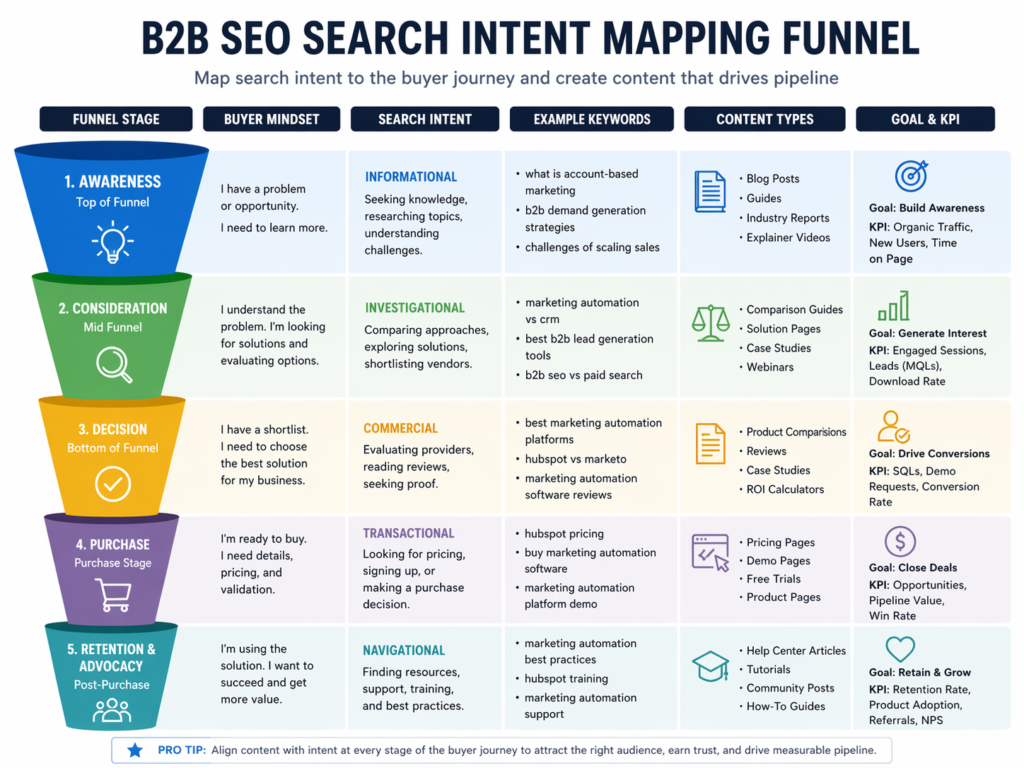
Map Search Intent Across the Buyer Journey
Start by grouping target keywords into three stages.
Awareness: buyers are trying to understand a problem
Example: “reduce cloud waste” or “B2B buyer journey SEO”
Consideration: buyers are comparing approaches or vendors
Example: “AWS vs Azure for regulated SaaS” or “best CRM for enterprise healthcare”
Decision: buyers are close to taking action
Example: “SEO agency for B2B SaaS” or “request cloud migration estimate”
This intent map keeps the case study focused on buyer behavior, not just keyword volume.
Build Topic Clusters Around High-Intent Keywords
A topic cluster usually includes one pillar page, several supporting articles, comparison pages, service pages, and proof assets.
For example.
A US SaaS company may need content around SOC 2, HIPAA, cloud integrations, and enterprise procurement.
A UK fintech company may need FCA, Open Banking, HMRC, Companies House, and UK-GDPR language.
A German SaaS vendor may need DSGVO/GDPR, BaFin, Frankfurt hosting, and German-language landing pages.
Localization is not just translation. It is about matching buyer expectations, compliance language, and regional trust signals.
Measure Rankings, Leads, Pipeline, and Revenue
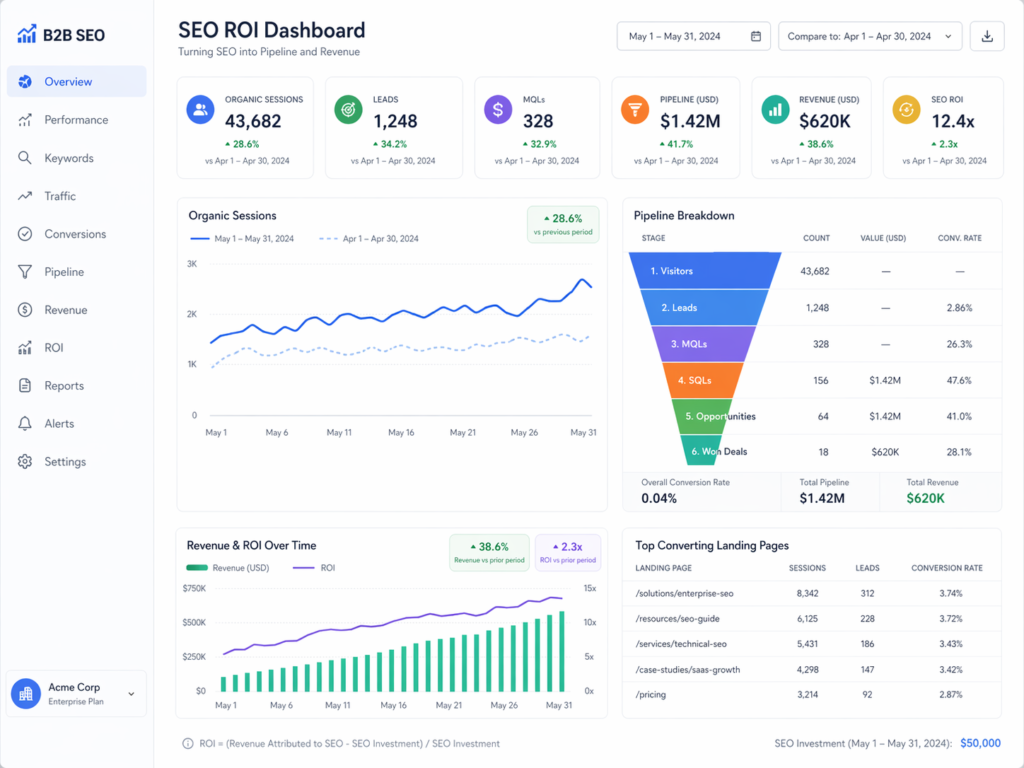
Track SEO progress at every stage. Use Google Search Console for impressions and rankings, GA4 for engagement and conversion tracking, and CRM tools like HubSpot or Salesforce for lead quality, opportunity value, and revenue influence.
The goal is to show movement from visibility to business impact.
A clean measurement flow could look like this.
Target keyword rankings improved.
Organic sessions increased from high-intent queries.
Demo requests or consultation forms increased.
Leads were qualified in the CRM.
Opportunities entered the sales pipeline.
Closed-won or influenced revenue was recorded.
Document What Changed
A strong case study explains what actually caused the improvement. Do not just show a graph going up.
Document the actions taken, such as.
New service pages
Updated comparison content
Technical SEO fixes
Internal linking improvements
Conversion-focused landing page changes
Better schema markup
Regional landing pages
Sales enablement assets
This helps readers trust the result because they can see the method behind it.
Package Proof Assets for Sales
The best B2B SEO case studies do not live only as blog posts. They become sales assets.
Turn one case study into:
A landing page for organic search
A one-page PDF for sales calls
A short LinkedIn post
A nurture email sequence
A slide for pitch decks
A procurement-friendly proof summary
Mak It Solutions’ Search Engine Optimization service is a natural fit for teams that want keyword research, content optimization, and analytics tracking. For stronger implementation, SEO can also connect with web designing services and front-end development services.
Repeat and Localize the Framework
A case study is most valuable when it becomes repeatable. Once the method works in one segment, adapt it for other regions, buyer types, or service lines.
For example, a framework built for US SaaS can be adapted for UK fintech, German cloud consulting, or EU e-commerce infrastructure. The structure stays the same, but the keywords, proof points, compliance language, and examples change.
How to Win High-Intent B2B SEO Queries
High-intent B2B SEO queries often have lower search volume, but they can convert better than broad informational topics.
Look for terms that show business need, urgency, or vendor evaluation, such as.
Services
Platform
Consulting
Implementation
Migration
Pricing
Comparison
Agency
Vendor
Case study
A keyword with 90 searches per month can be more valuable than one with 9,000 searches if it attracts CMOs, CTOs, CFOs, founders, or procurement teams with real budget authority.
The case study should explain why each keyword mattered. Show the target query, the buyer intent, the content created, and how that content influenced a lead or opportunity.
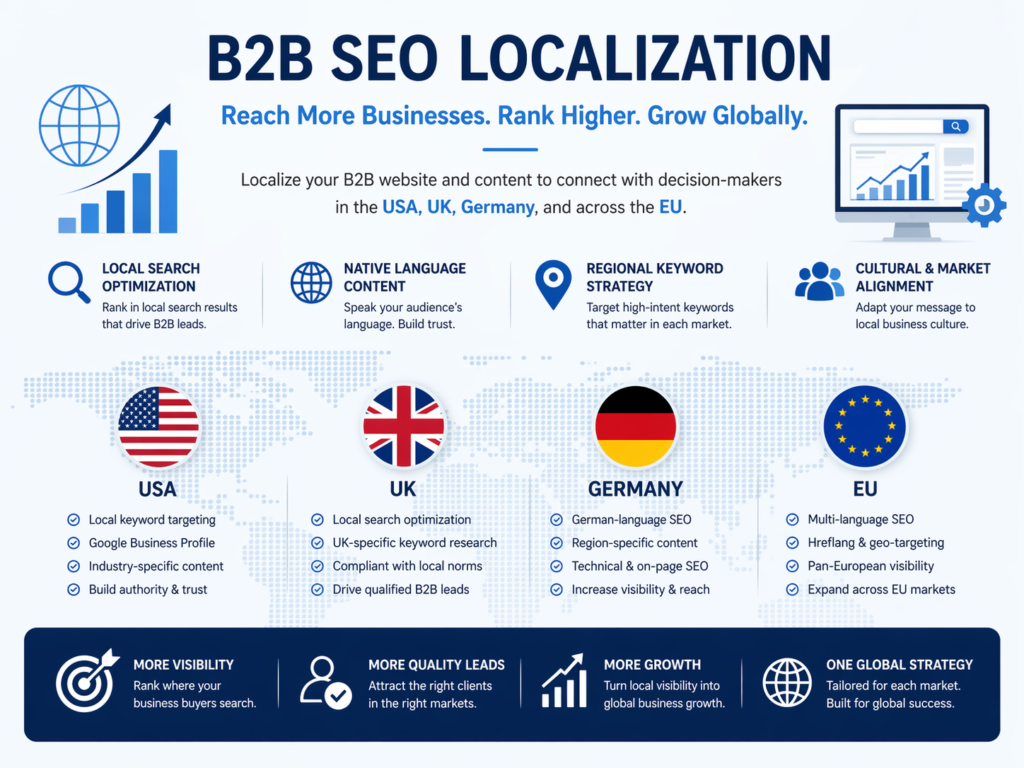
B2B SEO Case Study Framework for USA, UK, Germany, and EU Markets
A B2B SEO case study framework should be localized when the target markets include the USA, UK, Germany, or wider EU. Buyers in each region may care about different compliance terms, procurement processes, data hosting expectations, and trust signals.
USA.
In the United States, B2B SEO is often highly competitive across SaaS, healthcare, fintech, cybersecurity, and cloud services.
Buyers in New York, San Francisco, Austin, Boston, and other major tech markets may expect references to SOC 2, HIPAA, PCI DSS, AWS, Azure, integrations, and enterprise readiness.
For healthcare-related software, HIPAA language must be accurate. HHS describes the HIPAA Privacy Rule as setting national standards to protect medical records and other individually identifiable health information.
UK.
In the UK, a strong SEO case study should use terminology that British buyers recognize.
A London fintech buyer may care about FCA alignment, Open Banking, HMRC, Companies House, and UK-GDPR. A Manchester healthtech buyer may expect awareness of NHS procurement language and privacy requirements.
The ICO provides UK-GDPR guidance for organisations handling personal data, so UK-focused SEO content should use data protection language carefully and accurately.
Germany and EU: DSGVO, GDPR, BaFin, and Multilingual SEO
For Germany and the wider EU, SEO case studies should account for GDPR/DSGVO, data residency, local language preferences, and sector-specific trust signals.
A German financial services buyer may expect BaFin awareness. A cloud buyer in Frankfurt may care about EU hosting and data processing. A SaaS buyer in Amsterdam, Paris, Dublin, Stockholm, or Madrid may need localized examples rather than US-only proof.
For payment-related SaaS platforms, PCI DSS can also matter. The PCI Security Standards Council says its standards cover the way card data enters a system and how it is processed through secure payment applications.
B2B Content Strategy and Proof Assets That Convert
A case study becomes stronger when it supports both search and sales.
A good B2B content strategy can turn one SEO success story into.
A searchable landing page
A sales enablement PDF
A comparison page
A nurture sequence
A webinar topic
A proposal proof point
A LinkedIn thought leadership post
For technical service businesses, this is especially useful. SEO may bring the buyer in, but strong web design, development, and product delivery help convert that attention into a serious opportunity.
Mak It Solutions can connect SEO strategy with mobile app development services, React Native development services, and back-end development services when the buyer journey involves product, platform, or app development needs.
Common Mistakes in B2B SEO Case Studies
The biggest mistake is presenting SEO as a traffic story instead of a revenue story.
Other common mistakes include.
Focusing only on rankings without lead quality
Reporting traffic without pipeline context
Ignoring regional compliance signals
Using vague claims without proof
Publishing a case study without explaining the process
Overusing broad keywords that attract poor-fit visitors
Forgetting to connect SEO content with sales conversations
A strong case study should make one thing clear: the company did not just publish content. It targeted valuable queries, matched buyer intent, supported trust, and measured commercial impact.
To Sum Up
A B2B SEO case study framework is most valuable when it becomes a repeatable growth model. It helps marketing, sales, and leadership teams see how organic search supports real business outcomes.
Use it when leadership asks whether SEO is producing value. Use it when sales needs stronger proof. Use it when your team wants to turn rankings into qualified leads, pipeline, and measurable growth.
Mak It Solutions can help you build the framework, execute the content plan, and connect SEO performance to real pipeline. Explore the SEO service page or request a strategy review.( Click Here’s )
Key Takeaways
A strong B2B SEO case study framework should prove more than visibility. It should connect organic search to qualified leads, sales pipeline, and revenue influence.
The best framework includes:
Search intent mapping
High-intent keyword selection
Topic clusters
Regional localization
CRM-connected measurement
Sales-ready proof assets
A repeatable process
For USA, UK, Germany, and EU markets, localization matters. Compliance language, buyer terminology, city examples, and proof points should feel familiar to the target audience.
FAQs
Q : What should a B2B SEO case study include?
A : A B2B SEO case study should include the client profile, market context, baseline performance, target keywords, search intent map, content strategy, technical improvements, results, and business impact. It should also show how rankings translated into qualified organic leads, pipeline, or revenue.
Q : How long does B2B SEO take to generate qualified leads?
A : B2B SEO often takes several months to generate qualified leads, depending on competition, domain authority, content quality, and sales cycle length. Early signals may appear in Google Search Console within weeks, but pipeline impact usually takes longer. For competitive SaaS, cloud, cybersecurity, or consulting markets, a 6–12 month horizon is more realistic.
Q : How do B2B companies measure SEO ROI?
A : B2B companies measure SEO ROI by connecting organic search activity to conversions, sales opportunities, and closed revenue. Teams usually combine Google Search Console, GA4, HubSpot, Salesforce, and CRM data. Because B2B sales cycles are long, assisted conversions and multi-touch attribution are often more realistic than last-click reporting.
Q : Which keywords should B2B SaaS companies target first?
A : B2B SaaS companies should start with keywords that show clear commercial intent. These include comparison terms, integration queries, compliance-related searches, pricing modifiers, use-case pages, and industry-specific pain points. The best starting point is where buyer urgency and product fit overlap.
Q : How should B2B SEO content be localized for Europe?
A : B2B SEO content for Europe should localize language, compliance references, buyer examples, and hosting concerns. Germany may require DSGVO, BaFin, and Frankfurt data residency references. The UK may need UK-GDPR, FCA, NHS, or Companies House terminology. Do not simply translate US content; adapt it to local buyer expectations.