


B2B Service Provider Saudi Arabia: MENA Case Study Guide
B2B Service Provider Saudi Arabia: MENA Case Study Guide
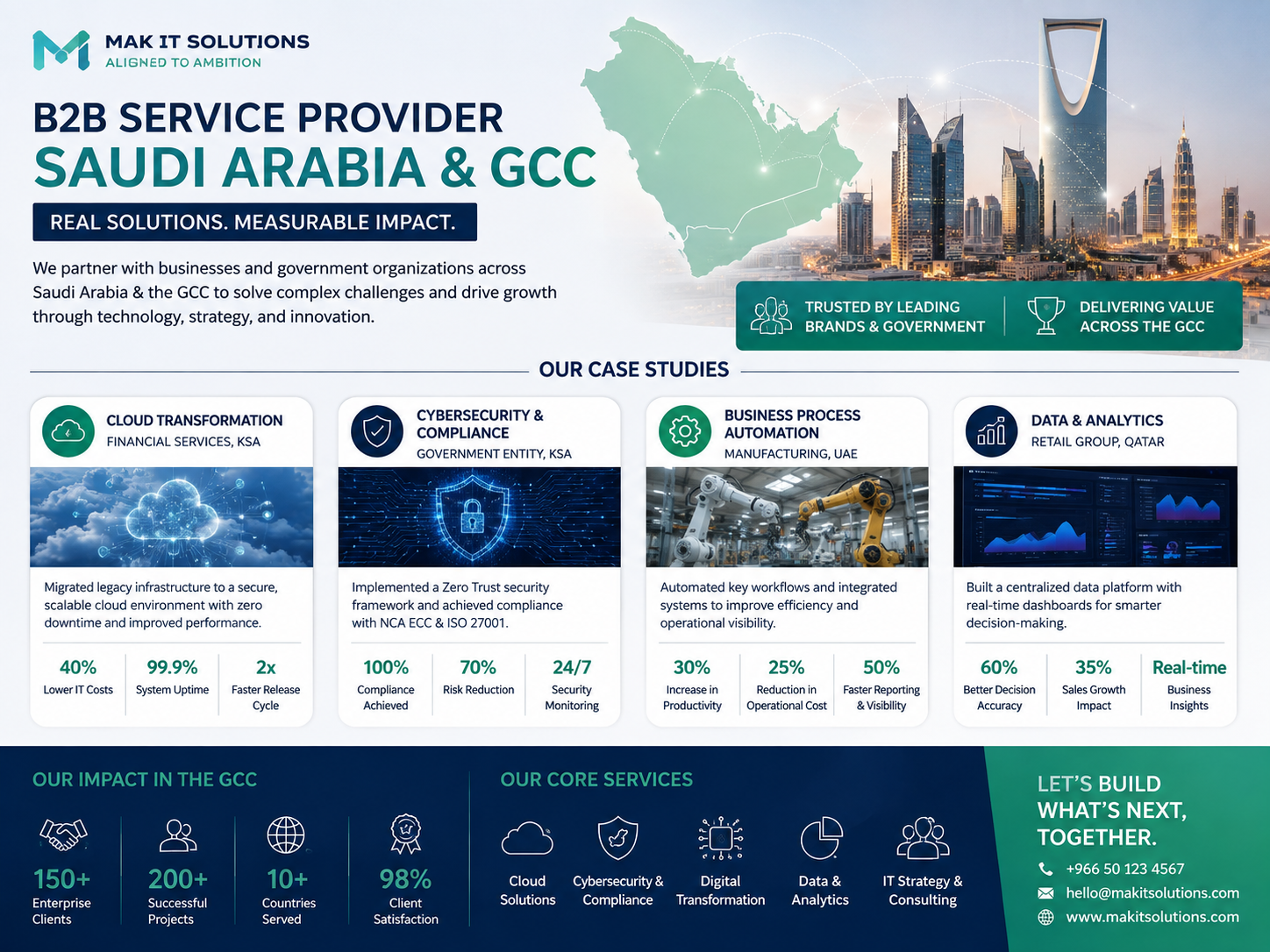
B2B Service Provider Saudi Arabia: MENA Case Study Guide
For a B2B service provider Saudi Arabia strategy, generic claims such as “trusted,” “innovative,” or “results-driven” are rarely enough to convince serious buyers. Procurement teams and decision-makers across Riyadh, Dubai, and Doha want evidence that a provider understands their market, industry, language requirements, compliance environment, and operational realities.
The simplest way to build that confidence is through localized case studies. Strong GCC case studies show what problem was solved, what local constraints mattered, how the provider executed, and what measurable result followed. That gives buyers something concrete to evaluate instead of another page full of promises.
Why GCC Buyers Need More Than Generic B2B Case Studies
Provider searches often signal stronger buying intent
Someone searching for a “B2B case study” may simply be researching. A buyer searching for a B2B service provider Saudi Arabia, an implementation partner, or a software company in Riyadh is more likely to be comparing potential vendors.
That is why case studies work best when they reinforce commercial pages such as Mak It Solutions’ digital marketing services and web development services, rather than sitting separately as portfolio content with no clear commercial path.
What Saudi, UAE, and Qatar buyers expect as proof
Strong GCC proof usually combines several signals.
Relevant market experience
Industry-specific understanding
Arabic and English delivery capability
Clear implementation expertise
Measurable business outcomes
Appropriate compliance or data-governance awareness
Compliance becomes especially important when a project touches finance, government, telecom, healthcare, or personal data.
Why local proof matters during vendor shortlisting
During RFPs and procurement reviews, buyers are trying to answer a simple but important question.
Has this company solved a comparable problem in a market like ours?
A relevant client success story can answer that question much faster than a broad capabilities page. That makes case studies useful for SEO, sales enablement, procurement conversations, and vendor evaluation.
How Localized Case Studies Strengthen B2B Service Provider Saudi Arabia Searches
Build content around service provider in Saudi Arabia
The most commercially useful format combines the service with the location. Examples include.
Cybersecurity provider Saudi Arabia
Software development company Riyadh
Cloud solutions provider KSA
Marketing agency Saudi Arabia
A B2B service provider Saudi Arabia page can then connect naturally to specialized capabilities such as search engine optimization services or business intelligence services.
The goal is not to repeat location keywords everywhere. It is to make the service, market, and commercial relevance obvious.
Add Riyadh, Jeddah, and Saudi market context where it is real
Mention Riyadh, Jeddah, or Dammam when the client, rollout, operating model, or target audience genuinely relates to those locations.
Local relevance becomes stronger when the city explains something meaningful about the project. Using city names purely as SEO decoration usually weakens the content instead of strengthening it.
Show the full Saudi proof chain
A useful case study should make the commercial story easy to extract.
Client sector → Saudi market → business problem → local constraint → solution → measurable result → timeframe
For example, a Riyadh fintech case study could explain how a provider adapted onboarding, infrastructure, or implementation processes around relevant Saudi financial requirements.
SAMA supervises regulated financial activities and also operates a fintech regulatory sandbox, so genuine regulatory context can make a case study more credible when it actually applies.
How UAE and Qatar Case Studies Should Differ From Saudi Content
Dubai and UAE pages need sharper commercial differentiation
Dubai is a highly competitive business market, so a useful case study should go beyond saying that a project was “successful.”
It should explain the industry, delivery model, commercial challenge, and measurable outcome.
For example, a Dubai e-commerce case study might focus on.
Arabic user experience
Mobile conversion
Cross-device performance
Scalable development
Regional customer journeys
Where relevant, this can connect naturally to capabilities such as React Native development expertise.
Qatar content can stand out through deeper local specificity
In Doha, detailed local context can help a provider differentiate itself. That may include procurement familiarity, bilingual delivery, sector knowledge, cloud architecture, or infrastructure requirements.
Google Cloud operates a Doha region, while Microsoft lists Qatar Central in Doha. Cloud location can therefore become relevant when architecture, latency, or residency requirements make regional infrastructure important.
GCC-wide delivery versus country-specific expertise
A regional provider can make cross-border delivery easier by using one delivery framework across several GCC markets.
Country-specialist teams, however, may offer deeper knowledge of local buying processes, regulations, industries, and business expectations.
In practice, the strongest positioning often combines both: a consistent GCC delivery model supported by localized Saudi, UAE, and Qatar execution.
What Compliance and Localization Signals Should GCC Case Studies Include?
Saudi Arabia.
For fintech or data-led engagements, references to SAMA, SDAIA, or NDMO should only appear when the project genuinely involved regulated operations, privacy, governance, hosting, or data management.
A Riyadh fintech scenario can credibly reference SAMA because the Saudi Central Bank regulates financial institutions and fintech activities. (SAMA Rulebook)
The key is relevance. Regulatory names should support the case study, not function as decorative authority signals.
UAE.
A UAE technology case study may reference TDRA when digital, telecom, or government-related requirements are relevant. DIFC or ADGM may matter in financial-services projects.
Infrastructure choices can also strengthen a technically detailed case study. Microsoft lists UAE Central in Abu Dhabi, while AWS operates a Middle East UAE region. These options can matter when regional architecture, availability, or data considerations shape the project.
Qatar.
For Qatar fintech projects, QCB can be particularly relevant. Its FinTech Supervision Department regulates QCB-licensed fintech companies and monitors compliance. (Qatar Central Bank)
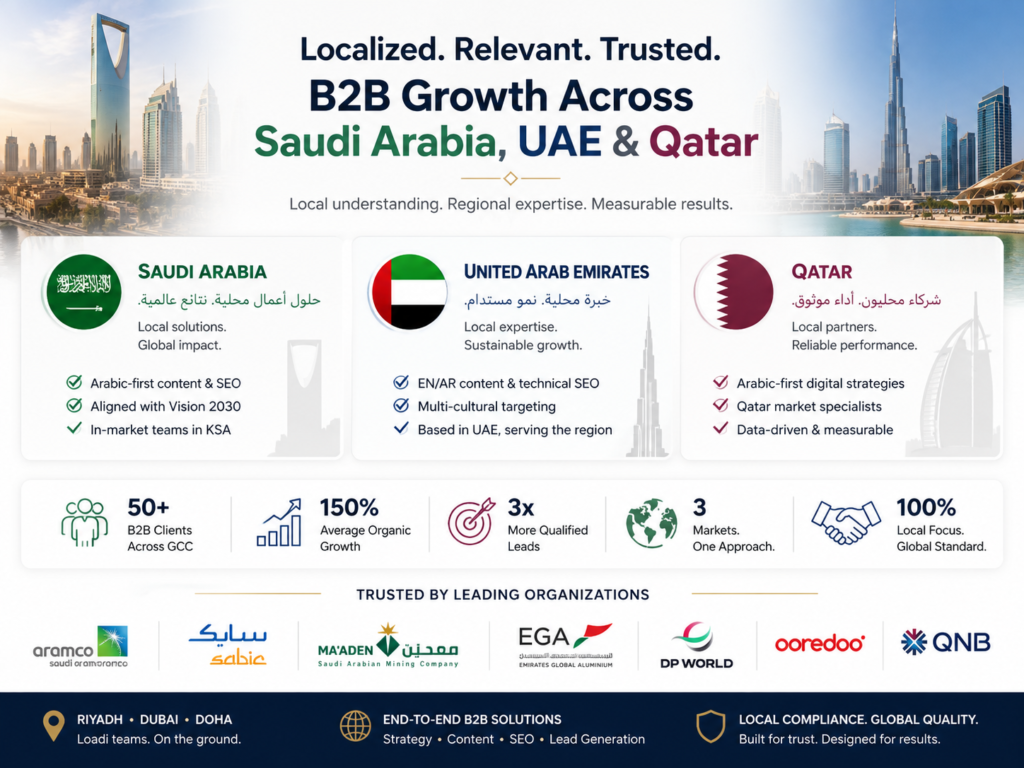
Again, the strongest case studies mention these organizations only when there is a clear relationship to the project.
How to Build a GCC Case Study That Helps Win Provider Searches
Define the buyer, service, and GCC market
Start by identifying.
The buyer
The service delivered
The client sector
The GCC country
The relevant city, if applicable
Then connect the case study to the most appropriate capability in Mak It Solutions’ services portfolio.
This gives the proof page a clear commercial purpose.
Document the local problem and constraint
Explain what made the engagement specifically relevant to the GCC.
That might include.
Arabic UX requirements
Procurement processes
Regulatory approval
Market-entry friction
Local hosting
Data residency
Bilingual customer journeys
Regional integration requirements
These details help buyers understand that the provider dealt with a real market situation rather than a generic project.
Show execution, quantified results, and timeframe
Replace vague success claims with results buyers can quickly evaluate.
Depending on the project, useful metrics may include.
Qualified leads
Pipeline contribution
Conversion improvement
Deployment speed
Implementation time
Cost efficiency
Revenue impact
Performance improvements
A B2B service provider Saudi Arabia case study becomes much more persuasive when readers can understand what changed and how long the result took to achieve.
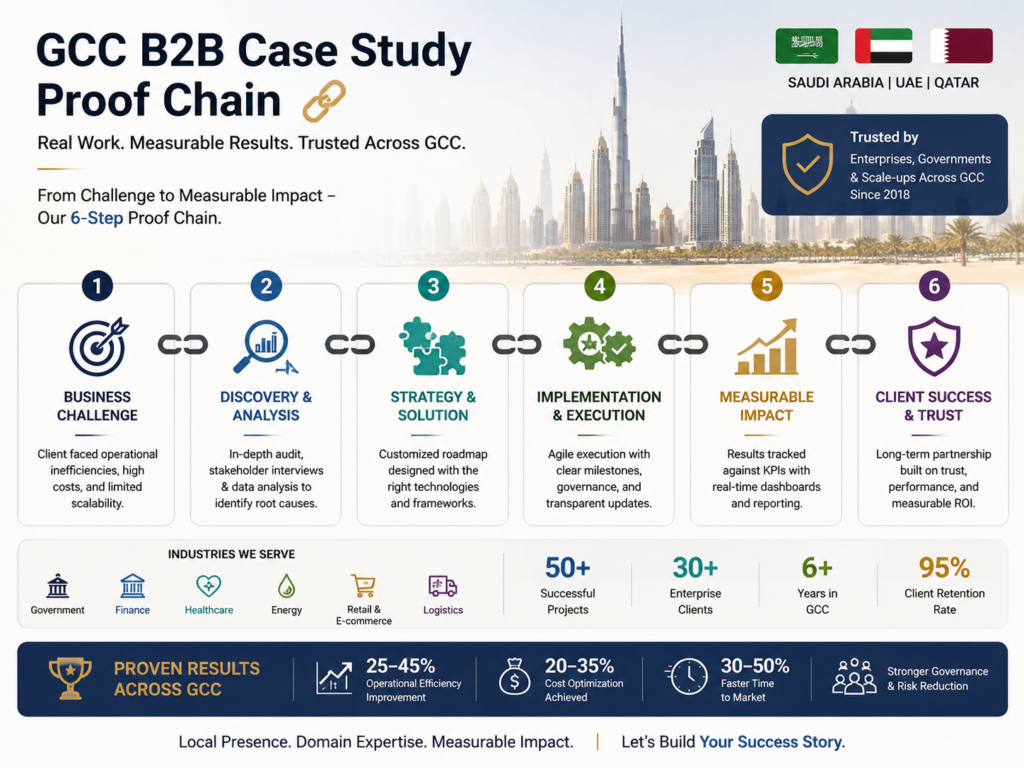
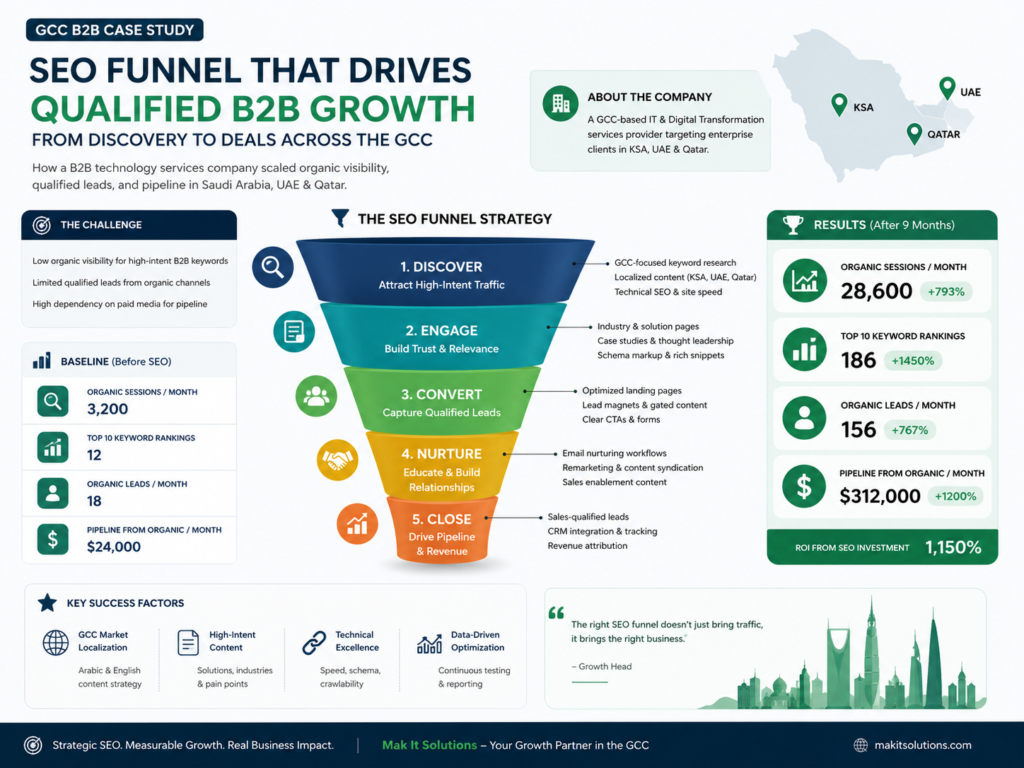
How Case Studies Support a Complete GCC SEO Funnel
Money pages capture direct provider demand
Service-location pages can target high-intent searches from buyers already looking for a vendor.
Case studies then support those pages by providing evidence that the company can deliver.
Technical providers can also connect relevant proof pages to capabilities such as backend development services.
Proof and comparison pages reduce buyer uncertainty
Case studies, provider comparisons, industry pages, and implementation examples all reduce uncertainty.
They help buyers answer questions such as.
Has this provider worked in my market?
Does it understand my industry?
Can it handle the implementation?
What type of results has it delivered?
Does it understand local constraints?
Those are commercial questions, not just SEO questions.
AEO pages answer vendor-selection questions directly
Question-led pages can support the same funnel by answering high-intent queries such as.
How do I choose a B2B service provider in Saudi Arabia?
What should I look for in a Riyadh technology partner?
Do GCC buyers prefer local case studies?
Should Saudi and UAE case studies be different?
Clear answers can help search engines and AI systems extract useful information while guiding buyers toward relevant proof and commercial services.
Best Practices for Publishing GCC B2B Case Studies
Put the market, sector, and outcome near the top
Readers should not have to scroll through a long introduction to understand the project.
State the following early.
Client sector
GCC market
Service delivered
Core problem
Key outcome
This improves readability and makes the page easier for answer engines to interpret.
Use local entities naturally
Useful GCC scenarios might include.
A Riyadh fintech aligning implementation with relevant SAMA requirements
A Dubai e-commerce brand improving Arabic and mobile customer experiences
A Doha SME evaluating Qatar-region cloud infrastructure
AWS also operates its Middle East Bahrain region, creating another regional infrastructure option when architecture and compliance requirements permit it.
The important point is that each reference should explain something real about the project.
Link every case study to a commercial next step
A proof page should not become a dead end.
Give readers a logical next action, such as
Requesting a consultation
Exploring a relevant service
Starting an RFP discussion
Reviewing a technical capability
Contacting the delivery team
For content-led and website projects, Mak It Solutions’ WordPress development services can provide another relevant commercial destination.
Last Words
For a B2B service provider Saudi Arabia strategy, strong case studies do more than showcase past work. They reduce buyer uncertainty, prove market understanding, support high-intent SEO pages, and give procurement teams evidence they can actually evaluate.
The strongest GCC case studies are specific. They explain the market, client problem, local constraint, implementation approach, measurable outcome, and timeframe without forcing location or compliance references where they do not belong.
Want to turn your Saudi, UAE, or Qatar experience into stronger commercial proof? Contact Mak It Solutions to discuss your market goals, explore the right digital services, and build a regional approach around relevant, measurable outcomes.
FAQs
Q : Do Saudi B2B buyers prefer local case studies from Riyadh or KSA clients?
A : Local Saudi proof can be persuasive because it demonstrates familiarity with the market rather than theoretical GCC knowledge. A Riyadh example may be particularly relevant for enterprise buyers, while a broader KSA case study can work well when delivery spans Jeddah, Dammam, or multiple regions.
For regulated sectors, relevant SAMA context may also strengthen credibility. However, the strongest case study is the one that best matches the buyer’s industry, problem, implementation complexity, and expected result.
Q : Should a Dubai service provider create separate UAE and Dubai case-study pages?
A : Sometimes. A dedicated Dubai page makes sense when the engagement, buyer audience, or commercial intent is genuinely Dubai-specific.
A broader UAE case study may be more appropriate when the implementation spans Dubai, Abu Dhabi, and other emirates. Avoid creating nearly identical pages just to target different locations; each page should contain genuinely distinct market context, client needs, and outcomes.
Q : Can a GCC-wide case study rank for Saudi Arabia provider searches?
A : A GCC-wide case study can support Saudi visibility, but it may be less directly relevant than Saudi-specific proof for a B2B service provider Saudi Arabia search.
A stronger approach is to use regional case studies alongside Saudi-focused commercial content that explains local delivery, industries, constraints, and outcomes. Regional proof should strengthen KSA relevance, not replace it.
Q : What results should a Qatar B2B case study include?
A : A Qatar case study should emphasize outcomes buyers can evaluate, such as implementation time, qualified leads, conversion improvement, cost efficiency, revenue impact, or deployment performance.
It should also explain any Doha-specific operating constraint, bilingual requirement, or regulated-sector consideration. For fintech, QCB context can be useful where the project genuinely involved regulated financial activity.
Q : Should GCC case studies be published in both English and Arabic?
A : For many GCC audiences, bilingual publishing can improve accessibility and buyer confidence, especially when Arabic-speaking executives, procurement teams, or government stakeholders are part of the buying committee.
The Arabic version should be professionally localized rather than mechanically translated. Technical terminology, claims, and measurable results should remain consistent between the two versions.