Blogs
Checkout Optimization in GCC: Reduce Cart Abandonment
Content Editor · November 24, 2026 · 13 min read
Direct answer
Is mada payment integration necessary for Saudi ecommerce stores?
Mada can be commercially valuable for Saudi ecommerce businesses, but it is not necessarily a universal legal requirement for every merchant. Retailers should evaluate customer preferences, payment provider capabilities and applicable SAMA requirements before choosing their integrations.
Getting customers to add products to their shopping carts is only half the battle. If your checkout is complicated, slow or missing familiar payment options, even customers who are ready to buy may leave. Checkout…
Checkout Optimization in GCC: Reduce Cart Abandonment
Getting customers to add products to their shopping carts is only half the battle. If your checkout is complicated, slow or missing familiar payment options, even customers who are ready to buy may leave.
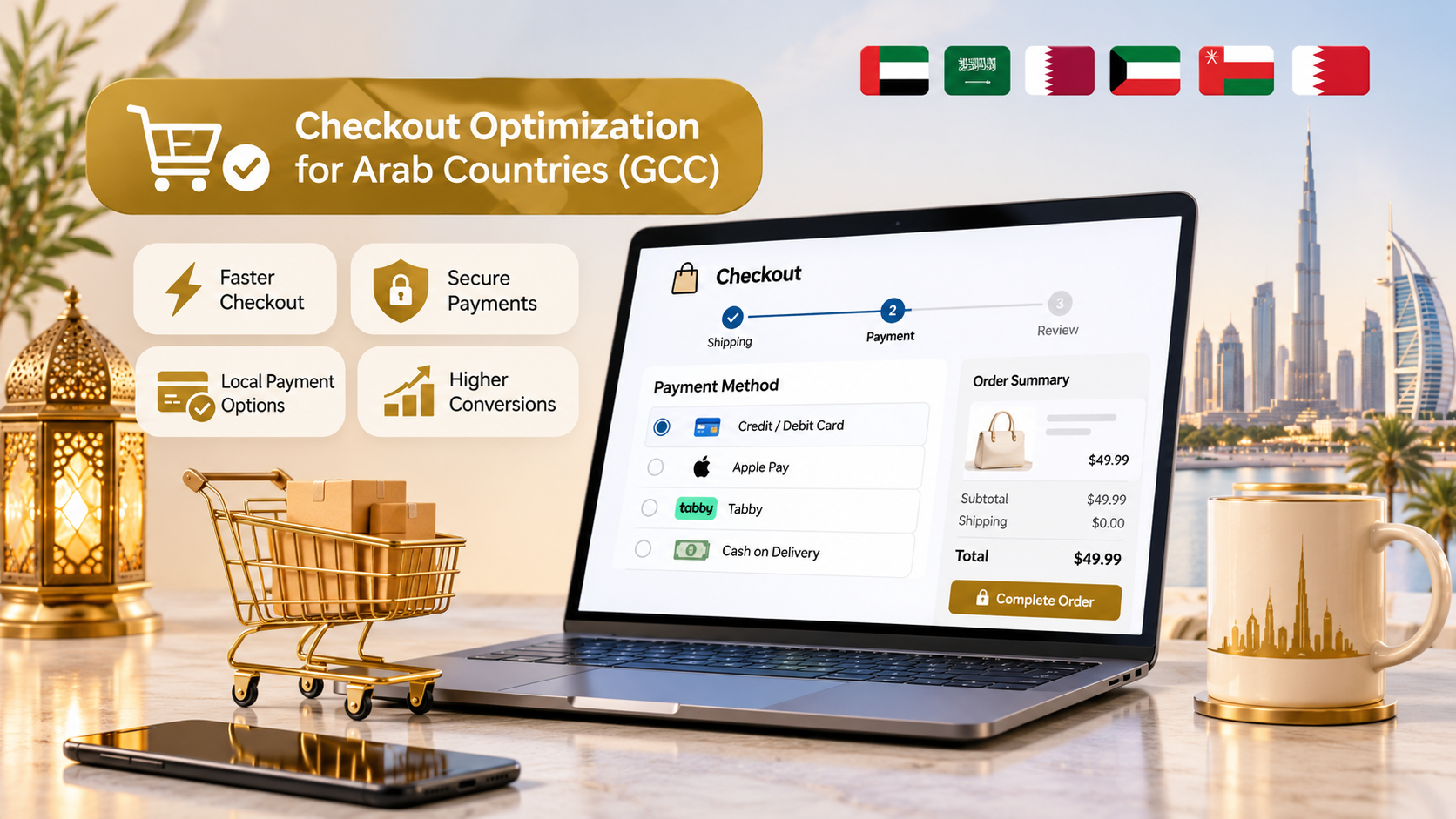
Checkout optimization helps ecommerce businesses across Arab countries reduce cart abandonment by simplifying forms, offering guest checkout, integrating local payment methods and improving Arabic mobile experiences. Transparent delivery costs, secure transactions and reliable payment recovery can also help improve checkout completion and customer confidence.
According to the Baymard Institute, approximately 70% of online shopping carts are abandoned globally. While this is an international benchmark rather than a GCC-specific statistic, it highlights the importance of improving the purchasing experience.
For businesses in Riyadh, Dubai and Doha, a better checkout experience presents an opportunity to generate more revenue from existing website traffic.
This guide focuses on the six GCC countries, with particular attention to Saudi Arabia, the UAE and Qatar. Other Arab markets, including Egypt, Jordan and Morocco, may have different payment preferences and customer expectations.
What Is Checkout Optimization and Why Does It Matter in the GCC?
Checkout optimization is the process of improving the ecommerce purchasing journey to reduce customer effort, eliminate unnecessary steps and make completing a transaction easier.
It involves more than redesigning a payment page. Everything from entering a delivery address to receiving an order confirmation contributes to the overall checkout experience.
Cart Abandonment vs. Checkout Abandonment
Although these terms are often used interchangeably, they measure different stages of the purchasing journey.
|
Metric |
Meaning |
|---|---|
|
Cart abandonment |
A customer adds products to their cart but does not complete a purchase. |
|
Checkout abandonment |
A customer starts the checkout process but leaves before completing the order. |
Tracking both metrics helps businesses understand where potential customers are dropping out and which areas need improvement.
Why Shoppers Abandon Ecommerce Checkouts in Arab Countries
Common reasons for incomplete purchases include.
Unexpected shipping charges.
Unavailable or unfamiliar payment methods.
Mandatory account registration.
Complicated delivery address forms.
Payment failures and unclear error messages.
Poor Arabic language support.
Unclear return and refund policies.
Limited mobile usability.
Concerns about payment security.
A customer may genuinely want your product but decide against purchasing because the checkout experience requires too much effort.
How Checkout Friction Affects Ecommerce Revenue
Every unnecessary checkout step can reduce the return on your customer acquisition spending.
Rather than immediately increasing advertising budgets, ecommerce businesses should examine whether their existing checkout experience is preventing customers from completing purchases.
Improving conversion efficiency can help businesses generate additional revenue without necessarily increasing website traffic.
7 Checkout Optimization Strategies to Reduce Cart Abandonment
An effective ecommerce checkout should feel simple, familiar and trustworthy. The following strategies can help GCC businesses identify and address common purchasing barriers.
Simplify Checkout Forms
Ask customers only for information necessary to process payments and deliver their orders.
Remove redundant fields, enable address autofill where available and use clear inline validation to help customers correct mistakes without restarting the process.
Address forms should also accommodate the delivery requirements of each target market.
Enable Guest Checkout
Not every customer wants to create an account before making a purchase.
Guest checkout allows first-time shoppers to complete their orders without unnecessary registration. Businesses can offer optional account creation after the purchase instead.
This is particularly useful for customers shopping through mobile advertisements or seasonal promotional campaigns.
Reduce Unnecessary Checkout Steps
A shorter checkout is not automatically better, but every step should serve a clear purpose.
Test single-page and multi-step checkout layouts to determine which performs better for your customers.
For multi-step checkouts, progress indicators can help shoppers understand how much information remains before completing their orders.
Prioritize Mobile Checkout Optimization
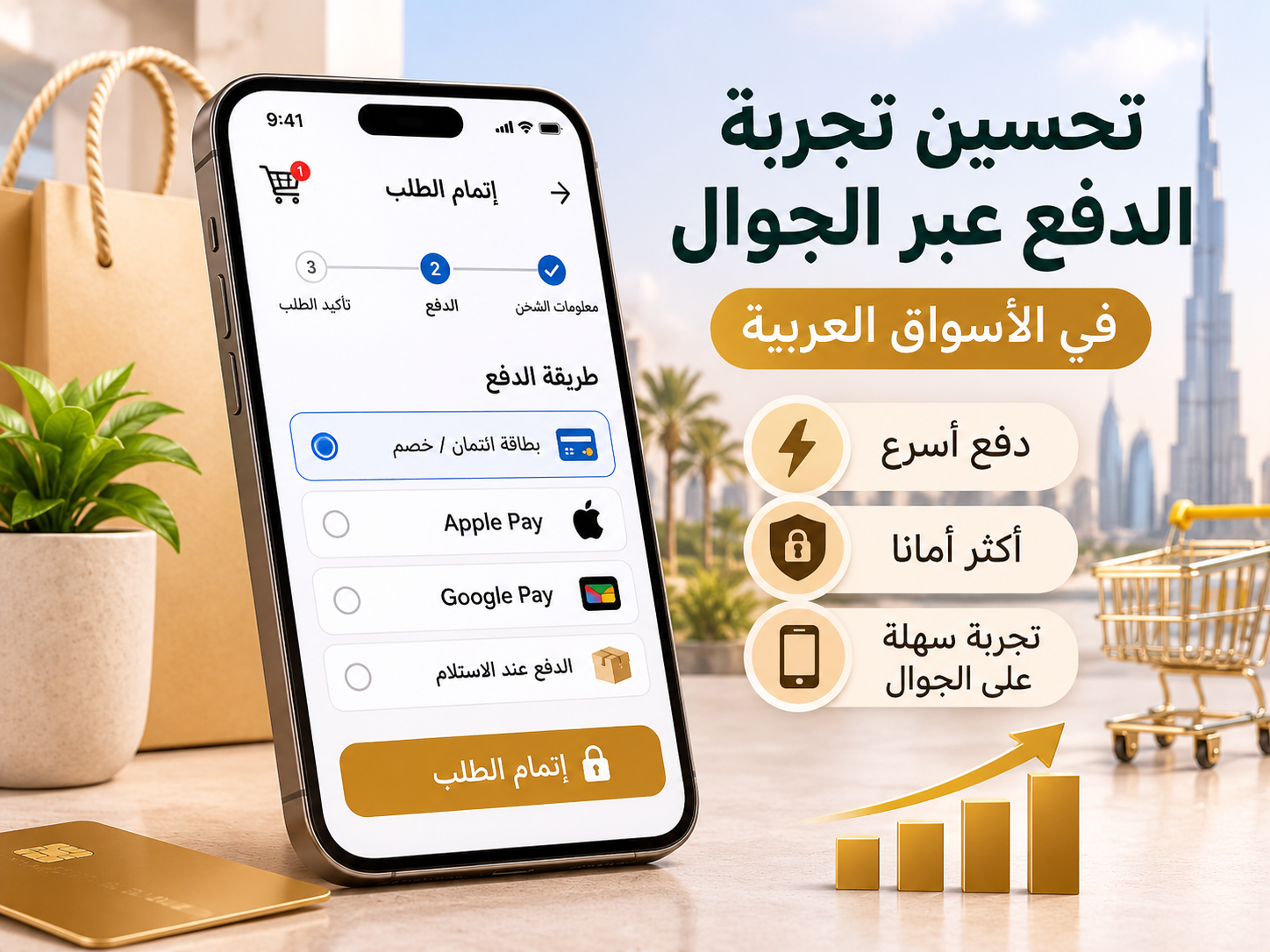
Mobile checkout should be designed around how customers actually interact with their smartphones.
Focus on.
Responsive checkout forms.
Large, accessible payment buttons.
Appropriate mobile keyboard inputs.
Fast-loading pages.
Supported express payment options.
Easy-to-read order summaries.
Customers should not need to zoom in, scroll horizontally or repeatedly enter the same information.
Provide a Natural Arabic Checkout Experience
Arabic localization requires more than translating English text.
An effective Arabic checkout should include proper right-to-left (RTL) layouts, readable typography, accurate translations and locally appropriate currency formatting.
Customers should also be able to switch between Arabic and English without losing their shopping cart or previously entered information.
Display Delivery Costs Early
Unexpected shipping charges can discourage customers who were otherwise ready to complete their purchases.
Show available delivery options, shipping fees and estimated arrival dates as early as possible.
For example, a Dubai electronics retailer could display delivery charges directly within the shopping cart rather than introducing them at the final payment stage.
Communicate Returns and Final Prices Clearly
Customers should know exactly what they are paying for and what happens if they need to return a product.
Make the final order total, applicable taxes, refund conditions and customer support information easy to find.
Clear communication reduces uncertainty and helps customers make informed purchasing decisions.
Integrating GCC Payment Methods to Improve Checkout Conversion
A well-designed checkout can still lose customers if it does not support their preferred payment methods.
Payment localization should therefore be a central part of any GCC ecommerce strategy.
Local Ecommerce Payment Methods Across GCC Countries
|
Country |
Payment methods to evaluate |
Currency |
|---|---|---|
|
Saudi Arabia |
mada, Apple Pay, Tabby, Tamara |
SAR |
|
UAE |
Cards, Apple Pay, BNPL |
AED |
|
Qatar |
NAPS, Himyan, supported digital wallets |
QAR |
|
Kuwait |
KNET |
KWD |
|
Bahrain |
BenefitPay |
BHD |
|
Oman |
OmanNet |
OMR |
Payment availability depends on merchant eligibility, acquiring arrangements, payment gateway support and technical integration capabilities.
Businesses should evaluate the methods relevant to their customers rather than adding every available payment option.
Digital Wallets, Buy Now Pay Later and Cash on Delivery
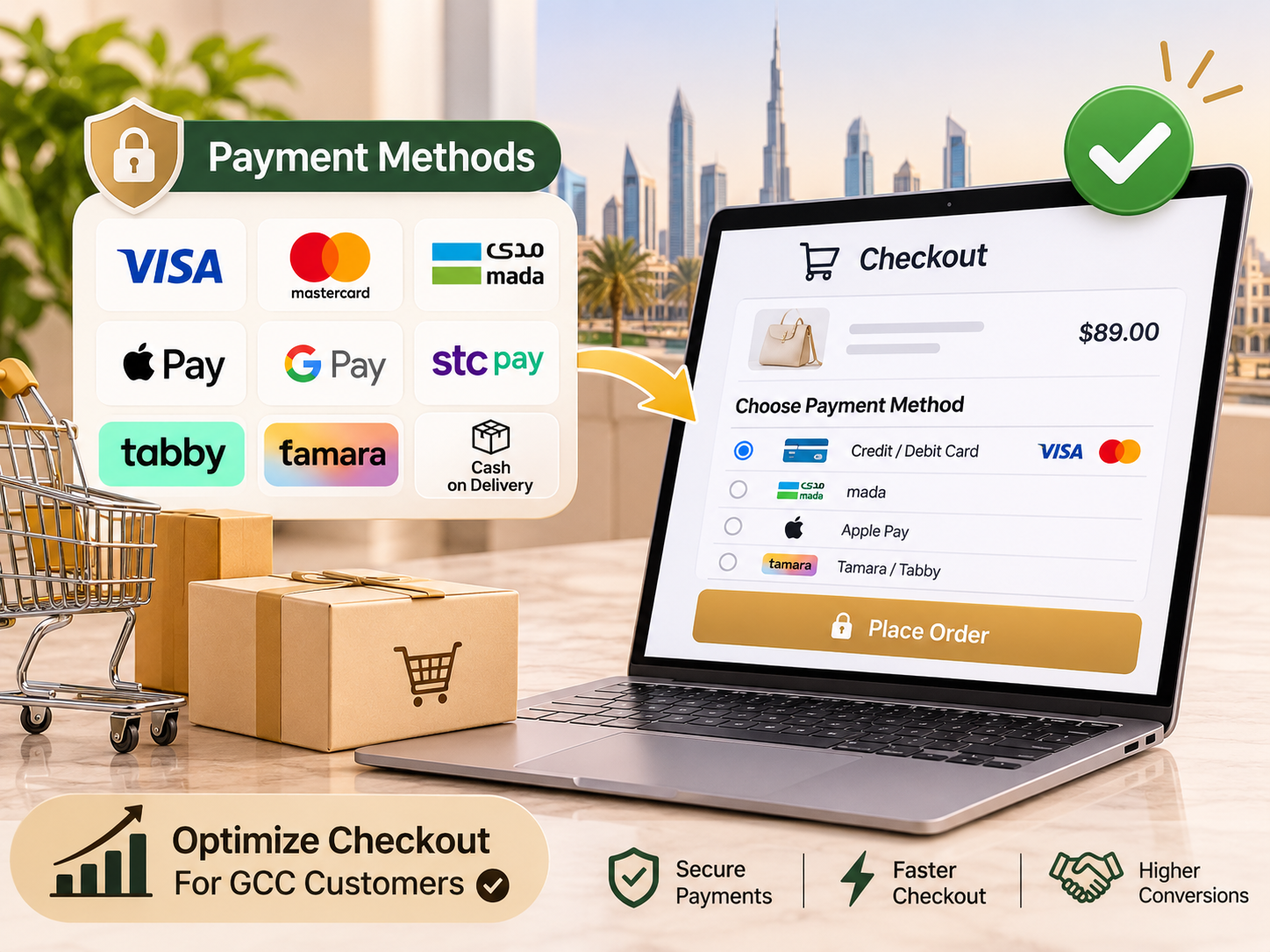
Digital wallets such as Apple Pay and Google Pay can simplify mobile payments where supported.
Buy Now Pay Later (BNPL) providers such as Tabby and Tamara may offer additional flexibility for eligible customers and merchants.
Cash on delivery can also be considered where commercially appropriate. However, businesses should implement suitable order confirmation procedures to manage failed deliveries and unfulfilled orders.
No individual payment method guarantees higher conversion rates. Performance should be measured against customer preferences, transaction costs and completed purchases.
Reducing Payment Failures and Authentication Friction
A failed payment should not force a customer to restart the entire checkout process.
Preserve entered information where appropriate, provide understandable error messages and allow customers to retry or select an alternative payment method.
Providers such as HyperPay, Tap Payments, PayTabs, Checkout.com and SADAD can be evaluated based on market coverage, supported payment networks, integration capabilities and payment authorization performance.
Checkout Optimization Best Practices for Saudi Arabia, UAE and Qatar
Although GCC countries share certain ecommerce characteristics, a single checkout configuration may not suit every market.
|
Saudi Arabia |
UAE |
Qatar |
|---|---|---|
|
High-quality Arabic UX |
Bilingual checkout UX |
Localized address fields |
|
mada integration |
Digital wallets |
NAPS and Himyan |
|
SAR pricing |
AED pricing |
QAR pricing |
|
National Address compatibility |
Flexible delivery instructions |
Zone and building information |
Checkout Optimization for Saudi Ecommerce Stores
Saudi ecommerce businesses should evaluate mada integration, Arabic checkout usability, Saudi National Address-compatible forms and transparent SAR pricing.
Applicable tax and invoicing requirements should also be considered through official guidance from the Zakat, Tax and Customs Authority (ZATCA).
For example, a Riyadh fashion retailer using Salla, Zid or Shopify could review its mobile checkout and simplify registration before launching a Ramadan campaign.
Where platform limitations prevent further improvements, professional ecommerce development services can help businesses explore suitable customization and integration options.
Mobile Checkout Optimization for UAE Online Stores
UAE ecommerce businesses should consider both Arabic and English-speaking customers when designing their checkout experiences.
Express payments, responsive forms and flexible delivery instructions can help customers shopping in Dubai, Abu Dhabi and Sharjah complete their orders with less effort.
Businesses investing in mobile app development should also prioritize reliable payment integrations and consistent checkout experiences across mobile applications and websites.
Checkout Optimization for Qatar and Other GCC Markets
Qatar ecommerce businesses should design address forms around their delivery partners' requirements, including relevant zone, street and building information.
A Doha retailer could simplify these fields while evaluating domestic payment networks supported by its acquiring partner.
Businesses expanding into Kuwait, Bahrain and Oman should similarly assess KNET, BenefitPay and OmanNet rather than assuming that their existing payment setup will meet every market's needs.
Building Secure and Compliant Ecommerce Checkout Experiences in the GCC
A convenient checkout must also protect customer information and support applicable regulatory requirements.
Security and compliance should be considered during checkout development rather than treated as an afterthought.
GCC Payment Regulations and Merchant Responsibilities
Businesses should evaluate appropriately authorized payment service providers within their target markets.
Relevant regulatory authorities include.
-
Saudi Arabia: Saudi Central Bank (SAMA).
-
Qatar: Qatar Central Bank (QCB).
Ordinary ecommerce retailers do not automatically require central bank licensing. Applicable obligations depend on their business activities, payment arrangements and regulatory classification.
Customer Data Privacy and Secure Payment Processing
Ecommerce businesses should consider Saudi Arabia's Personal Data Protection Law (PDPL), UAE data protection legislation and Qatar's applicable privacy framework.
Professional web development services can support secure checkout architecture through appropriate measures such as.
HTTPS encryption.
Payment tokenization.
Applicable PCI DSS requirements.
EMV 3-D Secure authentication.
Secure handling of customer information.
Controlled access to sensitive data.
Local data hosting requirements depend on applicable legal, regulatory and contractual obligations.
Checkout Trust Signals That Improve Customer Confidence
Customers should feel confident about sharing personal information and completing payments through your online store.
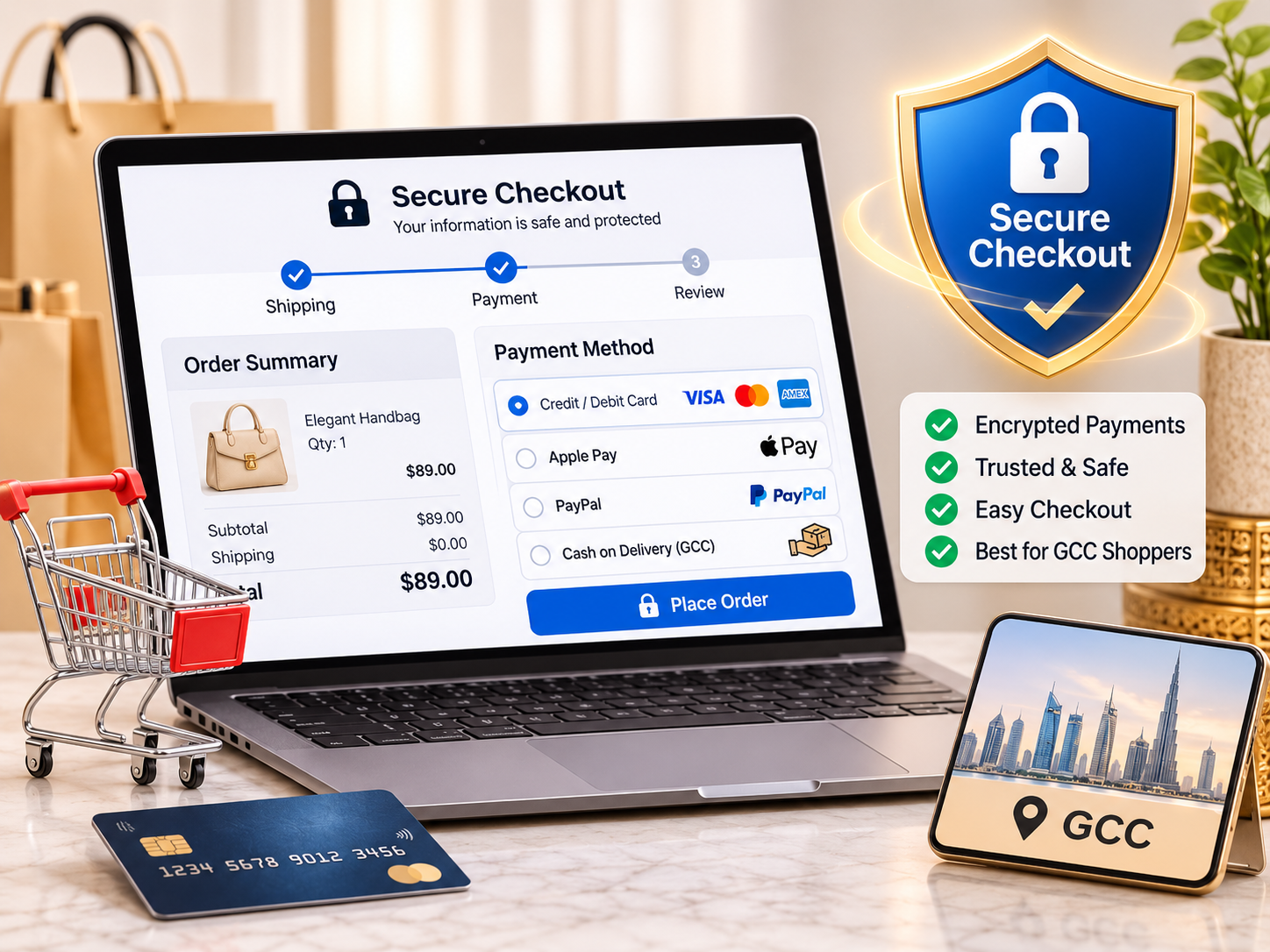
Useful trust signals include genuine customer reviews, recognizable payment methods, clear business information, accessible return policies and responsive bilingual customer support.
Avoid displaying misleading security badges or unsupported certification claims. Trust is built through genuine transparency and reliable service.
Regulatory requirements vary across GCC markets. Businesses should confirm their specific obligations with relevant authorities, payment providers or qualified compliance professionals.
How to Measure, Test and Improve Checkout Performance
Checkout optimization is an ongoing process. Without reliable measurement, businesses cannot determine which changes are actually improving performance.
Essential Checkout KPIs for GCC Ecommerce Businesses
|
KPI |
Calculation |
|---|---|
|
Cart abandonment rate |
(1 − completed purchases ÷ eligible carts) × 100 |
|
Checkout completion rate |
Completed checkouts ÷ initiated checkouts × 100 |
|
Checkout abandonment rate |
100% − checkout completion rate |
|
Payment authorization rate |
Approved authorizations ÷ attempted authorizations × 100 |
|
Ecommerce conversion rate |
Sessions with purchases ÷ total sessions × 100 |
|
Cart recovery rate |
Recovered carts ÷ eligible abandoned carts × 100 |
Use consistent measurement periods, attribution rules and customer cohorts when comparing results.
Checkout Performance Calculator: An Illustrative Example
Consider a hypothetical GCC ecommerce business with the following performance figures.
Checkout revenue opportunity calculator
Adjust the hypothetical figures to estimate potential additional revenue.55.0%
60.0%
+10 pp
+75
SAR 15,000
In this example, 1,000 shopping carts generate 750 checkout starts and 450 completed purchases.
The cart abandonment rate is 55%, while the checkout completion rate is 60%.
If checkout completion improves by 10 percentage points, the business could generate 75 additional orders. With an average order value of SAR 200, this represents SAR 15,000 in potential additional revenue for the measured period.
This hypothetical projection assumes unchanged checkout traffic and average order value. Actual results will depend on customer behavior, implementation quality and other business factors.
Using GA4 and A/B Testing to Identify Checkout Friction
Google Analytics 4 (GA4) can help businesses identify where shoppers leave the ecommerce purchasing journey.
Ecommerce conversion funnel
Customer views a product
view_item
Product added to shopping cart
add_to_cart
Customer starts checkout
begin_checkout
Delivery information submitted
add_shipping_info
Payment information submitted
add_payment_info
Purchase completed
purchase
These events help businesses understand whether customers are leaving before checkout, during address entry or at the payment stage.
With appropriate business intelligence solutions, ecommerce teams can segment checkout performance by country, device, language and payment method.
Test individual improvements through A/B testing rather than changing everything simultaneously. This makes it easier to identify which adjustments contribute to measurable results.
Recovering Abandoned Carts Without Compromising Customer Privacy
Not every abandoned cart represents a lost customer.
Consent-aware email and WhatsApp reminders can encourage interested shoppers to return and complete their purchases.
Recovery messages should be relevant, helpful and appropriately timed. Avoid excessive messaging or unnecessary discounts that reduce profitability.
Businesses can also test cart recovery campaigns around Ramadan, Eid and White Friday while respecting applicable marketing consent and privacy requirements.
To Sum Up
Your checkout should make purchasing easier, not create another obstacle between customers and your products.
For ecommerce businesses in Saudi Arabia, the UAE and Qatar, effective checkout optimization brings together Arabic localization, convenient payment options, transparent pricing, secure transactions and continuous performance testing. Mak It Sol
Start by identifying where customers abandon their purchases. Then prioritize improvements that address measurable problems rather than investing in unnecessary features.
At Mak IT Solutions, we understand the importance of connecting ecommerce technology with business objectives. Explore our ecommerce transformation experience to see how a structured development approach can support online businesses.
Book a free consultation with Mak IT Solutions to discuss a checkout UX audit tailored to your business and target GCC markets.
FAQs
Frequently asked questions
Quick answers related to this article.
Comments
Join the discussion. Comments are moderated.
No comments yet. Be the first to share a thought.
Building something related?
Tell us about your product goals — we’ll respond with a clear next step.
Discuss your project