
Blogs
Shopify Store Setup GCC: Dubai Growth Guide
Content Editor · November 17, 2026 · 11 min read

Direct answer
Can I Accept mada Payments on a Saudi Shopify Store?
Yes, potentially. Saudi Shopify merchants can accept mada payments through a compatible gateway that supports the network and their merchant configuration.
A successful Shopify store setup GCC requires more than a polished website. Customers in Saudi Arabia, the UAE and Qatar expect familiar payment methods, clear delivery information, local pricing and an easy mobile…
Shopify Store Setup GCC: Dubai Growth Guide
A successful Shopify store setup GCC requires more than a polished website. Customers in Saudi Arabia, the UAE and Qatar expect familiar payment methods, clear delivery information, local pricing and an easy mobile shopping experience.
To build a high-converting GCC Shopify store, merchants need Arabic-English localization, mobile-friendly design, compatible payment gateways, transparent shipping policies and market-specific compliance. Getting these essentials right helps reduce checkout friction and creates a stronger foundation for sustainable ecommerce growth.
Launching a Shopify store is relatively straightforward. Convincing customers in Riyadh, Dubai or Doha to complete their purchases takes more planning.
Here's how to build a localized storefront that meets regional expectations and supports long-term sales growth.
Shopify Store Setup GCC.
Understanding GCC Shopping Preferences
GCC markets share some shopping habits, but customers don't necessarily expect the same checkout experience.
Saudi customers may look for mada payments, while UAE shoppers often appreciate convenient digital wallets and flexible delivery options. In Qatar, displaying prices in QAR and providing dependable delivery coverage can make shopping easier.
A good storefront addresses these expectations before customers reach checkout.
Arabic and English Storefronts With RTL Support
A bilingual ecommerce storefront should do more than translate product descriptions.
Arabic content needs a right-to-left (RTL) layout that works naturally across navigation menus, product pages, forms and checkout-related interfaces.
Pay attention to.
-
Readable Arabic and English typography.
-
Easy language switching.
-
Mobile-friendly navigation.
-
Consistent pricing and product information.
-
Accessible buttons and checkout instructions.
Professional web designing services can help merchants create responsive storefronts while maintaining Arabic usability and consistent branding.
Shopify Markets and Local Currency Configuration
Shopify Markets helps merchants manage country-specific shopping experiences, including regional catalogs, pricing and localization.
Common GCC currencies include.
|
Market |
Currency |
Code |
|---|---|---|
|
Saudi Arabia |
Saudi Riyal |
SAR |
|
UAE |
UAE Dirham |
AED |
|
Qatar |
Qatari Riyal |
QAR |
One important distinction: displaying local-currency prices doesn't guarantee checkout in that currency.
According to Shopify's local currency documentation, processing payments in multiple currencies requires Shopify Payments or Adyen. Other payment providers generally process transactions in the store's default currency.
Verify these capabilities before finalizing your regional pricing strategy.
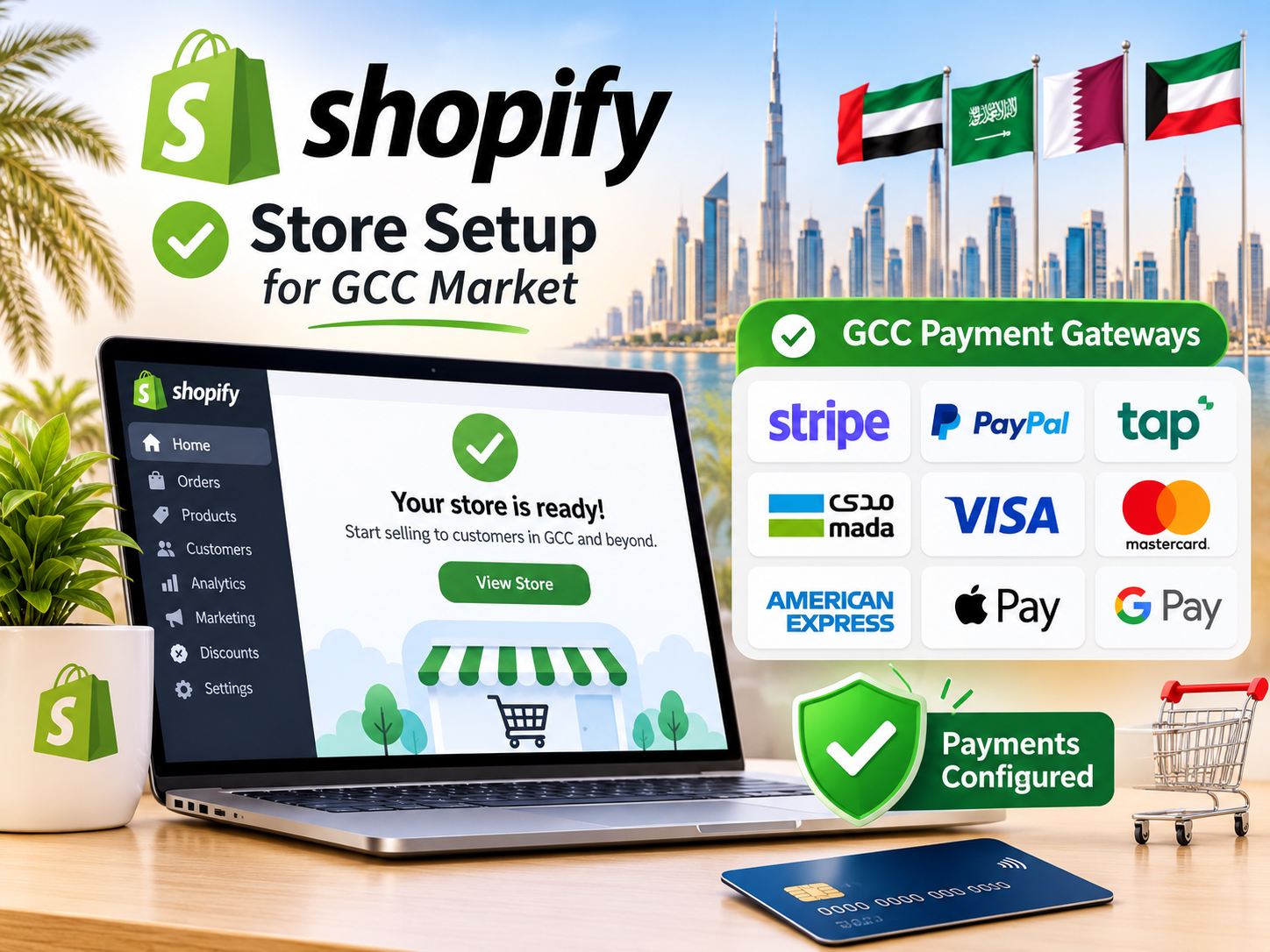
How to Set Up a Shopify Store for GCC Customers
Building a localized store becomes easier when business eligibility, design, payments and fulfillment are planned together.
Choose Your Shopify Plan and Verify Business Eligibility
Start by reviewing your business registration and available payment providers.
A Saudi merchant should check applicable commercial registration requirements. Businesses operating from Dubai or Doha must also verify their local licensing obligations.
Choose a Shopify plan based on your catalog, team requirements, reporting needs and intended integrations rather than subscription price alone.
Build Bilingual Product Pages and Localized Pricing
Select a responsive Shopify theme and create product pages that feel relevant to your customers.
Include clear product images, understandable descriptions, visible prices and realistic delivery information.
Avoid relying entirely on automated translations, especially for technical product specifications or important return conditions.
Mak It Solutions provides e-commerce development solutions for businesses looking to build structured storefronts with integrated shopping and checkout workflows.
GCC Shopify Launch Checklist
Use this checklist before accepting live customer orders.
Store launch readiness
0 of 8 complete
Don't skip testing. A storefront can look finished while payment failures, incorrect shipping rates or broken mobile layouts prevent customers from ordering.
GCC Payment Gateways, Shipping and Compliance
Comparing Saudi, UAE and Qatar Payment Methods
Customers are more comfortable completing purchases when checkout offers recognizable, reliable payment options.
|
Market |
Payment priorities |
Key considerations |
|---|---|---|
|
Saudi Arabia |
mada, cards, eligible wallets and BNPL |
ZATCA requirements, business registration |
|
UAE |
Cards, Apple Pay, Google Pay |
Trade licensing, FTA obligations |
|
Qatar |
Cards, eligible local gateways |
MOCI licensing, QCB payment oversight |
Saudi merchants can explore compatible mada-enabled gateways. However, integration availability, fees, supported transactions and merchant eligibility must be verified with the provider.
Apple Pay, Tabby, Tamara and cash on delivery (COD) should also be evaluated individually rather than assumed to work with every Shopify setup.
For UAE businesses, Shopify Payments is available to eligible merchants. Shopify announced support for the Advanced plan on August 26, 2026, having previously offered it on Plus. Current eligibility also depends on business documentation, banking arrangements and supported activities.
Saudi and Qatar merchants should review Shopify-compatible third-party payment providers for their business location and required payment methods.
VAT, Ecommerce Licensing and Customer Data Protection
Tax and licensing requirements should be considered before launch, not after sales begin.
Saudi Arabia applies a standard 15% VAT to taxable goods and services, with ZATCA overseeing relevant VAT and e-invoicing requirements. The UAE generally applies 5% VAT, subject to applicable exemptions and zero-rating provisions.
Merchants can review the Saudi ZATCA VAT guidance and the UAE Federal Tax Authority for regulatory guidance.
In Qatar, the Ministry of Commerce and Industry launched an ecommerce licensing service under Ministerial Decision No. 25 of 2026, providing a framework for eligible online commercial activities. Details are available through Qatar MOCI.
Businesses should also review applicable consumer protection and personal data rules. Financial activities may fall under oversight from regulators such as SAMA or QCB, while specific UAE jurisdictions, including ADGM and DIFC, have their own relevant requirements.
Regulatory note: Tax treatment, licensing and payment eligibility depend on the merchant's activities and jurisdiction. Obtain qualified local advice where necessary.
Shipping, Cash on Delivery and Returns
Reliable fulfillment matters just as much as an attractive storefront.
Consider these practical examples.
-
Riyadh retailer
Displays mada availability, shipping charges and clear return conditions. -
Dubai beauty brand
Uses bilingual descriptions and communicates courier delivery expectations. -
Doha specialty shop
Confirms local delivery coverage and supported payment options before advertising products.
Customers should understand delivery charges, estimated arrival and refund conditions before placing an order.
For COD orders, establish clear confirmation procedures, courier collection arrangements and reconciliation processes to reduce failed deliveries.
High-Converting Shopify Design and Checkout for GCC
Create Product Pages That Build Trust
Customers shouldn't have to search for basic information before making a purchase.
Strong product pages include accurate descriptions, clear images, genuine customer reviews, visible calls to action and delivery details.
Arabic and English branding should also feel consistent.
Professional graphic design support can help create cohesive product imagery, promotional banners and localized visual assets.
Reduce Cart Abandonment With Mobile Checkout
A complicated checkout adds unnecessary friction.
Keep forms focused, communicate delivery charges early and enable guest checkout where supported.
Test the experience on actual mobile devices. Check page loading, address forms, payment redirects, error messages and order confirmations.
A smooth checkout should make the next action obvious without overwhelming shoppers with unnecessary information.
Measure Conversion Rate and Order Performance
A successful store needs ongoing measurement.
Track.
-
Conversion rate.
The share of visits resulting in purchases. -
Add-to-cart rate.
How often shoppers add products to their carts. -
Average order value (AOV).
Revenue generated per completed order. -
Checkout completion.
How effectively shoppers finish checkout. -
Repeat purchase rate.
How frequently customers return.
Compare performance across Saudi Arabia, the UAE and Qatar rather than treating the GCC as a single audience.
Example Shopify conversion funnel
Illustrative numbers only not GCC industry benchmarks.
Product views
10,000
Added to cart
1,800
Reached checkout
1,000
Completed orders
650
In this hypothetical funnel, 6.5% of product views result in orders. This is not a session-based store conversion rate.
Business intelligence services can help merchants turn these metrics into useful reports and identify areas needing improvement.

Shopify Setup Costs and Launch Timelines in the GCC
How Much Does Shopify Store Setup Cost?
The cost of Shopify store setup in the GCC depends on your store's size, design requirements and integration complexity.
Common expenses include subscriptions, themes, bilingual content, applications, payment processing, development and ongoing maintenance.
|
Setup approach |
Budget profile |
Best suited for |
|---|---|---|
|
DIY |
Lower initial cost |
Small catalogs and simple storefronts |
|
Freelancer |
Moderate, scope-dependent |
Basic customization and integrations |
|
Agency |
Higher, project-dependent |
Advanced localization and complex ecommerce builds |
There is no universal budget that fits every Saudi, Emirati or Qatari business.
Saudi, UAE and Qatar Budget Considerations
Operating costs can vary between Riyadh, Dubai, Abu Dhabi and Doha.
Licensing, tax configuration, payment onboarding, translations and delivery arrangements may all affect the final investment.
Businesses requiring custom features can explore web development services to scope their technical requirements before committing to a budget.
Launch Phases and Potential Delays
Plan your launch around discovery, design, product preparation, payment approval, testing and deployment.
A focused minimum viable store may take several weeks, but the schedule depends on catalog size and complexity.
Gateway verification, Arabic content reviews and logistics integrations can extend the process.
Build time for revisions rather than rushing a checkout experience that hasn't been properly tested.
Grow Your GCC Shopify Sales After Launch
Shopify SEO for Saudi, UAE and Qatar Customers
Search visibility improves when pages match how local customers actually search.
Use descriptive product titles, localized category pages, relevant Arabic and English keywords, clean URLs and appropriate hreflang annotations.
Avoid duplicating regional pages without adapting their content.
Specialized SEO services can support technical SEO, regional keyword planning and long-term organic visibility.
WhatsApp Marketing and Customer Retention
Post-launch growth isn't limited to acquiring new buyers.
With appropriate customer consent, merchants can use WhatsApp communication, abandoned-cart emails and helpful post-purchase messages to encourage repeat purchases.
Keep communication relevant and provide suitable opt-out options.
Digital marketing services can help businesses develop acquisition and retention campaigns while respecting applicable marketing requirements.
Expand Across GCC Markets Without Losing Conversion
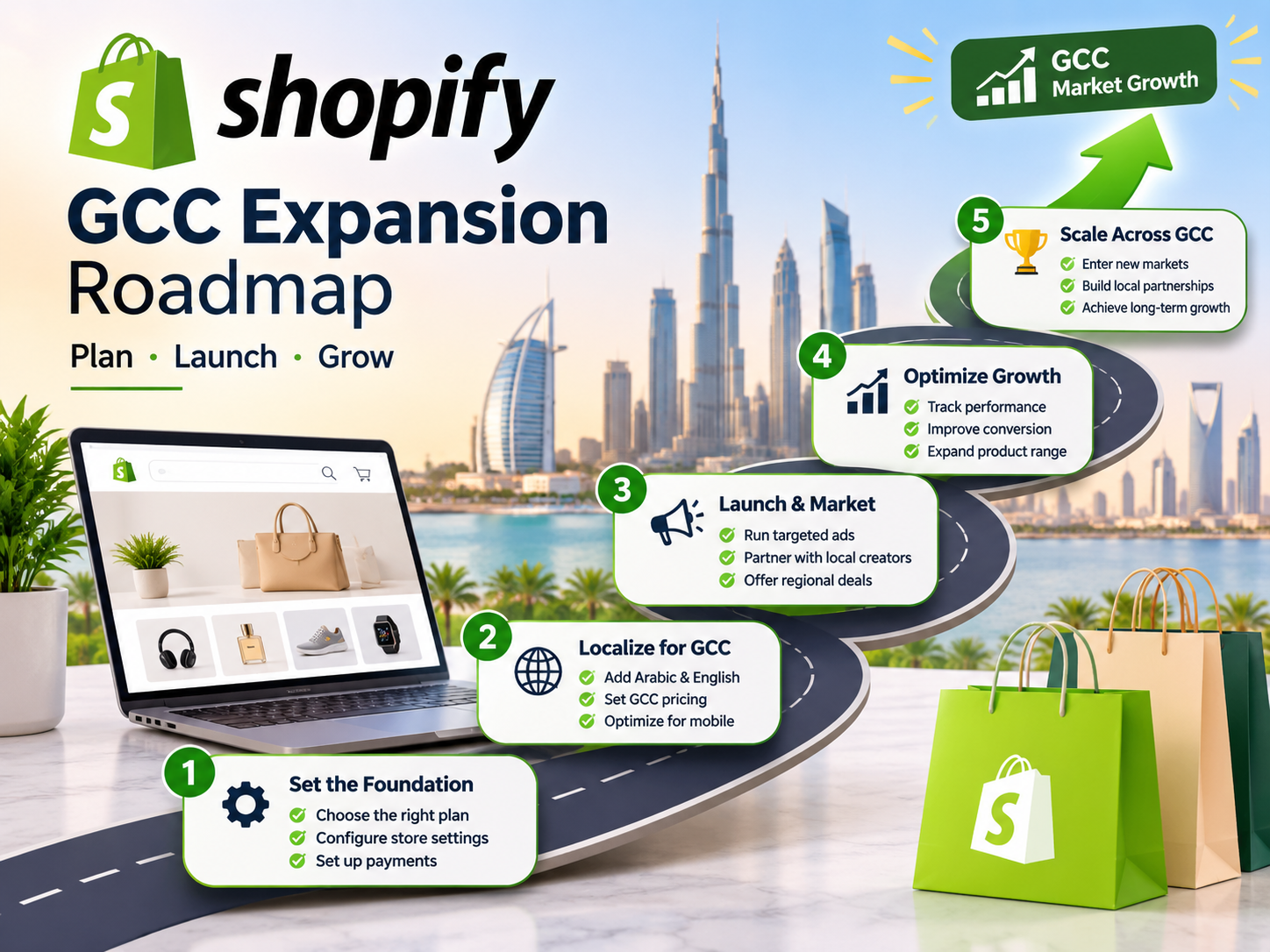
A Saudi retailer might begin by serving domestic customers, then test the UAE before entering Qatar.
Before expanding, review shipping coverage, customs charges, payment compatibility, customer support capacity and return handling.
Shopify Markets can help organize regional shopping experiences, but it does not replace local compliance planning.
For businesses needing greater control over the storefront experience, headless commerce development may offer additional frontend flexibility.
Expansion works best when merchants validate the next market rather than assuming a successful domestic store will perform identically elsewhere.
Concluding Remarks
A successful Shopify store setup GCC brings together localization, convenient checkout, reliable fulfillment and ongoing optimization.
For Saudi merchants in particular, mada compatibility, Arabic usability and transparent delivery policies deserve attention from the beginning. UAE and Qatar expansion introduces further payment, currency and regulatory considerations.
Start with a dependable shopping experience, measure how customers use it and improve the areas that create friction.
Ready to Launch Your GCC Shopify Store?
Mak It Solutions can help assess your bilingual storefront design, payment integrations, technical SEO and checkout performance.
Book a free 30-minute consultation to discuss a Shopify strategy tailored to your target GCC markets.
FAQs
Confirm eligibility, Shopify integration, processing fees, settlements and refunds before activation. Payment providers operate within the framework overseen by the Saudi Central Bank (SAMA).
However, offering Arabic and English can make the store more accessible to Emirati and expatriate customers.
However, checkout currency and settlement arrangements depend on the payment processor. Verify these features, gateway eligibility and applicable licensing requirements before launch.
Shopify merchants can configure COD as a manual payment method when their fulfillment arrangements support it. Merchants remain responsible for order confirmation, payment collection, reconciliation, refunds and applicable taxes.
Merchants should configure shipping destinations, verify payment compatibility and communicate any customs charges and return conditions. Product restrictions, tax obligations and consumer protection requirements should also be reviewed before expansion.
Frequently asked questions
Quick answers related to this article.
Comments
Join the discussion. Comments are moderated.
No comments yet. Be the first to share a thought.
Building something related?
Tell us about your product goals — we’ll respond with a clear next step.
Discuss your project