Blogs
Shopify vs Custom E-Commerce Development: GCC Guide Copy
Content Editor · November 23, 2026 · 8 min read
Direct answer
Can Saudi businesses use Shopify with mada and Apple Pay?
Saudi merchants may accept mada and Apple Pay through compatible payment providers, subject to gateway availability and merchant eligibility. Verify SAR settlement, refunds, and checkout compatibility before launching.
A Dubai fashion brand launching its first online store has different needs from a Riyadh wholesaler managing thousands of products, multiple warehouses, and complex pricing. That's why the Shopify vs Custom E-Commerce…
Shopify vs Custom E-Commerce Development: GCC Guide Copy
A Dubai fashion brand launching its first online store has different needs from a Riyadh wholesaler managing thousands of products, multiple warehouses, and complex pricing.
That's why the Shopify vs Custom E-Commerce Development decision isn't simply about design or launch costs. For businesses in Saudi Arabia, the UAE, and Qatar, payment compatibility, Arabic shopping experiences, integrations, and long-term flexibility matter just as much.
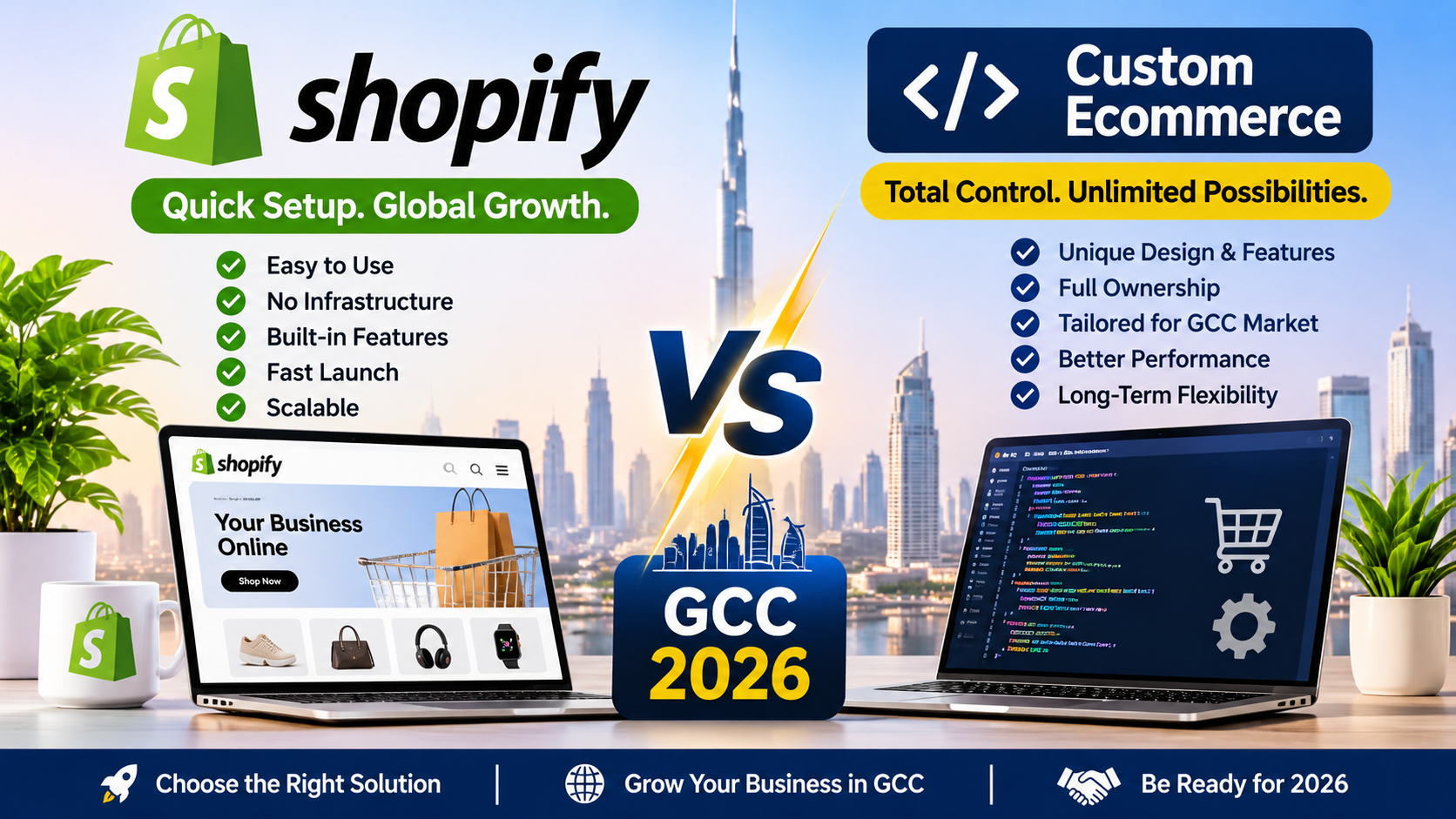
The short answer: Shopify is generally a better fit for businesses that want a faster launch, managed hosting, and standard retail features. Custom e-commerce development makes more sense when operations involve complex B2B pricing, specialized integrations, or greater control over the technology. Headless Shopify offers a middle ground.
Shopify vs Custom E-Commerce Development: Key Differences
Shopify provides a ready-made commerce foundation. Custom development allows businesses to build around their own processes.
The difference becomes clearer when comparing practical requirements.
| Factor | Shopify | Custom Development |
|---|---|---|
| Launch speed | Generally faster | Usually longer |
| Initial investment | Typically lower | Typically higher |
| Hosting | Managed | Business-controlled |
| Customization | Within platform capabilities | Highly flexible |
| Maintenance | Platform and merchant responsibilities | Primarily business responsibility |
| Scalability | Suitable for many growing stores | Depends on architecture |
What Shopify Offers GCC Brands
Shopify combines hosting, product management, checkout, themes, and applications within one ecosystem.
For a startup in Dubai or Doha, this can mean getting online without building every feature from scratch.
Businesses can also use professional e-commerce solutions to configure storefronts, connect payment providers, and improve the customer experience.
What Custom E-Commerce Development Offers
Custom development gives businesses more control over their storefront, backend architecture, and integrations.
It's particularly useful for companies managing negotiated B2B pricing, unusual ordering processes, or complicated warehouse operations.
That flexibility comes with additional responsibility for hosting, security, maintenance, and future upgrades.
What About Headless Shopify and Local Alternatives?
Headless Shopify separates the customer-facing storefront from Shopify's commerce backend, allowing more freedom over the shopping experience.
Saudi businesses should also compare Salla and Zid, while WooCommerce and BigCommerce remain relevant alternatives.
A fully custom platform isn't always necessary to achieve a distinctive storefront.
Shopify vs Custom Development in Saudi Arabia, UAE, and Qatar
GCC markets share several e-commerce priorities, but their payment systems, regulations, and customer expectations differ.
Saudi Arabia.
Saudi stores should prioritize Arabic usability, SAR pricing, mada compatibility, and relevant ZATCA e-invoicing requirements.
A Riyadh wholesaler connecting multiple warehouses and accounting systems may need specialized backend development.
Merchants should assess whether their invoicing systems must meet ZATCA's Phase Two integration requirements, which apply through notified taxpayer waves.
UAE.
Dubai and Abu Dhabi retailers frequently serve Arabic- and English-speaking customers.
Shopify can support bilingual storefronts, while eligible UAE businesses can access Shopify Payments on supported plans, subject to verification and onboarding requirements.
Before choosing a platform, confirm AED settlement, gateway compatibility, and applicable UAE VAT obligations.
See Shopify's UAE payment documentation.

Qatar.
For Doha businesses, QAR checkout, local payment providers, and reliable delivery integrations deserve particular attention.
Merchants should assess their payment provider's access to relevant domestic systems, including QPay and NAPS where applicable.
A suitable platform should also handle shipment updates, inventory synchronization, returns, and customer notifications.
| Requirement | Saudi Arabia | UAE | Qatar |
|---|---|---|---|
| Currency | SAR | AED | QAR |
| Payments | mada, compatible gateways | Shopify Payments for eligible businesses, other gateways | Compatible local providers |
| Tax | VAT and applicable ZATCA rules | VAT and FTA rules | Applicable local obligations |
| Language | Arabic-first | Arabic and English | Arabic and English |
| Logistics | Riyadh, Jeddah | Dubai, Abu Dhabi | Doha |
GCC Payments, Compliance, and Data Security
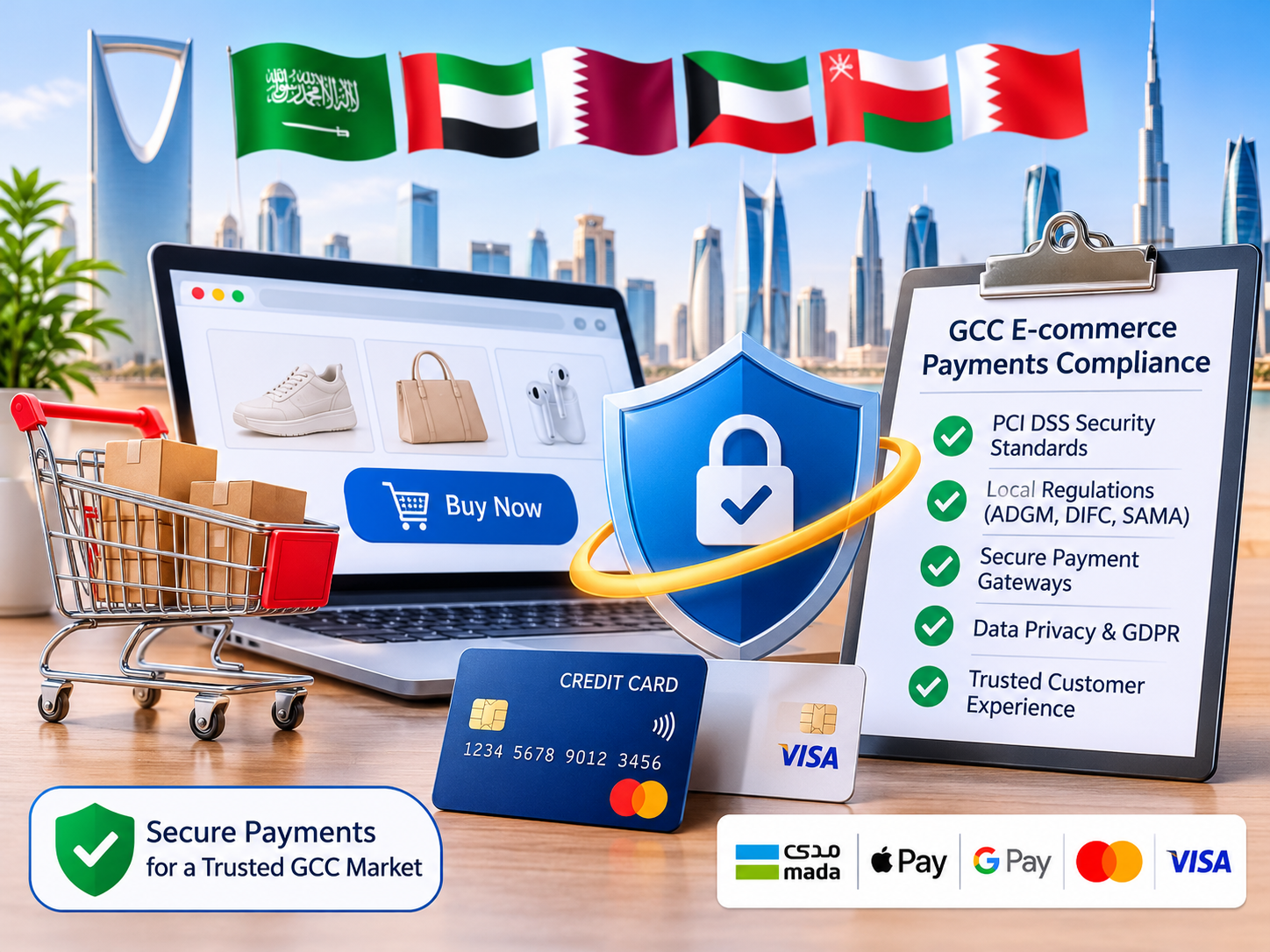
A visually appealing storefront won't help much if customers can't complete payments or the business struggles with compliance.
Choosing Payment Gateways
Depending on the market, businesses may evaluate.
Mada and Apple Pay
Tabby and Tamara
Tap Payments and HyperPay
Amazon Payment Services
Compatible local banking and payment providers
Availability differs by country, merchant eligibility, and platform configuration.
Test refunds, settlement currencies, transaction charges, and mobile checkout before committing to a provider.
VAT, E-Invoicing, and Privacy Requirements
Saudi merchants should consult ZATCA guidance for applicable invoicing obligations.
UAE retailers should check the Federal Tax Authority for VAT requirements, while Qatari businesses should assess local tax and payment regulations.
Customer data protection matters across all markets. Saudi PDPL, UAE privacy legislation, and Qatar's data protection framework may affect data collection, processing, and international transfers.
Regional cloud hosting options exist, but local hosting isn't automatically mandatory for every GCC business. Requirements depend on applicable laws, contracts, and business activities.
Arabic UX, Integrations, and GCC Scalability
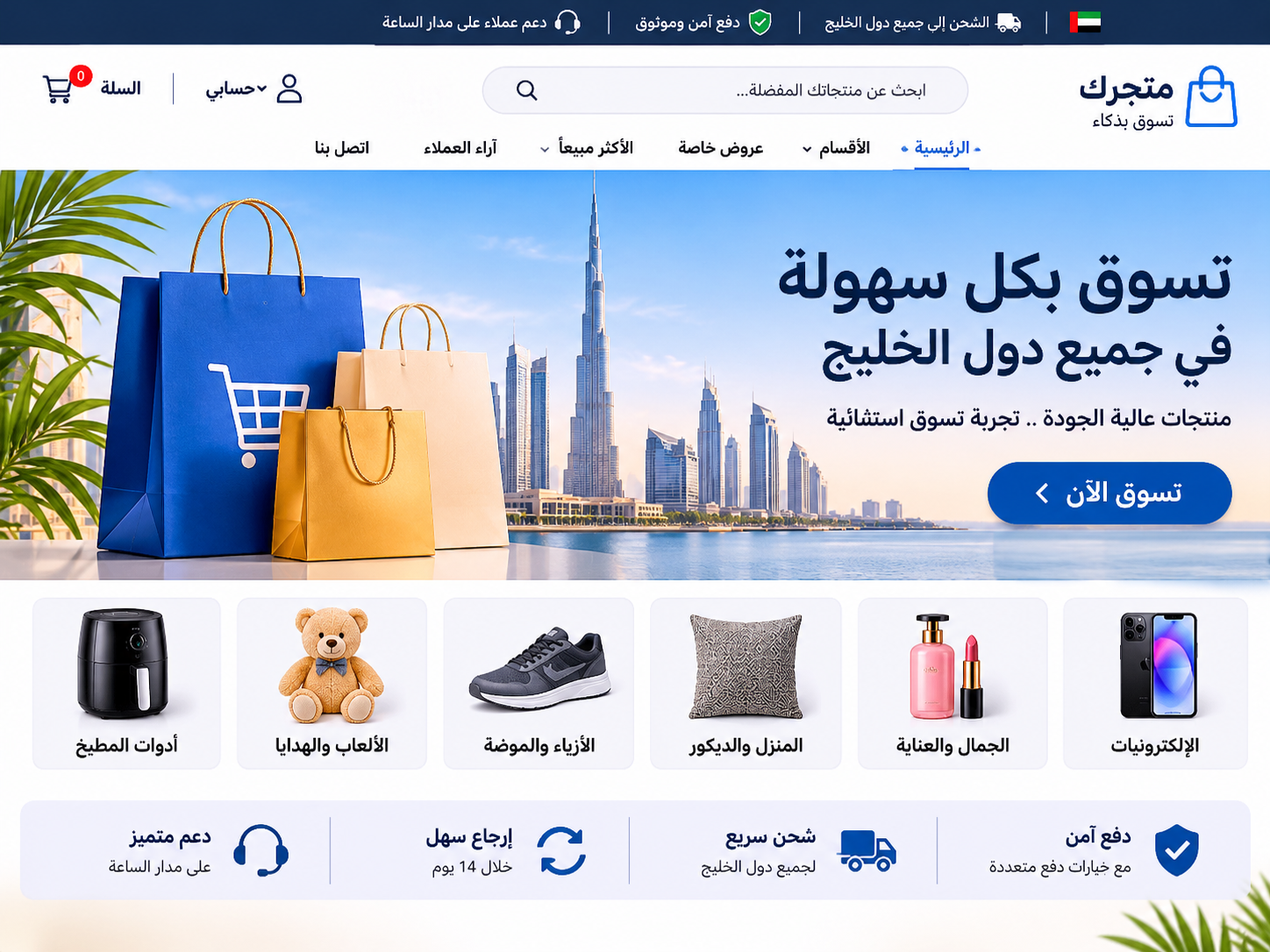
Arabic RTL Design Goes Beyond Translation
An Arabic storefront needs more than translated product descriptions.
Right-to-left navigation, readable typography, product filters, search, and checkout should work naturally on mobile devices.
Good web development helps businesses create consistent experiences across Arabic and English versions.
ERP, Inventory, and Delivery Integrations
Integrations often determine whether Shopify is sufficient or a custom platform is worth the investment.
Consider these illustrative business scenarios:
Riyadh B2B wholesaler.
A custom platform manages negotiated prices, ERP connections, and warehouse inventory.
Dubai fashion brand.
Shopify supports a streamlined direct-to-consumer launch, with potential expansion through mobile app development.
Doha omnichannel retailer.
Tailored integrations synchronize physical-store inventory, online orders, and delivery tracking.
These examples illustrate possible requirements, not actual client results.
Expanding Beyond One GCC Market
A business selling across Saudi Arabia, the UAE, and Qatar may need multiple currencies, localized payment methods, and market-specific fulfillment rules.
Expansion into Kuwait, Bahrain, and Oman adds considerations such as KNET compatibility, customs, and cross-border returns.
Headless commerce development may help brands requiring specialized storefronts across different markets.
Shopify vs Custom E-Commerce Development Cost in GCC
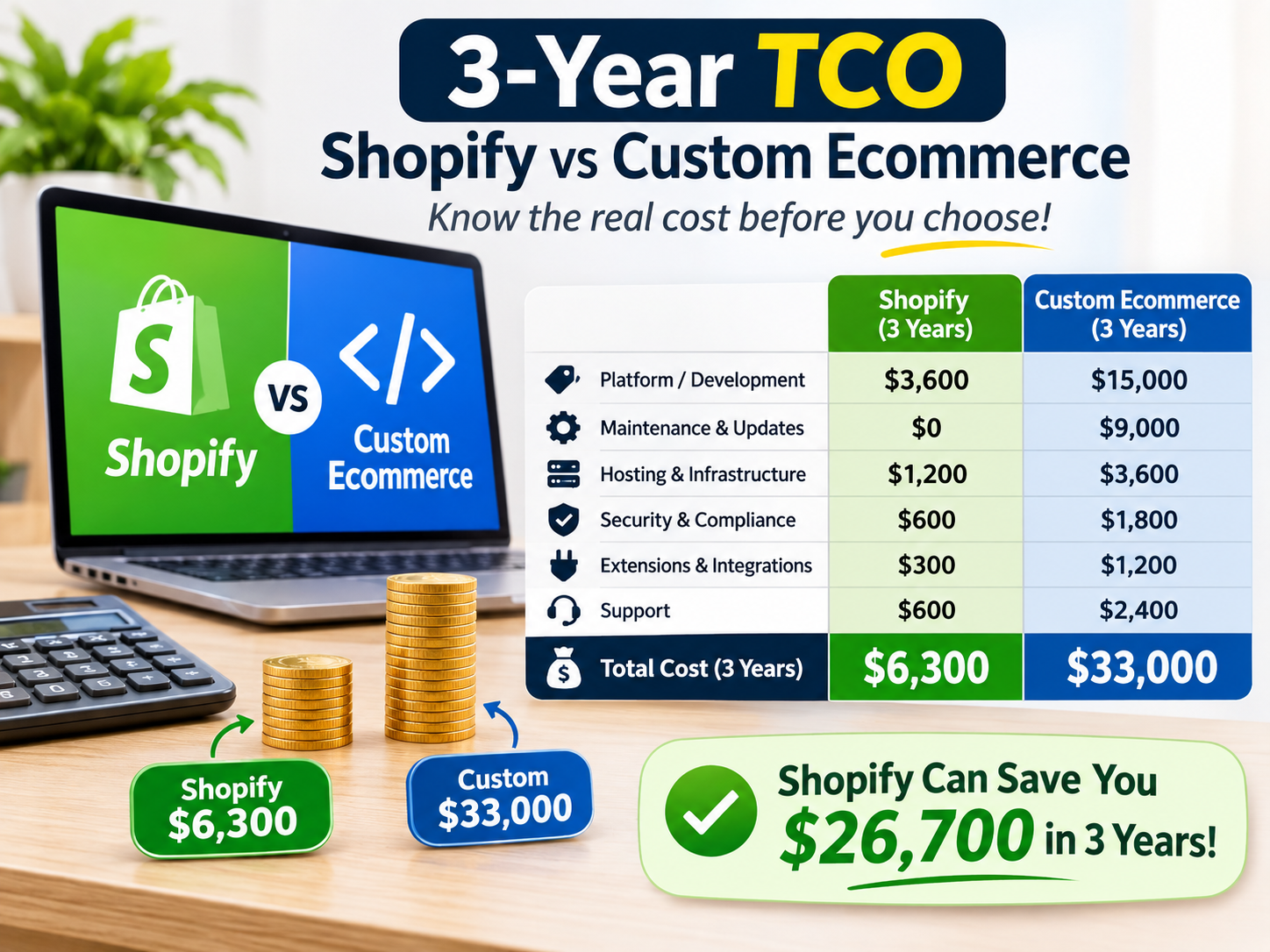
Shopify generally requires less initial development investment, but subscriptions, apps, transaction fees, and integrations contribute to ongoing expenses.
Custom development typically demands a larger upfront budget, with continuing costs for infrastructure, engineering, security, and maintenance.
Compare the Three-Year Total Cost of Ownership
Rather than comparing launch prices alone, calculate:
Three-year TCO = Initial build + 36 months of operating costs + integration and upgrade expenses
Include the following in your evaluation.
| Cost category | Shopify | Custom Development |
|---|---|---|
| Initial setup | Configuration and design | Discovery, design, engineering |
| Recurring costs | Plans, apps, gateway fees | Hosting, support, infrastructure |
| Integrations | Apps or custom connections | Custom API development |
| Maintenance | Platform updates and configuration | Security patches and upgrades |
| Future expansion | Platform-dependent | Architecture-dependent |
Use actual vendor quotations rather than generic market estimates.
A relatively simple Shopify implementation might take several weeks, while a heavily customized platform may take several months. Timelines depend on scope, approvals, and integration complexity.
Which E-Commerce Platform Should Your Gulf Brand Choose?
The best option depends on your business model, not platform popularity.
| Business priority | Recommended starting point |
|---|---|
| Fast D2C launch | Shopify |
| Saudi-focused retail | Compare Salla, Zid, and Shopify |
| Advanced storefront experience | Headless Shopify |
| Complex B2B or ERP workflows | Custom development |
| Existing WordPress ecosystem | WooCommerce |
A Practical GCC Platform Selection Checklist
Identify your target countries, currencies, products, and customers.
Confirm local payment gateway compatibility and invoicing obligations.
Evaluate Arabic UX, inventory, ERP, and delivery requirements.
Compare Shopify, headless Shopify, local alternatives, and custom development.
Calculate three-year ownership costs and identify future migration needs.
For many growing retailers, beginning with a managed platform is practical. Custom development becomes more attractive when specific operational requirements justify the additional investment.
Wrapping It Up
There's no universal winner in Shopify vs Custom E-Commerce Development.
Shopify offers convenience, faster implementation, and managed infrastructure. Custom development provides greater freedom when businesses have specialized processes or integration requirements.
For brands in Saudi Arabia, the UAE, and Qatar, the strongest decision starts with local payment support, Arabic usability, regulatory obligations, and realistic long-term costs. Mak It sol
Planning your GCC e-commerce project? Contact Mak It Solutions to discuss your requirements, compare development approaches, and choose an architecture suited to your business.
Frequently asked questions
Quick answers related to this article.
Comments
Join the discussion. Comments are moderated.
No comments yet. Be the first to share a thought.
Building something related?
Tell us about your product goals — we’ll respond with a clear next step.
Discuss your project