Blogs
WooCommerce Scaling: 10,000+ Daily Orders in GCC
Content Editor · November 26, 2026 · 9 min read
Direct answer
How much does enterprise WooCommerce hosting cost in Saudi Arabia?
Enterprise hosting costs depend on peak traffic, database requirements, cloud infrastructure, integrations, and engineering support. Saudi retailers should also budget for applicable ZATCA and PDPL requirements. A technical audit provides a more reliable estimate than a generic hosting package.
Imagine running a successful e-commerce store in Riyadh during Ramadan. Orders are increasing, marketing campaigns are performing well, and customers are ready to buy. Suddenly, checkout pages slow down, payments fail,…
WooCommerce Scaling: 10,000+ Daily Orders in GCC
Imagine running a successful e-commerce store in Riyadh during Ramadan. Orders are increasing, marketing campaigns are performing well, and customers are ready to buy. Suddenly, checkout pages slow down, payments fail, and inventory updates fall behind.
This is where effective WooCommerce scaling becomes essential for sustainable business growth.
WooCommerce can handle 10,000 or more daily orders with High-Performance Order Storage (HPOS), scalable cloud infrastructure, Redis caching, load balancing, and asynchronous order processing. However, businesses must validate their store's actual capacity through realistic load testing before handling enterprise-level traffic.
For retailers across Saudi Arabia, UAE, and Qatar, building a scalable WooCommerce store means looking beyond hosting upgrades. Payment reliability, database performance, regional compliance, and operational automation are equally important.
Can WooCommerce Handle 10,000+ Orders Per Day?
Understanding WooCommerce Enterprise Scalability
WooCommerce is capable of supporting high-volume e-commerce operations when backed by suitable infrastructure and efficient development practices.
Actual performance depends on factors such as.
Server resources and PHP workers
Database architecture
Plugin efficiency
Concurrent checkout sessions
Payment gateway performance
Inventory and ERP integrations
Professional WooCommerce development services can help identify technical limitations before they become expensive operational problems.
Calculating Peak Order Volume and Concurrent Checkouts
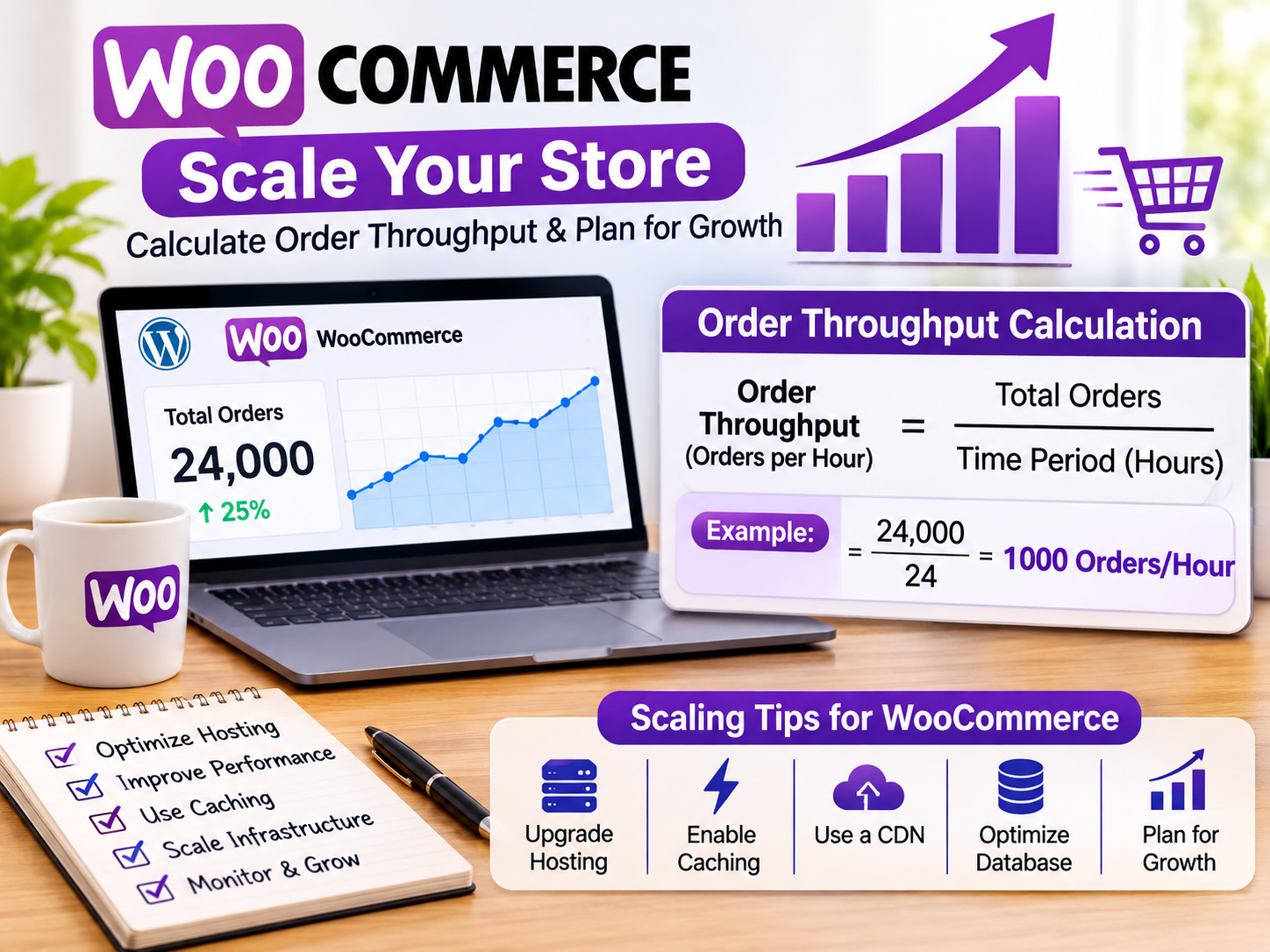
Daily order volume alone does not determine infrastructure requirements. Understanding when customers place those orders is just as important.
Consider a hypothetical GCC retailer processing 10,000 daily orders, with 30% arriving during a two-hour promotional campaign.
|
Capacity metric |
Estimated volume |
|---|---|
|
Daily orders |
10,000 |
|
Peak-period orders |
3,000 |
|
Peak sales window |
2 hours |
|
Average orders per hour |
417 |
|
Peak orders per hour |
1,500 |
|
Peak orders per minute |
25 |
|
Peak orders per second |
0.42 |
WooCommerce Order Capacity Calculator
Estimate your store's average and peak order processing requirements.30%
417
1,500
25.0
0.42
Actual server demand will be higher than completed order throughput alone suggests because customers also browse products, search, manage carts, and initiate payments.
Identifying the Biggest WooCommerce Scaling Bottlenecks
Slow database queries, insufficient PHP workers, inefficient plugins, delayed payment responses, and inventory synchronization issues are common performance bottlenecks.
Identify the underlying problem before spending more on hosting. Additional server resources may temporarily mask inefficient application code without resolving it.
WooCommerce Performance Optimization with HPOS and Caching
How WooCommerce HPOS Improves Order Processing
High-Performance Order Storage (HPOS) uses dedicated database tables and indexes to improve order-related operations.
HPOS has been enabled by default for new WooCommerce installations since version 8.2. Existing stores should review extension compatibility, create backups, and test migration before enabling it in production.
The official WooCommerce HPOS documentation provides technical implementation guidance.
WooCommerce Database Optimization for High-Volume Stores
A poorly optimized database can slow down even a powerful hosting environment.
Focus on inefficient MySQL queries, database indexes, connection management, and Action Scheduler workloads. Slow-query profiling helps identify extensions and processes consuming excessive resources.
Implementing Redis Object Caching and CDN Optimization
Redis object caching reduces repetitive database operations, while a Content Delivery Network (CDN) improves static content delivery.
However, customer-specific cart, checkout, and account pages must remain dynamic. Incorrect caching configurations can cause checkout errors and inconsistent customer sessions.
Follow the official WooCommerce caching guidelines when configuring these services.
WooCommerce Enterprise Hosting and Scalable Cloud Architecture
Choosing Cloud Hosting for Saudi Arabia, UAE and Qatar
Enterprise hosting should be selected based on regional latency, infrastructure reliability, service availability, and applicable data protection requirements.
GCC retailers can evaluate cloud infrastructure options such as AWS Bahrain, Azure UAE Central, and Google Cloud Doha, depending on their technical and regulatory needs.
WooCommerce Load Balancing and Horizontal Autoscaling
Horizontal scaling distributes application workloads across multiple servers rather than relying on a single, increasingly expensive machine.
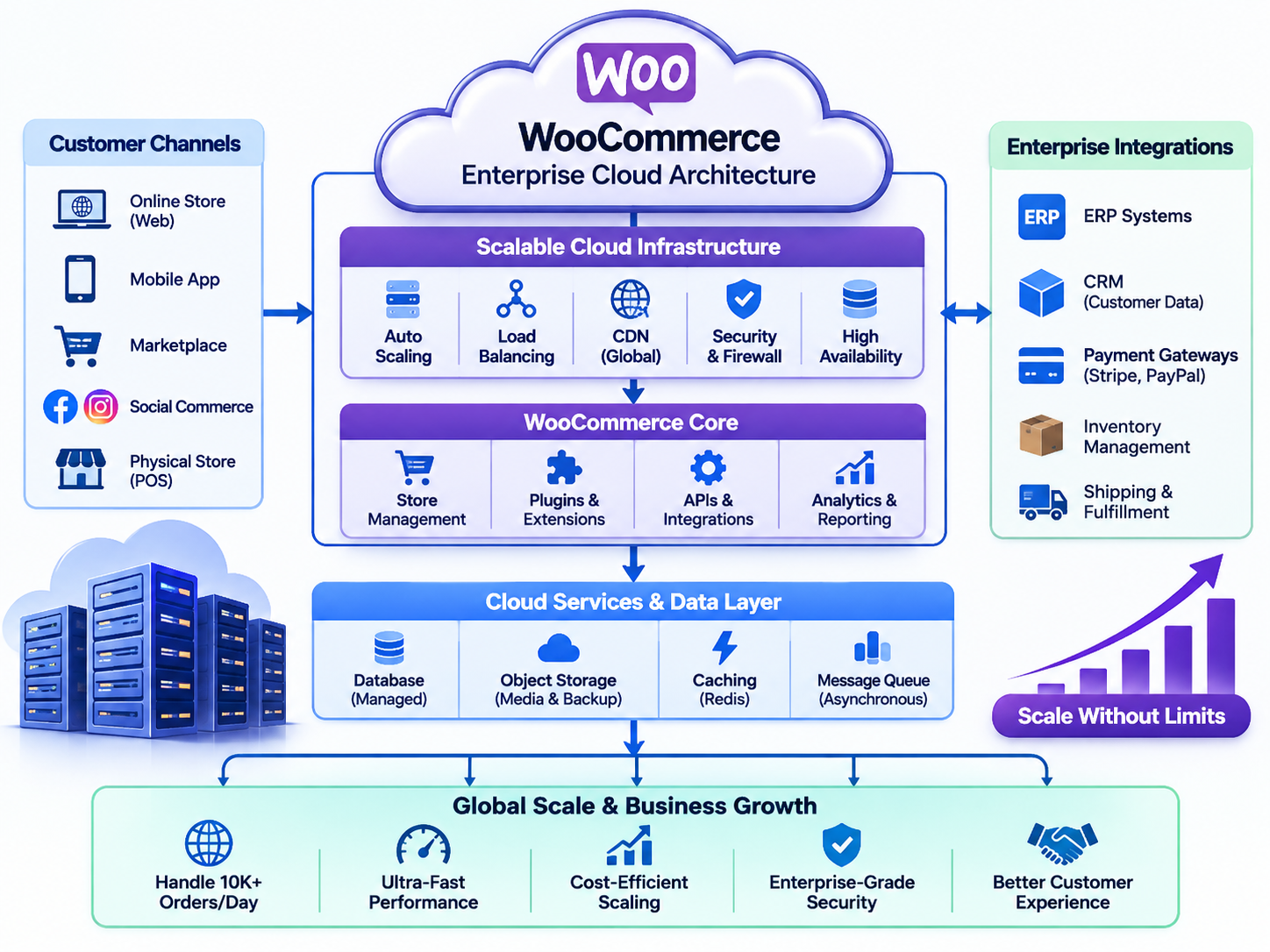
A well-designed architecture combines load balancing, scalable application servers, managed databases, persistent caching, and background processing.
Enterprise WooCommerce Cloud Architecture
Conceptual infrastructure for high-volume GCC e-commerce storesIllustrative architecture. Server counts and infrastructure configurations must be determined through technical assessment and load testing.Building High Availability, Monitoring and Disaster Recovery
Configure automated backups, infrastructure failover, application monitoring, and recovery objectives to minimize business disruption.
Experienced web development specialists can help identify and eliminate potential single points of failure.
WooCommerce Checkout Optimization for GCC Markets
Optimizing GCC Payment Gateways for High-Volume Orders
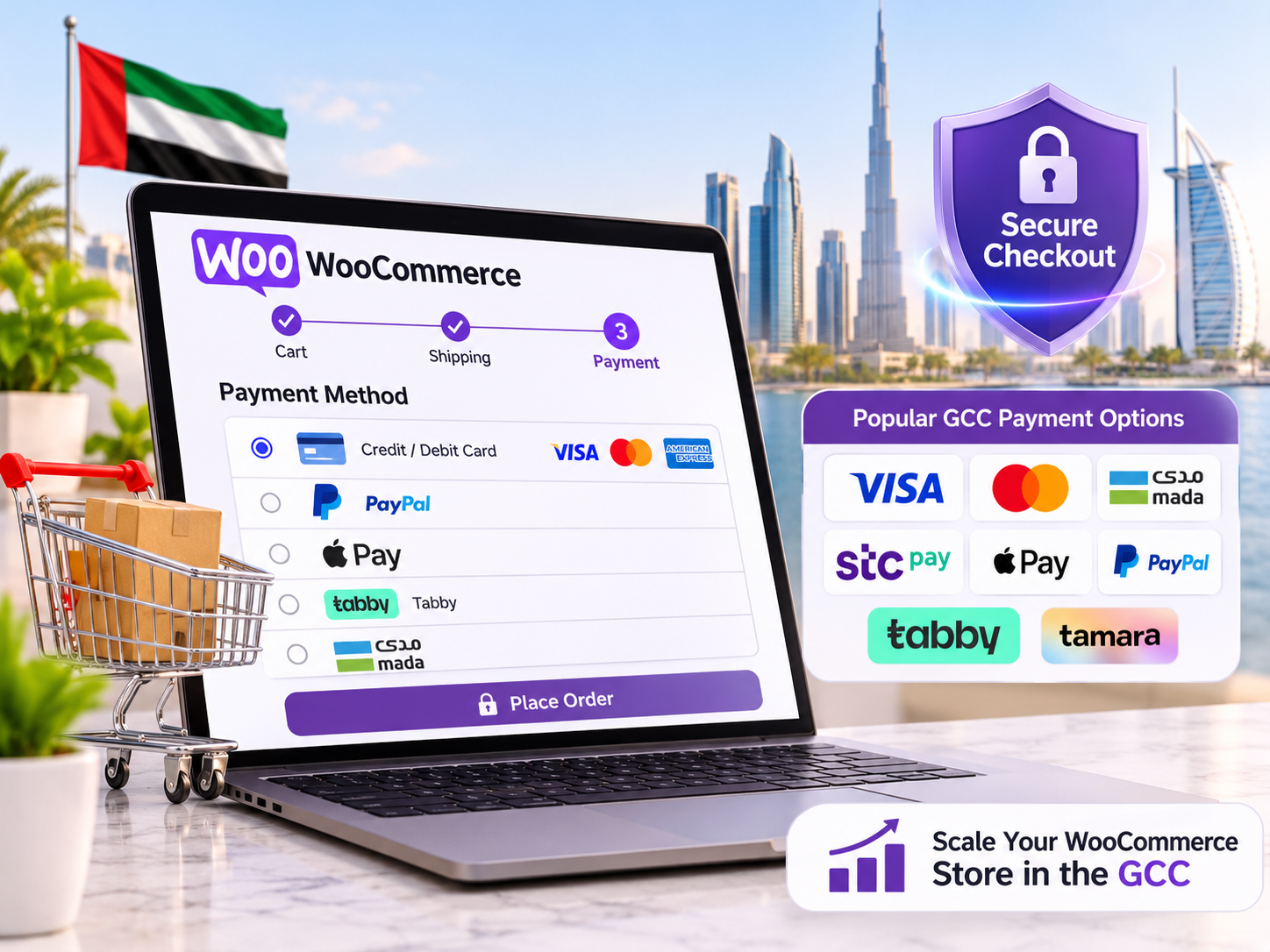
Regional payment preferences play an important role in checkout performance and customer experience.
|
Market |
Payment options and providers |
|---|---|
|
Saudi Arabia |
mada, HyperPay, Moyasar |
|
UAE |
Telr, Network International, Amazon Payment Services |
|
Qatar |
SADAD, QNB |
|
Wider GCC |
Tap Payments, Tabby, Tamara |
Provider availability, merchant eligibility, and transaction limits should be confirmed before integration.
Implement secure webhook validation, transaction reconciliation, controlled retries, and duplicate payment prevention to improve checkout reliability.
Improving Arabic RTL and Multi-Currency Checkout
Arabic-speaking customers should have access to a properly formatted right-to-left (RTL) interface rather than a partially translated checkout experience.
Support bilingual navigation, mobile-friendly checkout, and appropriate SAR, AED, and QAR currency configurations through reliable e-commerce development solutions.
Preventing Checkout Failures During High-Traffic Events
Ramadan, Eid, and White Friday campaigns can place significant pressure on payment systems and inventory operations.
Test payment latency, transaction failures, inventory contention, and checkout response times before increasing advertising expenditure.
WooCommerce Order Management Automation at Scale
Asynchronous Order Processing and Background Jobs
Not every operation needs to run while a customer completes checkout.
Use Action Scheduler to move suitable notifications, synchronization tasks, and webhook processing into monitored background queues. Critical payment and order validation processes must remain reliable throughout the transaction lifecycle.
WooCommerce ERP Integration and Inventory Synchronization
Connect ERP, accounting, and warehouse systems through reliable APIs.
Custom WordPress development services can support inventory reservation, stock synchronization, and integration workflows that reduce manual administrative work.
Automating GCC Fulfillment and Cross-Border Logistics
Integrating logistics providers such as SPL and Aramex can help automate shipment creation, tracking updates, and fulfillment operations.
Retailers should also account for cross-border delivery requirements and cash-on-delivery verification where applicable.
WooCommerce Scaling in Saudi Arabia, UAE and Qatar
Technical scalability must be supported by appropriate regional compliance. Hosting location, customer privacy, payment security, and cross-border data processing requirements vary by jurisdiction.
WooCommerce Scaling in Saudi Arabia: mada, ZATCA and PDPL
Saudi retailers preparing for Ramadan campaigns should prioritize mada payment reliability, applicable ZATCA e-invoicing requirements, and Personal Data Protection Law (PDPL) obligations.
Relevant SDAIA data governance frameworks should also be considered when designing customer data workflows.
WooCommerce Enterprise Scaling in UAE: Cloud and Data Protection
Retailers in Dubai and Abu Dhabi should evaluate applicable UAE data protection laws, payment service requirements, and relevant cloud infrastructure considerations.
Businesses operating within ADGM or DIFC may be subject to separate privacy regimes.
WooCommerce Scaling in Qatar and the Wider GCC
Qatar-based retailers expanding into Bahrain, Oman, and Kuwait should consider the applicable Qatar personal data privacy framework, payment requirements, regional latency, and cross-border fulfillment.
Domestic hosting is not universally mandatory across the GCC. Businesses should confirm their specific obligations with qualified compliance professionals before selecting infrastructure.
How to Scale WooCommerce to 10,000 Daily Orders: Step-by-Step Roadmap
WooCommerce Enterprise Scaling Roadmap
Audit
Identify hosting, plugin, database, and checkout bottlenecks.Optimize HPOS
Validate compatibility and improve database operations.Upgrade infrastructure
Implement scalable hosting, Redis, and load balancing.Automate integrations
Optimize payment, ERP, inventory, and fulfillment workflows.Load test
Simulate realistic Ramadan, Eid, and White Friday traffic.Monitor
Establish performance thresholds, alerts, and rollback procedures.Measuring WooCommerce Performance
Successful scaling should be measured through business-critical performance indicators rather than server specifications alone.
|
Performance metric |
What to measure |
|---|---|
|
Checkout latency |
Median and P95 response times |
|
Order throughput |
Completed orders per second |
|
Payment success |
Successful payment percentage |
|
Database performance |
Query latency and lock contention |
|
PHP workers |
Utilization and request queues |
|
Order queues |
Backlog and processing delays |
|
Infrastructure |
CPU, memory, and database usage |
|
Error rate |
HTTP and transaction failures |
These metrics help engineering teams make informed decisions about infrastructure upgrades and application optimization.
WooCommerce Scaling Costs, Timeline and Enterprise Support
Scaling costs depend on traffic patterns, existing technical debt, infrastructure requirements, and integration complexity.
|
Solution |
Cost structure |
Best suited for |
|---|---|---|
|
Managed hosting |
Subscription-based |
Growing retailers |
|
Custom cloud architecture |
Usage-based |
High-volume enterprises |
|
Enterprise support |
Project or retainer |
Complex retail operations |
Implementation timelines also vary depending on the condition of the existing store and the complexity of its integrations.
Combining infrastructure planning with an effective e-commerce marketing strategy helps businesses align technical capacity with anticipated customer demand.
Concluding Remarks
Successful WooCommerce scaling is not simply about purchasing a larger server. It requires efficient databases, reliable checkout processes, scalable infrastructure, automated operations, and continuous performance monitoring. Mak It Sol
For businesses across Saudi Arabia, UAE, and Qatar, the priority should be building an e-commerce environment that performs reliably during both everyday operations and major seasonal campaigns.
The right architecture, combined with realistic load testing and regional compliance planning, can help WooCommerce support long-term enterprise growth.
Explore Mak IT Solutions' technology services to build a scalable e-commerce infrastructure tailored to your GCC business.
Whether you are experiencing checkout delays, planning a regional expansion, or preparing for a major sales campaign, identifying performance limitations early can help protect revenue and customer experience.
Contact Mak IT Solutions to request a WooCommerce scalability audit.
FAQs
Frequently asked questions
Quick answers related to this article.
Comments
Join the discussion. Comments are moderated.
No comments yet. Be the first to share a thought.
Building something related?
Tell us about your product goals — we’ll respond with a clear next step.
Discuss your project