


Confidential Computing Explained Simply
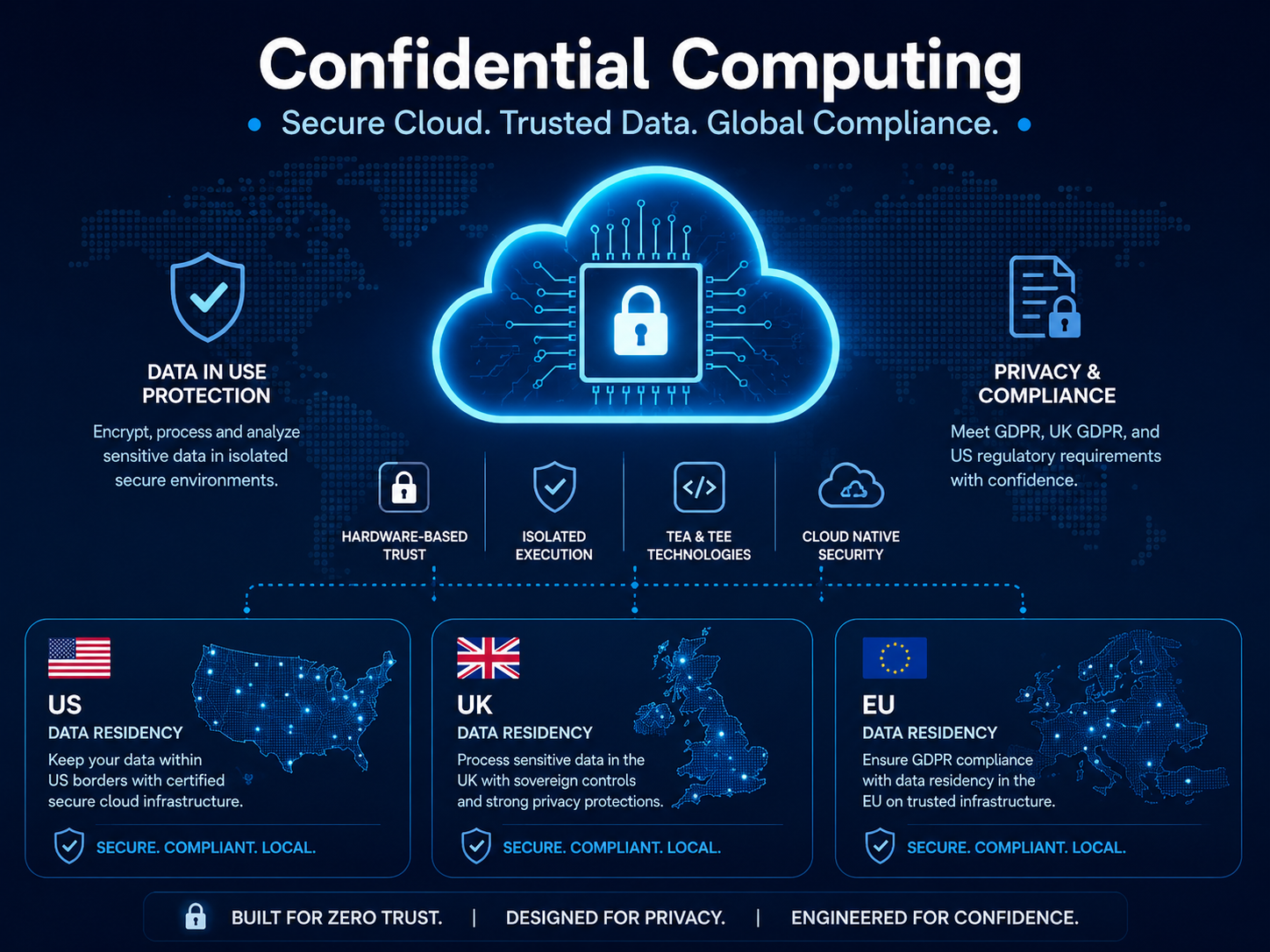
Confidential computing protects sensitive cloud data while it is being processed, not only when it is stored or moving across a network. It uses hardware-backed trusted execution environments, secure enclaves, encrypted memory, and remote attestation to reduce who or what can access plaintext data during cloud processing.
For USA, UK, Germany, and EU teams, confidential computing is most useful when AI, analytics, SaaS, healthcare, fintech, or regulated workloads need cloud scale without exposing sensitive information to broader infrastructure. It does not replace strong security governance, but it can strengthen the technical control story behind audits, DPIAs, vendor reviews, and customer trust.
Why Confidential Computing Matters Now
Most cloud security programs already encrypt data at rest and in transit. The harder gap is data in use.
Applications often need to decrypt information in memory to analyze, search, score, train, infer, or transform it. That is where confidential computing fits: it protects data while computation is happening.
The timing matters. Gartner forecast worldwide public cloud end-user spending to reach $723.4 billion in 2025, up from $595.7 billion in 2024. IBM’s 2025 Cost of a Data Breach Report lists the global average breach cost at USD 4.44 million. For regulated teams in New York, London, Berlin, Munich, and across the EU, protecting sensitive cloud workloads is no longer a “later” issue. It is part of practical risk management.
What Is Confidential Computing?
Confidential computing is a cloud-security approach that protects data in use by running computation inside a hardware-based, attested trusted execution environment. The Confidential Computing Consortium defines it around protection for data in use through hardware-backed, attested TEEs.
In simple terms, it creates a protected “safe room” inside cloud infrastructure. Your workload can process sensitive data there, while unauthorized software, administrators, other tenants, and parts of the cloud stack are restricted from viewing plaintext data.
For a SaaS vendor, this could mean processing tenant analytics inside a confidential virtual machine. For a healthcare AI team, it could mean analyzing ePHI while reducing exposure to the wider infrastructure layer.
Data at Rest, Data in Transit, and Data in Use
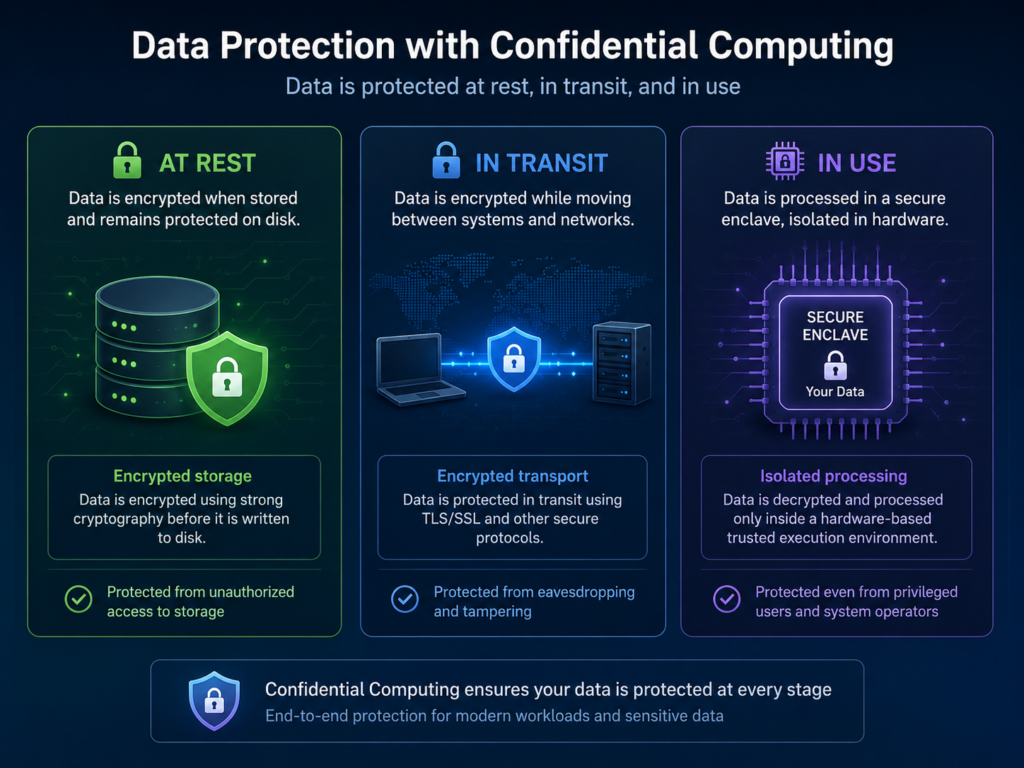
Cloud data usually exists in three states.
| Data State | Meaning | Common Protection |
|---|---|---|
| Data at rest | Stored in databases, disks, object storage, or backups | Storage encryption |
| Data in transit | Moving between apps, APIs, users, and services | TLS and network encryption |
| Data in use | Actively processed in memory | Confidential computing |
Traditional encryption covers the first two states well. Confidential computing focuses on the third: data-in-use protection.
That makes it especially relevant for AI inference, privacy-preserving analytics, fraud scoring, identity verification, confidential SaaS processing, and secure multi-party collaboration.
How Confidential Computing Works
Confidential computing works by combining hardware-backed isolation, encrypted memory, controlled key release, and remote attestation.
Trusted Execution Environments and Secure Enclaves
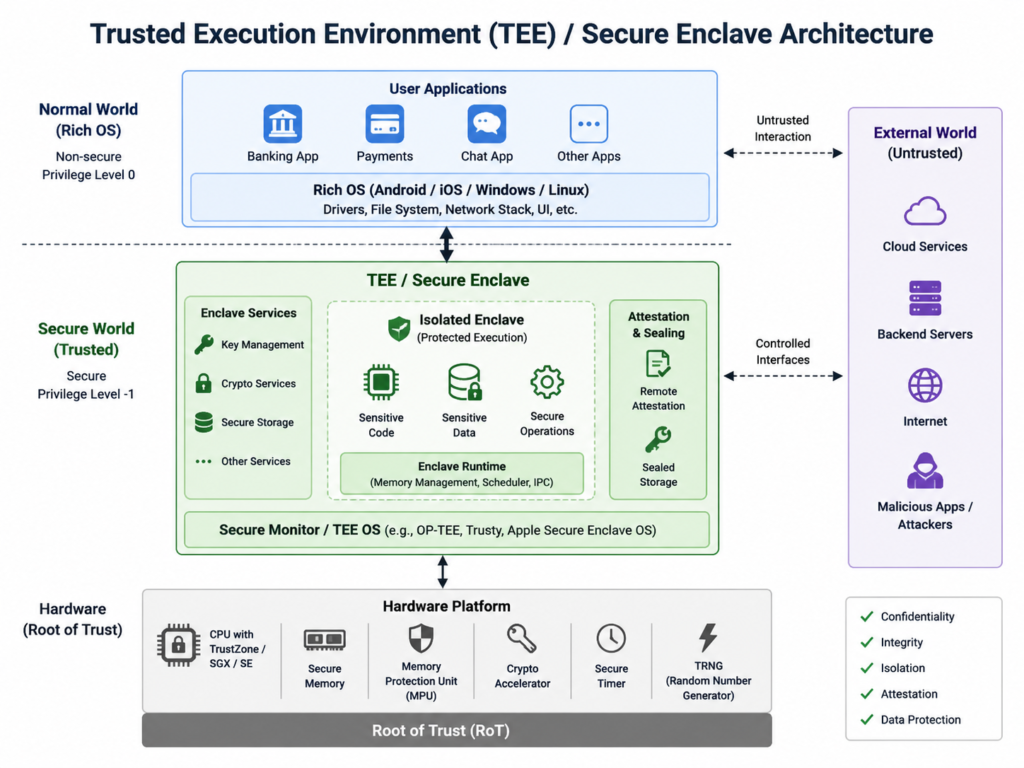
A trusted execution environment, or TEE, is an isolated execution area protected by hardware. Secure enclaves are one implementation of that idea.
They help keep selected code and data separated from the operating system, hypervisor, privileged software, and other infrastructure layers. Microsoft describes confidential computing as protecting data in use through computation in hardware-based, attested TEEs.
This does not remove every risk. Side-channel attacks, weak key management, misconfiguration, application bugs, and poor monitoring still matter. But it reduces the number of systems and people that must be trusted with plaintext data.
Remote Attestation and Verified Processing
Remote attestation lets a workload prove its identity and configuration before it receives secrets or processes sensitive data.
In practice, a key-management system can check whether the workload is running in an approved confidential environment with expected measurements. Only then are decryption keys released.
That gives security and audit teams more than a VM name or cloud-region label. It gives them evidence that the runtime environment matches policy.
Confidential Virtual Machines
Confidential virtual machines extend confidential computing to full VM workloads. They are useful when teams want stronger isolation without rewriting every application.
Azure confidential computing encrypts data in memory inside hardware-based TEEs and processes it after the cloud environment is verified. AWS Nitro Enclaves lets customers create isolated compute environments for highly sensitive data such as PII, healthcare, financial, and intellectual property data. Google Cloud Confidential VMs use hardware-based memory encryption to help protect data and applications while in use.
For modern SaaS and AI platforms, Mak It Solutions can connect confidential workloads with secure web development services, back-end development services, and cloud-ready APIs.
What Problems Does Confidential Computing Solve?
Confidential computing solves the “plaintext during processing” problem. It also helps reduce trust-boundary concerns when sensitive workloads move into shared cloud infrastructure.
It Helps Secure Sensitive Cloud Data
Cloud teams often want analytics, AI, automation, and managed infrastructure without exposing sensitive datasets more widely than necessary.
Confidential computing can support encrypted cloud processing for.
Customer records
Healthcare data
Financial data
Identity data
Payment-related workloads
Intellectual property
Sensitive AI prompts and model outputs
SaaS tenant analytics
For example, a San Francisco SaaS company could process tenant-level usage analytics inside confidential VMs while limiting exposure to platform administrators.
It Reduces Cloud Provider and Insider Access Risk
A major reason buyers explore confidential computing is reduced administrative access risk.
Azure says its confidential computing approach helps prevent access by cloud providers, administrators, and users when data is processed in verified environments. This is valuable in vendor-risk reviews, especially when customers ask: “Who can see our data during processing?”
It Supports AI, SaaS, Analytics, and Data Collaboration
AI and analytics need data. Regulated teams, however, cannot simply centralize everything and hope access controls are enough.
Confidential computing can support.
Confidential AI inference
Secure model scoring
Privacy-preserving analytics
Fintech risk scoring
Healthcare research
Identity verification
B2B data collaboration
Secure SaaS tenant processing
Apple’s Private Cloud Compute also reflects the broader move toward privacy-preserving cloud AI. Apple says PCC uses data only to fulfill the user’s request and deletes it after the response is returned.
Compliance Benefits for Regulated Industries
Confidential computing does not automatically make a workload compliant. Compliance still needs governance, policies, contracts, logging, risk assessments, retention rules, and evidence.
What confidential computing can do is strengthen technical safeguards for regulated cloud processing.
GDPR, UK GDPR, and DSGVO Cloud Security
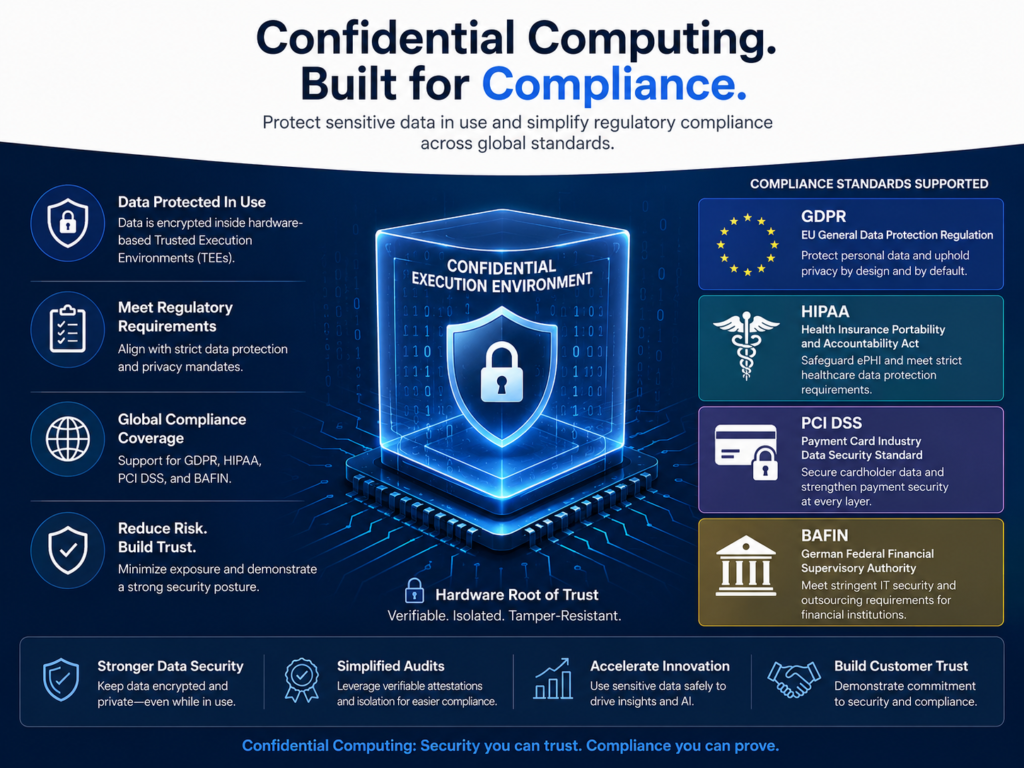
For GDPR, UK GDPR, and DSGVO programs, confidential computing can support privacy by design, DPIAs, data minimization, and security-of-processing controls.
GDPR Article 32 calls for appropriate technical and organizational measures based on risk, including encryption where suitable. The UK ICO also emphasizes appropriate technical and organizational measures under the UK GDPR security principle.
A Berlin analytics team, for example, may combine EU cloud regions, customer-managed keys, confidential VMs, audit logs, and remote attestation to support Article 32 evidence.
HIPAA, NHS, PCI DSS, and Financial Services
The HIPAA Security Rule requires administrative, physical, and technical safeguards to protect electronic protected health information. PCI DSS provides technical and operational requirements designed to protect payment account data.
That is why confidential computing is attractive for ePHI, NHS patient data, payment environments, SOC 2 controls, and ISO 27001 security programs.
A London health tech platform or New York payments provider can use it to narrow plaintext exposure during processing, while still maintaining access controls, monitoring, incident response, and audit documentation.
BaFin, DORA, NIS2, and German Cloud Risk
German and EU financial teams often evaluate cloud risk through BaFin expectations, DORA, NIS2, outsourcing controls, and data-sovereignty concerns.
DORA entered into application on January 17, 2025 and is designed to strengthen digital resilience across financial entities. NIS2 focuses on EU cybersecurity risk-management and reporting requirements for organizations in scope.
For Frankfurt, Munich, and Berlin teams, confidential computing should be part of a wider cloud risk model: region selection, key control, attestation, monitoring, exit planning, vendor oversight, and incident response.
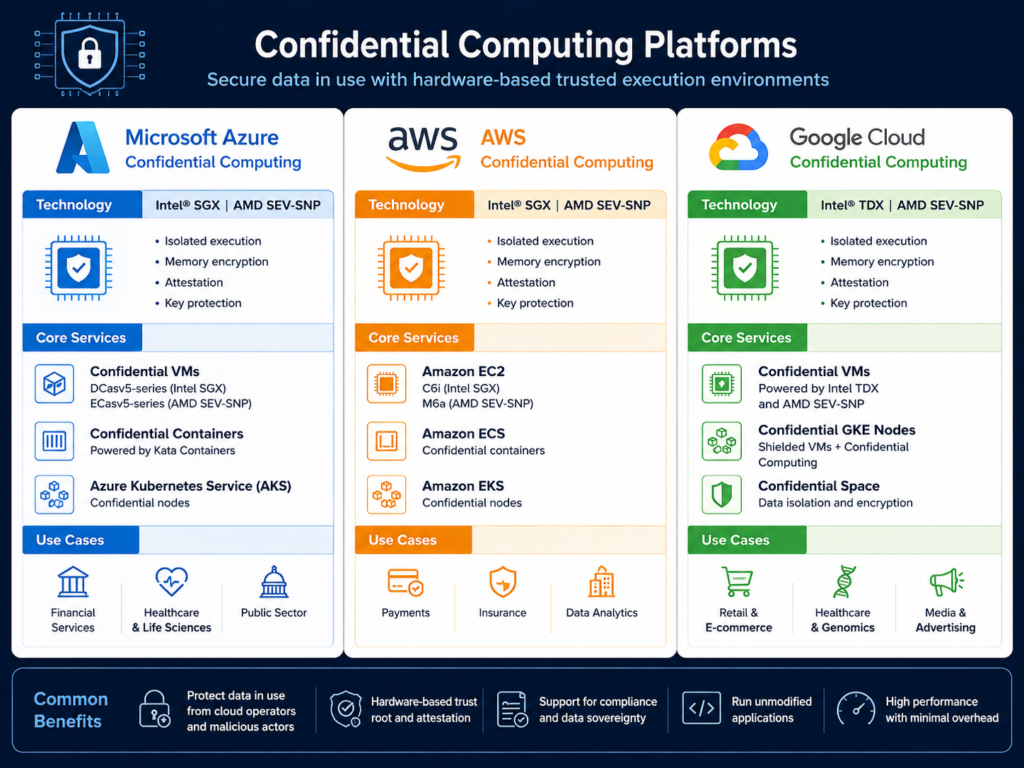
Confidential Computing Platforms Compared
The main hyper scalers all support confidential computing, but the right choice depends on workload design, existing cloud commitments, compliance needs, key management, and developer experience.
| Platform | Best Fit | Common Use |
|---|---|---|
| Azure Confidential Computing | Microsoft-heavy enterprise environments | Confidential VMs, containers, regulated workloads |
| AWS Nitro Enclaves | EC2-based isolated processing | Tokenization, PII, private keys, sensitive services |
| Google Cloud Confidential VMs | Full-VM data-in-use protection | Analytics, AI, data platforms, confidential workloads |
Azure Confidential Computing
Azure is strong for enterprise security programs and teams already invested in Microsoft identity, Azure Key Vault, and compliance tooling.
It supports multiple confidential computing technologies and helps protect code and data while they are in use.
AWS Nitro Enclaves
AWS Nitro Enclaves are well suited for cryptographic operations, tokenization, private key handling, PII processing, and isolated sensitive services inside EC2 architectures.
AWS describes Nitro Enclaves as isolated compute environments for processing highly sensitive data inside Amazon EC2 instances.
Google Cloud Confidential VMs
Google Cloud Confidential VMs focus on hardware-backed memory encryption for data in use.
They are useful for analytics, AI, and data-platform workloads where teams want VM-level confidentiality with minimal application changes.
For analytics-heavy workloads, Mak It Solutions can connect confidential infrastructure with Business Intelligence Services and secure Node.js development services.
Confidential Computing Use Cases by Region
Confidential computing use cases vary by regulation, sector, and buyer expectations.
USA.
In the USA, common use cases include HIPAA-aligned healthcare analytics, SOC 2 SaaS assurance, AI inference privacy, identity verification, and financial-risk scoring.
Teams in New York, San Francisco, Seattle, and Austin can use confidential computing to process sensitive datasets while reducing infrastructure-level exposure.
UK.
In the UK, NHS data programs, Open Banking platforms, FCA-regulated fintech, and London or Manchester SaaS companies can use confidential computing to support UK GDPR controls and cloud DPIAs.
Cisco’s 2025 Data Privacy Benchmark Study reported that 96% of respondents said privacy investments provided returns exceeding costs, which reinforces why privacy and cloud security are now board-level topics.
Germany and EU.
In Germany and the wider EU, confidential computing supports DSGVO, GDPR, BaFin, DORA, NIS2, and sovereignty-sensitive workloads.
Frankfurt, Berlin, Munich, Paris, Amsterdam, Dublin, and Zurich teams should combine it with EU region strategy, customer-managed keys, audit logs, vendor oversight, and documented risk decisions.
Is Confidential Computing Right for Your Cloud Strategy?
Confidential computing is right when stronger data-in-use protection is worth the added platform complexity, cost, and performance considerations.
Use Confidential Computing When You Handle
Regulated personal data
Sensitive AI workloads
Healthcare analytics
Financial scoring
Payment-related processing
High-trust SaaS workloads
Multi-party data collaboration
Cloud migrations with strict customer assurance needs
It is also valuable when sales, legal, or procurement teams keep hearing concerns about cloud-provider access.
Traditional Encryption May Be Enough When
Traditional encryption may be enough for lower-risk workloads, public content, basic internal apps, or systems where data is not sensitive during processing.
For many workloads, encryption at rest, TLS, IAM, logging, backups, vulnerability management, and least privilege still provide a strong baseline.
Confidential Computing Implementation Checklist
Use this checklist before choosing a platform or architecture.
Classify data by sensitivity, geography, and regulation.
Define the threat model: cloud admin, insider, malware, tenant escape, or third-party access.
Map controls to GDPR, UK GDPR, HIPAA, PCI DSS, SOC 2, ISO 27001, DORA, NIS2, or BaFin needs.
Choose Azure, AWS, Google Cloud, or a hybrid design.
Confirm TEE, secure enclave, or confidential VM support.
Implement remote attestation and key-release policies.
Use customer-managed keys where appropriate.
Monitor logs, performance, and security events.
Preserve audit evidence for customers, regulators, and internal risk teams.
Review limitations, including side-channel risk, app-layer bugs, and operational access models.
Mak It Solutions can help connect this checklist with secure mobile app development, SaaS architecture, analytics platforms, and cloud modernization.
Concluding Remarks
Confidential computing is becoming a practical option for teams that need secure cloud data processing without slowing down AI, SaaS, analytics, or regulated workloads.
Planning a secure AI, SaaS, analytics, or regulated cloud project? Mak It Solutions can help you assess where confidential computing fits, choose the right cloud pattern, and create a scoped implementation roadmap.
Start with a practical architecture review through the Mak It Solutions contact page and request a confidential computing readiness estimate.
Key Takeaways
Confidential computing protects data in use, closing a major cloud-security gap that traditional encryption does not fully address.
Its core building blocks include TEEs, secure enclaves, confidential VMs, encrypted memory, remote attestation, and controlled key release.
It can strengthen technical evidence for GDPR, UK GDPR, HIPAA, PCI DSS, BaFin, DORA, NIS2, SOC 2, and ISO 27001 programs, but it is not a compliance shortcut.
For regulated AI, SaaS, analytics, healthcare, fintech, and multi-party data workloads, confidential computing can make cloud processing safer and easier to explain to customers, auditors, and boards.
FAQs
Q : Is confidential computing the same as encryption?
A : No. Encryption protects data, but confidential computing focuses specifically on protecting data while it is being processed. It extends security to data in use through trusted execution environments, secure enclaves, encrypted memory, and attestation.
Q : Can confidential computing help with GDPR or UK GDPR?
A : Yes, confidential computing can support GDPR and UK GDPR security expectations where sensitive personal data is processed in cloud environments. It may strengthen technical safeguards, privacy-by-design controls, DPIA evidence, and data-minimization efforts. It does not automatically create compliance.
Q : Does confidential computing prevent cloud providers from seeing data?
A : It can significantly reduce cloud-provider and administrator access to plaintext data during processing, depending on the platform, configuration, and key-management model. Strong designs use hardware-backed isolation, remote attestation, customer-controlled keys, and strict release policies.
Q : What workloads benefit most from confidential computing?
A : The strongest candidates include healthcare ePHI, payment data, financial scoring, identity verification, confidential AI inference, SaaS tenant analytics, trade secrets, and multi-party data collaboration.
Q : Do Azure, AWS, and Google Cloud support confidential computing?
A : Yes. Azure offers confidential computing services, AWS supports Nitro Enclaves, and Google Cloud offers Confidential VMs. The right option depends on workload design, region availability, key management, attestation needs, compliance mapping, and existing cloud commitments.