


Cloud Strategy 2026: CIO Guide to Trust
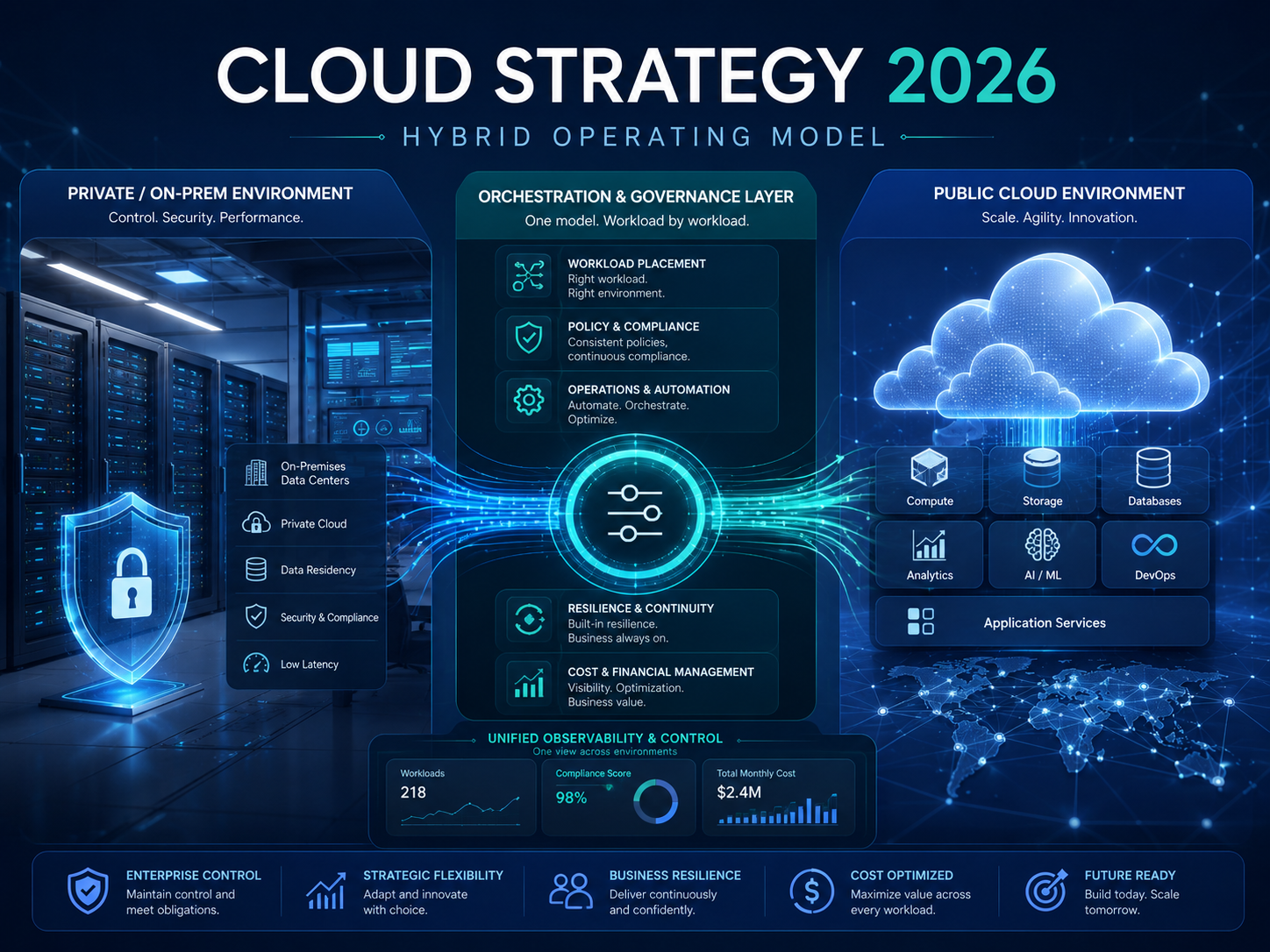
A strong cloud strategy 2026 is a workload-by-workload plan for deciding where each application, dataset and AI system should run. For regulated enterprises in the USA, UK, Germany and the EU, the strongest model is usually hybrid: public cloud where scale matters, private or sovereign cloud where control, compliance and resilience matter most.
Introduction.
Cloud strategy 2026 is no longer about moving everything to AWS, Azure or Google Cloud as fast as possible. That approach worked when speed was the main goal. It breaks down when AI workloads, data sovereignty, cyber risk, cloud waste and regulatory pressure all hit the same architecture.
For CIOs, CTOs and CISOs in New York, San Francisco, London, Berlin, Munich, Paris and Amsterdam, the real question is not “cloud or no cloud?” It is this:
Which platform gives this workload the right balance of trust, jurisdiction, latency, security, cost predictability and provable control?
That question matters because the stakes are now high. IBM’s 2025 Cost of a Data Breach Report put the global average breach cost at USD 4.44 million, while Flexera reported that 84% of surveyed organizations viewed cloud spend management as a top cloud challenge in 2025.
What Cloud Strategy 2026 Means for Enterprises
A practical cloud strategy for 2026 starts with workload placement, not platform preference. Public cloud, private cloud, multi-cloud, sovereign cloud and on-prem infrastructure all have a role. The goal is to decide where each workload performs best, costs sensibly and can be governed properly.
From Cloud-First to Workload-First Architecture
Cloud-first made sense when enterprises mainly wanted speed and elasticity. In 2026, workload-first planning is safer.
A SaaS dashboard may run well in public cloud. A data-heavy reporting platform may be cheaper in private infrastructure. A healthcare AI model using protected health information may need HIPAA-aware controls, stronger encryption, audit logging and a Business Associate Agreement. HHS guidance confirms that HIPAA-covered entities and business associates can use cloud services, but the cloud service provider may be considered a business associate when it creates, receives, maintains or transmits ePHI on their behalf.
In practice, the best architecture is rarely one-size-fits-all. It is a mapped portfolio.
Why CIOs, CTOs and CISOs Must Align Early
Cloud placement now affects finance, legal, security, engineering, procurement and operations. A CIO may want modernization. A CTO may want portability. A CISO may require zero trust, encryption, logging, isolation and evidence for auditors.
That alignment needs to happen before migration, not after a risky design is already in production.
Mak It Solutions’ guide on zero trust strategy for AI-era security connects cloud design with identity, AI access governance and secure data flows.
The 2026 Decision Lens.
Every major cloud decision should pass four tests.
| Decision Lens | What It Covers |
|---|---|
| Cost | Usage, egress, storage, licensing, support and FinOps maturity |
| Risk | Outages, misconfiguration, vendor concentration and recovery gaps |
| Trust | Security, auditability, provider access and compliance evidence |
| Control | Keys, contracts, regions, exit plans and operational visibility |
Flexera’s 2026 State of the Cloud findings also show how large this issue has become: more than three-quarters of large enterprises now spend over USD 5 million monthly on cloud services.
Build a Hybrid Cloud Operating Model for Cloud Strategy 2026
A strong cloud strategy 2026 should help teams decide placement by data sensitivity, latency, regulatory exposure, cost predictability, resilience, vendor lock-in and operational control. Hybrid cloud gives enterprises room to make those decisions workload by workload.
Public Cloud, Private Cloud, Multi-Cloud or Sovereign Cloud?
Public cloud is strong for elasticity, global reach, AI tooling and fast product delivery. Private cloud is often better for predictable workloads, tighter access control, legacy integration or local operations. Multi-cloud can reduce dependency on one hyperscaler, but it also adds complexity. Sovereign cloud supports stronger jurisdictional and operational control.
For comparison planning, Mak It Solutions’ multi-cloud strategy guide explains how resilience, governance and workload flexibility shape multi-provider decisions.
How to Prioritize Workloads by Sensitivity and Business Value
Start by classifying workloads into tiers.
Public-facing apps, analytics sandboxes and scalable web services may fit AWS, Azure or Google Cloud. Payment systems need PCI DSS scope control. Health care workflows need HIPAA, NHS or privacy-aware governance. German financial systems may need BaFin and DORA mapping.
A useful cloud placement matrix should include.
Data sensitivity
Revenue impact
Recovery time objective
Latency needs
Compliance exposure
Data residency and sovereignty needs
Encryption and key custody
Exit complexity
The point is simple: sensitive workloads deserve more design discipline.
Cloud Operating Model for USA, UK and EU Teams
US teams in Austin, Seattle or New York often prioritize HIPAA, SOC 2, PCI DSS and ISO 27001 evidence. UK teams in London or Manchester should consider UK GDPR, NCSC cloud principles and NHS cloud expectations.
The UK NCSC publishes cloud security principles covering areas such as data-in-transit protection, asset protection, resilience and separation between customers.
Germany and EU teams need to map GDPR/DSGVO, DORA, NIS2, BaFin expectations, EU AI Act obligations and data-transfer controls. The EDPB has also highlighted GDPR compliance challenges when public-sector bodies use cloud services.
Confidential Computing Strategy for Secure AI Workloads
Confidential computing helps protect sensitive data while it is being processed. That makes it especially relevant for AI, healthcare, finance, government workloads and cross-party data collaboration.
What Confidential Computing Protects in the Cloud
Traditional encryption protects data at rest and in transit. Confidential computing adds protection for data in use.
Google Cloud describes confidential computing as the protection of data in use through a hardware-based Trusted Execution Environment, or TEE.
This matters for AI model training, inference, fraud detection, clinical research, secure analytics and regulated collaboration.
Trusted Execution Environments for Data-in-Use Protection
Trusted Execution Environments create isolated processing areas that help limit access from the host operating system, hypervisor or cloud administrator. Common technologies include Intel SGX, AMD SEV, Intel TDX and confidential VM patterns.
For deeper technical education, Mak It Solutions’ article on confidential computing for sensitive cloud workloads explains how confidential workloads connect with data platforms and business intelligence.

Confidential AI for Healthcare, Finance and Government
Confidential AI can help organizations process sensitive data with stronger isolation.
A US healthcare company may use it for clinical decision support. A UK financial services firm may use it for fraud analytics. A German insurer in Frankfurt may use it for regulated model inference while keeping key custody and audit evidence under tighter control.
Confidential computing does not replace governance. It strengthens the security architecture around sensitive AI.
Cloud Repatriation Strategy and Cost Control
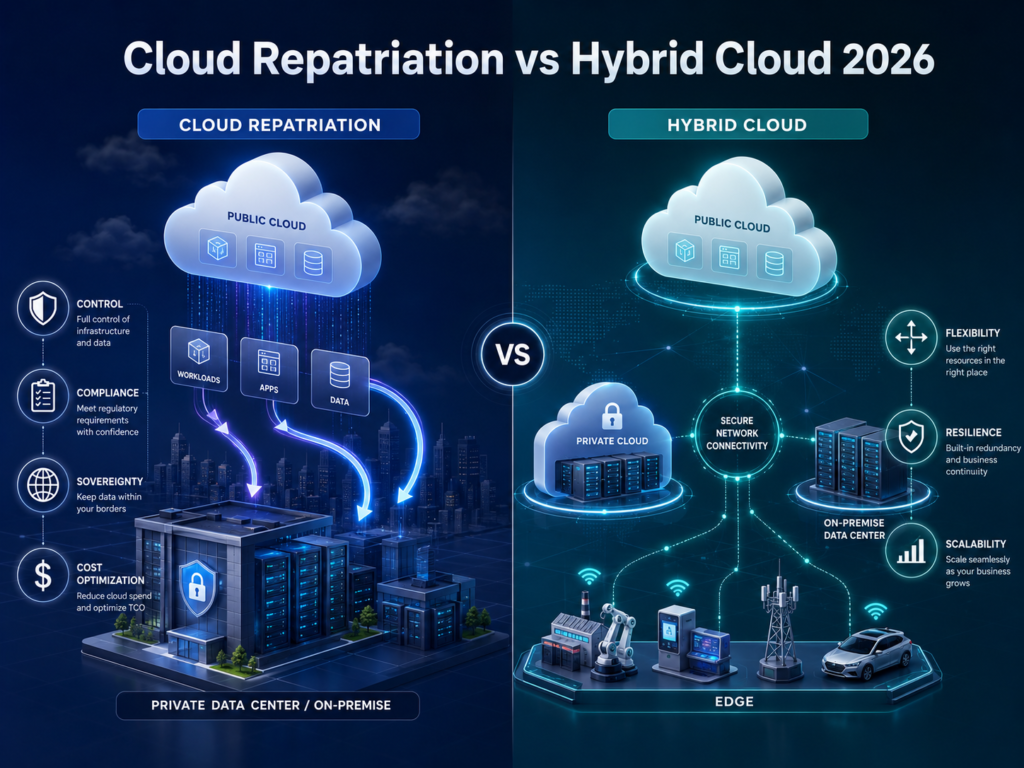
Cloud repatriation means moving selected workloads away from public cloud when cost, latency, compliance or control requirements no longer fit. It is not anti-cloud. It is placement discipline.
Why Enterprises Are Reconsidering Public Cloud Spend
Public cloud can become expensive when workloads run continuously, data transfer is heavy, environments are overprovisioned or teams lack FinOps accountability.
AI adds another layer of pressure. GPU workloads, vector databases, large data warehouses and GenAI APIs can grow quickly when teams do not control usage, retention, logging and model access.
The answer is not always repatriation. Sometimes it is reserved capacity, better storage tiers, autoscaling, Kubernetes optimization or managed database tuning.
Which Workloads Belong Back On-Prem or in Private Cloud
Good repatriation candidates often include.
Stable workloads with predictable usage
Data-heavy systems with high egress costs
Latency-sensitive industrial systems
Legacy platforms that are costly to refactor
Regulated workloads requiring local operational control
Systems with strict key-custody or jurisdictional requirements
The wrong move is to repatriate emotionally. The right move is to model the cost, risk and control impact first.
Repatriation vs Hybrid Cloud.
Repatriation moves selected workloads away from public cloud. Hybrid cloud creates a long-term operating model across public cloud, private cloud and on-prem infrastructure.
Most enterprises need hybrid cloud, not a full reversal.
Mak It Solutions’ business intelligence services can support analytics modernization where cloud platforms, private infrastructure and dashboards need to work together securely.
Geopatriation, Sovereign Cloud and Data Sovereignty
Geopatriation means moving data, applications or operations closer to local or sovereign infrastructure because of geopolitical, jurisdictional, compliance or operational-control risks. It is broader than repatriation because the driver is location, law and control.
What Geopatriation Means in Cloud Computing
Geopatriation may involve moving EU citizen data into EU regions, choosing European sovereign cloud providers, localizing encryption keys or reducing dependence on non-local support access.
For example, a Berlin health-tech company may keep sensitive patient analytics in Germany while using public cloud for non-sensitive product telemetry.
Sovereign Cloud Strategy for Germany and the EU
Sovereign cloud is relevant when jurisdiction, provider access, key custody and operational sovereignty matter. For German and EU organizations, providers and initiatives such as OVHcloud, IONOS, Scaleway, T-Systems, SecNumCloud, ANSSI and Gaia-X often enter the conversation.
Mak It Solutions’ guide on sovereign cloud vs hyperscalers is useful for comparing local control with hyperscaler scale.
Data Sovereignty Beyond Data Residency
Data residency means data is stored in a specific location. Data sovereignty asks deeper questions:
Who can access the data? Which laws apply? Where do support staff operate? Who controls the keys? How are audits performed? Can operations continue during legal, geopolitical or provider disruption?
EU data protection rules also include safeguards for international transfers, including adequacy decisions, standard contractual clauses and binding corporate rules.

Compliance Architecture Across USA, UK, Germany and EU
Compliance architecture translates legal obligations into controls, logs, contracts, runbooks and evidence. It should be built into the cloud strategy early, not patched in after deployment.
USA.
US healthcare teams need HIPAA safeguards and BAAs. SaaS and fintech teams often need SOC 2 controls, PCI DSS scope management and secure AI governance.
PCI DSS provides baseline technical and operational requirements designed to protect payment account data.
A San Francisco AI startup handling payment and health data should classify data before choosing cloud services, not after migration.
UK.
UK teams should map UK GDPR, NCSC guidance, NHS cloud expectations and financial resilience requirements.
For a London fintech, vendor concentration, exit planning, incident evidence and operational resilience can matter as much as infrastructure performance.
Germany/EU.
German and EU cloud strategies should map GDPR/DSGVO, BaFin expectations, Bundesbank considerations, DORA, NIS2, the EU Data Act and EU AI Act obligations.
DORA establishes an EU-wide oversight framework for critical ICT third-party providers in financial services, while NIS2 creates a cybersecurity framework across 18 critical sectors in the EU.
For secure AI programs, Mak It Solutions’ AI data leakage prevention guide and AI security monitoring guide connect cloud controls with prompt, log, RAG and agent governance.
2026 Cloud Strategy Roadmap and Vendor Evaluation
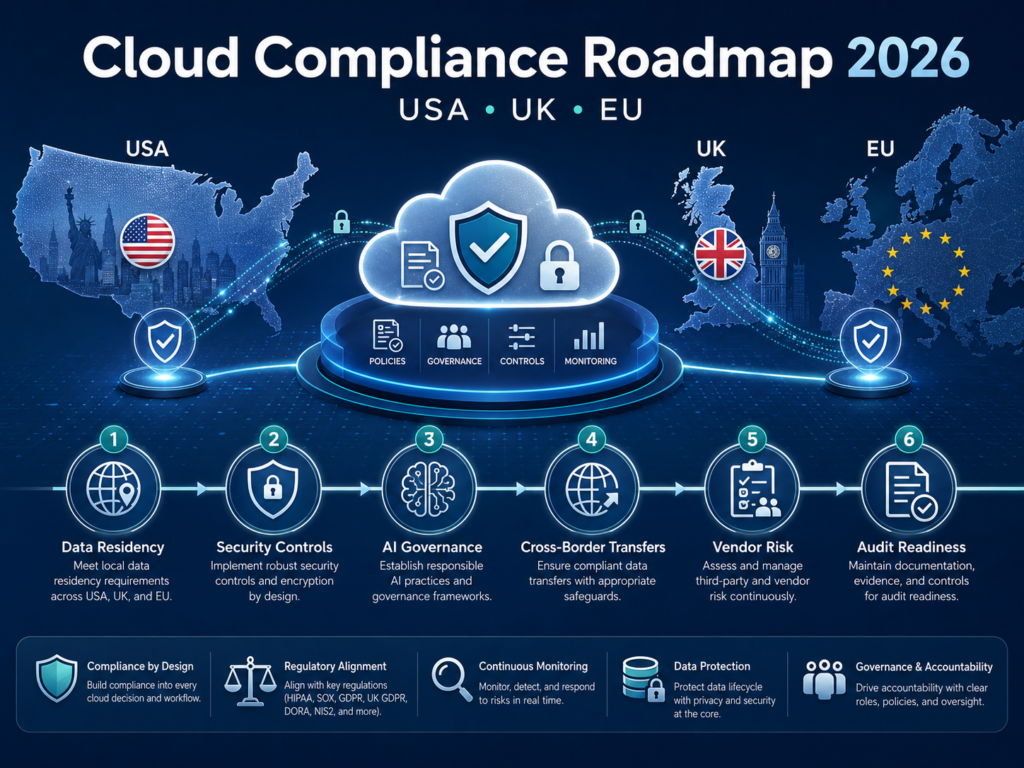
A 2026 roadmap should start with workload classification, compliance mapping, cost modeling, architecture review, resilience testing, vendor-risk assessment and phased modernization. The goal is not a perfect diagram. It is a practical decision system.
Create a 90-Day Cloud Strategy Assessment
Use the first 90 days to answer the questions that shape architecture, budget and risk.
Classify workloads by sensitivity, value and dependency.
Map compliance obligations by region: USA, UK, Germany and EU.
Review identity, encryption, observability, backup and resilience.
Model cost, egress, licensing and support requirements.
Build a phased roadmap for modernization, repatriation or sovereign placement.
This assessment gives leadership a shared view before money is committed to migrations, renewals or vendor contracts.
Questions to Ask AWS, Azure, Google Cloud and Local Providers
Before signing a 2026 cloud contract, ask providers about.
Region guarantees
Support access
Encryption key custody
Confidential computing availability
Exit assistance
DORA evidence
PCI DSS scope
HIPAA BAAs
UK GDPR and GDPR support
EU transfer safeguards
Incident response evidence
Egress costs and lock-in risk
Also ask how they support Kubernetes portability, VMware migration, Splunk integration, AI logging and audit-ready incident response.
When to Choose Advisory, Architecture or Migration Support
Choose advisory support when the cloud decision is unclear. Choose architecture support when the target model is known but the controls need design. Choose migration support when workloads, risks, owners and success criteria are already defined.
Mak It Solutions’ backend development services, Node.js development services and Python development services can support cloud-ready application modernization, API design and automation.
Concluding Remarks
A smart cloud strategy 2026 gives leaders a clear way to decide what belongs in public cloud, what needs private or sovereign infrastructure, and what should be redesigned before it creates risk.
For enterprises in the USA, UK, Germany and the wider EU, the winning cloud model will not be the loudest or most fashionable one. It will be the model that protects sensitive data, supports AI safely, controls spend and proves compliance when pressure rises.
Planning a 2026 cloud roadmap across AWS, Azure, Google Cloud, private cloud or sovereign infrastructure? Mak It Solutions can help you classify workloads, assess compliance exposure, model cost and design a phased architecture for AI, SaaS, data analytics and secure application modernization.
Start with a scoped cloud strategy assessment through Mak It Solutions and turn cloud uncertainty into a practical execution plan.( Click Here’s )
Key Takeaways
Cloud strategy 2026 is about workload placement, not blanket cloud-first migration.
Hybrid cloud is often the strongest model for regulated enterprises in the USA, UK, Germany and EU.
Confidential computing improves protection for data in use, especially in AI, healthcare and finance.
Cloud repatriation is useful when costs, latency or control requirements outweigh elasticity.
Sovereign cloud requires more than data residency; key custody, jurisdiction and operational control matter.
Vendor evaluation should include compliance evidence, exit planning, resilience and AI governance.
FAQs
Q : Is sovereign cloud the same as data residency?
A : No. Data residency means data is stored in a specific country or region. Sovereign cloud goes further by addressing legal jurisdiction, support access, encryption key custody, operational control, auditability and provider dependency.
Q : Can public cloud be used for sensitive healthcare or financial data?
A : Yes, but only with the right controls, contracts and compliance mapping. US healthcare workloads may need HIPAA safeguards and a Business Associate Agreement. Financial services workloads may need PCI DSS, SOC 2, DORA, BaFin or operational resilience evidence.
Q : What workloads are poor candidates for public cloud?
A : Poor candidates often include predictable workloads with little elasticity benefit, data-heavy systems with high egress costs, ultra-low-latency applications, legacy platforms that are expensive to refactor and workloads with strict jurisdictional or key-custody requirements.
Q : How does confidential computing support AI governance?
A : Confidential computing supports AI governance by helping protect sensitive data while it is being processed. It is useful for AI inference, secure analytics, multi-party collaboration, healthcare research, fraud detection and regulated decision systems.
Q : What should enterprises ask cloud vendors before signing a 2026 contract?
A : Ask about data location, support access, encryption key custody, confidential computing, audit evidence, resilience commitments, DORA or PCI DSS documentation, HIPAA BAAs, GDPR support, exit assistance, lock-in risk, egress costs and incident notification.