


Content Refresh Strategy That Recovers Lost Traffic
Content Refresh Strategy That Recovers Lost Traffic
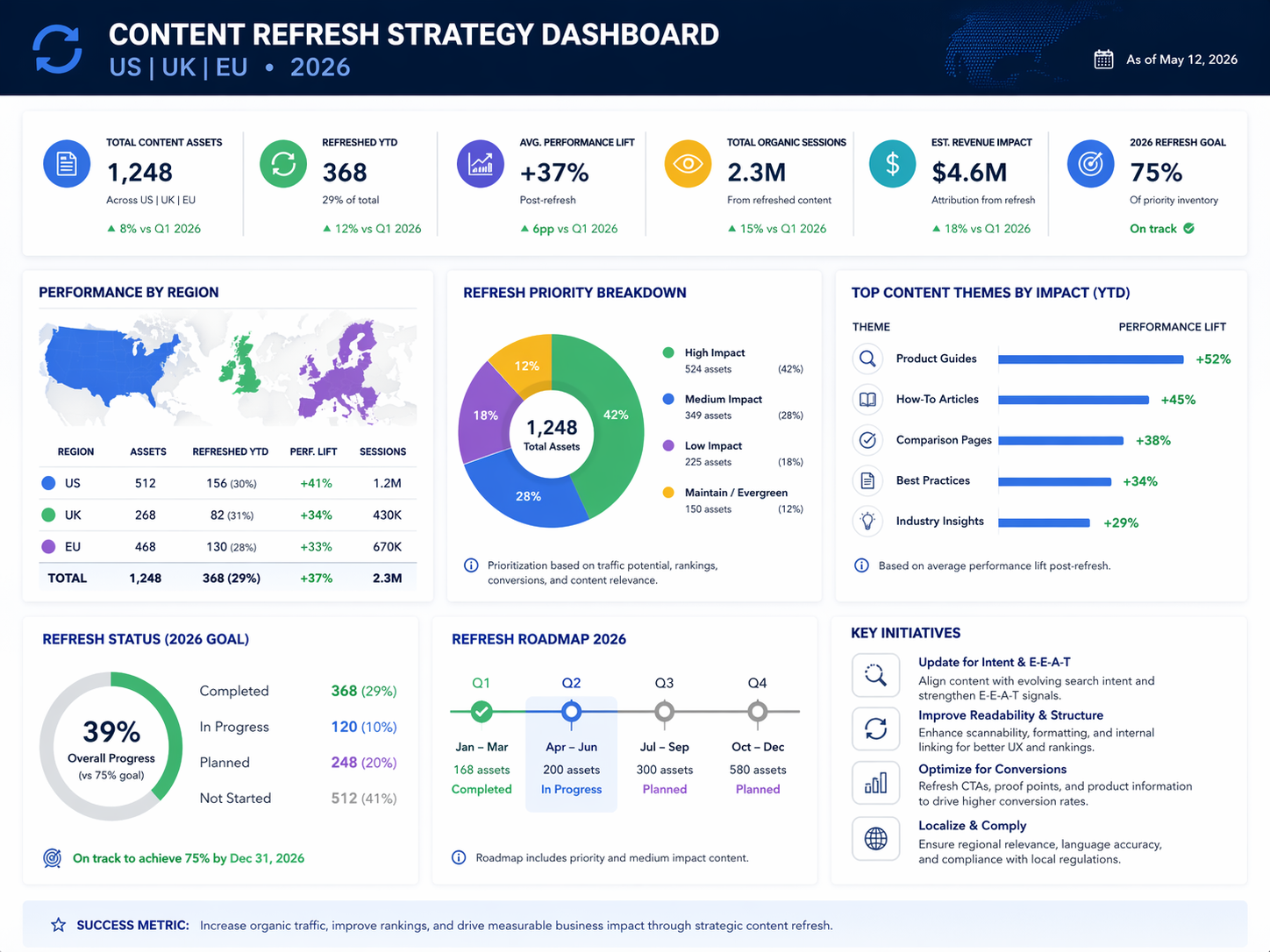
Content Refresh Strategy That Recovers Lost Traffic
Older blog posts do not always need a full rewrite to perform again. A strong content refresh strategy helps you recover rankings, revive declining traffic, and improve AI-search visibility by updating what matters most: search intent, facts, structure, and trust signals.
For most teams, this is the fastest way to improve aging content without rebuilding every page from scratch. Instead of throwing away an existing URL with history and authority, you strengthen the asset you already have and make it more useful for both readers and modern search systems.
What Is a Content Refresh Strategy?
A content refresh strategy is a structured process for improving an existing article so it better matches current search intent, current facts, and current SERP expectations.
That usually means keeping the same URL, updating weak sections, replacing outdated examples, improving on-page SEO, and making the page easier to understand for both humans and AI-powered search experiences.
Refreshing vs. rewriting vs. pruning
These three actions serve different goals:
| Approach | What it means | Best use case | Typical outcome |
|---|---|---|---|
| Refreshing | Updating an existing page | The topic still matters, but the content feels dated | Faster recovery potential |
| Rewriting | Rebuilding most of the article | The topic is still relevant, but the angle or structure no longer works | Stronger repositioning |
| Pruning | Removing, merging, or redirecting content | The page has little value or overlaps with stronger pages | Cleaner site structure |
For in-house teams and agencies, refreshing is often the most efficient option. You keep the authority the page has already built and improve the parts that now hold it back.

Why Blog Posts Lose Rankings Over Time
Posts lose visibility because the search landscape changes around them.
Intent shifts. Competitors improve their pages. Tools and examples become outdated. Search results also become more demanding, especially when Google starts favoring direct answers, comparison formats, and entity-rich pages.
Common reasons older posts decline
Search intent has changed since the article was first published
Competitors now offer better formatting or more current information
Internal links weakened as the site grew
Statistics, screenshots, or product references are outdated
The article answers the topic broadly, but not the current query clearly enough
A post that ranked well in 2023, for example, may feel too general in 2026 if the SERP now favors concise frameworks, tools, or checklist-style answers.
Why a Content Refresh Strategy Matters Now
A modern content refresh strategy is no longer just about rankings. It also helps your content stay competitive in featured snippets, AI-generated summaries, and answer-engine environments.
Older content often has one big advantage: authority. If the topic still fits your audience and offer, updating the page can be far more efficient than publishing a brand-new article targeting the same keyword.
That is especially useful for WordPress, HubSpot, and Shopify teams managing large content libraries across the US, UK, Germany, and the wider EU.
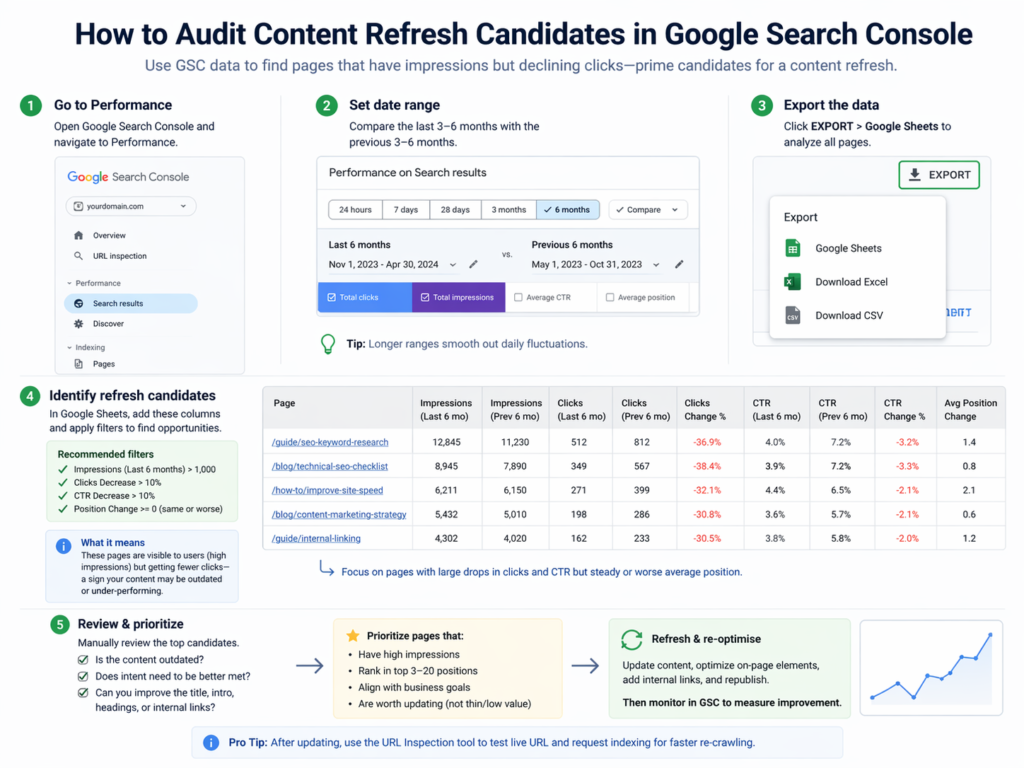
How to Audit and Prioritize Posts for Refreshing
A successful refresh starts with choosing the right URLs.
Focus first on pages that used to perform, still align with your business goals, and have enough authority to recover. This is where a practical audit matters more than guesswork.
What to look for in Search Console and analytics
Check for pages with.
Declining clicks
Falling average positions
Strong impressions but weak CTR
Older traffic trends moving steadily downward
Commercial relevance tied to services or conversions
A page that dropped from position 4 to position 11 is often a stronger refresh candidate than a page that never ranked meaningfully in the first place.
Which pages should come first?
Prioritize pages that have.
Clear ranking decay
Strong business relevance
Search intent that still matches the original topic
A realistic chance of recovery
For example, a declining post tied to SaaS onboarding, fintech compliance, healthcare workflows, or ecommerce growth may deserve more attention than a purely informational article with little conversion value.
When to refresh, consolidate, or prune
Use this simple rule.
Refresh when the core topic still matters
Consolidate when two pages compete for the same keyword or intent
Prune when the page has no strategic value and little chance of recovery
Large CMS sites especially benefit from this discipline because content sprawl builds up fast over time.
The Content Refresh Strategy Framework Step by Step
The best content refresh strategy improves intent match, clarity, usefulness, and trust without changing the URL unless absolutely necessary.
The goal is not to make the article longer. The goal is to make it better.
Recheck search intent
Before editing anything, search the target keyword again and study what the current SERP rewards.
Ask:
Does the query now favor list posts, comparisons, or step-by-step guides?
Are direct answers appearing higher than broad explainers?
Are competitors covering angles your page missed?
This prevents you from refreshing the wording while ignoring the real reason the page dropped.
Update facts, examples, and outdated statistics
Next, replace anything that makes the article feel old.
Expired statistics
Broken screenshots
Old product mentions
Outdated compliance references
Irrelevant examples
If your page touches healthcare, use current NHS or HHS context where appropriate. If it covers payments, mention frameworks like PCI DSS. If it targets privacy-sensitive EU audiences, reflect GDPR or data residency concerns naturally.
Improve headings and on-page structure
Strong structure makes older content easier to scan and easier for search systems to interpret.
Tighten weak H2s and H3s. Break long paragraphs. Add direct answer blocks early under major headings. Use bullet points where they genuinely improve clarity.
This improves topical reinforcement and helps users move through related content more naturally.
Add trust signals and experience-based detail
A refreshed article should feel more credible than it did before.
In practice, that often means adding.
Real frameworks or standards
More specific market examples
Practical implementation notes
Subtle experience-based language
Clearer editorial confidence without exaggeration
For example, a New York SaaS reader may care about qualified pipeline and CAC efficiency. A London team may respond better to practical implementation detail and governance clarity. A Berlin or Munich fintech audience may expect GDPR, DSGVO, or BaFin-aware examples before trusting the advice.
Review metadata and conversion paths
Do not stop at the body content.
Refresh the
SEO title
Meta description
Intro paragraph
CTA
Internal links
On-page relevance signals
A strong refresh should improve both discoverability and what happens after the click.
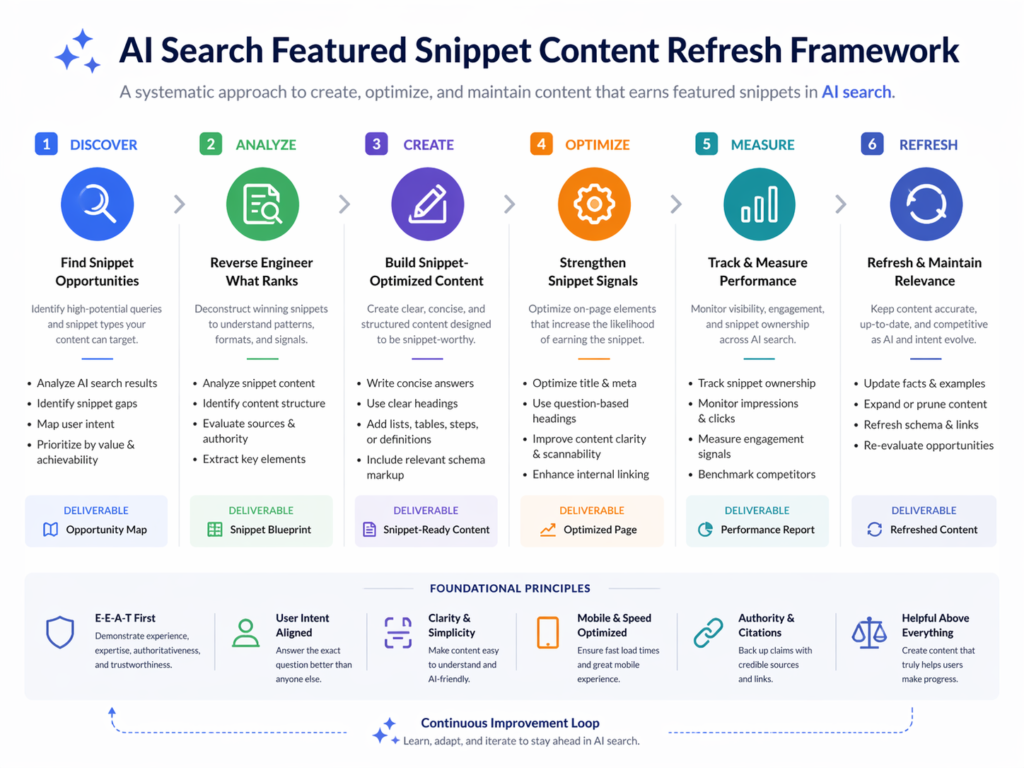
How to Refresh Content for AI Search, Featured Snippets, and AEO
To improve AI-search readiness without rewriting everything, make your content easier to extract, summarize, and trust.
That means answering the core question early, using cleaner structure, and removing bloated sections that bury useful information.
Add answer-first sections
Under each major heading, lead with a direct answer in the first two or three sentences. Then expand with explanation, examples, or actions.
This helps with.
Featured snippet visibility
AI Overviews and answer-engine extraction
Reader comprehension on mobile
Faster intent satisfaction
Use FAQ-style formatting where it fits
FAQ sections still work well when they answer real questions your audience actually asks.
Good FAQ answers are.
Short
Clear
Specific
Free of fluff
They help older posts feel more complete without forcing a full rewrite.
Update entities and context
Add current entities only where they genuinely fit. Depending on the page, that may include:
WordPress
HubSpot
Shopify
Google Search Console
GDPR
BaFin
HIPAA
SOC 2
This kind of context makes the article feel more current and improves topical clarity without turning the piece into keyword soup.
Localization Matters for US, UK, and EU Teams
A content refresh should not sound identical in every market.
Regional trust signals affect both rankings and conversions. The closer your examples feel to the audience’s reality, the stronger the page tends to perform after the click.
US.
In the US, refreshed B2B content often performs better when it connects updates to business outcomes like:
Qualified pipeline
Demo conversions
CAC efficiency
Revenue influence
That framing tends to resonate with growth-focused buyers and marketing leaders.
UK.
UK audiences often respond better to plain English, useful implementation detail, and visible trust logic.
For sectors shaped by regulated procurement or data governance, a clean and practical tone can be more persuasive than overly aggressive marketing language.
Germany and the wider EU.
In Germany and across the EU, privacy-aware examples matter more. A fintech article that ignores GDPR, DSGVO, or BaFin can feel incomplete. A healthcare article that skips data minimization or residency concerns may lose trust even if the writing is otherwise strong.
That does not mean every article needs legal language. It means examples should feel market-aware.
Content Refresh Checklist
A simple content refresh process usually works better than an overly complex one.
Use this checklist.
Confirm current search intent
Keep the URL when possible
Update the intro
Replace stale facts and examples
Tighten H2s and H3s
Improve internal linking
Add answer-first formatting
Refresh metadata
Strengthen the CTA
Benchmark performance after publishing
For many teams, this alone is enough to turn a fading post into a useful asset again.
Mistakes That Hurt Rankings After a Refresh
Refreshing content can backfire when the update is handled carelessly.
Common mistakes include.
Changing the angle too aggressively
Deleting sections that still satisfy intent
Altering the URL without a proper redirect
Stuffing in extra keywords unnaturally
Updating the date without making a meaningful improvement
Expanding word count without improving usefulness
The best refreshes feel sharper, not heavier.
How to Measure Results After Publishing
A refresh is only valuable if performance improves.
Track the page over 30, 60, and 90 days using metrics such as.
Clicks
Impressions
Average position
CTR
Engaged sessions
Assisted conversions
Form fills or demo requests
The strongest result is not just more traffic. It is better-qualified traffic that behaves more like your intended audience.

Final Thoughts
A smart content refresh strategy helps you recover more value from the content you already own. Instead of rewriting everything, you improve the pages that still deserve to rank and make them more useful for modern search.
If older posts are losing visibility, start with a focused audit, update the pages with the best recovery potential, and strengthen them for both human readers and AI-driven search experiences. That is usually where the fastest gains happen.( Click Here’s )
Key Takeaways
A content refresh strategy helps recover visibility faster than rewriting everything from scratch
The best candidates are pages with ranking decay, business value, and realistic recovery potential
Refresh intent, facts, structure, internal links, and trust signals before adding more words
Answer-first formatting helps older posts perform better in featured snippets and AI search
Localized examples improve trust across the US, UK, Germany, and the wider EU
Measuring results over 30, 60, and 90 days keeps refresh decisions grounded in performance
FAQs
Q : How often should you refresh blog content for SEO?
A : Review important posts every 6 to 12 months. Refresh sooner if rankings, CTR, conversions, or search intent shift noticeably. High-value pages in SaaS, healthcare, fintech, and ecommerce often need more frequent attention because tools, compliance expectations, and buyer behavior change faster.
Q : Can updating old blog posts improve rankings faster than publishing new ones?
A : Yes, often it can. An older page may already have authority, backlinks, internal links, and index history. When the topic still matters and the page is simply outdated, a well-planned refresh can produce gains faster than starting from zero.
Q : Should you change the publish date when refreshing content?
A : Only when the update is substantial. If you have revised statistics, examples, screenshots, compliance references, or recommendations, showing a real “last updated” date can improve trust. Cosmetic edits alone do not justify it.
Q : What metrics show whether a content refresh worked?
A : Start with clicks, impressions, average ranking position, and CTR in Google Search Console. Then look at engaged sessions, assisted conversions, form fills, demo requests, or revenue influence. Better traffic quality is often more important than traffic volume alone.
Q : Is it better to refresh content or create a new article targeting the same keyword?
A : Usually, refresh first if the existing article still matches the keyword and has some authority. Publishing a second page for the same intent can create cannibalization. A new article makes more sense when the original page serves the wrong audience or cannot be improved without changing the topic.