


Edge AI for Industrial Robots: 7 Critical Benefits
Edge AI for Industrial Robots: 7 Critical Benefits
Edge AI for Industrial Robots: 7 Critical Benefits
A robotic arm is picking components from a moving production line. Suddenly, a part shifts position. The robot’s vision system needs to recognize the change, calculate the correct position, and send updated information to the controller before the next movement.
Even small delays can affect production throughput. And when every camera frame must travel to a distant cloud server, network congestion or connectivity problems can make response times less predictable.
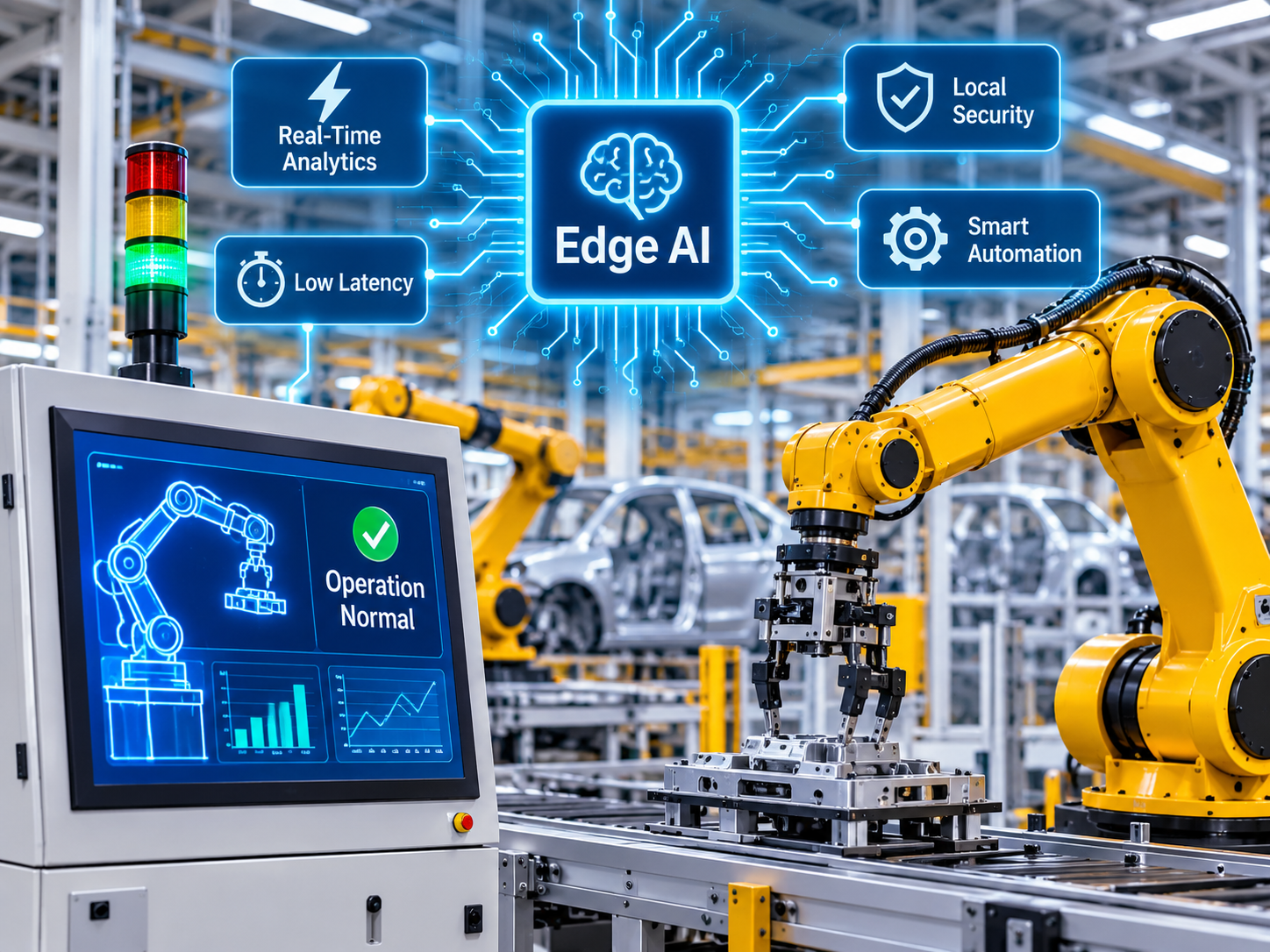
Edge AI for industrial robots addresses this challenge by running artificial intelligence models directly on robotic equipment or nearby industrial computers. This approach reduces dependence on remote processing and can improve response-time consistency, operational reliability, and control over manufacturing data.
The scale of industrial automation makes these decisions increasingly important. According to the International Federation of Robotics (IFR), approximately 542,000 industrial robots were installed worldwide in 2024, following 541,302 installations in 2023.
For manufacturers, the important question isn’t simply whether AI can improve automation. It’s where AI processing should happen to deliver reliable, measurable value on the factory floor.
What Is Edge AI for Industrial Robots?
Edge AI for industrial robots means executing machine learning models on a robot, an industrial PC, or a local factory server instead of depending on cloud infrastructure for every prediction.
These models can analyze camera images, identify components, detect manufacturing defects, and interpret sensor information close to the production process.
The main advantage is proximity. Data doesn’t always need to travel outside the factory before the system can act on it.
How Local AI Inference Works in Industrial Robotics
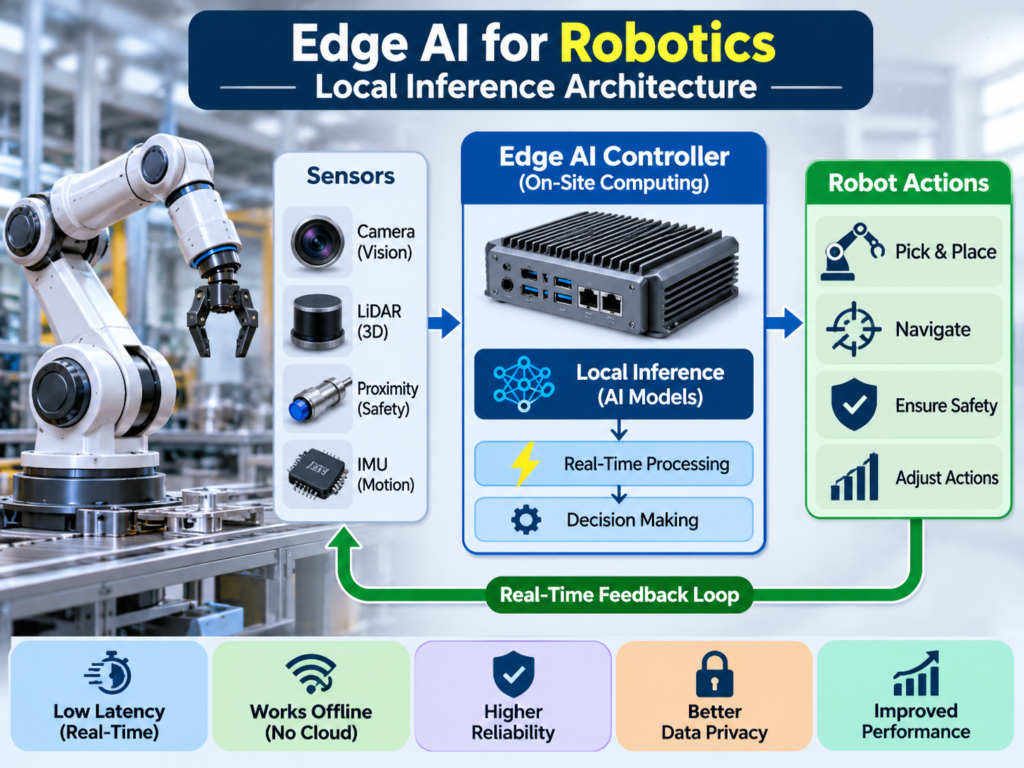
A typical edge AI workflow involves five connected activities:
Sensor capture: Industrial cameras or sensors collect images, temperatures, vibration signals, or positioning information.
Data preprocessing: Local computing equipment prepares the information for the AI model.
Model inference: The model identifies an object, detects an anomaly, or produces another prediction.
Controller integration: Approved interfaces pass the relevant output to a PLC or robot controller.
Robot response: The automation system performs the appropriate action within its validated operating and safety boundaries.
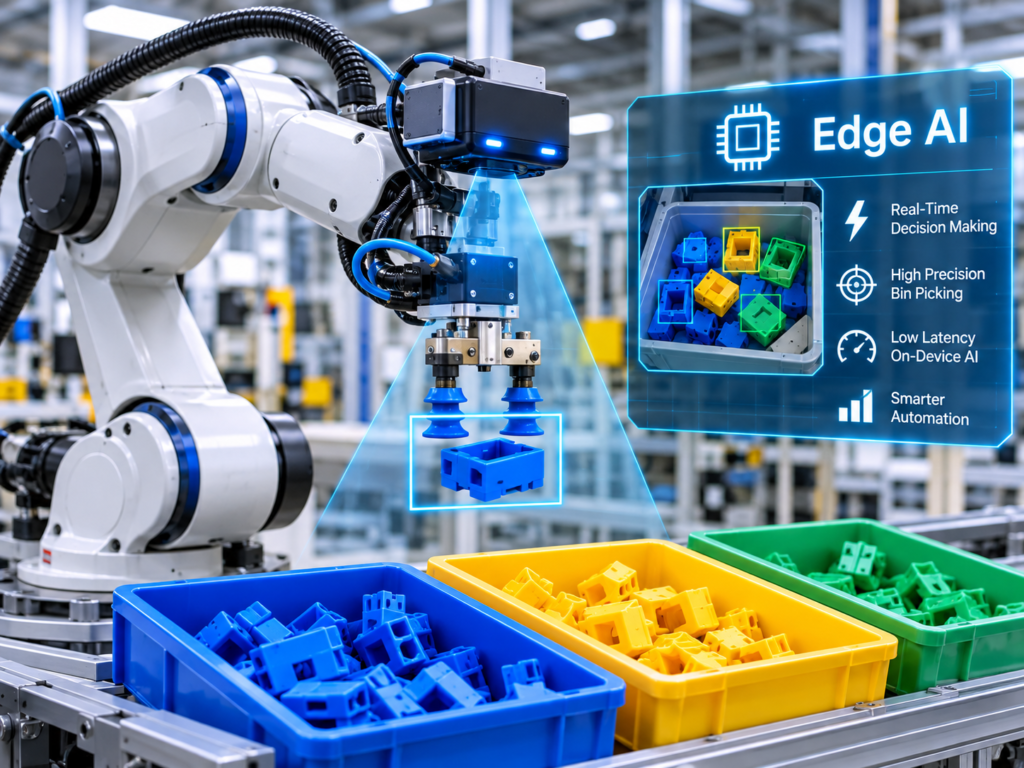
Consider a robotic bin-picking application. An overhead camera captures an image of randomly positioned metal parts. A nearby GPU-based computer identifies a suitable object and estimates its orientation. The robot controller then uses the approved information to plan the picking operation.
The AI handles perception, while the robot’s validated control and safety systems remain responsible for permitted movements and protective functions.
Edge Computing vs. Cloud AI for Industrial Robots
Not every industrial AI workload needs to run directly on the robot. Manufacturers generally choose between onboard processing, factory-edge infrastructure, and remote cloud computing.
|
Factor |
Onboard AI |
Factory Edge |
Cloud AI |
|---|---|---|---|
| Response time | Often low | Usually low |
Network-dependent |
| Connectivity | Minimal external dependency | Local network required |
External network typically required |
| Computing capacity | Hardware-limited | Moderate to high |
Highly scalable |
| Data location | Robot or device | On-premises |
Provider-dependent |
| Main costs | Hardware, power | Servers, maintenance |
Usage, data transfer |
| Best suited for | Dedicated robot tasks | Shared factory workloads |
Training, analytics, storage |
Local inference is not automatically faster in every situation. A large model may perform better on a powerful shared server than on a small embedded processor.
The right choice depends on the complete system, including workload size, communication delays, computing capacity, and operational requirements.
Why Local Inference Matters for Real-Time Industrial Robots
Industrial automation depends on repeatable timing. A system that responds quickly during testing but slows down under full production load may create unexpected delays.
Local inference can help reduce network-related uncertainty by keeping time-sensitive processing close to industrial equipment.
Reducing Latency and Network Jitter
Latency is often discussed as though it refers only to model execution time. In a working factory, however, the full sensor-to-action process matters much more.
End-to-end response includes image capture, preprocessing, model execution, communication, controller processing, and actuation.
Engineering teams should measure.
Median, p95, and p99 response times.
Network jitter and worst-case communication delays.
Inference throughput during sustained production.
Performance with multiple cameras or robots operating simultaneously.
Cycle-time consistency under realistic factory conditions.
These measurements reveal whether the proposed architecture can meet production requirements.
For example, a fast AI accelerator offers limited practical benefit if image transfer or controller communication creates a larger delay elsewhere in the system.
Offline Reliability and Manufacturing Data Control
A local inference system can continue processing supported workloads during an internet outage, provided the required models, sensors, controllers, and supporting services remain available on-site.
This matters particularly in factories where external network interruptions cannot be allowed to disrupt routine inspection or monitoring.
Local processing may also reduce unnecessary transfers of sensitive production images, manufacturing parameters, and proprietary product information.
However, keeping data inside the factory doesn’t automatically guarantee security. Manufacturers still need access controls, secure updates, network segmentation, monitoring, and appropriate retention policies.
Edge AI and Industrial Robot Safety
AI-assisted perception must not be confused with certified safety-rated control.
An AI model might identify an unexpected object near a workpiece, but that doesn’t make it a replacement for validated emergency stops, protective separation, or other safety functions.
Robot integration should account for applicable requirements such as ISO 10218, while industrial cybersecurity assessments may reference the IEC 62443 series.
The US NIST AI Risk Management Framework also provides useful guidance for identifying, assessing, and managing AI-related risks.
In practice, the safest architecture keeps AI-generated recommendations within clearly defined operational boundaries and relies on properly engineered safety systems.
What Hardware Does Industrial Edge AI Need?
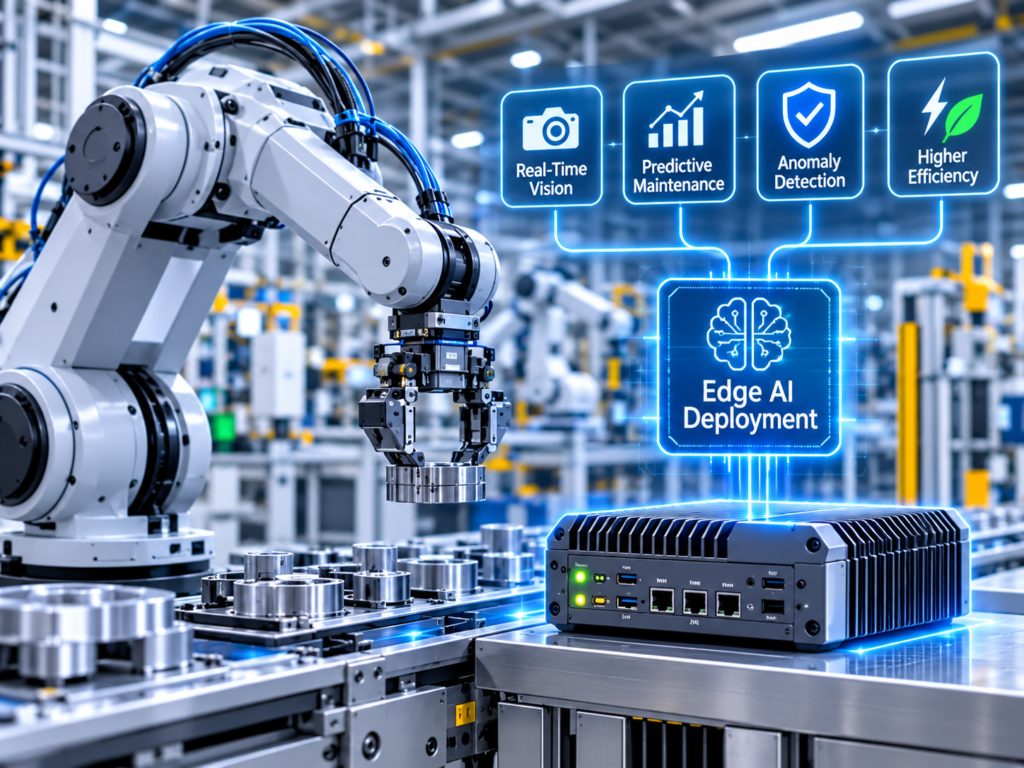
Edge AI deployments typically use embedded processors, industrial PCs, GPU accelerators, or shared inference servers.
The most suitable option depends on the model, the factory environment, and how the AI output will integrate with existing equipment.
NVIDIA Jetson, Industrial GPUs, and Local Inference Servers
Embedded platforms such as NVIDIA Jetson can support computer vision and neural network inference close to individual machines.
Industrial GPU servers can provide greater computing capacity for several cameras, production cells, or robotic systems.
Tools such as NVIDIA Tensor RT can optimize supported neural networks, including through reduced-precision inference, although changes in numerical precision must be validated against accuracy requirements.
Industrial computing ecosystems such as Siemens Industrial Edge and Bosch Rexroth ctrlX also offer integration options for selected manufacturing environments.
Before purchasing hardware, manufacturers should evaluate model size, memory requirements, camera count, thermal performance, power consumption, maintenance access, and long-term spare-part availability.
Connecting Edge AI with PLCs, ROS 2, and Factory Systems
An accurate AI model is only one part of a production-ready solution.
Its outputs must connect reliably with the surrounding automation environment, which may include.
PLCs and robot controllers.
ROS 2-based robotics software.
OPC UA, PROFINET, and Ether CAT communication.
SCADA monitoring systems.
Manufacturing execution systems (MES)
Manufacturers may use Python development services for prototype inference workflows and business intelligence solutions for aggregated production monitoring and reporting.
Production deployments also need disciplined model lifecycle management. That means version tracking, secure updates, performance monitoring, rollback procedures, and revalidation when software or manufacturing conditions change.
Where Does Edge AI Create Manufacturing Value?
Edge AI is most useful when a local prediction supports an operational decision that is frequent, time-sensitive, or difficult to manage through traditional automation alone.
The business value comes from measurable improvements in quality, throughput, equipment availability, or operational efficiency not simply from placing an AI accelerator near a robot.
Robotic Quality Inspection, Bin Picking, and Assembly
Computer vision is one of the clearest industrial use cases for local inference.
A factory might deploy edge AI to identify incorrectly positioned components, inspect assembled products, guide a robotic gripper, or detect visible defects.
For example, an automotive assembly cell may analyze a component’s orientation before placement. If the part is incorrectly positioned, the system can send updated information through the approved robot control interface.
Similarly, bin-picking robots can use local vision inference to identify suitable objects among overlapping or randomly arranged parts.
Manufacturers exploring these applications can review computer vision for quality control to understand related inspection workflows.
Predictive Maintenance and Equipment Monitoring
Local AI can also analyze vibration, temperature, and operating signals to identify unusual equipment behavior.
A monitoring system might flag changing motor vibration patterns or temperature anomalies for further investigation.
These predictions can help maintenance teams decide when additional inspection is necessary. They don’t automatically prove that a component will fail or eliminate the need for conventional maintenance procedures.
Actual benefits depend on sensor quality, model performance, maintenance workflows, and whether detected abnormalities lead to useful action.
Edge AI Deployment Costs and ROI
A realistic investment case includes much more than inference hardware.
Manufacturers should consider engineering time, controller integration, commissioning, cybersecurity, validation, maintenance, and possible production interruption.
The following example illustrates a simplified business case for a hypothetical factory.
Illustrative edge AI investment scenario
Initial investment
$40,000
Annual gross savings
$25,000
Annual maintenance
$5,000
Annual net benefit
$20,000
Hypothetical amounts in USD, not actual customer results or vendor quotations.
Under these assumptions, the simple payback period would be:
This calculation excludes financing, taxes, inflation, and production disruption during implementation. Actual results may differ substantially.
For a broader approach to automation investment decisions, see the warehouse robotics ROI analysis.
How to Deploy Edge AI for Industrial Robots
A successful deployment begins with production requirements rather than a preferred hardware platform.
Starting with one representative manufacturing cell allows engineering teams to establish meaningful performance baselines before considering wider adoption.
Five Steps to Integrate Edge AI with Existing Robots
Define operational requirements
Establish cycle-time targets, inference accuracy, failure conditions, safety boundaries, and acceptable response-time variability.
Select the inference architecture
Choose onboard processors, industrial PCs, or shared servers based on the workload, networking requirements, and factory environment.
Optimize and test the AI model
Evaluate memory consumption, throughput, quantization, prediction accuracy, and sustained performance on the target equipment.
Integrate with approved OT interfaces
Connect model outputs to supported PLCs, robot controllers, and communication protocols without bypassing validated safety systems.
Validate, deploy, and monitor
Test p95/p99 response times, network failures, cybersecurity, model drift, thermal behavior, and software rollback before scaling.
When Hybrid Edge-Cloud Architecture Makes Sense
A hybrid architecture often provides a practical balance between local performance and centralized computing.
The factory-edge system handles time-sensitive perception and inference. Cloud services can support model training, fleet-level analysis, long-term data storage, and non-critical reporting.
This arrangement allows manufacturers to benefit from scalable computing without making every production decision dependent on an external network connection.
Teams planning a deployment can also assess their existing software integration capabilities before committing to new infrastructure.
Edge AI Deployment in the USA, UK, Germany, and EU
The technical challenges of industrial edge AI are broadly similar across manufacturing regions. However, regulatory expectations, existing equipment, and data governance requirements can influence how a solution is designed.
US and UK Factory Integration Priorities
In US automotive manufacturing centers such as Detroit, local inference may support robotic inspection, assembly automation, and production monitoring.
A manufacturer with existing robotic equipment should first review controller compatibility, OT networking, and applicable machinery safety requirements.
In the UK, manufacturers operating older or mixed-vendor automation systems may place particular importance on reliable integration with established production infrastructure.
Where personal data is processed, UK deployments must also consider applicable UK GDPR and Data Protection Act requirements. The Information Commissioner’s Office provides official guidance on data protection responsibilities.
Germany and EU Data Governance and Machinery Safety
German industrial centers such as Stuttgart offer relevant examples of manufacturing environments where local inference can support precision assembly and inspection.
For EU deployments, applicable obligations may include GDPR, machinery safety legislation, and provisions of the EU AI Act, depending on the actual system and its intended purpose.
The European Commission’s AI Act guidance explains the regulation’s risk-based approach.
Not every industrial AI application is automatically classified as high-risk. Legal classification depends on the function, integration, intended use, and applicable rules.
According to the IFR’s World Robotics 2025 figures, Europe accounted for approximately 16% of new global industrial robot installations in 2024.
Across manufacturing environments in Germany, the Netherlands, and other EU countries, local inference may support data governance objectives by limiting unnecessary external transfers.
Nevertheless, on-premises processing alone does not establish compliance with privacy, AI, cybersecurity, or machinery safety requirements.
Outlook
The best edge AI deployment isn’t necessarily the one with the largest GPU or the most sophisticated model. It’s the one that solves a clearly defined manufacturing problem while meeting production, integration, reliability, and safety requirements.
For manufacturers evaluating edge AI for industrial robots, the sensible starting point is a feasibility assessment covering workloads, available hardware, controller compatibility, latency targets, data requirements, and operational risks. ( Click Here’s )
Mak It Solutions can help organizations discuss software integration, factory data workflows, and the scope of an industrial edge AI feasibility assessment, while identifying where specialist robotics and safety engineering expertise is required.
Key Takeaways
Edge AI enables industrial robots to process sensor information locally instead of depending on remote inference for every prediction.
Reliable performance depends on complete sensor-to-action timing, not model execution speed alone.
Onboard processors, industrial PCs, and shared inference servers serve different workloads.
Applications include robotic inspection, bin picking, assembly assistance, and equipment monitoring.
Deployment costs must account for integration, validation, cybersecurity, maintenance, and model lifecycle management.
Hybrid edge-cloud systems can combine local operational responsiveness with centralized training and analytics.
Safety and regulatory requirements vary by system design and deployment region.
FAQs
Q : Can existing industrial robots run AI without replacing their controllers?
A : Yes. Many existing robots can use external industrial PCs or edge computers to perform AI inference while retaining their primary controllers.
Compatibility depends on the manufacturer’s supported interfaces, communication protocols, response-time requirements, and safety constraints.
Q : What happens when an industrial robot loses edge AI connectivity?
A : A robot may continue operating during an internet outage if all necessary local services remain available.
If communication between the robot and the edge inference system fails, the equipment must follow a predefined, validated failure response. Network outages, delayed messages, and stale predictions should be tested before commissioning.
Q : How should manufacturers measure AI inference latency?
A : Manufacturers should measure both model execution time and the entire sensor-to-action response under realistic production conditions.
Relevant measurements include image capture, preprocessing, communication, inference, controller processing, and actuation, along with median, p95, p99, and appropriate worst-case timing.
Q : Can multiple industrial robots share one local AI server?
A : Yes. A shared factory-edge inference server can support multiple robots when computing capacity, networking, and scheduling meet their combined workload requirements.
However, shared infrastructure can introduce resource contention and common failure points, making concurrency testing and redundancy planning important.
Q : What ongoing costs should factories expect from edge AI?
A : Costs can include model retraining, software updates, cybersecurity maintenance, hardware replacement, sensor calibration, monitoring, troubleshooting, and production revalidation.
Changes in lighting, components, or camera positioning may also affect prediction accuracy, requiring additional maintenance and testing.