


Entity SEO Agency MENA for Saudi, UAE & Qatar
Entity SEO Agency MENA for Saudi, UAE & Qatar
Entity SEO Agency MENA for Saudi, UAE & Qatar
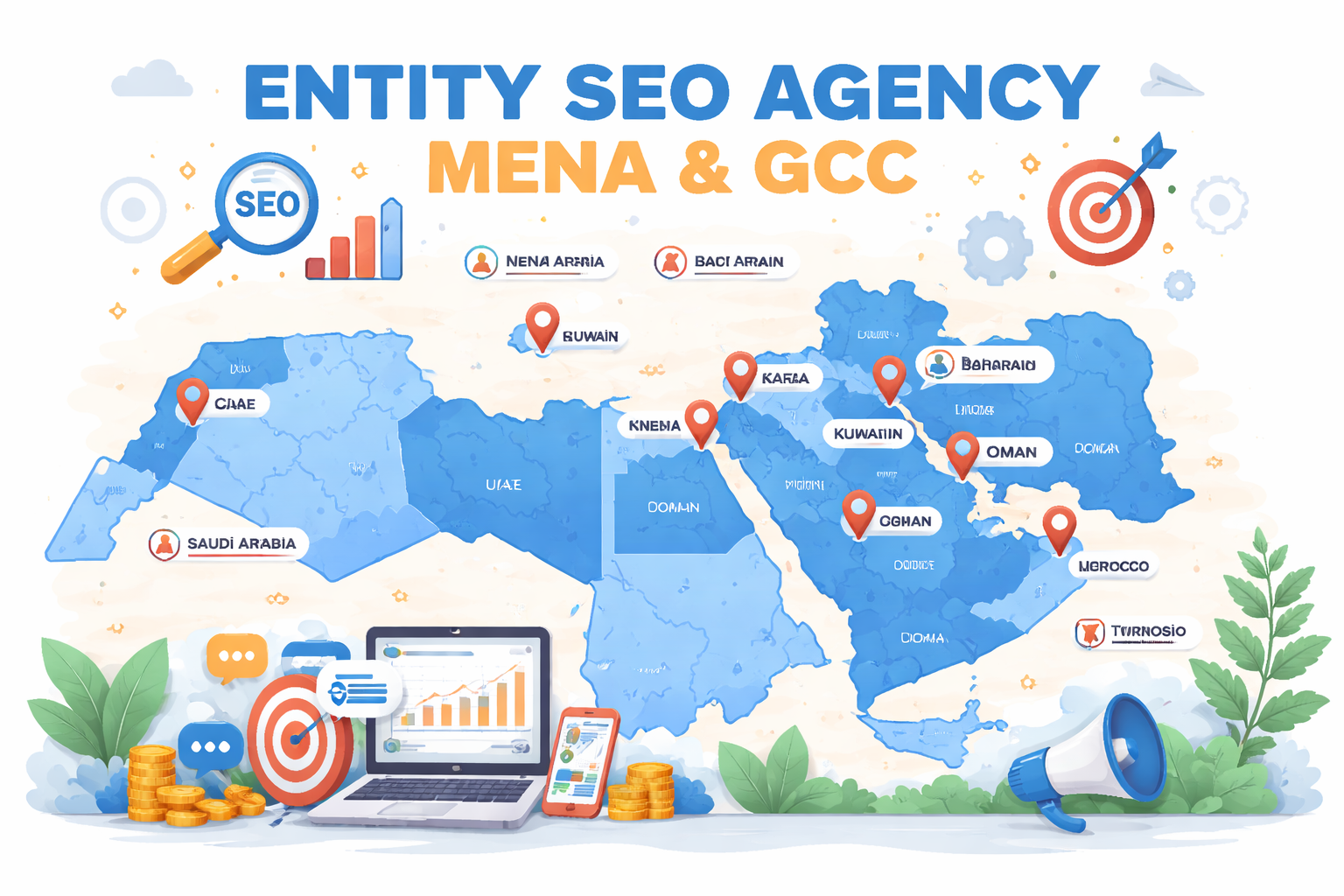
If your business wants to grow across Saudi Arabia, the UAE, and Qatar, entity SEO agency MENA is not just another SEO trend. It is a smarter way to help Google and AI-driven search understand your brand, your services, and the cities you serve.
In simple terms, entity SEO connects your business name, core offers, and location signals into one clear story. For GCC brands, that often leads to stronger branded search visibility, better trust, and more consistent Arabic-English discoverability across Riyadh, Dubai, and Doha.
Many companies in the region do good work but still struggle to show up the right way in search. Usually, the issue is not a lack of keywords. It is a lack of structure. A brand may describe itself one way in English, another way in Arabic, and then publish city pages that feel repetitive or disconnected. That weakens trust and makes it harder for search engines to understand what the business actually owns.
What Entity SEO Means for MENA Brands
Entity SEO is about building clarity.
Instead of relying only on keywords like “SEO company Riyadh” or “digital agency Dubai,” it helps search systems understand.
Who your business is
What services you offer
Which markets you serve
How those pages connect to each other
That matters even more in the GCC, where businesses often target multiple cities, operate bilingually, and need to build trust before a buyer ever gets in touch.
Entity SEO vs traditional local SEO
Traditional local SEO usually focuses on maps, citations, and location keywords.
Entity SEO goes further. It builds stronger relationships between your brand pages, service pages, and location pages so search engines can see that your business is genuinely relevant in a specific market. For a company working across Riyadh, Dubai, and Doha, that extra layer of clarity can make a real difference.
Why branded visibility matters in the GCC
In many GCC sectors, buyers do not choose based on price first. They check credibility first.
That is especially true in markets like Riyadh, Abu Dhabi, and Doha, where enterprise trust, governance language, and market fit can influence whether a brand feels established or uncertain. If your business name is not clearly associated with your core services and target cities, you lose momentum right at the research stage.
Why Brand + Service + Location SEO Matters in Riyadh, Dubai, and Doha
Search behavior is not identical across the GCC.
Riyadh often rewards trust, long-term credibility, and market seriousness. Dubai is more competitive and fast-moving, with stronger pressure around positioning, international visibility, and multilingual search. Doha usually responds better to focused, high-trust content instead of broad, repetitive city-page expansion.
That is why entity SEO agency MENA strategies work best when they reflect regional context instead of copying the same format across every page.
The Arabic-English consistency problem
One of the most common SEO issues for GCC brands is language inconsistency.
A company may use one service term in English, a looser translation in Arabic, and then another variation on a landing page. That splits relevance. It also weakens the semantic signals that help search engines connect your brand with the right service categories.
For businesses targeting Saudi Arabia, the UAE, and Qatar, bilingual consistency is not optional. It is part of the SEO foundation.
Why AI search raises the stakes
AI-generated search experiences pull answers from trusted, well-structured information.
That means thin city pages, vague service descriptions, and inconsistent naming are becoming bigger problems. If your site architecture does not clearly connect your brand, services, and markets, AI systems have less confidence in your relevance.
How to Structure Entity SEO for Saudi, UAE, and Qatar
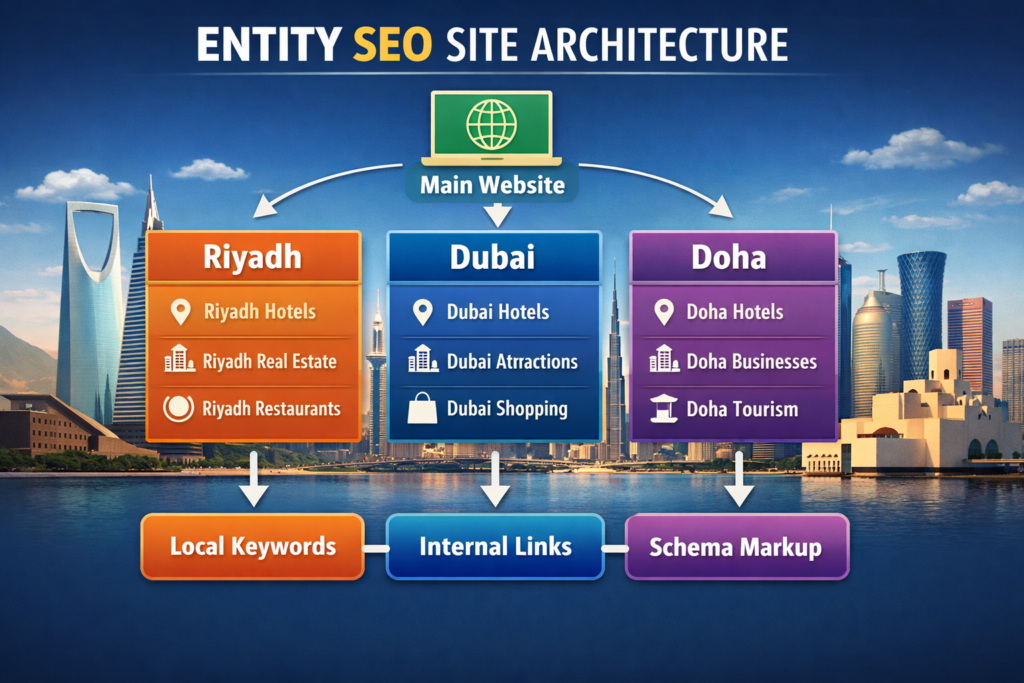
A strong GCC entity SEO setup usually starts with three layers.
Brand pages that define who you are
Service pages that show what you do
City or market pages that explain where and how you deliver value
The mistake many companies make is blending all three into overlapping pages.
Build pages with clear intent
Your brand page should build authority.
Your service pages should target commercial intent.
Your city pages should localize that value for Riyadh, Dubai, Doha, or other priority markets.
For example, a fintech company should not force everything into one generic page. It is better to separate the main brand authority page from a Riyadh fintech service page and a Dubai-focused enterprise payments page. That makes the structure easier for both users and search engines to understand.
Create city pages that are genuinely different
Changing only the city name is not enough.
A strong Riyadh page might highlight governance expectations, trust signals, and enterprise decision-making. A Dubai page may focus more on competitive visibility, multilingual positioning, and regional expansion. A Doha page often performs better when it feels sharper and more focused, with messaging around trust, relevance, and local business fit.
Each page should have its own.
Local examples
Buyer concerns
Internal links
Supporting FAQs
Proof points or use cases
Align Arabic UX and internal linking
This is where many brands quietly lose ground.
Your Arabic UX, service naming, and internal links should all reinforce the same story. When English and Arabic pages drift apart, authority also gets split. A cleaner internal linking setup helps connect related content and strengthens topical relevance across the whole site.
Useful internal links might point to.
Multilingual SEO guides
Arabic web design resources
Technical SEO pages
Service hub pages
Contact or consultation pages
GCC Trust Signals That Support Entity SEO
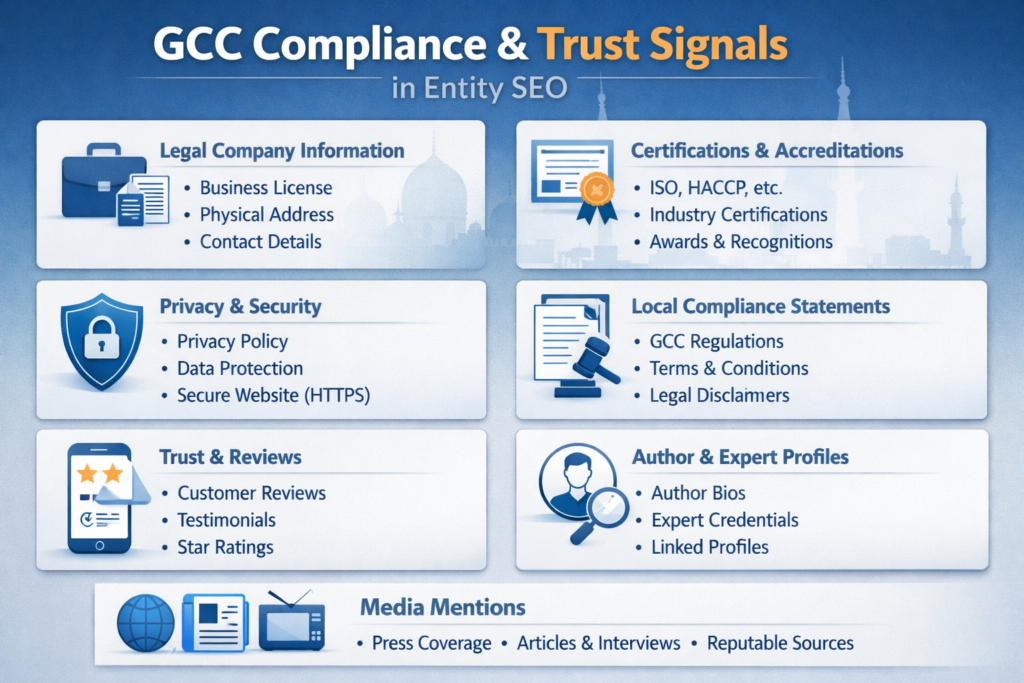
Trust matters in every market, but the signals vary across the GCC.
Saudi Arabia.
In Saudi Arabia, especially in Riyadh, brands often need stronger signals around structure, credibility, and governance. This is particularly relevant in fintech, enterprise tech, government-adjacent services, and high-trust B2B sectors.
Saudi buyers tend to respond better when the content feels grounded, specific, and aligned with real market expectations instead of sounding generic.
UAE.
In the UAE, especially Dubai and Abu Dhabi, trust is often shaped by professionalism, clarity, and commercial polish.
Brands targeting enterprise buyers usually perform better when their content shows maturity, multilingual readiness, and a clear understanding of how the UAE market works. Pages should feel precise, not bloated.
Qatar.
Qatar often rewards focus.
Instead of publishing too many shallow location pages, many brands do better with a smaller set of high-quality pages built around real service intent. For Doha, a trust-first structure usually works better than aggressive content expansion.
Best Use Cases for Entity SEO in the GCC
Not every company needs the same entity SEO setup. But some industries benefit more quickly than others.
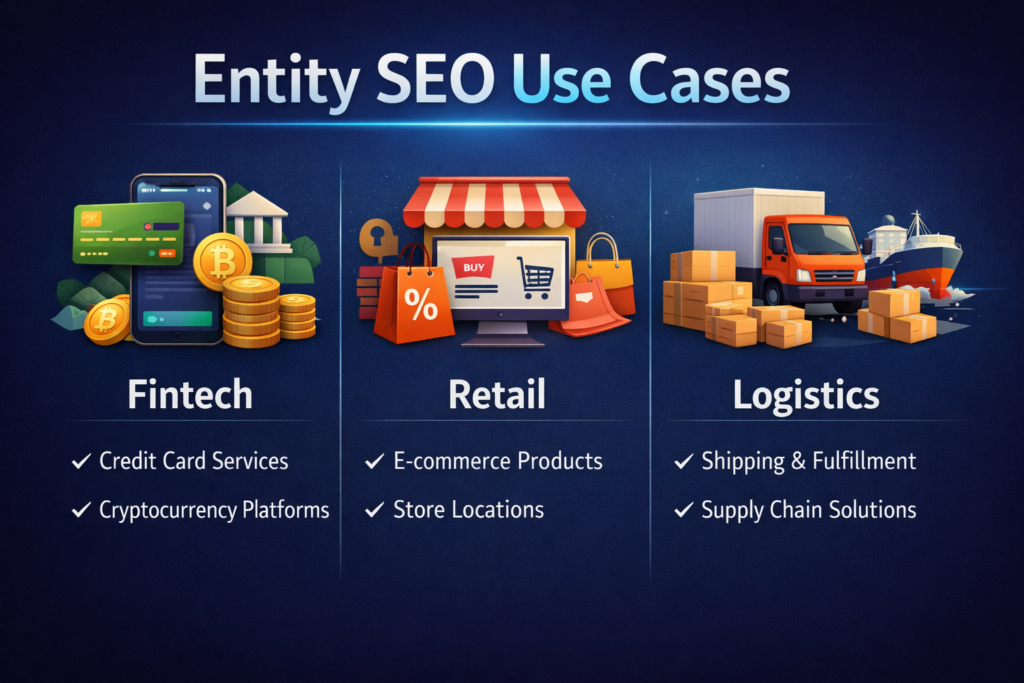
Fintech and regulated services
Fintech brands need to connect service expertise with trust, governance, and market relevance. In practice, this means building pages that feel credible for each market instead of publishing generic financial services content.
Retail and logistics businesses
Retail and logistics companies often serve multiple cities but use the same copy everywhere. That usually leads to weak differentiation. Better city pages can highlight delivery expectations, local service models, and city-specific buyer priorities.
Enterprise and government-adjacent brands
For enterprise-focused businesses, trust comes from clarity. Buyers want to understand exactly what the company does, where it operates, and whether it fits local market expectations. Entity SEO helps build that confidence before a sales conversation even begins.
Costs, Timelines, and Market Priorities
The right rollout depends on your business model, resources, and target markets.
Why the UAE is often a practical starting point
For many brands, the UAE is the easiest place to test entity-led SEO structure. Dubai and Abu Dhabi can help validate service messaging quickly while still supporting regional credibility.
When Saudi Arabia becomes the bigger opportunity
Saudi Arabia often becomes the higher-upside move when your growth depends on trust, long-term authority, and stronger commercial depth. Riyadh, in particular, tends to reward quality and seriousness over thin expansion tactics.
How Qatar fits into the strategy
Qatar usually works best as a focused market. A smaller, better-planned content structure often outperforms a large set of low-value pages. For many businesses, Doha should be treated as a precision market, not a volume play.
Best Practices for Brand + Service + Location SEO in MENA
Here are the principles that usually matter most.
Connect each core service to one clear page intent
Keep Arabic and English naming aligned
Make every city page meaningfully different
Strengthen branded search with local proof
Use internal links to reinforce topic relationships
Avoid duplicate pages built only around city modifiers
Write for trust, not just rankings
The strongest entity SEO agency MENA strategies are locally grounded. Riyadh needs trust and governance language. Dubai needs competitive clarity and multilingual structure. Doha needs focused authority and relevance.
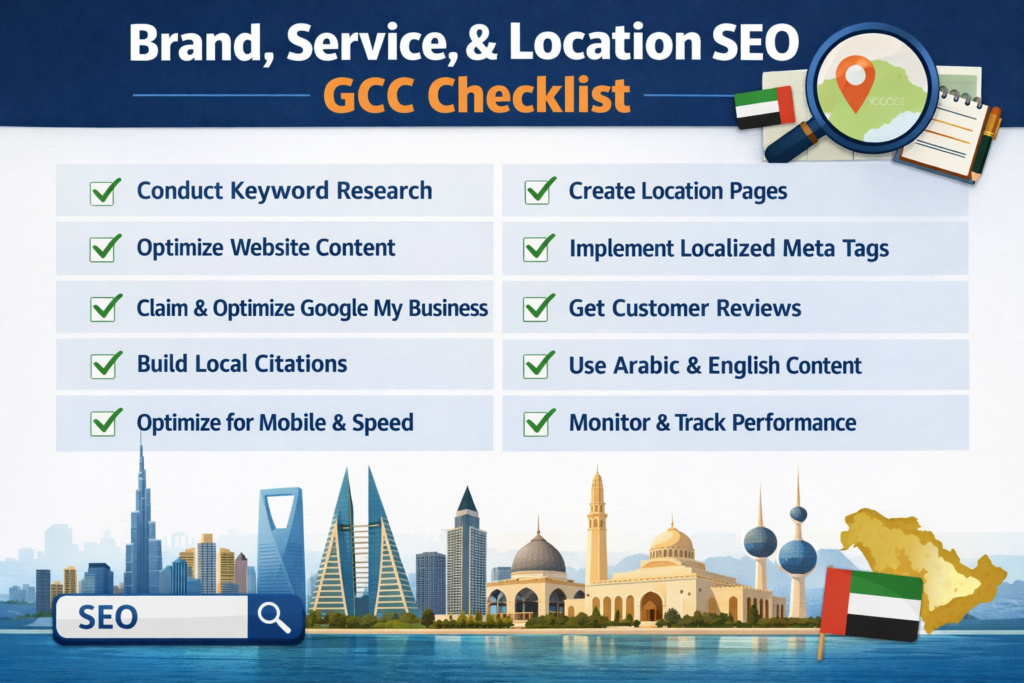
Last Words
Entity SEO is not about stuffing more location keywords into your site. It is about helping search engines and real buyers understand your business with confidence.
For GCC brands, that means building a clean relationship between brand, services, and markets. When your Riyadh, Dubai, and Doha pages all support one clear business story, your visibility becomes stronger, your authority becomes clearer, and your search performance becomes easier to scale.
If your company wants better results from entity SEO agency MENA work, start by auditing how your brand pages, service pages, and city pages connect today. That structure often matters more than most businesses think.( Click Here’s )
FAQs
Q : Is entity SEO better than local SEO for Saudi service businesses?
For many Saudi service businesses, yes. Local SEO still helps with map visibility and local discovery, but entity SEO is stronger when the goal is to connect brand trust, service expertise, and market relevance across Riyadh or wider Saudi campaigns.
Q : How should UAE brands handle Arabic and English SEO together?
A : They should keep naming, service descriptions, and page intent consistent in both languages. Loose translation often creates confusion. A better approach is to use one clear structure and localize carefully without changing the meaning.
Q : Do Qatar companies need a separate Doha page for every service?
A : Not always. A separate Doha page makes sense only when the service has distinct local intent, trust expectations, or buyer context. A focused architecture is usually better than publishing many thin pages.
Q : How can multi-location brands avoid duplicate city pages?
A : Each city page should reflect real differences in buyer needs, service proof, and market context. That means changing examples, internal links, FAQs, and messaging, not just swapping city names.
Q : Who benefits most from entity SEO in the GCC?
A : It is especially useful for fintech, enterprise tech, logistics, retail, and service-based brands expanding across multiple GCC markets. Any business that needs stronger branded visibility and trust can benefit from it.