


FAQ Strategy for SEO, AEO & Trust
An FAQ strategy is a structured way to answer real customer questions so users, search engines, and answer engines can understand your expertise faster. Done well, it improves SEO visibility, AI-answer discovery, trust, and lead quality.
The goal is not to stuff a page with questions. The goal is to place the right answers in the right part of the buyer journey: service pages, product pages, pricing pages, blog posts, support hubs, and conversion pages.
Why FAQ Strategy Matters Now
FAQ content is no longer just a support section at the bottom of a website. For modern SEO, AEO, and GEO, FAQs help search engines understand intent, help AI systems extract clear answers, and help buyers decide whether your business feels credible.
Google says AI Overviews provide a snapshot of key information with links for deeper exploration, which makes answer-first content more important for search visibility.
For users, FAQs reduce friction. They answer pricing, process, compliance, security, timelines, and technical concerns before someone contacts sales.
For businesses, that means better-qualified leads, fewer repeated questions, and stronger trust signals.
What Is an FAQ Strategy in SEO?
An FAQ strategy in SEO is a plan for identifying, writing, organizing, and improving question-based content that supports search intent, user trust, and business goals.
It is broader than an FAQ page.
FAQ page SEO usually focuses on one dedicated page. FAQ optimization improves individual questions and answers. FAQ strategy decides where each question belongs across your full website.
For example, a SaaS company might place.
Technical FAQs on product pages
Pricing objections on demo or quote pages
Security and compliance FAQs in a trust center
Setup questions inside onboarding or support content
For teams investing in SEO services or digital marketing services, FAQs can connect informational, commercial, and support intent in one clean content system.
A good FAQ strategy turns recurring user concerns into clear, searchable answers. It helps humans, search engines, and AI answer systems understand what your business offers, who it serves, and what users should do next.
FAQ SEO Best Practices That Help Rankings
Good FAQs are concise, accurate, scannable, and direct. The best answers respond to the question first, then add context.
Use Real Customer Questions
Start with the language your audience already uses.
Strong FAQ sources include.
Sales calls
Support tickets
CRM notes
Google Search Console queries
Internal site search
People Also Ask research
Product demo objections
Live chat conversations
A natural question like “How long does a custom web app take to build?” is usually better than a forced heading like “Best web app development services USA UK Germany.”
Google Search Central notes that FAQ structured data can make eligible content easier to display in rich results, but visibility is not guaranteed.
Match Each FAQ to Search Intent
Every FAQ should have a job.
Informational FAQs explain.
Commercial FAQs compare.
Decision-stage FAQs remove objections.
Support FAQs reduce confusion after purchase.
A web development services page might answer technology, timeline, security, and ownership questions. An e-commerce development page might answer checkout, PCI DSS, integrations, and platform migration questions.
Write for Featured Snippets, People Also Ask, and AI Overviews
The simplest structure usually works best.
Answer the question in the first sentence.
Add useful context.
Give the reader a next step.
A 2024 SparkToro/Datos study found that 58.5% of US Google searches and 59.7% of EU Google searches ended without a click, which makes zero-click visibility and answer visibility harder to ignore.
That does not mean clicks are dead. It means your content needs to earn visibility in more places than traditional blue links.
FAQ Schema Best Practices for Safe Structured Data
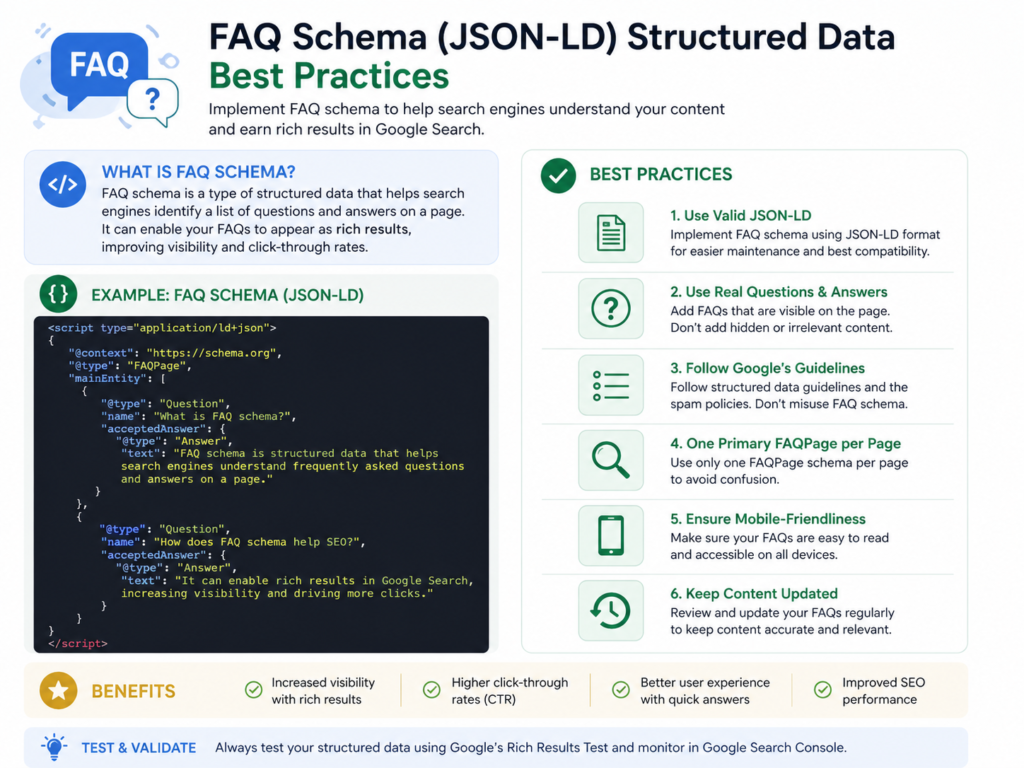
FAQ schema should only mark up visible, truthful Q&A content that accurately reflects the page.
Do not use schema to hide promotional claims.
Do not mark up questions that users cannot see.
Do not copy the same FAQ block across every service page.
When to Use FAQPage Structured Data
Use FAQPage schema when the page includes a real FAQ section with visible questions and answers.
JSON-LD is usually the cleanest implementation format because it keeps structured data separate from the visible HTML while still helping search engines understand the page.
Why FAQ Rich Results Are Not Guaranteed
Schema eligibility does not guarantee rich results. Structured data helps machines interpret content, but search appearance still depends on quality, relevance, authority, technical accuracy, and policy compliance.
For React development, Flutter development, or SaaS pages, the schema should reflect the exact questions answered on that page.
Safe FAQ schema is honest, page-specific, and visible to users. Treat it as structured clarification, not a shortcut to manipulate search results.
FAQ Mistakes That Hurt SEO, Trust, and UX
FAQs can hurt performance when they are thin, duplicated, misleading, or written only for search engines.
A vague answer like “Yes, we provide this service” does not help much. A stronger answer explains scope, conditions, risks, timeline, and the next step.
Common FAQ Mistakes
Avoid these patterns.
Thin answers with no practical value
Generic questions copied across multiple pages
Keyword-stuffed headings
Hidden FAQ schema
Overpromising outcomes
Legal, medical, or financial claims without care
Answers that end with “Contact us” but provide no real information
Better to publish 8 strong answers than 40 vague ones.
Be Extra Careful With YMYL Topics
YMYL topics need more caution because the wrong answer can affect someone’s money, health, legal position, or safety.
Healthcare FAQs in the US may need HIPAA-aware language. Finance FAQs in the UK may need FCA-aware language. Payment-related FAQs may need PCI DSS references where relevant.
The HHS explains that the HIPAA Privacy Rule protects individually identifiable health information held or transmitted by covered entities and business associates.
FAQ Optimization for AI Search, AEO, and GEO
FAQs support AI-search visibility when answers are specific, entity-rich, well-structured, and backed by trustworthy context.
AI systems need clear relationships between.
Questions
Answers
Entities
Locations
Standards
Services
Buyer intent
A weak FAQ says: “Yes, we support integrations.”
A stronger FAQ says: “Yes, our SaaS implementation process can include CRM, payment, analytics, and support desk integrations, depending on your stack and security requirements.”
Structure Answers for AI Overviews, Chat GPT, Gemini, and Featured Snippets
Use direct language. Mention named entities naturally. Keep the opening answer short.
Relevant entities may include Google Search Central, FAQ Page structured data, JSON-LD, E-E-A-T, YMYL, GDPR, SOC 2, ISO 27001, PCI DSS, HIPAA, FCA, BaFin, and UK-GDPR.
Google’s Q1 2025 remarks reported that AI Overviews had over 1.5 billion users per month, and Google’s AI Overviews page states the feature is available in over 120 countries and territories and 11 languages.
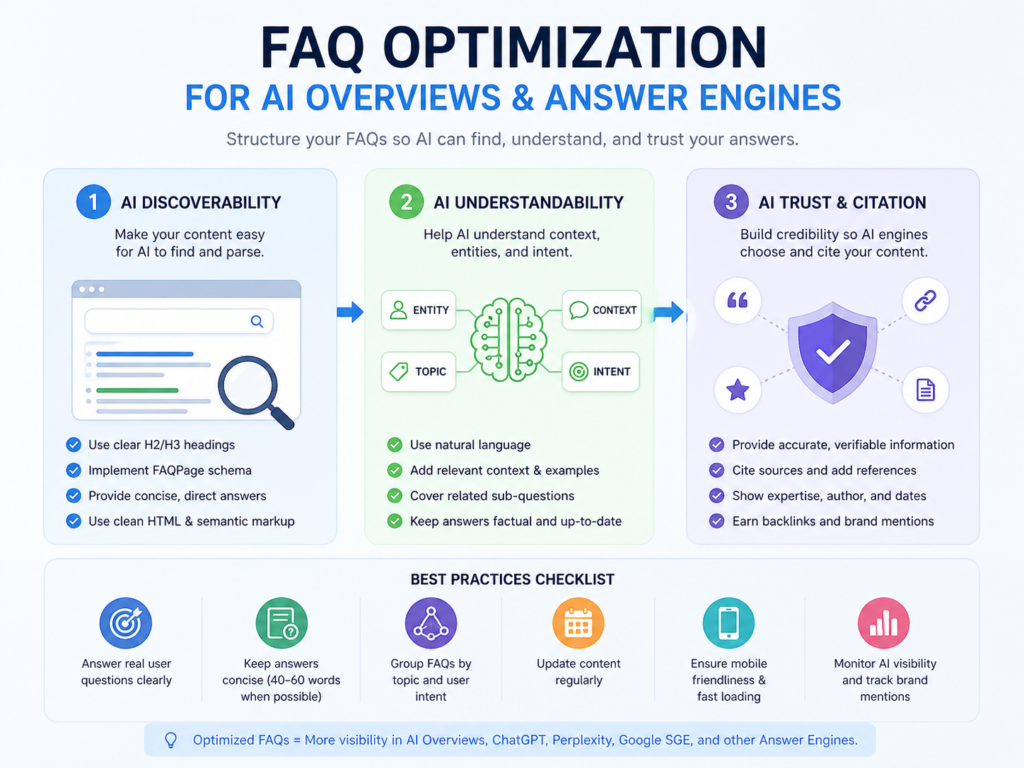
Strong AI-ready FAQs do not stop at yes or no. They explain who the answer applies to, what standards matter, and what action the reader should take next.
GEO FAQ Strategy for the USA, UK, Germany, and EU
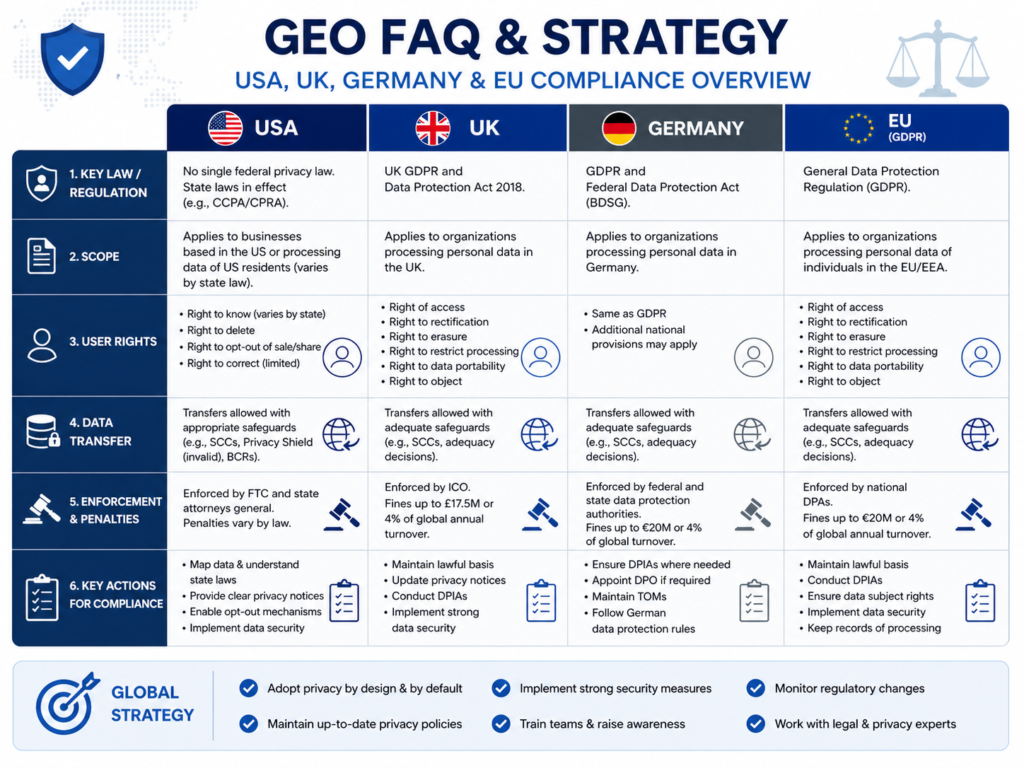
GEO-focused FAQs localize terminology, compliance references, examples, and buyer concerns for the target market.
A FAQ strategy for New York, London, Berlin, and Paris should not sound identical. The service may be similar, but the buyer’s expectations, compliance language, and decision triggers can be different.
USA FAQ Strategy
For US audiences, FAQ content may need to address HIPAA for healthcare, PCI DSS for payments, SOC 2 for SaaS procurement, and CCPA/CPRA for California data rights.
A New York fintech FAQ might mention SEC or FINRA expectations. An Austin SaaS FAQ may focus more on SOC 2, onboarding, integrations, and cloud security.
UK FAQ Strategy
For UK users, FAQs should use UK-GDPR, ICO, NHS, FCA, London, Manchester, and Birmingham references where relevant.
The ICO lists UK GDPR principles such as lawfulness, fairness, transparency, data minimisation, security, and accountability.
Germany and EU FAQ Strategy
For Germany and the wider EU, use terms like GDPR, DSGVO, BaFin, ePrivacy, EU AI Act, data residency, Berlin, Munich, Frankfurt, Dublin, Amsterdam, and Paris carefully.
The European Commission describes the AI Act as a risk-based framework for AI developers and deployers.
Localization is not just translation. It means adapting examples, standards, legal terms, support paths, and trust signals for each market.
Building a Conversion-Focused FAQ Strategy
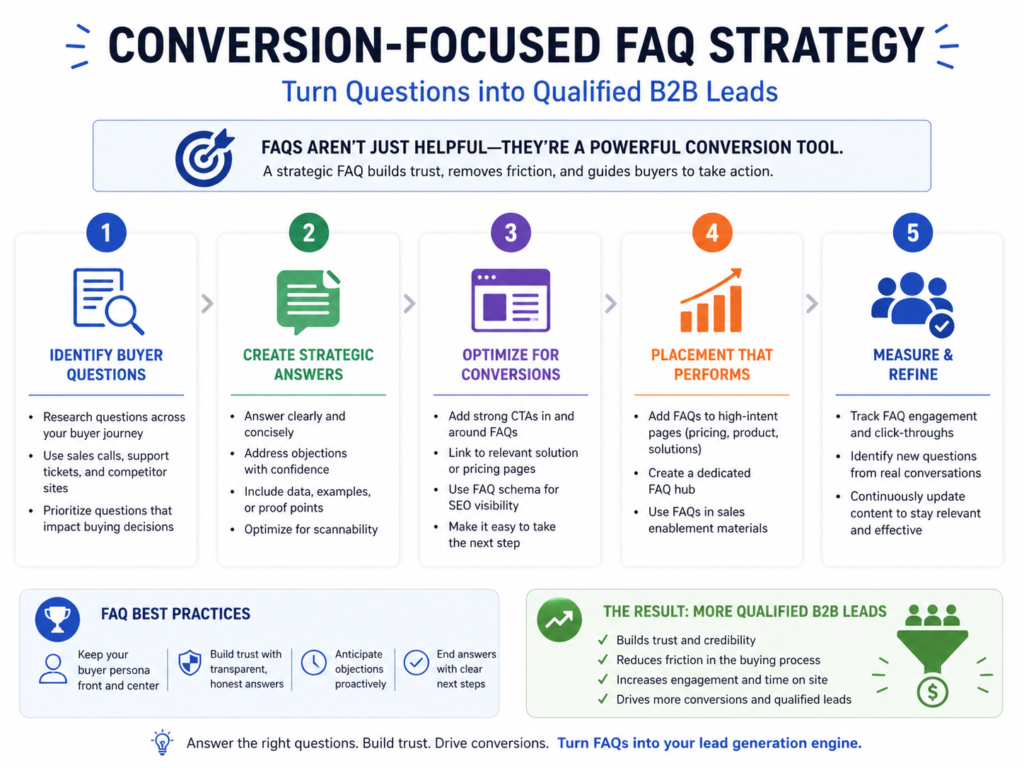
A conversion-focused FAQ strategy maps questions to buyer hesitation.
The goal is not more content. The goal is fewer unanswered objections before a demo, signup, quote, consultation, or checkout.
Map FAQs to the Buyer Journey
Use this simple structure.
| Buyer Stage | FAQ Focus | Example Question |
|---|---|---|
| Awareness | Problem education | “What is an FAQ strategy?” |
| Consideration | Options and fit | “Should FAQs go on service pages or a separate page?” |
| Decision | Risk reduction | “How do you handle schema, compliance, and content accuracy?” |
| Post-purchase | Support | “How often should FAQs be reviewed?” |
For B2B services, answer questions about scope, ownership, communication, reporting, security, and timelines.
For business intelligence services, FAQs might explain dashboards, data pipelines, KPIs, reporting cadence, and executive visibility.
Measure FAQ Performance
Track more than rankings.
Useful FAQ metrics include.
Search impressions
Organic clicks
Featured snippet or People Also Ask visibility
Assisted conversions
Demo form completion
Support ticket reduction
Lead quality
AI-answer mentions
Engagement on key service pages
The best FAQ strategy is not published once and forgotten. It should improve as customer questions, search behavior, and market expectations change.
To Sum Up
A smart FAQ strategy helps your website do more than answer basic questions. It supports search visibility, improves AEO performance, builds trust, and helps buyers move forward with less hesitation.
Want to turn your FAQ section into a search, trust, and conversion asset? Mak It Solutions can help you audit existing FAQs, map buyer questions, write answer-first content, and implement safe JSON-LD for your service or SaaS pages.
Book a scoped consultation and we’ll help you identify which FAQ opportunities can improve visibility, reduce objections, and support stronger leads across the US, UK, Germany, and EU.( Click Here’s )
Key Takeaways
A strong FAQ strategy connects real user questions to SEO, AEO, GEO, and conversion goals.
FAQ schema should only mark up visible, accurate, page-specific Q&A content.
Thin, duplicate, or misleading FAQs can damage trust and weaken search performance.
US, UK, Germany, and EU FAQ content should reflect local compliance language and buyer concerns.
AI-search visibility improves when answers are concise, entity-rich, and supported by trustworthy context.
FAQs
Q : Should every website have an FAQ page?
A : Not every website needs a separate FAQ page, but most websites benefit from FAQ content. Service businesses, SaaS platforms, ecommerce stores, healthcare providers, and B2B companies often need FAQs because buyers have predictable questions before they convert.
Q : Are FAQ pages still good for SEO in 2026?
A : Yes, FAQ pages can still support SEO in 2026 when they answer real questions clearly and avoid thin or duplicate content. Their value is broader than rich results because FAQs can support search intent mapping, featured snippets, People Also Ask visibility, AI Overviews, internal linking, and conversion support.
Q : How many questions should an FAQ section include?
A : Most page-level FAQ sections work best with 5 to 10 focused questions. A broader FAQ hub may include more, but it should be organized by category, such as pricing, security, integrations, compliance, and support.
Q : Should FAQs appear on product pages or a separate FAQ page?
A : FAQs should appear wherever they reduce friction. Product and service pages should include decision-stage questions about features, pricing, timelines, integrations, security, and support. A separate FAQ page can cover broader brand, policy, and support questions.
Q : Can FAQ content improve lead generation for B2B websites?
A : Yes, FAQ content can improve B2B lead generation by removing uncertainty before a user contacts sales. Good FAQs answer objections around budget, timeline, ownership, compliance, integrations, reporting, and expected outcomes.