


Internal Linking Strategy for SEO Growth
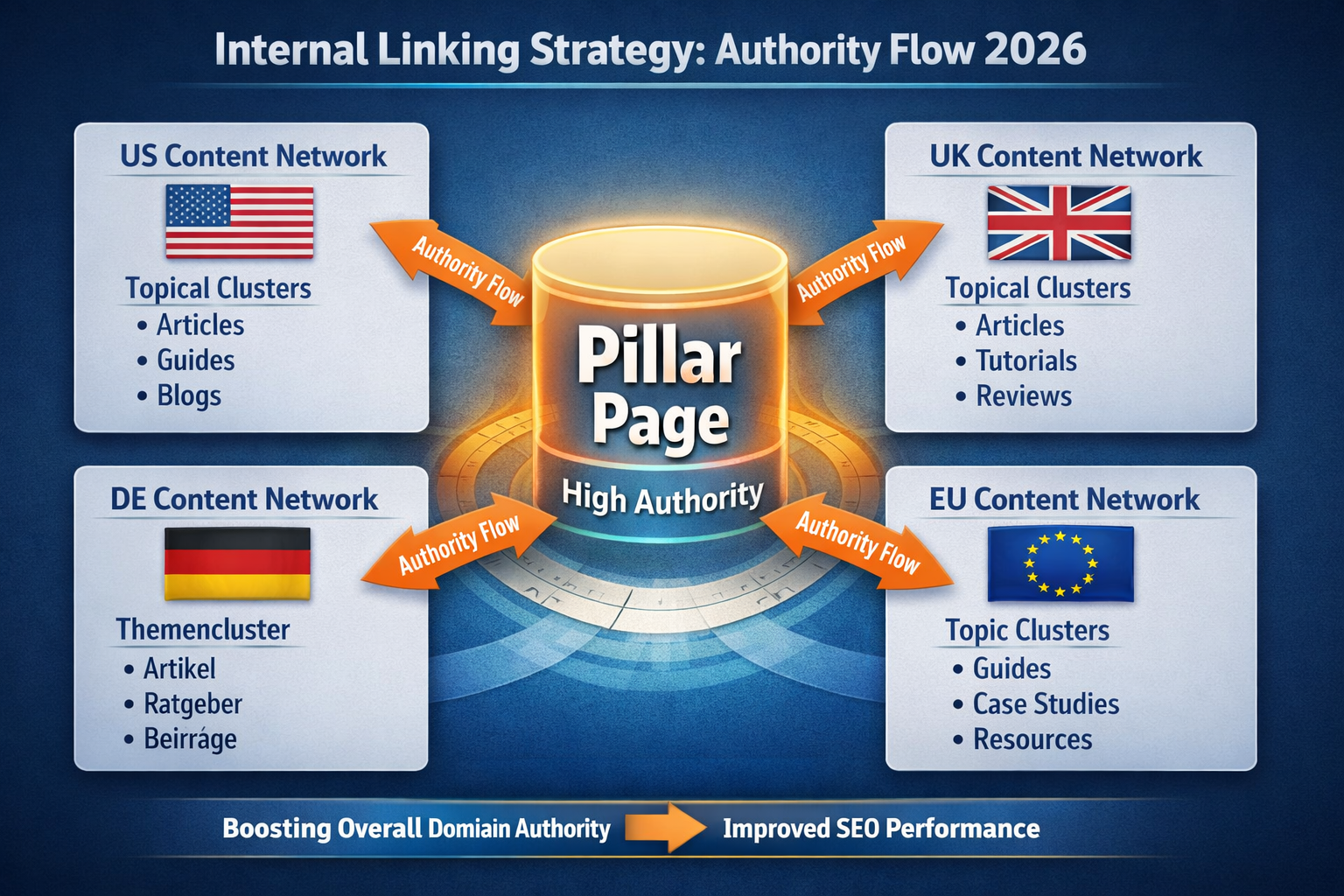
An internal linking strategy is the process of connecting your pages in a way that helps search engines understand your site and helps visitors move naturally toward the content that matters most. When it is done well, it improves crawl paths, strengthens topical authority, and gives your key pages more support from the rest of your website.
That makes internal linking one of the most practical SEO levers you can control. You cannot force backlinks. You cannot control every algorithm update. But you can control how your own pages connect, which pages receive the most internal support, and how clearly your site structure reflects search intent.
For businesses targeting the USA, UK, Germany, and the wider EU, this matters even more. Regional content paths, multilingual sections, and trust-sensitive pages all benefit from a cleaner internal structure that makes priority pages easier to discover and easier to understand.
What an Internal Linking Strategy Actually Means
Internal linking is not just about adding more links across a website.
A real internal linking strategy is a planned system for deciding.
Which pages deserve the most authority
Which supporting pages should reinforce those targets
How anchor text should reflect user intent
How users should move from informational content to commercial or conversion-focused pages
In practice, strong internal linking helps search engines see relationships between topics. It also helps people find the next logical page without friction.
That is the difference between random cross-linking and a site structure that actually builds authority.
Why Internal Linking Still Matters for SEO
Internal links do three important jobs at once.
First, they help search engines discover pages more efficiently. If a valuable page is buried too deep in the site, it is less likely to be crawled frequently and treated like a priority.
Second, they help define topical relevance. When several related pages point to one hub or service page using descriptive, context-rich anchors, that page becomes easier to understand within the wider topic.
Third, they help distribute authority internally. Pages that already perform well can pass stronger signals to pages that need more visibility.
For many websites, that is where the real opportunity sits. The content may already be good enough. The structure is what is holding it back.
How Internal Linking Builds Authority
Authority does not move randomly through a site. It tends to follow structure, prominence, and context.
If your homepage, category pages, and top-performing blog posts all support the same important destination pages, you send a much stronger signal about which URLs deserve attention.
A smart internal linking strategy builds authority by.
Linking high-visibility pages to priority pages
Grouping related content into clusters
Reducing unnecessary crawl depth
Using anchor text that matches the destination topic
Strengthening hubs that sit above supporting content
This creates a cleaner map for both search engines and users.
The Core Rules of a Strong Internal Linking Strategy
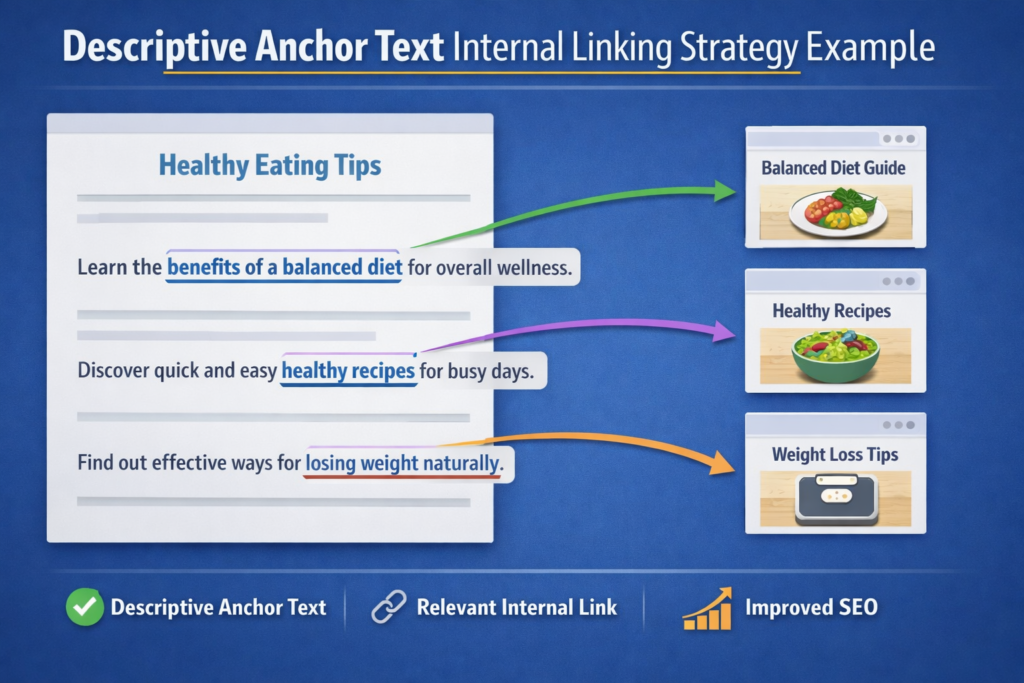
Use descriptive anchor text
Generic phrases like “click here” or “read more” add very little context.
Descriptive anchors work better because they tell both users and search engines what to expect. For example, anchors like SEO services, topic cluster strategy, or multilingual site structure are more useful than vague prompts.
The goal is not to force exact-match anchors everywhere. It is to make the destination obvious and relevant.
Keep important pages close to the surface
Pages that matter most should not sit deep inside the site.
Your key service pages, core category pages, and primary topic hubs should be reachable through logical paths from the homepage, navigation, and relevant supporting articles.
If revenue-driving pages are buried several clicks deep, they often receive less attention than they should.
Link by topic, not by habit
One of the most common mistakes is adding links simply because there is space for them.
Strong internal links should feel earned by context. A page about SEO audits can naturally link to crawl depth analysis, orphan pages, and technical site structure. It should not jump to unrelated pages just to increase link count.
Relevance matters more than volume.
Support money pages with editorial content
Commercial pages rarely carry the whole SEO load on their own.
They usually perform better when they are supported by educational pages, comparison content, FAQs, guides, and hub pages that answer surrounding questions. A well-structured blog can become one of the strongest internal support systems for service and product pages.
That is why content strategy and internal linking should never be treated as separate tasks.
Build a Scalable Internal Linking Structure
As websites grow, internal linking often becomes messy. New articles get published. Service pages get updated. Regional pages are added. But nobody steps back to check whether the structure still makes sense.
That is where scalable systems matter.
Use topic clusters
Topic clusters are one of the clearest ways to organize internal links.
A hub page targets the main topic. Supporting pages cover subtopics and link back to the hub. Related pages can also cross-link where it makes sense.
If your hub is about internal linking strategy, supporting content might cover.
Anchor text best practices
Crawl depth issues
Orphan pages
Multilingual internal linking
Internal link audits
Site architecture for SEO
This makes your site easier to understand as a subject-focused system rather than a collection of disconnected pages.
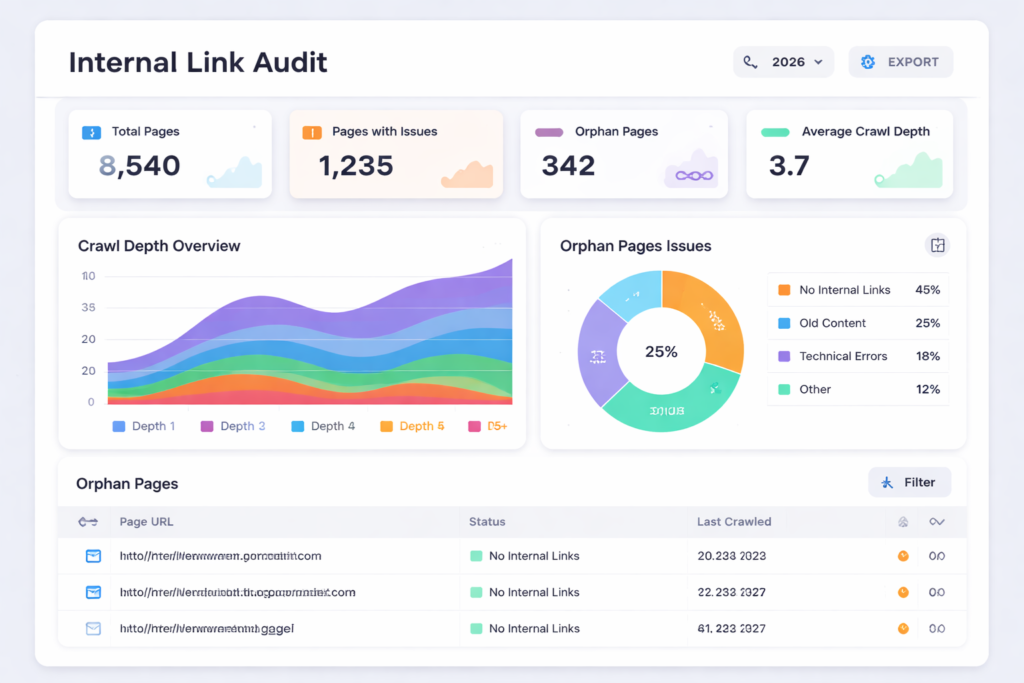
Prevent orphan pages
Orphan pages are pages with no meaningful internal path pointing to them.
They usually appear when content production moves faster than editorial planning. A page gets published, but it is never added to a hub, category, resource page, or related article module.
That creates wasted value.
Every important indexable page should have at least one clear internal path from a relevant section of the site. On larger sites, it should usually have several.
Create clear hierarchy signals
Hierarchy helps define which pages lead and which pages support.
A simple structure might look like this.
| Page Type | Main Role |
|---|---|
| Homepage | Passes broad authority to core sections |
| Service or category pages | Target commercial or priority terms |
| Hub pages | Organize topic-level authority |
| Supporting articles | Cover subtopics and reinforce hubs |
| Trust pages | Strengthen credibility and decision-making |
When that hierarchy is clear, internal links start doing more than moving traffic around. They start reinforcing purpose.
Internal Linking by Site Type
Blogs and content-heavy sites
Blogs perform best when they are organized into editorial clusters instead of isolated articles.
Related reading modules, hub pages, and in-content contextual links can help readers move deeper into the topic. That improves both engagement and structure.
Ecommerce websites
Ecommerce sites need more than category-to-product links.
The strongest setups usually include buying guides, comparison pages, FAQs, and collections that support product and category URLs. This gives commercial pages more context and more internal authority.
Enterprise and large multi-service websites
Larger websites need rules, not just good intentions.
That includes.
Approved anchor text patterns
Designated hub pages
Content templates with link opportunities
Regional or language-specific pathways
Regular audits for buried or overlinked pages
Without governance, scale creates noise.
Regional Considerations for the USA, UK, Germany, and EU
The fundamentals of internal linking do not change by country. The way users navigate, trust content, and expect localization often does.
USA
For US sites, internal linking often needs to support broad content ecosystems across service pages, educational resources, and conversion-focused pages.
In sectors like SaaS, healthcare, finance, or enterprise services, trust pathways matter. Informational pages should connect naturally to solution pages, case-study content, policy pages, and contact or consultation pages.
UK
UK audiences often respond well to clarity and structure, especially on publisher, public-service, and regulated-industry websites.
Internal links should make it easy to move from articles into service details, privacy information, trust content, and related resources without creating confusion.
Germany
German websites often need a more deliberate structure around precision, language consistency, and local user expectations.
If your site serves German-speaking users, anchors should feel native rather than translated word for word. Internal pathways should also respect the local version of the content rather than pushing users into English pages unnecessarily.

Wider EU
For EU-focused websites, multilingual structure becomes one of the biggest internal linking challenges.
English pages, German pages, and region-specific resources should not compete inside the same path without clear intent. A better approach is to create clean language or regional sections and keep internal links aligned with the user’s version of the journey.
That makes the architecture feel local instead of centrally forced.
How to Audit Internal Links at Scale
A good internal linking audit does not start by counting links. It starts by checking whether the right pages are getting the right support.
Look at.
Crawl depth for priority pages
Internal links pointing to commercial pages
Orphan pages or weakly connected pages
Anchor text quality
Overlinked pages that dilute focus
Gaps inside topic clusters
Broken or outdated destination paths
For smaller websites, a manual review may be enough.
For larger sites, especially those with multilingual sections or hundreds of URLs, you need crawler-based reporting and a repeatable workflow.
Common Internal Linking Mistakes
Random links with no topical relationship
More links do not automatically mean better SEO.
When links are added without a real topical reason, they dilute meaning instead of strengthening it.
Repeating the same anchor everywhere
Consistency is helpful. Uniformity is not always.
Different pages in the same topic cluster may deserve different anchors depending on intent. A service page and an educational guide should not always receive identical anchor phrasing.
Ignoring key pages after publishing them
Many pages are launched with strong copy and zero structural support.
If nobody links to them from relevant articles, hubs, or category pages, they struggle to gain traction.
Failing to align multilingual pathways
On international sites, internal links often break the user journey by moving readers into the wrong language version. That creates friction and weakens topical consistency.
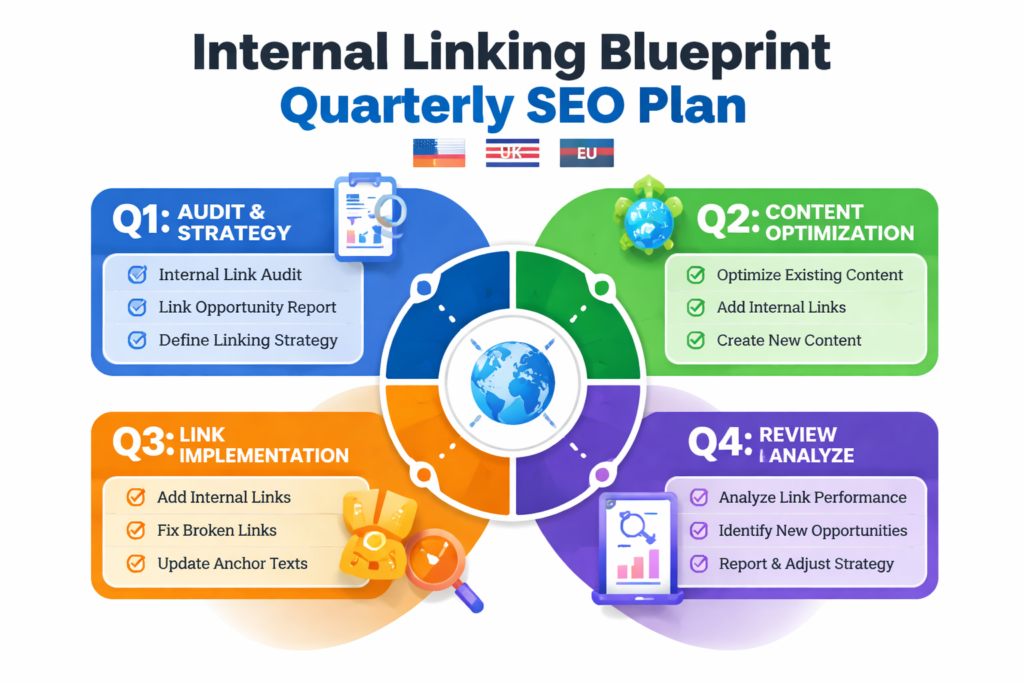
A Practical Internal Linking Blueprint You Can Use This Quarter
If you want a simple process, start here.
Identify authority pages
Find the pages that already attract traffic, links, or visibility.
These may include your homepage, top blog posts, major service pages, or resource hubs.
Mark your money pages and core hubs
Decide which pages matter most for conversions and which pages should act as topic leaders.
These are the pages that deserve the strongest internal support.
Add contextual links from related content
Go through relevant articles, landing pages, and resources.
Add links where they genuinely improve the reader journey. Focus on context, not forced placement.
Strengthen weak clusters
If a topic has several supporting pages but no strong hub, create one.
If a hub exists but has poor internal support, improve it.
Measure results
Track changes in.
Rankings for key pages
Crawl access and visibility
Internal link counts to priority URLs
assisted conversions from supporting content
The goal is not just to “improve internal linking.” The goal is to improve discoverability, relevance, and business outcomes.
Final Thoughts
If your site already has useful content but key pages still struggle to rank, the problem may not be quality. It may be architecture.
A well-planned internal linking strategy gives your best pages more support, makes your topical authority easier to understand, and creates a cleaner path from discovery to conversion. That is why internal linking deserves regular review, not occasional cleanup.
You do not need to rebuild the whole site overnight. Start with your most important pages, tighten the structure around them, and build outward from there.( Click Here’s )
Key Takeaways
A strong internal linking strategy helps search engines discover your pages, understand topic relationships, and identify which URLs deserve the most weight.
It also improves the user journey. People move more naturally through the site when the structure is logical and the next step feels obvious.
For websites targeting the USA, UK, Germany, and the EU, the best results usually come from combining topical clustering, descriptive anchors, shallow crawl paths, and region-aware navigation.
When good content is underperforming, internal structure is often the missing piece.
FAQs
Q : What is an internal linking strategy in SEO?
A : An internal linking strategy is a planned way of connecting pages across your website so users and search engines can navigate them more easily. It helps define page importance, topical relationships, and content hierarchy.
Q : How many internal links should a page have?
A : There is no fixed number. The right amount depends on the page length, purpose, and the number of relevant destinations that genuinely help the reader.
Q : Can internal links help pages rank better?
A : They can help important pages get discovered, understood, and supported more effectively. Internal links do not replace quality content, but they often improve how that content performs.
Q : What is the difference between topic clusters and regular internal links?
A : Regular internal links can be added casually. Topic clusters are structured systems built around a hub page and related supporting pages that reinforce one another.
Q : How should multilingual EU websites handle internal linking?
A : They should keep internal links aligned with the user’s language or regional path wherever possible. Localized anchors and clean content sections usually create a better experience than sending users across mixed-language journeys.
[…] It Solutions’ existing internal linking SEO guide provides a useful foundation for building this type of […]
[…] It Solutions’ guide to internal linking strategy explains how a deliberate linking structure can also reduce orphan pages and strengthen site […]
[…] technical SEO article can point readers toward Mak It Solutions’ SEO services or its detailed internal linking strategy guide when those pages genuinely expand on the […]