
Multi-Agent AI Architecture: 2026 Power Guide
Multi-Agent AI Architecture: 2026 Power Guide
Multi-Agent AI Architecture: 2026 Power Guide
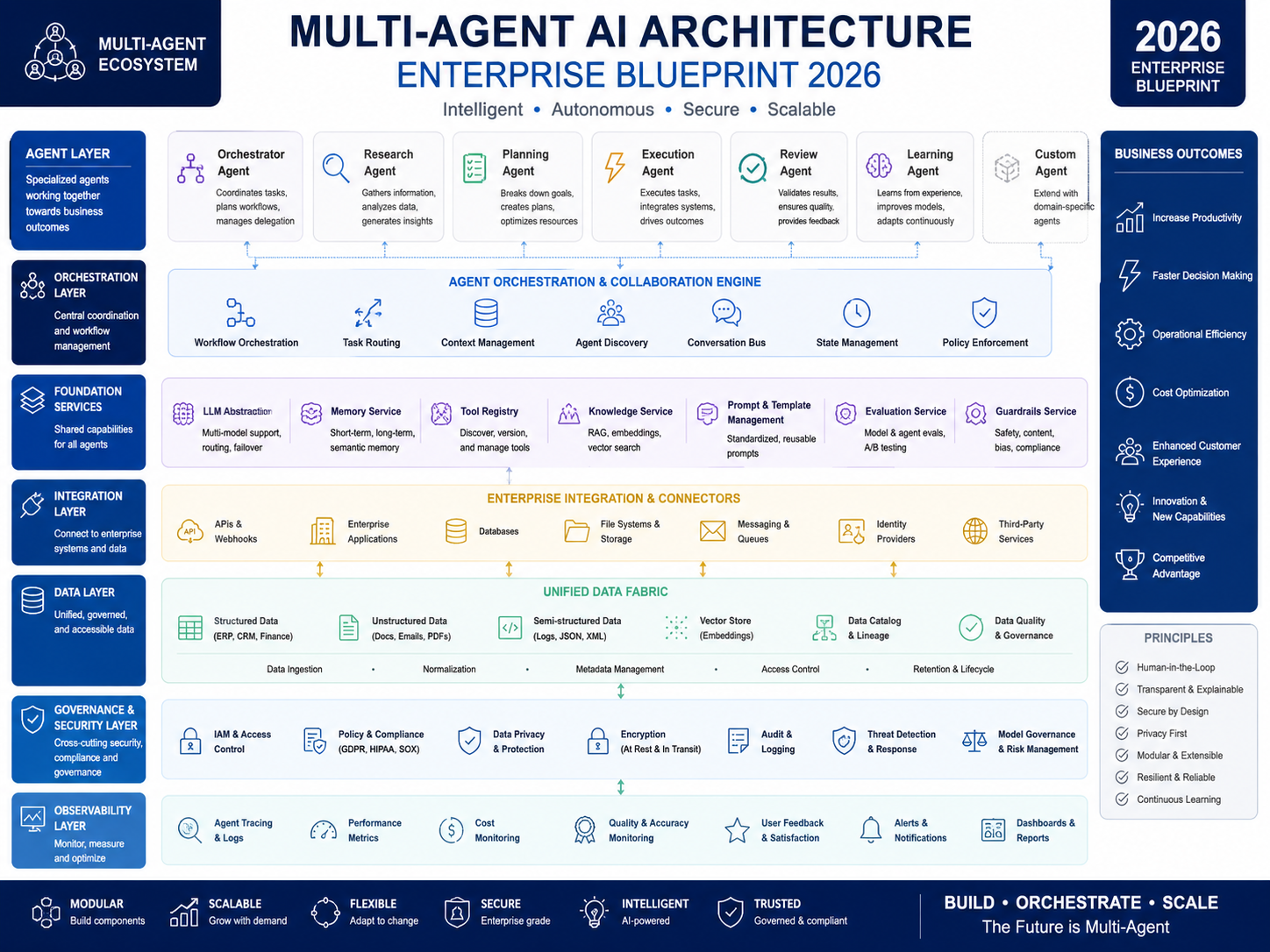
Multi-agent AI architecture helps enterprises move beyond basic copilots and build coordinated AI systems that can retrieve knowledge, use tools, check policy, and escalate risky decisions to humans. Instead of relying on one large assistant to handle everything, the architecture divides work across specialized agents with clear roles, permissions, memory, and governance.
In simple terms, multi-agent AI architecture is a secure design for AI agent teams. It is useful when a workflow needs more than a chatbot: private data retrieval, compliance checks, workflow execution, audit trails, and human approval.
AI adoption is no longer experimental for many enterprises. McKinsey’s 2025 global survey reports that 88% of respondents say their organizations regularly use AI in at least one business function, while 23% are already scaling agentic AI somewhere in the enterprise and another 39% are experimenting with it. Gartner also predicts that by 2028, 33% of enterprise software applications will include agentic AI, up from less than 1% in 2024.
For CTOs, CIOs, and AI architects in the USA, UK, Germany, and wider EU, the question is no longer “Should we test AI agents?” The real question is: “How do we design them safely enough for production?”
What Is Multi-Agent AI Architecture?
Multi-agent AI architecture is an enterprise system design where multiple AI agents work together to complete a workflow. Each agent has a defined job, such as retrieving data, checking policy, summarizing documents, validating outputs, calling APIs, or routing a task to a human reviewer.
A well-designed enterprise AI agent architecture usually includes.
Specialized agents for focused tasks
Approved tools and APIs with controlled permissions
Enterprise RAG for private knowledge retrieval
Short-term and long-term memory where appropriate
Orchestration logic to route tasks and manage handoffs
Guardrails for safety, policy, and compliance
Audit logs to show what happened, when, and why
The goal is not blind autonomy. The goal is controlled automation.
For example, an insurance claims workflow may include an intake agent, document-reading agent, fraud-risk agent, policy-checking agent, and escalation agent. Each agent contributes a small piece of the work, while the system keeps the overall process governed and traceable.
Multi-Agent AI Architecture vs Single-Agent AI
A single AI assistant can answer questions, summarize documents, or draft messages. That works for simple use cases.
Enterprise workflows are different. They often involve sensitive data, multiple systems, regional compliance rules, and decisions that need review. In those cases, a single agent can become too broad, too hard to monitor, and too risky to trust with end-to-end execution.
Here is the practical difference:
| Approach | Best For | Main Limitation |
|---|---|---|
| Traditional automation | Fixed, repeatable processes | Struggles with flexible reasoning |
| Single-agent AI | Simple support, drafting, summarization | Hard to control on complex tasks |
| Multi-agent AI architecture | Regulated, multi-step enterprise workflows | Needs strong orchestration and governance |
In practice, multi-agent systems architecture gives teams clearer accountability. One agent retrieves. Another validates. Another checks policy. A supervisor or orchestration layer decides what happens next.
For teams building AI-enabled portals, dashboards, or workflow systems, this layer can connect naturally with Mak It Solutions’ web development services, back-end development services, and business intelligence services.
Core Multi-Agent AI Architecture Patterns
The right architecture pattern depends on the workflow risk, required speed, audit needs, and level of autonomy the business can safely allow.
Supervisor-Worker Agent Architecture
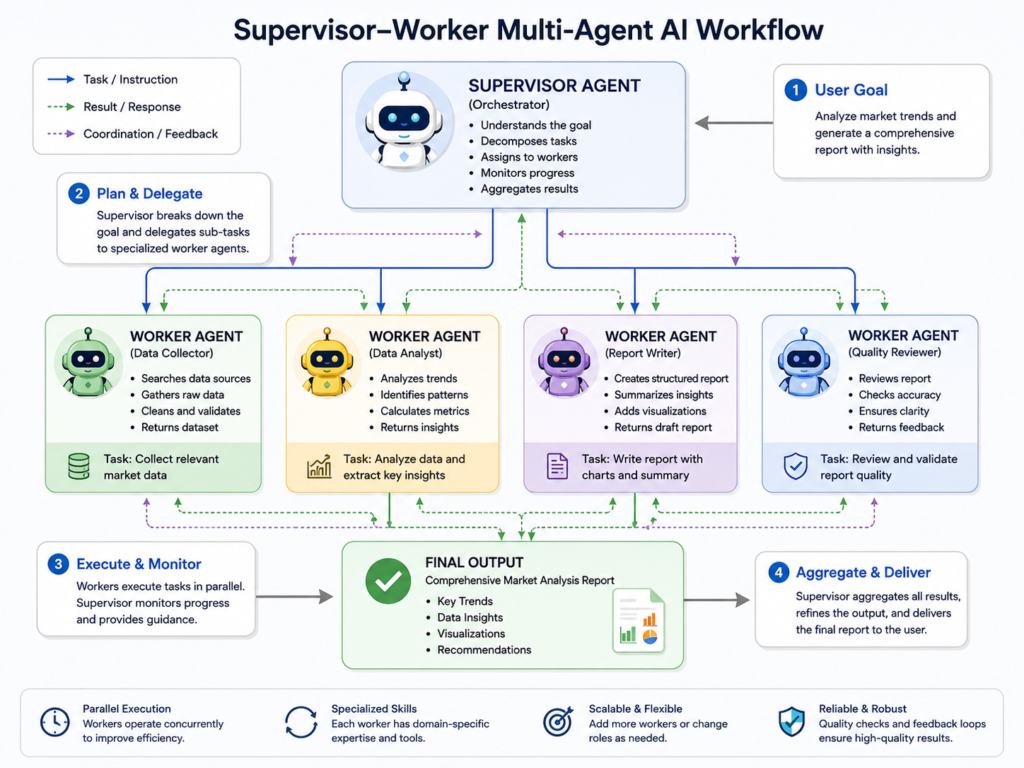
Supervisor-worker architecture uses one central controller to assign tasks to specialist agents. It is one of the safest patterns for regulated enterprise workflows because routing, retries, approvals, and escalation rules stay in one controlled layer.
A banking workflow, for example, may use a supervisor agent to route customer requests to KYC, payments, fraud, or compliance agents. The supervisor does not need to know every detail. It needs to know which agent should handle each task and when human approval is required.
This pattern works well for finance, healthcare, insurance, legal, IT operations, and customer support.
Hierarchical Multi-Agent Systems
A hierarchical system creates levels of responsibility. Junior agents handle narrow tasks. Senior agents review, combine, or escalate outputs.
This is useful when the workflow already has approval layers, such as claims review, procurement, compliance investigation, or medical administration. It mirrors how many enterprise teams already work.
Peer-to-Peer and Blackboard Patterns
Peer-to-peer agent systems allow agents to collaborate more freely. They can be helpful for research, software review, security analysis, and incident triage.
Blackboard architecture gives agents a shared workspace. Each agent adds findings until the system has enough context to produce a final answer. This can work well for legal discovery, threat investigation, and technical root-cause analysis.
For most regulated enterprises, a hybrid model is often best: supervisor-worker control with a shared workspace for evidence and intermediate reasoning.
Enterprise Orchestration, Tooling, and Integration
Agent orchestration is the control layer of multi-agent AI architecture. It decides which agent acts, which tool it can use, what data it can access, and when a human must review the output.
Without orchestration, agent systems can quickly become expensive, unpredictable, and hard to audit.
A production-ready orchestration layer should include.
Role-based access control
API and tool permissions
Prompt and policy versioning
Retry and fallback logic
Output validation
Human-in-the-loop checkpoints
Cost, latency, and quality monitoring
Full audit logs
Mak It Solutions’ guide to human-in-the-loop AI workflows is a useful companion for designing approval points, review queues, and escalation logic.
MCP, A2A, and Secure Tool Access
Modern agent systems increasingly rely on protocols and integration standards. Anthropic describes the Model Context Protocol as an open standard for building secure, two-way connections between data sources and AI-powered tools. Google’s Agent2Agent protocol is designed to let agents communicate, securely exchange information, and coordinate actions across enterprise platforms.
These protocols are helpful, but they are not a complete security strategy.
Enterprises still need identity management, secrets handling, sandboxing, rate limits, approval policies, data-loss prevention, monitoring, and incident response. Agents should never receive unrestricted access to production systems just because a connector exists.
Integrating Agents with Existing Enterprise Systems
A practical enterprise AI agent architecture should not become a separate “AI island.” It should connect with the systems teams already use, such as AWS, Microsoft Azure, Google Cloud, IBM, Redis, SAP, Salesforce, ServiceNow, Snowflake, Databricks, Microsoft 365, CRM platforms, ERP systems, and observability tools.
For engineering teams, Mak It Solutions’ Node.js development services and Python development services can support the API, orchestration, and backend layers behind these workflows.
For field teams and mobile-first operations, agent outputs can also be exposed through Mak It Solutions’ mobile app development services.
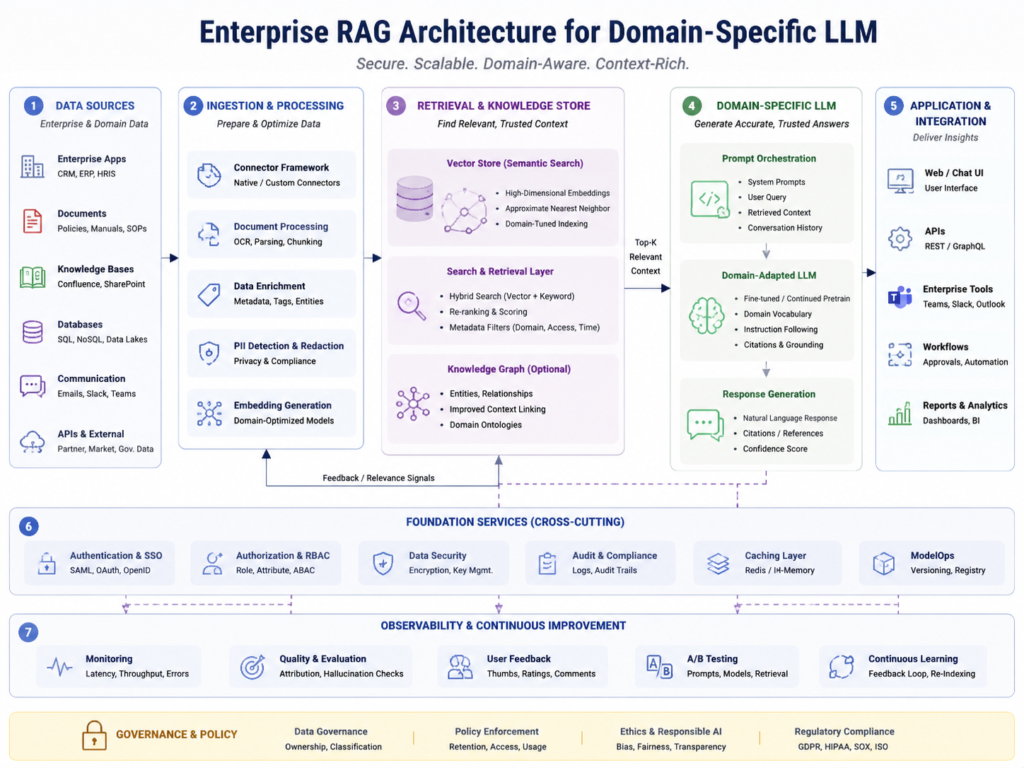
Domain-Specific LLMs, RAG, and Knowledge Grounding
Generic LLMs are useful, but enterprise workflows need more than fluent answers. They need answers grounded in approved knowledge, current policies, customer records, product documentation, and compliance rules.
That is where domain-specific LLM architecture and enterprise RAG become important.
Why Enterprise RAG Matters
Enterprise RAG connects AI agents to trusted internal knowledge sources. This may include policies, contracts, support tickets, claims history, product documents, data warehouse records, or clinical notes.
A strong RAG layer should include.
Access control by user, role, and region
Source ranking and relevance checks
Freshness checks for outdated documents
Citations or source references
Data minimization
Logging of retrieved context
A useful rule for production systems is simple: agents should retrieve before they reason, and cite before they recommend.
Domain Expert Agents for Regulated Workflows
Domain expert agents can improve quality when workflows require industry context. Healthcare teams may use agents for prior authorization support, coding assistance, or patient-message triage under HIPAA-aligned safeguards. Financial firms may use agents for risk summaries, transaction monitoring, or compliance-sensitive communication review.
In Germany and wider EU deployments, teams may also need stronger model-risk documentation, data residency controls, and audit evidence for BaFin-sensitive or DORA-related workflows.
Governance, Security, and Compliance by Region
A secure multi-agent AI architecture must prove more than what the AI produced. It should also show which data was used, which tools were called, which policies were checked, and who approved the final action.
That matters because the cost of weak governance is high. IBM’s 2024 Cost of a Data Breach research found the global average breach cost reached USD 4.88 million, a 10% increase from 2023.
USA.
In the US, healthcare workflows need HIPAA Security Rule safeguards for electronic protected health information. HHS states that the Security Rule requires administrative, physical, and technical safeguards for ePHI.
Fintech, banking, and insurance teams should also account for SOC 2, PCI DSS, FINRA expectations, SEC-related controls, model-risk management, and customer communication review.
A New York fintech or Boston health tech should start with a narrow use case, sensitive-data mapping, human approval workflows, and strong audit logging before allowing agents to take action.
UK.
In the UK, agent systems that process personal data need careful data protection design. ICO guidance defines personal data as information relating to an identified or identifiable natural person and notes that UK GDPR covers personal data processed by automated means.
For London banks, Manchester SaaS firms, NHS-related workflows, and public sector systems, visibility is critical. Teams should log prompts, retrieved sources, outputs, reviewer decisions, and exceptions.
For FCA-sensitive workflows, avoid black-box automation where customers, auditors, or compliance teams cannot understand the decision path.
Germany and EU.
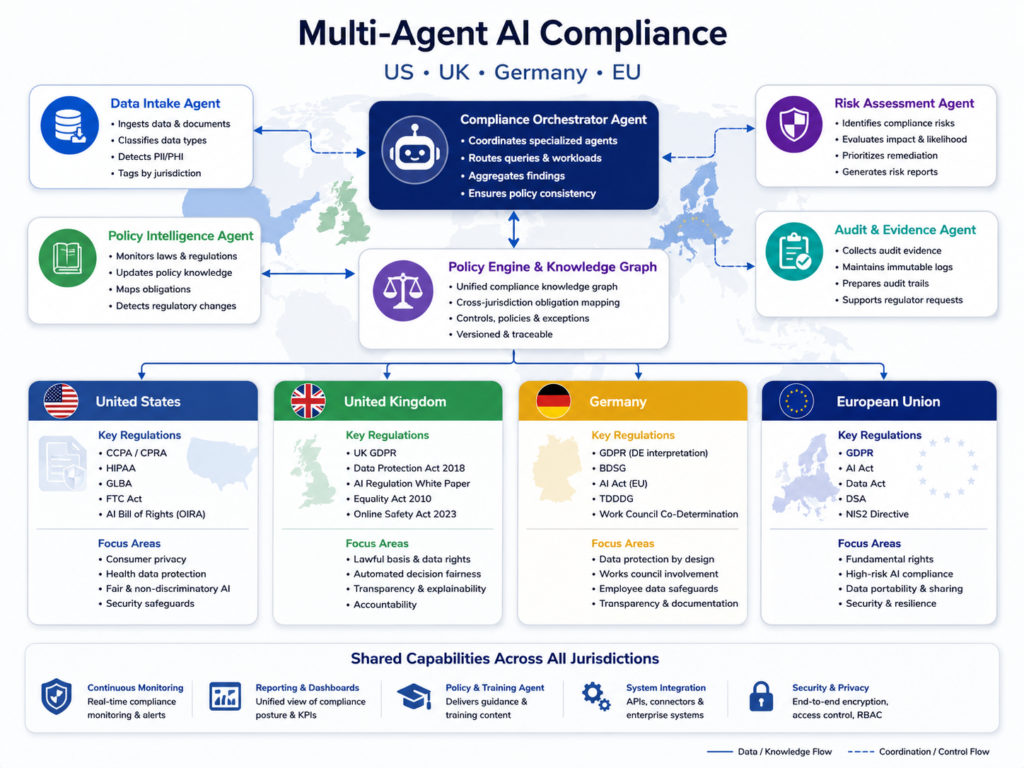
Germany and EU deployments need special attention to GDPR/DSGVO, EU AI Act obligations, DORA, NIS2, works council expectations, cloud regions, and cross-border data transfers.
The EU AI Act entered into force on August 1, 2024, and the European Commission describes it as a risk-based framework for AI developers and deployers. The Commission’s current guidance states that prohibited-practice rules became effective in February 2025, GPAI rules became effective in August 2025, transparency rules are set for August 2026, and high-risk AI rules are scheduled for August 2026 and August 2027.
DORA has applied since January 17, 2025, and covers digital operational resilience for financial entities and ICT third-party service providers across the EU financial sector.
For Berlin, Munich, Frankfurt, Dublin, Amsterdam, Paris, and Zurich deployments, consider EU data residency, sovereign cloud options, audit trails, vendor risk, and local governance expectations early in the design.
For sensitive cloud workloads, Mak It Solutions’ article on confidential computing for sensitive cloud workloads adds useful security context.
Regional Deployment Playbooks
The same multi-agent AI architecture may need different hosting, consent, logging, and escalation rules depending on where it is deployed.
USA
US teams often start with customer support, claims operations, healthcare administration, fintech compliance, DevOps, and internal knowledge search. In cities such as New York, San Francisco, Seattle, and Boston, the strongest pilots usually connect AI agents to measurable business workflows instead of isolated demos.
UK
UK teams may focus on banking operations, complaint triage, NHS-adjacent administration, public sector knowledge management, and SaaS support. Human oversight and explainability should be designed before the pilot goes live, not added later.
Germany and Wider Europe
German and EU teams often prioritize industrial AI, financial resilience, data residency, and auditability. Frankfurt financial firms should design with BaFin and DORA expectations in mind. Berlin and Munich product teams may need strong documentation for engineering, works councils, and privacy review.
Production Roadmap for Multi-Agent AI Architecture
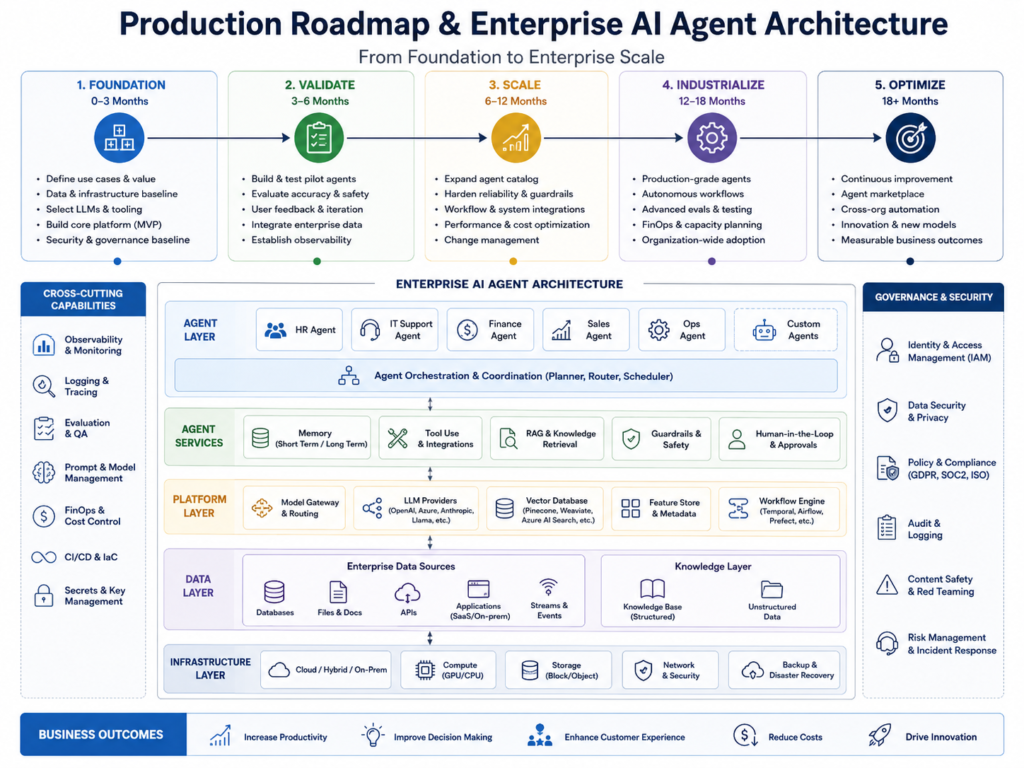
A safe production roadmap starts small and scales only after the system proves value, reliability, and control.
Step-by-Step Roadmap
Assess workflows, data sensitivity, business value, and risk.
Design agent roles, permissions, memory, RAG, and audit logs.
Pilot one workflow with human review and clear KPIs.
Govern with testing, monitoring, policies, and compliance evidence.
Scale only after quality, cost, latency, and escalation metrics are stable.
KPIs to Track
Track grounded accuracy, hallucination rate, retrieval quality, latency, token cost, tool-call success, escalation rate, user satisfaction, audit completeness, and business ROI.
Adoption alone is not enough. Stack Overflow’s 2025 Developer Survey found that 84% of respondents were using or planning to use AI tools in development, but 66% also said their biggest frustration was AI solutions that are “almost right, but not quite.”
That is exactly why enterprise AI agents need governance, testing, and human escalation.
Concluding Remarks
Multi-agent AI architecture can help enterprises turn AI from a helpful assistant into a governed workflow layer. The best systems are not the most autonomous; they are the most controlled, observable, and useful.
Planning a secure multi-agent AI architecture for SaaS, cloud, mobile, healthcare, fintech, or enterprise operations? Mak It Solutions can help you scope the use case, map integrations, design governance controls, and build a practical pilot.
Start with a scoped estimate through the Mak It Solutions contact page and turn your AI agent idea into a secure production roadmap.
Key Takeaways
Multi-agent AI architecture is best for complex workflows that need specialized agents, private knowledge, secure tools, and human review.
Supervisor-worker and hierarchical patterns are usually safer for regulated enterprise environments.
Enterprise RAG improves accuracy by grounding agent outputs in approved knowledge.
USA, UK, Germany, and EU deployments need different compliance, data residency, and audit controls.
MCP and A2A can help with integration, but they do not replace identity, governance, and security design.
Start with one measurable pilot before scaling agentic AI across departments.
FAQs
Q : How many AI agents does an enterprise workflow usually need?
A : Most enterprise workflows start with three to seven agents. A simple system may only need an intake agent, retrieval agent, and response agent. Regulated workflows often need extra agents for compliance checks, audit logging, fraud review, and human escalation.
Q : What is the difference between agent orchestration and workflow automation?
A : Workflow automation follows predefined process rules. Agent orchestration controls how AI agents reason, route tasks, use tools, share memory, validate outputs, and escalate issues. In practice, automation is the process rail, while orchestration is the control layer.
Q : Can multi-agent AI systems access private company data safely?
A : Yes, but only with proper architecture. Safe access requires role-based permissions, enterprise RAG, encryption, audit logs, data minimization, secret management, and human approval for sensitive actions. Agents should retrieve only the data needed for the task.
Q : What are the biggest risks of unmanaged AI agents?
A : The biggest risks include data leakage, hallucinated decisions, unauthorized tool use, prompt injection, weak auditability, rising cloud costs, and unclear accountability. Governance and monitoring reduce those risks before deployment expands.
Q : Should enterprises build custom multi-agent AI architecture or use a platform?
A : Use a platform for low-risk, standard workflows where integrations and governance needs are simple. Build custom architecture when the workflow involves regulated data, proprietary systems, complex approvals, or region-specific compliance. Many enterprises use a hybrid approach.