
Semantic Layer for AI Agents: The Essential Guide
Semantic Layer for AI Agents: The Essential Guide
Semantic Layer for AI Agents: The Essential Guide
AI agents can write SQL, analyze dashboards, and answer complex business questions in seconds. But speed means little if an agent calculates revenue incorrectly, ignores access permissions, or produces an answer nobody can verify.
A semantic layer for AI agents solves a critical part of this problem. It connects AI-powered analytics to standardized business metrics, approved data relationships, and governed access policies. Instead of guessing what database columns mean, agents can query trusted business definitions and return more consistent, traceable answers.
The business case is becoming harder to ignore. McKinsey’s 2025 State of AI research reported that 88% of surveyed respondents said their organizations regularly used AI in at least one business function, compared with 78% in the previous survey.
Data quality, however, remains a major obstacle. According to dbt Labs’ 2025 State of Analytics Engineering report, over 56% of respondents identified poor data quality as a challenge.
For enterprises across the USA, UK, Germany, and wider EU, reliable agentic analytics depends on something more fundamental than powerful language models: trusted business definitions, secure access, and a well-designed data architecture.
What Is a Semantic Layer for AI Agents?
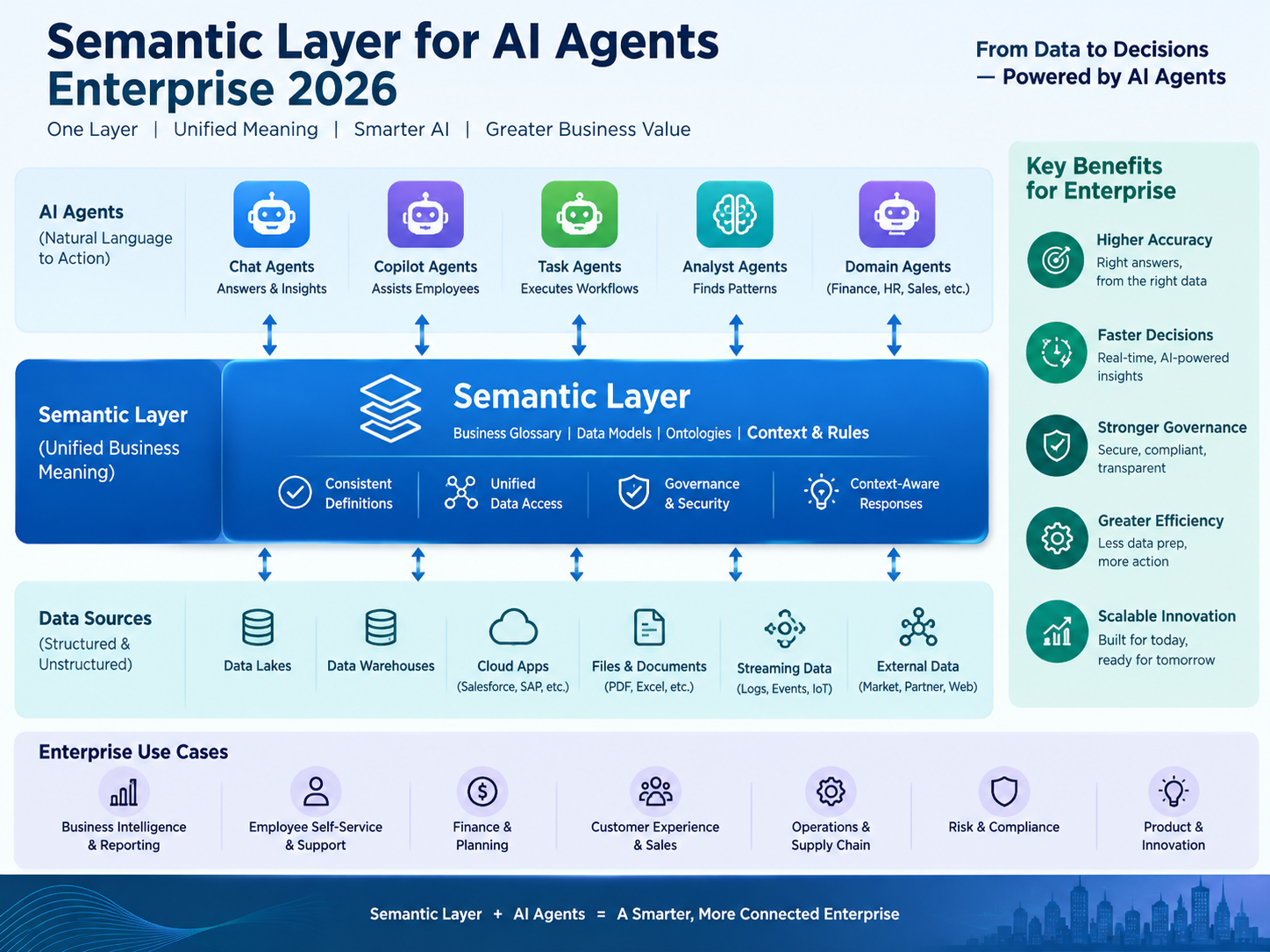
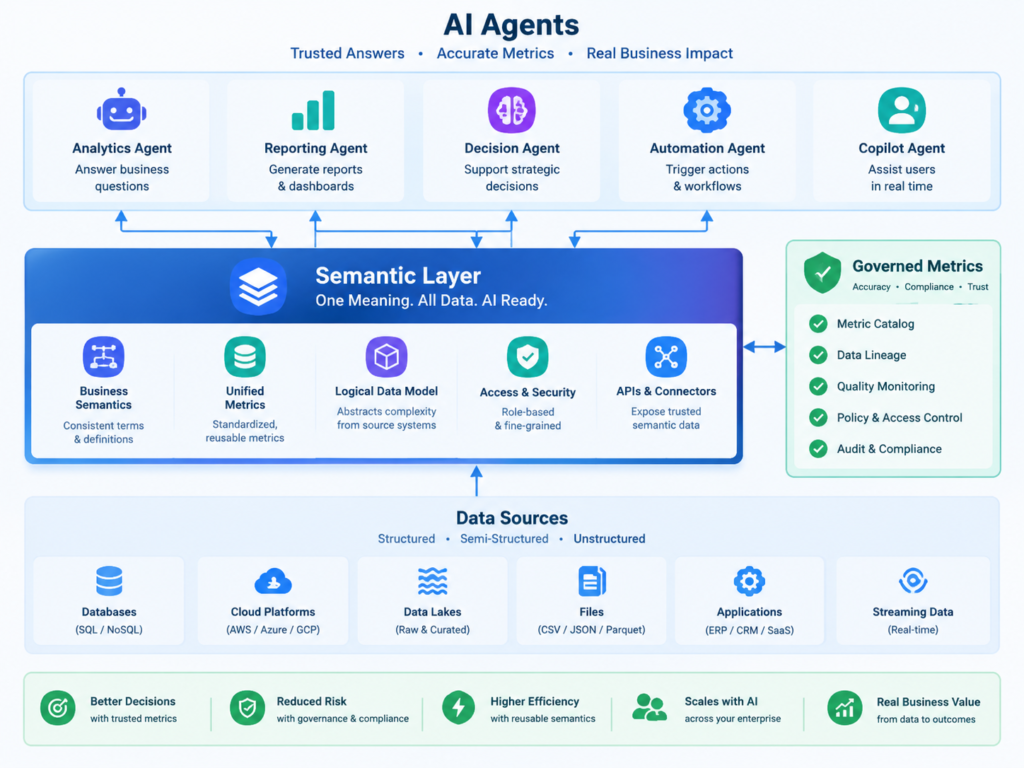
A semantic layer for AI agents is a governed interface between enterprise data systems and AI applications. It organizes business metrics, dimensions, relationships, and calculation rules so agents can interpret and query information consistently.
Rather than forcing an AI agent to understand every underlying table, the semantic layer presents approved business concepts such as net revenue, customer retention, or sales by region.
Semantic Layer vs. Semantic Data Model.
Although these terms are related, they serve different purposes.
A semantic data model defines what business information means. A semantic layer makes those definitions available to reporting tools, applications, and AI agents.
|
Component |
Primary function |
|---|---|
| Raw database schema | Stores tables, columns, and technical relationships |
| Semantic data model | Defines business entities, metrics, and calculation rules |
| Semantic layer | Exposes governed definitions to analytics tools and AI agents |
In practice, organizations need both reliable modeling and controlled access.
A semantic model without a suitable interface may be difficult for AI agents to use. A semantic interface without well-defined metrics can simply make inconsistent information easier to retrieve.
Metrics, Dimensions, Measures, and Business Relationships
An effective semantic model connects technical data to the language businesses actually use.
Its core components include.
Measures: Numerical values such as sales amounts, transaction counts, or operating costs.
Metrics: Defined business calculations such as net revenue, retention rate, or customer acquisition cost.
Dimensions: Attributes used to analyze results, including region, product, and reporting period.
Relationships: Connections between entities such as customers, orders, products, and refunds.
Grain: The level of detail at which information is recorded or aggregated.
Grain deserves particular attention. An incorrect relationship between order-level and item-level records can duplicate revenue, even when the SQL query executes successfully.
Why Natural Language Analytics Needs Business Context
Imagine asking an AI agent.
“What was our net revenue last quarter?”
The agent might find a column labeled revenue. But that column alone cannot explain whether discounts, refunds, taxes, or canceled orders are included.
A governed semantic model provides those rules.
This allows natural-language analytics to move beyond technically valid queries toward answers that reflect agreed business definitions.
How Does Agentic Analytics Architecture Work?
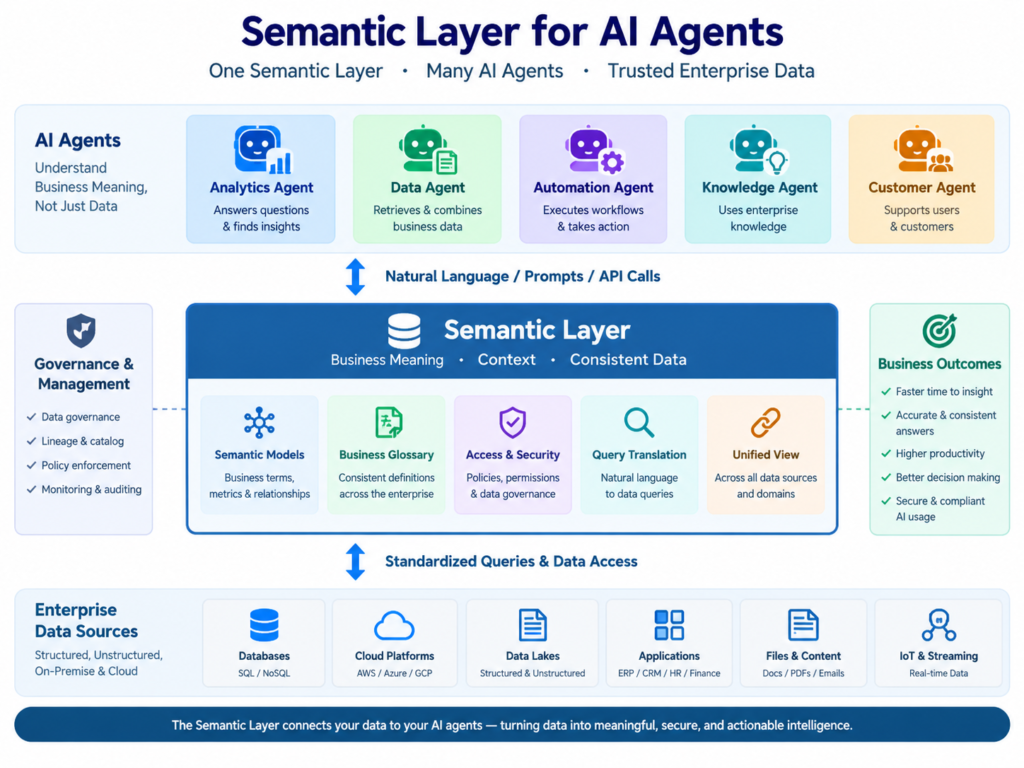
Agentic analytics combines language models, orchestration services, semantic interfaces, and enterprise data systems.
The process begins with a user’s business question and ends with an authorized response supported by approved metrics and traceable data.
From User Prompt to Governed Analytics Response
A typical workflow follows these stages.
Business question
“What was net revenue last quarter?”
AI agent and orchestration
Interpret intent and select approved tools
Governed semantic layer
Business definitions · Permissions · Semantic APIs / MCP
Authorized query execution
Snowflake · Databricks · SQL data platforms
Validated analytics response
Certified metrics · Source evidence · Audit trail
Security, authorization, and validation across the workflow
The orchestration service identifies the requested business metric, applies the relevant authorization context, and invokes an approved data service.
The resulting response should include enough information to establish how the answer was calculated, including relevant filters, reporting periods, and source references.
MCP, Semantic APIs, and Text-to-SQL Integration
The Model Context Protocol (MCP) provides a standardized way for AI systems to interact with external tools and services.
Semantic APIs can make approved metrics available to agents without exposing unrestricted database access.
Text-to-SQL can also remain part of the architecture, provided generated queries are validated and executed through constrained, least-privilege access.
For implementation, Python development can support agent orchestration and data-processing components, while Node.js API services can support authenticated integrations.
Semantic Layer vs. Knowledge Graph in Agentic BI
A semantic layer and a knowledge graph solve related but different problems.
A semantic layer focuses on governed analytical definitions, while a knowledge graph represents entities and their relationships.
For example, a semantic layer can define how customer lifetime value is calculated. A knowledge graph may help an agent understand connections between customers, subscriptions, products, and organizations.
Used together, they can improve business context and support more sophisticated analytical questions.
Why Governed Metrics Improve AI Analytics Accuracy
Governed metrics reduce inconsistent calculations by giving AI agents approved definitions and relationships to work with.
They cannot eliminate hallucinations or guarantee correctness. Independent testing and output validation remain essential.
Certified KPIs vs. Raw Text-to-SQL Results
Consider a request for net revenue by region.
An unrestricted AI agent could accidentally include canceled transactions, duplicate order values through joins, or apply an incorrect reporting period.
A certified metric can define the calculation explicitly.
Net revenue = Eligible sales Approved discounts Recognized refunds
This is an illustrative formula. The exact calculation must reflect the organization’s accounting policies and business rules.
The semantic model should also specify currency, transaction grain, recognized revenue dates, regional attribution, and permitted filters.
When these rules are centralized, dashboards, analysts, and AI agents can work from consistent definitions.
Row-Level Security, RBAC, and Metric Lineage
Reliable analytics requires more than accurate calculations.
Three important governance controls are.
Role-based access control (RBAC): Restricts operations according to assigned roles.
Row-level security: Limits which records a user can access.
Metric lineage: Records where reported values originate and how they are transformed.
For enterprise business intelligence services, these controls support consistent reporting across departments while reducing unnecessary access to sensitive information.
Authorization should be enforced by trusted services and data platforms not merely through instructions given to an AI model.
Testing Hallucinations, Accuracy, and Explain ability
A useful test is whether an agent’s answer matches a known, independently verified result.
Testing should cover normal business questions as well as difficult scenarios, including ambiguous terminology, missing records, unusual aggregation rules, and unauthorized access requests.
Agents should acknowledge unavailable information rather than fabricate calculations or explanations.
Query logs, metric versions, source references, and access decisions also help teams investigate unexpected results.
Regional Compliance: USA, UK, Germany, and EU
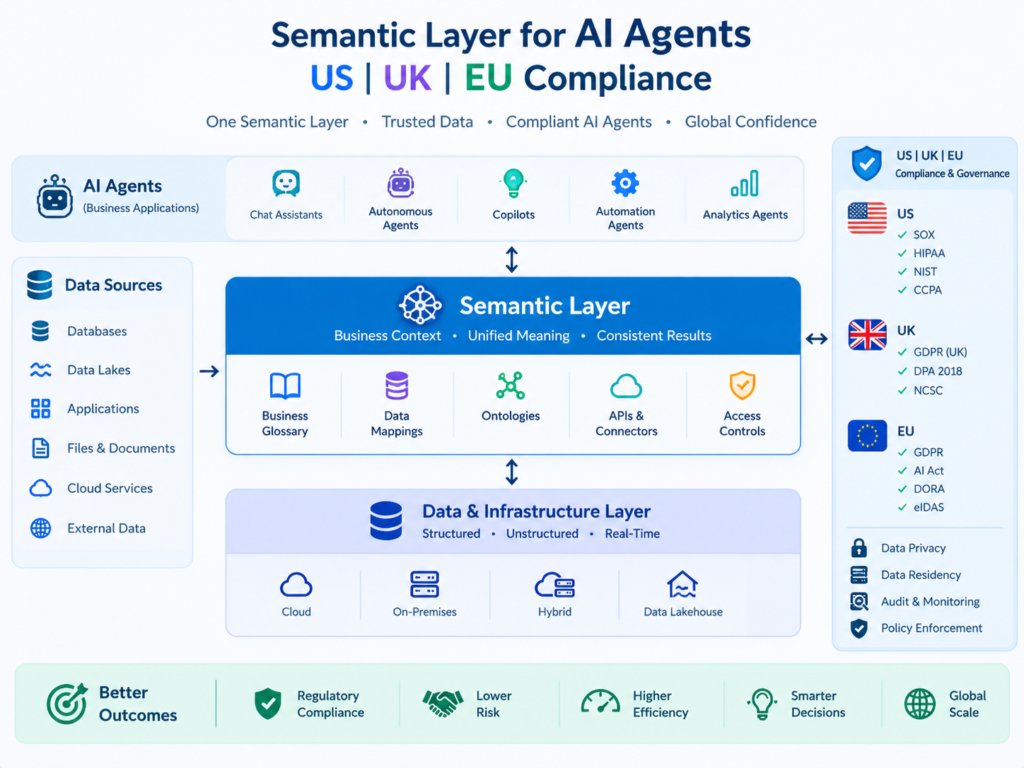
A semantic layer can support enterprise compliance through controlled data access, consistent policies, and auditable queries.
However, a semantic layer does not make an organization compliant by itself. Legal compliance depends on how data is collected, processed, stored, transferred, and protected.
USA.
A healthcare provider in New York using AI analytics may need to satisfy HIPAA requirements when processing protected health information.
Relevant safeguards can include encryption, identity management, minimum-necessary access controls, and audit logging.
Organizations should consult the official HHS HIPAA Security Rule guidance.
SOC 2 reports may support vendor assurance, while PCI DSS requirements may apply to relevant payment-card environments.
UK.
Financial institutions in London need to consider UK GDPR requirements alongside applicable Financial Conduct Authority obligations.
For NHS-related analytics, additional health-information governance rules may also apply.
The UK Information Commissioner’s Office provides guidance covering data protection, lawful processing, security, and international transfers.
Semantic governance can assist with access restrictions and auditability, but organizations must separately assess their legal obligations.
Germany and EU.
In Germany, the EU General Data Protection Regulation (GDPR), commonly called DSGVO, applies to relevant personal-data processing.
Financial institutions in Frankfurt may also face BaFin supervision and applicable Digital Operational Resilience Act (DORA) requirements.
Manufacturing businesses in Berlin may need to manage access to customer information, employee records, and sensitive industrial data.
The EU AI Act introduces risk-based requirements for AI systems. However, not every enterprise analytics application is automatically classified as high-risk.
Similarly, hosting data in an EU cloud region may support residency requirements, but it does not automatically establish GDPR compliance.
Organizations should evaluate their actual data-processing activities, deployment configurations, and regulatory responsibilities.
How to Build a Semantic Layer for AI Agents
Building an enterprise semantic layer starts with a limited set of valuable business questions—not a complete redesign of the existing data platform.
A practical approach is to establish trusted metrics, connect them through controlled interfaces, and validate performance before broad deployment.
Define KPIs, Dimensions, Joins, and Ownership
Start by selecting five to ten important business metrics, such as revenue, retention, and customer acquisition cost.
For each metric, document its calculation rules, reporting grain, time dimensions, relationships, and exclusions.
Assign a responsible business owner who can approve changes and resolve disagreements over definitions.
Version control is important because a change to one metric can affect dashboards, financial reporting, and agent-generated responses simultaneously.
Connect Agent Tools Using MCP or Semantic APIs
Tools such as dbt Metric Flow and Cube can help organizations model and expose governed analytical metrics.
Depending on platform capabilities, agents may connect through authenticated MCP tools, REST APIs, GraphQL interfaces, or other supported query services.
Snowflake and Databricks can provide underlying analytical infrastructure when their supported integration and authorization patterns fit the deployment.
Custom web development can also help organizations create secure, business-facing portals for governed AI analytics.
The key architectural principle is to expose approved capabilities without giving every agent unrestricted access to enterprise databases.
Validate Accuracy, Security, Latency, and Cost
Begin with a pilot of approximately 20 representative business questions.
Compare agent-generated answers against independently verified results.
Measure.
Numerical accuracy and metric consistency.
Permission enforcement and unauthorized access attempts.
Response latency and query execution costs.
Reliability when data is incomplete or ambiguous.
Resilience to prompt injection and misleading requests.
Expand the deployment only after measurable acceptance criteria have been met.
Best Semantic Layer Tools for Agentic Analytics
There is no universally best semantic layer platform.
The right choice depends on existing infrastructure, governance maturity, deployment requirements, integration capabilities, and ongoing operating costs.
dbt Metric Flow vs. Cube.
dbt Metric Flow focuses on code-defined business metrics and consistent analytical querying.
Cube provides semantic modeling and query services that may be useful for embedded analytics, API-driven applications, and performance-sensitive workloads.
Both approaches require evaluation of access controls, compatibility, maintenance requirements, and the interfaces available to AI agents.
The official dbt Semantic Layer documentation provides a useful starting point for understanding supported semantic-layer capabilities.
Snowflake, Databricks, Power BI, and Look ML
Organizations already using Snowflake or Databricks may prefer native semantic or metric-governance capabilities where they meet the intended requirements.
Microsoft Power BI/Fabric semantic models and Look ML provide established approaches for governing BI-oriented calculations.
Before introducing another semantic platform, assess whether existing models can be reused or exposed through secure integration services.
Compare Portability, Security, Pricing, and Integration
|
Platform |
Main strength |
What to evaluate |
|---|---|---|
| dbt Metric Flow | Code-governed business metrics | API availability and supported integrations |
| Cube | Semantic query services | Caching, deployment, and access policies |
| Snowflake | Warehouse-aligned semantic views | Permissions and runtime costs |
| Databricks | Lakehouse metric governance | Catalog controls and agent access |
| Power BI/Fabric | Established BI semantic models | Licensing, capacity, and permissions |
| LookML | Governed BI modeling | Looker integration and portability |
Pricing comparisons should consider more than software licenses.
Warehouse consumption, engineering maintenance, security operations, support, and infrastructure ownership all contribute to the total cost of operating a semantic layer.
ROI and Production Readiness for Enterprise AI Agents
A semantic layer should deliver measurable improvements in analytics quality, operating efficiency, and governance.
High agent usage alone does not demonstrate business value.
Measure Metric Accuracy, Latency, and Analyst Time Saved
Establish a baseline before deployment.
Compare verified answer accuracy, time to insight, query costs, and operational incidents before and after introducing governed analytics.
Infrastructure complexity also matters. Flexera’s 2024 State of the Cloud report found that 89% of surveyed organizations used multiple cloud environments.
This illustrates why ownership, integration, and cost visibility deserve attention in enterprise analytics architecture.
Evaluate Deployment, Ownership, and Data Residency
Production readiness requires clear accountability.
Organizations should define who owns business metrics, infrastructure, permissions, monitoring, incident response, and deployment approvals.
For US, UK, and EU operations, document relevant hosting locations, data-transfer mechanisms, contractual obligations, and disaster-recovery arrangements.
Enterprise Semantic Layer Readiness Checklist
Use this checklist before making governed analytics available to a wider group of AI agents.
Enterprise readiness.
0 of 6 complete.
A successful implementation starts with trusted definitions, introduces controlled agent access, and expands through evidence-based testing.
Final Recommendation
A semantic layer for AI agents provides the business definitions and governance controls needed to make enterprise AI analytics more reliable.
The biggest improvement does not come from giving agents more data. It comes from giving them access to the right data, through approved metrics, properly enforced permissions, and verifiable query results.
For businesses planning agentic analytics, a focused pilot is a sensible starting point. Define critical metrics, assess current data architecture, test accuracy, and establish security expectations before expanding.
Mak It Solutions can help organizations assess data architecture, integration requirements, and business intelligence modernization opportunities.
Contact Mak It Solutions to request a Semantic Layer Readiness Assessment and discuss a practical pilot for your enterprise.
Key Takeaways
A semantic layer gives AI agents governed business context rather than relying entirely on raw database schemas.
Certified KPIs, documented relationships, and lineage improve the consistency and traceability of analytical answers.
MCP and semantic APIs can connect AI agents to approved enterprise data services.
Permissions and validation must be enforced independently of the language model.
US, UK, and EU regulatory obligations require jurisdiction-specific assessment.
The best platform depends on existing infrastructure, integration needs, security requirements, and total cost.
Enterprise ROI should be evaluated through measurable accuracy, productivity, performance, and governance outcomes.
FAQs
Q : Can AI agents query a semantic layer without direct database access?
A : Yes. AI agents can retrieve approved metrics through semantic APIs, MCP-connected tools, and controlled query services without receiving unrestricted database credentials.
Authentication, user-level authorization, and auditing are still necessary because a semantic interface does not automatically prevent data leakage.
Q : Does an enterprise need to replace existing BI dashboards to adopt agentic analytics?
A : No. Agentic analytics can operate alongside existing reporting applications.
Organizations using Power BI, Looker, or other BI platforms can evaluate whether their current semantic definitions can be reused or integrated.
Mak It Solutions’ business intelligence capabilities offer a relevant starting point for reviewing existing reporting infrastructure.
Q : How often should semantic metric definitions be updated?
A : Definitions should be updated when business rules, source data structures, reporting requirements, or applicable regulations change.
There is no universal schedule. Updates should follow ownership approval, version control, impact assessment, and regression testing.
Q : Can a single semantic layer support multiple AI agents and LLM providers?
A : Yes. A shared semantic layer can support different AI agents and model providers through compatible interfaces and governed tools.
However, authentication, API compatibility, provider-specific controls, and sensitive-data handling must be evaluated for each integration.
Q : What is a practical starting scope for a semantic-layer pilot?
A : A manageable pilot can focus on one business domain, five to ten governed KPIs, and approximately 20 representative business questions.
Revenue analytics is one possible starting point because responses can be compared against existing approved financial reports.
Review relevant technology services and technical insights before defining a larger implementation roadmap.
The pilot should demonstrate measurable correctness, security, and operational feasibility—not simply conversational fluency.