


Sovereign AI GCC: KSA, UAE & Qatar Buyer Guide
Sovereign AI GCC: KSA, UAE & Qatar Buyer Guide
Sovereign AI GCC: KSA, UAE & Qatar Buyer Guide
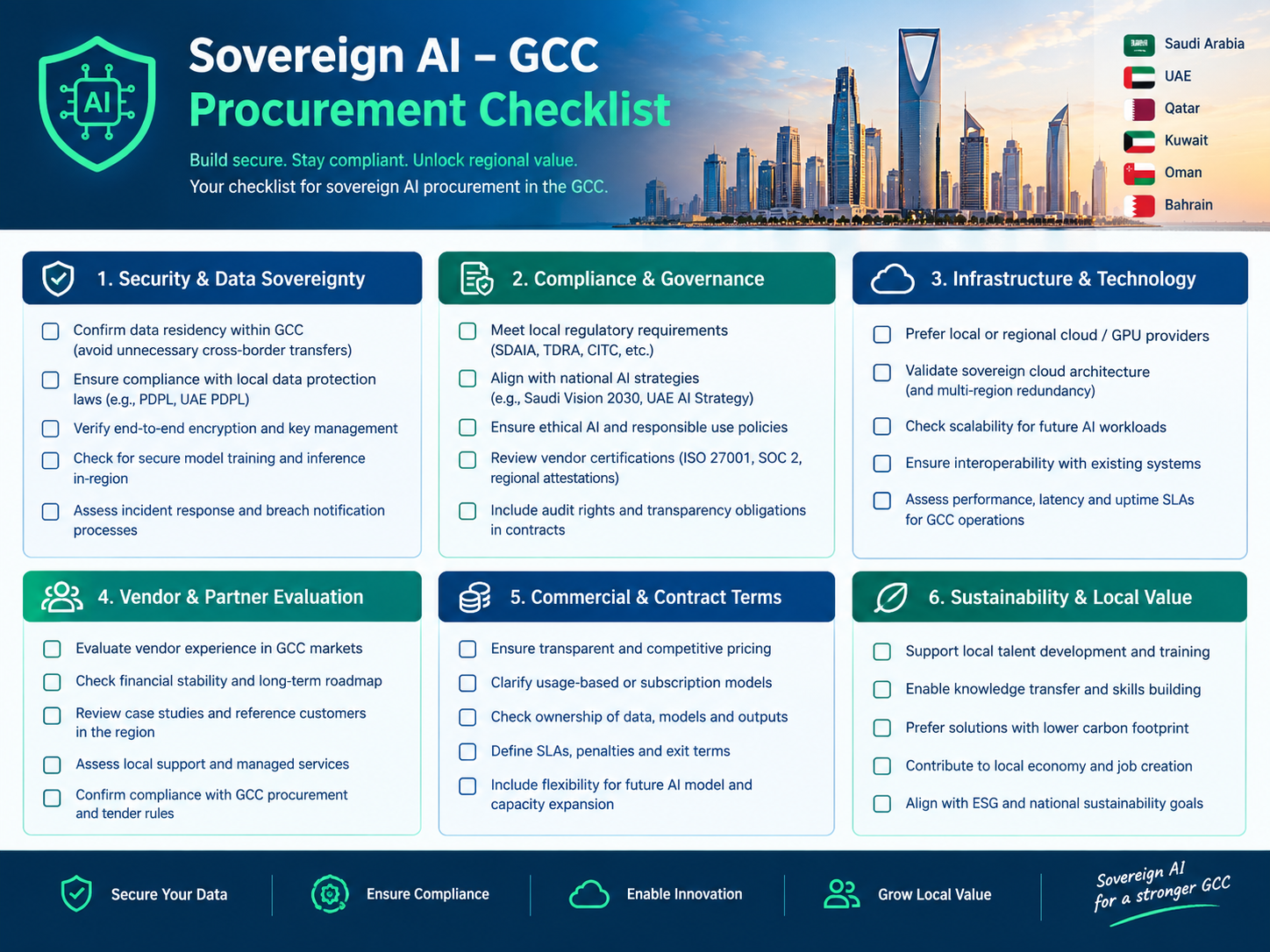
Buying sovereign AI GCC infrastructure involves far more than choosing a server in Riyadh, Dubai, Abu Dhabi or Doha. Local hosting can still involve overseas administrators, external subprocessors, cross-border telemetry, vendor-controlled encryption keys or model-training practices that weaken sovereignty.
A strong sovereign AI GCC procurement process should verify four things early: where data and inference run, who can access the environment, who controls encryption keys, and what rights the vendor has over enterprise data. CIOs should then validate auditability, resilience, subprocessor transparency, portability and enforceable exit rights before approving a platform.
For broader architectural context, see Mak It Solutions’ GCC sovereign cloud and data residency guidance.
What Should a Sovereign AI GCC Checklist Include?
A practical sovereign AI GCC checklist should cover 10 core controls.
Data classification
Data-processing geography
AI inference geography
Privileged administrator access
Encryption-key custody
Model-training and data-use rights
Sub processor visibility
Auditability
Business continuity and resilience
Data and model portability
These controls help procurement teams separate genuine sovereignty from a simple “hosted locally” marketing claim.
Define Data, Processing and Inference Residency
Start by documenting where prompts, uploaded files, retrieval data, backups, logs and inference workloads physically run.
Data-at-rest residency answers only part of the question. A workload may store information locally while sending prompts, telemetry or operational data elsewhere for processing or support.
Procurement teams should therefore ask vendors for clear data-flow diagrams covering normal operations, troubleshooting, disaster recovery and support scenarios.
Verify Administrator Access and Encryption-Key Control
Next, identify who can obtain privileged access to the platform and where those administrators are located.
Review standard support access, emergency-access procedures, approval workflows and logging. Where appropriate, customer-controlled encryption keys can give the enterprise greater control, but key-management architecture should still be examined carefully.
Every privileged administrative action should also be traceable through reliable audit records.
Audit Training Rights, Subprocessors and Exit Terms
AI contracts need explicit language covering the use of customer prompts, documents, outputs and fine-tuning data.
Procurement teams should establish whether enterprise information may be used for model training, product improvement, evaluation or other secondary purposes. Subprocessors should be disclosed, and material changes should follow an agreed notification process.
Exit terms matter just as much as onboarding. The organization should know how it will retrieve its data, configurations, model-related assets and other business-critical information when the relationship ends.
Data Residency vs Operational and Model Sovereignty
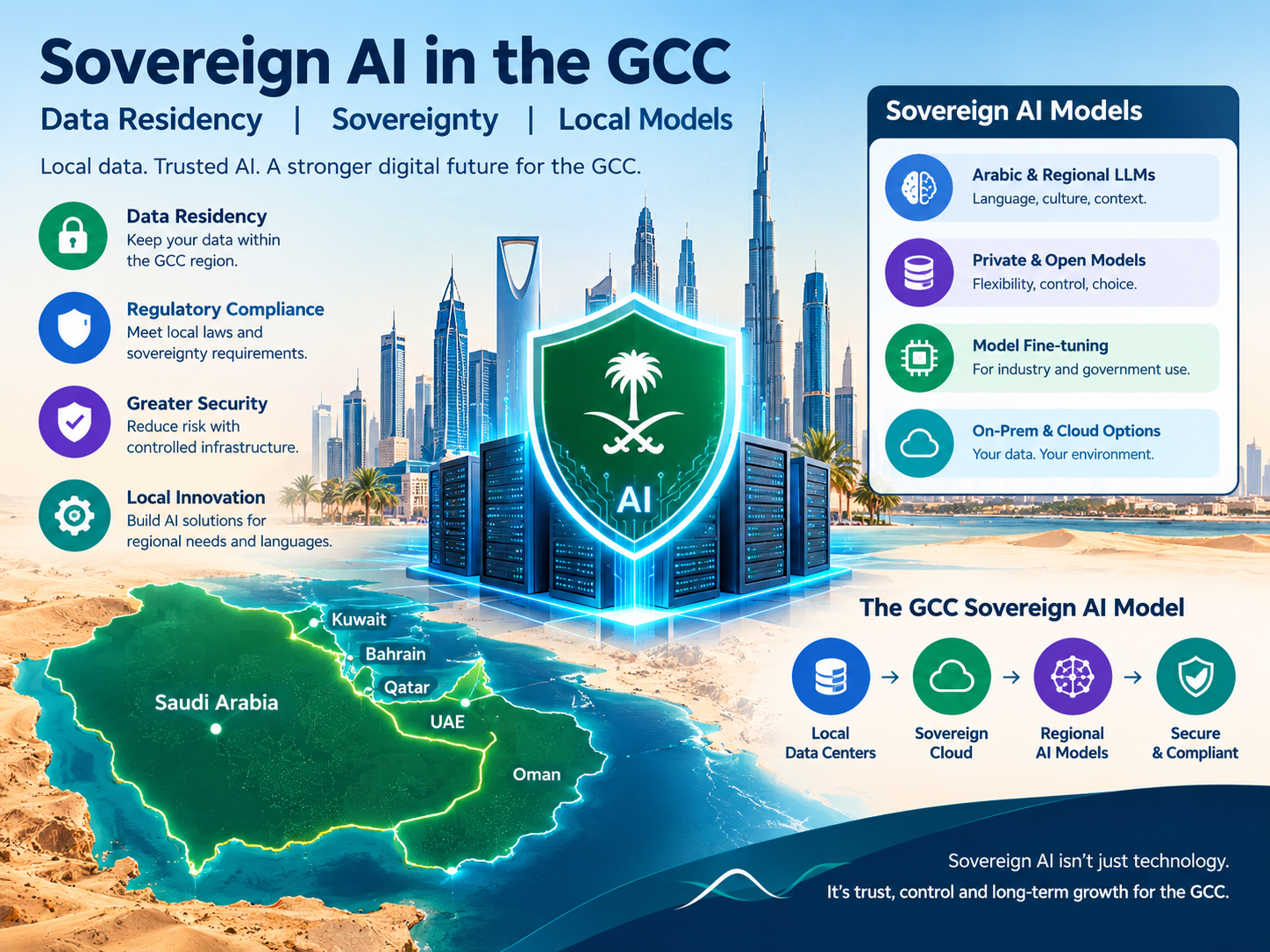
Sovereignty is easier to evaluate when it is divided into distinct layers.
What Data Residency Actually Proves
Data residency answers where information is stored or processed.
It does not automatically prove.
Who can access that information
Which administrators have privileged control
Where inference takes place
Where logs or telemetry are sent
Which legal jurisdictions may affect service operations
A local data center can therefore support sovereignty without, by itself, proving it.
What Operational Sovereignty Means for GCC CIOs
Operational sovereignty focuses on who runs the environment and how control is exercised.
CIOs should review support operations, security operations centers, network administration, incident response, privileged access and dependencies on offshore teams or systems.
In practice, this is often where the gap between “regional hosting” and meaningful sovereign control becomes visible.
What AI Model Sovereignty Adds
AI introduces another layer: the model itself.
Buyers should examine model provenance, model weights where relevant, fine-tuning practices, retrieval stores, update processes, external API dependencies and portability.
The core question is simple: if the vendor changes its model, architecture, commercial terms or operating model, how much control does the enterprise retain over its AI environment?
Saudi Sovereign AI GCC Procurement Requirements
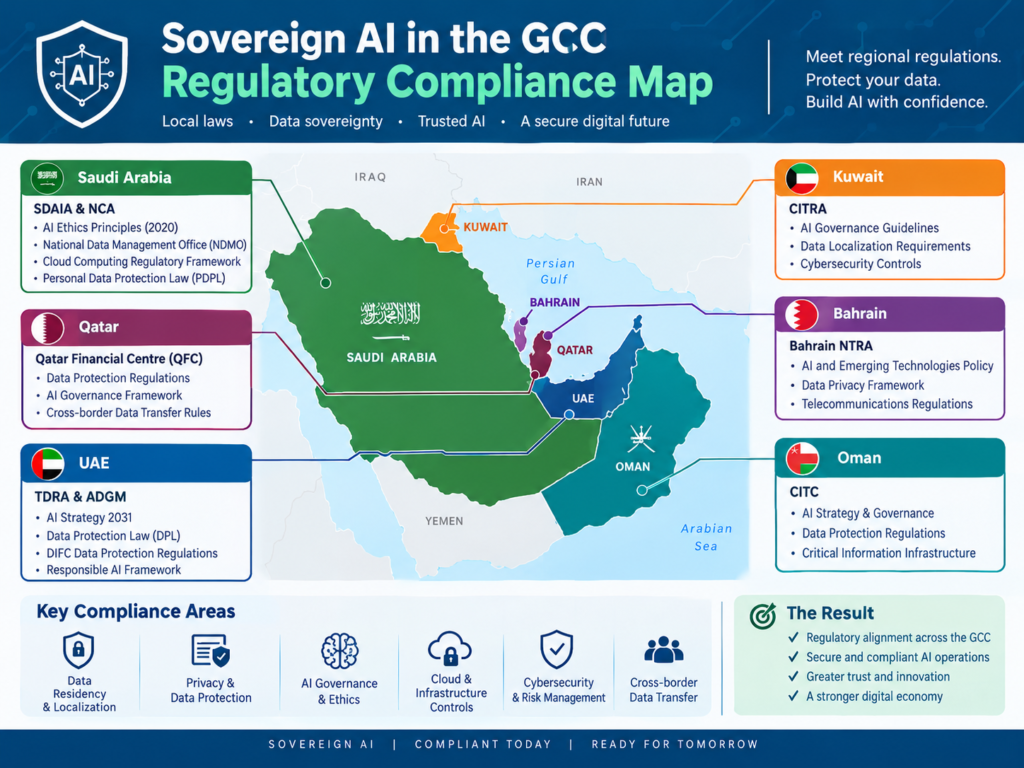
Saudi organizations should connect AI procurement with applicable privacy, data-governance, cybersecurity and sector-specific requirements.
Map AI Procurement to SDAIA, NDMO and Saudi PDPL
Organizations processing personal data should assess their deployment against applicable Saudi Personal Data Protection Law requirements and relevant SDAIA or NDMO governance expectations.
SDAIA provides official resources covering Saudi data-protection regulations and policies. Procurement, legal and security teams should use those requirements when defining data-handling, transfer, retention and vendor-access controls.
See the official Saudi SDAIA Personal Data Protection Law resources.
For broader AI implementation planning, see the GCC AI adoption roadmap.
Test Cloud and Cybersecurity Controls Against NCA Requirements
Security claims should be supported with evidence.
Ask vendors for architecture diagrams, access-control documentation, control mappings, security reports, incident-response procedures and relevant audit evidence.
Saudi organizations should also determine whether the National Cybersecurity Authority’s Cloud Cybersecurity Controls apply to their environment and procurement scope.
Add SAMA Controls for Saudi Financial Institutions
Banks and other SAMA-regulated organizations have additional third-party and outsourcing considerations.
A Riyadh financial institution evaluating an AI platform should review due diligence, ongoing monitoring, audit access, business continuity, contractual safeguards and any approval or no-objection requirements that apply to the proposed arrangement.
The official Saudi Central Bank outsourcing rules should be assessed alongside broader privacy and cybersecurity obligations.
UAE and Qatar Sovereign AI Vendor Due Diligence
Sovereign AI requirements also vary by jurisdiction and sector across the Gulf. A single “GCC compliant” label is rarely detailed enough for procurement.
Assess UAE Data Transfers, FEDnet and Sovereign Cloud
A Dubai e-commerce company, for example, should examine processing geography, support access, sub processors and data flows before deploying AI across customer-facing services.
Federal UAE data-protection requirements may be relevant depending on the organization and workload. For federal-government environments, TDRA’s Federal Network, or FEDnet, also illustrates how sovereign infrastructure can involve secure connectivity, cloud services, backup and disaster recovery not just hosting location.
Treat DIFC and ADGM as Distinct Compliance Contexts
Financial organizations should not assume every UAE workload falls under the same regulatory framework.
DIFC and ADGM operate their own data-protection regimes. A Dubai or Abu Dhabi financial organization should identify the applicable jurisdiction before finalizing contractual, hosting and cross-border processing requirements.
That determination should happen before vendor selection rather than after technical architecture has already been locked in.
Ask Qatar Vendors for QCB, Security and Exit Evidence
A Doha financial institution should request evidence covering access governance, encryption, auditability, continuity, subcontractors and migration.
For QCB-licensed organizations, the Qatar Central Bank Cloud Computing Regulation is an important part of the cloud-governance context.
Local infrastructure can support a sovereign design, but local region availability alone does not prove that every regulatory, security or operational requirement has been met.
How to Score Sovereign AI GCC Vendors Before an RFP Award
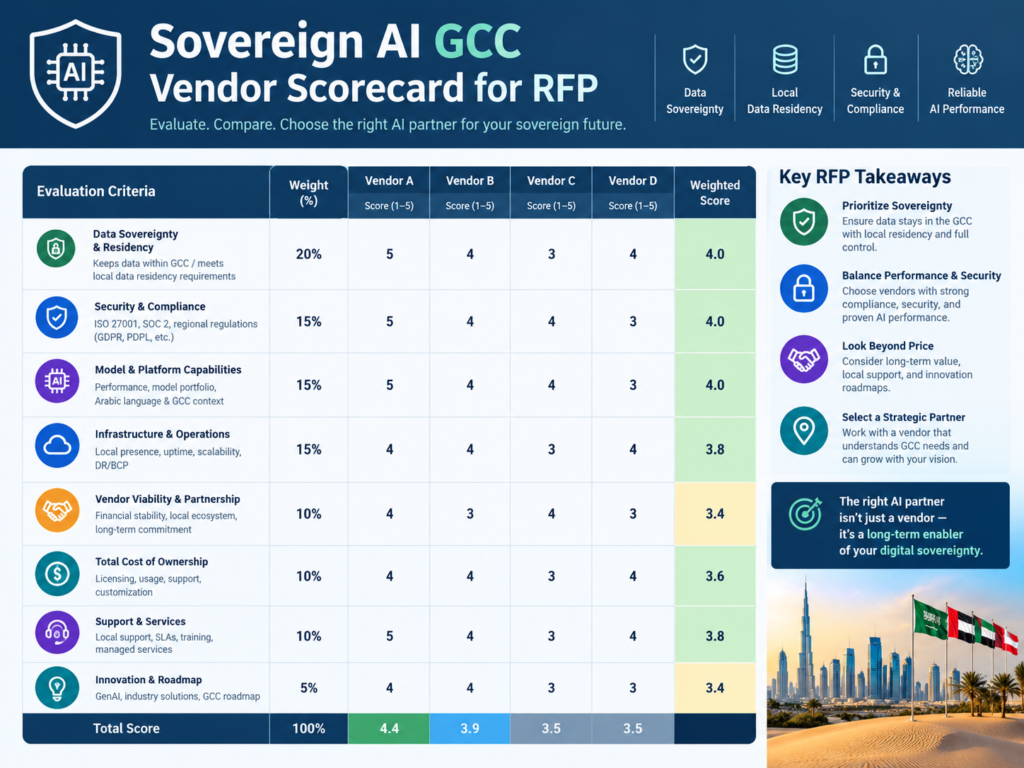
A procurement process becomes more defensible when sovereignty is converted into measurable gates and weighted criteria.
Create Pass/Fail Sovereignty Gates
Before scoring commercial features, eliminate vendors that cannot provide acceptable evidence for essential requirements.
Typical pass/fail gates include.
Approved processing and inference geography
Controlled privileged access
Transparent sub processors
Acceptable data-use and training terms
Audit evidence
Encryption and key-management controls
Tested continuity arrangements
Workable exit and migration rights
A vendor that fails a mandatory sovereignty requirement should not compensate for that failure simply by scoring well on price or product features.
Build a Weighted Vendor Scorecard
A starting scorecard could look like this.
| Evaluation area | Example weighting |
|---|---|
| Sovereignty | 30% |
| Security and compliance | 25% |
| AI governance | 15% |
| Architecture | 10% |
| Arabic localization | 10% |
| Commercial and exit terms | 10% |
The exact weightings should reflect the organization’s sector, risk appetite, regulatory exposure and workload sensitivity.
Demand Evidence, Not Sovereign-AI Marketing Claims
Every major claim should be supported by evidence such as.
Data-flow diagrams
Architecture diagrams
Model documentation or model cards
Training and data-use policies
Security reports
Sub processor registers
Incident-response procedures
Business-continuity evidence
Export and migration plans
For additional operational controls, see the AI security monitoring guide.
A Riyadh fintech may combine regulatory gates with customer-controlled keys. A Dubai e-commerce company may put greater emphasis on UAE processing, customer-data handling and Arabic mobile journeys. A Doha financial organization may focus heavily on cloud governance, audit evidence and exit readiness.
An Abu Dhabi financial firm should separately map any ADGM-specific requirements relevant to its workload.
GCC AI Architecture, Arabic UX and Vendor Risk
Procurement should also account for the architecture and user experience that sit around the sovereign-control model.
Compare Sovereign Cloud, Private Cloud and On-Premises AI
Managed sovereign cloud, private cloud, hybrid infrastructure and on-premises AI each involve different trade-offs.
Evaluate them against.
Regulatory fit
Data sensitivity
Latency
Cost
Operational complexity
Scalability
Hardware and GPU requirements
Disaster recovery
Vendor dependency
Portability
A cloud region elsewhere in the GCC should not automatically be treated as satisfying a Saudi, UAE or Qatar residency requirement. The correct architecture depends on the specific workload and the obligations attached to it.
For GPU-heavy environments, see Mak It Solutions’ AI supercomputing platforms GCC guide.
Evaluate Arabic-First AI, Not Just Arabic Support
For GCC customer-facing systems, “supports Arabic” is too vague.
Testing should cover the language patterns users actually rely on, including.
Modern Standard Arabic
Gulf dialects
Saudi and Emirati terminology
Arabic-English code switching
Right-to-left interfaces
Arabic OCR
Search and retrieval from Arabic documents
Arabic quality should be evaluated as a functional requirement, not as a cosmetic interface feature.
Test Resilience, Portability and AI Supply-Chain Dependency
AI platforms often depend on proprietary APIs, specialized GPU infrastructure, external models, vector databases and vendor-specific orchestration layers.
Procurement teams should examine what happens when one of those dependencies becomes unavailable, changes price or is no longer acceptable from a compliance perspective.
Zero Trust architecture and tested disaster recovery can strengthen long-term resilience. See the Zero Trust strategy for AI-era systems and GCC cloud disaster recovery guidance.
Final Sovereign AI GCC Procurement Decision
The final decision should come down to control that can be demonstrated, audited and enforced.
The 10 Questions to Resolve Before Vendor Approval
Before approving a sovereign AI provider, confirm.
Where is enterprise data stored?
Where is data processed?
Where does AI inference run?
Who can obtain privileged administrative access?
Who controls the encryption keys?
Can enterprise data be used for model training or product improvement?
Which sub processors are involved?
What audit evidence is available?
How does the platform operate during outages or regional disruption?
Can the organization migrate its data, configurations and model-related assets without unreasonable dependency on the vendor?
When a “Sovereign” AI Platform Should Fail Procurement
A platform should face serious procurement scrutiny when the vendor cannot clearly explain processing locations, sub processors, privileged access, data-use rights, key custody, audit rights or exit procedures.
Ambiguity is itself a risk when sovereignty is a formal requirement.
Turn the Checklist Into an RFP and Vendor Scorecard
The strongest sovereign AI GCC procurement programs translate promises into measurable controls.
A sovereignty claim should become one of four things: evidence, an SLA, a contractual obligation or a pass/fail RFP requirement. That makes the decision easier to audit and gives security, legal, compliance and technology teams a common framework for vendor approval.
Mak It Solutions’ broader technology services can support architecture, software and data implementation around that governance model.
Compliance note.
This checklist is intended for technology procurement and planning, not legal or regulatory advice. Organizations should confirm current requirements with their legal, compliance and regulatory teams before making deployment decisions.
Last Words
A sovereign AI GCC strategy is not proven by a local data-center address. It is proven by documented control over data, inference, administrators, encryption, model usage, subprocessors, auditability, resilience and exit.
For GCC CIOs, the procurement principle is straightforward: every sovereignty claim should be verifiable before it becomes contractual.
Planning a sovereign AI deployment in Saudi Arabia, the UAE or Qatar? Contact Mak It Solutions to turn this checklist into a practical RFP, architecture review or GCC technology strategy.
FAQs
Q : Does hosting AI in Saudi Arabia automatically make it sovereign?
A : No. Hosting in Saudi Arabia addresses location, but sovereignty also depends on processing, inference, administrator access, encryption-key control, sub processors, model-training practices and exit arrangements.
Saudi organizations handling personal data should separately assess applicable PDPL requirements and any relevant cybersecurity or sector-specific controls.
Q : What evidence should UAE enterprises request from a sovereign AI provider?
A : Request architecture and data-flow diagrams, sub processor lists, administrator locations, encryption architecture, model-training terms, audit evidence, incident procedures and tested migration plans.
The organization should also establish which UAE legal or regulatory framework applies to the particular workload.
Q : Do Saudi banks need additional SAMA checks when procuring AI platforms?
A : Yes. SAMA-regulated organizations may need additional outsourcing, third-party risk, audit, resilience and contractual checks beyond general cloud, privacy and cybersecurity due diligence.
Compliance, legal, cybersecurity and operational-resilience teams should be involved before the AI platform is approved.
Q : What AI vendor controls matter most for Qatar financial institutions?
A : Important controls include processing geography, privileged access, encryption, subcontractor transparency, auditability, business continuity and a documented exit process.
For QCB-licensed organizations, applicable QCB cloud requirements should also be incorporated into vendor due diligence.
Q : Should GCC enterprises require Arabic-first capabilities from sovereign AI vendors?
A : For Arabic-facing workloads, usually yes.
Testing should cover Gulf dialects, local terminology, Arabic-English code switching, RTL interfaces, Arabic OCR and retrieval quality. For services aligned with initiatives such as Saudi Vision 2030, reliable Arabic workflows may be an important operational requirement rather than an optional feature.
[…] Makes an AI Data Center […]
[…] It Solutions’ private AI infrastructure GCC guide and sovereign AI GCC guide provide additional regional infrastructure […]