
AI Data Centers Middle East: GCC Pricing Impact
AI Data Centers Middle East: GCC Pricing Impact
AI Data Centers Middle East: GCC Pricing Impact
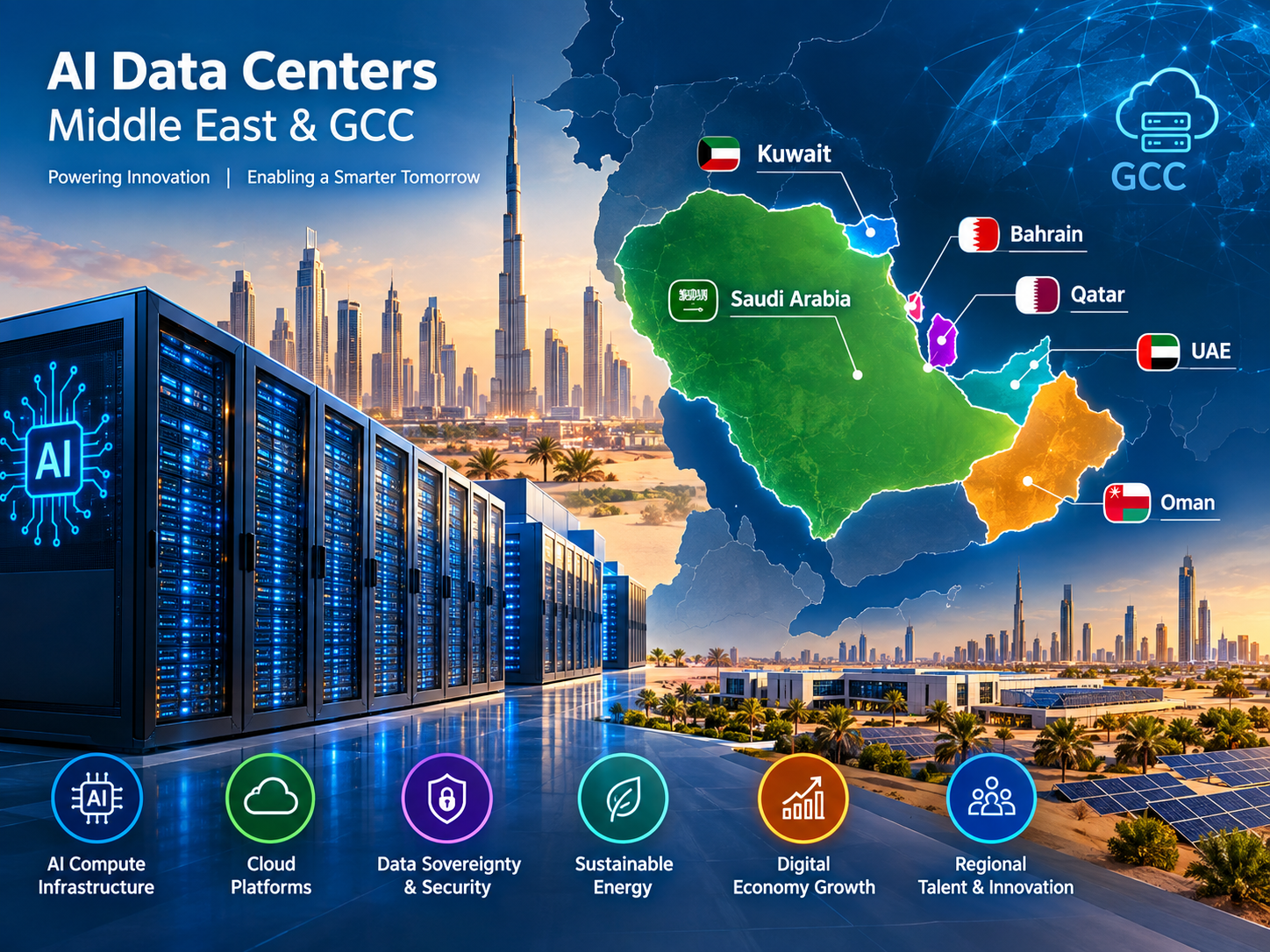
Saudi Arabia, the UAE and Qatar are investing heavily in AI data centers Middle East businesses can use closer to home. The obvious question for GCC companies is whether all that new local compute will actually make AI cheaper.
The short answer: local AI infrastructure can reduce total deployment costs, but it does not guarantee cheaper GPU-hours, inference or API pricing. Lower latency, less cross-border data movement and simpler residency architectures can improve the economics of AI projects, while hardware supply, electricity, utilization and competition still determine the underlying price of compute.
What Makes an AI Data Center Different?
Traditional cloud facilities support a broad mix of websites, databases, enterprise software and virtual machines. AI-focused data centers are built for much denser workloads.
They typically need powerful GPU infrastructure, high-bandwidth networking, advanced cooling and substantial electrical capacity. Those requirements make AI infrastructure expensive to build and expensive to operate.
For GCC businesses developing data-heavy products, that infrastructure can also sit alongside business intelligence services, analytics platforms and application backends.
Why Saudi Arabia, the UAE and Qatar Are Adding Local Capacity
The push is about more than buying GPUs. Governments and businesses across the Gulf are focusing on sovereign AI capabilities, Arabic-language models, cloud data residency, digital government and regional technology investment.
Major cloud infrastructure already exists across the region. AWS operates Middle East regions in Bahrain and the UAE, while Google Cloud lists regions in Doha and Dammam.
Saudi Arabia is also building a broader domestic AI stack through HUMAIN. PIF says the company operates across data centers, cloud infrastructure, models and applications, with a focus on expanding Saudi AI capabilities.
How AI Data Centers Middle East Expansion Could Reduce Costs
More local infrastructure can make AI projects economically easier even if the headline GPU price does not fall.
That distinction is important.
Lower Latency and Less International Data Movement
A Riyadh fintech running inference locally does not need to send every request to a distant region. The same applies to a Dubai retailer delivering real-time recommendations or a Doha company operating an Arabic-language assistant.
Shorter network routes can improve responsiveness and may reduce international data-transfer exposure.
Combined with well-designed backend development infrastructure, that can translate into a noticeably faster customer experience.
Simpler Data Residency Architecture
For regulated workloads, the cheapest cloud instance is not always the cheapest deployable solution.
Saudi financial institutions, for example, must account for SAMA cloud requirements. The SAMA Cyber Security Framework says that, in principle, cloud services should be located in Saudi Arabia, with explicit approval required when relevant cloud services are used outside the Kingdom.
Local infrastructure may therefore reduce the architectural and governance work needed to keep certain workloads compliant.
Local Hosting Can Lower TCO Without Lowering GPU Prices
It helps to separate two ideas.
Compute price: GPU-hours, instances, tokens and inference.
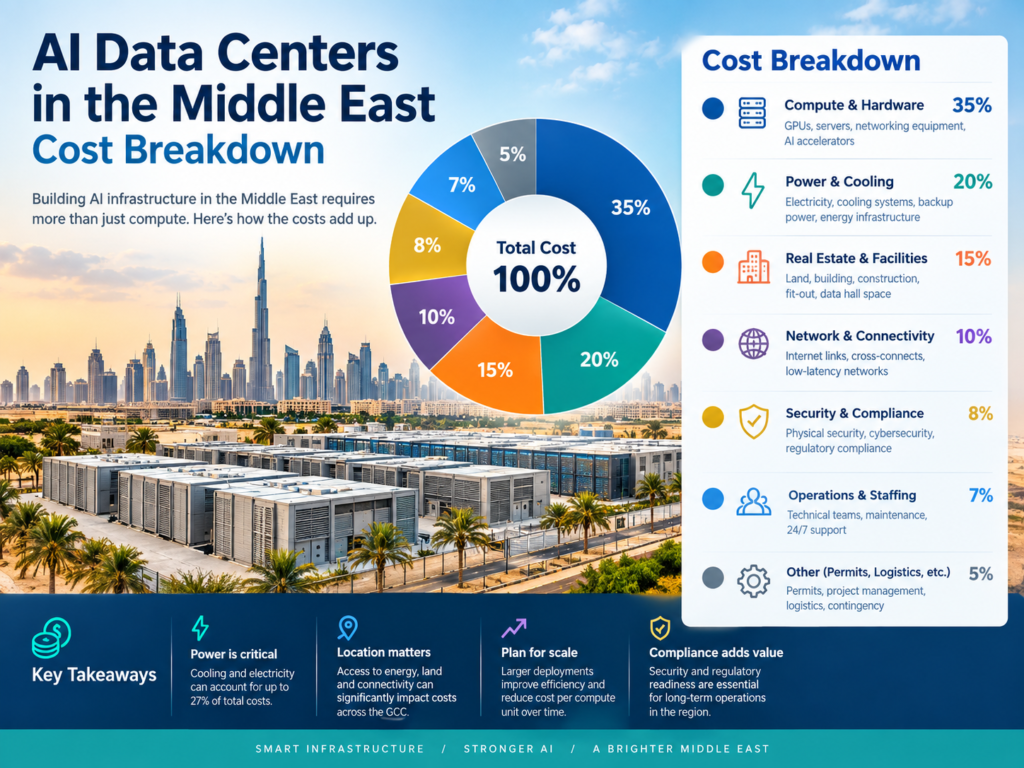
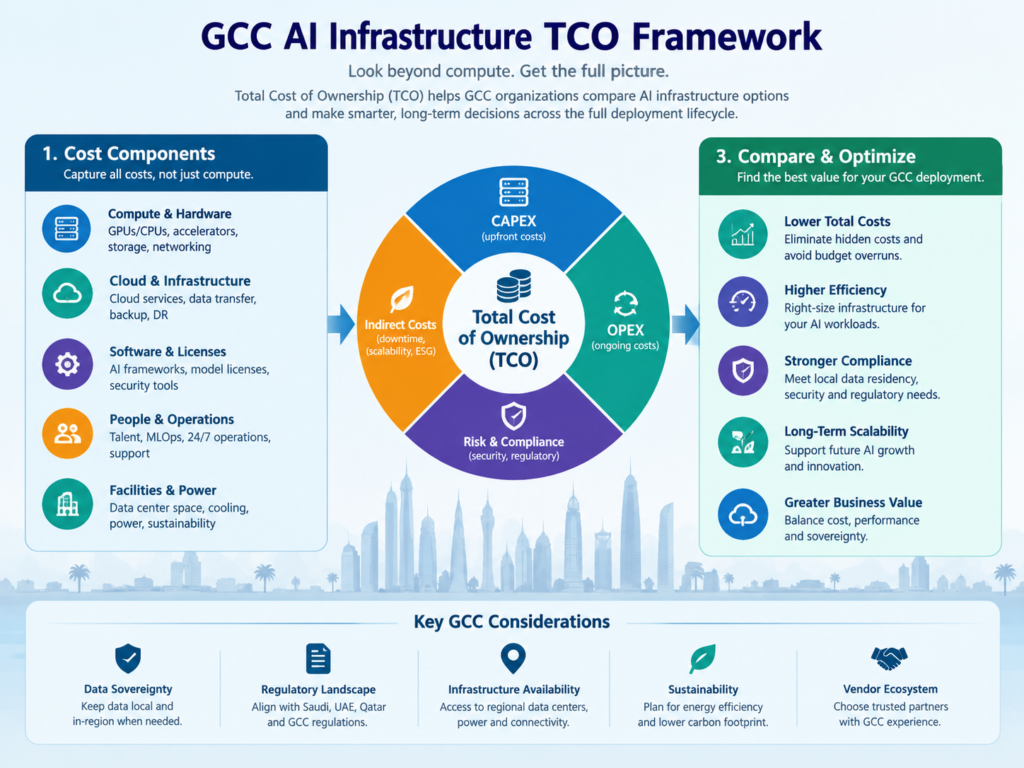
Total cost of ownership: compute plus storage, egress, networking, security, compliance, staffing, resilience and operations.
A local provider could charge more for raw compute but still produce a lower overall deployment cost for a workload that would otherwise require complex cross-border architecture.
That is one of the biggest reasons AI data centers Middle East growth matters to GCC businesses.
Why More GCC GPU Capacity Does Not Automatically Mean Cheap AI
New capacity increases supply, but several cost pressures remain.
GPUs Are Only Valuable When They Are Used Efficiently
High-end accelerators are expensive assets. A GPU cluster that remains underutilized still has to cover hardware, financing, power, cooling, networking and facility costs.
Providers therefore need strong utilization before additional capacity can translate into aggressive pricing.
Sovereign Infrastructure May Carry a Premium
Government agencies, banks, healthcare organizations and other regulated enterprises may deliberately choose infrastructure that provides tighter control over data location, governance or operational jurisdiction.
That environment can cost more than a standard public-cloud configuration.
The buyer is not simply paying for compute. The buyer is also paying to reduce risk.
Competition Determines Whether Savings Reach Customers
Additional providers and additional capacity can create pricing pressure, but announcements alone are not enough.
GCC customers benefit most when multiple providers have usable capacity, comparable services and a genuine incentive to compete for workloads.
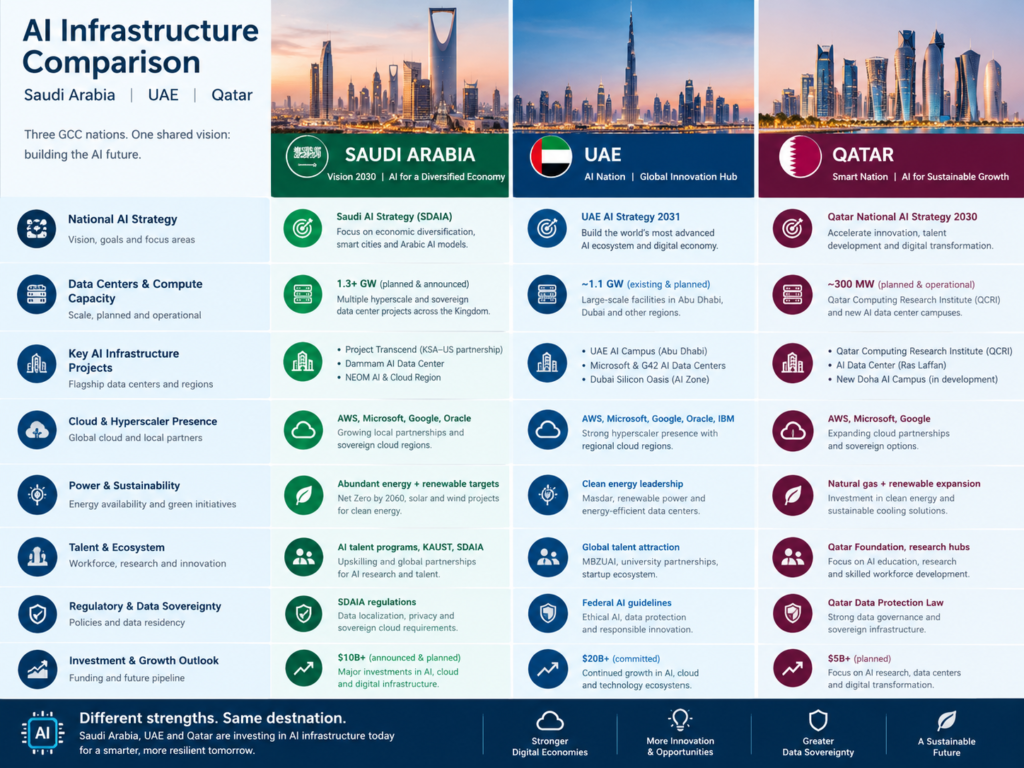
Saudi Arabia vs UAE vs Qatar.
The three markets are developing differently, so the economic impact of local AI infrastructure will not be identical.
Saudi Arabia.
Saudi Arabia combines a large domestic market with Vision 2030 technology investment, local cloud infrastructure and growing AI capacity.
HUMAIN is part of that expansion, while Google Cloud already lists Dammam as a Saudi region. Microsoft confirmed on August 31, 2026, that its Saudi Arabia East datacenter region is scheduled to become available to customers in November 2026.
Oracle also operates cloud regions in Riyadh and Jeddah.
For regulated Riyadh businesses, especially financial institutions, expanding domestic cloud choice can be valuable even before raw AI compute becomes cheaper.
UAE.
The UAE’s advantage is its combination of established cloud infrastructure, sovereign technology investment and ambitious frontier-scale projects.
Stargate UAE was announced as a 1GW AI cluster in Abu Dhabi, with an initial 200MW expected to go live in 2026. Open AI named G42, Oracle, NVIDIA, Cisco and SoftBank among the partners.
That scale could eventually improve access to compute in the UAE, but capacity does not automatically equal lower prices.
For a Dubai e-commerce business, the stronger near-term benefit may be faster regional inference, easier architecture and more deployment choices. That infrastructure can support applications built through e-commerce development services and mobile app development without assuming local GPUs will always beat overseas regions on price.
Qatar.
Qatar has a smaller addressable market than Saudi Arabia or the UAE, but it has been building meaningful local cloud and data-center capacity.
Qatar’s Ministry of Communications and Information Technology announced Azure OpenAI availability through Microsoft’s local Qatar cloud region, with GPUs supporting in-country data processing.
MEEZA is also expanding its domestic data-center footprint. In July 2026, the company announced completion of a 4MW expansion supporting a global hyper scaler and said additional capacity was under development.
For Doha businesses, local infrastructure can be especially useful when residency, latency or governance requirements matter more than the lowest available global compute rate.
How Data Residency Changes the Cost of AI in the GCC
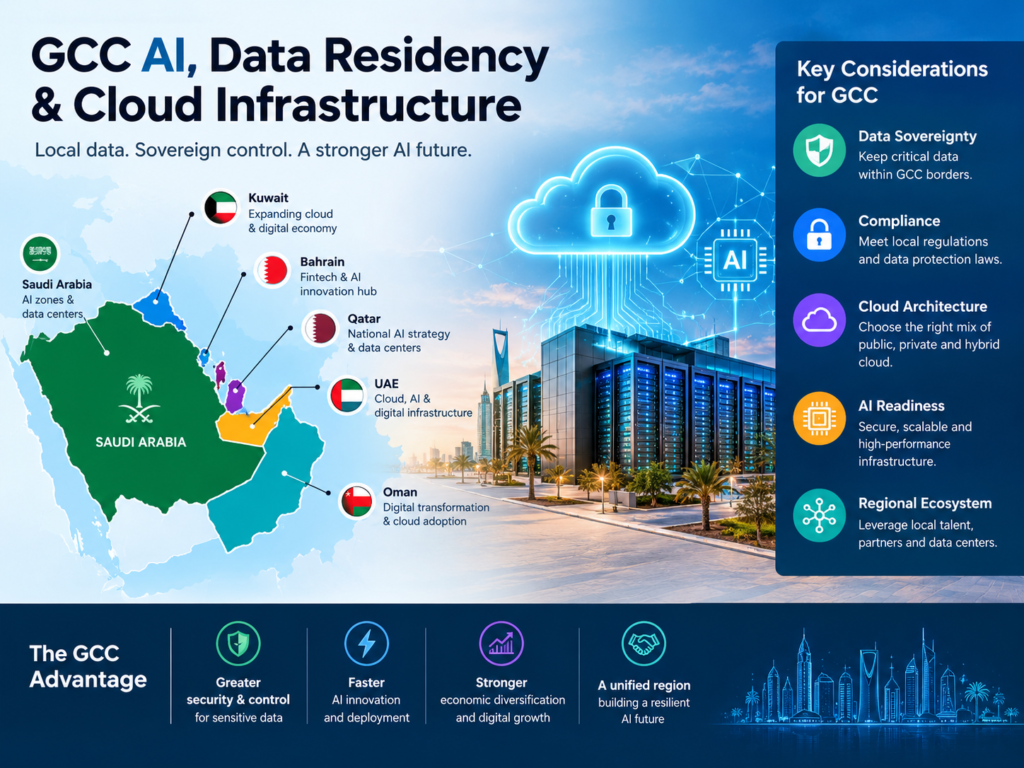
Data residency is sometimes treated purely as a legal or compliance question. In practice, it can also change project economics.
If regulations or internal policies limit where sensitive information can be processed, a technically cheaper foreign service may require extra controls or may not be suitable for the workload at all.
Saudi Arabia
Saudi organizations need to assess national and sector-specific requirements, with financial institutions facing additional SAMA controls.
For relevant banking workloads, the location of cloud services can directly affect architecture decisions.
UAE
The UAE Information Assurance Regulation requires organizations to assess restrictions relevant to cloud processing, storage and retention, including rules that may limit where certain information can be stored.
That makes data location part of the TCO calculation rather than a box to tick after infrastructure has already been selected.
Qatar
Qatar Central Bank’s technology-risk rules tell banks to consider the geography and jurisdiction in which cloud-hosted and backed-up data physically resides.
For sensitive banking use cases, local or carefully governed infrastructure can therefore provide economic value through lower compliance complexity as well as lower latency.
How GCC Companies Should Compare AI Infrastructure Costs
The safest approach is to compare realistic deployment scenarios rather than GPU prices in isolation.
Compare Compute, Egress and Networking Together
Start with the obvious costs.
GPU or accelerator usage
Model inference
Storage
Data egress
Private connectivity
Support and networking
A low instance price can become less attractive once data movement and connectivity are included.
Add Residency, Security and Operational Costs
Then calculate the expenses that are often left out of cloud calculators.
Compliance controls
Cybersecurity
Disaster recovery
Monitoring
Engineering and cloud operations
Workload management
Data-governance requirements
This gives a more credible total cost of ownership.
Compare Different GCC Deployment Models
For the same workload, compare:
| Deployment model | Cost | Latency | Residency control | Scalability |
|---|---|---|---|---|
| Overseas public cloud | Potentially competitive | Higher for GCC users | Depends on workload and jurisdiction | High |
| Local hyper scaler region | Moderate to competitive | Lower | Stronger local options | High |
| Sovereign/local GPU infrastructure | May carry a premium | Low | Potentially strongest | Depends on available capacity |
The right answer depends on the business.
A Riyadh fintech may prioritize SAMA requirements. An Abu Dhabi healthcare organization may care more about sovereign control. A Dubai retailer may focus on low-latency personalization, while a Doha SME might combine local cloud resources with scalable web development services.
What Will Decide AI Pricing in the Middle East?
Several forces will determine whether regional AI costs actually fall.
GPU Supply and Competition
More local capacity gives customers additional choices, but only available, usable capacity matters.
A large announced data-center project does not affect today’s customer pricing until the infrastructure is operational and accessible.
Power, Cooling and Utilization
AI facilities remain capital-intensive. Electricity, cooling, financing and accelerator utilization all feed into provider economics.
Even in markets with abundant energy investment, operators still need to recover the cost of expensive infrastructure.
Workload Optimization
Companies can sometimes save more by improving how they use AI than by changing regions.
Model selection, batching, caching, quantization, retrieval design and workload scheduling can materially change inference requirements. Buying cheaper compute will not fix an inefficient AI architecture.
The Likely GCC Outcome: Better AI Economics, Not Guaranteed Cheap AI
The expansion of AI data centers Middle East markets is likely to make AI easier to deploy across the GCC.
Businesses should gain more regional options, lower latency and stronger choices for workloads affected by data-residency requirements. Increased supply may also create more competition over time.
But local infrastructure should not be confused with automatically cheap infrastructure.
GPU availability, utilization, electricity, financing and provider competition will continue to shape the price of AI. For many GCC companies, the real win may be lower total deployment cost and fewer architectural compromises, even when the GPU-hour itself is not the cheapest available globally.
Concluding Remarks
Planning an AI deployment in Saudi Arabia, the UAE, or Qatar requires looking beyond compute prices. Businesses should evaluate the complete architecture including scalability, data location, security, application design, deployment infrastructure, and long-term operating costs. A well-planned architecture can provide a more reliable foundation for scaling AI while avoiding unnecessary infrastructure and development costs.
Mak It Solutions supports businesses with custom software, backend development, scalable application architecture, deployment, and ongoing technical support.
Explore Mak It Solutions‘ technology and development services or contact the team for a consultation to plan an AI deployment around your business requirements, data-location needs, scalability goals, and realistic total cost.
FAQs
Q : Are AI data centers already available in Saudi Arabia?
A : Yes. Saudi Arabia already has substantial cloud and data-center infrastructure, including Google Cloud’s Dammam region and Oracle regions in Riyadh and Jeddah. HUMAIN is also developing AI infrastructure, while Microsoft’s Saudi Arabia East region is scheduled for customer availability in November 2026.
Q : What is sovereign AI cloud in the UAE?
A : Sovereign AI cloud generally refers to infrastructure designed to provide organizations with tighter control over data location, security, governance and operational jurisdiction. It can be attractive for government and regulated workloads, although those additional controls may come at a premium.
Q : Can Qatar companies host AI workloads locally?
A : Yes. Microsoft has cloud infrastructure in Qatar, and MCIT announced local Azure OpenAI processing supported by GPUs in Microsoft’s Qatar region. Qatar also has domestic data-center infrastructure from providers such as MEEZA.
Q : Is GPU cloud cheaper in Dubai than overseas regions?
A : Not necessarily. UAE-hosted infrastructure can reduce latency, international data-transfer exposure and some compliance complexity, but GPU pricing still depends on accelerator costs, electricity, cooling, utilization and provider margins.
Q : Which GCC market has the strongest AI data-center momentum?
A : Saudi Arabia and the UAE currently stand out for large-scale investment and infrastructure expansion, while Qatar is building a smaller but strategically important local ecosystem. For buyers, however, the “strongest” market depends on the workload, provider availability, residency requirements and actual pricing rather than announced capacity alone.