


Topic Clusters for SEO Growth in the US & EU
Topic Clusters for SEO Growth in the US & EU
Topic Clusters for SEO Growth in the US & EU
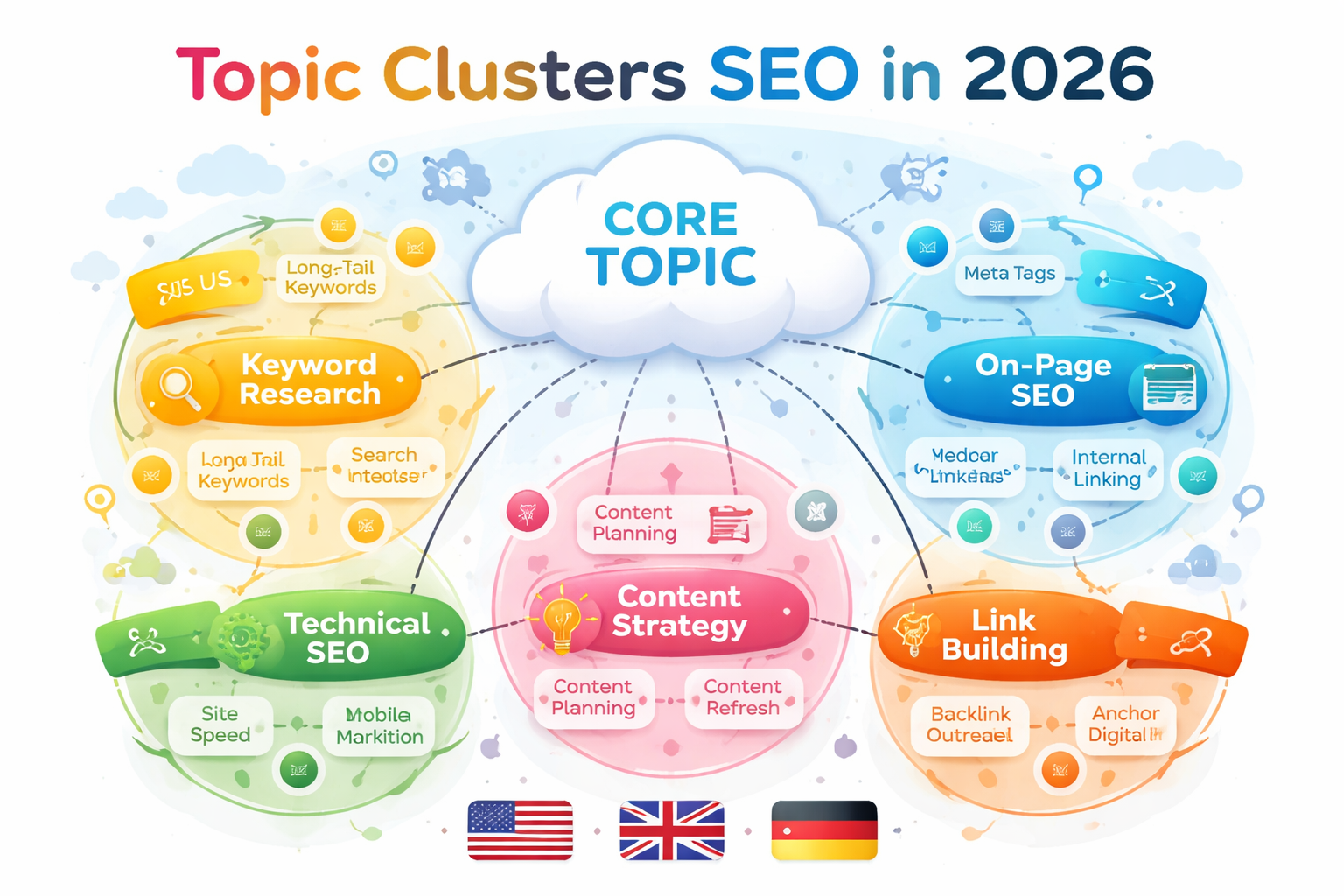
Topic clusters are one of the clearest ways to build topical authority, strengthen internal linking, and make your website easier for both search engines and AI-driven search experiences to understand. Instead of publishing random articles, you create one strong pillar page and support it with related content that answers specific questions and links back in a logical way.
For brands targeting the US, UK, Germany, and wider Europe, this structure does more than improve rankings. It also helps you create a content system that feels organized, trustworthy, and scalable.
What Are Topic Clusters?
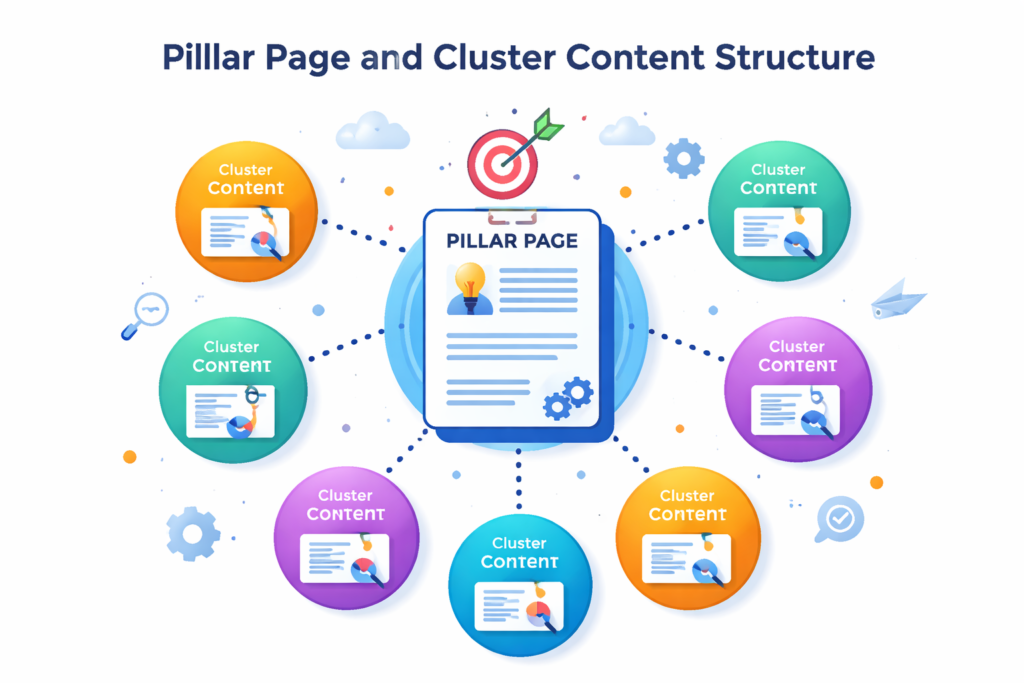
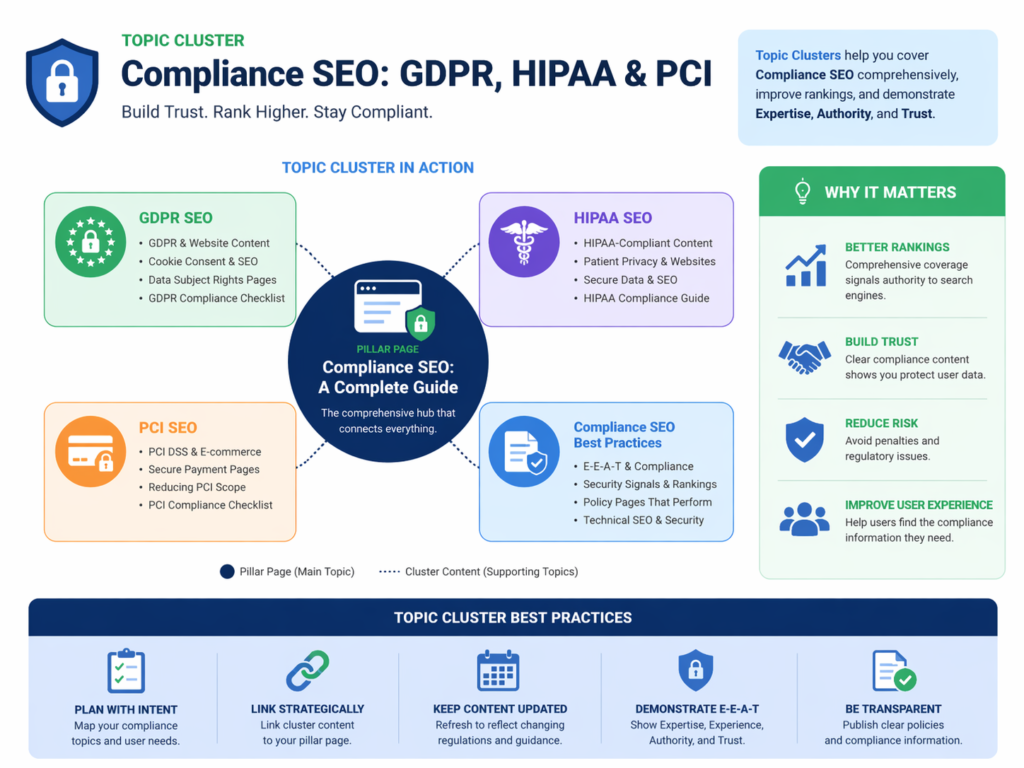
Topic clusters are a group of interlinked pages built around one core subject. The main page, often called a pillar page, covers the topic broadly. Supporting pages go deeper into related subtopics and connect back to the pillar and, where useful, to each other.
In simple terms, topic clusters help search engines understand what your site knows well. They also help readers move from general information to more specific answers without getting lost.
Topic clusters, pillar pages, and content hubs
These terms are closely related, but they are not exactly the same.
Pillar page: the main page covering the broader topic
Cluster content: supporting pages focused on narrower questions
Content hub: the larger destination where users explore the subject
Topic cluster: the overall strategy connecting all of them
A good topic cluster turns separate articles into a connected content asset.
Why Topic Clusters Matter for SEO in 2026
Topic clusters matter because search visibility now depends on more than just publishing blog posts with keywords. Search engines look at structure, relevance, internal links, and topical depth. AI-powered search experiences also reward content that answers questions clearly and sits within a strong content ecosystem.
That makes topic clusters useful for both traditional SEO and AEO.
They improve internal linking
Internal links are what hold a topic cluster together. When a pillar page links to supporting pages, and those pages link back naturally, you create clearer crawl paths and stronger context signals.
This is especially valuable on larger B2B SaaS, enterprise, and service-based websites where older content often becomes isolated over time.
They build topical authority
A well-built cluster shows breadth and depth. Instead of writing one article about a subject and moving on, you show that your site covers that topic from multiple angles.
For example.
A fintech company in London might build a cluster around regulated content strategy
A healthcare SaaS brand in New York could create a hub around patient portal UX and secure workflows
A Berlin-based platform may publish supporting content tied to DSGVO, compliance messaging, and data governance expectations
This kind of structure makes your expertise easier to understand and easier to trust.
They support AI-driven search visibility
AI search systems tend to favor content that is easy to extract, summarize, and connect. A topic cluster naturally supports that by combining.
Direct answers
Clear headings
Supporting context
Strong internal links
Consistent topical coverage
In practice, that gives your pages a better chance of appearing useful in both search results and AI-generated answer experiences.
How Topic Clusters Improve Rankings
Topic clusters improve rankings because they make relationships between pages clearer. They help search engines see which page is the main authority, which pages support it, and how the entire section of your site fits together.
They also improve the user journey. Someone landing on your pillar page can quickly find the next relevant answer instead of bouncing back to search.
Stronger semantic relevance
A cluster gives context to every page. A broad guide on topic clusters for SEO becomes more valuable when it is supported by pages about.
Keyword clustering
Internal linking strategy
Pillar page planning
Content cannibalization
Content hub architecture
Conversion-focused supporting pages
Each page reinforces the main topic while answering a more specific intent.
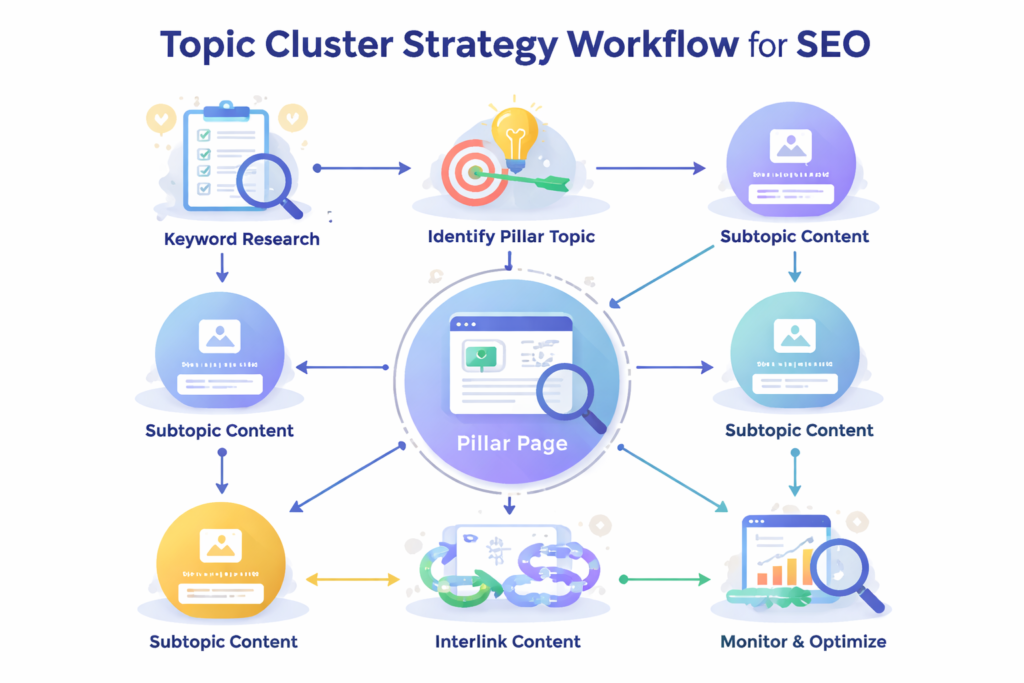
Better crawl efficiency
When your pages are connected properly, crawlers can discover and understand them more efficiently. That is often one of the hidden wins of a good cluster strategy, especially on growing websites with dozens or hundreds of pages.
Less keyword cannibalization
Without a clear structure, multiple pages often end up targeting the same intent. That creates overlap and weakens performance. Topic clusters help you assign a clear role to each page so your content works together instead of competing with itself.
How to Build a Topic Cluster Strategy
Building topic clusters starts with one core topic and expands into supporting content based on intent, relevance, and business value. The goal is not to publish more pages for the sake of it. The goal is to publish the right pages in the right structure.
Choose one core topic
Start with a topic that matters to both your audience and your business.
For example.
Onboarding automation for a B2B SaaS brand
Secure patient communications for a healthcare company
Technical SEO architecture for an agency
Content strategy for regulated fintech products
A strong core topic gives your cluster commercial relevance from the start.
Map subtopics by search intent
Once you have the core topic, map related subtopics based on what users actually want to know.
Common intent buckets include.
Informational queries
Comparison queries
Problem-solving queries
Commercial investigation queries
Conversion-focused queries
This is where keyword clustering becomes useful. You are not just collecting keywords. You are grouping them into meaningful content opportunities.
Assign page roles clearly
Every page in the cluster should have a job.
A practical structure usually looks like this.
| Page Type | Purpose |
|---|---|
| Pillar page | Covers the main topic broadly |
| Cluster article | Goes deep on one subtopic |
| Conversion page | Connects intent to a service or offer |
| Supporting resource | Adds trust, examples, templates, or FAQs |
This clarity reduces overlap and makes internal linking much easier to manage.
Build the internal linking map
Your pillar page should link to every major supporting page. Supporting pages should link back to the pillar and, where relevant, to related cluster pages.
Keep anchor text natural. Avoid forcing exact-match phrases into every link. The structure should feel useful to the reader, not mechanical.
Refresh and expand over time
Topic clusters are not a one-time project. They work best when reviewed regularly.
A simple maintenance rhythm includes:
Refreshing key pillar pages
Updating examples and references
Improving weak internal links
Merging overlapping posts
Adding new supporting pages as search intent evolves
Content Hub Architecture That Actually Works
A content hub should feel easy to navigate, easy to scan, and easy to expand. If users cannot quickly understand where to go next, the hub is not doing its job.
What a strong pillar page includes
A good pillar page usually has.
A clear answer near the top
Logical H2 and H3 sections
Short summaries of each subtopic
Internal links to deeper resources
A natural path toward commercial pages or next steps
It should lead the topic, not try to rank for every long-tail keyword on its own.
When “topic cluster” and “content hub” mean different things
In the US, many SEO teams talk about topic clusters as the strategy and pillar pages as the main asset.
In the UK, content hub often sounds more editorial and user-focused.
In Germany and some wider EU contexts, content architecture may land better with enterprise stakeholders because it sounds practical, structured, and operational.
The labels may change by market, but the strategy remains the same.
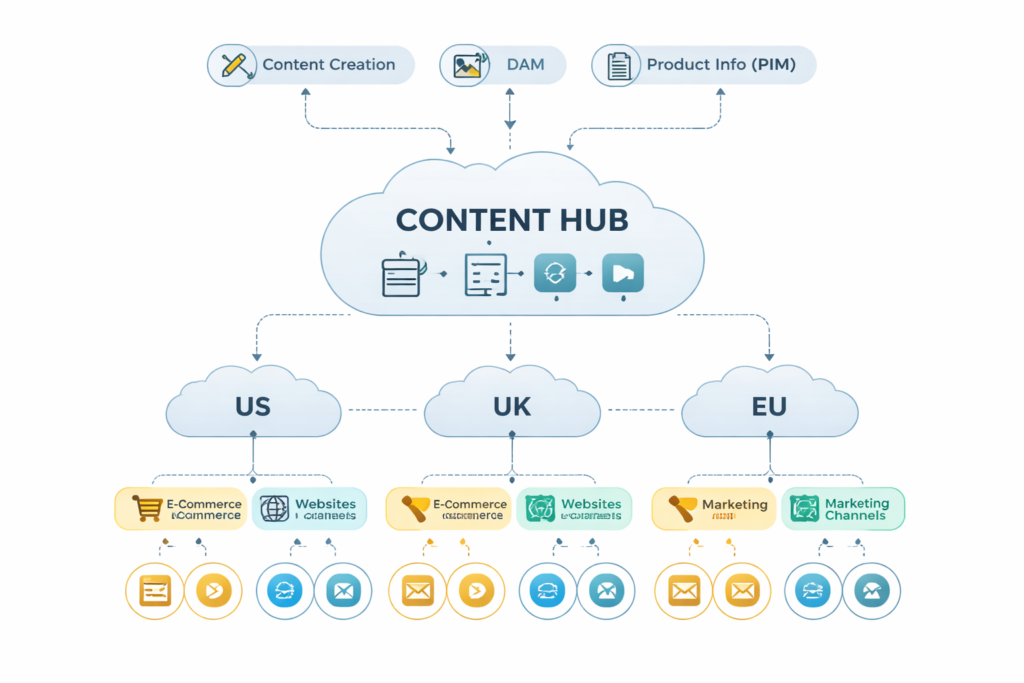
Topic Clusters in the US, UK, Germany, and Wider Europe
The core model of topic clusters works across markets, but local context still matters. Search behavior, terminology, compliance expectations, and buying habits can shape how your content should be framed.
Local expectations matter
A US audience may respond more strongly to growth, performance, and pipeline language.
A UK audience often expects tighter wording, clearer governance, and less hype.
German and broader EU buyers may look for structure, documentation, and trust signals earlier in the journey.
That means a localized cluster is not just translated content. It is content adapted to how buyers think and evaluate risk.
Compliance and trust signals can shape the cluster
In regulated sectors, content strategy often overlaps with trust-building.
Relevant frameworks may include.
GDPR
UK GDPR
DSGVO
HIPAA
PCI DSS
SOC 2
For a fintech, healthcare, or enterprise data brand, these are not side notes. They influence what readers need to see before they are comfortable moving forward.
Market-specific examples make content stronger
A generic example rarely lands as well as a localized one.
For instance.
A New York healthcare platform may need content around secure patient workflows
A London fintech brand may need pages tied to Open Banking and UK data governance
A Berlin software company may need messaging that reflects compliance-heavy enterprise buying cycles
Those details make the content more credible and more useful.
How to Measure Topic Cluster Performance
A topic cluster should be measured as a system, not just as a collection of individual articles.
Useful KPIs to track
Look at metrics such as.
Rankings across the full topic group
Internal link coverage
Organic clicks to commercial pages
Assisted conversions
Engagement by cluster
Content decay on older supporting pages
This gives you a clearer picture of whether the cluster is actually helping business performance.
What success usually looks like
A strong cluster often leads to.
Better visibility across related queries
Improved user flow between pages
Stronger engagement on supporting articles
More consistent traffic to conversion pages
Fewer isolated or underperforming posts
From a small business point of view, that is often far more valuable than publishing a high volume of disconnected content.
Common Topic Cluster Mistakes to Avoid
The idea sounds simple, but a lot of websites still get the structure wrong.
Publishing support content without a real pillar page
Without a central page, your cluster becomes a loose collection of articles instead of a usable hub.
Letting multiple pages target the same intent
If several pages are trying to rank for the same question, you weaken all of them. Intent mapping matters.
Ignoring internal linking until later
Internal links are not a finishing touch. They are part of the strategy from day one.
Skipping localization and trust context
For US, UK, and EU markets, broad content may not be enough. Local expectations, industry language, and trust signals can influence performance more than many teams expect.
To Sum Up
Topic clusters give your site structure, depth, and direction. They help search engines understand your expertise, help readers find better answers, and help your business turn content into a more strategic asset.
If you are starting from scratch, begin with one strong pillar page and three to five tightly aligned supporting articles. If you already have scattered content, audit what exists first. In many cases, improving the structure you already have will produce faster wins than publishing another disconnected post.
For brands targeting the US and EU, topic clusters are not just an SEO tactic anymore. They are a smarter way to build a content system that can support rankings, AI visibility, and long-term authority.( Click Here’s )
FAQs
Q : How many cluster pages should support one pillar page?
A : There is no fixed number, but 3 to 8 strong cluster pages is a practical starting point for many websites. The right number depends on topic breadth, competition, and business goals.
Q : Are topic clusters better than traditional blog categories?
A : Usually, yes. Categories help with navigation, but topic clusters are built around intent, internal linking, and topical relevance. They are more strategic and usually more useful for SEO.
Q : How often should you update a content hub?
A : A light review every quarter is a sensible starting point. Faster-moving sectors such as fintech, healthcare, and AI may need more frequent updates.
Q : Can small websites build authority with only a few topic clusters?
A : Yes. A small website does not need dozens of hubs. One focused, well-structured topic cluster can outperform a large batch of unrelated posts.
Q : What tools help with keyword clustering and internal link planning?
A : Many teams use Ahrefs, Semrush, Google Search Console, crawling tools, and a simple spreadsheet or planning doc. The tool matters less than having a clear method.