


Website Redesign SEO Guide: Relaunch Without Traffic Loss
Website Redesign SEO Guide: Relaunch Without Traffic Loss
Website Redesign SEO Guide: Relaunch Without Traffic Loss
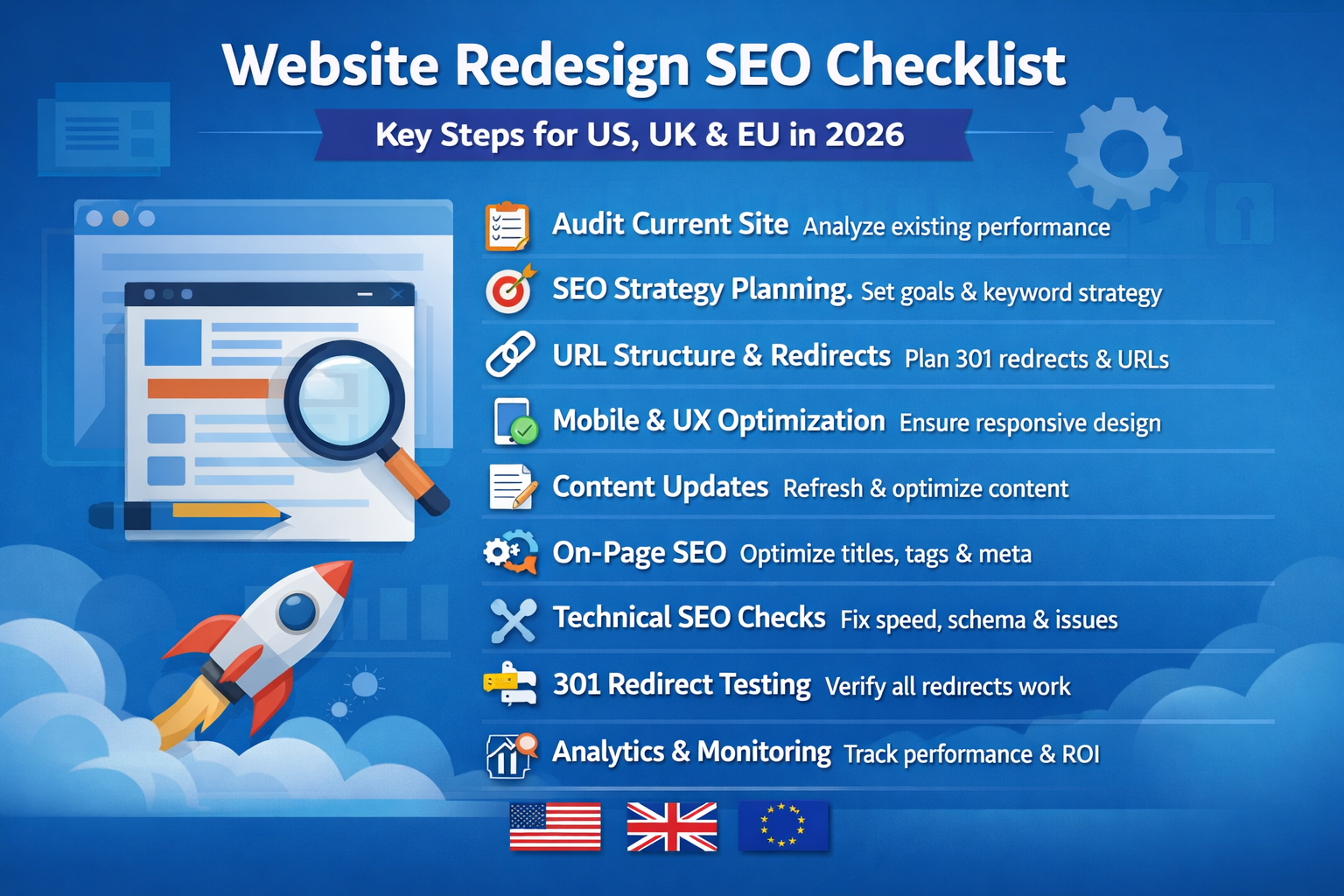
A redesign can improve your site, but it can also damage years of SEO progress if the launch is rushed. Website redesign SEO is about protecting the rankings, traffic, and conversion paths you already have while improving design, speed, usability, and site structure.
The safest way to approach website redesign SEO is simple: benchmark what is working now, keep valuable URLs where possible, map every changed URL carefully, test the new site before launch, and monitor performance closely after release. Most ranking losses happen when teams change templates, internal links, metadata, or indexing controls without a proper migration plan.
For teams in the US, UK, Germany, and the wider EU, the stakes are often higher than design alone. A relaunch can affect lead generation, reporting, compliance workflows, and multilingual search visibility all at once.
What website redesign SEO actually means
Website redesign SEO is the process of updating a site’s design, CMS, templates, or structure without weakening the search signals that already support organic visibility. That includes far more than title tags.
In practice, it usually covers.
URL structure
Redirect planning
Canonicals
Internal linking
Indexation controls
Structured data
Core Web Vitals
Analytics continuity
Hreflang and localized content handling
A visual refresh on its own is usually low risk. The real SEO danger starts when the redesign also changes page hierarchy, content depth, navigation, rendering behavior, or crawl paths.
Why rankings drop after a redesign
Most traffic losses after a relaunch are not caused by the new look. They happen because core SEO signals get interrupted during the move.
Common causes include.
URLs changing without one-to-one redirects
Important pages being removed or merged badly
Broken canonicals
Internal links pointing to outdated or weak destinations
Noindex tags accidentally left on live pages
Slower templates with heavier scripts and media
Lost schema markup
Incorrect hreflang on multilingual sites
A redesign can look cleaner to stakeholders and still quietly reduce organic performance underneath. That is why launch-day polish is never enough on its own.
The smartest pre-launch move: benchmark everything first
Before design or development moves too far, capture a clear baseline. Without it, post-launch diagnosis becomes guesswork.
At minimum, benchmark.
Top landing pages
Organic clicks and impressions
Average ranking positions
Conversions from organic traffic
Indexed page count
Internal link hubs
Core Web Vitals
Structured data coverage
Top-linked pages from backlinks
Try to preserve at least 3 to 6 months of pre-launch data for comparison. For larger sites, it also helps to segment by template type, revenue-driving sections, and regional versions.
This matters because when a service page in London or a product hub in Berlin drops after launch, you need a clean before-and-after record. Without that, teams waste time debating causes instead of fixing the actual issue.
Website migration SEO checklist: protect URLs before launch
If you only do one thing right during a redesign, make it URL planning. Strong URL mapping prevents a huge share of avoidable ranking loss.

Keep important URLs where possible
The lowest-risk option is usually to keep valuable URLs unchanged. If the page already performs well, there should be a strong business reason before changing it.
Build a one-to-one redirect map
When URLs must change, every valuable old URL should point to the closest equivalent new page.
Do not send everything to the homepage. That weakens relevance and creates a frustrating user experience.
Your redirect map should be built from.
Current site crawl data
XML sitemaps
Top landing pages
Backlink data
High-converting pages
Regional and multilingual URLs
Clean up common redirect problems
Before launch, check for.
Redirect chains
Redirect loops
Broken destinations
Mixed canonical signals
Orphaned new pages
Legacy URLs with no mapped replacement
For enterprise sites, sign-off should include SEO, development, analytics, content, and compliance stakeholders. A redesign is not just a design handoff. It is a coordinated deployment.
Technical SEO QA for staging and launch day
This is where many preventable losses get caught.
Your staging site should be usable for testing, but it should not be indexable. Once the site goes live, those controls must be removed cleanly from production and replaced with the correct live SEO setup.
On staging, check.
Password protection is enabled
Noindex is in place where appropriate
Test crawls can still access pages you need to review
Canonicals are not pointing to the wrong environment
Templates render correctly on mobile and desktop
Structured data is present on the right page types
Internal links are crawlable
Navigation and breadcrumbs match the new architecture
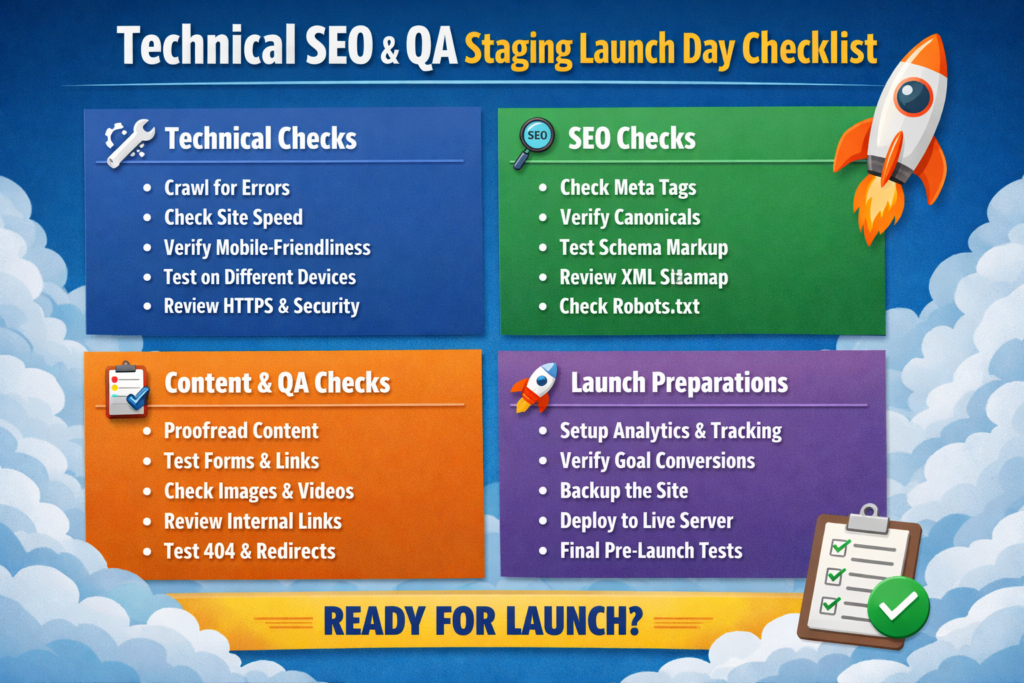
On launch day, check.
301 redirects work correctly
Live pages self-canonicalize properly
XML sitemap is updated
Robots rules are correct
No accidental noindex remains on production
Analytics and conversion tracking fire correctly
Internal links point to final URLs
Hreflang clusters are valid
Priority pages load fast enough
This step is especially important for multilingual UK and EU websites. Once a redesign introduces country or language variants, weak hreflang or inconsistent localization can create indexation confusion quickly.
Website redesign SEO for US, UK, Germany, and EU teams
The core SEO rules are similar everywhere, but operational priorities often change by market.
US teams
US redesign projects often involve larger site architectures, complex marketing stacks, and stricter reporting expectations. Healthcare, SaaS, finance, and ecommerce brands usually need tighter alignment between SEO, analytics, privacy, and development teams.
From a practical business point of view, the goal is often simple: preserve lead generation while modernizing the site.
UK teams
UK teams frequently deal with layered approvals, accessibility reviews, and agency-style relaunch workflows. That can slow launches, but it also creates a good opportunity to catch issues before they go live.
For organizations in cities like London or Manchester, the challenge is often less about knowing what to do and more about getting every stakeholder aligned early enough.
Germany and wider EU teams
For Germany and the wider EU, localization usually matters more. Teams often need closer attention to:
Hreflang setup
Language-country targeting
Localized templates
Consent handling
Regional hosting preferences
Content differentiation across markets
Many EU teams also frame the project as an SEO relaunch rather than a redesign, which makes sense. The risk is often operational continuity, not just visual change.
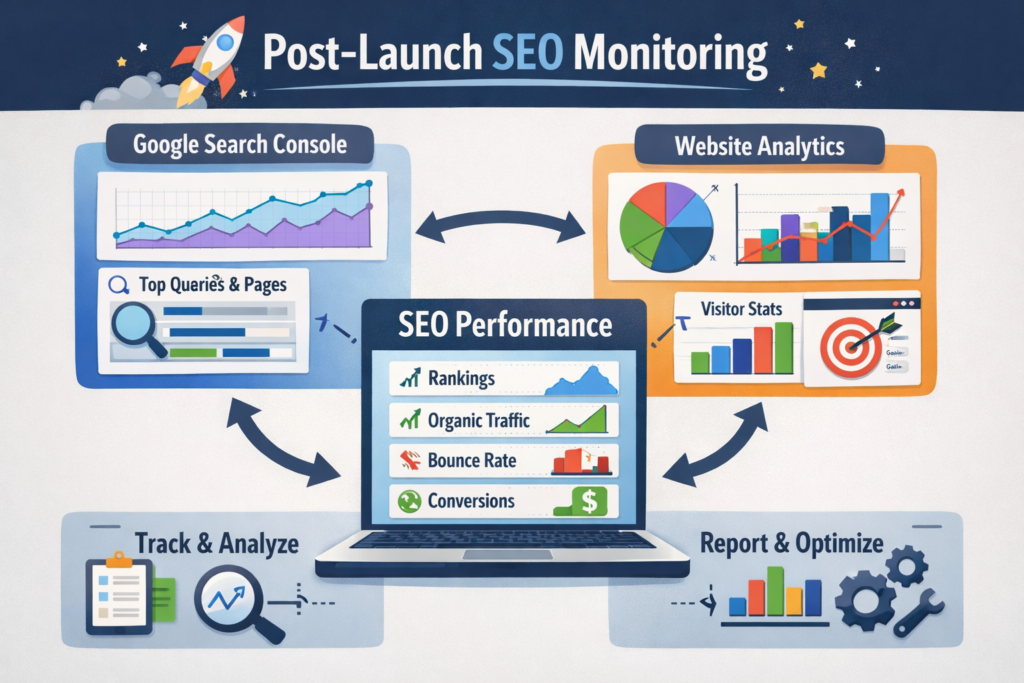
Post-launch monitoring: what to watch first
A relaunch is not finished when the site goes live. The first few days often reveal issues that were missed in QA.
Monitor daily right after launch.
Organic clicks and impressions
Index coverage trends
Crawl errors
Redirect behavior
Top landing page performance
Conversion paths
Core Web Vitals
Regional and language-specific pages
Server logs, if available
Watch your top 20 to 50 pages first. These pages usually tell you the truth fastest. If they are stable, the rest of the rollout is often easier to manage. If they are not, you have an early signal that something bigger needs attention.
A well-managed relaunch may stabilize in days or a few weeks. Large migrations can take longer, especially when URL changes, architecture shifts, or multilingual dependencies are involved.
Recovery plan if traffic drops after relaunch
If performance falls after launch, start with technical truth, not assumptions.
Check these first.
Are old URLs redirecting correctly?
Are live pages indexable?
Are canonicals consistent?
Are top landing pages still present and internally linked?
Is the XML sitemap current?
Is analytics tracking still accurate?
Do not rush into rewriting content before checking the basics. Many redesign-related traffic drops come from technical implementation errors, not content quality.
For different site types, recovery priorities usually look like this:
| Site type | First priority |
|---|---|
| Ecommerce | Categories, filters, product templates |
| SaaS | Core solution pages, demo paths, pricing pages |
| Healthcare | Indexation, consent, analytics, critical service pages |
| Enterprise B2B | Revenue pages, internal linking, reporting continuity |
| Multilingual sites | Hreflang, canonicals, localized URLs |
Escalate quickly when the issue is systemic. Examples include widespread deindexing, broken rendering, incorrect cross-canonicals, or major template-level tracking failures.
A practical website redesign SEO checklist
Here is the version teams actually need during planning and launch.
Before development starts
Benchmark traffic, rankings, conversions, and key pages
Identify pages that must be preserved
Document current site architecture
Flag top-performing URLs and templates
Align SEO, dev, UX, analytics, and compliance teams
Before launch
Finalize redirect map
Validate canonicals
Check internal linking
Test structured data
Review mobile performance
Validate hreflang for regional sites
Confirm analytics and events
Generate updated XML sitemap
After launch
Test priority redirects immediately
Check indexation signals
Monitor top landing pages
Review crawl errors and logs
Compare performance against the baseline
Fix template-level issues before minor page edits.

Final Take
A safe redesign is not about keeping everything the same. It is about protecting the signals that already work while improving the parts that need to evolve.
Done well, website redesign SEO helps you launch a better site without sacrificing rankings, traffic, or conversions. Done badly, it can erase organic momentum that took years to build.
The strongest redesigns usually follow the same pattern: benchmark early, protect valuable URLs, test carefully, launch with control, and monitor hard in the first phase after release. That is what keeps a relaunch from becoming a reset.( Click Here’s )
FAQs
Q : Does changing website design alone hurt SEO?
A : Usually not. Rankings tend to shift when the redesign also changes URLs, page speed, internal linking, metadata, structured data, or indexation controls.
Q : Should I keep the same URLs during a redesign?
A : Yes, where practical. Keeping strong URLs reduces migration risk and preserves existing search signals.
Q : How long does SEO take to stabilize after a redesign?
A : It depends on the scale of change. Smaller redesigns may settle in days, while larger migrations can take weeks.
Q : What is the biggest SEO mistake during a relaunch?
A : Changing important URLs without a proper redirect plan is one of the most common and expensive mistakes.
Q : How do I protect multilingual SEO during a European relaunch?
A : Keep language-country targeting consistent, validate hreflang carefully, preserve localized content, and avoid conflicting canonicals.